
Marijuana Drying And Curing Equipment Market Size and Share
Market Overview
| Study Period | 2019 - 2030 |
|---|---|
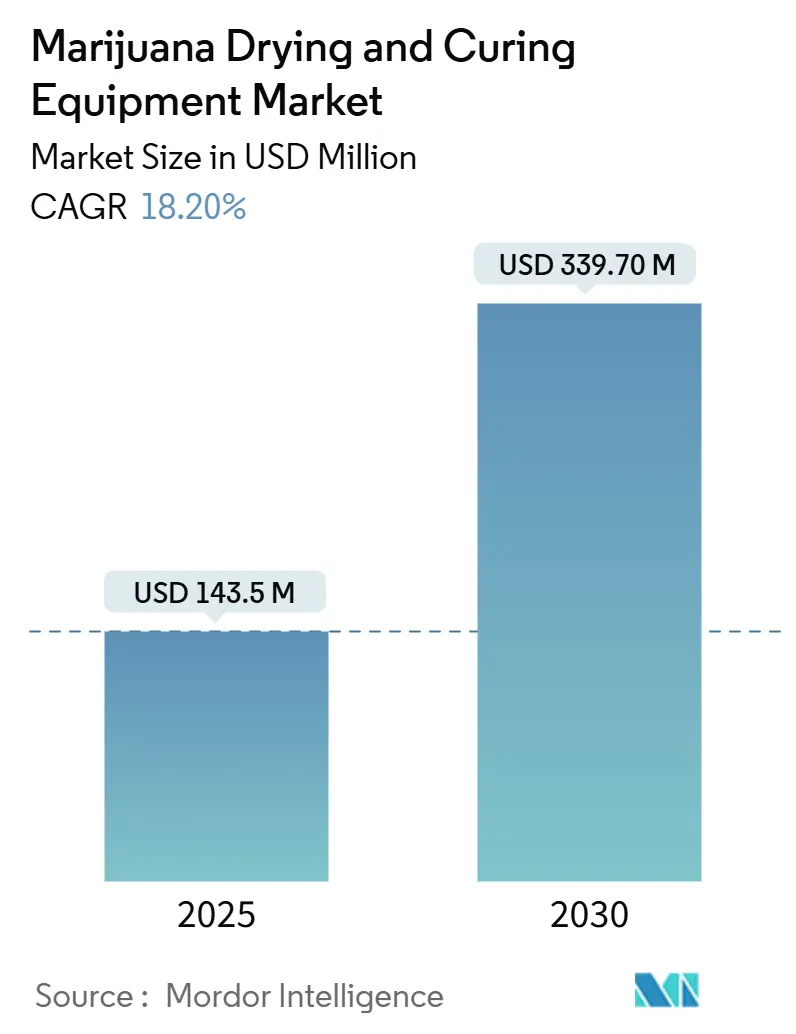
| Market Size (2025) | USD 143.5 Million |
| Market Size (2030) | USD 339.70 Million |
| Growth Rate (2025 - 2030) | 18.20 % |
| Fastest Growing Market | Asia Pacific |
| Largest Market | North America |
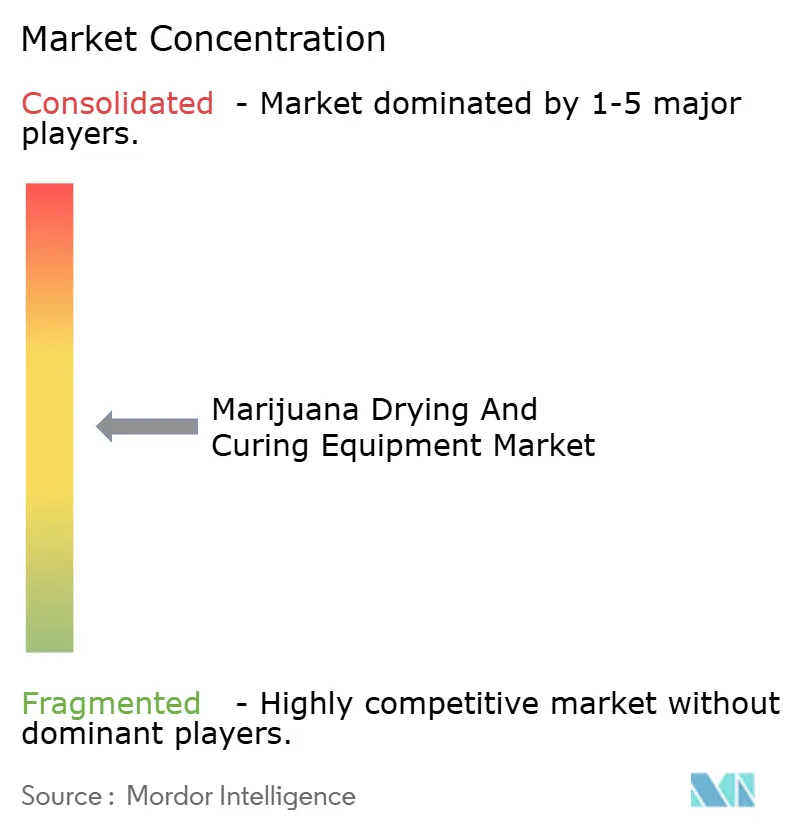
| Market Concentration | Medium |
Major Players *Disclaimer: Major Players sorted in no particular order Image © Mordor Intelligence. Reuse requires attribution under CC BY 4.0. | |
Marijuana Drying And Curing Equipment Market Analysis by Mordor Intelligence
The marijuana drying and curing equipment market size is USD 143.5 million in 2025 and is forecast to reach USD 339.7 million by 2030, translating to an 18.2% CAGR over the period. The growth reflects a maturing cultivation landscape that favors industrial-scale post-harvest systems able to meet stringent GMP and energy-efficiency requirements. Rapid licensing activity, financial incentives for closed-loop dehumidification, and widespread integration of IoT moisture analytics together accelerate equipment replacement cycles. Operators seeking premium dried flower margins prioritize technologies that preserve cannabinoid and terpene integrity, while facility designers shift toward continuous conveyor processing to match year-round harvest schedules. Competitive positioning centers on proprietary vacuum-microwave, freeze-dry, and heat-pump solutions that shorten cycle times, lower energy costs, and simplify GMP validation.
Key Report Takeaways
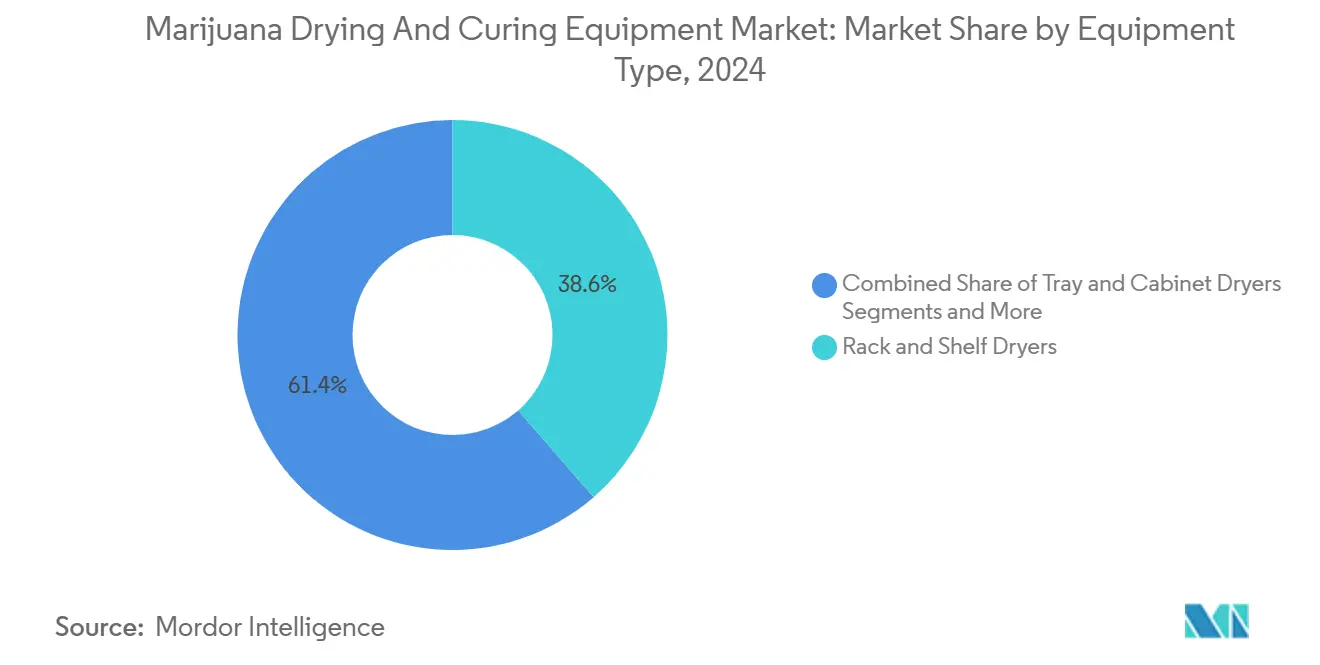
- By equipment type, rack and shelf dryers held a 38.6% share of the Marijuana Drying and Curing Equipment market in 2024; conveyor and belt dryers are advancing at a 12.6% CAGR to 2030.
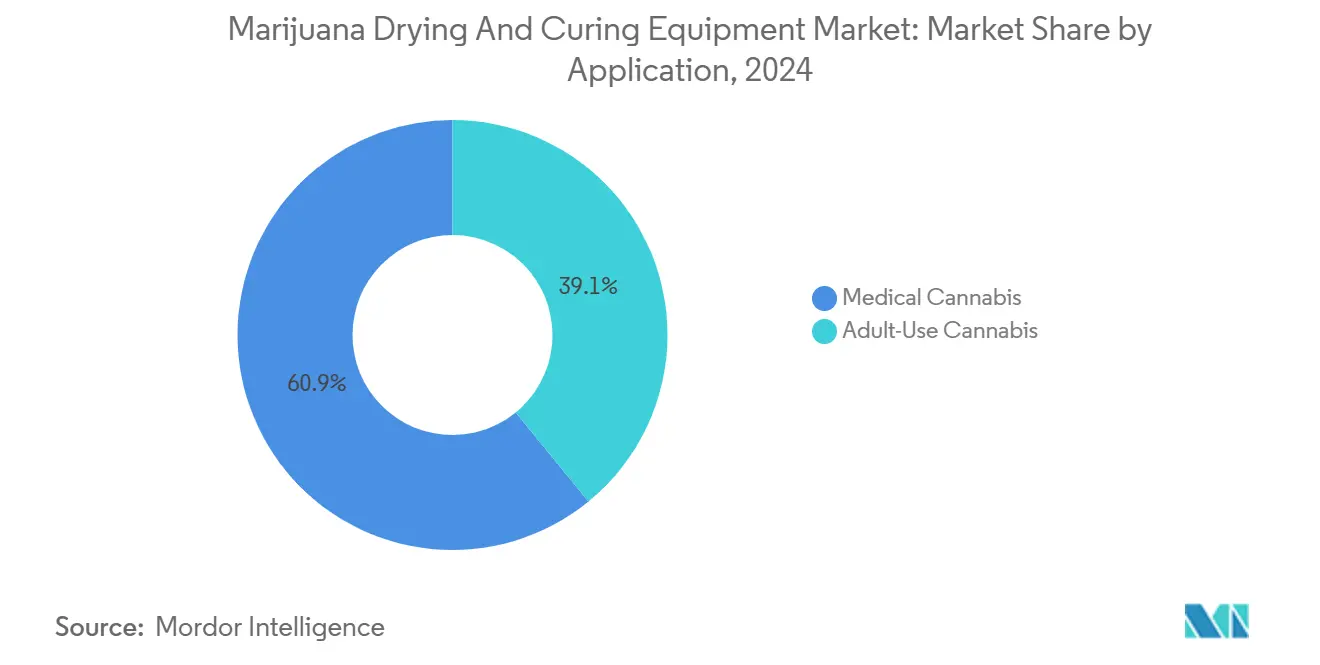
- By application, medical processing accounted for 60.9% of the Marijuana Drying and Curing Equipment market share in 2024, while adult-use processing is expanding at a 13.1% CAGR through 2030.
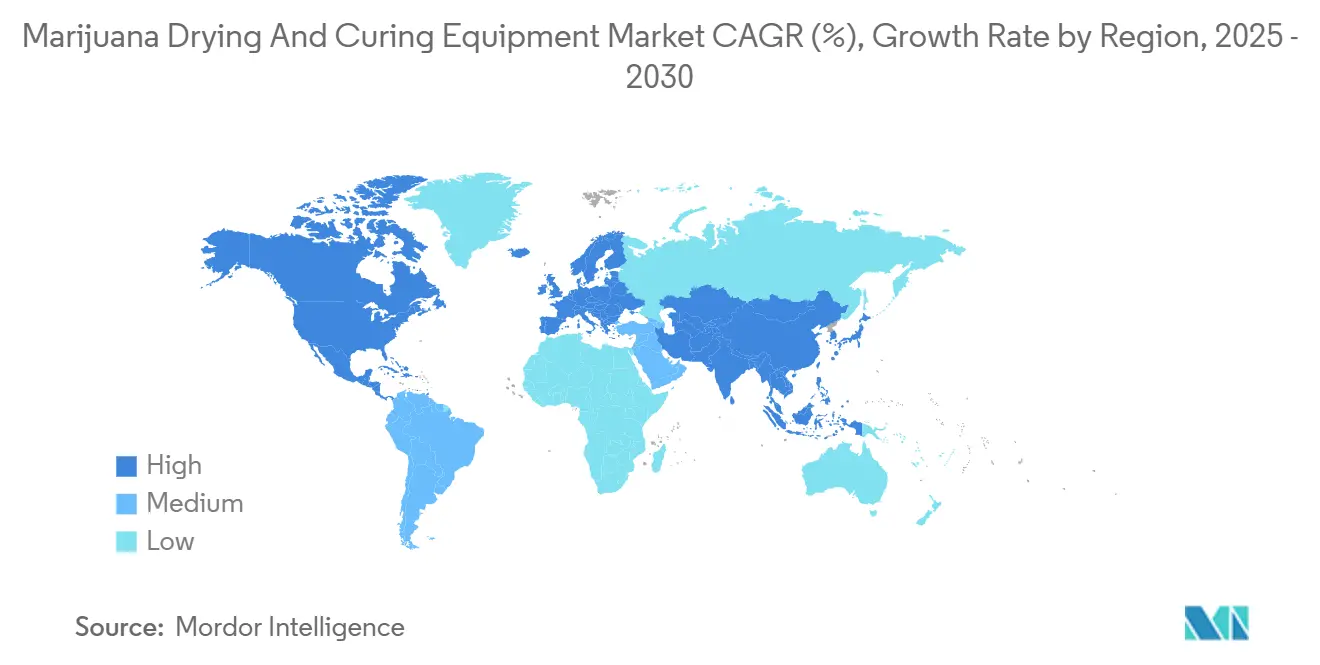
- By geography, North America led with 60.2% revenue share in 2024; Asia Pacific is forecast to post a 12.8% CAGR from 2025–2030.
Note: Market size and forecast figures in this report are generated using Mordor Intelligence’s proprietary estimation framework, updated with the latest available data and insights as of January 2026.
Market Trends and Insights
Drivers Impact Analysis of Marijuana Drying And Curing Equipment Market*
| Driver | (~) % Impact on CAGR Forecast | Geographic Relevance | Impact Timeline |
|---|---|---|---|
| Rapid expansion of licensed cultivation facilities | +4.20% | North America & Europe, expanding to APAC | Medium term (2–4 years) |
| Rising consumer demand for premium-grade dried flower | +3.80% | Global, concentration in mature markets | Short term (≤ 2 years) |
| Increasing adoption of automated post-harvest solutions | +3.10% | North America & EU, early APAC uptake | Medium term (2–4 years) |
| Energy-efficient closed-loop drying incentives | +2.40% | North America, spreading to Europe | Long term (≥ 4 years) |
| Integration of IoT sensors for real-time moisture analytics | +2.00% | Global, led by tech-forward markets | Short term (≤ 2 years) |
| Emergence of GMP-certified export hubs in emerging markets | +1.80% | APAC core, spill-over to MEA & South America | Long term (≥ 4 years) |
| Source: Mordor Intelligence | |||
Rapid Expansion of Licensed Cultivation Facilities
Licensed acreage continues to climb as Thailand, Germany, and Japan implement liberalized frameworks that mandate industrial drying capacity. New permits require environmental controls capable of handling hundreds of pounds per batch, pushing cultivators toward conveyor-belt designs that can operate in multishift cycles. In Germany, streamlined GMP licensing removes historical barriers and fast-tracks site commissioning, fueling demand for validated rack and conveyor systems that integrate directly with ERP traceability. Large build-outs amplify aftermarket opportunities because operators often retrofit existing units to maintain compliance as rules tighten. These expansions reinforce steady hardware refresh every three to five years, securing a predictable revenue stream for vendors.
Rising Consumer Demand for Premium-Grade Dried Flower
Shoppers now reward terpene-rich bud with price uplifts reaching 60%, triggering investments in vacuum-microwave and freeze-dry solutions able to cut water activity without degrading volatiles. EnWave’s REV lines dry in 35 minutes versus traditional multi-day hang rooms while retaining THC potency, allowing cultivators to shorten inventory cycles and hit top-shelf pricing tiers.[1]EnWave Corporation, “Dry Cannabis Better, Faster,” enwave.net Hyperspectral cameras monitor terpene spectra during dehydration and feed machine-learning models that stop cycles at strain-specific endpoints with 95% accuracy.[2]Colorado Energy Office, “Cannabis Resource Optimization Program (CROP),” energyoffice.colorado.govThese tools institutionalize premium positioning, helping growers differentiate in crowded adult-use channels and recoup equipment costs rapidly.
Increasing Adoption of Automated Post-Harvest Solutions
Labor scarcity and higher wages prompt facilities to link trimmers, conveyors, and dryers into seamless production cells that cut manual handling by 70%. Cann Systems couples heat-pump dehumidifiers with PLC-driven airflow controls, ensuring repeatable conditions without constant operator intervention. Remote dashboards push sensor data to cloud platforms where predictive algorithms schedule defrost cycles and flag maintenance windows, lowering downtime risk. COVID-era distancing policies accelerated automation investment and have since become standard practice, embedding long-term growth momentum.
Energy-Efficient Closed-Loop Drying Technology Incentives
Colorado’s CROP program offsets capital for high-efficiency HVAC retrofits, reducing energy by up to 33% in compliant facilities.[3]Frontiers in Plant Science, “Non-destructive Assessment of Cannabis Quality During Drying,” frontiersin.orgSimilar rebates in Oregon guarantee quicker payback for heat-pump dryers that re-use latent heat and slash kilowatt hours by 40–50%. Equipment specifiers increasingly submit life-cycle cost models during permitting, with regulators fast-tracking applications that exceed baseline efficiency. Vendors highlight ISO 50001 readiness and publish third-party audited power curves to satisfy due diligence requirements, turning sustainability into a competitive lever.
Restraints Impact Analysis of Marijuana Drying And Curing Equipment Market*
| Restraint | (~) % Impact on CAGR Forecast | Geographic Relevance | Impact Timeline |
|---|---|---|---|
| High upfront capital costs of industrial-scale systems | -2.80% | Global, stronger in emerging markets | Short term (≤ 2 years) |
| Fragmented and shifting regulatory requirements | -2.10% | Global, acute in new-legal markets | Medium term (2–4 years) |
| Persistent labor skill gaps in equipment operation | -1.40% | North America & Europe, rising in APAC | Medium term (2–4 years) |
| Supply-chain bottlenecks for specialty steel components | -1.20% | Global, focus in manufacturing hubs | Short term (≤ 2 years) |
| Source: Mordor Intelligence | |||
High Upfront Capital Costs of Industrial-Scale Systems
Conveyor or freeze-dry lines capable of drying 785 lb per cycle can top USD 1 million, forcing smaller growers to seek external financing. Lease-to-own programs cover up to 75% of capital yet often carry premium interest, tightening cash flow in the first two years. Modular dryers that expand capacity in 100-lb increments lower entry cost but raise per-pound spending compared with integrated systems. Toll-processing centers like REVworx offer pay-per-run alternatives but create scheduling constraints that limit flexibility during peak harvest.
Fragmented & Shifting Regulatory Requirements
Each jurisdiction dictates distinct GMP, material-handling, and documentation standards, compelling vendors to customize designs and generate multiple validation packages. A rule change in South Korea banning cannabis references in labeling forced certain manufacturers to reconfigure control panels and software interfaces. Divergent standards inflate certification timelines and hinder global economies of scale, elevating overall project cost and elongating return periods for growers crossing borders.
*Our forecasts treat driver/restraint impacts as directional, not additive. The impact forecasts reflect baseline growth, mix effects, and variable interactions.
Marijuana Drying And Curing Equipment Market Segment Analysis
By Equipment Type:
Continuous Systems Displace Batch DominanceThe segment generated USD 55.4 million in 2025, with rack and shelf formats still leading because of modest entry cost and simple layout. They captured 38.6% of Marijuana Drying and Curing Equipment market share in 2024, yet conveyor and belt units, expanding at 12.6% CAGR, are set to outpace as scale drives adoption. Conveyor platforms eliminate idle time between loads, match trimming throughput, and often integrate with robotic box fillers. Energy-focused operators adopt heat-pump dehumidifiers that reclaim sensible heat and trim utility bills by 40%. Vacuum-microwave and freeze-dry categories serve premium SKUs; despite higher capital, they deliver cycle times measured in minutes, improving asset turnover and reducing microbial risk. Patent filings on Joule-heating vacuum kilns suggest further efficiency gains are on the horizon.
Second-generation conveyor units now ship with embedded cameras, vibration-isolation beds, and strain-specific recipe libraries, converting them into data-rich assets. Because pharmaceutical buyers demand full batch traceability, rack systems are retrofitted with RFID shelf tags. Equipment suppliers in the Marijuana Drying and Curing Equipment industry cater to multistate operators by offering mirrored control software that standardizes SOPs across dispersed facilities, minimizing training time and audit variance.



By Application:
Medical Standards Anchor Investment, Adult-Use Volumes Lift GrowthMedical facilities accounted for 60.9% revenue in 2024 as national health agencies require validated environmental controls and microbiological records. Here, the Marijuana Drying and Curing Equipment market size for medical end use reached USD 87.5 million and is tracking a mid-teens growth curve in line with prescription uptake. Adult-use processors, climbing at 13.1% CAGR, chase throughput to meet fast turnover dispensary demand. They increasingly specify conveyor belts paired with continuous inline terpene capture skids that maintain aromatic quality despite high throughput.
Growth of minor cannabinoid SKUs such as CBN and CBG triggers upgrading to low-temperature freeze-dryers that safeguard fragile compounds. Price pressure in recreational channels drives automation capex aimed at lowering cost per pound, while medical producers maintain willingness to pay for premium GMP features. Cross-pollination occurs as adult-use brands introduce limited-edition terpene-rich lines, borrowing vacuum-microwave technology that originated in pharmaceutical workflows, further blurring application boundaries within the Marijuana Drying and Curing Equipment market.
Geography Analysis
North America Marijuana Drying and Curing Equipment Market
North America retained 60.2% share of the 2024 global Marijuana Drying and Curing Equipment market, translating to USD 86.4 million revenue, underpinned by mature state regulations, established cultivar genetics, and accessible financing. Federal banking barriers persist, yet specialized lenders and leasing firms fill the gap, sustaining capital flows. Incentive programs in Colorado and Oregon advance closed-loop retrofits, while Canadian exporters favor GMP-qualified freeze-dryers to satisfy EU buyers.
Europe Marijuana Drying and Curing Equipment Market
Europe ranks second, powered by Germany’s 2025 regulatory overhaul, which dropped prior narcotics licensing while upholding strict EU-GMP demands. French pilot trials evolved into a permanent framework in 2025, unlocking new orders for tray and cabinet dryers vetted for pharmaceutical compliance. Southern European greenhouse cultivators select hybrid solar-assisted dryers that blend free heat with humidity control to reduce operating cost.
APAC Marijuana Drying and Curing Equipment Market
Asia Pacific is projected to log a 12.8% CAGR through 2030, lifting regional Marijuana Drying and Curing Equipment market size from USD 23.6 million in 2025 to USD 43.2 million by 2030. Thailand’s market surge after the Cannabis-Hemp Act revision accelerates capacity build-outs that demand mid-size rack systems with local service support. Japan’s pharmaceutical focus drives early procurement of small-batch GMP vacuum units with stainless contact surfaces certified to JIS standards. Australia adds incremental demand via vertically integrated indoor farms that embrace IoT-enabled heat-pump dryers to lower grid reliance.
LATAM and MEA Marijuana Drying and Curing Equipment Market
Elsewhere, Latin America and the Middle East remain nascent but show promise. Colombian and Moroccan producers eye EU export channels and thus adopt European GMP-oriented equipment from day one. African nations investigate toll-dry facilities adjacent to cultivation zones, a model that could unlock late-decade equipment contracts once legal frameworks stabilize.

Competitive Landscape
The competitive field sits at a moderate concentration. EnWave’s patented vacuum-microwave portfolio dominates high-speed premium drying and accounts for roughly 15% of installed global capacity. Cann Systems leads the energy-efficient heat-pump niche, especially among U.S. indoor farms. Mobius leverages its trimming heritage to upsell integrated conveyors and dryers, capturing share among vertically integrated multistate operators.
Strategic moves lean toward proprietary technology and service bundling. EnWave expanded its REVworx toll-manufacturing hub, offering processing as a service that seeds eventual equipment purchases. Cann Systems introduced subscription-based remote monitoring that rolls software, sensor upgrades, and spare parts into a single monthly fee, deepening client lock-in. Smaller innovators target freeze-dry micro-batches, providing plug-and-play units for craft cultivators who want premium SKUs without seven-figure budgets.
Supply-chain risk remains. Specialty stainless steel sourcing delays extend lead times to 30 weeks for large conveyor frames. Firms thus localize fabrication or maintain raw-material inventory, but this ties up working capital. Regulatory complexity favors incumbents with certification teams who can navigate multi-region GMP audits.
Marijuana Drying And Curing Equipment Industry Leaders
Cann Systems LLC
Darwin Chambers
EnWave Corporation
AutoCure
Conviron
- *Disclaimer: Major Players sorted in no particular order
Marijuana Drying And Curing Equipment Market Companies Covered in this Report
- Cann Systems LLC
- EnWave Corporation
- Darwin Chambers
- AutoCure
- Conviron
- Luna Technologies
- Mobius Trimmer
- GreenBroz Inc.
- Canarm Ltd.
- Harvest Right
- The Original Resinator
- Quest (Anden)
- ChuanTai Machinery
- Henan Guoxin Machinery
- Grobo Inc.
- ProCann Solutions
- Ecodyst
- Precision Extraction Solutions
- Global Garden Company
- IQ Air

Recent Industry Developments in Marijuana Drying And Curing Equipment Market
- March 2025: Agrify raised USD 35 million to scale vertical farm units fully integrated with heat-pump drying modules.
- February 2025: Mobius previewed the TD15, TD25, and MD48 trimmers that dovetail with automated conveyor dryers for seamless post-harvest lines.
- February 2025: EnWave outlined plans to enlarge its U.S. REVworx toll site, adding a continuous vacuum-microwave tunnel to meet rising premium flower demand.


Global Marijuana Drying And Curing Equipment Market Report Scope
| Rack & Shelf Dryers |
| Tray & Cabinet Dryers |
| Conveyor / Belt Dryers |
| Freeze / Vacuum Dryers |
| Hybrid Dehumidifier Systems |
| Medical Cannabis |
| Adult-Use (Recreational) Cannabis |
| North America | United States |
| Canada | |
| Mexico | |
| Europe | Germany |
| United Kingdom | |
| France | |
| Italy | |
| Spain | |
| Rest of Europe | |
| Asia Pacific | China |
| Japan | |
| India | |
| South Korea | |
| Australia | |
| Rest of Asia Pacific | |
| Middle East & Africa | GCC |
| South Africa | |
| Rest of Middle East & Africa | |
| South America | Brazil |
| Argentina | |
| Rest of South America |
| By Equipment Type | Rack & Shelf Dryers | |
| Tray & Cabinet Dryers | ||
| Conveyor / Belt Dryers | ||
| Freeze / Vacuum Dryers | ||
| Hybrid Dehumidifier Systems | ||
| By Application | Medical Cannabis | |
| Adult-Use (Recreational) Cannabis | ||
| By Geography | North America | United States |
| Canada | ||
| Mexico | ||
| Europe | Germany | |
| United Kingdom | ||
| France | ||
| Italy | ||
| Spain | ||
| Rest of Europe | ||
| Asia Pacific | China | |
| Japan | ||
| India | ||
| South Korea | ||
| Australia | ||
| Rest of Asia Pacific | ||
| Middle East & Africa | GCC | |
| South Africa | ||
| Rest of Middle East & Africa | ||
| South America | Brazil | |
| Argentina | ||
| Rest of South America | ||


Key Questions Answered in the Report
What is the current value of the Marijuana Drying and Curing Equipment market?
The market stands at USD 143.5 million in 2025 and is projected to climb to USD 339.7 million by 2030.
Which equipment type is growing the fastest?
Conveyor and belt dryers post the highest growth at 12.6% CAGR as large facilities pursue continuous processing.
Why are energy-efficient dryers gaining traction?
Utility incentives and closed-loop heat-pump designs cut energy consumption by up to 50%, improving payback.
Which region will add the most new demand through 2030?
Asia Pacific will grow at a 12.8% CAGR as Thailand, Japan, and Australia expand cultivation under new laws.
How do IoT sensors improve post-harvest outcomes?
Real-time moisture analytics enable predictive control that avoids over-drying, preserves terpenes, and reduces waste.
Page last updated on:


 Your data is secure and never sold or shared.


