
Managed Voice Security Services Market Size and Share
Market Overview
| Study Period | 2021 - 2032 |
|---|---|
| Market Size (2027) | USD 3.32 Billion |
| Market Size (2032) | USD 6.54 Billion |
| Growth Rate (2027 - 2032) | 14.52 % |
| Fastest Growing Market | Asia-Pacific |
| Largest Market | North America |
| Market Concentration | Low |
Major Players *Disclaimer: Major Players sorted in no particular order Image © Mordor Intelligence. Reuse requires attribution under CC BY 4.0. | |
Managed Voice Security Services Market Analysis by Mordor Intelligence
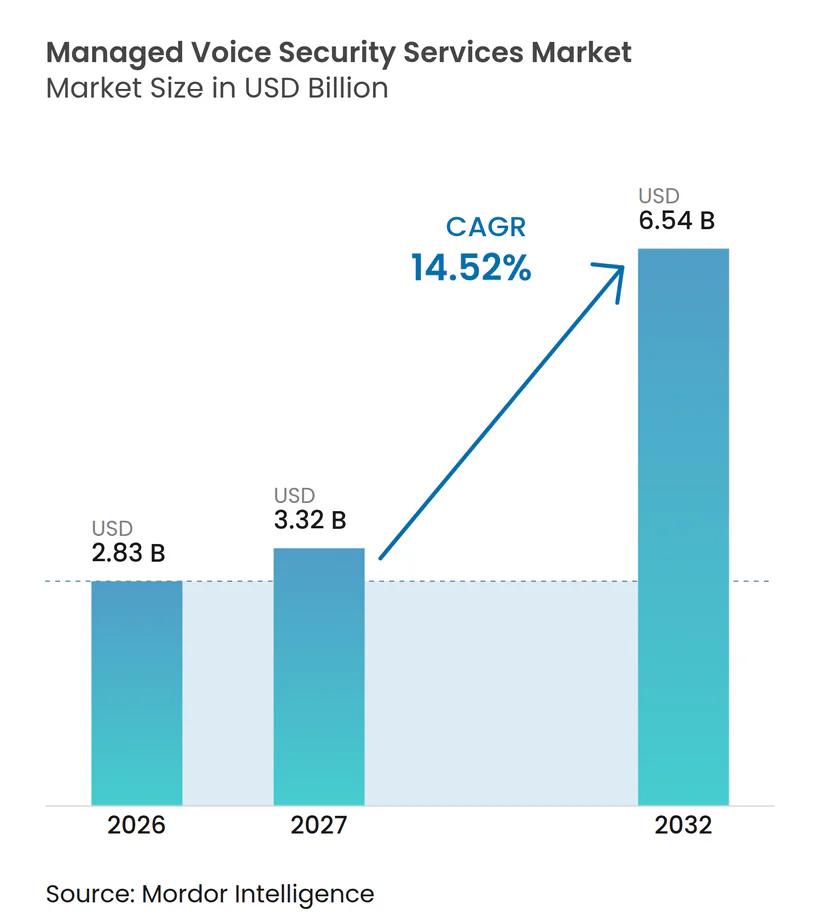
The managed voice security services market size is projected to expand from USD 2.83 billion in 2026 and USD 3.24 billion in 2027 to USD 6.54 billion by 2032, registering a CAGR of 14.52% between 2027 and 2032. Rising exposure to telecom fraud is moving voice security from a network operations issue to a financial and customer-protection priority. Managed offerings can give carriers and enterprises continual monitoring, fraud intelligence, and incident support without building specialist teams. Caller authentication rules are also widening the compliance burden for smaller communications service providers. Cloud contact centers are creating more opportunities to integrate passive authentication into existing call flows. The managed voice security services market is therefore shifting toward layered protection that combines caller identity, behavioral signals, and threat intelligence.
Key Report Takeaways
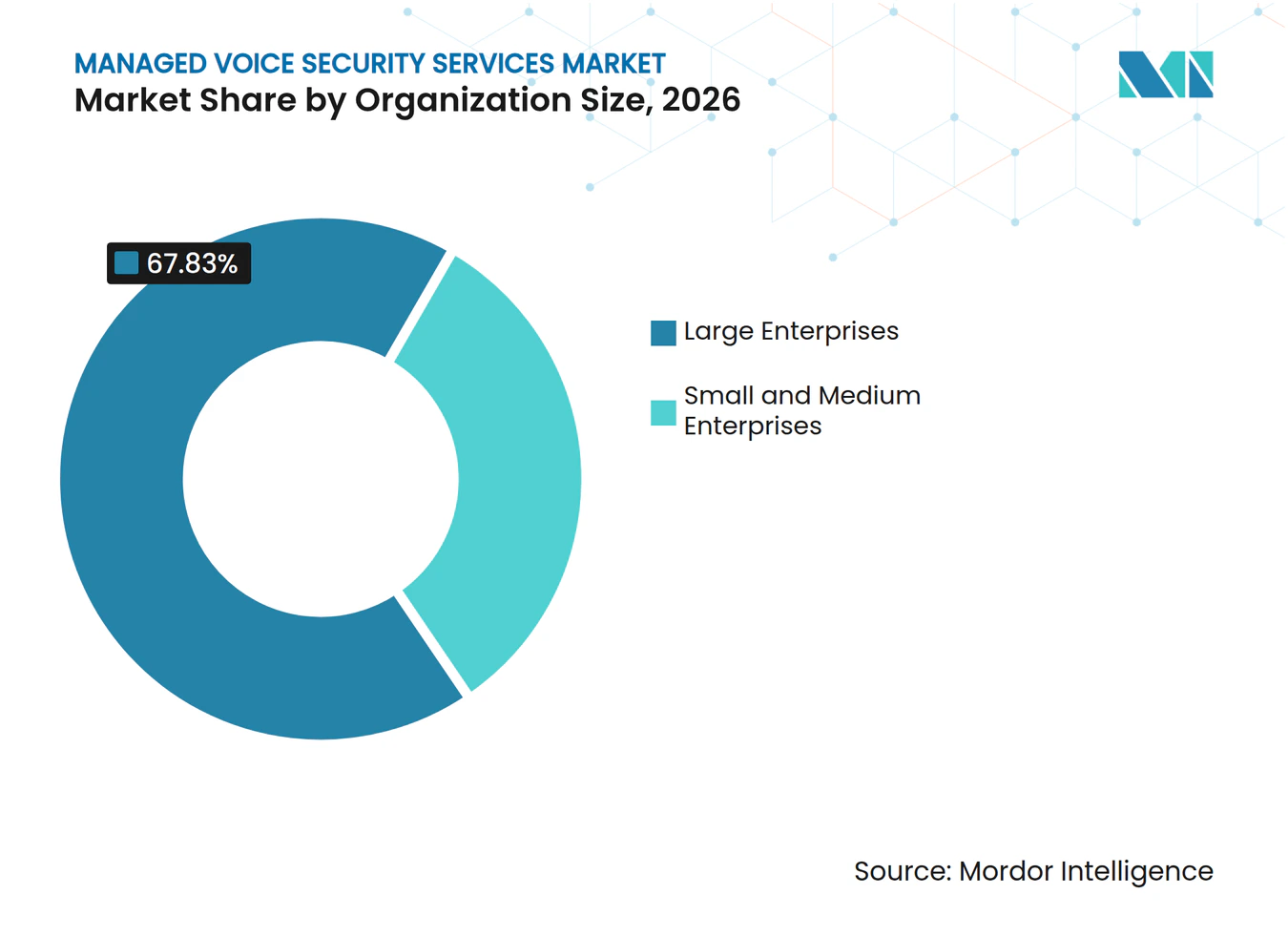
- By organization size, large enterprises held 67.83% of the managed voice security services share in 2026, while small and medium enterprises are projected to expand at a 15.07% CAGR through 2032.
- By application, robocall and spam mitigation held 32.47% of the managed voice security services share in 2026, while contact center inbound authentication is projected to expand at a 15.43% CAGR through 2032.
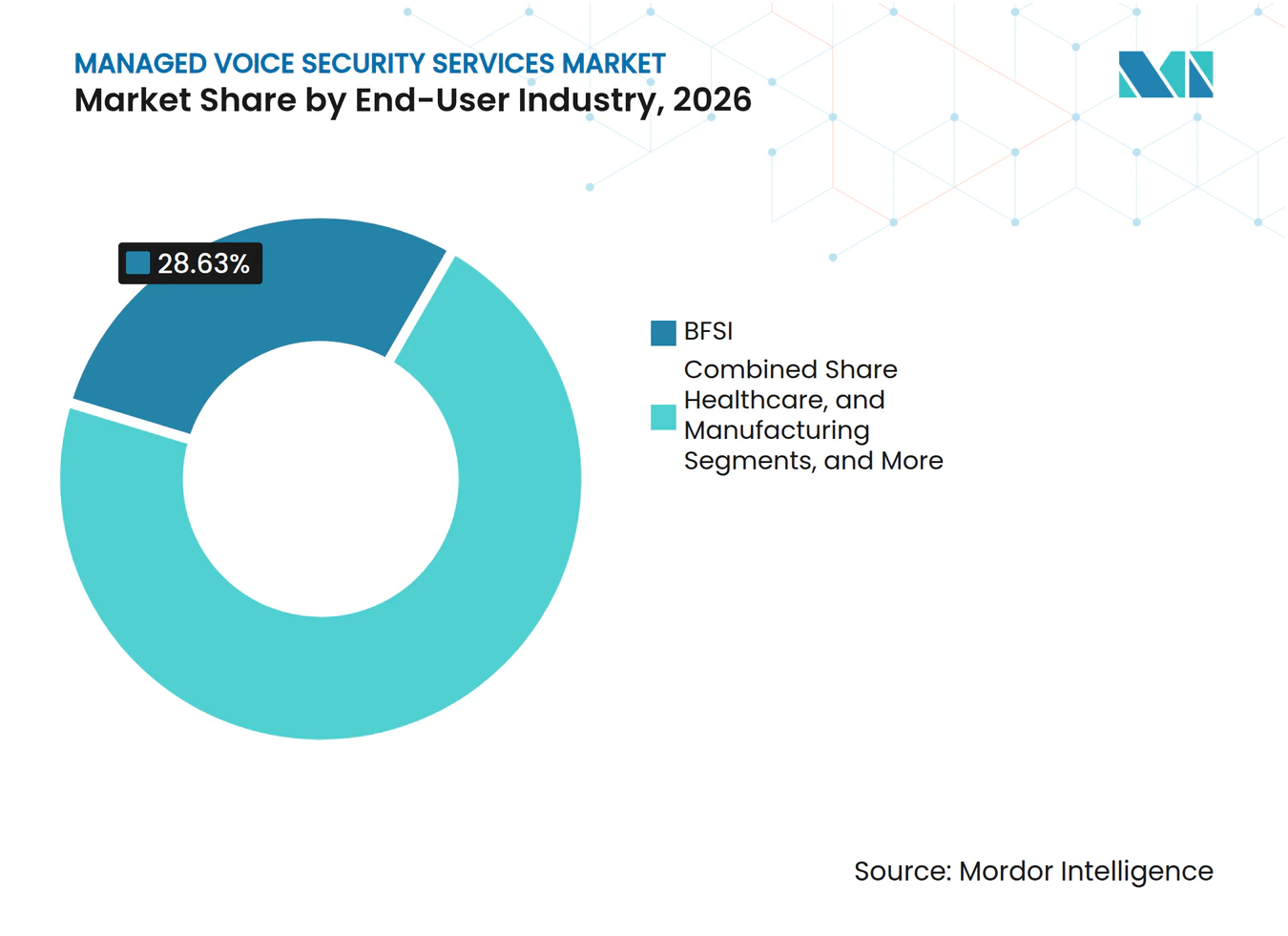
- By end-user industry, BFSI held 28.63% of the managed voice security services share in 2026, while healthcare is projected to expand at a 15.37% CAGR through 2032.
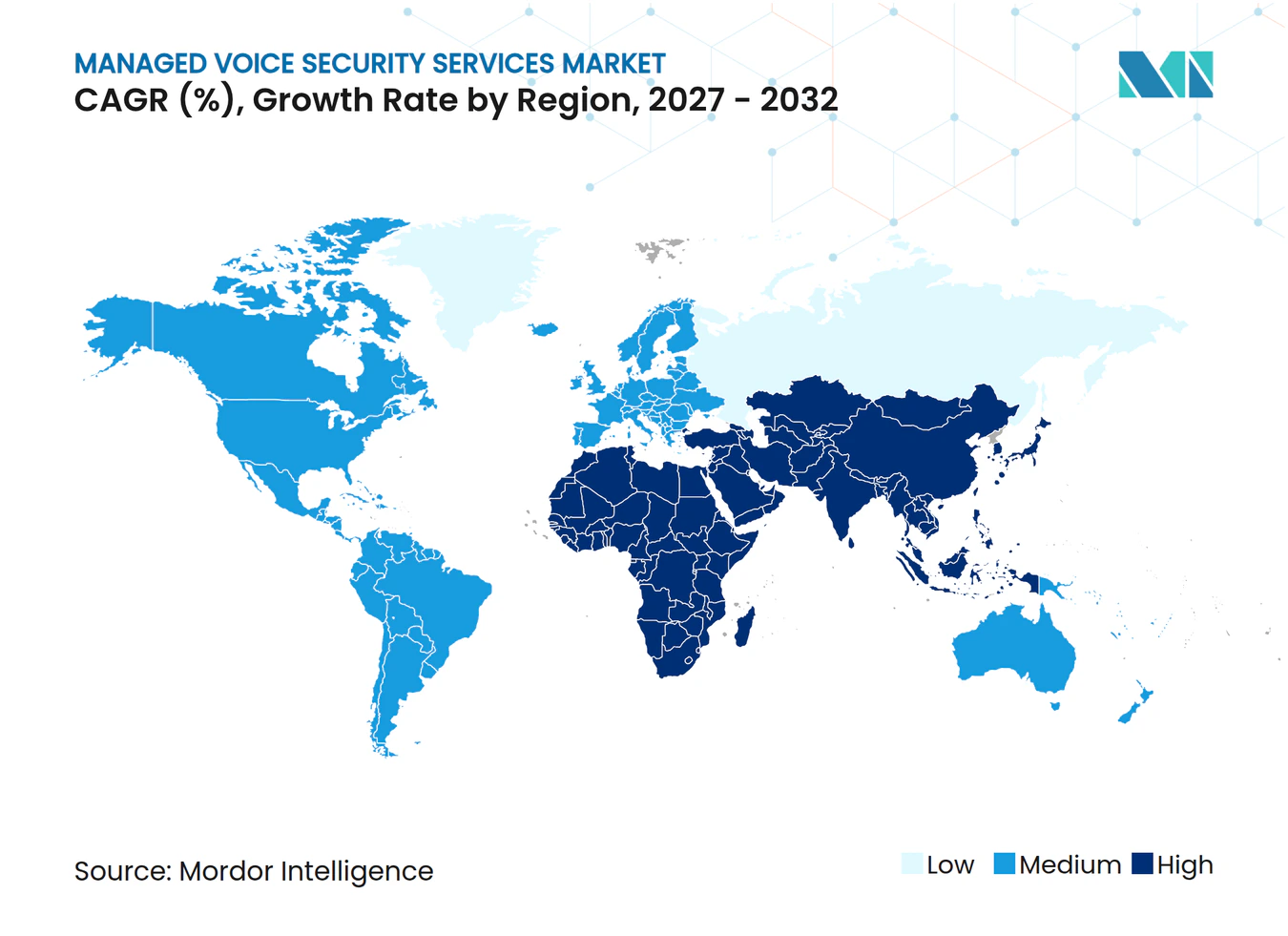
- By geography, North America held 42.87% of the managed voice security services market share in 2026, while Asia-Pacific is projected to expand at a 15.82% CAGR through 2032.
Note: Market numbers in this report are based on Mordor Intelligence's proprietary estimation framework, which combines nine months of actuals with Q4 projections for base year 2026.
Market Trends and Insights
Drivers Impact Analysis of Managed Voice Security Services Market*
| Driver | (~) % Impact on CAGR Forecast | Geographic Relevance | Impact Timeline |
|---|---|---|---|
| Rising Telecom Fraud Losses and Enterprise Voice Exposure | +3.2% | Global | Short term (≤ 2 years) |
| Mandatory Caller ID Authentication and Robocall Mitigation Compliance | +2.8% | North America and Europe | Short term (≤ 2 years) |
| AI-Enabled Voice Cloning and Deepfake Impersonation | +2.5% | Global | Medium term (2-4 years) |
| Cloud Contact Center Expansion and Passive Authentication Demand | +2.1% | North America and Asia-Pacific | Medium term (2-4 years) |
| Carrier Need for Cross-Protocol Voice Fraud Visibility | +1.6% | Europe, Asia-Pacific, and Middle East | Long term (≥ 4 years) |
| Managed Detection of Silent AI Bots and IVR Mining | +1.2% | North America and Europe | Medium term (2-4 years) |
| Source: Mordor Intelligence | |||
Rising Telecom Fraud Losses and Enterprise Voice Exposure
Global telecom fraud losses reached USD 41.82 billion in 2025, compared with USD 38.95 billion in 2023. The reported losses included more than USD 19 billion from subscription fraud, account takeover, and social engineering scams. This mix shows that attackers are increasingly targeting customer identities as well as communications networks. The response now involves security leaders and finance teams, not only network operations staff, across many affected organizations. TNS reported that 9.8% of inbound enterprise voice traffic was classified as threatening across its monitored call activity. The managed voice security services market can address this exposure through continual monitoring and managed fraud analysis.
Mandatory Caller ID Authentication and Robocall Mitigation Compliance
The FCC adopted call authentication trust-anchor rules in August 2025, with the rules taking effect on September 18, 2025. The rules keep providers accountable when they use third parties to sign calls. This closes a route that had allowed some smaller carriers to outsource attestation decisions without retaining full responsibility. Smaller providers now need stronger visibility into calls and upstream carrier connections. TNS reported that non-top-tier providers had 20% STIR/SHAKEN compliance, compared with 85% for the 7 largest U.S. carriers. Managed attestation, robocall mitigation database support, and fraud monitoring can help providers meet these obligations in the managed voice security services market.
AI-Enabled Voice Cloning and Deepfake Impersonation
Voice cloning has become easier to use as real-time speech synthesis tools become more available. Pindrop reported that at least 8 real-time speech-to-synthesis models were released in 2025, including 4 in December. Two of those releases used open-source licenses, which reduced barriers for bad actors. This changes the threat because an attacker can increase activity without a comparable increase in cost. Enterprises in the managed voice security services market are responding with passive biometrics, liveness checks, and device-signal analysis. Pindrop reported that its customers avoided USD 283 million in fraud losses during 2025, with Passport authentication benefits recorded across 385 million calls.[1]
Cloud Contact Center Expansion and Passive Authentication Demand
Cloud contact center platforms allow voice analysis to operate as a software layer within existing call flows. This can reduce the need for dedicated servers and separate enrollment processes. Microsoft added voice biometric authentication capabilities to Dynamics 365 Contact Center in its 2026 Wave 1 release. Platform-native features may reduce demand for isolated authentication modules. Independent providers in the managed voice security services market can respond by emphasizing broader intelligence, network visibility, and managed operations. TNS analyzes 1.5 billion daily call events across more than 500 operators, which illustrates the scale available to providers with network-level data.
Restraints Impact Analysis of Managed Voice Security Services Market*
| Restraint | (~) % Impact on CAGR Forecast | Geographic Relevance | Impact Timeline |
|---|---|---|---|
| Integration Complexity Across TDM, SIP, IMS, and Legacy PBX Environments | -1.8% | Global, with particular weight in Europe and Asia-Pacific | Long term (≥ 4 years) |
| Biometric Privacy, Consent, and Data Retention Obligations | -1.4% | Europe, North America, Japan, and South Korea | Medium term (2-4 years) |
| False Positives and Trust Erosion in Automated Call Blocking | -1.0% | North America and Europe | Medium term (2-4 years) |
| Scarcity of High-Quality, Cross-Language Voice Fraud Training Data | -0.6% | Asia-Pacific, Middle East and Africa, and South America | Long term (≥ 4 years) |
| Source: Mordor Intelligence | |||
Integration Complexity Across TDM, SIP, IMS, and Legacy PBX Environments
Legacy TDM switches, SIP border controllers, IMS cores, and PBX systems remain common in banking, government, and manufacturing. These sectors often replace communications assets slowly because their equipment has long depreciation cycles. TDM signaling can strip STIR/SHAKEN signatures during call routing and disrupt the authentication chain. TNS linked legacy non-IP infrastructure to the lower compliance rate among non-top-tier providers. Managed deployments across mixed TDM and SIP settings can take months or years to complete. Bespoke work for multi-site and multi-protocol environments can limit providers' ability to apply standardized delivery models
Biometric Privacy, Consent, and Data Retention Obligations
Voiceprints are special-category biometric data under Article 9 of the EU General Data Protection Regulation. Organizations must establish an appropriate legal basis, obtain consent where required, and maintain deletion processes. In October 2026, Switzerland's Federal Administrative Court upheld the requirement for PostFinance AG to secure express consent before creating voiceprints. The decision also required the deletion of templates without retroactive consent by February 2027. U.S. state rules, including Illinois BIPA, add different consent, retention, and destruction requirements. These overlapping rules can lengthen legal reviews and create uneven deployment schedules for multinational customers.
*Our forecasts treat driver/restraint impacts as directional, not additive. The impact forecasts reflect baseline growth, mix effects, and variable interactions.
Managed Voice Security Services Market Segment Analysis
By Organization Size:
Large Enterprises Retain Scale Advantages While SMEs Gain AccessLarge enterprises held 67.83% of the managed voice security services share in 2026. Their high-value contact centers, multiple sites, and fraud teams create an immediate need for layered voice controls, because a disruption or authentication failure can affect many customers and operational teams at the same time. Banks, insurers, and telecommunications operators are important demand centers within this group. Many deploy caller ID verification, passive biometrics, and call-risk scoring in the same managed workflow. Large environments also produce greater volumes of calls that can support advanced monitoring programs. Their complex systems make coordination with a managed provider valuable. These customers generally have the procurement capacity to adopt several controls at once, including integration work, ongoing service agreements, and governance processes needed to manage security performance over time. This keeps large enterprises central to the managed voice security services market, as their scale creates a need for security controls that remain reliable across locations, business units, customer groups, and several types of telephony infrastructure.
Small and medium enterprises are projected to grow at a CAGR of 15.07% through 2032. API-first platforms can lower deployment barriers compared with older on-premises systems, allowing smaller operators to introduce targeted protections without replacing each part of their existing communications infrastructure. Subex launched FraudZap in June 2025 with a modular design aimed at rapid deployment. The company stated that the product could be deployed in days and reduce total infrastructure cost by up to 50% compared with traditional systems. Such products give smaller telecom operators a way to adopt targeted fraud controls. The extension of STIR/SHAKEN obligations to smaller providers further supports demand for external help, because compliance responsibilities can be difficult to manage alongside daily network, customer-service, and commercial priorities. Smaller firms in the managed voice security services market can focus their resources on operating their businesses while managed partners handle more specialized security tasks, including monitoring, rule updates, and assistance with fraud patterns that may be difficult for a small internal team to track alone.


By Application:
Robocall Mitigation Remains Core While Inbound Authentication Gains ImportanceRobocall and spam mitigation held 32.47% of the managed voice security services share in 2026. The segment remains important because providers and enterprises must manage unwanted calls across the communications chain, including traffic that can damage customer trust, use agent capacity, or create direct operational costs. Reputation scoring, call-velocity analysis, and attestation auditing are established tools in these programs. Caller ID spoofing prevention and telephony denial-of-service protection focus on threats at the network edge. Toll fraud and international revenue share fraud involve financially motivated routing abuse. The ITU published guidance on methodologies to mitigate wangiri fraud in February 2025. These established control needs keep robocall mitigation central to the managed voice security services market, because enterprises and carriers need a practical way to reduce harmful traffic before it affects customers, agents, network resources, or compliance obligations.[2]
Contact center inbound authentication is projected to grow at a CAGR of 15.43% through 2032. The application responds to vishing and IVR mining activity that seeks to exploit customer interactions. Authentication at the agent handoff can help organizations assess risk before access is granted or sensitive actions are completed, which is particularly relevant when a caller seeks account changes, payment instructions, or health-related information. Pindrop reported that real-time bot detection at a Fortune 500 healthcare organization reduced inbound bot call volume by 94.3% within 4 months. The case study also cited protection for more than USD 73 million in health savings account balances. Other applications include identifying agentic AI callers that can appear similar to human callers. Real-time liveness scoring will become more relevant as automated inbound traffic grows, since organizations will need stronger ways to distinguish normal customer activity from synthetic voice interactions that attempt to pass through ordinary call-screening steps.
By End-User Industry:
BFSI Holds the Largest Share While Healthcare Grows FasterBFSI held 28.63% of the managed voice security services share in 2026. Financial institutions face account takeover, beneficiary manipulation, and fraudulent claims activity through their customer contact channels, where a convincing caller can attempt to exploit an agent or an automated verification process. These risks support the use of layered authentication and fraud detection. Banks and insurers also operate large contact centers with high volumes of customer interactions. NICE and Pindrop completed a native integration for voice authentication and fraud detection in CXone in January 2026. The integration gives customers a way to procure Pindrop capabilities through existing CXone contracts. Pre-integrated options can be attractive when financial services buyers want fewer separate technology relationships, because integrated procurement and implementation can reduce coordination demands while maintaining closer links between contact center processes and security functions.
Healthcare is projected to grow at a CAGR of 15.37% through 2032. Telehealth appointments create more voice-based identity interactions between patients and providers in the managed voice security services market. This expands the number of settings where organizations must balance easy access with secure authentication, while ensuring that patients and staff can complete routine interactions without unnecessary friction or repeated verification steps. The draft also identifies risks to IVR systems involving prescription access and patient records. Healthcare organizations must consider these risks alongside privacy requirements for protected health information. Retail and e-commerce, IT and telecommunications, manufacturing, and government and defense make up the other customer groups. Telecommunications providers face international revenue share fraud and caller line identification spoofing. Manufacturers and public agencies face voice social engineering directed at finance and procurement teams, where an impersonated executive, supplier, or official can use a familiar voice interaction to seek payments, credentials, or changes to established procedures.


Geography Analysis
North America accounted for 42.87% of the managed voice security services market share in 2026. The region combines established caller-authentication rules, large contact center operators, and a mature vendor base. The United States provides most regional revenue, while Canada and Mexico add demand through cross-border fraud controls and STIR/SHAKEN adoption. TNS reported an 85% compliance rate among the 7 largest U.S. carriers, compared with 20% among non-top-tier providers, creating demand for external fraud intelligence and compliance support among smaller carriers. South America is developing as Brazil and Argentina expand robocall and spam mitigation activity, supported by digital banking adoption and stronger consumer-protection enforcement.
Europe is the second-largest regional area in the managed voice security services market. Biometric data rules and national cooperation on telecom fraud influence customer requirements, especially in Germany, the United Kingdom, and France, which have substantial financial services and public-sector contact center activity. The October 2026 Swiss ruling on express consent for voiceprints increased attention on biometric data practices and reinforces the need for documented consent processes, auditable deletion procedures, and careful assessment of EU AI Act and ENISA governance considerations. Italy, Spain, and Russia are secondary European markets with exposure to voice spoofing in financial services and e-government channels.
Asia-Pacific is projected to grow at a CAGR of 15.82% through 2032, the fastest regional rate in the managed voice security services market. Japan, South Korea, India, and Australia are seeing increased institutional focus on deepfake voice fraud, and Japan's Ministry of Internal Affairs and Communications supported related detection work by NTT East Japan and NABLAS for fixed-line and mobile services in August 2025. The Japanese program cited annual special fraud damage of JPY 141.42 billion (USD 924 million), with 80% of cases initiated by telephone contact. SoftBank, BBSS, and Kagawa Prefecture Police also agreed in June 2026 to use AI-based voice and text analysis against phone fraud, while Saudi Arabia and the United Arab Emirates are key Middle East markets. South Africa, Nigeria, and Egypt show growing interest in mobile-money fraud controls.
Competitive Landscape
Market Concentration
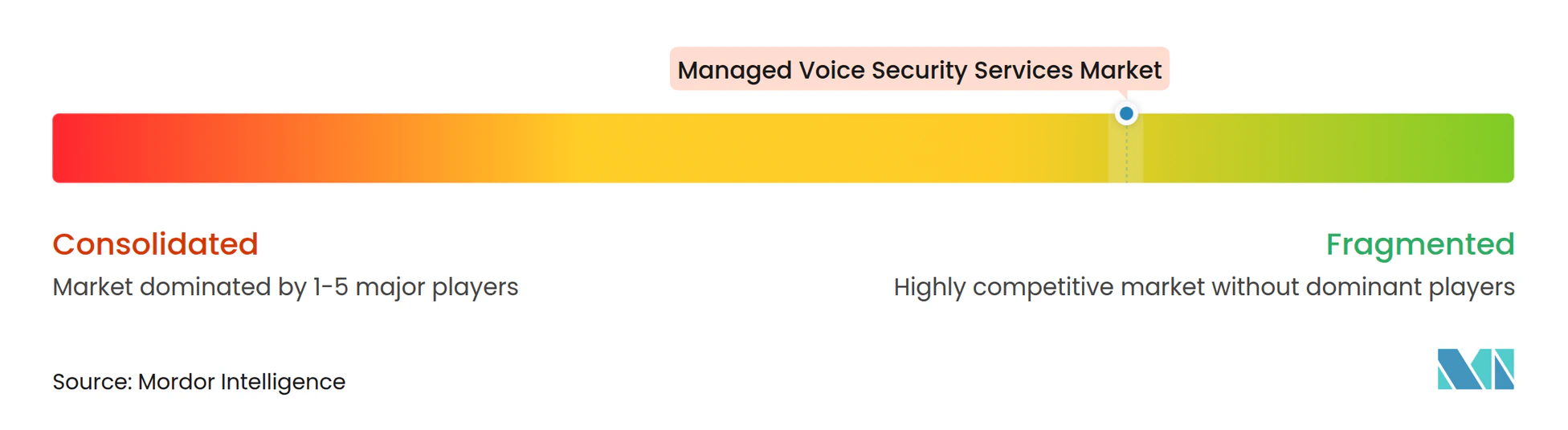
The managed voice security services market has a moderately fragmented structure, with specialist providers, contact center platforms, and number intelligence operators each serving different layers of communications security and fraud management. Pindrop, SecureLogix, Mobileum, and ValidSoft compete with NICE, Verint, and Uniphore, while TNS, iconectiv, and Numeracle participate through number intelligence and registry services, with differentiation increasingly based on the breadth and timeliness of fraud intelligence. Carrier-scale call analysis can build a library of signals that individual enterprise installations cannot generate alone, creating an advantage for providers with broad communications visibility. The managed voice security services market also rewards vendors that combine authentication, behavioral analysis, and managed response. No company market-share figures were supplied, so the report does not assign a concentration estimate from vendor share data for the managed voice security services market.
Platform integration is becoming an important route to market, as NICE and Pindrop completed their native CXone integration in January 2026 after 2 years of engineering work and created a resale path for Pindrop services inside existing CXone contracts. Pindrop had also partnered with Webex by Cisco in October 2025 to bring passive voice biometrics, fraud detection, and meeting deepfake detection to the Webex environment. These examples show that specialists are seeking distribution through established CCaaS and collaboration platforms. A 2026 U.S. patent application for detecting and blocking generative AI voice bots used in telephony denial-of-service activity shows continuing work on proprietary detection methods. The pace of intellectual property development can create short-term differences before common interoperability approaches emerge.
The managed voice security services market also has an opening in cross-protocol fraud visibility for carriers using both SS7 and SIP environments. The ITU guidance on wangiri mitigation and GSMA fraud-prevention work points toward standards-aligned approaches, while Auraya has expanded marketplace distribution through Five9 CX Marketplace and NICE CXexchange to shorten activation time for voice biometrics and deepfake detection. Mobileum partnered with Apate.ai in September 2026 to combine its Active Intelligence Platform with conversational AI agents that can engage suspected fraudsters, generating scam intelligence while disrupting ongoing activity.[3] These moves show that competitors are pursuing integration, simplified deployment, and active disruption alongside passive detection, serving different customer operating needs.
Managed Voice Security Services Industry Leaders
-
Transaction Network Services, Inc.
-
Pindrop Security, Inc.
-
Mobileum Inc.
-
SecureLogix Corporation
-
NICE Ltd.
- *Disclaimer: Major Players sorted in no particular order
Managed Voice Security Services Market Companies Covered in this Report
- Transaction Network Services, Inc.
- SecureLogix Corporation
- Mobileum Inc.
- Pindrop Security, Inc.
- NICE Ltd.
- Nuance Communications, Inc.
- Verint Systems Inc.
- Uniphore Technologies Inc.
- LexisNexis Risk Solutions Inc.
- First Orion Corporation
- Hiya, Inc.
- iconectiv, LLC
- TransNexus, Inc.
- Twilio Inc.
- Sinch AB
- Ribbon Communications Operating Company, Inc.
- Subex Limited
- TransUnion LLC
- YouMail, Inc.
- Numeracle, Inc.
- Neural Technologies Limited
- ValidSoft Limited
- Auraya Systems Pty Ltd
- Phonexia s.r.o.
- Daon, Inc.
Recent Industry Developments in Managed Voice Security Services Market
- October 2026: Transaction Network Services acquired NetNumber, a provider of phone number intelligence and registry services. The transaction expands TNS's portfolio with global number portability, digital identity verification, and routing capabilities, creating a stronger integrated platform for combating communications fraud across CSPs, CPaaS providers, and enterprises in more than 50 countries.
- September 2026: Pindrop launched Pindrop BotStopper technology, a standalone real-time AI voice agent and automated caller detection product built on its Pulse deepfake detection engine, backed by the AI Voice Consortium, a registry of more than 5,000 AI voices. In a June 2026 Podonos independent benchmark, Pindrop Pulse exceeded 95% accuracy and was identified as the fastest accurate detector evaluated, enabling 2-second real-time classification of synthetic callers.
- September 2026: Mobileum and Apate.ai announced a partnership integrating Mobileum's Active Intelligence Platform with Apate's conversational AI agents, enabling CSPs to engage fraudsters directly in simulated real-time conversations to build scam intelligence and disrupt operations at scale.
- June 2026: SoftBank and BBSS entered a 3-party agreement with Kagawa Prefecture Police in Japan, signed May 26, 2026, to deploy AI-powered analysis of voice calls and text to detect and prevent phone-based social engineering fraud, targeting national special fraud damages exceeding JPY 141.42 billion (USD 924 million) annually, with plans to release
Global Managed Voice Security Services Market Report Scope
The Managed Voice Security Services Market comprises security services that enable enterprises, telecommunications operators, and contact centers to detect, prevent, monitor, and mitigate voice-based fraud, spoofing, robocalls, telephony attacks, and identity impersonation across traditional and IP-based communication environments. These services include caller ID authentication, robocall and spam mitigation, contact center inbound authentication, telephony denial-of-service protection, toll fraud and international revenue share fraud prevention, voice biometrics, voice fraud analytics, and AI-generated voice impersonation detection. Managed service providers deliver continuous call monitoring, threat intelligence, fraud detection, authentication management, and security operations across traditional telephony, Session Initiation Protocol (SIP), IP Multimedia Subsystem (IMS), private branch exchange (PBX), and cloud contact center environments.
The Managed Voice Security Services Market Report is Segmented by Organization Size (Large Enterprises, and Small and Medium Enterprises), Application (Robocall and Spam Mitigation, Caller ID Spoofing Prevention, Contact Center Inbound Authentication, Telephony Denial of Service Protection, Toll Fraud and International Revenue Share Fraud Prevention, and Other Applications), End-User Industry (Information Technology and Telecommunications, BFSI, Healthcare, Retail and E-Commerce, Manufacturing, Government and Defense, and Other End-User Industries), and Geography (North America, South America, Europe, Asia-Pacific, Middle East, and Africa). The Market Forecasts are Provided in Terms of Value (USD).
Segmentation Overview
| Large Enterprises |
| Small and Medium Enterprises |
| Robocall and Spam Mitigation |
| Caller ID Spoofing Prevention |
| Contact Center Inbound Authentication |
| Telephony Denial of Service Protection |
| Toll Fraud and International Revenue Share Fraud Prevention |
| Other Applications |
| Information Technology and Telecommunications |
| BFSI |
| Healthcare |
| Retail and E-Commerce |
| Manufacturing |
| Government and Defense |
| Other End-User Industries |
| North America | United States |
| Canada | |
| Mexico | |
| South America | Brazil |
| Argentina | |
| Rest of South America | |
| Europe | Germany |
| United Kingdom | |
| France | |
| Italy | |
| Spain | |
| Russia | |
| Rest of Europe | |
| Asia-Pacific | China |
| India | |
| Japan | |
| South Korea | |
| Australia | |
| Rest of Asia-Pacific | |
| Middle East | Saudi Arabia |
| United Arab Emirates | |
| Turkey | |
| Rest of Middle East | |
| Africa | South Africa |
| Egypt | |
| Nigeria | |
| Rest of Africa |
| By Organization Size | Large Enterprises | |
| Small and Medium Enterprises | ||
| By Application | Robocall and Spam Mitigation | |
| Caller ID Spoofing Prevention | ||
| Contact Center Inbound Authentication | ||
| Telephony Denial of Service Protection | ||
| Toll Fraud and International Revenue Share Fraud Prevention | ||
| Other Applications | ||
| By End-User Industry | Information Technology and Telecommunications | |
| BFSI | ||
| Healthcare | ||
| Retail and E-Commerce | ||
| Manufacturing | ||
| Government and Defense | ||
| Other End-User Industries | ||
| By Geography | North America | United States |
| Canada | ||
| Mexico | ||
| South America | Brazil | |
| Argentina | ||
| Rest of South America | ||
| Europe | Germany | |
| United Kingdom | ||
| France | ||
| Italy | ||
| Spain | ||
| Russia | ||
| Rest of Europe | ||
| Asia-Pacific | China | |
| India | ||
| Japan | ||
| South Korea | ||
| Australia | ||
| Rest of Asia-Pacific | ||
| Middle East | Saudi Arabia | |
| United Arab Emirates | ||
| Turkey | ||
| Rest of Middle East | ||
| Africa | South Africa | |
| Egypt | ||
| Nigeria | ||
| Rest of Africa | ||
Key Questions Answered in the Report
What is the managed voice security services market size?
The managed voice security services market size is projected to increase from USD 2.83 billion in 2026 and USD 3.24 billion in 2027 to USD 6.54 billion by 2032, at a 14.52% CAGR. Growth reflects the expanding requirement for authentication, fraud intelligence, and managed security operations across enterprise and carrier voice environments.
What is driving demand for managed voice security services?
Telecom fraud exposure, caller-authentication obligations, voice-cloning risks, and wider cloud contact center adoption are supporting demand. Managed services can provide monitoring, threat intelligence, and response support without requiring each buyer to build a dedicated voice-security team.
Which end-user sector is expanding fastest?
Healthcare is projected to grow at a 15.37% CAGR through 2032 as telehealth creates more voice authentication touchpoints. Providers must also address threats to IVR systems, prescription access, and patient records, while meeting privacy obligations that can influence deployment plans and internal approval processes.
Which region is expanding fastest?
Asia-Pacific is projected to grow at a 15.82% CAGR through 2032, supported by institutional responses to voice fraud and deepfake risks. Japan, South Korea, India, and Australia are receiving increasing attention in this regional response.