
Managed Third-Party Cyber Risk Operations Services Market Size and Share
Market Overview
| Study Period | 2021 - 2032 |
|---|---|
| Market Size (2027) | USD 2.07 Billion |
| Market Size (2032) | USD 4.11 Billion |
| Growth Rate (2027 - 2032) | 14.29 % |
| Fastest Growing Market | Asia-Pacific |
| Largest Market | North America |
| Market Concentration | Medium |
Major Players *Disclaimer: Major Players sorted in no particular order Image © Mordor Intelligence. Reuse requires attribution under CC BY 4.0. | |
Managed Third-Party Cyber Risk Operations Services Market Analysis by Mordor Intelligence
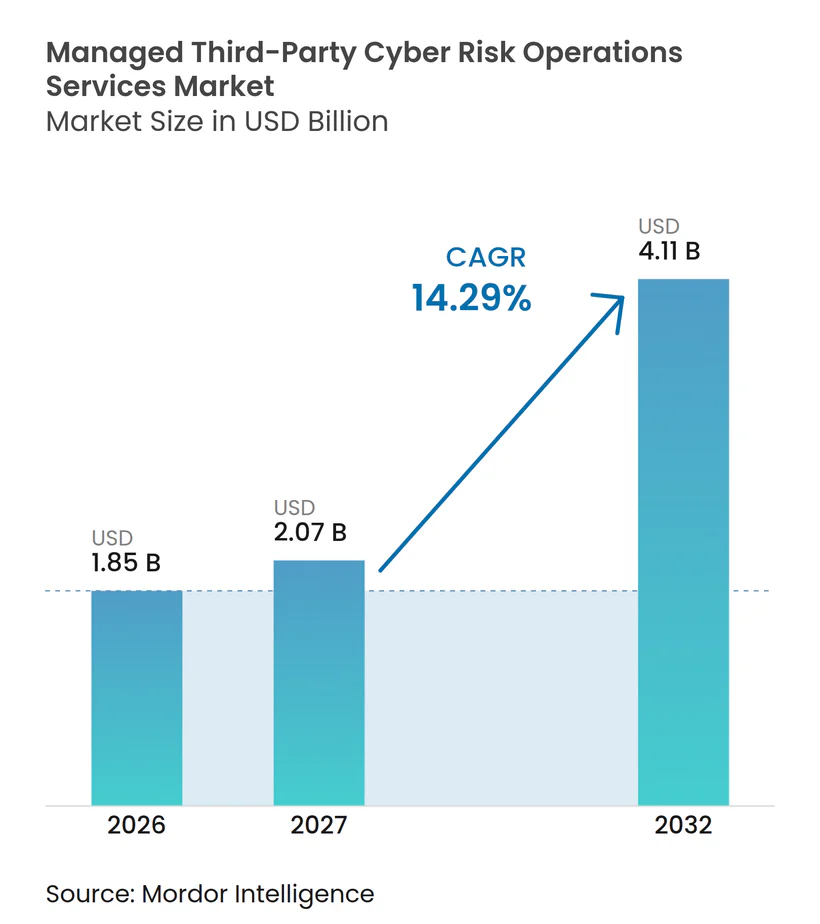
The managed third-party cyber risk operations services market size is projected to expand from USD 1.85 billion in 2026 and USD 2.11 billion in 2027 to USD 4.11 billion by 2032, registering a CAGR of 14.29% between 2027 and 2032. Supply-chain breach frequency, regulatory oversight, and increasingly complex vendor ecosystems are expanding the need for outsourced risk operations across regulated and lightly regulated sectors. Verizon reported that third parties were involved in 30% of confirmed breaches in its 2025 report, which supports the case for recurring monitoring rather than isolated vendor reviews. Enterprises are moving from one-time audits to managed service contracts as exposure events occur more quickly than periodic review cycles can address, and internal teams struggle to manage each new supplier connection. Providers are competing through automated questionnaires, real-time threat intelligence, and shared delivery infrastructure that can support larger vendor populations. Buyers increasingly expect evidence that a provider can reduce breach exposure, not only increase monitoring coverage or complete more assessments.
Key Report Takeaways
- By service type, Managed Due Diligence and Assessment Operations held 33.51% of the managed third-party cyber risk operations services market in 2026, while Continuous Monitoring and Cyber-Risk Intelligence Operations is projected to expand at a 15.25% CAGR through 2032.
- By delivery model, Fully Managed Services held 40.11% revenue share in 2026, and is projected to expand at a 15.40% CAGR through 2032.
- By industry vertical, Banking, Financial Services, and Insurance accounted for 30.31% of revenue in the managed third-party cyber risk operations services market in 2026, and is projected to expand at a 15.81% CAGR through 2032.
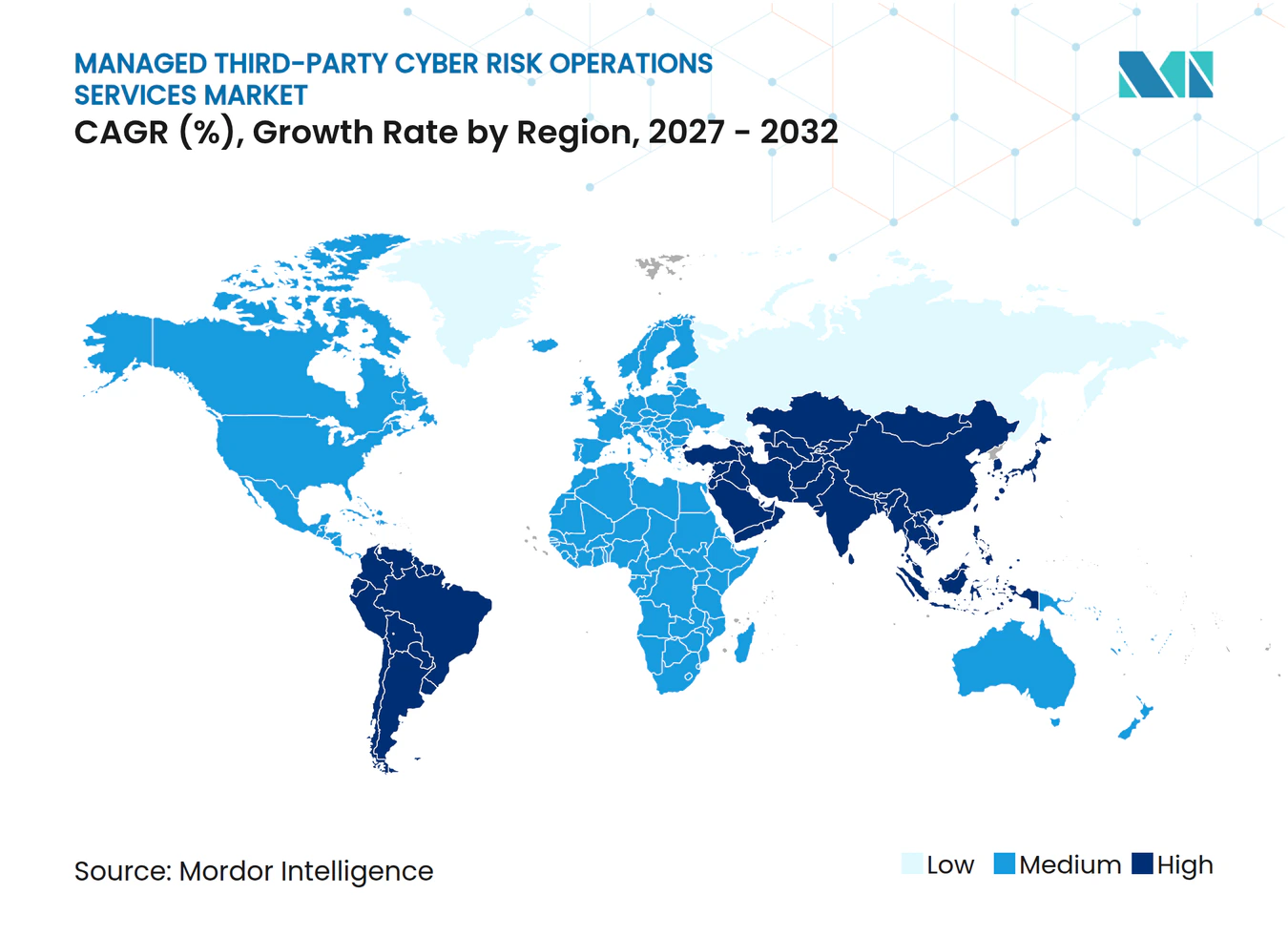
- By geography, North America held 44.05% revenue share in 2026, while Asia-Pacific is projected to expand at a 15.78% CAGR through 2032.
Note: Market numbers in this report are based on Mordor Intelligence's proprietary estimation framework, which combines nine months of actuals with Q4 projections for base year 2026.
Market Trends and Insights
Drivers Impact Analysis of Managed Third-Party Cyber Risk Operations Services Market*
| Driver | (~) % Impact on CAGR Forecast | Geographic Relevance | Impact Timeline |
|---|---|---|---|
| Escalating Third-Party Cyberattacks and Ransomware Exposure | +3.5% | Global | Short term (≤ 2 years) |
| Tightening Digital Resilience and Outsourcing Regulations | +3.0% | North America and Europe primarily, with spillover to Asia-Pacific and the Middle East and Africa | Medium term (2-4 years) |
| Expanding Cloud, SaaS, and Supply-Chain Ecosystems | +2.5% | Global, with Asia-Pacific acceleration | Long term (≥ 4 years) |
| Shift from Periodic Reviews to Continuous Monitoring and Automation | +2.0% | Global, led by North America | Medium term (2-4 years) |
| Evidence Reuse Across Multi-Customer Supplier Assessments | +1.2% | North America and Europe | Long term (≥ 4 years) |
| Rising Demand for Threat-Informed Nth-Party Exposure Mapping | +0.8% | Global, with early adoption in North America | Long term (≥ 4 years) |
| Source: Mordor Intelligence | |||
Escalating Third-Party Cyberattacks and Ransomware Exposure
Supply-chain intrusions are becoming a central route for organized threat actors, and periodic vendor audits cannot respond to this pace of change. Cipher reported that supply-chain attacks doubled in 2025 and carried a global annual cost of USD 53.2 billion. The company also reported that supply-chain incidents represented 22.5% of recorded security breaches and required an average of 254 days to detect and contain. Black Kite examined 136 verified major events in 2025 and found that a vendor compromise created an average of 5.28 downstream victims.[1] Verizon found ransomware in 44% of breach records in its 2025 Data Breach Investigations Report. These conditions support demand in the managed third-party cyber risk operations services market for continuous intelligence, ransomware risk scoring, timely supplier escalation, and practical coordination between security, procurement, and legal teams.
Tightening Digital Resilience and Outsourcing Regulations
Regulatory requirements are making documented third-party oversight a continuing operating requirement across major jurisdictions. DORA has applied to cover European financial entities since January 17, 2025, and requires registers of ICT third-party arrangements and risk assessments before engaging providers. The European Supervisory Authorities published guidance in July 2025 for oversight arrangements involving critical ICT third-party providers. New York State issued guidance in October 2025 that identified cloud computing, AI integrations, and fintech solutions as areas requiring an adaptive approach to third-party risk governance. Regulation EU 2025/37 established a certification scheme for managed security service providers within the NIS2 structure. The managed third-party cyber risk operations services market benefits when clients need ongoing records, monitoring, supplier oversight, and clear reporting that internal teams cannot sustain economically.
Expanding Cloud, SaaS, and Supply-Chain Ecosystems
Enterprise technology environments now contain more cloud services, SaaS connections, and supplier relationships than many risk teams can assess manually. SecurityScorecard surveyed 546 IT directors and CISOs in 2025 and reported that more than 70% had experienced a material third-party cybersecurity incident in the prior 12 months. The same survey found that fewer than half monitored cybersecurity across even 50% of their third-party supply chains. SaaS integrations can introduce API-level data sharing and sub-processors without a matching change in the supplier review process. This limits the value of questionnaires completed only at onboarding. The managed third-party cyber risk operations services market is positioned to address this gap through broader vendor coverage, continuous visibility across shared infrastructure, and risk reviews that follow changes in the underlying supplier environment.
Shift from Periodic Reviews to Continuous Monitoring and Automation
Annual and quarterly assessments can miss risks that appear between review cycles, which is moving buyers toward trigger-based monitoring. SecurityScorecard introduced TITAN AI in March 2026 and stated that the platform can reduce manual TPRM effort by up to 95%. The company also stated that its approach can enable up to 75% fewer supply-chain breaches through continuous threat-informed remediation. Bitsight reported 39% year-on-year growth in vendor risk management customers in September 2025 and said its Trust Management Hub included 68,000 organizations. It also reported that framework intelligence reduced assessment processing time from up to 8 hours to 90 seconds in early deployments. Automation allows providers in the managed third-party cyber risk operations services market to serve more vendors per analyst while retaining human review for higher-risk decisions and exception handling.
Restraints Impact Analysis of Managed Third-Party Cyber Risk Operations Services Market*
| Restraint | (~) % Impact on CAGR Forecast | Geographic Relevance | Impact Timeline |
|---|---|---|---|
| High Implementation and Integration Costs Across Siloed Risk Stacks | -1.5% | Global, more acute in emerging markets | Short term (≤ 2 years) |
| Data Quality, Privacy, and Cross-Border Information-Sharing Constraints | -1.2% | Europe and Asia-Pacific core | Medium term (2-4 years) |
| Supplier Fatigue from Repeated Questionnaires and Evidence Requests | -0.8% | Global | Short term (≤ 2 years) |
| Ambiguous Accountability for Nth-Party Risk and Incident Escalation | -0.5% | Global | Long term (≥ 4 years) |
| Source: Mordor Intelligence | |||
High Implementation and Integration Costs Across Siloed Risk Stacks
Enterprise deployments require links to procurement platforms, contract databases, governance systems, and security operations tools. This can increase implementation cost and extend launch timelines for a managed program. Organizations often use 3 to 5 disconnected tools for ratings feeds, questionnaires, contract repositories, and issue tracking. Financial institutions face additional data-mapping work because legacy core banking systems were not built for cybersecurity information exchange. Manufacturing companies can face similar issues with operational technology platforms, where operational continuity needs can limit system changes. The managed third-party cyber risk operations services market is responding with pre-built integrations, although custom work remains necessary for many multinational clients and for organizations with decentralized procurement processes.
Data Quality, Privacy, and Cross-Border Information-Sharing Constraints
Managed programs depend on complete data from enterprise clients, their suppliers, and service providers. Confidentiality clauses and inconsistent disclosure practices can limit access to configurations, access logs, and subprocessor lists. The EU General Data Protection Regulation, Brazil's LGPD, and Singapore's Personal Data Protection Act can constrain how these data are shared across jurisdictions. China’s Data Security Law can restrict outbound data transfers and may require locally compliant infrastructure. A 2025 peer-reviewed survey found that 60% of healthcare delivery organizations did not routinely monitor third-party access to sensitive information. These factors can slow standardized global assessments and increase the cost of cross-border delivery in the managed third-party cyber risk operations services market, particularly when each supplier must provide evidence through different local processes.
*Our forecasts treat driver/restraint impacts as directional, not additive. The impact forecasts reflect baseline growth, mix effects, and variable interactions.
Managed Third-Party Cyber Risk Operations Services Market Segment Analysis
By Service Type:
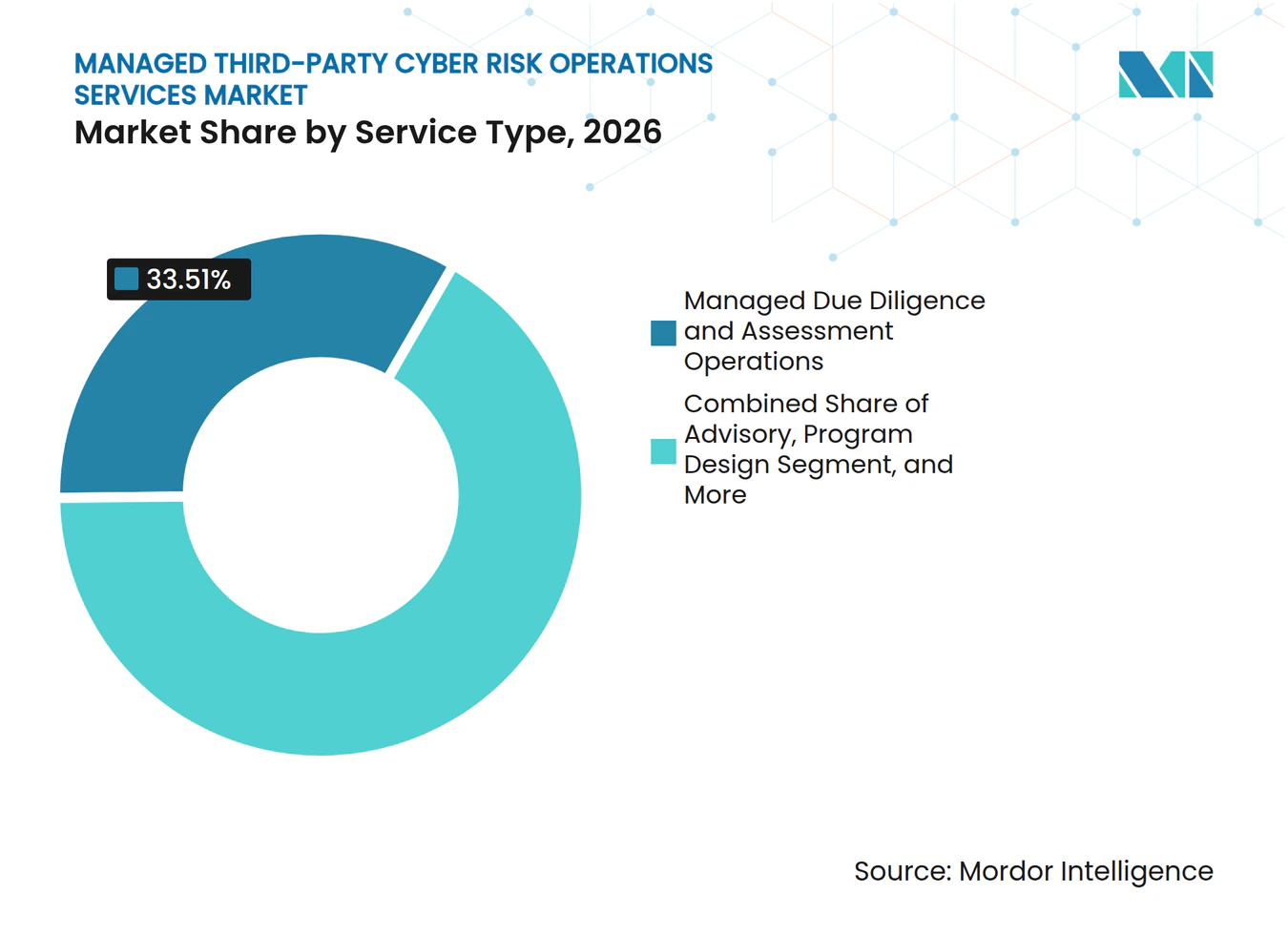
Assessment Supports Core Demand, Monitoring Leads ExpansionManaged Due Diligence and Assessment Operations accounted for 33.51% of revenue in 2026. Organizations use these services for supplier onboarding, periodic reassessments, and evidence review across the vendor lifecycle. Formal due diligence remains necessary when a supplier is engaged, even as later monitoring becomes more automated. Assessment findings also establish the risk tiers that determine where ongoing surveillance resources are focused, making this service a stable operational foundation for the managed third-party cyber risk operations services market.
Continuous Monitoring and Cyber-Risk Intelligence Operations is projected to expand at a 15.25% CAGR through 2032. This service addresses the visibility gap between scheduled assessments by following external threat signals and material technology changes. Remediation, Incident Response, and Breach Coordination Operations command higher engagement prices because providers coordinate clients, suppliers, and reporting requirements during sensitive events. Reporting, Compliance Evidence, and Program Administration Services support board reporting, while advisory and co-sourced services remain relevant for organizations that are still building their programs in the managed third-party cyber risk operations services market.



By Delivery Model:
Fully Managed Programs Lead, Co-Sourced Programs Broaden AdoptionFully Managed Services held 40.11% of the managed third-party cyber risk operations services market in 2026 and is projected to expand at a 15.48% CAGR through 2032. The model addresses the difficulty of hiring and retaining dedicated analysts for vendor-risk work. It also gives clients access to flexible capacity during periods of high supplier onboarding activity and changing assessment volumes. Technology-Enabled Specialist Services are expanding via platforms that offer managed assessment capabilities delivered through delivery partners, supporting clients who need specialized tools and external operational support.
Co-Sourced Services are used when a provider manages monitoring and evidence processing while the client retains risk acceptance and escalation authority. This arrangement can meet internal governance requirements without a complete transfer of operational responsibility. Project-Based Outsourced Services continue to support acquisition reviews and one-time program builds where a defined scope is appropriate. Their role is narrower because clients increasingly convert project work into recurring managed operations agreements once processes and risk priorities are established in the managed third-party cyber risk operations services market.
By Industry Vertical:
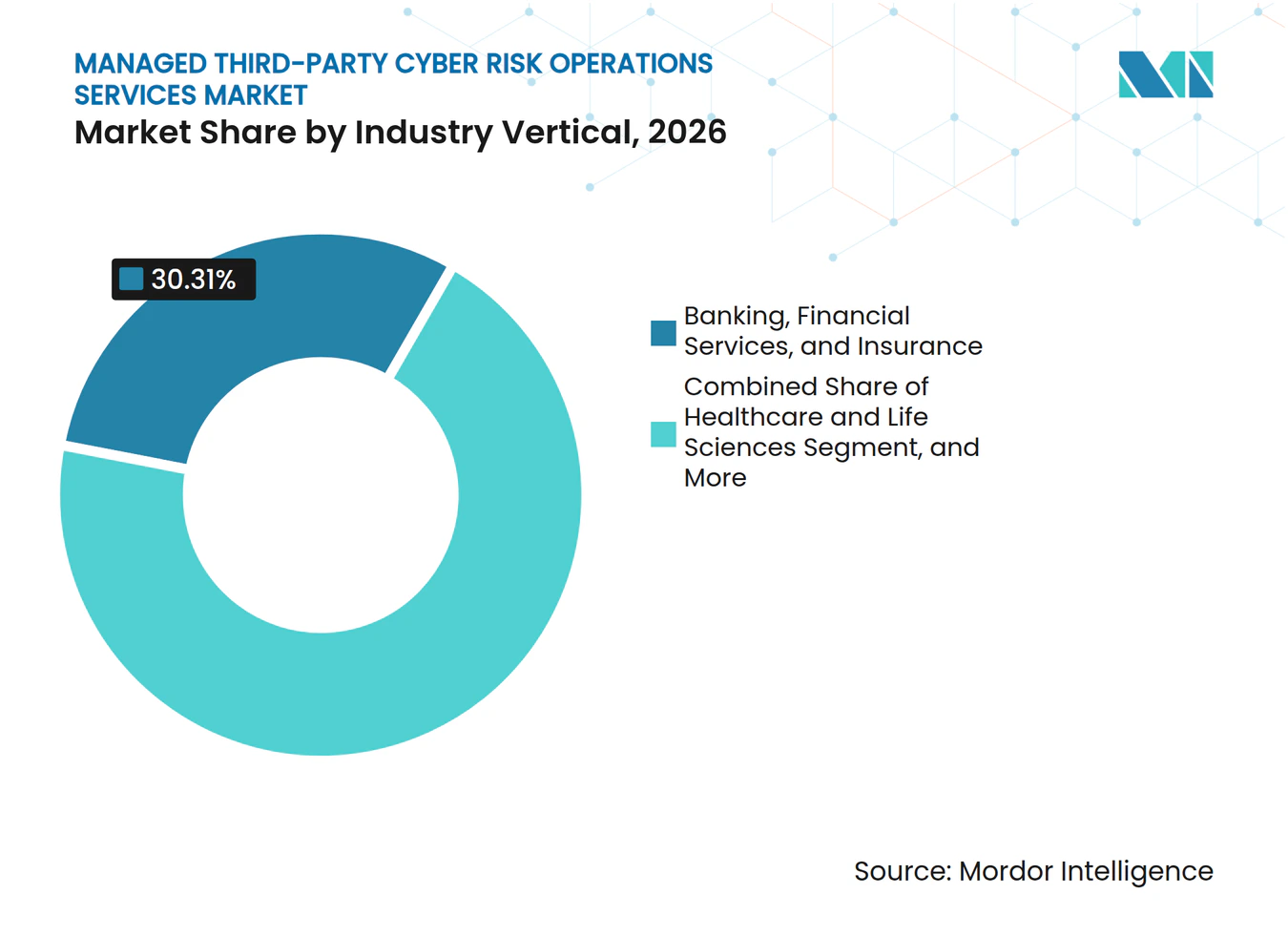
BFSI Leads Spending, Healthcare Adds DemandBanking, Financial Services, and Insurance held 30.31% of managed third-party cyber risk operations services market share in 2026 and is projected to expand at a 15.48% CAGR through 2032. Prudential, payment card, and capital markets requirements have made third-party oversight a well-established activity in this vertical. IT and Telecom follow because software supply chains, SaaS providers, and API data-sharing arrangements require more than annual assessment cycles. Government and Defense also require vendor screening for foreign ownership, control, and influence for organizations that handle sensitive systems and confidential data.
The Healthcare and Life Sciences segment is developing as a high-demand vertical as shortcomings in vendor oversight become more visible. A 2025 healthcare survey found that 51.1% of delivery organizations maintained a complete inventory of third parties accessing their networks, while 56% had experienced a third-party breach in the preceding 12 months. The study found that 48% of respondents identified staffing constraints as the principal barrier. Manufacturing, Energy, and Utilities are also adding operational technology vendors to their third-party risk programs as critical infrastructure requirements broaden their supplier oversight needs within the managed third-party cyber risk operations services market.

Geography Analysis
North America held 44.05% of the managed third-party cyber risk operations services market share in 2026. The region combines regulated financial institutions, technology multinationals, and federal defense contractors with supplier networks that can span hundreds or thousands of organizations. U.S. Securities and Exchange Commission rules require listed registrants to describe their cybersecurity risk-management and governance processes, including third-party risks, in annual disclosures. Morgan Stanley’s 2026 annual report described pre-engagement security reviews, risk-based oversight, independent audit submissions, and questionnaire-based monitoring as elements of its cybersecurity risk-management approach.[2] The United States leads regional spending, while Canada and Mexico present additional demand as oversight programs mature and buyers adopt more formal processes for supplier selection, monitoring, and remediation.
Canada’s OSFI B-10 guidance on technology and cyber risk supports an operating environment that is directionally aligned with third-party oversight needs. Mexico remains at an earlier stage, but manufacturing multinationals are addressing supply-chain cybersecurity around operational technology and connected production systems. These conditions expand the potential client base across the continent and favor providers able to align risk operations with procurement and security teams. They also favor delivery models that combine regulatory evidence with ongoing technical monitoring in the managed third-party cyber risk operations services market.
Asia-Pacific is projected to expand at a 15.78% CAGR through 2032, the highest regional rate in the managed third-party cyber risk operations services market. Japan’s Financial Services Agency issued cybersecurity guidelines in July 2025 that included lifecycle requirements for supplier due diligence, continuous monitoring, and contract termination controls. Japan’s Ministry of Economy, Trade, and Industry advanced a supply-chain security evaluation framework in April 2025, with a 2026 launch target and assessments based on operational criticality.[3] BlueVoyant entered Japan through a commercial agreement with Marubeni I-DIGIO in April 2025, targeting manufacturers and financial institutions. Europe remains the second-largest geography because DORA applies across EU member states, with Germany, the United Kingdom, France, the Netherlands, and Italy representing the largest concentration of regulated financial entities. The United Kingdom also operates its own Critical Third Party designation regime, creating a separate compliance consideration for firms active in both the United Kingdom and the European Union. South America, the Middle East, and Africa add demand in Brazil, Saudi Arabia, the United Arab Emirates, and South Africa, where digitization is enlarging supplier ecosystems and formal risk programs are still developing.
Competitive Landscape
Market Concentration
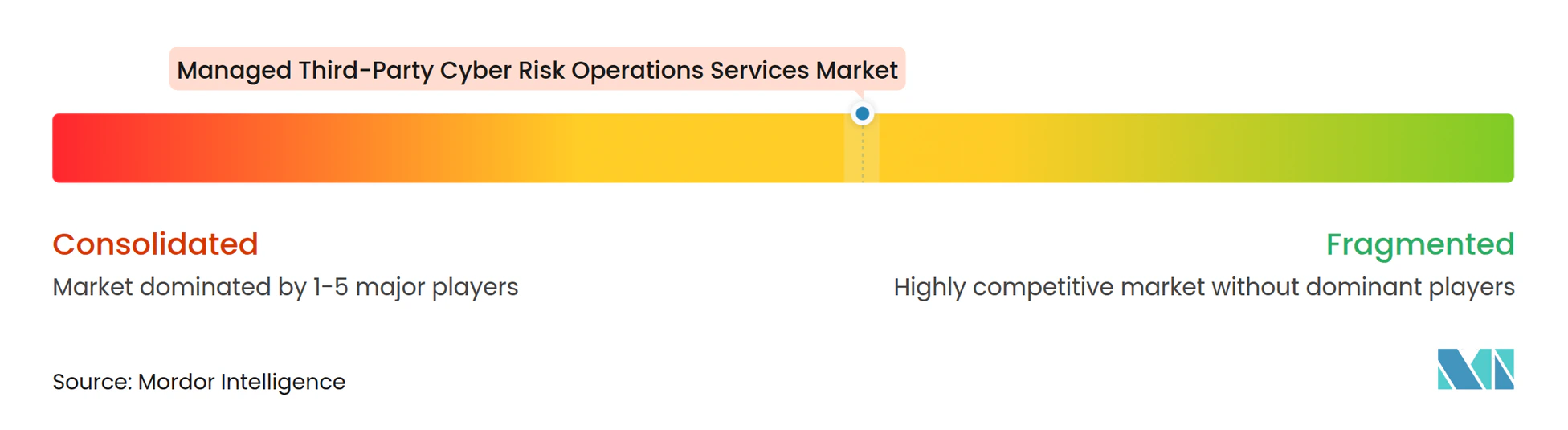
The managed third-party cyber risk operations services market is moderately consolidated among premium providers and fragmented among regional and midmarket firms. BitSight, SecurityScorecard, UpGuard, and BlueVoyant operate global platforms with managed delivery capabilities, proprietary threat intelligence, and partner networks. These capabilities help vendors extend geographic coverage without adding equivalent delivery headcount, while supporting more consistent monitoring across large vendor populations. SecurityScorecard reported 160% year-on-year annual recurring revenue growth in its channel program and more than 600 global delivery partners in February 2026. The platform-led approach is increasing competition for standalone consulting engagements and encouraging providers to combine technology with operating services.
Acquisitions are influencing how providers combine risk intelligence, workflow technology, and managed operations. SecurityScorecard acquired Driftnet in May 2026 and stated that Driftnet indexed 40% more internet-exposed hosts than competing intelligence providers. The transaction added real-time supply-chain scanning to its TITAN AI platform, including a capability designed to identify internet-facing supplier exposure. Mitratech acquired Prevalent, which placed AI-enabled third-party risk capabilities within a broader governance, risk, and compliance portfolio. Vanta acquired Riskey in July 2025, adding real-time third-party and fourth-party monitoring to its compliance automation platform in the managed third-party cyber risk operations services market.
Sector specialization remains important where supplier workflows follow industry-specific requirements. Fortress Information Security focuses on critical infrastructure and Energy and Utilities, while Meditology Services focuses on healthcare. Shared-evidence networks from Risk Ledger and Whistic aim to reduce supplier fatigue by allowing a completed assessment to be reused with multiple enterprise clients. This approach addresses cost barriers for midmarket buyers who cannot justify enterprise-scale programs or dedicate teams to repeated supplier evidence requests. The managed third-party cyber risk operations services market is also attracting compliance automation vendors that can add continuous vendor monitoring to their existing platforms, which broadens the set of companies competing for recurring risk operations work.
Managed Third-Party Cyber Risk Operations Services Industry Leaders
-
BitSight Technologies, Inc.
-
SecurityScorecard, Inc.
-
UpGuard, Inc.
-
Black Kite, Inc.
-
CyberVadis SAS
- *Disclaimer: Major Players sorted in no particular order
Managed Third-Party Cyber Risk Operations Services Market Companies Covered in this Report
- BitSight Technologies, Inc.
- SecurityScorecard, Inc.
- UpGuard, Inc.
- Black Kite, Inc.
- CyberVadis SAS
- Panorays, Inc.
- Prevalent, Inc.
- ProcessUnity, Inc.
- Whistic, Inc.
- Risk Ledger Limited
- Venminder, Inc.
- Fortress Information Security, LLC
- Safe Security, Inc.
- Aravo Solutions, Inc.
- BlueVoyant, Inc.
- VISO TRUST, Inc.
- CyberGRX, Inc.
- 3rdRisk, Inc.
- RiskRecon, Inc.
- CyberSaint, Inc.
Recent Industry Developments in Managed Third-Party Cyber Risk Operations Services Market
- August 2026: Prevalent AI secured a USD 22 million growth-equity investment from Integrity Growth Partners, accelerating AI-powered assessment automation development and expanding its sales capacity across North America and Europe.
- May 2026: SecurityScorecard completed its acquisition of Driftnet, integrating Driftnet's internet discovery engine, which indexes 40% more internet-exposed hosts than competing providers, into its TITAN AI platform to deliver real-time supply-chain scanning and shadow AI risk detection.
- April 2026: Protecht, an enterprise GRC platform, completed its acquisition of VISO TRUST, adding AI-powered third-party risk management to its product suite and competing for enterprise clients seeking integrated GRC and TPRM coverage under a single vendor.
- March 2026: SecurityScorecard unveiled TITAN AI at RSA Conference 2026 on March 23, launching a 3-tier managed intelligence platform, TITAN Watch, TITAN Assess, and TITAN Secure, claiming up to 95% reduction in manual TPRM effort and up to 75% fewer supply-chain breaches through continuous threat-informed remediation.
Global Managed Third-Party Cyber Risk Operations Services Market Report Scope
The Managed Third-Party Cyber Risk Operations Services Market comprises outsourced and co-sourced services that help organizations identify, assess, monitor, and manage cybersecurity risks arising from third-party suppliers, service providers, business partners, and extended supply-chain relationships. These services include managed due diligence and risk assessments, continuous cyber-risk monitoring and intelligence, remediation coordination, incident response and breach coordination, compliance reporting, evidence management, and third-party risk program administration. Providers also deliver advisory, program design, and specialist operational support to help organizations evaluate supplier security posture, track remediation activities, and manage risks across direct and indirect third parties.
The Managed Third-Party Cyber Risk Operations Services Market Report is Segmented by Service Type (Managed Due Diligence and Assessment Operations, Continuous Monitoring and Cyber-Risk Intelligence Operations, Remediation, Incident Response and Breach Coordination Operations, Reporting, Compliance Evidence and Program Administration Services, and Advisory, Program Design and Co-Sourced Operations), Delivery Model (Fully Managed Services, Co-Sourced Services, Project-Based Outsourced Services, and Technology-Enabled Specialist Services), Industry Vertical (Banking, Financial Services and Insurance, IT and Telecom, Healthcare and Life Sciences, Government and Defense, Retail and Consumer Goods, Manufacturing, Energy and Utilities, and Other Industry Verticals), and Geography (North America, South America, Europe, Asia-Pacific, Middle East, and Africa). The Market Forecasts are Provided in Terms of Value (USD).
Segmentation Overview
| Managed Due Diligence and Assessment Operations |
| Continuous Monitoring and Cyber-Risk Intelligence Operations |
| Remediation, Incident Response, and Breach Coordination Operations |
| Reporting, Compliance Evidence, and Program Administration Services |
| Advisory, Program Design, and Co-Sourced Operations |
| Fully Managed Services |
| Co-Sourced Services |
| Project-Based Outsourced Services |
| Technology-Enabled Specialist Services |
| Banking, Financial Services, and Insurance |
| IT and Telecom |
| Healthcare and Life Sciences |
| Government and Defense |
| Retail and Consumer Goods |
| Manufacturing |
| Energy and Utilities |
| Other Industry Verticals |
| North America | United States |
| Canada | |
| Mexico | |
| South America | Brazil |
| Argentina | |
| Chile | |
| Rest of South America | |
| Europe | Germany |
| United Kingdom | |
| France | |
| Italy | |
| Spain | |
| Netherlands | |
| Rest of Europe | |
| Asia-Pacific | China |
| Japan | |
| India | |
| South Korea | |
| Singapore | |
| Rest of Asia-Pacific | |
| Middle East | Saudi Arabia |
| United Arab Emirates | |
| Turkey | |
| Rest of Middle East | |
| Africa | South Africa |
| Nigeria | |
| Kenya | |
| Rest of Africa |
| By Service Type | Managed Due Diligence and Assessment Operations | |
| Continuous Monitoring and Cyber-Risk Intelligence Operations | ||
| Remediation, Incident Response, and Breach Coordination Operations | ||
| Reporting, Compliance Evidence, and Program Administration Services | ||
| Advisory, Program Design, and Co-Sourced Operations | ||
| By Delivery Model | Fully Managed Services | |
| Co-Sourced Services | ||
| Project-Based Outsourced Services | ||
| Technology-Enabled Specialist Services | ||
| By Industry Vertical | Banking, Financial Services, and Insurance | |
| IT and Telecom | ||
| Healthcare and Life Sciences | ||
| Government and Defense | ||
| Retail and Consumer Goods | ||
| Manufacturing | ||
| Energy and Utilities | ||
| Other Industry Verticals | ||
| By Geography | North America | United States |
| Canada | ||
| Mexico | ||
| South America | Brazil | |
| Argentina | ||
| Chile | ||
| Rest of South America | ||
| Europe | Germany | |
| United Kingdom | ||
| France | ||
| Italy | ||
| Spain | ||
| Netherlands | ||
| Rest of Europe | ||
| Asia-Pacific | China | |
| Japan | ||
| India | ||
| South Korea | ||
| Singapore | ||
| Rest of Asia-Pacific | ||
| Middle East | Saudi Arabia | |
| United Arab Emirates | ||
| Turkey | ||
| Rest of Middle East | ||
| Africa | South Africa | |
| Nigeria | ||
| Kenya | ||
| Rest of Africa | ||
Key Questions Answered in the Report
What is the size of the managed third-party cyber risk operations services market?
The sector is projected at USD 1.85 billion in 2026 and USD 2.11 billion in 2027, with a forecast value of USD 4.11 billion by 2032. The forecast reflects demand for continuous supplier oversight rather than periodic review alone across complex, interconnected business and technology environments that require sustained operational attention.
What is driving demand for the managed third-party cyber risk operations services market?
Rising supply-chain incidents, regulations such as DORA, and the need to monitor complex cloud and SaaS supplier ecosystems are supporting adoption. These conditions increase the burden on internal security and procurement teams.
Which service type leads managed third-party cyber risk operations services?
Managed Due Diligence and Assessment Operations leads with 33.51% share in 2026, while Continuous Monitoring and Cyber-Risk Intelligence Operations is projected to expand at a 15.25% CAGR through 2032. Organizations use both services to cover onboarding and ongoing risk signals.
Which delivery model is most used for third-party cyber risk operations?
Fully Managed Services leads with 40.11% share in 2026 because many organizations lack the specialized personnel required to operate these programs internally. The model also gives clients flexible capacity during higher onboarding volumes.
Which end-user sector has the highest use of managed third-party cyber risk operations services?
Banking, Financial Services, and Insurance leads with 30.31% share in 2026, supported by established supplier oversight requirements. IT and Telecom also requires frequent monitoring because of software supply-chain and API risks.
Which region is expanding fastest for managed third-party cyber risk operations services?
Asia-Pacific is projected to expand at a 15.78% CAGR through 2032, supported by formalized cybersecurity requirements and growing digital supplier networks. Japan is a key contributor because its new guidance covers supplier risk across the lifecycle, from onboarding through monitoring and contract termination.