
Managed SD-Branch Security Services Market Size and Share
Market Overview
| Study Period | 2021 - 2032 |
|---|---|
| Market Size (2027) | USD 10.72 Billion |
| Market Size (2032) | USD 24.86 Billion |
| Growth Rate (2027 - 2032) | 18.32 % |
| Fastest Growing Market | Asia-Pacific |
| Largest Market | North America |
| Market Concentration | Medium |
Major Players *Disclaimer: Major Players sorted in no particular order Image © Mordor Intelligence. Reuse requires attribution under CC BY 4.0. | |
Managed SD-Branch Security Services Market Analysis by Mordor Intelligence
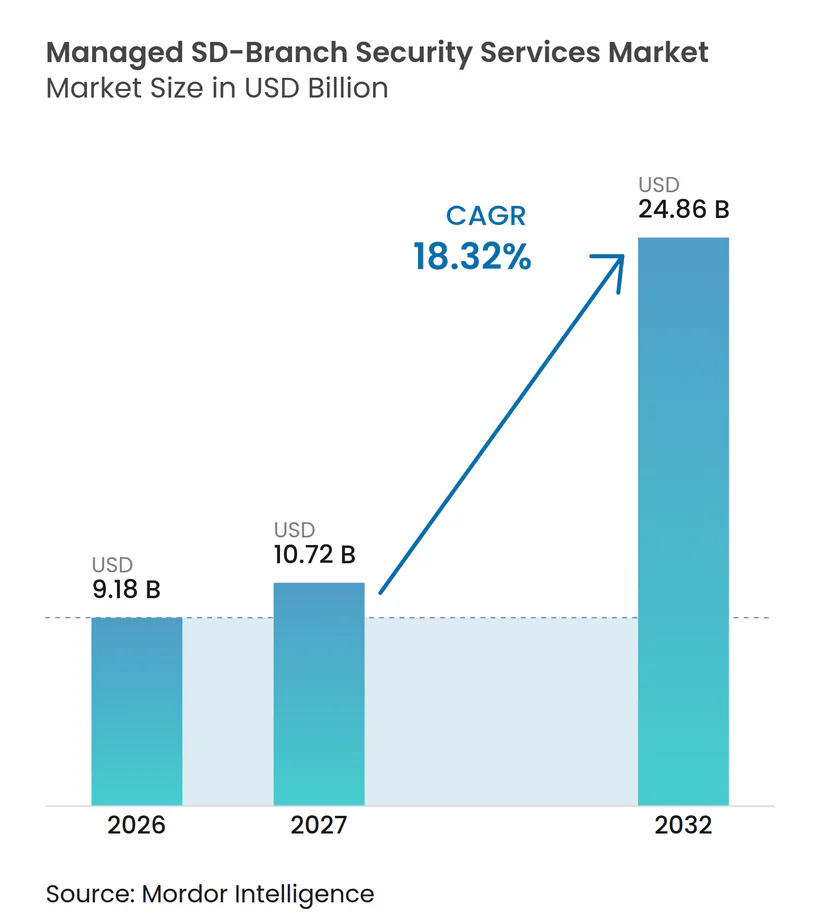
The Managed SD-Branch Security Services Market size is expected to increase from USD 9.18 billion in 2026 to USD 10.72 billion in 2027 and reach USD 24.86 billion by 2032, growing at a CAGR of 18.32% over 2027-2032. The managed SD-Branch security services market is being shaped by enterprises replacing separate branch security tools with integrated services that combine networking, security controls, and ongoing operations. Cloud and SaaS traffic has reduced the practicality of routing branch traffic through central data centers, while connected devices have expanded the number of endpoints that require oversight. Compliance requirements and zero-trust approaches are also pushing organizations toward services that can support policy enforcement and audit activities across dispersed sites. Providers are responding by combining SD-WAN, Secure Service Edge capabilities, and security operations under a single delivery model. This gives the managed SD-Branch security services market room to expand, where organizations need clearer operational responsibility and sustained security monitoring.
Key Report Takeaways
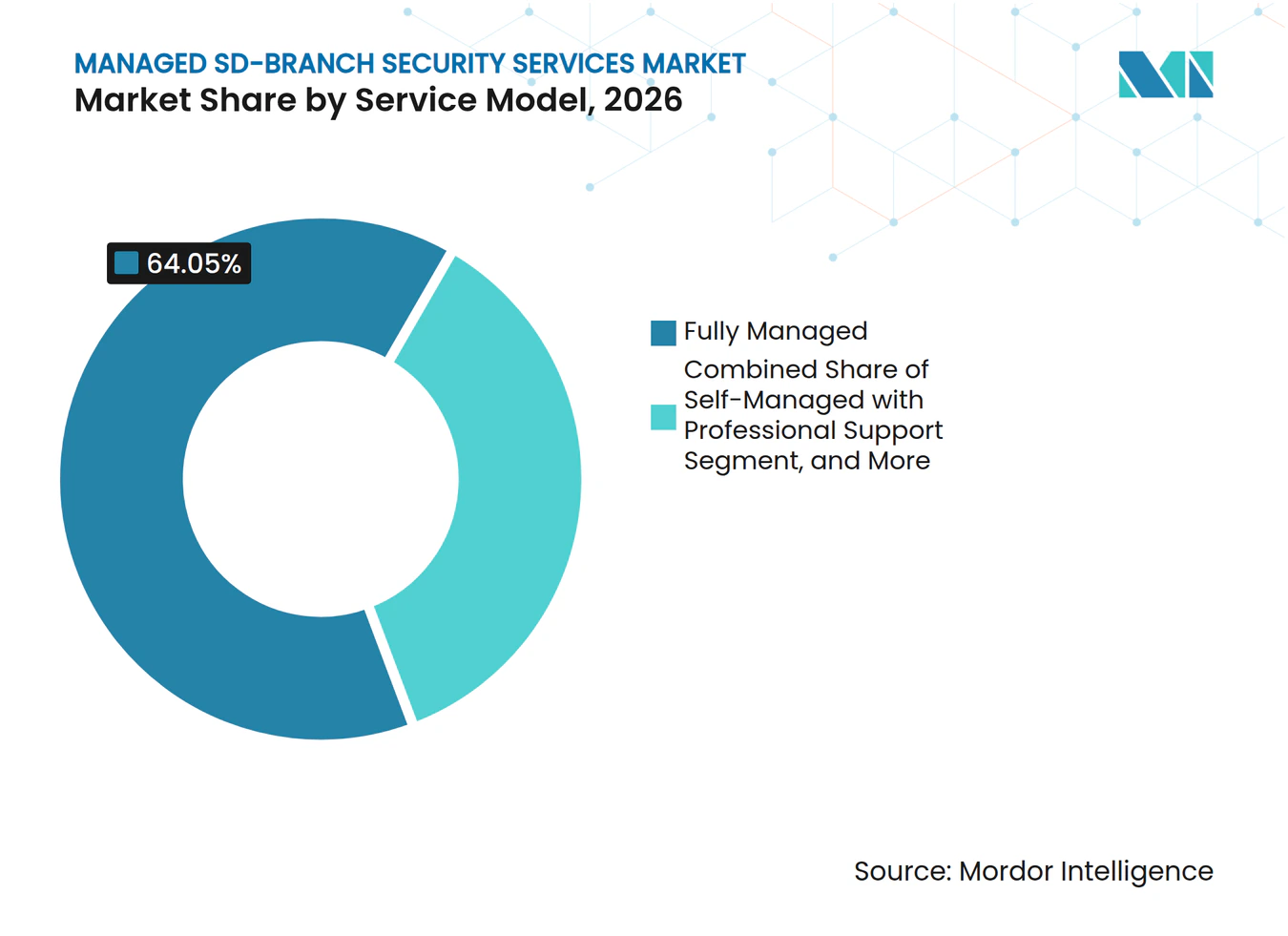
- By service model, fully managed services led service-model revenue with 64.05% in 2026 and are projected to expand at a 19.25% CAGR through 2032.
- By security function, Secure SD-WAN and Next-Generation Firewall held 33.99% of revenue in 2026, while Managed Detection, Response, and Security Operations is projected to expand at a 19.63% CAGR through 2032.
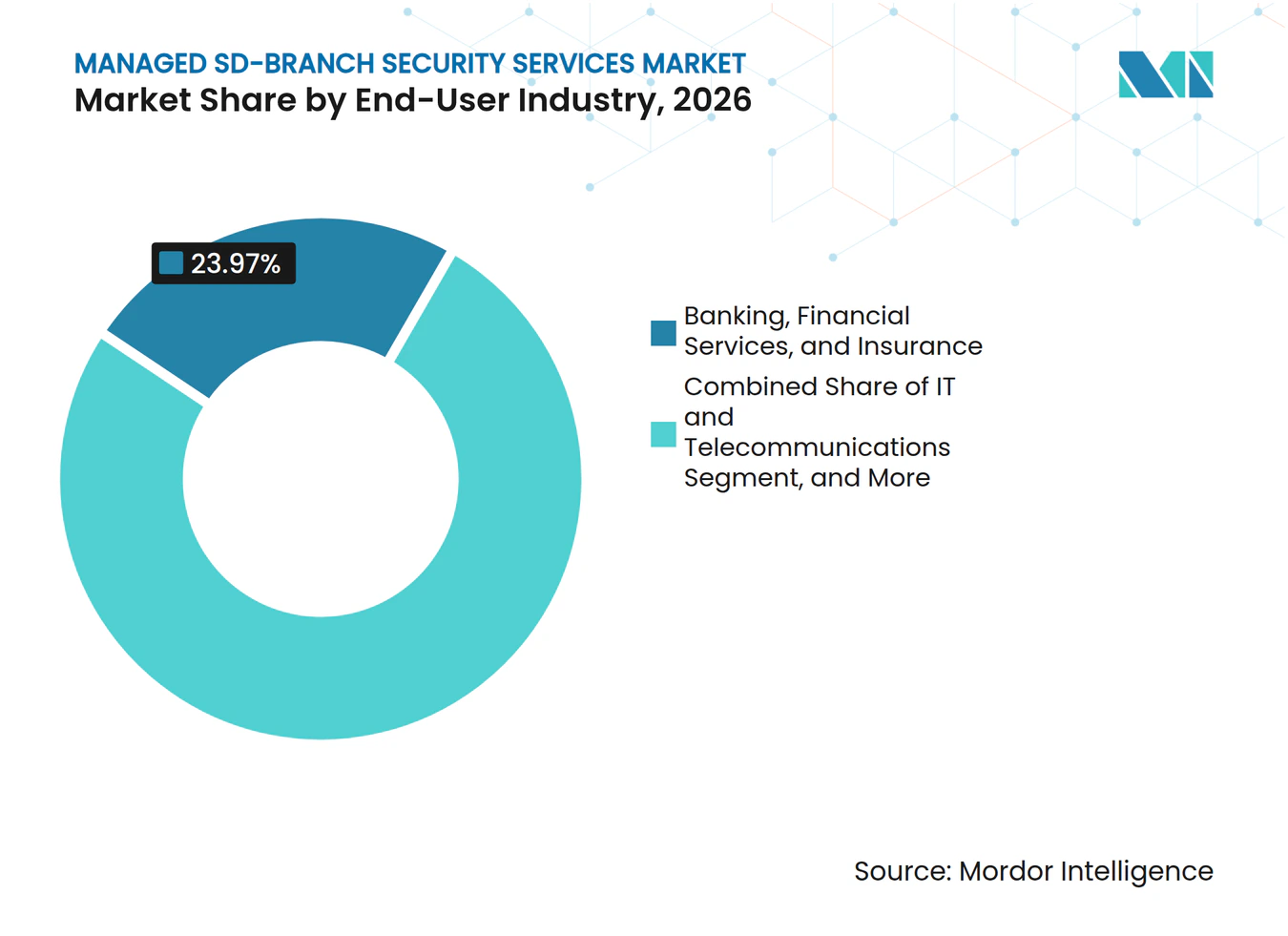
- By end-user industry, BFSI held 23.97% of revenue in 2026, while Manufacturing and Industrial is projected to expand at a 19.65% CAGR through 2032.
- By geography, North America held 41.03% of revenue in 2026, while Asia-Pacific is projected to expand at a 19.52% CAGR through 2032.
Note: Market numbers in this report are based on Mordor Intelligence's proprietary estimation framework, which combines nine months of actuals with Q4 projections for base year 2026.
Market Trends and Insights
Drivers Impact Analysis of Managed SD-Branch Security Services Market*
| Driver | (~) % Impact on CAGR Forecast | Geographic Relevance | Impact Timeline |
|---|---|---|---|
| Convergence of SD-WAN, Security, and Branch Networking | +3.8% | Global | Short term (≤ 2 years) |
| Zero-Trust and Cybersecurity Compliance Requirements | +3.1% | North America and Europe | Medium term (2-4 years) |
| Rising Cloud and SaaS Traffic at Distributed Branches | +2.6% | Global | Short term (≤ 2 years) |
| MSSP Adoption of Turnkey SASE and SD-Branch Operations | +2.3% | North America and Europe | Medium term (2-4 years) |
| Expansion of IoT and Unmanaged Devices at Branches | +1.9% | Asia-Pacific core, spillover to the Middle East and Africa | Long term (≥ 4 years) |
| eSIM-Native Security for Cellular IoT and Temporary Sites | +0.8% | Asia-Pacific core, spillover to the Middle East, Africa, and South America | Long term (≥ 4 years) |
| Source: Mordor Intelligence | |||
Convergence of SD-WAN, Security, and Branch Networking
The managed SD-Branch security services market benefits as enterprises move security enforcement closer to the branch edge. This change follows the decline of a single data-center perimeter as the main control point for distributed work and cloud traffic. Integrated SD-WAN and next-generation firewall deployments can give providers visibility across traffic entering, leaving, and moving within a branch. Security Service Edge analytics can extend that visibility into cloud-delivered security controls. A unified architecture can reduce the burden of managing separate policy sets and shorten the time needed to address incidents. The managed SD-Branch security services market, therefore, favors providers that can deliver networking, security, and operations through a consistent service arrangement.
Zero-Trust and Cybersecurity Compliance Requirements
The managed SD-Branch security services market is supported by zero-trust requirements that are becoming more relevant to regulated organizations. Germany completed NIS2 transposition in December 2025, while Austria, Portugal, and Sweden also finalized national cybersecurity statutes during that period. Organizations working across jurisdictions need security controls that can support segmentation, access verification, incident reporting, and the collection of audit evidence. NIST SP 800-207, DORA requirements for information and communications technology risk management, and NIS2 network segmentation provisions all reinforce the need for verifiable controls. Managed providers can take responsibility for applying policies and documenting service activity across multiple sites. This structure can make longer service arrangements more attractive, where compliance work would otherwise fall on internal teams.
Rising Cloud and SaaS Traffic at Distributed Branches
The managed SD-Branch security services market is gaining from the movement of application traffic toward cloud and SaaS platforms. Routing encrypted branch traffic through a central firewall can add delay and increase MPLS costs when users are connecting directly to cloud resources. Branch-based inspection and cloud security controls can provide a more direct path for approved traffic. High-volume inspection can still create data-transfer charges within cloud security arrangements. Providers can limit unnecessary reinspection by applying identity-aware controls and differentiating lower-risk SaaS traffic from traffic that requires deeper inspection. This approach links security policy design to network cost management for organizations with large branch estates.
MSSP Adoption of Turnkey SASE and SD-Branch Operations
The managed SD-Branch security services market is advancing as managed security service providers adopt turnkey SASE and SD-Branch platforms. A fully managed arrangement can combine threat monitoring, incident response, performance monitoring, patching, and appliance lifecycle support. This model addresses the difficulty of maintaining a security operations center and specialized network skills internally. It also lets mid-market organizations use capabilities that once required large enterprise budgets and dedicated teams. Shared managed platforms can support deployments across 20 to 200 branch sites on a per-site basis. The managed SD-Branch security services market can therefore draw demand from smaller distributed organizations as well as large network refresh programs.
Restraints Impact Analysis of Managed SD-Branch Security Services Market*
| Restraint | (~) % Impact on CAGR Forecast | Geographic Relevance | Impact Timeline |
|---|---|---|---|
| Shortage of Skilled SASE and Branch Security Operators | -2.0% | Global, most acute in South and Southeast Asia and Sub-Saharan Africa | Short term (≤ 2 years) |
| Inline Inspection Latency for Real-Time Applications | -1.5% | Global | Short term (≤ 2 years) |
| SaaS Egress Fees for Cloud-Based Inspection Workloads | -1.1% | North America and Europe | Medium term (2-4 years) |
| Proprietary Policy Languages and Multi-Vendor Interoperability Gaps | -0.8% | Global, multi-vendor environments | Medium term (2-4 years) |
| Source: Mordor Intelligence | |||
Shortage of Skilled SASE and Branch Security Operators
The shortage of SASE and branch security professionals limits how quickly providers can scale managed delivery. ISACA reported in 2025 that 55% of cybersecurity teams were understaffed and 65% had unfilled roles. The same source stated that 29% of enterprises trained non-security employees for security roles, compared with 41% in the prior year.[1] ISC2 found that only 18% of hiring managers considered entry-level professionals capable of handling cloud security tasks, despite cloud security being a leading required competency. Providers need engineers able to manage SASE policies and continuous branch security operations. The constraint can reinforce outsourcing demand while restricting the speed at which service capacity becomes available.
Inline Inspection Latency for Real-Time Applications
Full inline inspection can create delays for voice, video, and industrial control traffic at branch sites. The constraint is especially important in manufacturing and healthcare settings that use operational technology protocols such as Modbus and MQTT. These environments may require round-trip performance below 50 milliseconds, which cloud-based inspection services cannot always provide across every location. Decryption, classification, and reencryption add processing work and propagation delay to traffic flows. Providers can place more security processing in branch appliances, but this raises hardware spending and reduces part of the cloud-first cost advantage. This tradeoff can slow the adoption of fully managed inline inspection in factory automation, hospital environments, and financial trading locations.
*Our forecasts treat driver/restraint impacts as directional, not additive. The impact forecasts reflect baseline growth, mix effects, and variable interactions.
Managed SD-Branch Security Services Market Segment Analysis
By Service Model:
Fully Managed Delivery Supports Revenue LeadershipFully managed services held 64.05% of the Managed SD-Branch security services market share in 2026. The position reflects the operational difficulty of running a SASE policy engine, a security operations center, and branch appliance management at the same time. Enterprises often lack the staffing needed to maintain all of these functions across dispersed sites. The fully managed model gives one provider responsibility for monitoring, policy administration, threat response, and lifecycle work. This can simplify operational accountability for organizations that want a defined service-level arrangement.
Fully managed delivery is also projected to expand at a 19.25% CAGR from 2027 to 2032. IoT device growth and larger branch estates increase the work involved in managing access controls, zero-trust policies, and threat response processes. Co-managed services serve organizations that want architectural visibility while delegating threat detection and policy enforcement. Self-managed services with professional support remain relevant for large enterprises that require audits, configuration support, or incident response retainers rather than daily operations. Aryaka launched Unified SASE as a Service 2.0 in November 2025 with a single-vendor, single-operator delivery model, a 99.999% uptime service-level agreement, and a 10-minute P1 incident acknowledgment target.[2]



By Security Function:
Threat Detection Expands the Managed Service RoleSecure SD-WAN and Next-Generation Firewall held 33.99% of the Managed SD-Branch security services market size in 2026. This function remains the foundation for protecting connectivity and for supporting the installed base of managed firewall appliances. Managed Detection, Response, and Security Operations is projected to expand at a 19.63% CAGR from 2027 to 2032. Its faster pace reflects the need to address lateral movement and insider threats that can persist after basic connectivity controls are deployed. The managed SD-Branch security services market is thus moving beyond connection security toward ongoing detection and response.
Zero Trust Network Access is increasingly connected to compliance needs that call for session-level controls and continuous verification. Network Access Control and IoT Security are gaining relevance as branches add unmanaged and connected devices. Secure Web Gateway and Cloud Access Security Broker functions support SaaS inspection closer to users and can limit unnecessary central backhauling. Firewall-as-a-Service and intrusion prevention can complement hardware-based deployments at branches that do not justify dedicated refresh cycles. Versa announced an automated integration between Versa Secure SD-WAN and Zscaler Internet Access in March 2026, covering tunnel provisioning, point-of-presence selection, and self-healing networking.
By End-User Industry:
BFSI Leads as Industrial Sites Add Security RequirementsBFSI held 23.97% of end-user revenue in 2026. Financial institutions have high branch density and face significant requirements for operational resilience, access control, and oversight of distributed systems. These conditions make managed service delivery relevant where banks and insurers need consistent controls across many offices. The sector also has strong exposure to DORA requirements in the European Union and guidance from U.S. financial regulators. This keeps the sector central to the managed SD-Branch security services market.
Manufacturing and Industrial is projected to expand at a 19.65% CAGR from 2027 to 2032. Factory networks that once operated separately are increasingly connected to cloud analytics, remote vendor access, and enterprise resource planning systems. This raises the need for zero-trust segmentation between information technology and operational technology environments. Siemens launched SINEC Secure Connect in October 2025 as a zero-trust platform for operational technology networks that provides IEC 62443-compliant encrypted machine-to-cloud connections without VPN exposure. Healthcare and Life Sciences, government and public sector, IT and telecommunications, retail and e-commerce, and energy and utilities also add demand through existing SD-WAN deployments and distributed access requirements.

Geography Analysis
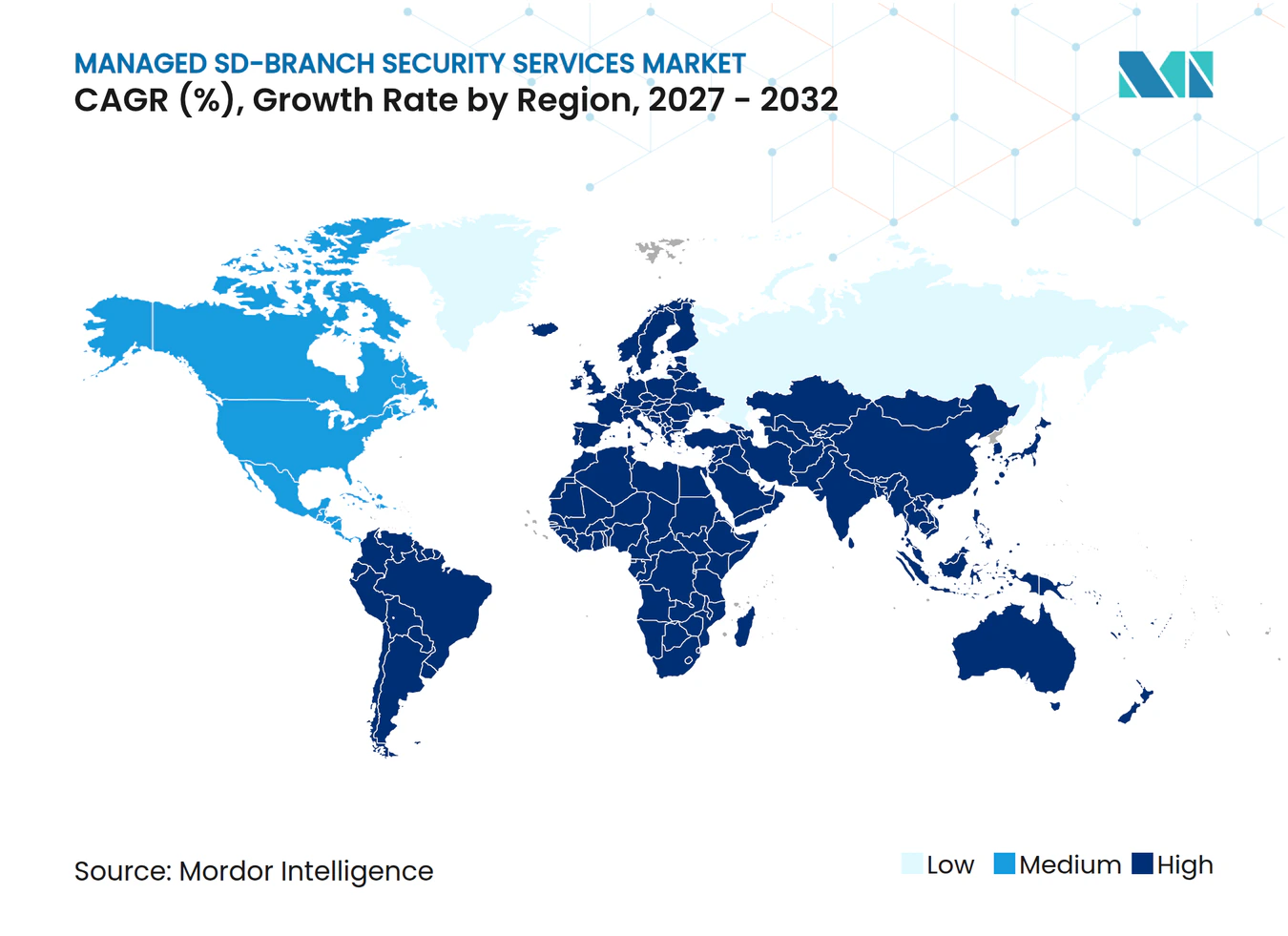
North America held 41.03% of the Managed SD-Branch security services market share in 2026. The region benefits from large enterprise branch networks, mature managed security service provider ecosystems, and security procurement practices aligned with NIST guidance and Executive Order 14028. U.S. federal contractors and regulated organizations need stronger access controls and continuous monitoring across distributed sites. Canada’s financial services activity and Mexico’s automotive manufacturing links to U.S. and European parent systems broaden demand beyond the U.S. core. The region is a key setting for platforms that combine networking and security in one managed service.
Asia-Pacific is projected to expand at a 19.52% CAGR from 2027 to 2032. Cloud adoption in India, regulatory modernization in Australia and Japan, and 5G deployment are supporting wider use of secure branch connectivity. KDDI began commercial delivery of Japan’s first carrier-operated SASE service on July 1, 2025, combining its SD-WAN platform with Cisco security functions through a carrier billing relationship.[3] China follows a separate path because data localization and the Multi-Level Protection Scheme shape local security demand. India and Southeast Asia have a significant talent gap, which supports fully managed delivery as an entry model for multinational service providers.
Europe has substantial revenue because NIS2, DORA, and GDPR create layered compliance requirements for branch security and cloud inspection. Germany, Austria, Portugal, and Sweden finalized relevant national cybersecurity statutes in 2025, increasing attention to segmentation and incident reporting. Providers that can offer European security operations centers and data handling practices aligned with sovereignty expectations have a distinct position in the region. South America is developing from a smaller base through financial services and retail demand, while Saudi Arabia and the United Arab Emirates are building distributed networks under digitization programs, and Africa remains early-stage, with South Africa and Egypt as the main demand centers.
Competitive Landscape
Market Concentration
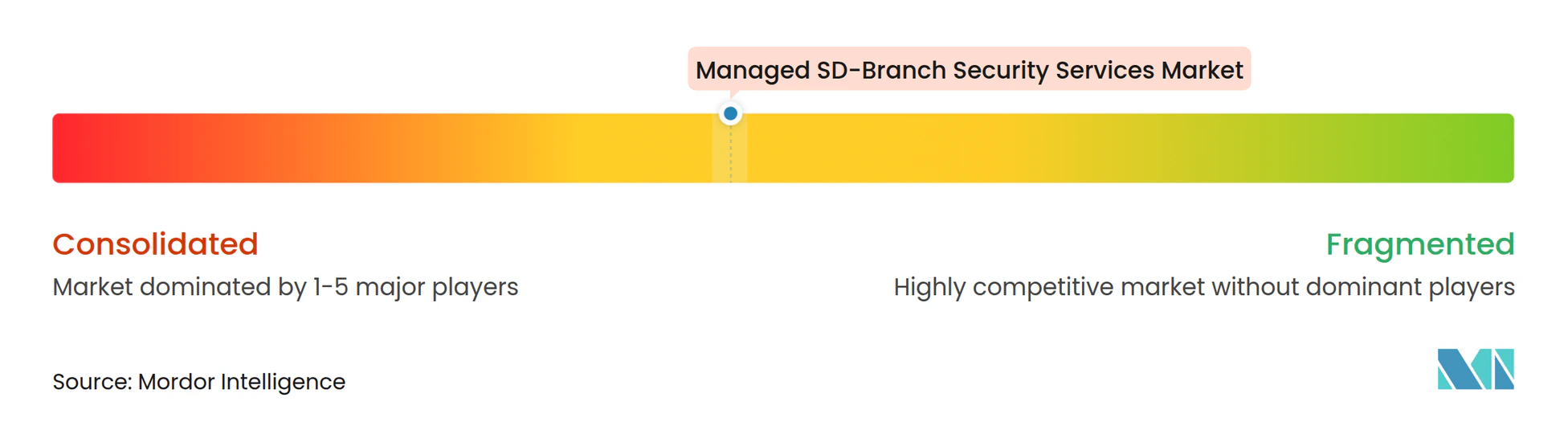
The managed SD-Branch security services market is moderately consolidated among leading platforms and fragmented among regional and mid-market providers. Vendors that control both the SD-WAN layer and the Security Service Edge layer can offer a more unified policy structure. This model can reduce the integration work required from enterprise customers and managed service providers. Competition centers on the ability to bundle more security functions into a single managed contract. Providers also compete on service accountability, response capability, and support for complex branch deployments.
Mid-market organizations with 20 to 200 locations remain an important opportunity because many need managed protection without building large internal teams. Telecom operators are becoming more relevant by adding managed branch security to connectivity contracts and established billing relationships. KDDI’s July 2025 carrier-operated SASE launch in Japan is an example of this approach. AireSpring launched a Managed FortiSASE service in August 2025 that combined Fortinet’s platform with its operations team and IT service management platform. These offerings show how service providers can package networking and security operations together.
SonicWall reported in November 2025 that Zero Trust and Cloud Secure Edge bookings increased by more than 500% year over year, while Managed Security Services bookings recorded double-digit growth. The company also reported a doubling of new managed security service provider partner additions. The managed SD-Branch security services market also rewards providers able to meet regional requirements for data handling and security operations. Further consolidation may occur as Security Service Edge-focused vendors look for SD-WAN capabilities and platform vendors look for additional managed security functions.
Managed SD-Branch Security Services Industry Leaders
-
Fortinet, Inc.
-
Cisco Systems, Inc.
-
Palo Alto Networks, Inc.
-
Zscaler, Inc.
-
Cato Networks, Ltd.
- *Disclaimer: Major Players sorted in no particular order
Managed SD-Branch Security Services Market Companies Covered in this Report
- Akamai Technologies, Inc.
- Aryaka Networks, Inc.
- Barracuda Networks, Inc.
- Cato Networks, Ltd.
- Check Point Software Technologies Ltd.
- Cisco Systems, Inc.
- Cloudflare, Inc.
- Cradlepoint, Inc.
- Extreme Networks, Inc.
- Fortinet, Inc.
- Forcepoint LLC
- Hewlett Packard Enterprise Company
- Juniper Networks, Inc.
- Netskope, Inc.
- Open Systems AG
- Palo Alto Networks, Inc.
- Sangfor Technologies Inc.
- SonicWall Inc.
- Versa Networks, Inc.
- Zscaler, Inc.
Recent Industry Developments in Managed SD-Branch Security Services Market
- September 2026: Palo Alto Networks reported full-year SASE bookings growth of 40% for fiscal 2026, confirmed the closure of its two largest-ever acquisitions, CyberArk and Chronosphere, and disclosed that it displaced legacy vendor architectures in 100 accounts worth more than USD 400 million in total contract value during the fiscal year.
- March 2026: Hewlett Packard Enterprise announced a unified SASE platform built on HPE Networking EdgeConnect at HPE Discover on June 16, 2026, integrating SD-WAN and cloud-delivered security under an AI-native management console for enterprise accounts with large HPE Aruba and Juniper Mist network estates.
- March 2026: Versa Networks announced an integration between Versa Secure SD-WAN and Zscaler Internet Access on March 23, 2026, enabling automated tunnel provisioning, intelligent point-of-presence selection, and self-healing networking.
- February 2026: Palo Alto Networks announced its intent to acquire Koi to extend its Prisma AIRS platform with AI-native attack surface coverage for autonomous agent frameworks and browser-based AI tools.
Global Managed SD-Branch Security Services Market Report Scope
The Managed SD-Branch Security Services Market comprises managed network security services that integrate software-defined wide area networking (SD-WAN), branch connectivity, and security capabilities to protect distributed enterprise locations, users, applications, and connected devices. These services include the deployment, configuration, monitoring, and management of secure SD-WAN, next-generation firewalls, secure web gateways, cloud access security brokers, zero trust network access, firewall-as-a-service, intrusion prevention, network access control, and IoT security. Managed service providers deliver these capabilities through fully managed, co-managed, and professionally supported service models, including integrated security operations, threat detection and response, and cloud-delivered security for enterprise branches, remote sites, and temporary locations.
The Managed SD-Branch Security Services Market Report is Segmented by Service Model (Fully Managed, Co-Managed, and Self-Managed with Professional Support), Security Function (Secure SD-WAN and Next-Generation Firewall, Secure Web Gateway and Cloud Access Security Broker, Zero Trust Network Access, Managed Detection, Response and Security Operations, Firewall-as-a-Service and Intrusion Prevention, and Network Access Control and IoT Security), End-User Industry (Banking, Financial Services and Insurance, IT and Telecommunications, Retail and E-Commerce, Manufacturing and Industrial, Healthcare and Life Sciences, Government and Public Sector, Energy and Utilities, and Other End-User Industries), and Geography (North America, South America, Europe, Asia-Pacific, Middle East, and Africa). The Market Forecasts are Provided in Terms of Value (USD).
Segmentation Overview
| Fully Managed |
| Co-Managed |
| Self-Managed with Professional Support |
| Secure SD-WAN and Next-Generation Firewall |
| Secure Web Gateway and Cloud Access Security Broker |
| Zero Trust Network Access |
| Managed Detection, Response, and Security Operations |
| Firewall-as-a-Service and Intrusion Prevention |
| Network Access Control and IoT Security |
| Banking, Financial Services, and Insurance |
| IT and Telecommunications |
| Retail and E-Commerce |
| Manufacturing and Industrial |
| Healthcare and Life Sciences |
| Government and Public Sector |
| Energy and Utilities |
| Other End-User Industries |
| North America | United States |
| Canada | |
| Mexico | |
| South America | Brazil |
| Argentina | |
| Rest of South America | |
| Europe | Germany |
| United Kingdom | |
| France | |
| Russia | |
| Rest of Europe | |
| Asia-Pacific | China |
| Japan | |
| India | |
| Australia and New Zealand | |
| Rest of Asia-Pacific | |
| Middle East | Turkey |
| Saudi Arabia | |
| United Arab Emirates | |
| Rest of Middle East | |
| Africa | South Africa |
| Egypt | |
| Rest of Africa |
| By Service Model | Fully Managed | |
| Co-Managed | ||
| Self-Managed with Professional Support | ||
| By Security Function | Secure SD-WAN and Next-Generation Firewall | |
| Secure Web Gateway and Cloud Access Security Broker | ||
| Zero Trust Network Access | ||
| Managed Detection, Response, and Security Operations | ||
| Firewall-as-a-Service and Intrusion Prevention | ||
| Network Access Control and IoT Security | ||
| By End-User Industry | Banking, Financial Services, and Insurance | |
| IT and Telecommunications | ||
| Retail and E-Commerce | ||
| Manufacturing and Industrial | ||
| Healthcare and Life Sciences | ||
| Government and Public Sector | ||
| Energy and Utilities | ||
| Other End-User Industries | ||
| By Geography | North America | United States |
| Canada | ||
| Mexico | ||
| South America | Brazil | |
| Argentina | ||
| Rest of South America | ||
| Europe | Germany | |
| United Kingdom | ||
| France | ||
| Russia | ||
| Rest of Europe | ||
| Asia-Pacific | China | |
| Japan | ||
| India | ||
| Australia and New Zealand | ||
| Rest of Asia-Pacific | ||
| Middle East | Turkey | |
| Saudi Arabia | ||
| United Arab Emirates | ||
| Rest of Middle East | ||
| Africa | South Africa | |
| Egypt | ||
| Rest of Africa | ||
Key Questions Answered in the Report
What is the size of the Managed SD-Branch Security Services Market?
The Managed SD-Branch Security Services Market is valued at USD 9.18 billion in 2026 and is projected to reach USD 24.86 billion by 2032, at an 18.32% CAGR from 2027 to 2032. The forecast reflects demand for integrated branch networking, cloud security controls, and managed operations.
Which service model leads managed SD-Branch security services?
Fully managed services lead with 64.05% revenue share in 2026 and are projected to expand at a 19.25% CAGR through 2032. Customers use this model when they need a provider to manage monitoring, policy work, threat response, and branch device lifecycle activity.
Which security function is expanding fastest?
Managed Detection, Response, and Security Operations is projected to expand at a 19.63% CAGR from 2027 to 2032. The function addresses ongoing threat monitoring and response needs that remain after connectivity protection is established at a branch site.
Which end-user sector has the largest share?
BFSI leads end-user demand with 23.97% of revenue in 2026, supported by branch density and regulatory exposure. Financial organizations require consistent security and resilience controls across offices, customer-facing locations, and distributed access points.
Which region has the largest revenue position?
North America leads with 41.03% of revenue in 2026, supported by large enterprise branch networks and mature managed security ecosystems. The region also has procurement requirements that emphasize continuous monitoring, access control, and security accountability.
What is driving adoption at industrial sites?
Manufacturing and Industrial is projected to expand at a 19.65% CAGR through 2032 as factory networks connect to cloud, remote access, and enterprise systems. The sector needs segmentation between information technology and operational technology environments as site connectivity becomes more extensive.