
Managed Mobile Application Security Services Market Size and Share
Market Overview
| Study Period | 2021 - 2032 |
|---|---|
| Market Size (2027) | USD 1.32 Billion |
| Market Size (2032) | USD 2.84 Billion |
| Growth Rate (2027 - 2032) | 16.56 % |
| Fastest Growing Market | Asia-Pacific |
| Largest Market | North America |
| Market Concentration | Low |
Major Players *Disclaimer: Major Players sorted in no particular order Image © Mordor Intelligence. Reuse requires attribution under CC BY 4.0. | |
Managed Mobile Application Security Services Market Analysis by Mordor Intelligence
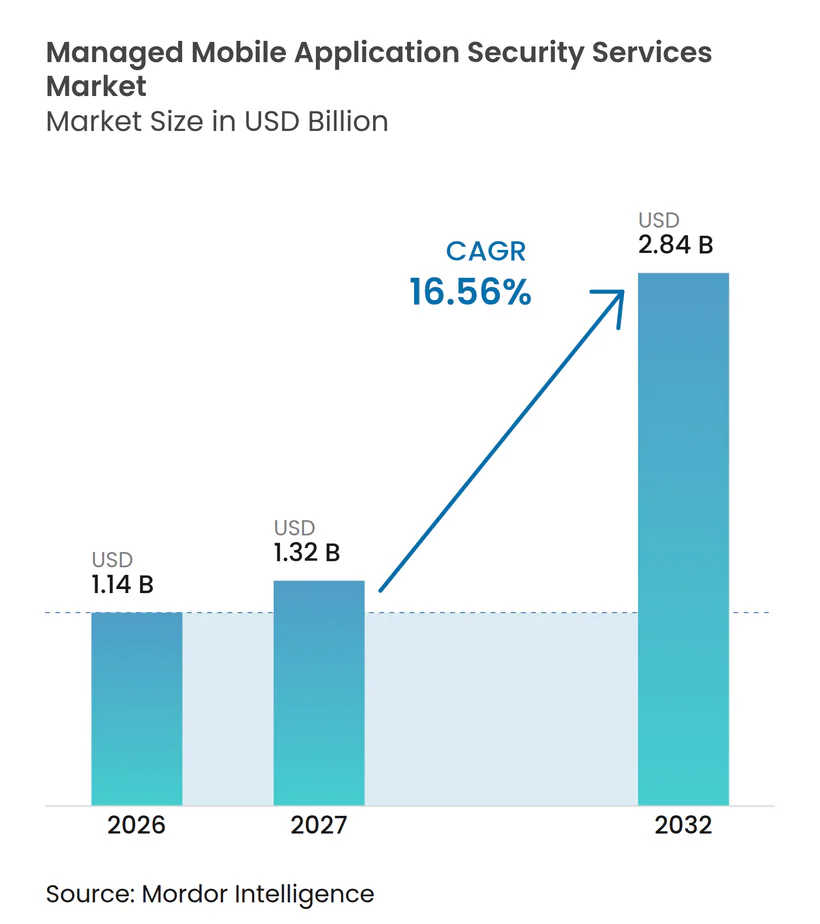
The Managed Mobile Application Security Services Market size is valued at USD 1.14 billion in 2026 and is forecast to reach USD 2.84 billion by 2032, growing at a CAGR of 16.56% from 2027 to 2032. The managed mobile application security services market is expanding as enterprises treat mobile applications as a core business channel rather than an extension of their websites or desktop systems. Threat activity, fraud exposure, and continuous compliance needs are making periodic testing less suitable for organizations that operate customer-facing mobile applications. Providers are responding by combining testing, runtime protection, fraud controls, and security operations telemetry within managed contracts. The market also benefits from demand for delivery models that let security teams retain policy control while drawing on external expertise. Integration with older identity, data, and security systems remains a practical constraint, particularly for organizations with limited internal security resources.
Key Report Takeaways
- By security function, Mobile Application Security Testing held 34.67% of the managed mobile application security services market share in 2026, while Mobile Fraud, Bot, and Account-Takeover Protection is projected to expand at a 17.43% CAGR through 2032.
- By enterprise size, large enterprises held 65.83% of the market share in 2026, while small and medium enterprises are projected to expand at a 17.32% CAGR through 2032.
- By service delivery model, Fully Managed Services held 42.37% of the market share in 2026, while the Managed Platform model is projected to expand at a 17.63% CAGR through 2032.
- By deployment model, cloud-based deployment held 64.27% of the market share in 2026, while hybrid deployment is projected to expand at a 17.23% CAGR through 2032.
- By end-user industry, BFSI held 27.43% of the market share in 2026, while healthcare is projected to expand at a 17.36% CAGR through 2032.
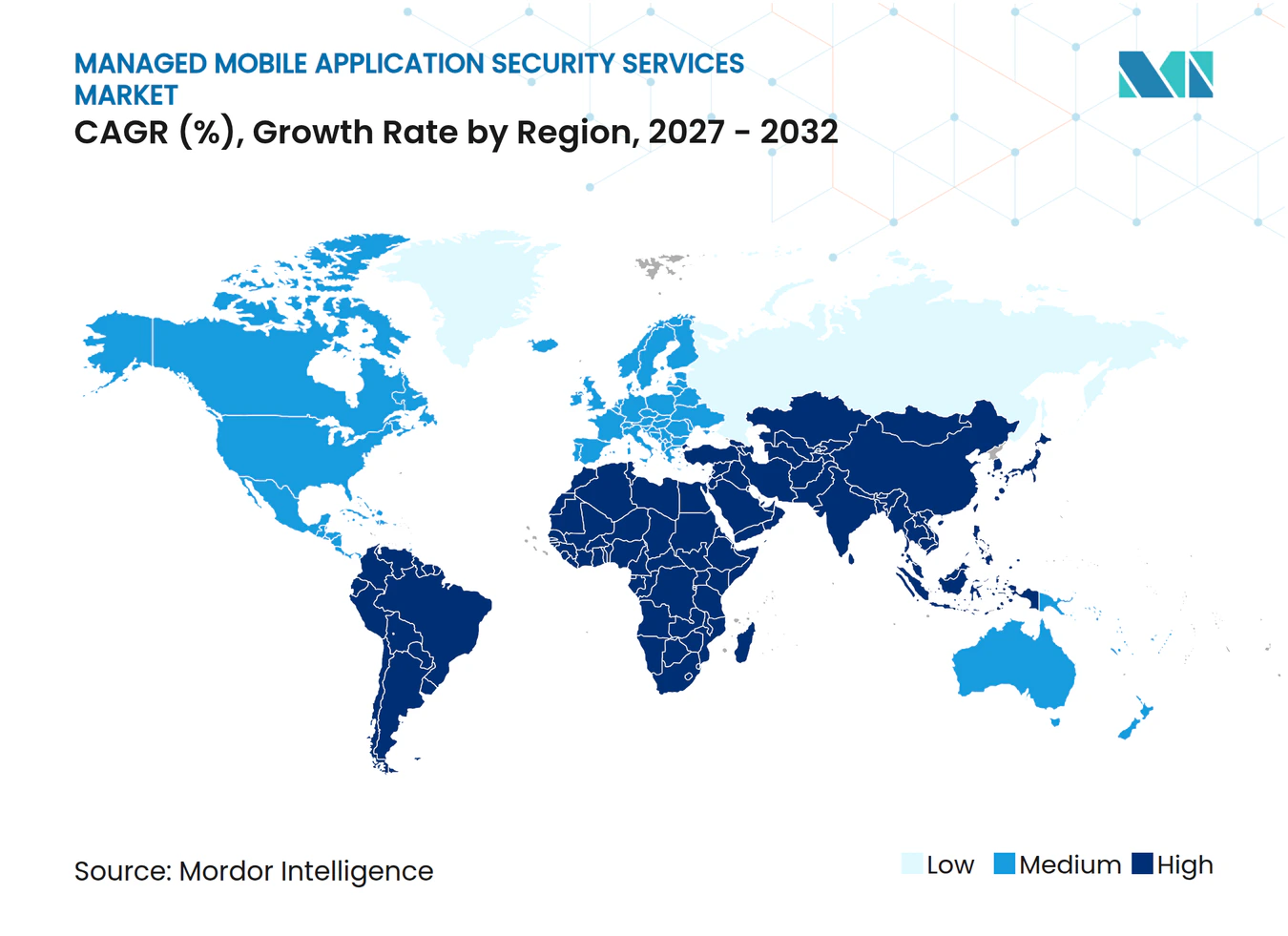
- By geography, North America held 40.17% of the market share in 2026, while Asia-Pacific is projected to expand at a 17.58% CAGR through 2032.
Note: Market numbers in this report are based on Mordor Intelligence's proprietary estimation framework, which combines nine months of actuals with Q4 projections for base year 2026.
Market Trends and Insights
Drivers Impact Analysis of Managed Mobile Application Security Services Market*
| Driver | (~) % Impact on CAGR Forecast | Geographic Relevance | Impact Timeline |
|---|---|---|---|
| Escalating Mobile Cyber-Threats and Fraud | +4.8% | Global | Short term (≤ 2 years) |
| BYOD and Remote-Work Proliferation | +3.5% | Global, strongest in North America and Europe | Medium term (2-4 years) |
| Tightening Privacy and Sector Compliance Mandates | +2.9% | North America, EU, Asia-Pacific core | Medium term (2-4 years) |
| Zero-Trust Integration for Mobile Endpoints | +2.4% | North America and EU, spillover to Asia-Pacific | Medium term (2-4 years) |
| Mobile Risk Telemetry Blind Spots in Existing SOCs | +1.9% | Global | Short term (≤ 2 years) |
| AI-Generated Mobile Code Expanding Security Workloads | +1.6% | Global | Long term (≥ 4 years) |
| Source: Mordor Intelligence | |||
Escalating Mobile Cyber-Threats and Fraud
The managed mobile application security services market is responding to a broader and more persistent mobile attack surface. Guardsquare reported that 72% of surveyed organizations experienced at least 1 mobile application security incident during the prior year, while 65% reported customer churn after an incident. Kaspersky recorded 14,059,465 attacks on mobile devices in 2025 and noted a several-fold increase in mobile banking Trojan packages.[1] The report identified India, Turkey, and Brazil as areas with concentrated banking Trojan activity. Digital.ai reported that 87% of monitored applications were attacked in 2026, up from 55% in 2022, as artificial intelligence lowered the cost of reverse engineering and exploit generation. These conditions support demand for managed services that provide persistent monitoring, testing, and response rather than a single assessment.
BYOD and Remote-Work Proliferation
Personal-device use is now embedded in many work environments, which increases the value of application-layer security controls. Mobile device management can manage enrolled devices, but it does not remove risks from phishing delivered through consumer messaging applications. Lookout found that mobile device management did not materially reduce phishing encounter rates on widely used messaging platforms. This limitation makes managed application protection relevant alongside device management and unified endpoint management investments. NIST guidance for enterprise mobile device security provides a control baseline for organizations that manage both organization-owned and personally owned devices. The managed mobile application security services market can therefore address a gap between device administration and protection of the business application itself. This supports providers that can protect applications without requiring extensive device enrollment or creating avoidable user friction.
Tightening Privacy and Sector Compliance Mandates
Regulation is shifting mobile protection from a technical preference to a documented operational requirement. The European Commission states that the Cyber Resilience Act requires manufacturers to actively report vulnerabilities that have been exploited and severe incidents through defined channels once the applicable reporting requirements take effect. China’s financial regulator issued mobile application management requirements for banking and insurance institutions in 2025, including security reinforcement, encrypted data transmission, and periodic risk assessments. The New York Department of Financial Services amended Part 500 requirements, also raising expectations for vulnerability management and malicious-code protections. These overlapping requirements favor managed providers that can supply repeatable evidence, vulnerability workflows, and compliance reporting. The managed mobile application security services market benefits when application publishers seek controls that can be demonstrated to regulators, auditors, and enterprise customers.
Zero-Trust Integration for Mobile Endpoints
Zero-trust programs increasingly extend to the mobile endpoint, where device posture and application integrity affect access decisions. CrowdStrike made its Falcon Zero Trust Assessment available for iOS and Android in May 2025, adding real-time trust evaluation for mobile endpoints to its platform. NIST describes continuous verification as a central feature of zero-trust architecture. Mobile controls can assess code integrity, device posture, and session behavior, which complements network-focused controls that address lateral movement. Zscaler introduced Zscaler Cellular in 2026 to apply zero-trust policy enforcement through mobile network connectivity. The managed mobile application security services market gains from this broader security architecture because enterprises need tools and operational expertise that connect mobile signals with identity and access policies. Providers with established integrations can reduce the effort required to move from a zero-trust plan to a daily operating practice.
Restraints Impact Analysis of Managed Mobile Application Security Services Market*
| Restraint | (~) % Impact on CAGR Forecast | Geographic Relevance | Impact Timeline |
|---|---|---|---|
| Integration Complexity with Legacy IT Stacks | -2.2% | Global | Short term (≤ 2 years) |
| Budget Constraints for Mid-Sized Enterprises | -1.7% | Global, strongest in South America and Africa | Medium term (2-4 years) |
| Cross-Tenant Data Isolation and Data-Sovereignty Requirements | -1.3% | EU, Asia-Pacific | Medium term (2-4 years) |
| Mobile Risk-Scoring Explainability and User-Trust Friction | -0.8% | Global | Long term (≥ 4 years) |
| Source: Mordor Intelligence | |||
Integration Complexity with Legacy IT Stacks
Legacy architectures can delay the deployment of managed mobile security services. Older identity systems, security information and event management platforms, and application interfaces may not provide the telemetry or authentication flows required for continuous mobile risk verification. A 2025 study of zero-trust assessment practices identified legacy compatibility as a leading deployment challenge. Organizations may need interface changes, middleware, or authentication modernization before a provider can deliver meaningful detection coverage. This work can extend approval and deployment cycles, particularly where the mobile application is tied to older backend systems. Providers that offer tested connectors for common identity, device management, and security operations platforms can reduce this source of friction. The managed mobile application security services market, therefore, rewards interoperability as much as the depth of an individual security feature.
Budget Constraints for Mid-Sized Enterprises
Mid-sized organizations often recognize mobile risk but have limited capacity to add specialized tools and staff at the same time. CrowdStrike reported that 36% of small and medium-sized businesses were investing in new security tools, while 93% acknowledged cyber risk. Verizon found that 57% of small and medium-sized businesses considered themselves at a resource disadvantage when responding to mobile security attacks. These organizations may defer purchases, reduce service scope, or rely on general endpoint protection rather than adopting mobile-specific coverage. For the managed mobile application security services market, clear service tiers and transparent per-user pricing can make adoption more feasible for buyers that lack dedicated mobile security teams. This restraint is most visible where budget cycles are short, and security spending must compete with direct operational priorities.
*Our forecasts treat driver/restraint impacts as directional, not additive. The impact forecasts reflect baseline growth, mix effects, and variable interactions.
Managed Mobile Application Security Services Market Segment Analysis
By Security Function:
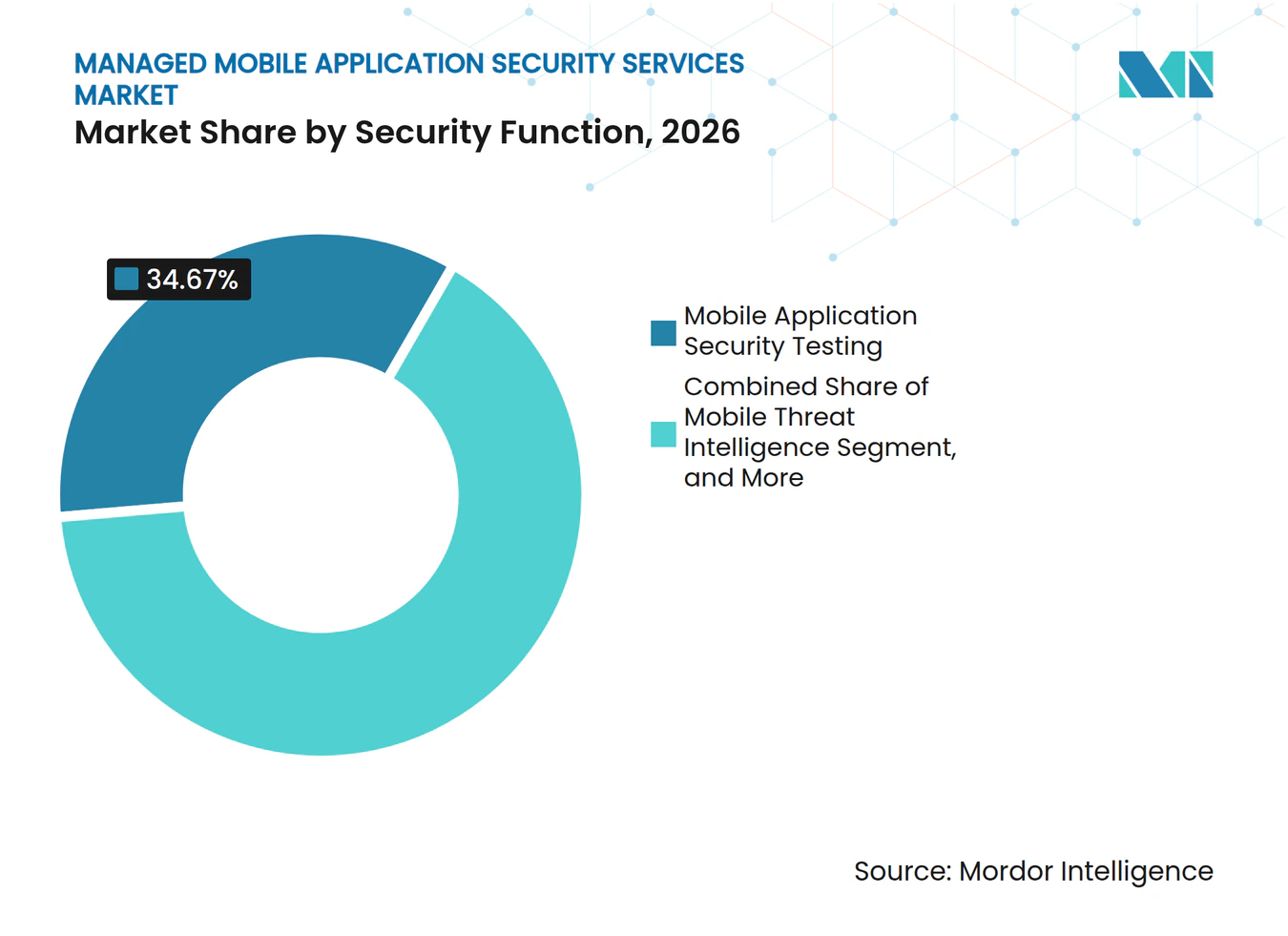
Testing Anchors Share While Fraud Defense AcceleratesMobile Application Security Testing held 34.67% of the managed mobile application security services market share in 2026. It remains a common starting point because organizations need to identify weaknesses before prioritizing remediation or runtime controls. The Open Worldwide Application Security Project (OWASP) Mobile Application Security Verification Standard provides a recognized reference for evaluating application controls.
Mobile Fraud, Bot, and Account-Takeover Protection is projected to grow at a 17.43% CAGR through 2032. TransUnion reported that account takeover fraud increased 21% globally from the first half of 2024 to the first half of 2025. Application shielding and runtime application self-protection address manipulation after release. An IEEE study found that up to 73.6% of iOS applications used fewer than half of the recommended hardening techniques.



By Enterprise Size:
Large Enterprises Lead While SMEs Grow FasterLarge enterprises held 65.83% of the managed mobile application security services market share in 2026. Their position reflects larger application portfolios, complex regulatory obligations, and significant brand exposure. These organizations need links with identity systems, security operations workflows, and audit reporting. Guardsquare found that 96% of surveyed organizations with multilayered mobile protection reported fewer security incidents.
Small and medium enterprises are projected to grow at a 17.32% CAGR through 2032. Managed delivery gives these buyers access to expertise they may not be able to recruit and retain. Verizon found that 54% of small and medium-sized businesses believed they had more to lose from a mobile-related breach in relative terms than larger organizations. Quick deployment, limited administration, and clear pricing remain central buying considerations.
By Service Delivery Model:
Fully Managed Services Lead While Platforms Gain GroundFully Managed Services held 42.37% of the market share in 2026. In the managed mobile application security services market, this model appeals to regulated buyers who want a third party to operate mobile detection, response, and compliance reporting. It can support active oversight without a separate internal mobile security operations center. The model also suits organizations that need support outside standard business hours.
The Managed Platform model is projected to grow at a 17.63% CAGR through 2032. It gives security teams policy control, audit trails, and external expertise. Appdome introduced MobileBOT Defense with identity-first API protection in April 2026 through a no-code workflow. Buyers can select fully managed, co-managed, or platform-based service delivery models based on their internal skills and governance needs.
By Deployment Model:
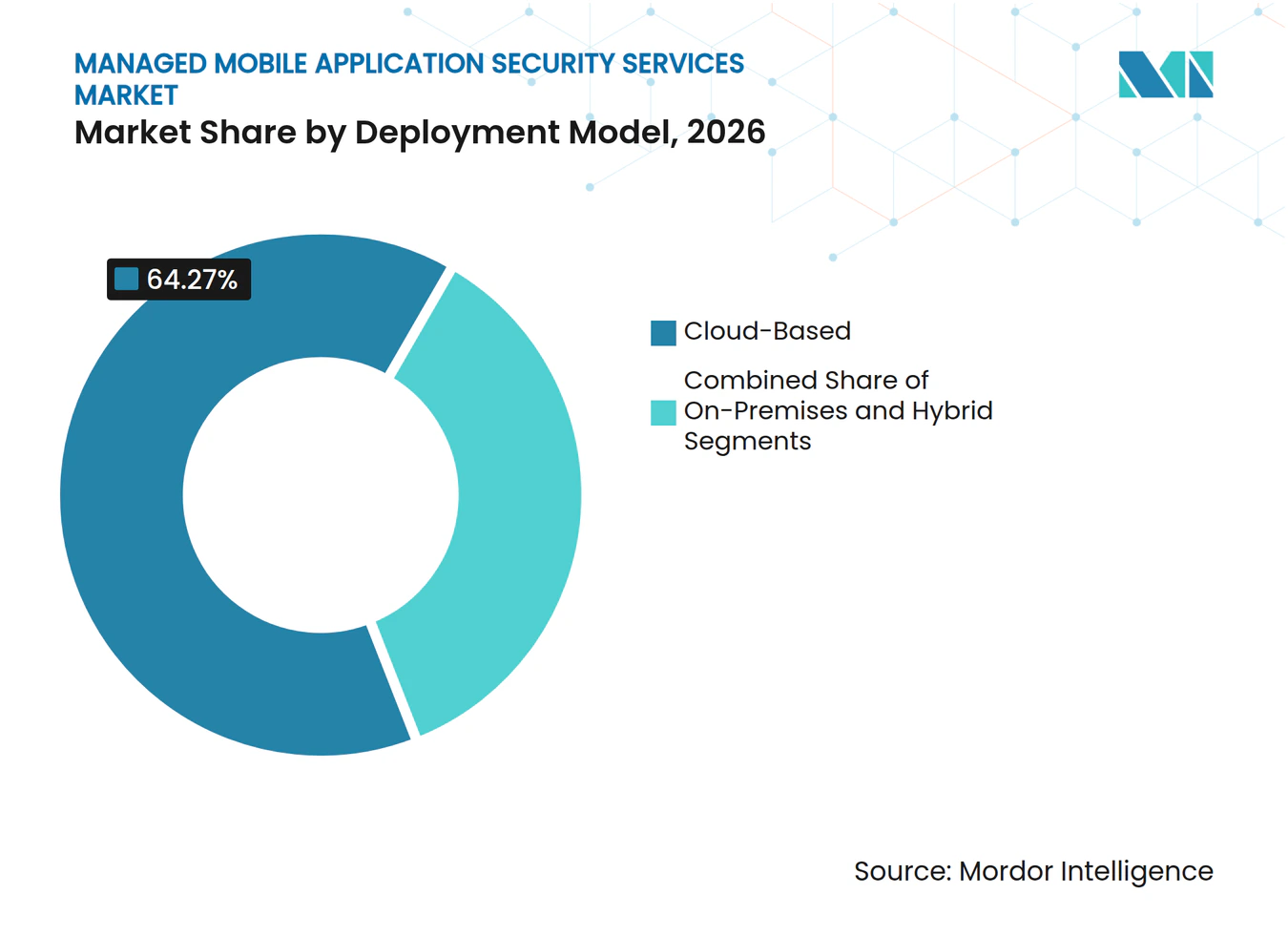
Cloud Leads While Hybrid Addresses Control NeedsCloud-based deployment held 64.27% of the managed mobile application security services market share in 2026. It supports real-time threat intelligence, centralized policy management, and rapid updates for dispersed device populations. It also supports scalable, self-service policy and audit functions. These capabilities explain why cloud remains the leading architecture for deploying managed mobile application security services.
Hybrid deployment is projected to grow at a 17.23% CAGR through 2032. It suits customers who want cloud intelligence but require local enforcement or controlled telemetry storage. The European Commission describes the Cyber Resilience Act (CRA) as a framework for safer digital products. Hybrid capability is gaining substantial traction in various government, defense, critical infrastructure, and regulated financial services.

By End-User Industry:
BFSI Leads While Healthcare Expands QuicklyBFSI held 27.43% market share in the managed mobile application security services market in 2026. Mobile banking, payment, and financial services applications manage valuable accounts and transactions. BioCatch reported an 11% year-over-year increase in fraud originating from mobile channels among United Kingdom banks in 2025.[2] Compliance needs make providers with fraud controls and reporting capabilities attractive.
Healthcare is projected to grow at a 17.36% CAGR through 2032. In the managed mobile application security services market, hospitals and digital health providers are expanding patient monitoring, telehealth, and access to health records through mobile applications. The U.S. Department of Health and Human Services stated that the HIPAA Security Rule requires safeguards for electronic protected health information. Government and defense customers may favor hybrid or on-premises deployments due to classified and sensitive application requirements.
Geography Analysis
North America held 40.17% of the managed mobile application security services market share in 2026. The region has a large concentration of regulated financial institutions, healthcare systems, government bodies, and defense contractors. The United States contributes the largest share of demand through federal guidance and sector-specific oversight. The Cybersecurity and Infrastructure Security Agency operates the Continuous Diagnostics and Mitigation program for federal civilian agencies. T-Mobile and Palo Alto Networks launched a managed SASE 5G offering in May 2025.
Europe is the second-largest regional market. Germany, the United Kingdom, and France form the core demand base. The European Commission identifies the Cyber Resilience Act as a framework for secure products with digital elements. Germany’s BSI Technical Guideline TR-03174 sets requirements for mobile applications in financial services. Pradeo and 7P Group announced a European sovereign mobile security partnership in April 2026.[3]
Asia-Pacific is projected to grow at a 17.58% CAGR through 2032. Mobile-first banking, payments, and enterprise access expand the need for application protection. Zimperium signed 12 banking institutions in Asia-Pacific during fiscal year 2025 and reported 67% year-over-year growth in regional mobile banking Trojans. South America, the Middle East, and Africa offer a developing demand base as mobile banking and digital government expand.
Competitive Landscape
Market Concentration
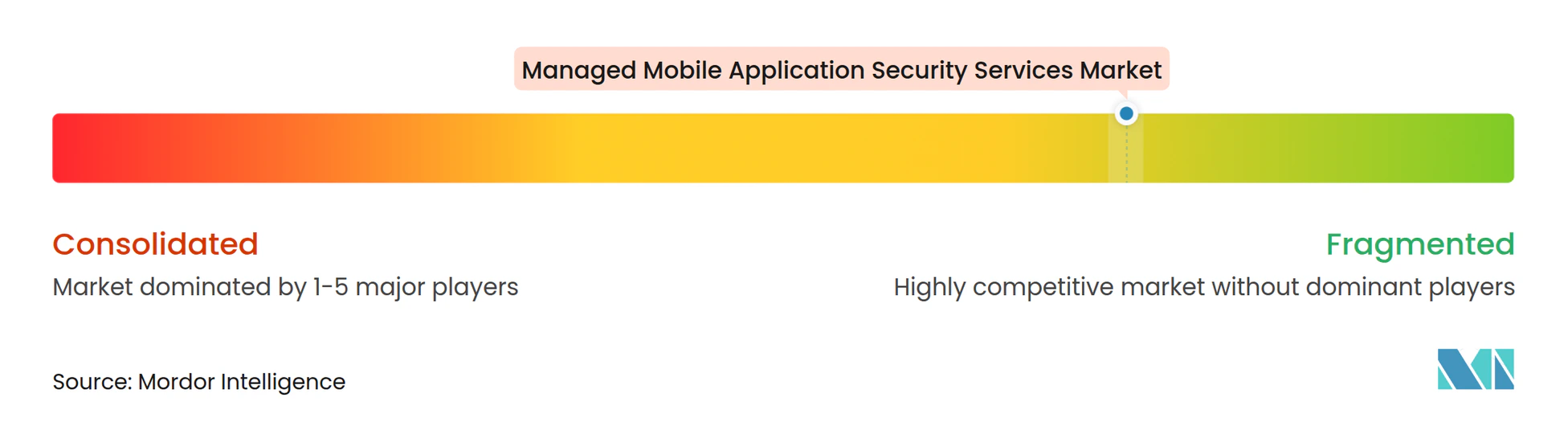
The managed mobile application security services market includes specialized vendors and broad cybersecurity platforms, with no single dominant supplier. Zimperium, Lookout, Appdome, NowSecure, Pradeo, Promon, and Appknox compete on mobile-focused capabilities. Palo Alto Networks, CrowdStrike, Microsoft, and IBM offer mobile security within larger enterprise portfolios. OneSpan completed its acquisition of Build38 in March 2026, expanding its runtime application protection and shielding capabilities. Lookout sold its cloud security business to Fortra in May 2025 to focus on mobile endpoint security.
Competition increasingly depends on connecting mobile threat data with broader security operations. NowSecure launched its Agentic AI Data Partner Program in March 2026, making risk intelligence from more than 4 million assessments available to security platforms. Zimperium integrated mobile threat telemetry with Sekoia’s security operations platform in October 2026.[4] These moves address the problem of mobile events being isolated from other investigations. OWASP Mobile Application Security Verification Standard alignment gives buyers a recognized basis for evaluating controls.
Mid-market platforms and mobile telemetry integration remain important opportunities. Mid-sized organizations need low operational overhead, while large clients need integration and audit-ready reporting. Compliance needs can favor suppliers with regional data-handling options and established delivery processes. Appdome’s no-code identity-first mobile API protection, introduced in April 2026, illustrates the focus on accessible deployment.
Managed Mobile Application Security Services Industry Leaders
-
IBM Corporation
-
Microsoft Corporation
-
Accenture plc
-
Zimperium, Inc
-
Lookout, Inc.
- *Disclaimer: Major Players sorted in no particular order
Managed Mobile Application Security Services Market Companies Covered in this Report
- Accenture plc
- Appdome Inc.
- Check Point Software Technologies Ltd.
- Cisco Systems, Inc.
- CrowdStrike Holdings, Inc.
- Guardsquare NV
- IBM Corporation
- Ivanti, Inc.
- Lookout, Inc.
- Microsoft Corporation
- NowSecure, Inc.
- OneSpan Inc.
- Palo Alto Networks, Inc.
- Pradeo SAS
- Promon AS
- Rapid7, Inc.
- Synopsys, Inc.
- Veracode, Inc.
- Zimperium, Inc.
- Appknox Pte. Ltd.
Recent Industry Developments in Managed Mobile Application Security Services Market
- October 2026: Zimperium and Sekoia announced a product integration combining Zimperium's AI-empowered Mobile Threat Defense with Sekoia's autonomous SOC platform, enabling security operations teams to investigate mobile threat telemetry alongside broader enterprise attack signals. The integration directly addresses the structural gap between mobile threat detection and enterprise security operations, representing a material step toward unified mobile-plus-SOC managed security delivery.
- September 2026: The EU Cyber Resilience Act Article 14 reporting obligations came into force, requiring manufacturers of products with digital elements, including mobile applications, to notify ENISA and national CSIRTs of actively exploited vulnerabilities within 24 hours. This regulatory milestone materially broadens the addressable market for managed mobile application security services across all EU member states.
- September 2026: ookout integrated Android Enterprise Device Trust APIs into its Mobile AI Security Platform, receiving hardware- and OS-level patch telemetry directly from Google to power its Mobile Software Exposure Center. The integration closes a persistent visibility gap in enterprise mobile exposure management and strengthens Lookout's position as a SOC telemetry provider for Android fleets.
- August 2026: Appdome announced Live Update, a capability enabling organizations to modify security, anti-fraud, and bot-defense policies in live published mobile applications without a new build or app-store resubmission. This capability reduces the response latency gap between active attack campaigns and policy adjustment, which has been a structural disadvantage of traditional SDK-based mobile protection.
Global Managed Mobile Application Security Services Market Report Scope
The Managed Mobile Application Security Services Market comprises security services that enable organizations to assess, protect, monitor, and maintain the security of mobile applications across their development and operational lifecycles. These services cover mobile application security testing, application shielding, runtime application self-protection (RASP), mobile threat intelligence and monitoring, mobile fraud and bot protection, account-takeover prevention, and secure mobile DevSecOps and compliance support. Managed service providers deliver application vulnerability assessment, runtime threat detection, security policy management, continuous monitoring, and remediation support to protect mobile applications, application data, user sessions, and transactions across enterprise environments.
The Managed Mobile Application Security Services Market Report is Segmented by Security Function (Mobile Application Security Testing, Application Shielding and Runtime Application Self-Protection, Mobile Threat Intelligence and Monitoring, Mobile Fraud, Bot, and Account-Takeover Protection, and Secure Mobile DevSecOps and Compliance Support), Enterprise Size (Large Enterprises, and Small and Medium Enterprises), Service Delivery Model (Fully Managed Services, Co-Managed Services, and Managed Platform), Deployment Model (On-Premises, Cloud-Based, and Hybrid), End-User Industry (Information Technology and Telecommunications, BFSI, Healthcare, Retail and E-Commerce, Manufacturing, Government and Defense, and Other End-User Industries), and Geography (North America, South America, Europe, Asia-Pacific, Middle East, and Africa). The Market Forecasts are Provided in Terms of Value (USD).
Segmentation Overview
| Mobile Application Security Testing |
| Application Shielding and Runtime Application Self-Protection |
| Mobile Threat Intelligence and Monitoring |
| Mobile Fraud, Bot, and Account-Takeover Protection |
| Secure Mobile DevSecOps and Compliance Support |
| Large Enterprises |
| Small and Medium Enterprises |
| Fully Managed Services |
| Co-Managed Services |
| Managed Platform |
| On-Premises |
| Cloud-Based |
| Hybrid |
| Information Technology and Telecommunications |
| BFSI |
| Healthcare |
| Retail and E-Commerce |
| Manufacturing |
| Government and Defense |
| Other End-User Industries |
| North America | United States |
| Canada | |
| Mexico | |
| South America | Brazil |
| Argentina | |
| Rest of South America | |
| Europe | Germany |
| United Kingdom | |
| France | |
| Italy | |
| Spain | |
| Russia | |
| Rest of Europe | |
| Asia-Pacific | China |
| India | |
| Japan | |
| South Korea | |
| Australia | |
| Rest of Asia-Pacific | |
| Middle East | Saudi Arabia |
| United Arab Emirates | |
| Turkey | |
| Rest of Middle East | |
| Africa | South Africa |
| Egypt | |
| Nigeria | |
| Rest of Africa |
| By Security Function | Mobile Application Security Testing | |
| Application Shielding and Runtime Application Self-Protection | ||
| Mobile Threat Intelligence and Monitoring | ||
| Mobile Fraud, Bot, and Account-Takeover Protection | ||
| Secure Mobile DevSecOps and Compliance Support | ||
| By Enterprise Size | Large Enterprises | |
| Small and Medium Enterprises | ||
| By Service Delivery Model | Fully Managed Services | |
| Co-Managed Services | ||
| Managed Platform | ||
| By Deployment Model | On-Premises | |
| Cloud-Based | ||
| Hybrid | ||
| By End-User Industry | Information Technology and Telecommunications | |
| BFSI | ||
| Healthcare | ||
| Retail and E-Commerce | ||
| Manufacturing | ||
| Government and Defense | ||
| Other End-User Industries | ||
| By Geography | North America | United States |
| Canada | ||
| Mexico | ||
| South America | Brazil | |
| Argentina | ||
| Rest of South America | ||
| Europe | Germany | |
| United Kingdom | ||
| France | ||
| Italy | ||
| Spain | ||
| Russia | ||
| Rest of Europe | ||
| Asia-Pacific | China | |
| India | ||
| Japan | ||
| South Korea | ||
| Australia | ||
| Rest of Asia-Pacific | ||
| Middle East | Saudi Arabia | |
| United Arab Emirates | ||
| Turkey | ||
| Rest of Middle East | ||
| Africa | South Africa | |
| Egypt | ||
| Nigeria | ||
| Rest of Africa | ||
Key Questions Answered in the Report
What is the managed mobile application security services market size?
The managed mobile application security services market is valued at USD 1.14 billion in 2026 and is forecast to reach USD 2.84 billion by 2032, at a 16.56% CAGR from 2027 to 2032.
What is driving demand for managed mobile application security services?
Persistent mobile attacks, fraud exposure, compliance requirements, and security operations visibility gaps are encouraging organizations to adopt managed protection.
Which service delivery model leads managed mobile application security services?
Fully Managed Services leads with a 42.37% share in 2026, while the Managed Platform model is forecast to grow fastest at a 17.63% CAGR through 2032.
Which end-user sector has the largest demand for managed mobile application security services?
BFSI leads with a 27.43% share in 2026 because mobile banking and payment applications face direct fraud, account takeover, and compliance risks.
Which region is growing fastest for managed mobile application security services?
Asia-Pacific is projected to grow at a 17.58% CAGR through 2032, supported by mobile-first banking, payments, and business services.
Why do organizations choose hybrid deployment for mobile application security?
Hybrid deployment lets organizations use cloud threat intelligence while keeping selected policy enforcement or sensitive telemetry in private environments.