
Managed Identity Governance Services Market Size and Share
Market Overview
| Study Period | 2021 - 2032 |
|---|---|
| Market Size (2027) | USD 2.79 Billion |
| Market Size (2032) | USD 5.34 Billion |
| Growth Rate (2027 - 2032) | 13.86 % |
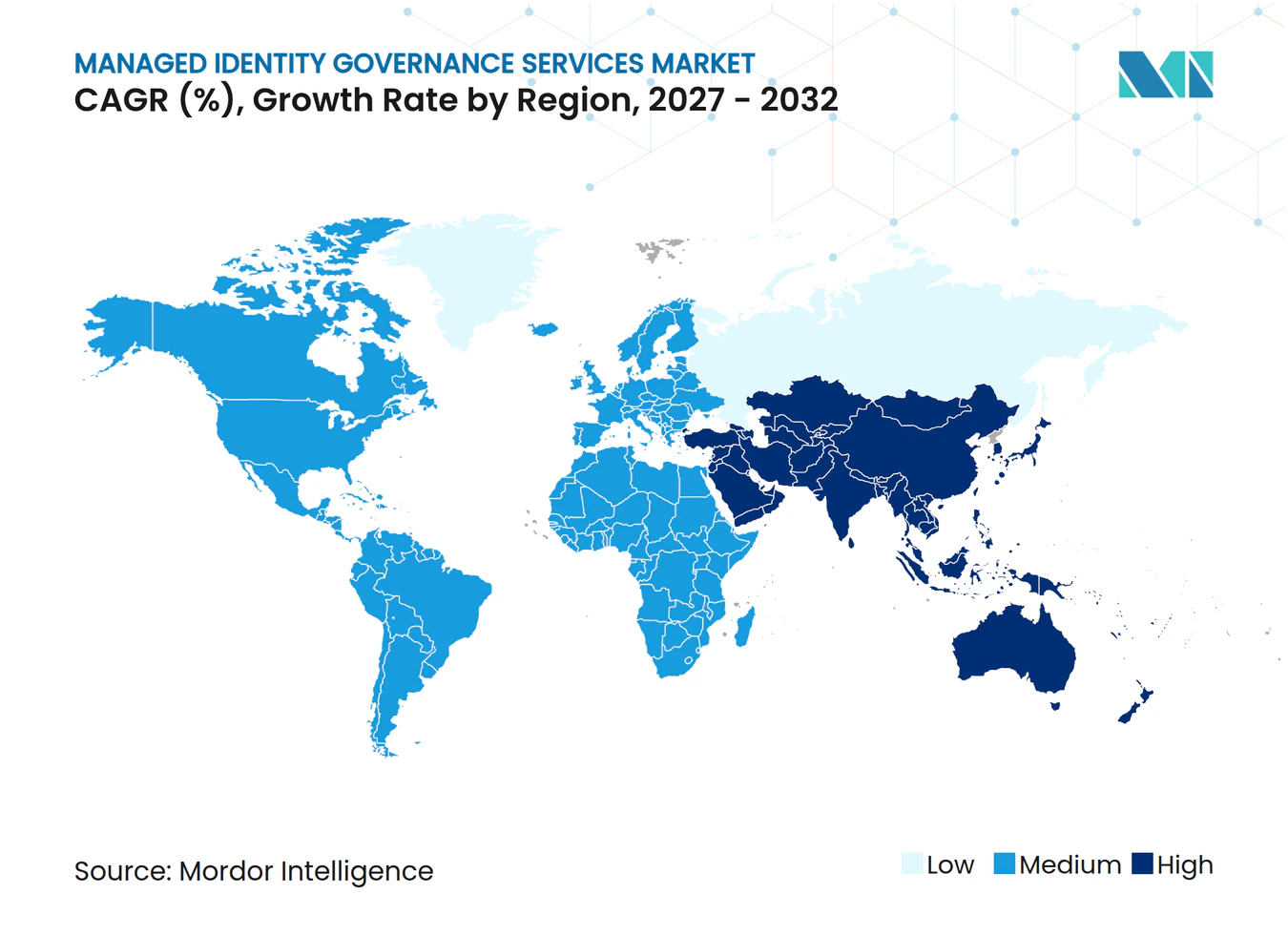
| Fastest Growing Market | Asia-Pacific |
| Largest Market | North America |
| Market Concentration | Medium |
Major Players *Disclaimer: Major Players sorted in no particular order Image © Mordor Intelligence. Reuse requires attribution under CC BY 4.0. | |
Managed Identity Governance Services Market Analysis by Mordor Intelligence
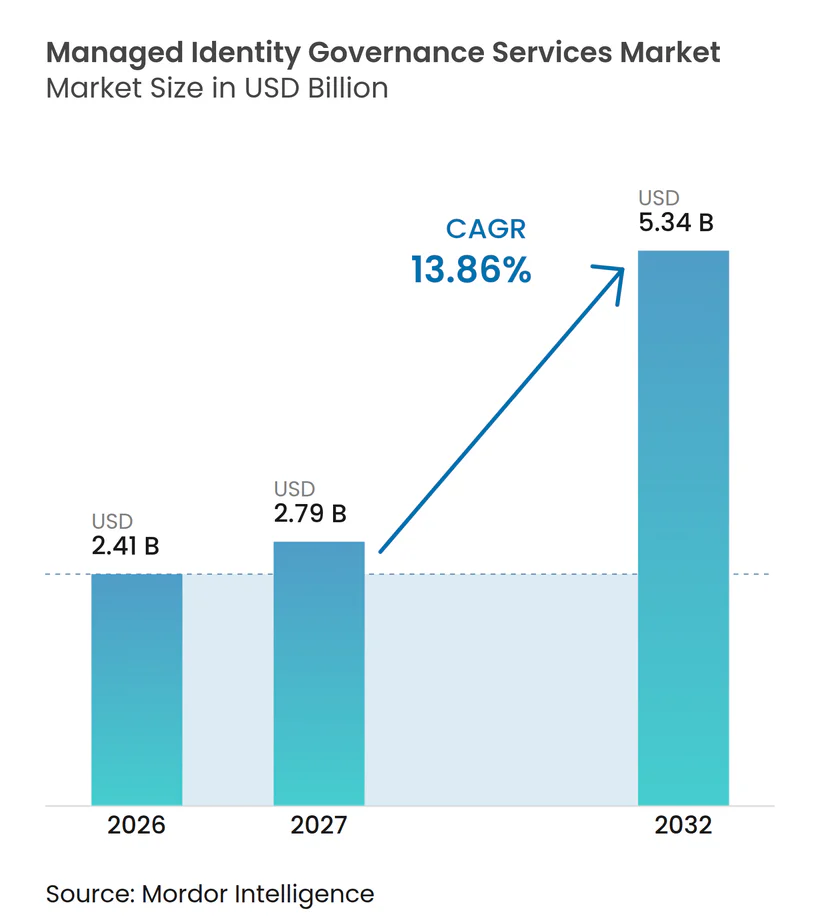
The managed identity governance services market size is projected to expand from USD 2.41 billion in 2026 and USD 2.79 billion in 2027 to USD 5.34 billion by 2032, registering a CAGR of 13.86% between 2027 and 2032. The managed identity governance services market is benefiting as organizations move responsibility for provisioning, access reviews, segregation-of-duties controls, and privileged access governance to specialist providers. Buyers are shifting from isolated access-certification tools to ongoing services that span the identity lifecycle and provide evidence for audits. Cloud-native delivery provides the technical foundation for this change by enabling more centralized operations and reusable connections across client environments. The managed identity governance services market also has a new opportunity in machine and AI-agent identities, where access changes faster than scheduled human review processes can keep pace with. Competition is moving toward broader platform coverage, AI-specific governance capabilities, and delivery models that reduce reliance on scarce internal identity specialists.
Key Report Takeaways
- By service scope, Managed Identity Lifecycle and Provisioning held 25.31% revenue share in 2026, while Managed Non-Human and AI-Agent Identity Governance is projected to expand at a 14.86% CAGR through 2032 in the managed identity governance services market.
- By deployment type, cloud-native managed services accounted for 60.99% revenue share in 2026 and are projected to expand at a 14.44% CAGR through 2032.
- By organization size, large enterprises held an 82.37% revenue share in the managed identity governance services market in 2026, while small and medium enterprises are projected to expand at a 14.27% CAGR through 2032.
- By service delivery model, fully managed operations held 55.19% revenue share in 2026 and are projected to expand at a 14.46% CAGR through 2032.
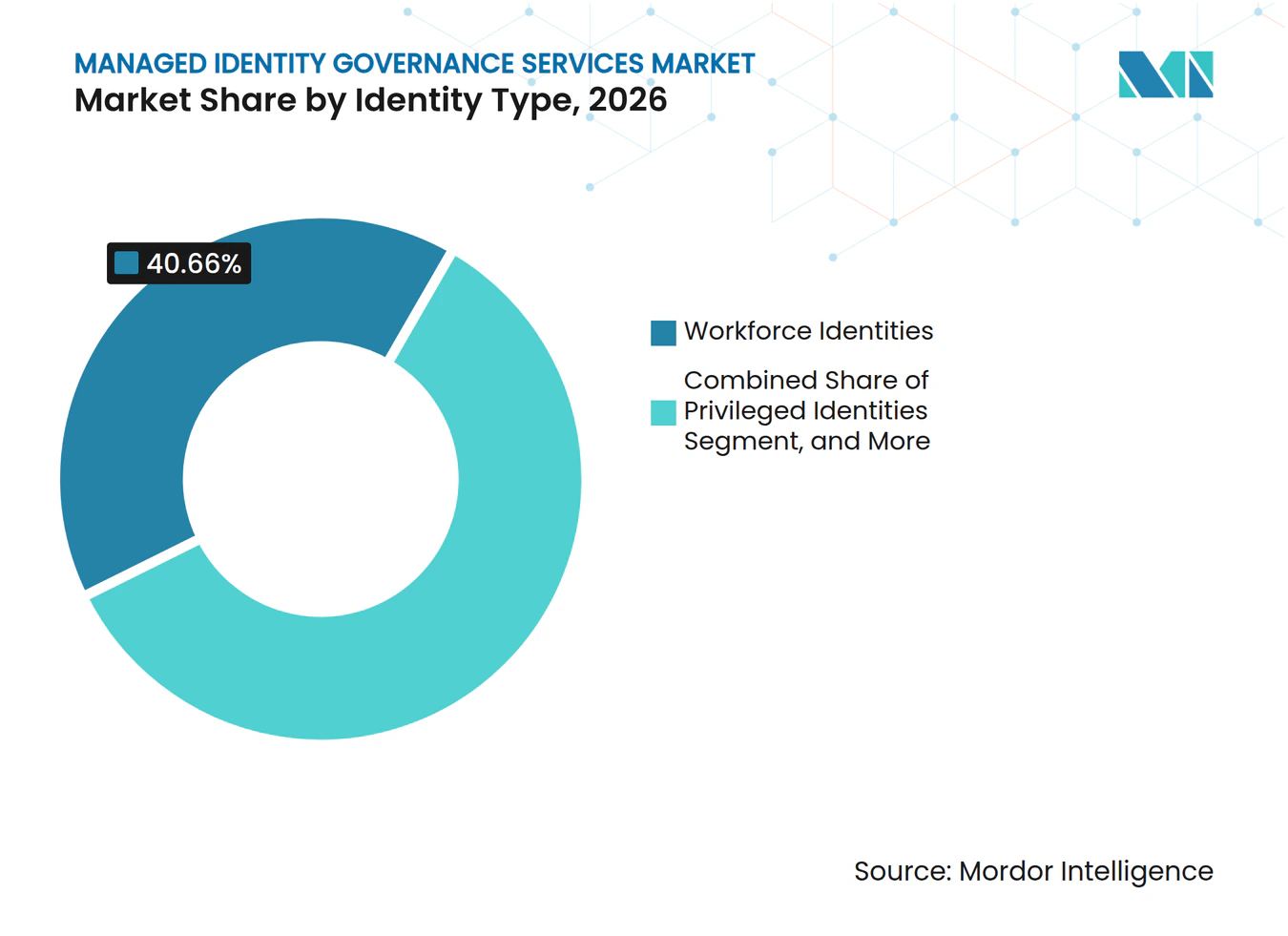
- By identity type, workforce identities held 40.66% revenue share in 2026, while AI-Agent Identities are projected to expand at a 14.83% CAGR through 2032.
- By industry vertical, BFSI held 24.27% revenue share in 2026, while Healthcare and Life Sciences are projected to expand at a 15.46% CAGR through 2032 in the managed identity governance services market
- By geography, North America held 48.96% revenue share in 2026, while Asia-Pacific is projected to expand at a 14.82% CAGR through 2032.
Note: Market numbers in this report are based on Mordor Intelligence's proprietary estimation framework, which combines nine months of actuals with Q4 projections for base year 2026.
Market Trends and Insights
Drivers Impact Analysis of Managed Identity Governance Services Market*
| Driver | (~) % Impact on CAGR Forecast | Geographic Relevance | Impact Timeline |
|---|---|---|---|
| Regulatory Enforcement of Periodic Access Reviews and Least-Privilege Controls | +3.2% | Global, with concentrated effect in Europe, North America, and Asia-Pacific core | Short term (≤ 2 years) |
| Expansion of Hybrid and Multi-Cloud Identity Estates | +2.8% | Global, with intensity in North America, Europe, and Asia-Pacific | Medium term (2-4 years) |
| Shortage of Skilled Identity Governance Engineers | +2.4% | Global, with acute pressure in North America and Western Europe | Short term (≤ 2 years) |
| Increasing Governance of Non-Human and AI-Agent Identities | +2.1% | Global, with early adoption intensity in North America and Europe | Medium term (2-4 years) |
| Zero-Trust and Passwordless Programs Increasing Access-Governance Workloads | +1.6% | North America and Europe, expanding to Asia-Pacific | Medium term (2-4 years) |
| Continuous Compliance Evidence Requirements | +1.2% | North America, Europe, and Australia | Long term (≥ 4 years) |
| Source: Mordor Intelligence | |||
Regulatory Enforcement of Periodic Access Reviews and Least-Privilege Controls
The managed identity governance services market is supported by regulations that require enterprises to demonstrate how access is approved, reviewed, and revoked. The Digital Operational Resilience Act became binding on European Union financial entities on January 17, 2025, and requires that access rights follow the need-to-know, least-privilege, and segregation-of-duties principles.[1] Germany's NIS2 implementation expanded the scope of compliance for covered organizations and reinforced the requirement for structured identity controls. PCI DSS 4.0 and CMMC 2.0 place similar pressure, with access controls and audit trails as contractual or regulatory obligations. Managed providers can turn those recurring tasks into standard service procedures, reducing the operational burden for organizations with multiple compliance programs. The managed identity governance services market, therefore, benefits when compliance teams need evidence of continuous operation rather than written policies alone.
Expansion of Hybrid and Multi-Cloud Identity Estates
The managed identity governance services market is benefiting from identity estates spanning public cloud platforms, private infrastructure, legacy directories, and enterprise applications. A user change can require updates across several systems, while roles and entitlement models often vary between environments. This creates work that depends on federation, connector management, and cross-domain entitlement mapping rather than simple user administration. ManageEngine reported that 49% of respondents identified governance gaps, and 48% identified compliance pressure as the leading identity investment priority in 2026. Providers can spread the cost of maintaining connectors across multiple customers, whereas a single enterprise would need to cover that maintenance internally. The managed identity governance services market gains from this operating model because the identity estate becomes harder to manage as more systems are added.
Shortage of Skilled Identity Governance Engineers
The shortage of skilled identity governance engineers strengthens the case for outsourced operations in the managed identity governance services market. SANS found that 60% of surveyed organizations viewed the skills gap as their leading workforce challenge in 2026, compared with 40% that cited headcount shortages. The finding shows that employers need specialized capability, not only additional personnel. ISC2 also reported that 95% of respondents' organizations had at least 1 cybersecurity skill need, and 59% described the deficiency as critical or significant. A service provider can supply a team with experience across provisioning, access certification, and privileged access processes under a recurring contract. This model limits the disruption that follows long hiring cycles, salary pressure, and turnover among scarce specialists.
Increasing Governance of Non-Human and AI-Agent Identities
The managed identity governance services market is expanding into non-human and AI-agent identity governance as enterprises automate more work. Cloud Security Alliance research states that non-human identities outnumber human users by an average of 45 to 1, and the ratio can reach 144 to 1 in cloud-native environments. These identities use credentials, service accounts, tokens, and workload permissions that may not have an assigned owner or a regular review cycle. AI agents pose an additional challenge because they can request delegated access and complete tasks faster than a reviewer can inspect the access path. Saviynt introduced Identity Security for AI in March 2026 to cover discovery, lifecycle governance, and runtime controls for AI agents. Managed providers can add discovery, credential rotation, and runtime authorization as specialist services rather than asking each customer to build these capabilities internally.
Restraints Impact Analysis of Managed Identity Governance Services Market*
| Restraint | (~) % Impact on CAGR Forecast | Geographic Relevance | Impact Timeline |
|---|---|---|---|
| Brownfield Connector and Data-Quality Complexity | -1.2% | Global, with highest complexity in large enterprise environments across North America and Europe | Medium term (2-4 years) |
| Fragmented Data-Residency and Cross-Border Processing Rules | -0.9% | Europe, Asia-Pacific, and Middle East, with cross-border implications in multinational deployments | Long term (≥ 4 years) |
| Slow Payback from Legacy Role Remediation | -0.7% | Global, with particular friction in legacy-heavy sectors in North America and Europe | Medium term (2-4 years) |
| Concentration of Identity Expertise in Scarce Specialists | -0.5% | Global, with most acute shortage in North America | Short term (≤ 2 years) |
| Source: Mordor Intelligence | |||
Brownfield Connector and Data-Quality Complexity
The managed identity governance services market faces slower onboarding, where customers operate older applications and fragmented authoritative data. Large enterprises can have ERP systems, proprietary mainframes, and older directories that lack standard interfaces for identity lifecycle automation. Each application may need a tailored connector before provisioning or access review can proceed safely. Data quality is equally important because incomplete HR records or inconsistent role taxonomies can cause automated rules to fail. The Cloud Security Alliance notes that non-human identity programs often begin with missing ownership information, which limits lifecycle control from the outset. These constraints can lengthen implementation timelines, delay customer value realization, and reduce the operating leverage providers expect from repeatable service delivery.
Fragmented Data-Residency and Cross-Border Processing Rules
Data residency requirements can limit the adoption of a standardized delivery model in the managed identity governance services market. Identity data includes personal attributes, entitlements, access logs, and records that support audit activity. GDPR rules on international transfers, national localization requirements, and sector-specific sovereignty obligations can determine where those records are processed.[2] Omada announced Omada Identity Sovereign in June 2026 as a containerized option for regulated organizations using customer-controlled infrastructure. Separate regional deployments can raise delivery costs and limit the reuse of centralized analytics. Providers must also maintain documentation and controls that demonstrate compliant cross-border processing for multinational customers.
*Our forecasts treat driver/restraint impacts as directional, not additive. The impact forecasts reflect baseline growth, mix effects, and variable interactions.
Managed Identity Governance Services Market Segment Analysis
By Service Scope:
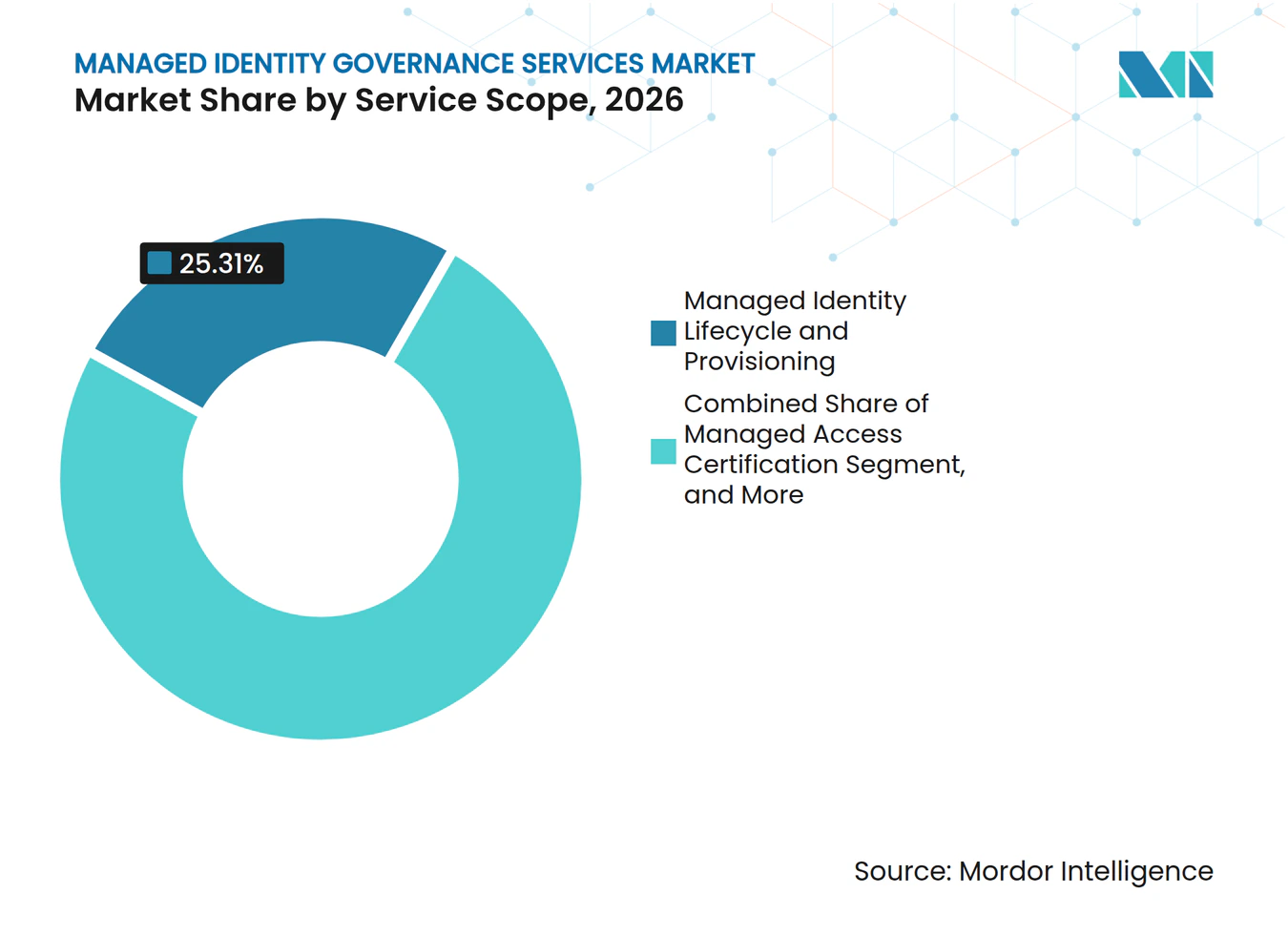
AI-Agent Governance Reshapes the Service Revenue MixManaged Identity Lifecycle and Provisioning held 25.31% of the managed identity governance services market share in 2026. The category remains the operating foundation because it automates joiner-mover-leaver workflows across complex HR-to-IT chains. Managed Access Certification and Recertification, and Managed Identity Governance and Administration support continuous compliance, evidence, and policy administration. Managed Privileged and Segregation-of-Duties Governance addresses sensitive permissions that audit bodies examine most closely, particularly in financial services. These established service lines support recurring contracts because user roles, applications, and business processes are continually evolving.
Managed Non-Human and AI-Agent Identity Governance is projected to expand at a 14.86% CAGR through 2032. It addresses machine identities, service accounts, workloads, and agents whose permissions sit outside standard employee identity processes. Saviynt launched Zuma in July 2026 to discover and govern AI agents, large language models, AI applications, and other non-human identities. The need for discovery, ownership attribution, lifecycle control, and runtime evaluation can separate this work from human identity operations. The managed identity governance services market is likely to see providers distinguish these services through specialized controls, tools, and delivery expertise.



By Deployment Type:
Cloud-Native Infrastructure Anchors Managed Service EconomicsCloud-native managed services accounted for 60.99% of the deployment segment in 2026. The model benefits from centralized monitoring, API-based integration, multi-tenant operations, and lower-cost service updates where target systems have available connectors. Hybrid services remain important where customers use cloud applications but retain on-premises ERP systems or legacy directories. Customer-hosted and on-premises delivery serves users in defense, government, and financial infrastructure with tighter data control requirements. Cloud-native managed services are projected to expand at a 14.44% CAGR through 2032.
Private cloud approaches sit between shared cloud delivery and traditional on-premises operation. Omada launched Identity Cloud Private in May 2026 for regulated enterprises and government organizations that require a customer-controlled Azure tenant. This design preserves cloud functions while allowing customers to retain control over the identity data plane. Better cloud emulation of established connectors can lower the switching barrier for mid-market customers with older infrastructure. The managed identity governance services market will retain several deployment models even as cloud-native delivery leads overall demand.
By Organization Size:
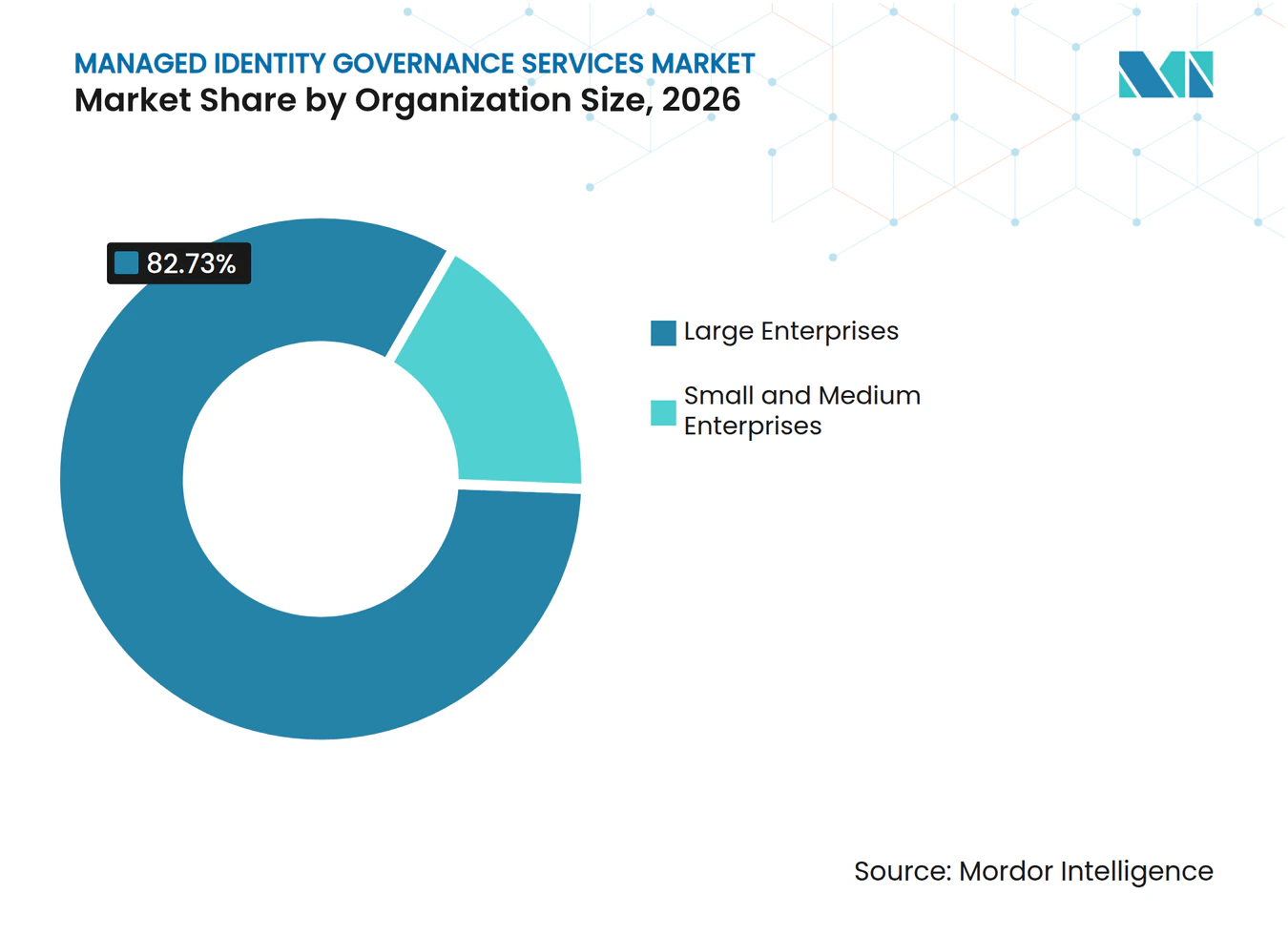
Large Enterprise Dominance Masks Significant SME RunwayLarge enterprises held 82.37% of revenue in 2026. These organizations manage more users, applications, suppliers, and regulated workflows, resulting in higher contract values and a broader service scope. Their identity environments often require coordinated controls across complex HR-to-IT processes and several business systems. Historic delivery periods of 12 to 24 months limited adoption by smaller organizations. Large enterprises will remain the core customers for broad, multi-region identity governance programs.
Small and medium enterprises are projected to expand at a 14.27% CAGR through 2032. NIS2 applies to entities with as few as 50 employees in covered sectors, and the Cloud Security Alliance's 2025 guidance recommends managed security service providers where internal capability is limited. Omada released a Docker-based Cloud Application Gateway in April 2026, bringing average new-customer onboarding to under 30 minutes. Faster deployment lets smaller buyers use external specialist capability without carrying a full internal identity team. The managed identity governance services market can therefore extend below the historic 1,000-employee buyer threshold.

By Service Delivery Model:
Full Outsourcing Consolidates DemandFully managed operations held 55.19% of the service delivery segment in 2026. This model transfers recurring access certification, provisioning, entitlement review, and privileged access work to the provider. It appeals when internal teams cannot consistently perform those activities, although buyers retain policy and oversight responsibilities. Co-managed operations suit organizations that want ownership of internal governance, while Managed Platform and Advisory Services support customers that require configuration and optimization. Fully managed operations are projected to expand at a 14.46% CAGR through 2032.
Fully managed delivery can give providers clearer revenue visibility and more predictable service volumes. That position can support investment in automation for recurring review campaigns and lifecycle requests. Co-managed and advisory services remain relevant where program design, policy knowledge, and business judgment are central. The managed identity governance services industry benefits from both models, but fully managed delivery has the larger current revenue base. The managed identity governance services market can expand where buyers view external operations as a way to limit staffing and execution risk.
By Identity Type:
AI-Agent Identities Emerge as the Defining Growth CategoryWorkforce identities held 40.66% of the identity type segment in 2026. They remain the largest category because enterprises have long invested in employee onboarding, role changes, termination workflows, role-based access control, and certification. External workforce, third-party, privileged, and machine identities require different ownership and review processes because they operate outside standard employee records or pose higher access risks. Containers, APIs, and microservices are increasing the inventory of service accounts, keys, and workload identities. The managed identity governance services market needs delivery models that can apply suitable controls across all these populations.
AI-Agent Identities are projected to expand at a 14.83% CAGR through 2032. Agents can request access, form delegated permission chains, and complete high-impact workflows before a human reviewer sees the activity. The Cloud Security Alliance identifies non-human identity governance as a major gap, and OWASP published the Non-Human Identities Top 10 in January 2025 as a risk reference. SailPoint made its Agentic Fabric generally available in August 2026 as part of its unified Identity Security offering. The category creates a distinct service opportunity because governance must operate at machine speed.
By Industry Vertical:
Healthcare Urgency Accelerates Fastest Among Regulated SectorsBFSI held 24.27% of revenue in 2026. Financial institutions manage identity-sensitive obligations under DORA, PCI DSS 4.0, SOX, and national supervisory rules, supporting demand for certification, privileged access, and segregation-of-duties controls. Complex product systems, high-value transactions, and large third-party ecosystems increase the cost of weak access control. IT and Telecom, Government and Public Defense, Energy and Utilities, Manufacturing, Retail and E-Commerce, and Education also need broader identity control as their technology perimeters expand. The managed identity governance services market, therefore, serves a wide range of sectors with varying compliance and operational needs.
Healthcare and Life Sciences are projected to expand at a 15.46% CAGR through 2032. The US Department of Health and Human Services proposed stronger HIPAA Security Rule controls in January 2025, including multi-factor authentication and encryption for electronic protected health information. HIPAA already requires access controls, unique user identification, and audit controls under Section 164.312. Health systems must manage access for clinicians, contractors, and clinical technology users while producing evidence across operational and clinical systems. Providers can support lifecycle management and certification where internal IT teams face budget and staffing constraints.
Geography Analysis
North America Managed Identity Governance Services Market
North America accounted for 48.96% of the managed identity governance services market share in 2026. The United States has a dense population of enterprises in finance, healthcare, technology, and government that operate under NIST Cybersecurity Framework 2.0 guidance, SEC disclosure rules, and state privacy requirements.[3] Canada has active financial and public-sector buyers, while Mexico is seeing demand growth driven by digital banking and nearshoring manufacturing. SailPoint's March 2026 collaboration with AWS made Machine Identity Security and Agent Identity Security available through AWS Marketplace, placing procurement within established cloud channels. The managed identity governance services market benefits from buyers being able to acquire governance capabilities alongside broader cloud services.
APAC Managed Identity Governance Services Market
Asia-Pacific is projected to expand at a 14.82% CAGR through 2032. The region combines expanding cloud adoption, evolving data protection rules, and a growing base of specialist managed service providers. Japan Business Systems launched an ID Managed Service for Microsoft Entra ID in July 2026, while Hitachi Solutions Create launched an ID Governance Management Solution in May 2026. India, China, South Korea, and Australia have different demand patterns shaped by national privacy rules and cloud-first infrastructure plans. The managed identity governance services market can expand as providers build local delivery capacity for regulated customers.
EMEA and South America Managed Identity Governance Services Market
Europe holds the second-largest regional share of the managed identity governance services market because DORA and NIS2 increase the need for demonstrable identity controls. Germany, the United Kingdom, and France are major country markets, and Omada's May 2026 Identity Cloud Private launch addressed the needs of sovereignty-aware deployments for regulated enterprises. South America is developing from a lower base, with Brazil's data-protection rules supporting early investment in finance and technology. The Middle East and Africa remain earlier in adoption, although Saudi Arabia, the UAE, South Africa, and Nigeria present demand through public-sector, financial services, and telecommunications activity.
Competitive Landscape
Market Concentration
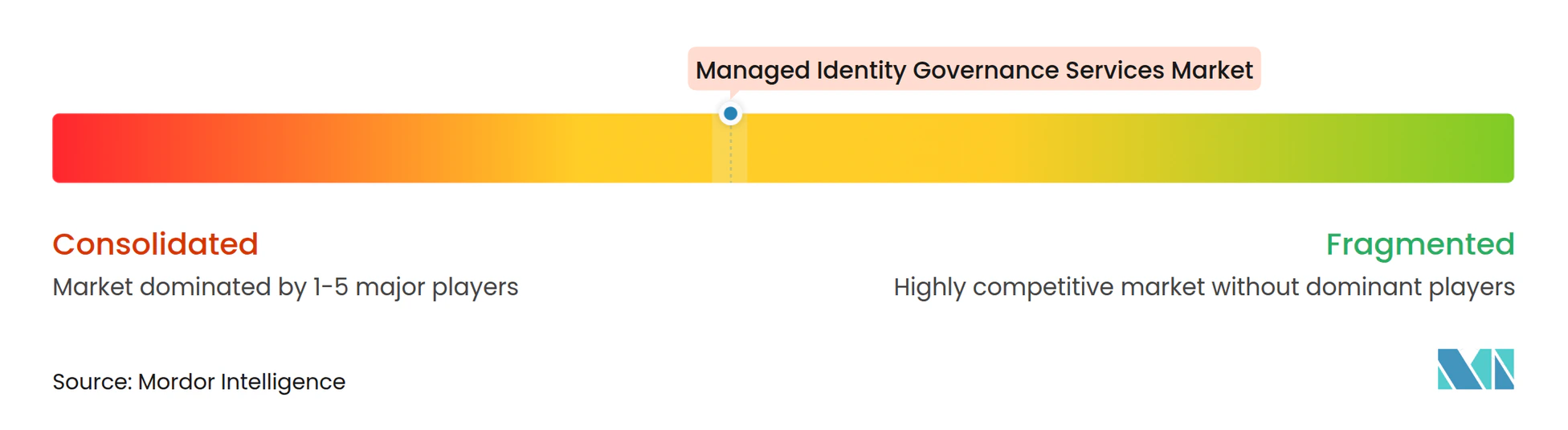
The managed identity governance services market is moderately concentrated at the upper end, where IGA vendors support channel ecosystems of systems integrators and regional service providers. SailPoint and Saviynt provide platforms that service partners configure and operate for enterprise customers. Large providers compete on global coverage, delivery capacity, technical partnerships, and support across multiple regulatory settings. The managed identity governance services market also presents an opportunity in AI-agent governance, as many enterprises have not established formal agent controls. ServiceNow completed its acquisition of Veza in March 2026, integrating Veza's identity security capabilities into its broader security and risk portfolio.[4]
Competition also comes from providers focused on rapid deployment and AI-native operating models. SailPoint introduced a unified Identity Security solution in August 2026, combining Agentic Fabric and Human Fabric for continuous identity discovery and governance. Saviynt launched an AI identity control platform in March 2026 to govern agents from discovery through runtime. Pathlock introduced Nexus in June 2026 for access, controls, identity, and application security across SAP, Oracle, Workday, and more than 150 applications. Competitive success depends on integration capability, delivery assurance, regulatory support, and control coverage.
Omada acquired EmpowerID in September 2026, adding runtime AI-agent governance capabilities to its portfolio. CrowdStrike launched Falcon Next-Gen Identity Security in August 2025 to protect human, non-human, and AI-agent identities across the hybrid identity lifecycle. These developments increase overlap between identity, cloud security, and security operations platforms. The managed identity governance services market remains open to specialist providers that can demonstrate credible delivery and sector knowledge.
Managed Identity Governance Services Industry Leaders
-
SailPoint, Inc.
-
Saviynt, Inc.
-
Omada A/S
-
One Identity LLC
-
RSA Security LLC
- *Disclaimer: Major Players sorted in no particular order
Managed Identity Governance Services Market Companies Covered in this Report
- SailPoint, Inc.
- Saviynt, Inc.
- Omada A/S
- One Identity LLC
- RSA Security LLC
- Radiant Logic, Inc.
- Pathlock, Inc.
- EmpowerID, Inc.
- Bravura Security, Inc.
- Fischer International Identity, LLC
- SecureAuth Corporation
- Simeio Solutions, LLC
- Clear Skye, Inc.
- Zilla Security, Inc.
- ConductorOne, Inc.
- Lumos, Inc.
- Zluri Technologies Private Limited
- Tools4ever B.V.
- Identity Automation, Inc.
- Veza Technologies, Inc.
- Apono, Inc.
Recent Industry Developments in Managed Identity Governance Services Market
- September 2026: Omada A/S acquired EmpowerID, a pioneer in AI agent governance. The acquisition brought EmpowerID's runtime agent governance capabilities into the Omada portfolio, strengthening Omada's ability to enforce security controls for human, non-human, and AI-agent identities across enterprise environments.
- August 2026: SailPoint unveiled its unified Identity Security solution, combining SailPoint Agentic Fabric, generally available, and SailPoint Human Fabric. The solution introduced continuous, real-time identity discovery and governance across human and non-human populations, with lightweight endpoint and browser sensors surfacing hidden AI agents, credentials, and Model Context Protocol servers, alongside a centralized kill switch for rogue agents. KPMG Canada was identified as an early alliance partner for the launch.
- July 2026: Saviynt launched Zuma, a platform for discovering and governing AI agents, large language models, AI applications, and other non-human identities. The announcement coincided with Saviynt reporting annual recurring revenue above USD 300 million, bookings growth above 80%, and 96% customer retention, a commercial scale signal for the AI identity governance service category.
- June 2026: Omada launched Omada Agent Governance, extending its identity governance fabric to AI agents and non-human identities in an environment-agnostic architecture. Separately, Lumos launched the Identity Agent Force, a suite of AI governance agents, including an Access Review Agent, an NHI Owner Hunter, and an Agent Ownership Finder, serving enterprise customers including Mars, Netskope, and GitHub.
Global Managed Identity Governance Services Market Report Scope
The Managed Identity Governance Services Market refers to the provision of outsourced services that help organizations manage, monitor, and govern digital identities and their access to enterprise systems, applications, data, and infrastructure. These services include identity governance and administration, access certification, identity lifecycle management and provisioning, privileged access governance, segregation-of-duties management, and governance of machine identities and AI agents. Managed identity governance services help organizations enforce access policies, automate identity-related processes, maintain regulatory compliance, reduce unauthorized access risks, and improve overall security.
The Managed Identity Governance Services Market Report is Segmented by Service Scope (Managed Identity Governance and Administration, Managed Access Certification, Managed Identity Lifecycle and Provisioning, Managed Privileged and Segregation-of-Duties Governance, and Managed Non-Human and AI-Agent Identity Governance), Deployment Model (Cloud-Native Managed Service, Hybrid Managed Service, and Customer-Hosted and On-Premises Managed Service), Organization Size (Large Enterprises and Small and Medium Enterprises), Service Delivery Model (Fully Managed Operations, Co-Managed Operations, and Managed Platform and Advisory Services), Identity Type (Workforce Identities, External Workforce and Third-Party Identities, Privileged Identities, Machine, Service, and Workload Identities, and AI-Agent Identities), Industry Vertical (BFSI, IT and Telecom, Healthcare and Life Sciences, Government and Public Defense, Energy and Utilities, Manufacturing, Retail and E-Commerce, and Education), and Geography (North America, South America, Europe, Asia-Pacific, Middle East, and Africa). The Market Forecasts are Provided in Terms of Value (USD).
Segmentation Overview
| Managed Identity Governance and Administration |
| Managed Access Certification |
| Managed Identity Lifecycle and Provisioning |
| Managed Privileged and Segregation-of-Duties Governance |
| Managed Non-Human and AI-Agent Identity Governance |
| Cloud-Native Managed Service |
| Hybrid Managed Service |
| Customer-Hosted and On-Premises Managed Service |
| Large Enterprises |
| Small and Medium Enterprises |
| Fully Managed Operations |
| Co-Managed Operations |
| Managed Platform and Advisory Services |
| Workforce Identities |
| External Workforce and Third-Party Identities |
| Privileged Identities |
| Machine, Service, and Workload Identities |
| AI-Agent Identities |
| BFSI |
| IT and Telecom |
| Healthcare and Life Sciences |
| Government and Public Defense |
| Energy and Utilities |
| Manufacturing |
| Retail and E-Commerce |
| Education |
| North America | United States |
| Canada | |
| Mexico | |
| South America | Brazil |
| Argentina | |
| Rest of South America | |
| Europe | United Kingdom |
| Germany | |
| France | |
| Italy | |
| Spain | |
| Rest of Europe | |
| Asia-Pacific | China |
| India | |
| Japan | |
| South Korea | |
| Australia | |
| Rest of Asia-Pacific | |
| Middle East | Saudi Arabia |
| United Arab Emirates | |
| Turkey | |
| Rest of Middle East | |
| Africa | South Africa |
| Nigeria | |
| Rest of Africa |
| By Service Scope | Managed Identity Governance and Administration | |
| Managed Access Certification | ||
| Managed Identity Lifecycle and Provisioning | ||
| Managed Privileged and Segregation-of-Duties Governance | ||
| Managed Non-Human and AI-Agent Identity Governance | ||
| By Deployment Model | Cloud-Native Managed Service | |
| Hybrid Managed Service | ||
| Customer-Hosted and On-Premises Managed Service | ||
| By Organization Size | Large Enterprises | |
| Small and Medium Enterprises | ||
| By Service Delivery Model | Fully Managed Operations | |
| Co-Managed Operations | ||
| Managed Platform and Advisory Services | ||
| By Identity Type | Workforce Identities | |
| External Workforce and Third-Party Identities | ||
| Privileged Identities | ||
| Machine, Service, and Workload Identities | ||
| AI-Agent Identities | ||
| By Industry Vertical | BFSI | |
| IT and Telecom | ||
| Healthcare and Life Sciences | ||
| Government and Public Defense | ||
| Energy and Utilities | ||
| Manufacturing | ||
| Retail and E-Commerce | ||
| Education | ||
| By Geography | North America | United States |
| Canada | ||
| Mexico | ||
| South America | Brazil | |
| Argentina | ||
| Rest of South America | ||
| Europe | United Kingdom | |
| Germany | ||
| France | ||
| Italy | ||
| Spain | ||
| Rest of Europe | ||
| Asia-Pacific | China | |
| India | ||
| Japan | ||
| South Korea | ||
| Australia | ||
| Rest of Asia-Pacific | ||
| Middle East | Saudi Arabia | |
| United Arab Emirates | ||
| Turkey | ||
| Rest of Middle East | ||
| Africa | South Africa | |
| Nigeria | ||
| Rest of Africa | ||
Key Questions Answered in the Report
What is the managed identity governance services market size?
The managed identity governance services market size is projected to expand from USD 2.41 billion in 2026 and USD 2.79 billion in 2027 to USD 5.34 billion by 2032, at a 13.86% CAGR.
What is driving adoption of managed identity governance services?
Regulatory access-control obligations, multi-cloud complexity, shortages of skilled identity staff, and rising non-human identity volumes are supporting adoption.
Which service category is expanding fastest?
Managed Non-Human and AI-Agent Identity Governance is projected to expand at a 14.86% CAGR through 2032.
Which deployment model leads managed identity governance services?
Cloud-native managed services led with 60.99% revenue share in 2026 and are projected to expand at a 14.44% CAGR through 2032.
Which end-user vertical has the fastest projected expansion?
Healthcare and Life Sciences is projected to expand at a 15.46% CAGR through 2032 as health organizations face greater access-control and evidence requirements.
Which region is expanding fastest for managed identity governance services?
Asia-Pacific is projected to expand at a 14.82% CAGR through 2032, supported by cloud adoption and changing data-protection requirements.