
Managed Email Security Services Market Size and Share
Market Overview
| Study Period | 2021 - 2032 |
|---|---|
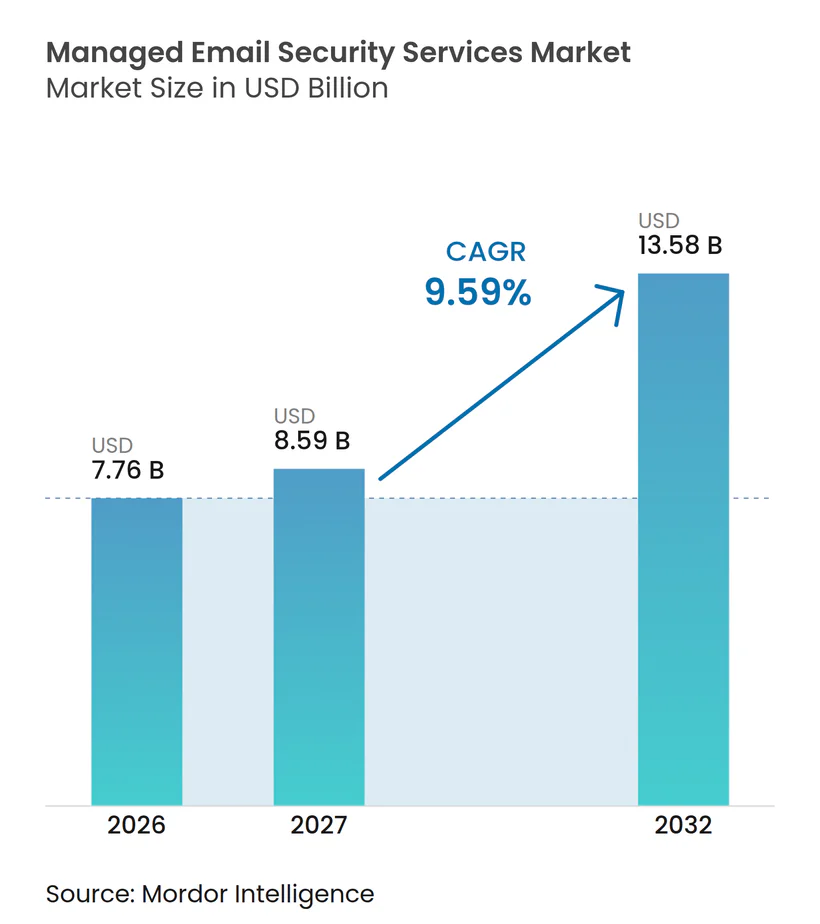
| Market Size (2027) | USD 8.59 Billion |
| Market Size (2032) | USD 13.58 Billion |
| Growth Rate (2027 - 2032) | 9.59 % |
| Fastest Growing Market | Asia-Pacific |
| Largest Market | North America |
| Market Concentration | Medium |
Major Players *Disclaimer: Major Players sorted in no particular order Image © Mordor Intelligence. Reuse requires attribution under CC BY 4.0. | |
Managed Email Security Services Market Analysis by Mordor Intelligence
The managed email security services market size is USD 7.76 billion in 2026 and is forecast to reach USD 13.58 billion by 2032, growing at a CAGR of 9.59% from 2027 to 2032. The managed email security services market is moving from gateway-focused protection toward continuous monitoring, detection, and response delivered by specialist providers. Email threats remain a central driver because phishing, business email compromise, and ransomware can create material financial and operational losses. Cloud productivity platforms have also expanded the scope of protection because organizations need coverage across email and collaboration tools. Providers that combine policy management, automated remediation, and audit-ready reporting are positioned to serve regulated customers and smaller organizations that cannot build dedicated teams. Consolidation and AI-focused product launches are increasing the value placed on broad platforms and scalable managed delivery.
Key Report Takeaways
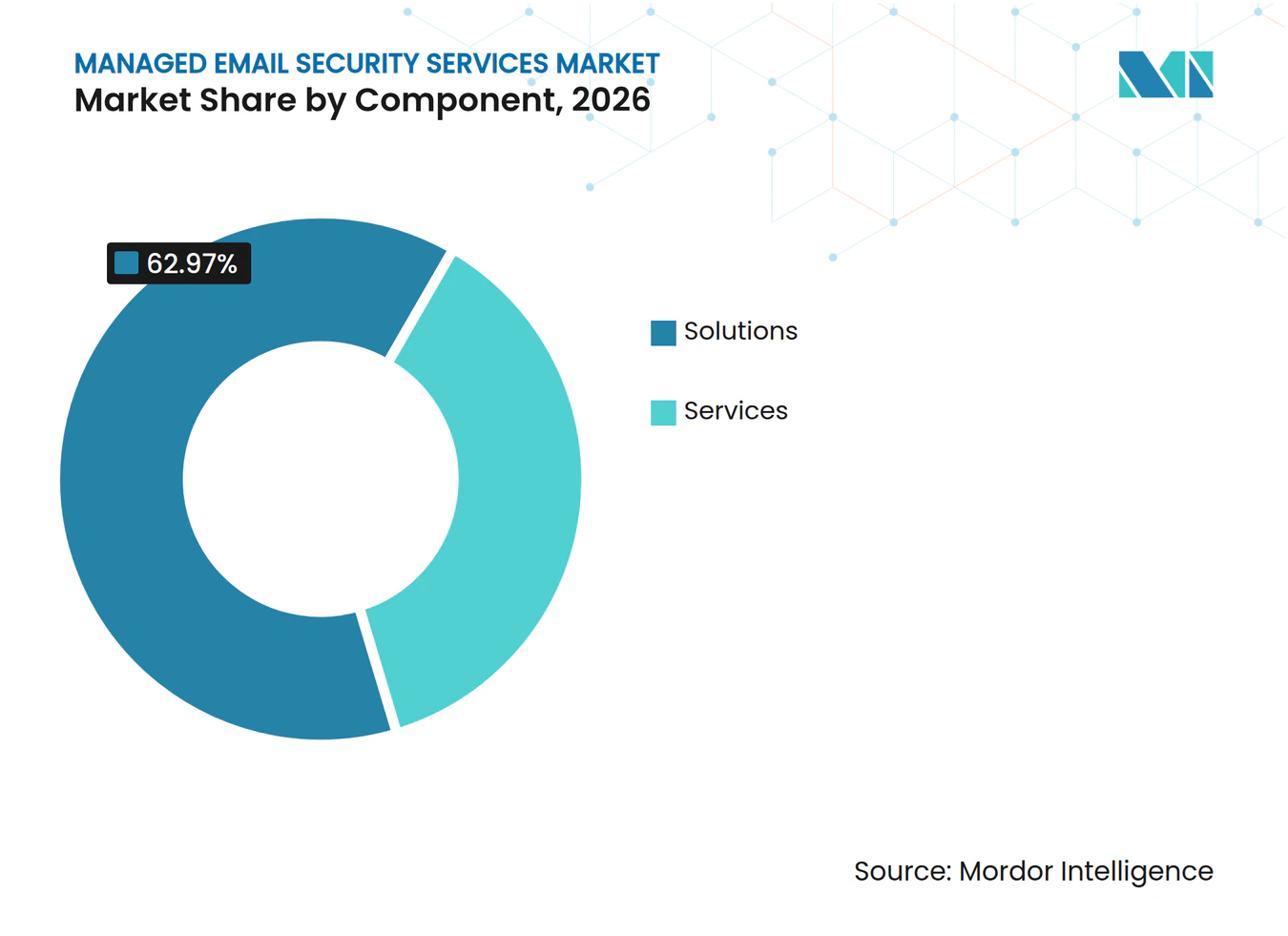
- By component, solutions held 62.97% of the managed email security services market in 2026, while services are projected to expand at a CAGR of 10.86% through 2032.
- By service type, Policy Enforcement and Optimization held 24.93% of revenue in 2026, while Security Awareness and Phishing Resilience is projected to expand at a CAGR of 10.63% through 2032.
- By deployment mode, cloud-based deployment held 71.37% of revenue in 2026 and is projected to expand at a CAGR of 10.59% through 2032.
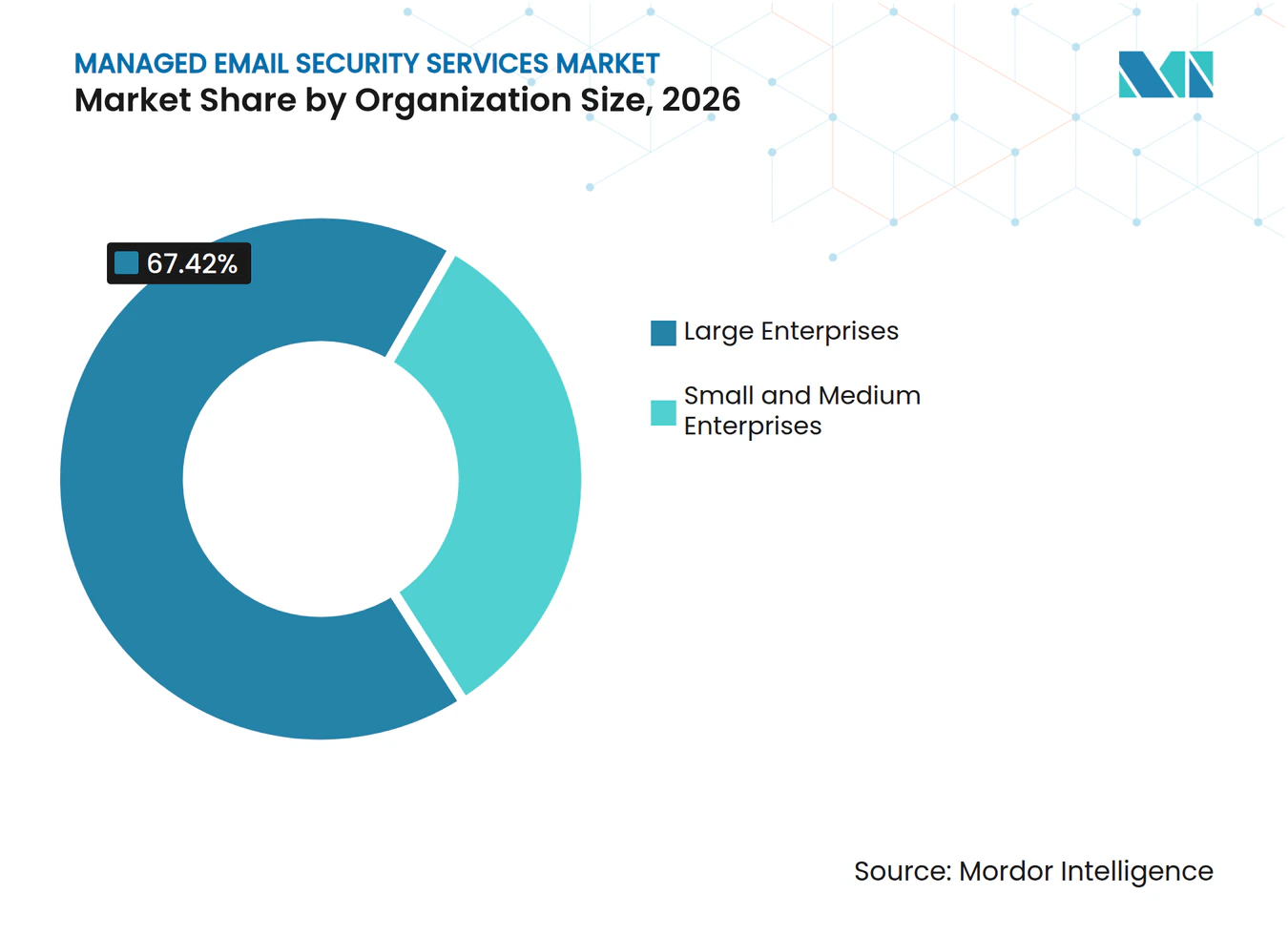
- By organization size, large enterprises held 67.42% of revenue in 2026, while SMEs are projected to expand at a CAGR of 11.08% through 2032.
- By end-user industry, BFSI held 21.83% of revenue in 2026, while energy and utilities is projected to expand at a CAGR of 10.47% through 2032.
- By geography, North America held 38.74% of revenue in 2026, while Asia-Pacific is projected to expand at a CAGR of 10.23% through 2032.
Note: Market numbers in this report are based on Mordor Intelligence's proprietary estimation framework, which combines nine months of actuals with Q4 projections for base year 2026.
Market Trends and Insights
Drivers Impact Analysis of Managed Email Security Services Market*
| Driver | (~) % Impact on CAGR Forecast | Geographic Relevance | Impact Timeline |
|---|---|---|---|
| Rising Phishing, BEC, and Ransomware Incidents | +3.2% | Global, highest concentration in North America and Europe | Short term (≤ 2 years) |
| Accelerating Cloud Email and Hybrid Work Adoption | +2.1% | Global, fastest adoption in Asia-Pacific and South America | Medium term (2-4 years) |
| Increasing Email Authentication and Cybersecurity Compliance Requirements | +1.8% | Global, concentrated in North America, EU, and GCC | Medium term (2-4 years) |
| AI-Enabled Detection and Automated Incident Response Adoption | +1.5% | Global, technology adoption fastest in North America and East Asia | Medium term (2-4 years) |
| Multi-Tenant AI Operations for Small and Medium-Sized Enterprises | +0.8% | Asia-Pacific, Europe, and North America | Long term (≥ 4 years) |
| Post-Delivery Visibility Gaps Across Email and Collaboration Platforms | +0.7% | Global, concentrated in Microsoft 365 and Google Workspace environments | Medium term (2-4 years) |
| Source: Mordor Intelligence | |||
Rising Phishing, Business Email Compromise, and Ransomware Incidents
Microsoft detected 7.6 billion email-based phishing threats during the second quarter of 2026, showing the scale of exposure that sustains demand in the managed email security services market. An automated BEC campaign reached more than 67,000 users across 42,000 organizations in under 3 hours on June 1, which reduced the time available for manual intervention. The FBI reported USD 3 billion in BEC losses during 2025 and recorded 3,611 ransomware complaints.[1] The same FBI report identified 63 new ransomware variants, adding pressure on organizations to improve detection and response. These patterns favor managed operations that can investigate alerts continuously and coordinate containment when campaigns move quickly. The managed email security services market benefits from managed coverage, which can reduce the burden on internal teams during high-volume incidents.
Accelerating Cloud Email and Hybrid Work Adoption
Cloud productivity suites have made email security more dependent on direct integration with tenant environments. Microsoft reported that its protection removed 70.8% of malicious emails after delivery between November 2025 and January 2026, while integrated cloud email security partners contributed the remaining 29.2% of post-delivery removals. That gap supports services that connect to Microsoft 365 and Google Workspace via APIs and respond across tenants. Kaspersky recorded email-client threats on 2.76% of industrial control system computers in the fourth quarter of 2025. Hybrid work can also link routine business communications with industrial and operational environments. The managed email security services market, therefore, has opportunities for providers that apply consistent controls across email, collaboration, and distributed workforces.
Increasing Email Authentication and Cybersecurity Compliance Requirements
Microsoft began rejecting noncompliant high-volume senders to Outlook.com domains on May 5, 2025, when SPF, DKIM, and DMARC requirements took effect. The requirements make email authentication an ongoing operational responsibility rather than a one-time technical project. DORA became applicable to regulated EU financial entities in January 2025 and covers ICT risk management practices, including the protection of electronic communications. CISA Binding Operational Directive 25-01 also requires federal civilian agencies to strengthen secure cloud practices, including an enforceable DMARC posture. Financial institutions must manage these obligations alongside their sector-specific controls. The managed email security services market gains from providers that translate authentication, monitoring, and evidence collection into a repeatable service.
AI-Enabled Detection and Automated Incident Response Adoption
AI is changing email operations by allowing providers to assess unusual user and communication patterns at scale. Darktrace introduced a managed email security offering for MSSPs in March 2026 that covers email, Microsoft Teams, and user identities. Mimecast stated that its Mihra AI agent delivered up to a 7x improvement in threat-response times for early-access customers. IRONSCALES introduced 3 AI agents for red teaming, phishing operations, and phishing simulation in its Winter 2026 release. These products can make detection and response processes more consistent across customer environments. The managed email security services market is consequently shifting toward service commitments that can be measured through detection and response performance.
Restraints Impact Analysis of Managed Email Security Services Market*
| Restraint | (~) % Impact on CAGR Forecast | Geographic Relevance | Impact Timeline |
|---|---|---|---|
| High Total Cost of Ownership for Layered Email Security Stacks | -1.4% | Global, most pronounced in mid-market organizations | Short term (≤ 2 years) |
| Shortage of Email Security Operations and Threat-Hunting Skills | -0.9% | Global, most severe in Asia-Pacific and Middle East and Africa | Medium term (2-4 years) |
| API Throttling and Telemetry Access Constraints in Cloud Mail Platforms | -0.5% | Global, concentrated in markets with high Microsoft 365 and Google Workspace penetration | Medium term (2-4 years) |
| Privacy and Employee-Trust Concerns From Behavioral Email Inspection | -0.4% | EU, UK, and regulated North American markets | Long term (≥ 4 years) |
| Source: Mordor Intelligence | |||
High Total Cost of Ownership for Layered Email Security Stacks
Layered security stacks can increase total costs due to multiple licenses, overlapping tools, integration work, and operational oversight. TitanHQ found that organizations commonly use at least 2 email security solutions because native Microsoft 365 capabilities do not address every threat category. This can make the managed email security services market more attractive when providers consolidate gateway inspection, API-based detection, and remediation into a single service. Poorly configured systems can also create false positives that absorb analyst time. The cost issue is strongest for mid-market organizations with limited budgets and smaller security teams. Buyers may favor integrated platforms when the operational savings offset the cost of replacing separate point products.
Shortage of Email Security Operations and Threat-Hunting Skills
Specialist email operations require expertise in threat intelligence, authentication protocols, and behavioral analysis. Kaseya reported that human error and skills shortages were among the leading challenges organizations expected to face in 2026. The shortage can constrain implementation and oversight where organizations retain fragmented tools. It also supports outsourced service delivery, enabling providers to spread scarce expertise across multiple customers.
*Our forecasts treat driver/restraint impacts as directional, not additive. The impact forecasts reflect baseline growth, mix effects, and variable interactions.
Managed Email Security Services Market Segment Analysis
By Component:
Managed Services Outsourcing Reshapes Revenue MixSolutions accounted for 62.97% of managed email security services market revenue in 2026, supported by cloud-native detection engines, policy management consoles, and DMARC reporting platforms that buyers typically obtain through subscription arrangements. These platforms now extend beyond traditional secure email gateways, connecting directly to Microsoft 365 and Google Workspace via API-based, integrated cloud email security architectures. Direct integration avoids MX-record rerouting, which can delay detection and introduce an unnecessary point of failure in the path used for business communications. It also enables a provider to remove a malicious message after delivery across a tenant, which is harder to achieve with a conventional appliance-only approach. Solutions, therefore, remain the technical base for policy enforcement, threat detection, reporting, and the managed workflows that customers adopt around them.
Services are projected to expand at a CAGR of 10.86% through 2032, the fastest component rate, as organizations add managed detection and response and phishing simulation programs to their installed technology. These contracts provide ongoing monitoring and established response processes, rather than relying only on periodic software renewals and internal staff availability. Recurring service relationships can create stronger switching barriers because the provider develops knowledge of a customer’s domains, users, mail flows, policies, and escalation requirements. Proofpoint completed its acquisition of Hornetsecurity in 2025 to extend its managed-service presence in the MSP and SMB channel. The managed email security services industry is therefore becoming more dependent on a combined product and operational service model.


By Service Type:
Policy Enforcement and Security Awareness Lead Contrasting Growth CurvesPolicy Enforcement and Optimization held 24.93% of service-type revenue in 2026 because multi-domain organizations need continuous management of DMARC, DKIM, and SPF settings across business units, partners, and external senders. Maintaining those controls requires ongoing configuration, testing, exception management, and evidence that mail is being authenticated in line with changing policy requirements. Financial institutions and organizations with complex supplier ecosystems often face the greatest burden, as they must maintain trusted mail flows while meeting internal and external compliance expectations. Managed providers can convert that work into a standing service that includes monitoring, configuration updates, documentation, and practical guidance for internal teams. The category can also open the way for broader managed protection because authentication reviews frequently reveal gaps in monitoring, incident response, and third-party sender control.
Security Awareness and Phishing Resilience is projected to expand at a CAGR of 10.63% through 2032, reflecting the continued importance of employee behavior in preventing account compromise and fraudulent payments. Barracuda found that phishing represented 48% of malicious email activity in its 2026 report. It also reported that 90% of high-volume phishing campaigns used phishing-as-a-service kits, making sophisticated methods available to a wider group of attackers. Managed programs can update training and simulations in response to current techniques, connect employee reports to security operations, and identify groups requiring additional support. The managed email security services market also includes monitoring, threat detection, authentication, encryption, data-loss prevention, archiving, and continuity services that providers increasingly package within coordinated agreements.
By Deployment Mode:
Cloud Dominance Deepens as Hybrid Fills Sovereignty GapsCloud-based deployment held 71.37% of revenue in 2026 and represented the largest managed email security services market share by deployment mode, reflecting the central role of Microsoft 365 and Google Workspace in business communications. It is also projected to expand at a 10.59% CAGR through 2032, making it the fastest-growing deployment choice as organizations standardize on cloud productivity environments. API-direct connections can investigate messages after delivery, automate remediation across a tenant, and avoid the routing changes required by many traditional gateway architectures. Cloud platforms can also deploy updated detection models and service improvements without the maintenance windows associated with locally installed systems. Multi-tenant cloud environments allow managed providers to deliver consistent protection, reporting, and operational processes across many customers at an economically viable cost.
On-premises deployment remains relevant when air-gapped systems, tightly controlled mail routing, or physically segregated infrastructure are required for security or compliance. Defense contractors, classified government environments, and certain financial-market operators may retain those controls even as other business systems move to cloud services. Hybrid deployment provides an alternative when customers need cloud-native detection but require sensitive mail to pass through in-country infrastructure or remain within defined data boundaries. Germany, France, India, and parts of Asia-Pacific are notable settings for such data-residency requirements, which can affect architecture decisions even when cloud tools are preferred. TrendAI expanded regional data-residency options through a UK serving site in 2025, showing how vendors are adapting to these needs.
By Organization Size:
Large Enterprise Scale and SME Channel ConvergenceLarge enterprises accounted for 67.42% of the managed email security services market revenue in 2026 because their multi-domain environments, broad attack surfaces, and regulatory exposure require wider service coverage. These organizations may need protection across geographically dispersed tenants, multi-language threat detection, formal incident escalation, and integrations with SIEM and XDR platforms. Centralized policy management becomes particularly valuable where several subsidiaries, operating jurisdictions, and third-party domains must be managed without disrupting legitimate communication. Established managed providers are well-positioned in this segment because they can combine technical controls, managed monitoring, audit evidence, and incident response into a single enterprise service construct. This breadth of requirement supports higher contract values than a simple single-tenant deployment, even when the underlying mail platform is standardized.
SMEs are projected to expand at a CAGR of 11.08% through 2032, supported by MSP delivery models that make enterprise-grade protection available without requiring dedicated in-house email security teams. ConnectWise launched email security and security awareness training with Proofpoint in August 2025. The integration allowed MSPs to clone security profiles across customer tenants, reducing set-up time from hours to minutes and improving the economic basis for serving many smaller clients. IRONSCALES also added encryption and AI-agent capabilities through a multi-tenant console in its Winter 2026 release, reinforcing the same scalable delivery approach.

By End-User Industry:
BFSI Anchors Revenue While Energy and Utilities AcceleratesBFSI held 21.83% of the managed email security services market revenue in 2026, supported by the sector’s persistent fraud exposure, dense regulatory obligations, and established purchasing of managed security services. Financial institutions must manage controls over authentication, access, encryption, resilience, logging, and evidence retention while maintaining reliable communication with customers, partners, and regulators. DORA became applicable in January 2025 and requires regulated EU financial entities to manage ICT risks through documented controls. New York’s amended cybersecurity regulation added requirements that became effective on May 1, 2025, for covered entities. These requirements support services that can document policy enforcement, monitor threats, and coordinate remediation for mid-sized banks and insurers with limited specialist capacity.
Energy and utilities are projected to expand at a CAGR of 10.47% through 2032 because email can provide a route into organizations that operate critical infrastructure and connected operational technology. The UK Energy Sector Cyber Security Strategy for 2026 to 2030 identifies cyber resilience as a continuing priority for the sector.[2] Stronger authentication, phishing resilience, and managed monitoring can address the email path used in targeted intrusion attempts against these operators. Healthcare, government and defense also generate demand because ransomware can disrupt clinical systems, essential services, and the handling of sensitive public information. IT and telecommunications, retail and e-commerce, manufacturing, education, professional services, transportation and logistics, and hospitality and travel contribute further demand, which reduces reliance on any one customer group within the managed email security services market.
Geography Analysis
North America Managed Email Security Services Market
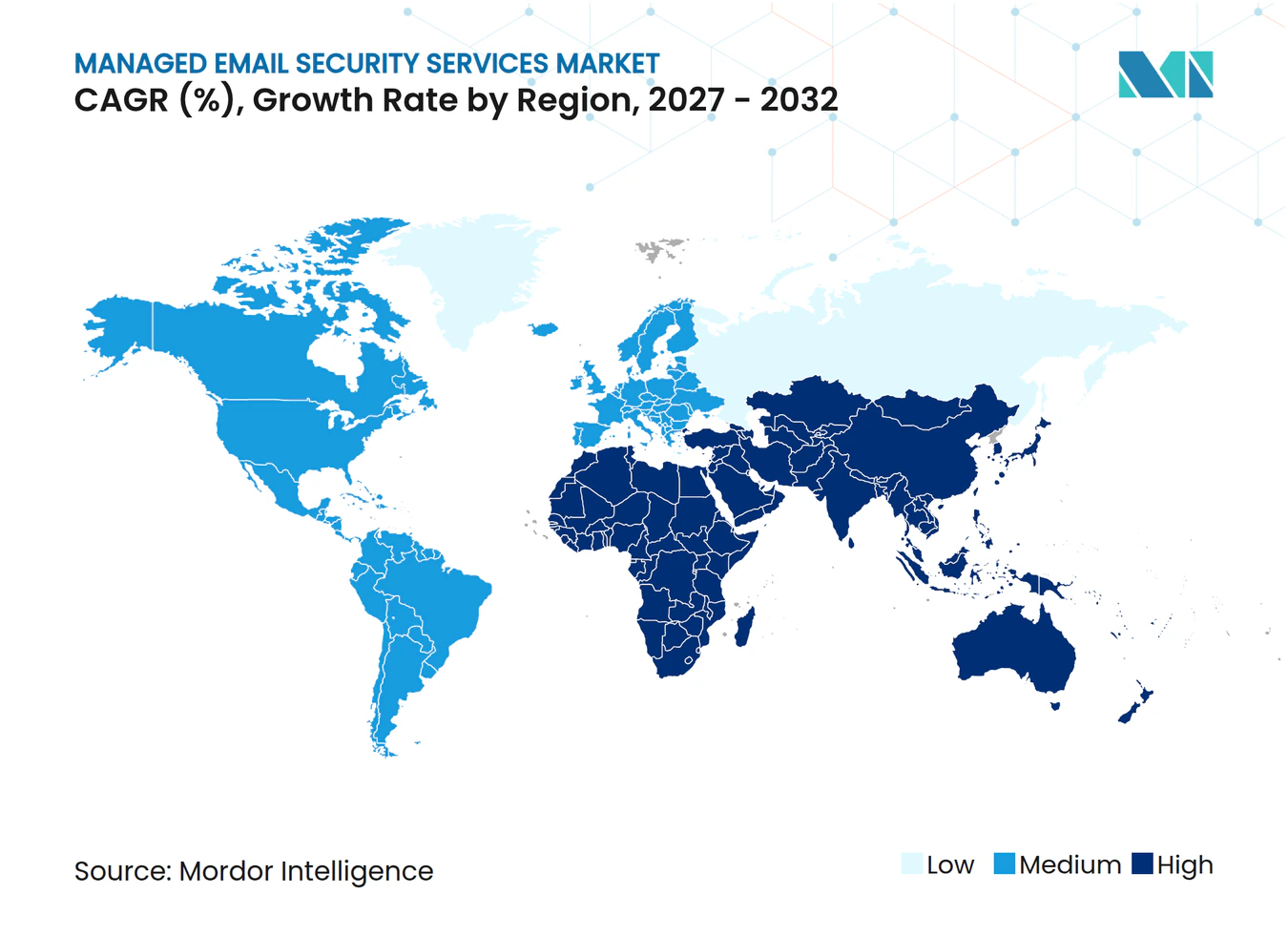
North America accounted for 38.74% of revenue in 2026, the largest share of the managed email security services market by geography. The region combines a large base of enterprise technology buyers with extensive security and procurement requirements. CISA Binding Operational Directive 25-01 strengthens secure cloud practices for federal civilian agencies, while a DFARS rule published in September 2025 advanced cybersecurity implementation requirements for covered defense contractors.[3] These standards can influence suppliers and other organizations that support public-sector customers. Canada and Mexico also drive demand through enterprise modernization and security practices aligned with recognized frameworks.
APAC Managed Email Security Services Market
Asia-Pacific is projected to expand at a CAGR of 10.23% through 2032. The managed email security services market is supported by expanding digital services, growing BFSI activity, and strengthening national security requirements. India’s financial sector is a material opportunity because security controls, data localization, and incident reporting obligations require dependable operational processes. IRONSCALES expanded its presence in Asia-Pacific and Japan in 2025 and added data centers to support regional performance and data residency needs. The region’s SME and MSP channels can favor providers that offer simple multi-tenant operations. China has distinct requirements for encryption and cross-border data handling, which can support localized service models.
EMEA and South America Managed Email Security Services Market
Europe has substantial demand through Germany, the UK, and France, where privacy requirements sit alongside cyber protection obligations, and the CNIL issued a recommendation on email tracking pixels in May 2026. This environment can favor providers that offer clear retention controls and transparent handling of employee data. South America is led by Brazil and Argentina, where enterprise digitization is expanding the need for managed security. The Middle East, especially Saudi Arabia and the UAE, and Africa, led by South Africa and Egypt, are growing from a lower base as digital infrastructure investment and cybersecurity requirements advance.
Competitive Landscape
Market Concentration
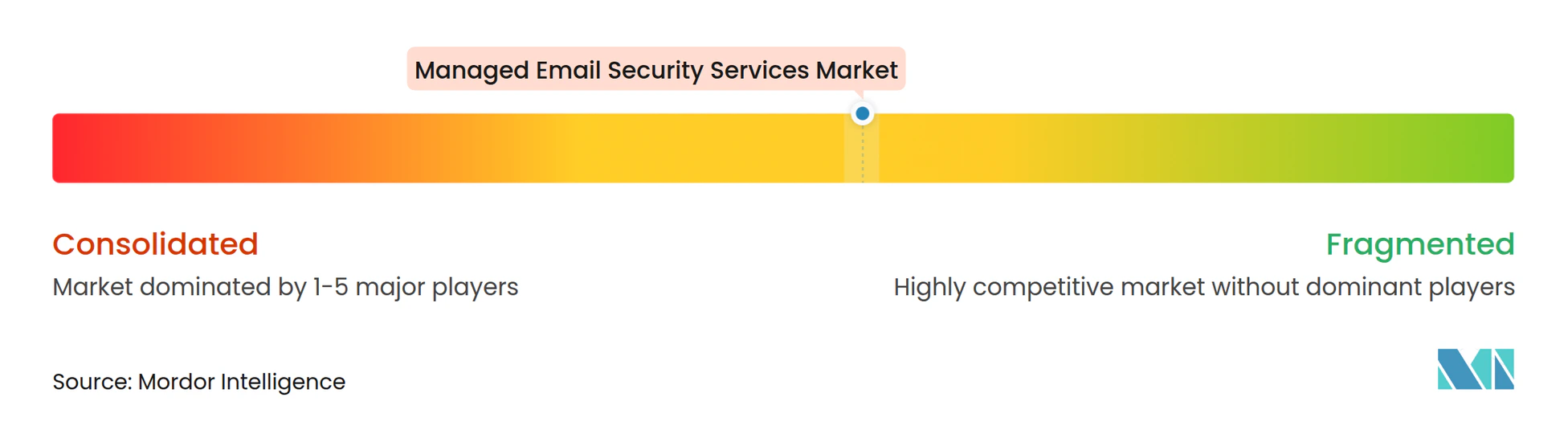
The managed email security services market combines established platform vendors with newer providers built around behavioral and AI-based detection, and the market is moderately concentrated. Proofpoint, Mimecast, Microsoft, Cisco, and Broadcom have broad enterprise positions, while the shift toward API-based, integrated cloud email security puts pressure on vendors that rely mainly on gateway architectures. Fortinet entered the email security market as a Challenger after acquiring Perception Point in December 2024 and integrating email protection into its Security Fabric, demonstrating how platform vendors are adding this capability to broader security portfolios. Larger providers can cross-sell managed services through enterprise relationships, but specialized providers can compete by offering detection methods that address threats conventional rules miss. This mix gives customers a choice between broad suites, focused tools, and MSP-delivered services.
Proofpoint announced an agreement in October 2026 to acquire Varonis for USD 6.3 billion, with closing expected in the first half of 2027, and completed its Hornetsecurity acquisition in 2025 to strengthen its SMB and MSP position.[4] The proposed Varonis transaction shifts competition beyond inbox protection toward data-access governance and AI-agent security. Darktrace launched an MSSP-oriented managed email security offering in March 2026, while Mimecast introduced Agent Risk Center and Managed Threat Response in August 2026. These actions show that vendors are competing for breadth of platforms and channel-ready service delivery. They also reflect the importance of combining proprietary AI with operational systems that support multi-tenant delivery.
AI-native challengers are seeking to differentiate through behavioral analysis, agentic workflows, and flexible deployments for Microsoft 365 and Google Workspace. Abnormal Security raised USD 250 million in October 2025 at a USD 5 billion valuation, demonstrating investor interest in this model. Valimail and EasyDMARC focus on DMARC-based managed services, and every provider must show strong technical implementation, reliable detection, and clear response processes to retain customers. The market remains competitive because customers can choose among suites, specialists, and MSP-delivered offerings.
Managed Email Security Services Industry Leaders
-
Proofpoint, Inc.
-
Mimecast Limited
-
Microsoft Corporation
-
Cisco Systems, Inc.
-
Barracuda Networks, Inc.
- *Disclaimer: Major Players sorted in no particular order
Managed Email Security Services Market Companies Covered in this Report
- Proofpoint, Inc.
- Mimecast Limited
- Microsoft Corporation
- Cisco Systems, Inc.
- Barracuda Networks, Inc.
- Broadcom Inc.
- Google LLC
- Fortinet, Inc.
- Sophos Limited
- Trend Micro Incorporated
- Check Point Software Technologies Ltd.
- IRONSCALES, Inc.
- Abnormal Security Corporation
- Darktrace Holdings plc
- Fortra LLC
- Cofense Inc.
- OpenText Corporation
- Trustwave Holdings, Inc.
- Retarus GmbH
- Valimail, Inc.
- EasyDMARC Inc.
Recent Industry Developments in Managed Email Security Services Market
- October 2026: Proofpoint announced a definitive agreement to acquire Varonis Systems in an all-cash transaction valued at approximately USD 6.3 billion, expected to close in the first half of 2027 subject to regulatory and shareholder approvals. The combination is intended to create a unified platform serving more than 16,000 enterprises connecting email and communications security with data access governance and AI agent security, positioning the merged entity as the industry’s largest pure-play data and AI cybersecurity organization.
- August 2026: Mimecast unveiled 2 significant platform additions at Black Hat USA 2026, the Agent Risk Center beta for discovering, monitoring, and governing AI agents across the enterprise, and Managed Threat Response, a redesigned 24/7 managed service combining AI-driven triage with analyst-confirmed remediation to close the gap in uninvestigated security alerts across customer environments.
- June 2026: Barracuda Networks unveiled Barracuda Integrated Email Protection, an AI-powered Integrated Cloud Email Security solution providing continuous, full-lifecycle threat detection and autonomous agentic remediation across Microsoft 365 and Google Workspace, with multi-tenant support designed to lower MSP operational overhead and accelerate client onboarding.
- March 2026: Darktrace launched its first MSSP-oriented managed email security offering, enabling channel partners to deliver AI-native protection for email, Microsoft Teams, and user identities through the Darktrace/EMAIL platform, supported by updates to the Darktrace Defenders Partner Program to improve operational scalability across multiple client environments.
Global Managed Email Security Services Market Report Scope
Managed Email Security Services Market refers to the market for outsourced, cloud-based solutions that protect organizations’ email systems from cyberthreats, including phishing, spam, malware, ransomware, business email compromise, and data loss. These services are managed by third-party providers and typically include email filtering, threat detection, encryption, data loss prevention, email authentication, incident response, and continuous monitoring to secure inbound and outbound email communications.
The Managed Email Security Services Market Report is Segmented by Component (Solutions and Services), Service Type (Managed Monitoring and Reporting, Policy Enforcement and Optimization, Threat Detection and Incident Response, Managed Authentication and Compliance, Email Encryption and Data Loss Prevention, Email Archiving and Continuity, and Security Awareness and Phishing Resilience), Deployment Mode (Cloud-Based, On-Premises, and Hybrid), Organization Size (Small and Medium Enterprises and Large Enterprises), End-User Industry (Information Technology and Telecommunications, BFSI, Healthcare, Retail and E-Commerce, Manufacturing, Government and Defense, Education, Energy and Utilities, and Other End-User Industries), and Geography (North America, South America, Europe, Asia-Pacific, Middle East, and Africa). The Market Forecasts are Provided in Terms of Value (USD).
Segmentation Overview
| Solutions |
| Services |
| Managed Monitoring and Reporting |
| Policy Enforcement and Optimization |
| Threat Detection and Incident Response |
| Managed Authentication and Compliance |
| Email Encryption and Data Loss Prevention |
| Email Archiving and Continuity |
| Security Awareness and Phishing Resilience |
| Cloud-Based |
| On-Premises |
| Hybrid |
| Small and Medium Enterprises |
| Large Enterprises |
| Information Technology and Telecommunications |
| BFSI |
| Healthcare |
| Retail and E-Commerce |
| Manufacturing |
| Government and Defense |
| Education |
| Energy and Utilities |
| Other End-User Industries |
| North America | United States |
| Canada | |
| Mexico | |
| South America | Brazil |
| Argentina | |
| Rest of South America | |
| Europe | Germany |
| United Kingdom | |
| France | |
| Italy | |
| Spain | |
| Russia | |
| Rest of Europe | |
| Asia-Pacific | China |
| India | |
| Japan | |
| South Korea | |
| Australia | |
| Rest of Asia-Pacific | |
| Middle East | Saudi Arabia |
| United Arab Emirates | |
| Turkey | |
| Rest of Middle East | |
| Africa | South Africa |
| Egypt | |
| Nigeria | |
| Rest of Africa |
| By Component | Solutions | |
| Services | ||
| By Service Type | Managed Monitoring and Reporting | |
| Policy Enforcement and Optimization | ||
| Threat Detection and Incident Response | ||
| Managed Authentication and Compliance | ||
| Email Encryption and Data Loss Prevention | ||
| Email Archiving and Continuity | ||
| Security Awareness and Phishing Resilience | ||
| By Deployment Mode | Cloud-Based | |
| On-Premises | ||
| Hybrid | ||
| By Organization Size | Small and Medium Enterprises | |
| Large Enterprises | ||
| By End-User Industry | Information Technology and Telecommunications | |
| BFSI | ||
| Healthcare | ||
| Retail and E-Commerce | ||
| Manufacturing | ||
| Government and Defense | ||
| Education | ||
| Energy and Utilities | ||
| Other End-User Industries | ||
| By Geography | North America | United States |
| Canada | ||
| Mexico | ||
| South America | Brazil | |
| Argentina | ||
| Rest of South America | ||
| Europe | Germany | |
| United Kingdom | ||
| France | ||
| Italy | ||
| Spain | ||
| Russia | ||
| Rest of Europe | ||
| Asia-Pacific | China | |
| India | ||
| Japan | ||
| South Korea | ||
| Australia | ||
| Rest of Asia-Pacific | ||
| Middle East | Saudi Arabia | |
| United Arab Emirates | ||
| Turkey | ||
| Rest of Middle East | ||
| Africa | South Africa | |
| Egypt | ||
| Nigeria | ||
| Rest of Africa | ||
Key Questions Answered in the Report
What is the managed email security services market size?
The managed email security services market size is USD 7.76 billion in 2026 and is forecast to reach USD 13.58 billion by 2032 at a CAGR of 9.59% from 2027 to 2032.
What is driving demand for managed email security services?
The managed email security services market is supported by phishing, BEC, ransomware, cloud email adoption, and stricter authentication requirements, all of which increase demand for continuous managed protection.
Which component is growing fastest in managed email security services?
Within the managed email security services market, services are projected to grow at a CAGR of 10.86% through 2032 as organizations adopt managed detection, response, and phishing resilience programs.
Which deployment model leads this sector?
The managed email security services market is led by cloud-based deployment, which held 71.37% of revenue in 2026 and is projected to grow at a CAGR of 10.59% through 2032.
Which customer group is expected to grow fastest?
SMEs are projected to expand at a CAGR of 11.08% through 2032 because MSP models make managed protection more accessible, lower implementation work, and reduce the need for dedicated internal email security operations, specialized threat-hunting staff, and separate monitoring tools.
Which region is expected to grow fastest for managed email security services?
Asia-Pacific is projected to expand at a CAGR of 10.23% through 2032. In the managed email security services market, this expansion is supported by digitalization, financial-sector demand, expanding security requirements, and wider use of managed service providers across regional customer groups.