
Managed Email Archiving and Retention Services Market Size and Share
Market Overview
| Study Period | 2021 - 2032 |
|---|---|
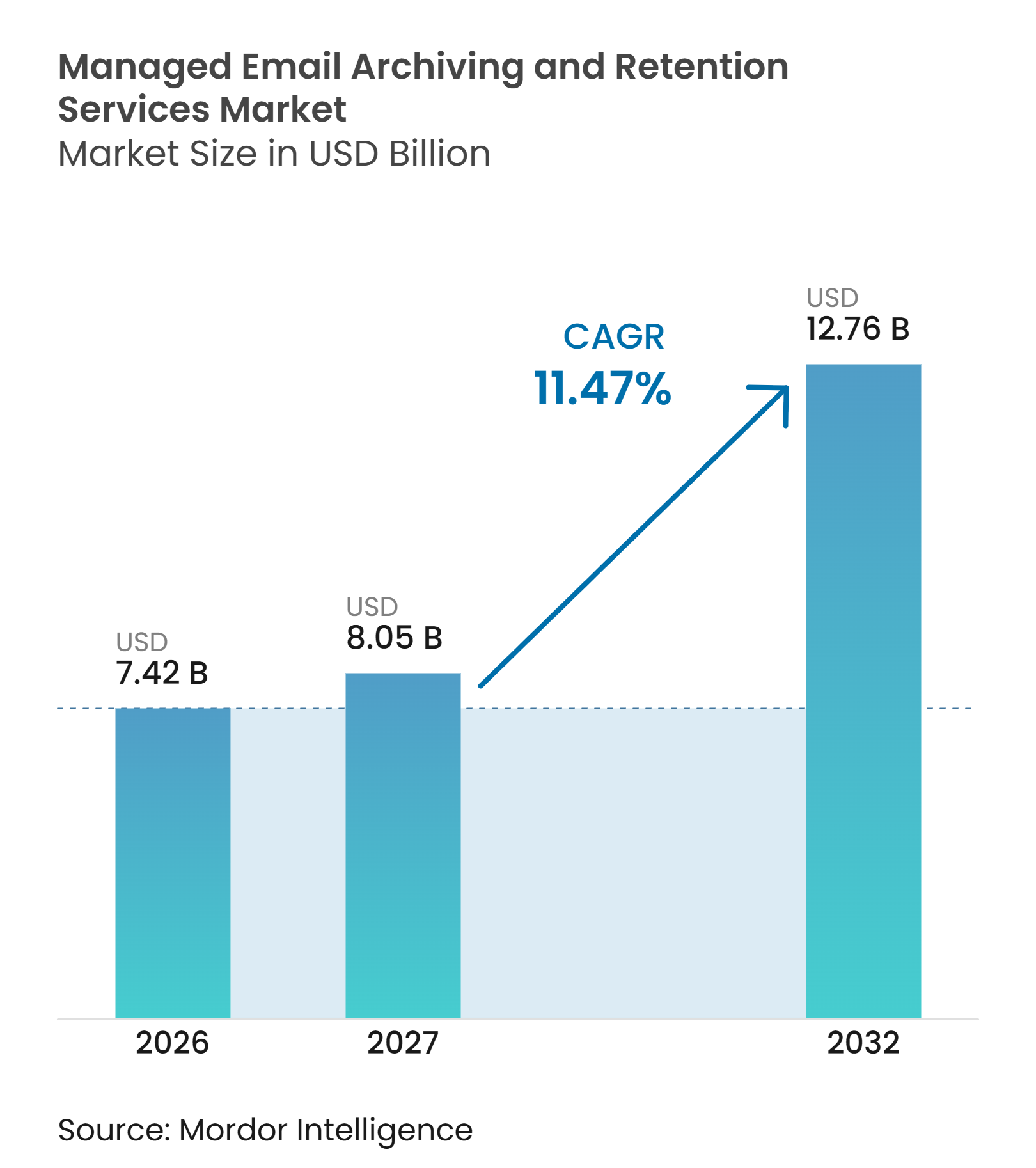
| Market Size (2027) | USD 8.05 Billion |
| Market Size (2032) | USD 12.76 Billion |
| Growth Rate (2027 - 2031) | 11.47 % |
| Fastest Growing Market | Asia-Pacific |
| Largest Market | North America |
| Market Concentration | Medium |
Major Players *Disclaimer: Major Players sorted in no particular order Image © Mordor Intelligence. Reuse requires attribution under CC BY 4.0. | |
Managed Email Archiving and Retention Services Market Analysis by Mordor Intelligence
The managed email archiving and retention services market size is valued at USD 7.42 billion in 2026 and is forecast to reach USD 12.76 billion by 2032, expanding at a CAGR of 11.47% from 2027 to 2032. The managed email archiving and retention services market is moving beyond its earlier role as a financial-services compliance tool because recordkeeping obligations now apply across more regulated organizations. Cloud productivity adoption has also exposed gaps in native retention, legal hold, and multi-channel capture capabilities. Ransomware has made tamper-resistant archives relevant to both compliance leaders and security teams. Vendors are responding by combining communication capture, review tools, and managed operations within broader governance platforms. Native retention products from Microsoft and Google may constrain standalone platform demand among less-regulated mid-sized organizations, although they do not yet offer the same governance depth required in regulated sectors.
Key Report Takeaways
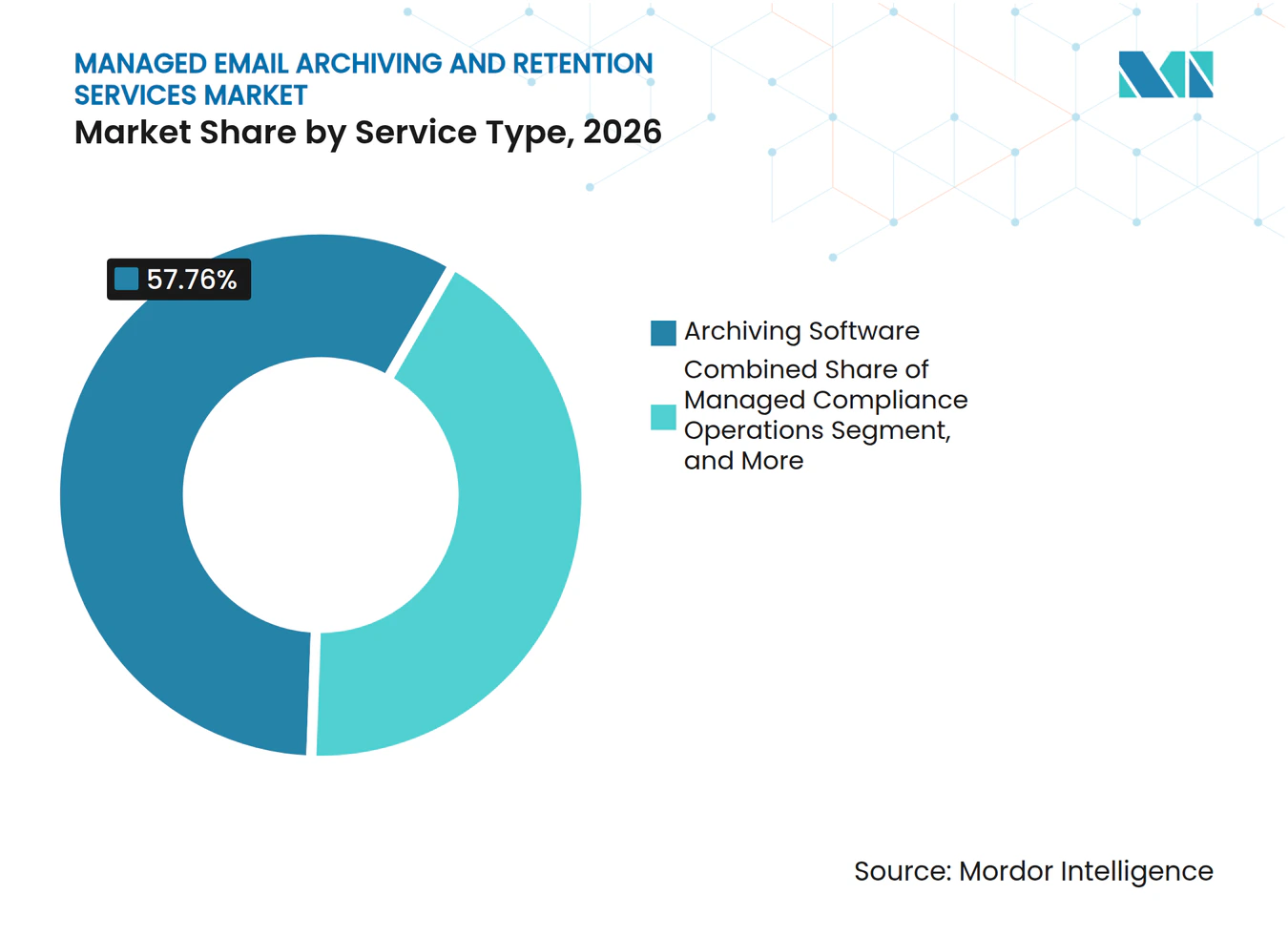
- By service type, archiving software held 57.76% of service-type revenue in 2026, while managed compliance operations is projected to expand at a CAGR of 12.62% through 2032.
- By delivery model, direct enterprise subscription accounted for 46.69% of revenue in 2026, while managed service provider delivery is projected to expand at a CAGR of 12.84% through 2032.
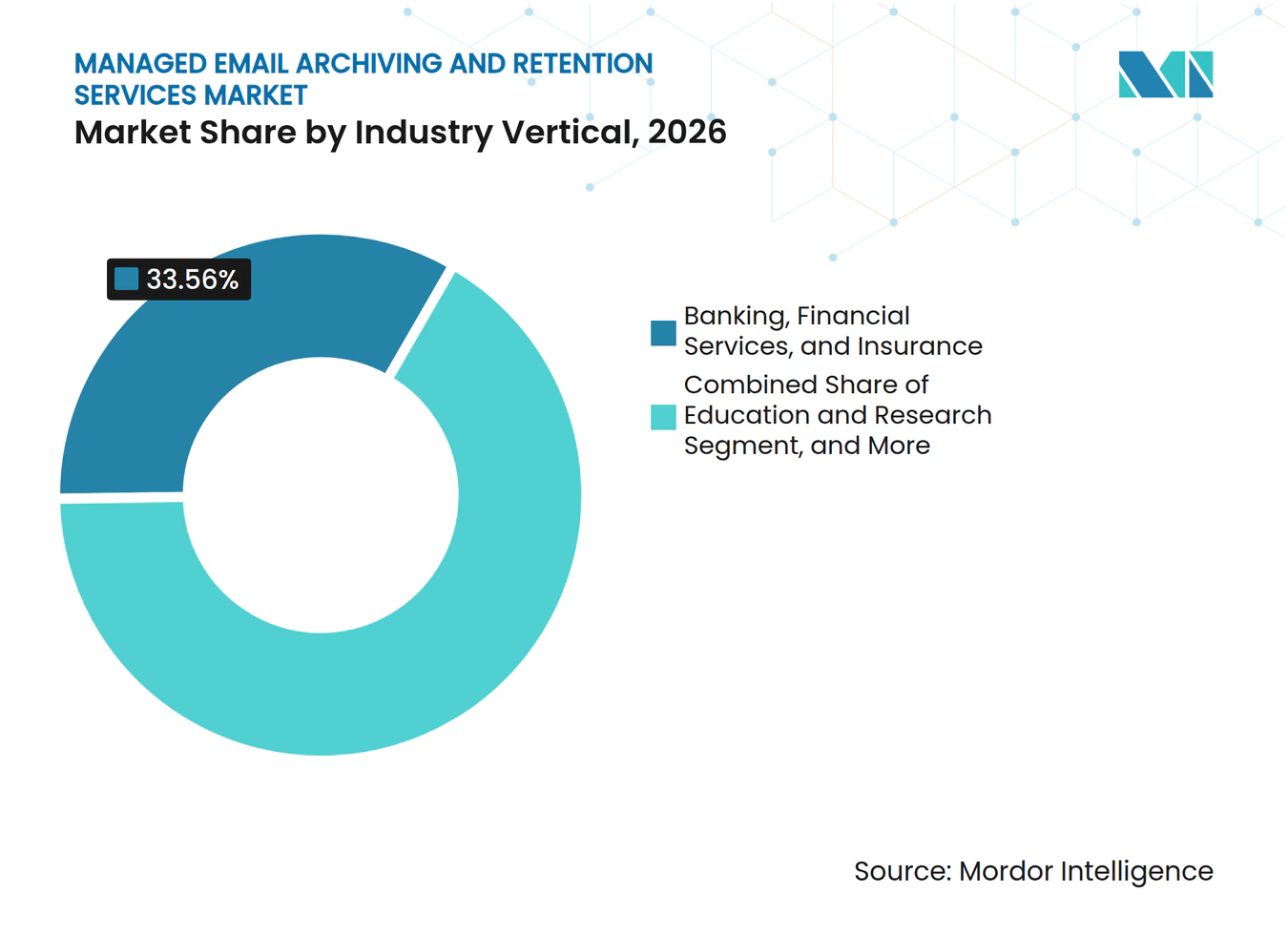
- By industry vertical, BFSI held 33.56% of revenue in 2026 and is projected to expand at a CAGR of 12.78% through 2032.
- By geography, North America held 43.34% of revenue in 2026, while Asia-Pacific is projected to expand at a CAGR of 12.68% through 2032.
Note: Market numbers in this report are based on Mordor Intelligence's proprietary estimation framework, which combines nine months of actuals with Q4 projections for base year 2026.
Market Trends and Insights
Drivers Impact Analysis of Managed Email Archiving and Retention Services Market*
| Driver | (~) % Impact on CAGR Forecast | Geographic Relevance | Impact Timeline |
|---|---|---|---|
| Escalating Electronic-Communications Recordkeeping Mandates | +3.2% | Global, concentrated enforcement in North America and Europe | Short term (≤ 2 years) |
| Cloud Migration and Microsoft 365 Adoption | +2.5% | Global, with highest intensity in North America and Europe | Short term (≤ 2 years) |
| Ransomware and Immutable-Archive Requirements | +1.8% | Global | Medium term (2-4 years) |
| AI-Enabled eDiscovery and Supervision Demand | +1.3% | North America, Europe, and Asia-Pacific | Medium term (2-4 years) |
| Sovereign-Cloud Programs and In-Region Retention | +0.9% | Europe, Asia-Pacific, and the Middle East | Long term (≥ 4 years) |
| Retention Metadata as Training-Ready Data for Generative AI | +0.6% | North America and Europe | Long term (≥ 4 years) |
| Source: Mordor Intelligence | |||
Escalating Electronic-Communications Recordkeeping Mandates
The managed email archiving and retention services market is supported by the broader geographic and sectoral reach of rules for retaining electronic communications. FINRA's 2025 report identified continuing failures by broker-dealers to capture, review, and archive business communications, including communications sent through third-party vendor accounts and personal-device channels.[1] The SEC's January 2023 amendments to Rule 17a-4 strengthened third-party recordkeeping undertaking requirements and kept responsibility with the regulated entity. Organizations can therefore face examination findings even when their archive infrastructure is technically compliant if vendor oversight and communications sampling are weak. These operating gaps favor providers that combine technology with documented review and supervision procedures. Japan's Financial Instruments and Exchange Act requires registered securities firms to retain email records and retrieve them promptly, which sustains demand in a mature Asia-Pacific jurisdiction.
Cloud Migration and Microsoft 365 Adoption
Cloud migration is creating a clear opening for the managed email archiving and retention services market because retention needs become more visible when communications are centralized on Microsoft 365. Microsoft increased auto-expanding archive capacity for eligible E5 users from 1.5 TB to 3 TB in October 2026, improving storage capacity without resolving governance and third-party undertaking requirements.[2] Native functions can be insufficient where organizations need immutable storage, multi-custodian legal holds, or capture across channels beyond email. Exchange Online processes more than 400 billion emails each month, demonstrating the scale of data that must be indexed and retained. The managed email archiving and retention services market benefits when organizations treat compliance metadata and search quality as operating requirements rather than storage features. Mid-sized organizations moving from server-based email are likely to favor managed service providers when they do not have internal resources to operate these controls.
Ransomware and Immutable-Archive Requirements
Ransomware attacks on backup infrastructure have raised the value of secure email archives as a recovery resource in the managed email archiving and retention services market. Sophos found that 66% of ransomware incidents with encrypted data used backups for recovery in 2026, compared with 54% in its 2025 survey.[3] Proofpoint reported that 62% of organizations used immutable backup technology, although only 16% of those deployments met its definition of absolute immutability. Managed providers address this gap through WORM-compliant retention, custody-chain records, and third-party audit support. This makes archive design relevant to recovery planning as well as to the managed email archiving and retention services market's compliance role. CISA's August 2026 advisory on Gunra ransomware recommended offline, immutable backups in a physically separate and segmented location.
AI-Enabled eDiscovery and Supervision Demand
The managed email archiving and retention services market is also gaining from the use of AI in eDiscovery and communications supervision. Compliance teams must review rising volumes of email, Teams, Slack, WhatsApp, and AI-generated communications, which exceeds the capacity of manual review teams. AI-assisted tools can prioritize risk, support multilingual review, and analyze context without relying solely on manually maintained keyword lists. Smarsh reported that its latest tools use behavioral and contextual signals to reduce predictable low-value alerts in multilingual communications. These capabilities can direct reviewer attention to higher-risk records while retaining a documented review process. Theta Lake obtained ISO 42001 certification for its AI detection and review features in 2026, while Archive360 worked with Microsoft on agentic AI for detecting and preserving policy violations in archived communications.
Restraints Impact Analysis of Managed Email Archiving and Retention Services Market*
| Restraint | (~) % Impact on CAGR Forecast | Geographic Relevance | Impact Timeline |
|---|---|---|---|
| Complexity and Cost of Legacy PST and Archive Migration | -2.1% | Global, with highest intensity in North America and Europe | Short term (≤ 2 years) |
| Overlap with Native Microsoft 365 and Google Workspace Retention Features | -1.7% | Global | Medium term (2-4 years) |
| Cross-Border Data-Transfer and Data-Sovereignty Constraints | -1.0% | Europe, Asia-Pacific, and the Middle East | Long term (≥ 4 years) |
| Hidden API, Egress, and Long-Term Storage Costs | -0.7% | Global | Medium term (2-4 years) |
| Source: Mordor Intelligence | |||
Complexity and Cost of Legacy PST and Archive Migration
Legacy Personal Storage Table files and on-premises archives remain a material barrier to adoption in the managed email archiving and retention services market. Organizations must preserve chain of custody, remove duplicates, convert formats, and retain searchability and legal-hold integrity while moving historical data. Migration projects can run for 12 to 24 months and require professional-services budgets that could otherwise fund a managed subscription. Errors such as orphaned items, detached mailbox stubs, and failed hash validation can create discovery risk after the technical migration has ended. This raises the cost and duration of decisions in the managed email archiving and retention services market for organizations with large legacy repositories. Archive360 offers tools intended to preserve chain of custody when organizations leave systems such as Veritas Enterprise Vault and OpenText AXS-One, but the required effort can keep buyers in extended proof-of-concept phases.
Overlap with Native Microsoft 365 and Google Workspace Retention Features
Improving retention capabilities in Microsoft Purview and Google Vault can limit demand for standalone services, especially in sectors with less demanding compliance requirements. Mimecast expanded its Google Workspace coverage in June 2025 to include Google Chat, Google Meet, Google Calendar, and Google Drive, seeking to provide governance functions beyond native retention. Microsoft's January 2026 Auto Archiving feature moves aging messages when mailbox utilization reaches 96%, which further narrows the storage-management gap. The constraint is strongest in mid-sized organizations where cost sensitivity is higher and formal recordkeeping duties are narrower. The managed email archiving and retention services market is less exposed where regulated buyers need formal supervision and third-party access arrangements. Regulated buyers still require audit trails, third-party undertakings, and supervision workflows that native tools do not fully provide.
*Our forecasts treat driver/restraint impacts as directional, not additive. The impact forecasts reflect baseline growth, mix effects, and variable interactions.
Managed Email Archiving and Retention Services Market Segment Analysis
By Service Type:
Compliance Operations Outpacing Software GrowthManaged compliance operations is projected to expand at a CAGR of 12.62% from 2027 to 2032, making it the fastest-growing service type in the managed email archiving and retention services industry. Regional banks, investment advisers, and healthcare systems are increasingly assigning daily supervision, audit-trail management, and examination-response work to specialists. This preference shifts the buying decision from selecting software to identifying a provider that can operate a compliance function. It also brings operational accountability and archive technology into the same vendor relationship. Buyers use these services when internal teams cannot consistently maintain review processes and regulatory evidence.
Archiving software held 57.76% of the managed email archiving and retention services market size in 2026 because cloud-native subscriptions remain deeply established across enterprise accounts. Consulting and assessment work often introduces mid-sized organizations to compliance readiness requirements before a broader deployment. Integration and migration services benefit from the replacement of legacy archive platforms, while support and maintenance provide lower-margin recurring revenue. This established software base gives the managed email archiving and retention services market a platform for adding managed operations alongside subscriptions. Proofpoint introduced its Nuclei Discovery and Archive Suite for small and medium-sized businesses in March 2026, combining one-click deployment with AI-powered compliance supervision.



By Delivery Model:
MSP Channel Outpacing Direct Enterprise GrowthManaged service provider delivery is projected to expand at a CAGR of 12.84% from 2027 to 2032 as retail companies, manufacturers, and regional financial institutions seek operational support. These customers often lack staff who can configure, maintain, and document a deployment independently. Proofpoint signed an agreement in Q2 2025 to acquire Hornetsecurity to extend human-centric security and archiving capabilities to managed service providers serving small and medium-sized businesses. The transaction showed that leading vendors view the channel as an important route to smaller regulated customers.
Direct enterprise subscription represented 46.69% of managed email archiving and retention services market share in 2026, supported by large accounts in BFSI, government, and healthcare. These organizations tend to negotiate multi-year agreements directly and retain compliance technology teams to manage configurations. Systems integrators and resellers remain important in government and enterprise procurements that require competitive bidding or integration with content-management systems. The managed email archiving and retention services industry also relies on local integrators in sovereign-cloud settings, where local contracts and security clearances can be decisive. Regardless of the channel, the regulated entity remains responsible for recordkeeping, which can lead buyers to add managed operations after deployment.
By Industry Vertical:
BFSI Leads Revenue and Fastest Growth SimultaneouslyBFSI held 33.56% of revenue in 2026 and is projected to expand at a CAGR of 12.78% through 2032. Its position reflects strict communication-retention requirements under SEC Rule 17a-4, FINRA Rule 4511, MiFID II, and UK Financial Conduct Authority conduct rules. The sector treats eDiscovery, trade surveillance, and supervisory review as required operational infrastructure. It must also capture a widening set of communications, including AI-assistant outputs, WhatsApp, voice, and traditional email. FINRA continued to identify recordkeeping weaknesses involving business communications in its 2025 oversight report.
Government and public-sector organizations retain official communications to meet freedom-of-information, public-records, and inquiry obligations. South Korea's National Archives identified a cloud-based Intelligent Records Management System as a 2025 priority, reflecting a public-sector modernization path that may be relevant elsewhere in Asia-Pacific. Healthcare and life sciences organizations face new retention needs as telehealth expands patient communication beyond conventional email. IT and telecommunications, education and research, retail and e-commerce, and manufacturing and energy each face distinct recordkeeping or litigation needs. This range reduces reliance on financial services alone within the managed email archiving and retention services market.

Geography Analysis
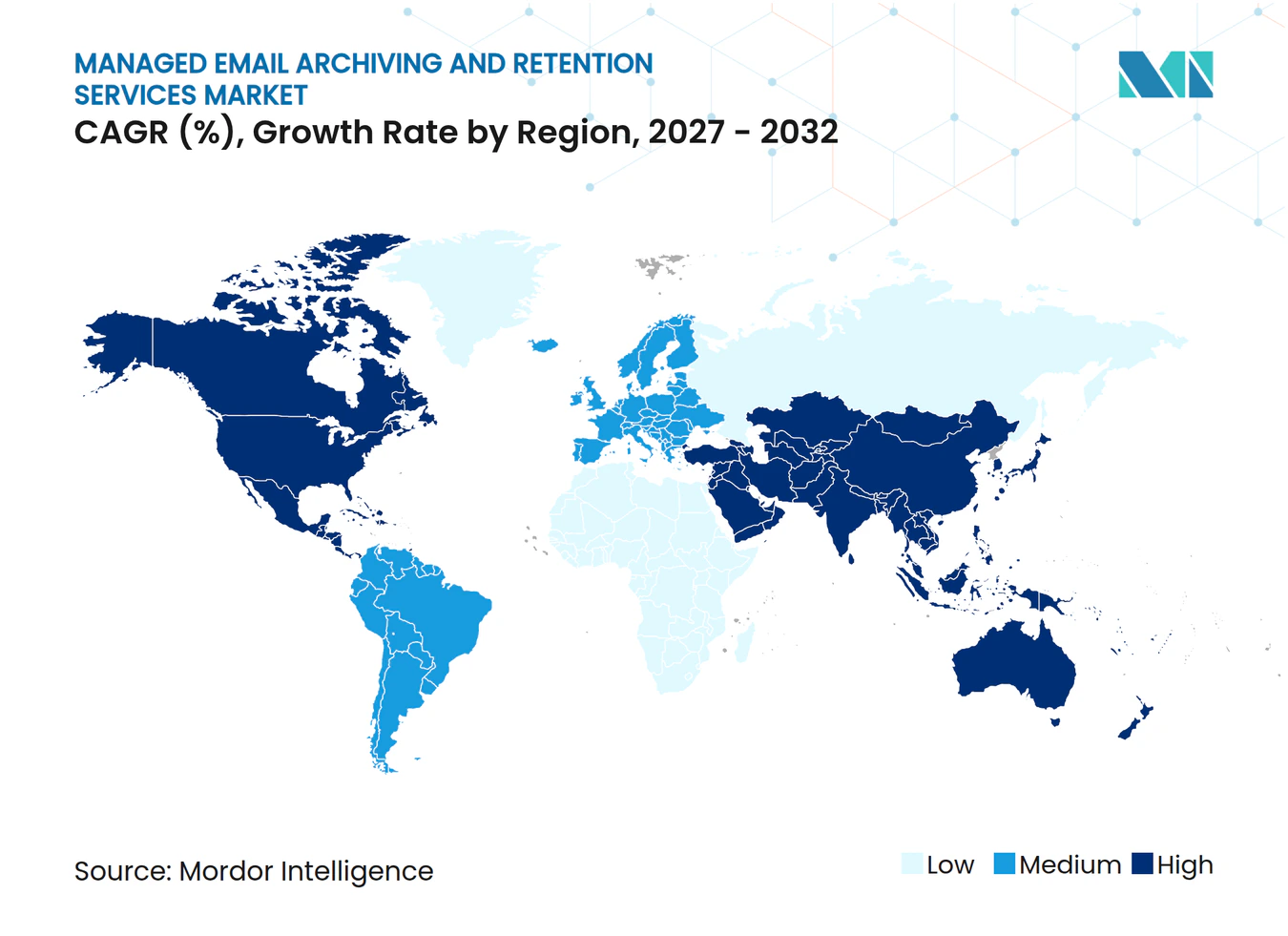
North America held 43.34% of the managed email archiving and retention services market share in 2026. Its maturity reflects long-standing federal and self-regulatory requirements that have driven enterprise adoption. Vendors increasingly offer managed compliance operations, supervision services, and examination-readiness programs in addition to retention and search tools. Canada applies electronic-communications retention requirements to capital-markets participants through CIRO, and Mexico is formalizing electronic recordkeeping requirements for financial services. The managed email archiving and retention services market is also shaped by vendor acquisitions and platform consolidation in the region.
Asia-Pacific is projected to expand at a CAGR of 12.68% from 2027 to 2032. New privacy statutes, digital financial-services activity, and public-sector modernization support demand across the region. Japan requires securities firms to retain email and retrieve it promptly, while the e-Bunsho Law has expanded electronic document requirements for corporations. South Korea's Personal Information Protection Act amendment became effective in September 2026 and introduced stricter obligations for personal data in electronic communications. Theta Lake launched China data-center deployments in March 2026 to support data localization needs under China's Cybersecurity Law and Personal Information Protection Law.
Europe is the second-largest regional market, shaped by GDPR data-minimization requirements, MiFID II retention rules, and UK supervisory expectations. Germany, France, and the United Kingdom remain substantial enterprise markets, while demand elsewhere in Europe rises as compliance practices mature. Brazil's Lei Geral de Proteção de Dados is extending formal governance obligations to enterprise communications in South America. Saudi Arabia and the United Arab Emirates are investing in sovereign-cloud infrastructure for government and financial-services use.
Competitive Landscape
Market Concentration
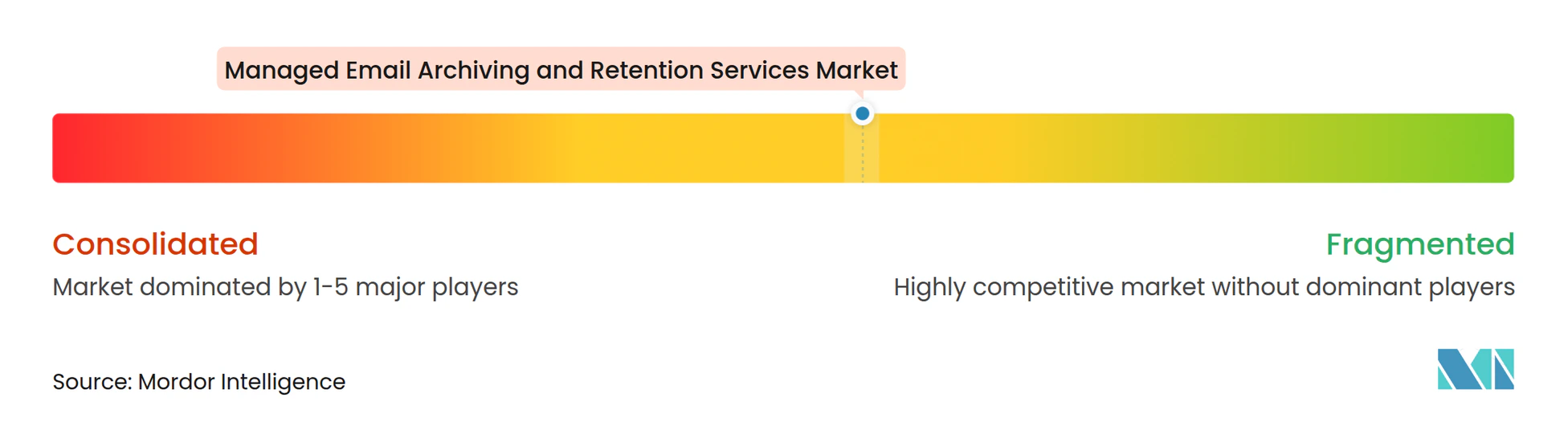
The managed email archiving and retention services market has moderate concentration at the enterprise tier. Large buyers favor providers that can capture more than 100 communication channels, support AI-assisted supervision, and offer deployment options that meet data-residency needs. This creates a meaningful barrier for storage-only and single-channel products. Proofpoint integrated Nuclei's serverless AI-native architecture into its governance offering after acquiring the company in 2025. Smarsh acquired CallCabinet in February 2025 to add voice capture, transcription, sentiment analysis, and speaker identification to its platform.
Within the managed email archiving and retention services market, ZL Technologies and Global Relay differentiate through multi-custodian eDiscovery and cross-jurisdiction governance capabilities. Theta Lake's ISO 42001 certification adds an independent standards-based consideration for buyers evaluating AI detection features. The small and medium-sized business segment has fewer governance-grade options, which explains the focus on simplified, AI-supported deployments. Proofpoint's March 2026 suite sought to address this need through self-service eDiscovery, one-click deployment, AI-powered supervision, and no export fees. Buyers in this segment may choose managed channels when they cannot assemble internal compliance teams.
Sovereign-cloud archiving is a developing opportunity in Europe, Gulf Cooperation Council markets, and China because archived data may need to remain inside a defined jurisdiction. OpenText announced a EUR 105 million investment in Cork and Galway in 2026 for agentic AI and sovereign-cloud expansion in Europe. FINRA's requirement for third-party recordkeeping vendors to file access undertakings directly with regulators favors providers with established operational and regulatory capabilities. The managed email archiving and retention services market remains open to specialized vendors, but compliance infrastructure and multi-channel coverage shape buyer selection.
Managed Email Archiving and Retention Services Industry Leaders
-
Proofpoint, Inc.
-
Smarsh, Inc.
-
Mimecast Services Limited
-
Veritas Technologies LLC
-
Global Relay Communications Inc.
- *Disclaimer: Major Players sorted in no particular order
Managed Email Archiving and Retention Services Market Companies Covered in this Report
- Proofpoint, Inc.
- Smarsh, Inc.
- Mimecast Services Limited
- Global Relay Communications Inc.
- Jatheon Technologies Inc.
- Archive360, Inc.
- ZL Technologies, Inc.
- Pagefreezer Software Inc.
- MailStore Software GmbH
- Intradyn, Inc.
- TitanHQ Limited
- MirrorWeb Limited
- Theta Lake, Inc.
- Veritas Technologies LLC
- Barracuda Networks, Inc.
- OpenText Corporation
- Commvault Systems, Inc.
- Micro Focus International plc
- Solix Technologies, Inc.
- HubStor Inc.
Recent Industry Developments in Managed Email Archiving and Retention Services Market
- October 2026: Smarsh expanded capabilities across Professional Archive, Web Archive, Cyber Compliance, and Vendor Risk Management, adding planned capture support for Claude Cowork through the Claude Compliance API and deploying AI-powered Noise Reduction and Misconduct Detection agents. These agents surface behavioral and contextual risk signals in multilingual communications and reduce predictable, low-value alerts, moving compliance surveillance toward continuous, AI-assisted oversight. The update also extends capture coverage for emerging AI-enabled work patterns that can create regulated business records.
- October 2026: Barracuda Cloud Archiving Service added multi-language user interface support, allowing compliance teams in non-English markets to navigate archiving workflows in their preferred language, a capability valued in European and Asia-Pacific enterprise procurement where local-language operations are a baseline requirement. The feature is intended to simplify administration for distributed teams that manage retention obligations across several languages.
- September 2026: Smarsh launched AskSmarsh AI and an MCP Server, enabling natural-language querying across communications archives without requiring structured search syntax. The capability represents a shift from search-and-retrieve to conversational investigation workflows, allowing compliance officers to interrogate archived data directly and reducing the technical barrier to ad hoc regulatory inquiry response. It supports archive users who need to locate and interpret records without relying on specialized search syntax.
- September 2026: Barracuda Cloud Archiving Service migrated its Microsoft 365 integration from Exchange Web Services to Microsoft Graph following Microsoft's deprecation of EWS for Exchange Online. The change required administrator re-authentication to ensure continuity of nightly email sync and maintain archiving compliance obligations.
Global Managed Email Archiving and Retention Services Market Report Scope
The Managed Email Archiving and Retention Services Market comprises outsourced and cloud-based services that enable organizations to capture, archive, retain, manage, search, monitor, and retrieve business email communications in accordance with corporate governance, legal discovery, regulatory compliance, and data-retention requirements.
The Managed Email Archiving and Retention Services Market Report is Segmented by Service Type (Archiving Software, Consulting and Assessment, Integration and Migration, Support and Maintenance, and Managed Compliance Operations), Delivery Model (Direct Enterprise Subscription, Managed Service Provider Delivery, and Systems Integrator and Reseller Delivery), Industry Vertical (Banking, Financial Services, and Insurance; Government and Public Sector; Healthcare and Life Sciences; Information Technology and Telecommunications; Education and Research; Retail and E-Commerce; Manufacturing and Energy; and Other Industry Verticals), and Geography (North America [United States, Canada, and Mexico], South America [Brazil, Argentina, and Rest of South America], Europe [United Kingdom, Germany, France, Russia, and Rest of Europe], Asia-Pacific [China, Japan, India, and Rest of Asia-Pacific], Middle East [Saudi Arabia, United Arab Emirates, Turkey, and Rest of Middle East], and Africa [South Africa, Nigeria, and Rest of Africa]). The Market Forecasts are Provided in Terms of Value (USD).
Segmentation Overview
| Archiving Software |
| Consulting and Assessment |
| Integration and Migration |
| Support and Maintenance |
| Managed Compliance Operations |
| Direct Enterprise Subscription |
| Managed Service Provider Delivery |
| Systems Integrator and Reseller Delivery |
| Banking, Financial Services, and Insurance |
| Government and Public Sector |
| Healthcare and Life Sciences |
| Information Technology and Telecommunications |
| Education and Research |
| Retail and E-Commerce |
| Manufacturing and Energy |
| Other Industry Verticals |
| North America | United States |
| Canada | |
| Mexico | |
| South America | Brazil |
| Argentina | |
| Rest of South America | |
| Europe | United Kingdom |
| Germany | |
| France | |
| Russia | |
| Rest of Europe | |
| Asia-Pacific | China |
| Japan | |
| India | |
| Rest of Asia-Pacific | |
| Middle East | Saudi Arabia |
| United Arab Emirates | |
| Turkey | |
| Rest of Middle East | |
| Africa | South Africa |
| Nigeria | |
| Rest of Africa |
| By Service Type | Archiving Software | |
| Consulting and Assessment | ||
| Integration and Migration | ||
| Support and Maintenance | ||
| Managed Compliance Operations | ||
| By Delivery Model | Direct Enterprise Subscription | |
| Managed Service Provider Delivery | ||
| Systems Integrator and Reseller Delivery | ||
| By Industry Vertical | Banking, Financial Services, and Insurance | |
| Government and Public Sector | ||
| Healthcare and Life Sciences | ||
| Information Technology and Telecommunications | ||
| Education and Research | ||
| Retail and E-Commerce | ||
| Manufacturing and Energy | ||
| Other Industry Verticals | ||
| By Geography | North America | United States |
| Canada | ||
| Mexico | ||
| South America | Brazil | |
| Argentina | ||
| Rest of South America | ||
| Europe | United Kingdom | |
| Germany | ||
| France | ||
| Russia | ||
| Rest of Europe | ||
| Asia-Pacific | China | |
| Japan | ||
| India | ||
| Rest of Asia-Pacific | ||
| Middle East | Saudi Arabia | |
| United Arab Emirates | ||
| Turkey | ||
| Rest of Middle East | ||
| Africa | South Africa | |
| Nigeria | ||
| Rest of Africa | ||
Key Questions Answered in the Report
What is the managed email archiving and retention services market size?
The market is valued at USD 7.42 billion in 2026 and is forecast to reach USD 12.76 billion by 2032, with an 11.47% CAGR from 2027 to 2032.
Which service type is expanding fastest?
Managed Compliance Operations is projected to expand at a CAGR of 12.62% through 2032, as buyers increasingly outsource supervision and examination-response work.
Why are managed services gaining adoption?
Mid-sized regulated organizations often need help configuring, operating, and documenting retention controls across multiple communication channels.
Which customer vertical leads demand?
Banking, Financial Services, and Insurance (BFSI) held 33.56% of revenue in 2026 and is projected to expand at a CAGR of 12.78% through 2032.
Which region is expanding fastest?
Asia-Pacific is projected to expand at a CAGR of 12.68% through 2032, supported by privacy rules, digital financial services, and public-sector modernization.
Can native cloud retention tools replace dedicated archiving services?
Native tools can support storage management, but highly regulated organizations still need stronger audit trails, supervision workflows, multi-channel capture, and third-party recordkeeping capabilities.