
Managed Email Services Market Size and Share
Market Overview
| Study Period | 2021 - 2032 |
|---|---|
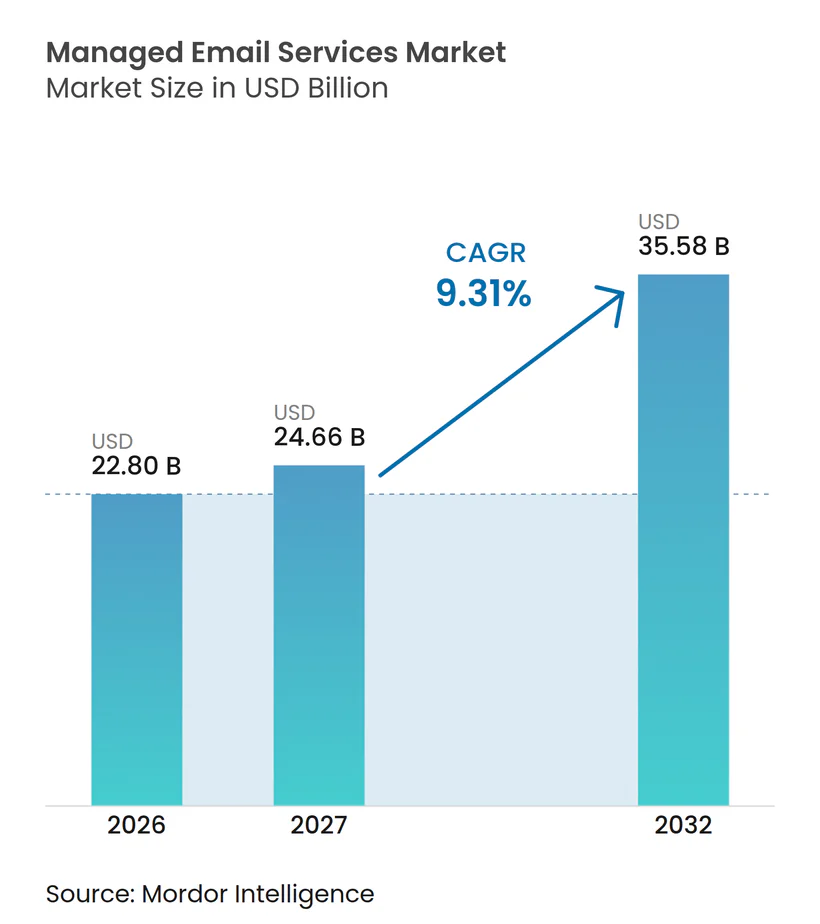
| Market Size (2027) | USD 24.66 Billion |
| Market Size (2032) | USD 35.58 Billion |
| Growth Rate (2027 - 2032) | 9.31 % |
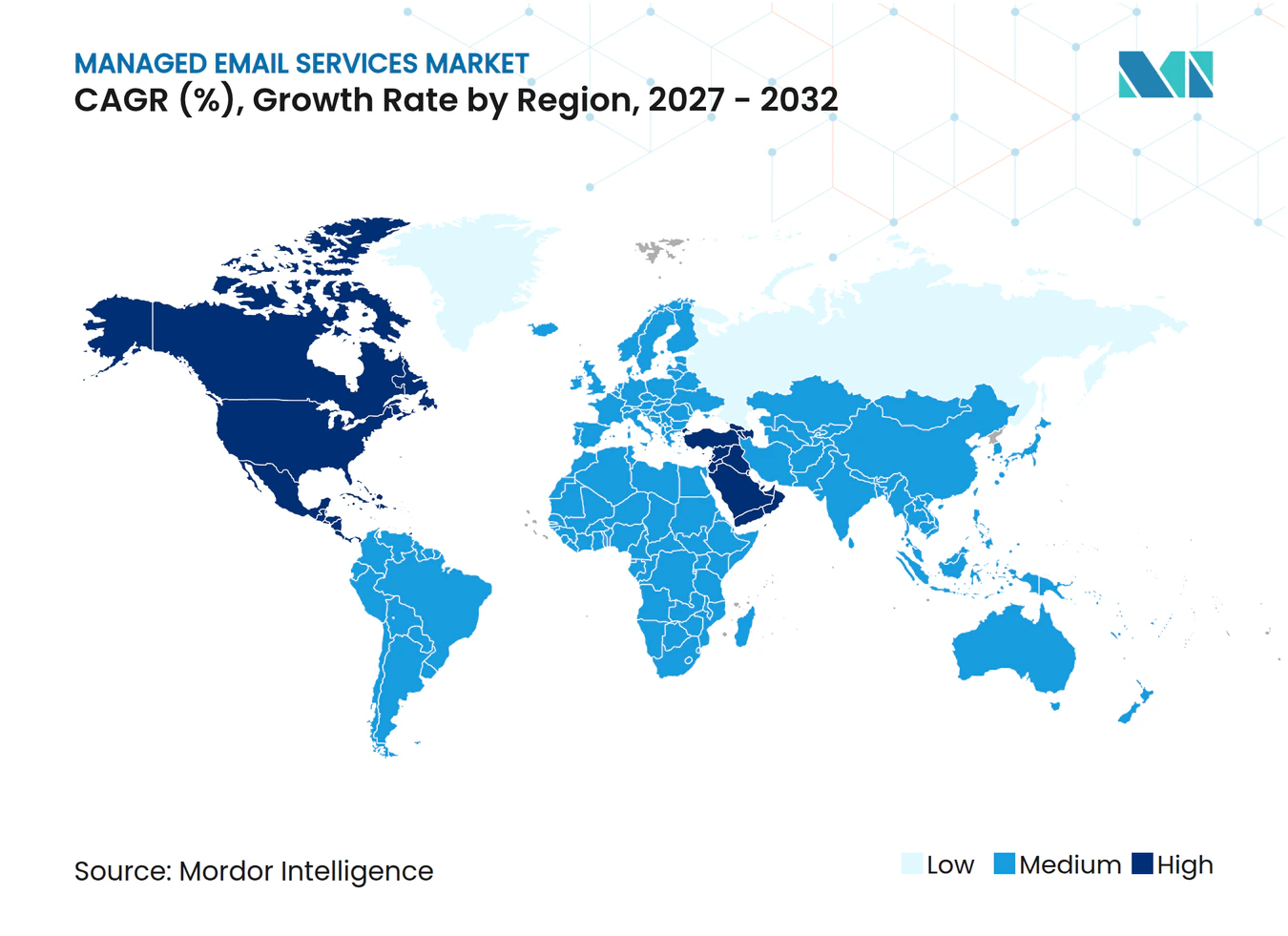
| Fastest Growing Market | Middle East |
| Largest Market | North America |
| Market Concentration | Medium |
Major Players *Disclaimer: Major Players sorted in no particular order Image © Mordor Intelligence. Reuse requires attribution under CC BY 4.0. | |
Managed Email Services Market Analysis by Mordor Intelligence
The Managed Email Services Market size is projected to expand from USD 22.80 billion in 2026 to USD 35.58 billion by 2032, registering a CAGR of 9.31% between 2027 and 2032. The managed email services market is shifting from in-house administration toward externally operated hosting, security, compliance, and mailbox support. Email remains a material entry point for enterprise attacks, while retention obligations and hybrid work have made mailboxes harder to manage internally. Providers are increasingly competing on security overlays, compliance controls, and service response rather than basic hosting alone. Bundled protections from Microsoft 365 and Google Workspace limit demand for entry-level offerings, particularly among price-sensitive buyers. This leaves the strongest opportunities in regulated organizations and in locations where data residency, incident response, and compliance requirements exceed the capabilities of bundled tools.
Key Report Takeaways
- By service type, email hosting and mailbox operations held 35.61% of the market in 2026, while email security and threat protection is projected to expand at a 10.82% CAGR through 2032.
- By organization size, large enterprises accounted for 64.62% of the market in 2026, while SMEs are projected to expand at a 10.75% CAGR through 2032.
- By security and management function, spam, malware, and phishing filtering held 23.69% of the market in 2026, while integrated cloud email security is projected to expand at a 10.63% CAGR through 2032.
- By customer type, managed service providers and resellers held 29.99% of the Managed Email Services Market in 2026 and are projected to expand at a 10.25% CAGR through 2032.
- By geography, North America accounted for 37.98% of the market in 2026, while the Middle East is projected to expand at a 10.79% CAGR through 2032.
Note: Market numbers in this report are based on Mordor Intelligence's proprietary estimation framework, which combines nine months of actuals with Q4 projections for base year 2026.
Market Trends and Insights
Drivers Impact Analysis of Managed Email Services Market*
| Driver | (~) % Impact on CAGR Forecast | Geographic Relevance | Impact Timeline |
|---|---|---|---|
| Rising Phishing, Business Email Compromise, and Ransomware Exposure | +2.3% | Global, with acute concentration in North America and Asia-Pacific | Short term (≤ 2 years) |
| Enterprise Cloud Migration and Hybrid Workforce Expansion | +1.8% | Global, strongest in North America, Europe, and Asia-Pacific | Medium term (2–4 years) |
| AI-Enabled Threat Detection and Automated Mailbox Operations | +1.4% | Global, led by North America and Europe | Medium term (2–4 years) |
| Regulatory Demand for Retention, E-Discovery, and Data Protection | +1.1% | Europe and North America, with spillover to Asia-Pacific and the Middle East | Long term (≥ 4 years) |
| Demand for 24/7 Managed Expertise and Faster Incident Response | +0.8% | Global, with elevated demand in BFSI and healthcare | Short term (≤ 2 years) |
| Sovereign-Cloud and Provider-Independent Email Requirements | +0.5% | Europe, the Middle East, and Asia-Pacific national markets | Long term (≥ 4 years) |
| Source: Mordor Intelligence | |||
Rising Phishing, Business Email Compromise, and Ransomware Exposure
The managed email services market is supported by the continuing scale and changing nature of email-based intrusion attempts. The Anti-Phishing Working Group recorded 3.8 million phishing attacks globally in 2025, showing the volume that corporate mail systems must manage. Wire-transfer business email compromise attacks rose 136% in Q4 2025 from Q3, and the average fraudulent wire request reached USD 50,297.[1] Deceptive links appeared in 52% of malicious emails in 2025, compared with 43% in 2024, as attackers used generative AI to make messages more convincing. Cloudflare also reported that more than 5% of global email traffic was malicious in 2025, a 16% year-over-year increase. Scripted Sparrow sends an estimated 6 million targeted emails each month to accounts-payable teams, which illustrates why continuous monitoring is becoming more important.
Enterprise Cloud Migration and Hybrid Workforce Expansion
Cloud-hosted email has become the standard operating model for many enterprises, supporting demand across the managed email services market. Eurostat reported that 85.15% of European Union enterprises using paid cloud computing used cloud email in 2025. Paid cloud use among all European Union enterprises reached 52.74% in 2025, an increase of 7.42 percentage points from 2023.[2] Ireland’s enterprise cloud email adoption rose from 52.3% in 2023 to 64.2% in 2025, including progress in manufacturing and construction. Hybrid work expands the number of devices and locations connecting to corporate mailboxes, which raises administrative and security demands. As Microsoft 365 and Google Workspace take a larger role in hosting, providers can increasingly differentiate through security, compliance, and service layers that sit on top of those platforms.
AI-Enabled Threat Detection and Automated Mailbox Operations
Artificial intelligence is changing the operating model for the managed email services market by expanding detection coverage without a matching increase in staffing. A 2026 IEEE study reported 96.03% accuracy for a hybrid classifier that distinguished legitimate email, human-authored phishing, and LLM-generated phishing.[3] Cloudflare reduced missed malicious detections by 20.4% between Q3 and Q4 2025 through AI refinements. Providers can use automation for policy templates, onboarding guidance, and anomaly triage. These functions can reduce the personnel costs that limit margins in managed operations. Faster detection and remediation are important because an active business email compromise campaign can progress in less than 24 hours.
Regulatory Demand for Retention, E-Discovery, and Data Protection
The managed email services market is broadening the role of providers beyond daily mailbox administration. Article 21 of the NIS2 Directive requires risk-management measures that include encryption, multi-factor authentication, and supply-chain security where appropriate. These requirements increase the need for controlled email environments among mid-sized and large European organizations. The European Commission proposed targeted NIS2 amendments in January 2026, which could extend obligations to additional categories of entities. In the United States, healthcare and financial services organizations must manage preservation, retention, and discovery obligations for electronic communications. Organizations operating across jurisdictions often seek a single provider for archiving, compliance, and incident reporting, which can increase contract scope and duration.
Restraints Impact Analysis of Managed Email Services Market*
| Restraint | (~) % Impact on CAGR Forecast | Geographic Relevance | Impact Timeline |
|---|---|---|---|
| Bundled Protection Within Microsoft 365 and Google Workspace | -1.7% | Global, with the highest SME concentration in North America and Europe | Short term (≤ 2 years) |
| High Integration, Migration, and Ongoing Monitoring Costs | -1.2% | Global, disproportionately affecting mid-market and emerging-market organizations | Medium term (2–4 years) |
| Shortage of Skilled Email Security and Compliance Professionals | -0.8% | Global, strongest in Asia-Pacific and the Middle East and Africa | Medium term (2–4 years) |
| API Throttling, Data-Residency Constraints, and Privacy Pushback | -0.5% | Europe and Asia-Pacific, with spillover to the Middle East | Long term (≥ 4 years) |
| Source: Mordor Intelligence | |||
Bundled Protection Within Microsoft 365 and Google Workspace
Bundled security within large productivity suites narrows the addressable demand for standalone services in the managed email services market. Microsoft Defender for Office 365 and Google Workspace provide spam, malware, and safe-link protections within their broader subscriptions. This is particularly influential among smaller organizations that have limited security budgets. Advanced business email compromise, LLM-generated spear phishing, and zero-day link manipulation can still require additional monitoring beyond initial platform defenses. Organizations in BFSI and healthcare may also avoid relying on one provider for both the email platform and all security telemetry. Providers that position their tools as API-native overlays, rather than replacements for Microsoft 365 or Google Workspace, can address this concern more effectively.
High Integration, Migration, and Ongoing Monitoring Costs
Integration, migration, and continuous tuning can make the full cost of a managed email service higher than the quoted subscription price. This issue is most visible in organizations that operate legacy Exchange, Microsoft 365, and Google Workspace at the same time. Consistent policy enforcement in those environments can require custom integration, longer implementation periods, and slower adoption across the managed email services market. Fortinet found that 71% of organizations considered the cybersecurity skills shortage a material risk in 2026, up from 67% in 2024. SANS found that 60% of organizations identified the skills gap as their leading workforce challenge, while 55% needed 6 months or longer to fill senior cybersecurity roles. Pre-built migration tools, automated policy ingestion, and professional-services support can help providers convert projects that otherwise stall during evaluation.
*Our forecasts treat driver/restraint impacts as directional, not additive. The impact forecasts reflect baseline growth, mix effects, and variable interactions.
Managed Email Services Market Segment Analysis
By Service Type:
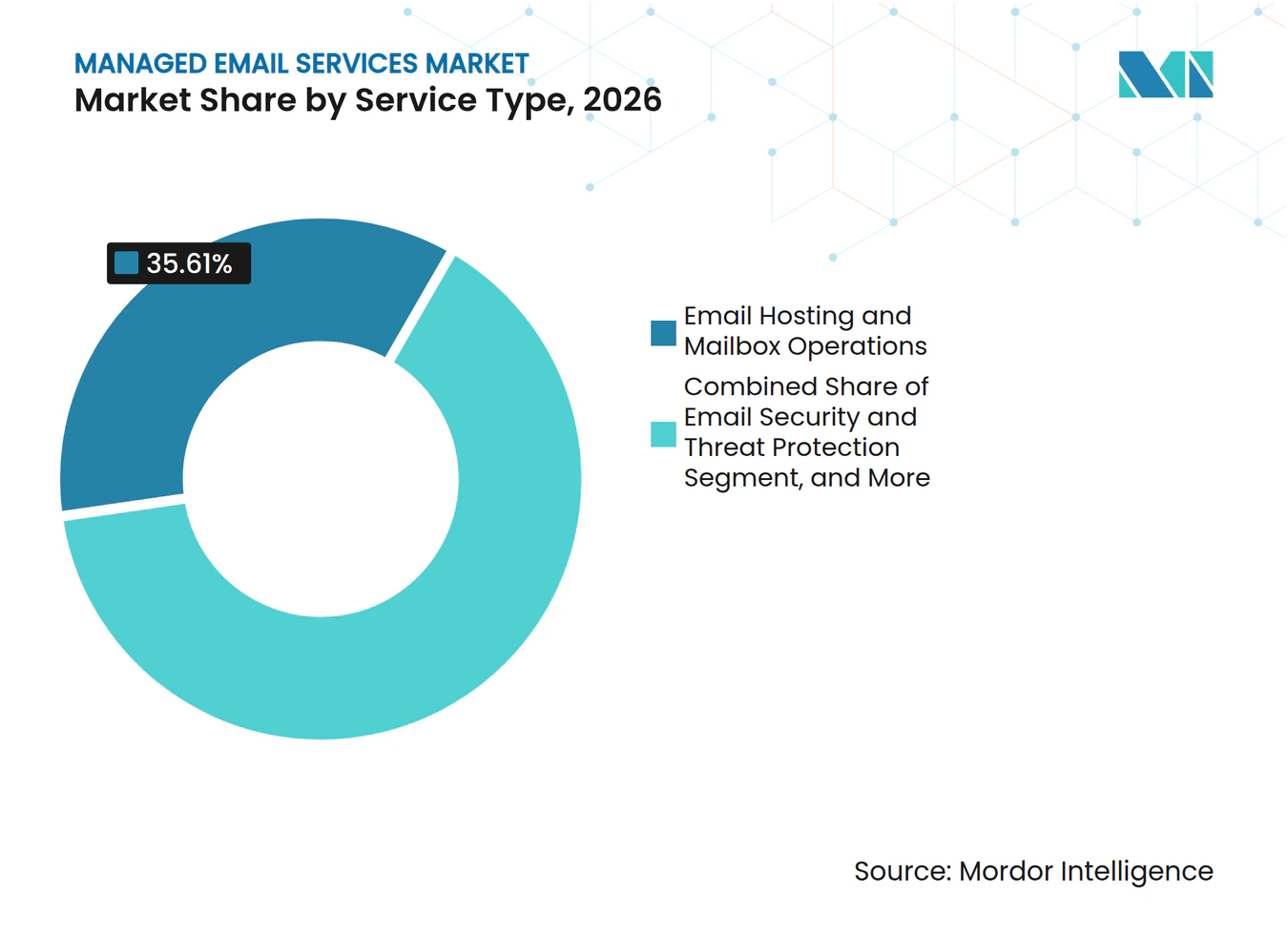
Security and Compliance Services Gain ImportanceEmail hosting and mailbox operations held 35.61% of the Managed Email Services Market share in 2026. This service gives providers recurring relationships that can support later security, compliance, and archiving sales. Hosting remains important because enterprises need reliable administration, mailbox provisioning, and ongoing operational support. It is also becoming more standardized as Microsoft 365 and Google Workspace host a greater share of enterprise mailboxes. This standardization puts pressure on providers that offer only basic mailbox management. It also directs competition toward specialized services that solve operational and regulatory needs. Email security and threat protection is projected to expand at a 10.82% CAGR through 2032. This pace reflects the burden that complex email attacks place on internal security teams.
Within the managed email services market, deliverability, authentication, and reputation management have moved beyond routine administration for many senders. Google’s bulk-sender requirements, introduced in 2024, raised the importance of DMARC-based authentication for organizations that send high volumes of email. Managed support can help organizations maintain authentication records and protect sending reputation. Archiving, compliance, and e-discovery services are also important for financial services organizations facing electronic communications retention requirements. Continuity, backup, and disaster recovery services address the need for recoverable mail data during legal review and incident investigation. Migration and professional services remain relevant as organizations consolidate legacy Exchange systems into cloud environments. As basic hosting becomes more interchangeable, service providers that combine security, compliance intelligence, and skilled operational support have more room to differentiate.



By Organization Size:
SME Adoption Expands the Addressable BaseLarge enterprises accounted for 64.62% of the managed email services market in 2026. Their leading position reflects earlier adoption of comprehensive management across multiple regions and complex IT environments. Large organizations often have stronger requirements for archiving, e-discovery, and continuous incident management. They also have the budget to procure dedicated professional services during migrations and policy changes. Their mix of platforms and business units can make uniform email controls difficult to maintain internally. These conditions support long-term managed service contracts. SMEs are projected to expand at a 10.75% CAGR through 2032. Their higher pace reflects the wider availability of multi-tenant platforms and channel-led delivery.
This wider use of cloud services gives smaller organizations a practical route to managed mailbox and security offerings. Managed service providers can apply standardized policies and threat intelligence across many customers through one multi-tenant environment. That model improves per-customer economics and makes enterprise-grade controls accessible to smaller companies. Proofpoint completed its USD 1.8 billion acquisition of Hornetsecurity in December 2025, expanding its access to Microsoft 365 security customers in the SMB and MSP channel. Regulated SMEs face many of the same data protection and reporting duties as large organizations, but they usually have fewer internal specialists. This makes managed services a practical option when compliance demands exceed in-house capacity.
By Security and Management Function:
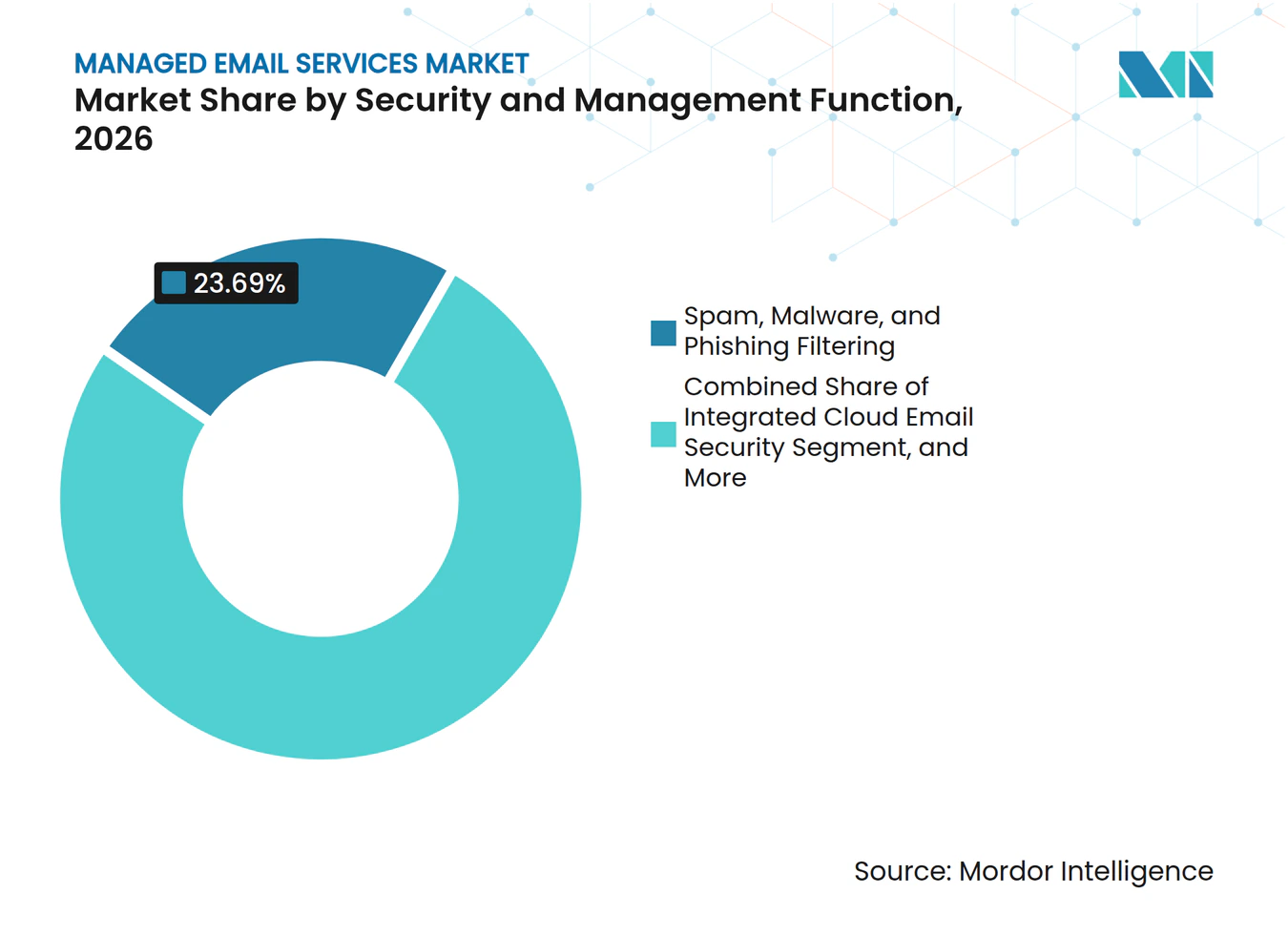
Integrated Cloud Email Security AdvancesSpam, malware, and phishing filtering held 23.69% of the market in 2026. Filtering remains the first control layer for almost every business email environment. It blocks routine unwanted mail and common malicious content before it reaches users. Organizations continue to require these controls even when they deploy more advanced tools. The function also provides an entry point for broader security contracts. Its large installed base makes it important for retention and cross-selling. Integrated cloud email security is projected to expand at a 10.63% CAGR through 2032. Its adoption reflects the movement from perimeter gateways toward mailbox-layer inspection and response.
Integrated cloud email security can support pre-delivery scanning, post-delivery message retraction, and behavioral monitoring. These functions are useful when account compromise or link changes occur after a message has entered the mailbox. Research presented at ACL EMNLP 2026 found that structural hiding techniques could reduce the performance of many non-LLM classifiers to below chance. This supports the case for security systems that use more adaptive detection methods. Email encryption and data loss prevention are also gaining importance because audit programs commonly examine email controls. Archiving and compliance services meet preservation requirements, while continuity services address the need for more granular recovery and forensic access. The resulting portfolio allows providers to package prevention, detection, retention, and recovery within the same service relationship.

By Customer Type:
Managed Service Providers and Resellers Lead the ChannelManaged service providers and resellers held 29.99% of the managed email services market in 2026. The same customer group is projected to expand at a 10.25% CAGR through 2032. This makes it the only segmentation group in which the largest and fastest-expanding designation overlaps. Multi-tenant delivery is central to that position. Providers can standardize policy management, threat intelligence, reporting, and onboarding across many SME accounts. This operating model reduces the cost of delivering security and compliance functions at smaller customer scale. It also gives technology vendors an efficient route into fragmented customer bases.
TitanHQ reported that 1 in 5 organizations served by MSPs lost money through a business email compromise attack during the previous 12 months. That exposure creates a commercial reason for MSPs to offer stronger managed security as part of client retention. The managed email services market also serves direct enterprise customers that buy these services as an additional layer around existing Microsoft 365 or Google Workspace environments. BFSI, healthcare, public-sector bodies, and educational institutions can have high renewal potential because of compliance and continuity needs. Retail, e-commerce, IT, telecom, manufacturing, energy, and utilities also face procurement and accounts-payable phishing risks. Providers that can show measurable detection, response, and reporting outcomes are better placed to serve those customer groups.
Geography Analysis
North America accounted for 37.98% of the Managed Email Services Market share in 2026. The region benefits from a large base of regulated enterprises and mature multi-cloud infrastructure within the managed email services market. Financial services, healthcare, and government organizations create demand for archiving, e-discovery, and around-the-clock incident management. The United States represents most regional spending because of its concentration of large enterprise buyers. Canada adds demand through cloud-first government technology adoption, while Mexico benefits as multinational manufacturers strengthen email security. North America also has a concentration of specialist vendors whose domestic customer references support international sales.
The Middle East is projected to expand at a 10.79% CAGR through 2032, the fastest rate among the reported regions. In the managed email services market, Saudi Arabia’s Vision 2030 investments, rising enterprise cloud adoption in the United Arab Emirates, and expanding cybersecurity requirements support this position. The United Arab Emirates has become a regional MSP hub serving the Gulf Cooperation Council. Israel contributes a strong cybersecurity innovation base. South America is led by Brazil, where the Lei Geral de Proteção de Dados has raised awareness of email compliance. Argentina and Chile contribute smaller regional positions, while uneven cloud adoption and macroeconomic volatility limit broader uptake. Africa remains at an earlier stage, with South Africa leading the continent and Nigeria, Kenya, and Egypt emerging as demand centers.
Europe is a regulation-led part of the managed email services market. NIS2 requirements concerning security measures for network and information systems are broadening the group of organizations that need compliance-grade email controls. Germany leads adoption with support from national cybersecurity guidance, while France has increased interest in sovereign cloud workloads. Proposed January 2026 NIS2 amendments could create another procurement cycle across the European mid-market. Asia-Pacific benefits from increasing cloud use, with Japan providing an established email security base and India offering a large opportunity among IT and BPO organizations. Proofpoint Japan held 29.1% of Japan’s anti-spam email market by shipment value in 2025. India’s large base of enterprise email environments, combined with limited internal security capacity in some organizations, supports demand for managed operations.
Competitive Landscape
Market Concentration
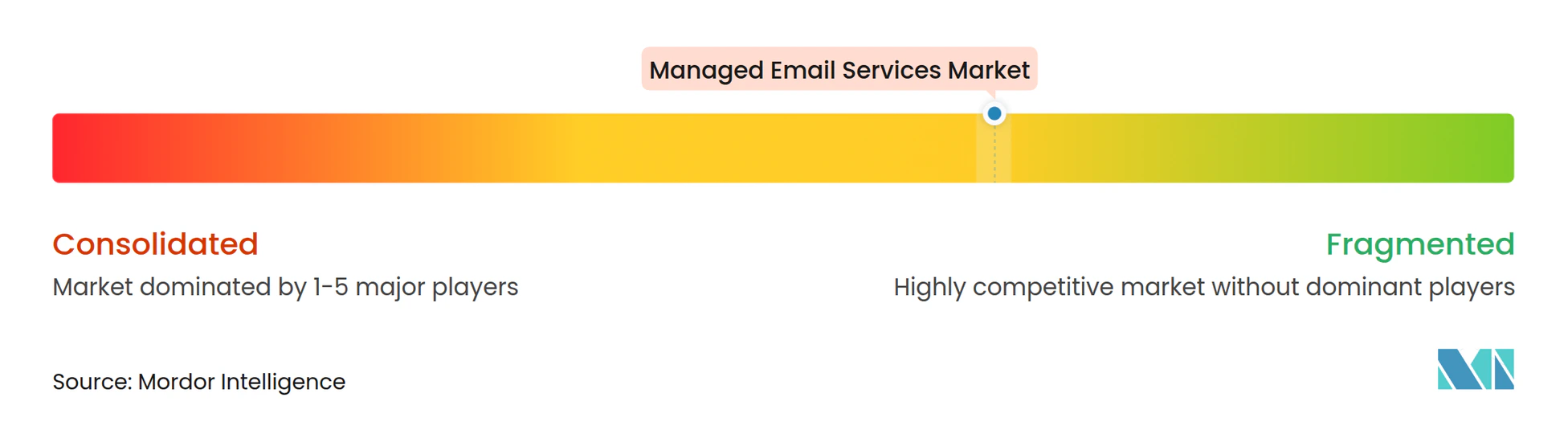
The managed email services market is moderately fragmented. Established cybersecurity platforms, specialist email security firms, and hosted email infrastructure providers compete from different positions in the value chain. Basic hosting is increasingly available through hyperscaler platforms, which directs service providers toward security, compliance, continuity, and response services. This creates a clear split between broad platform providers and narrower specialists. Platform providers are extending their offerings into insider risk, identity, and cloud security. Behavioral-AI specialists compete through detection quality and investigation speed. Hosted infrastructure vendors continue to serve customers that require controlled mailbox environments and tailored operations.
Proofpoint completed its USD 1.8 billion acquisition of Hornetsecurity in December 2025, adding access to the European MSP and SMB channel. The company later announced a USD 6.3 billion definitive agreement to acquire Varonis Systems in October 2026. These transactions show a move toward integrated email, human risk, and data security capabilities. Proofpoint also joined the Microsoft Integrated Cloud Email Security ecosystem, supporting an API-native approach that operates alongside hyperscaler mail platforms. KPN introduced KPN Mail and Cloud in October 2026 with European Union-based data storage, two-factor authentication, and built-in phishing and virus protection. These moves reflect a competitive focus on coexisting with productivity platforms while meeting sovereign-data and security requirements.
Opportunities in the managed email services market remain in sovereign-cloud deployments for government and critical-infrastructure operators. Compliance-as-a-service is also relevant for mid-market organizations in the Middle East and Southeast Asia. LuxSci, Echoworx, and MailChannels serve narrower compliance, encryption, or deliverability requirements. Topsec Cloud Solutions serves Asia-Pacific customers where data-residency needs can favor local providers. MailSPEC launched CommuniGate SPEC 8.1 in April 2026 for organizations that require sovereign, on-premises, and air-gapped email deployments. Research on agent-native email gateways indicates that sender authentication, phishing detection, and prompt-injection screening may increasingly be combined within delivery infrastructure. This gives providers a reason to invest in integrated controls that protect both messages and the systems that process them.
Managed Email Services Industry Leaders
-
Proofpoint, Inc.
-
Barracuda Networks, Inc.
-
Mimecast Limited
-
Hornetsecurity GmbH
-
Retarus GmbH
- *Disclaimer: Major Players sorted in no particular order
Managed Email Services Market Companies Covered in this Report
- Mimecast Limited
- Proofpoint, Inc.
- Barracuda Networks, Inc.
- Hornetsecurity GmbH
- Retarus GmbH
- Open-Xchange GmbH
- IceWarp, Inc.
- Atmail Pty Ltd
- Alinto SAS
- Intermedia.net, Inc.
- Rackspace Technology, Inc.
- Egress Software Technologies Ltd.
- IRONSCALES Ltd.
- Abnormal Security Corporation
- MailChannels Corporation
- MailRoute, Inc.
- Topsec Cloud Solutions Limited
- EnGuard, LLC
- LuxSci, Inc.
- Echoworx Corporation
Recent Industry Developments in Managed Email Services Market
- October 2026: Proofpoint announced a USD 6.3 billion definitive agreement to acquire Varonis Systems, combining email and human risk management with data security posture management and data detection and response technologies. Disclosed October 15, 2026 via Proofpoint's newsroom, the deal positions the combined entity as a global leader in protecting against AI-accelerated threats and data risks.
- October 2026: KPN introduced KPN Mail and Cloud, a sovereign email and storage service with data storage exclusively within the European Union, built-in two-factor authentication, and phishing and virus protection as standard, per KPN's corporate communications.
- September 2026: Proofpoint expanded AI-powered investigation capabilities to Microsoft 365 by launching Proofpoint Prism Investigator and Human Communications Intelligence, enabling organizations to analyze intent across human and AI interactions, disclosed September 10, 2026.
- April 2026: MailSPEC launched CommuniGate SPEC 8.1, a sovereign on-premises email and unified messaging platform for finance, healthcare, defense contractors, and government agencies requiring jurisdictional control and air-gapped deployments, supporting ITAR, CMMC, and NIST 800-171/800-53, announced Paris, April 14, 2026.
Global Managed Email Services Market Report Scope
The Managed Email Services Market comprises outsourced and cloud-based services delivered by specialized providers to manage, secure, optimize, and support an organization’s email infrastructure and communications environment.
The Managed Email Services Market Report is Segmented by Service Type (Email Hosting and Mailbox Operations, Email Security and Threat Protection, Email Archiving, Compliance, and E-Discovery, Email Continuity, Backup, and Disaster Recovery, Email Migration, Integration, and Professional Services, Deliverability, Authentication, and Reputation Management), Organization Size (Large Enterprises, Small and Medium-Sized Enterprises), Security and Management Function (Secure Email Gateway, Integrated Cloud Email Security, Email Encryption and Data Loss Prevention, Email Archiving and Compliance, Spam, Malware, and Phishing Filtering, Email Continuity and Disaster Recovery), Customer Type (Managed Service Providers and Resellers, Direct Enterprise Customers, Public Sector and Educational Institutions, Healthcare Organizations, Banking, Financial Services, and Insurance, Retail and E-Commerce, IT and Telecom, Manufacturing, Energy, and Utilities), and Geography (North America [United States, Canada, Mexico], South America [Brazil, Argentina, Chile, Rest of South America], Europe [Germany, United Kingdom, France, Italy, Spain, Russia, Rest of Europe], Asia-Pacific [China, Japan, India, South Korea, Australia and New Zealand, Rest of Asia-Pacific], Middle East [Saudi Arabia, United Arab Emirates, Turkey, Israel, Rest of Middle East], Africa [South Africa, Nigeria, Kenya, Egypt, Rest of Africa]). The Market Forecasts are Provided in Terms of Value (USD).
Segmentation Overview
| Email Hosting and Mailbox Operations |
| Email Security and Threat Protection |
| Email Archiving, Compliance, and E-Discovery |
| Email Continuity, Backup, and Disaster Recovery |
| Email Migration, Integration, and Professional Services |
| Deliverability, Authentication, and Reputation Management |
| Large Enterprises |
| Small and Medium-Sized Enterprises |
| Secure Email Gateway |
| Integrated Cloud Email Security |
| Email Encryption and Data Loss Prevention |
| Email Archiving and Compliance |
| Spam, Malware, and Phishing Filtering |
| Email Continuity and Disaster Recovery |
| Managed Service Providers and Resellers |
| Direct Enterprise Customers |
| Public Sector and Educational Institutions |
| Healthcare Organizations |
| Banking, Financial Services, and Insurance |
| Retail and E-Commerce |
| IT and Telecom |
| Manufacturing, Energy, and Utilities |
| North America | United States |
| Canada | |
| Mexico | |
| South America | Brazil |
| Argentina | |
| Chile | |
| Rest of South America | |
| Europe | Germany |
| United Kingdom | |
| France | |
| Italy | |
| Spain | |
| Russia | |
| Rest of Europe | |
| Asia-Pacific | China |
| Japan | |
| India | |
| South Korea | |
| Australia and New Zealand | |
| Rest of Asia-Pacific | |
| Middle East | Saudi Arabia |
| United Arab Emirates | |
| Turkey | |
| Israel | |
| Rest of Middle East | |
| Africa | South Africa |
| Nigeria | |
| Kenya | |
| Egypt | |
| Rest of Africa |
| By Service Type | Email Hosting and Mailbox Operations | |
| Email Security and Threat Protection | ||
| Email Archiving, Compliance, and E-Discovery | ||
| Email Continuity, Backup, and Disaster Recovery | ||
| Email Migration, Integration, and Professional Services | ||
| Deliverability, Authentication, and Reputation Management | ||
| By Organization Size | Large Enterprises | |
| Small and Medium-Sized Enterprises | ||
| By Security and Management Function | Secure Email Gateway | |
| Integrated Cloud Email Security | ||
| Email Encryption and Data Loss Prevention | ||
| Email Archiving and Compliance | ||
| Spam, Malware, and Phishing Filtering | ||
| Email Continuity and Disaster Recovery | ||
| By Customer Type | Managed Service Providers and Resellers | |
| Direct Enterprise Customers | ||
| Public Sector and Educational Institutions | ||
| Healthcare Organizations | ||
| Banking, Financial Services, and Insurance | ||
| Retail and E-Commerce | ||
| IT and Telecom | ||
| Manufacturing, Energy, and Utilities | ||
| By Geography | North America | United States |
| Canada | ||
| Mexico | ||
| South America | Brazil | |
| Argentina | ||
| Chile | ||
| Rest of South America | ||
| Europe | Germany | |
| United Kingdom | ||
| France | ||
| Italy | ||
| Spain | ||
| Russia | ||
| Rest of Europe | ||
| Asia-Pacific | China | |
| Japan | ||
| India | ||
| South Korea | ||
| Australia and New Zealand | ||
| Rest of Asia-Pacific | ||
| Middle East | Saudi Arabia | |
| United Arab Emirates | ||
| Turkey | ||
| Israel | ||
| Rest of Middle East | ||
| Africa | South Africa | |
| Nigeria | ||
| Kenya | ||
| Egypt | ||
| Rest of Africa | ||
Key Questions Answered in the Report
What is the size of the managed email services market?
The managed email services market is valued at USD 22.80 billion in 2026 and is projected to reach USD 35.58 billion by 2032, at a 9.31% CAGR from 2027 to 2032.
What is driving demand for managed email services?
Phishing volume, business email compromise (BEC), cloud migration, hybrid work models, and compliance requirements are increasing the need for externally managed security and mailbox operations.
Which managed email service is expanding fastest?
Email Security and Threat Protection is projected to expand at a 10.82% CAGR through 2032, faster than the other reported service types.
Which organizations are adopting these services fastest?
SMEs are projected to expand at a 10.75% CAGR through 2032 as multi-tenant delivery models make advanced email security and management capabilities more accessible.
Which region leads spending on managed email services?
North America held 37.98% of the global market in 2026, supported by a large base of regulated enterprises and mature cloud infrastructure adoption.
What is the leading channel for managed email delivery?
Managed Service Providers (MSPs) and Resellers held 29.99% market share in 2026 and are projected to expand at a 10.25% CAGR through 2032.