
DMARC Management Services Market Size and Share
Market Overview
| Study Period | 2020 - 2031 |
|---|---|
| Market Size (2026) | USD 1.45 Billion |
| Market Size (2031) | USD 2.61 Billion |
| Growth Rate (2026 - 2031) | 12.40 % |
| Fastest Growing Market | Asia-Pacific |
| Largest Market | North America |
| Market Concentration | Medium |
Major Players *Disclaimer: Major Players sorted in no particular order Image © Mordor Intelligence. Reuse requires attribution under CC BY 4.0. | |
DMARC Management Services Market Analysis by Mordor Intelligence
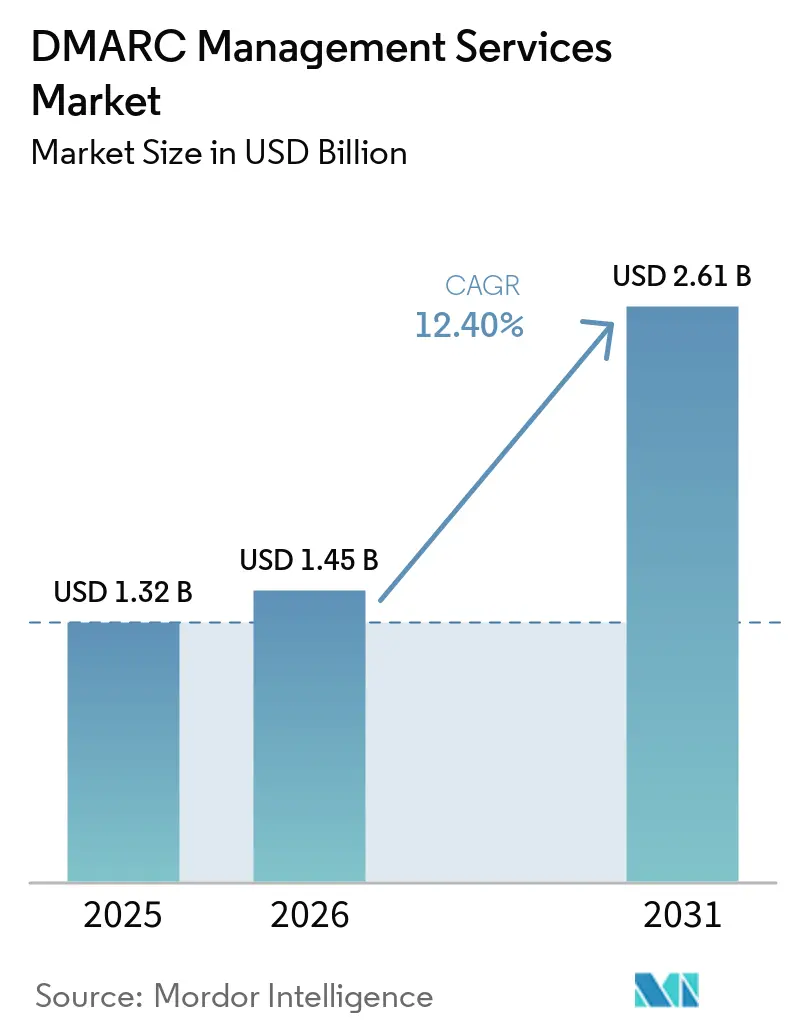
The DMARC management services market size was valued at USD 1.32 billion in 2025 and is estimated to grow from USD 1.45 billion in 2026 to reach USD 2.61 billion by 2031, growing at a CAGR of 12.40% from 2026 to 2031. Rising losses from business email compromise are pushing email authentication into core security planning. Bulk-sender requirements and payment-security obligations have made DMARC deployment a more immediate priority for many organizations. The main opportunity lies in shifting domains from monitoring to enforcement policies without disrupting legitimate email. Providers are responding with managed monitoring, policy support, threat intelligence, and integrations with broader security tools. Competition increasingly depends on the ability to support complex sender environments, multi-domain programs, and managed service providers.
Key Report Takeaways
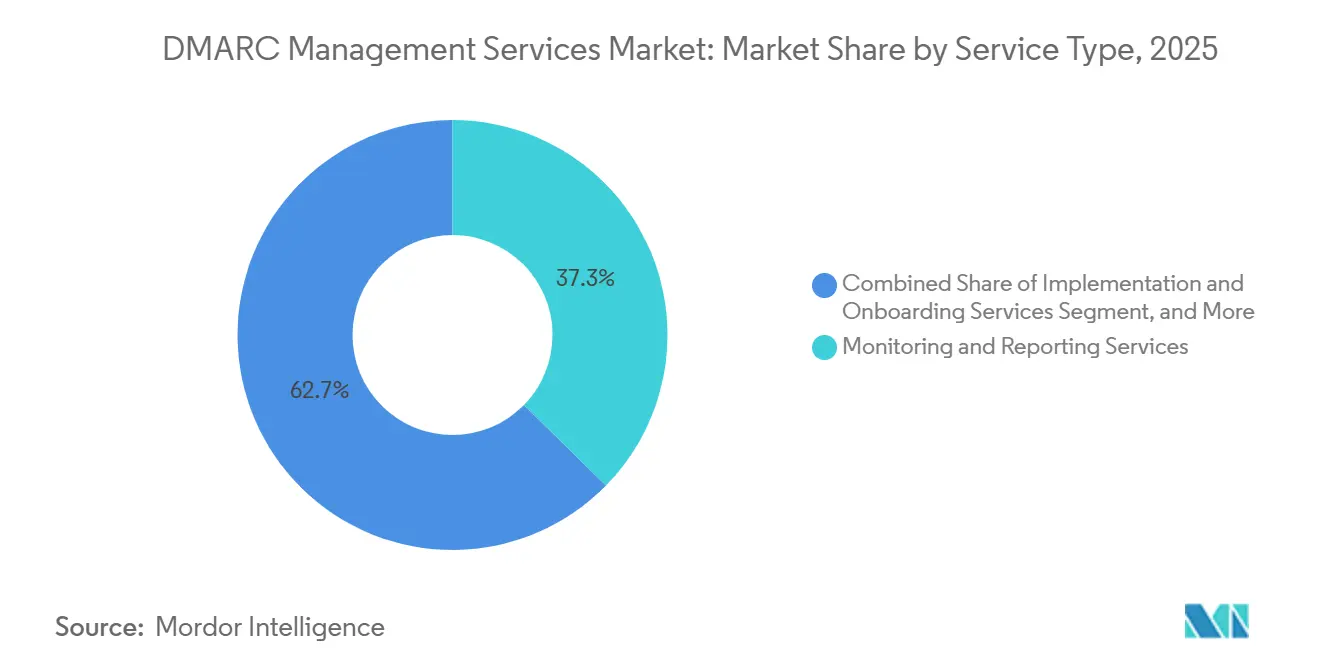
- By service type, monitoring and reporting services held 37.34% of the DMARC management services market share in 2025, while threat detection and incident response services are projected to expand at a 13.44% CAGR through 2031.
- By organization size, large enterprises held 70.29% of the DMARC management services market share in 2025, while small and medium-sized enterprises are projected to expand at a 13.72% CAGR through 2031.
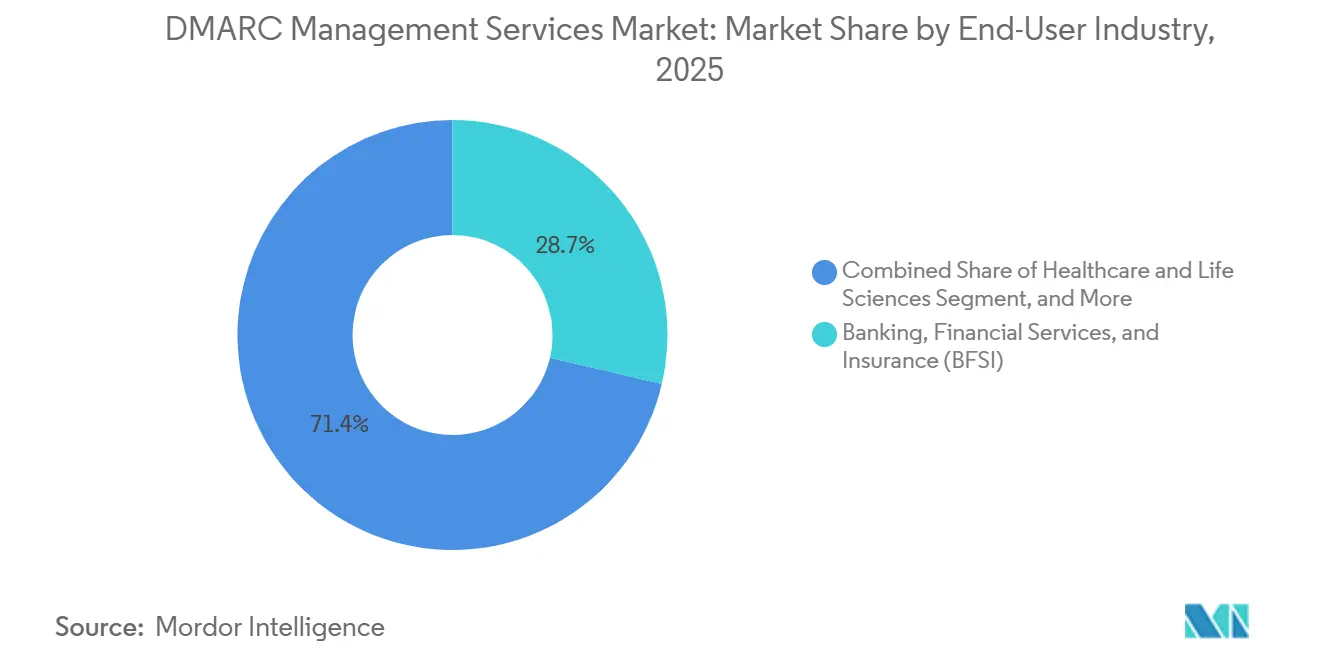
- By end-user industry, BFSI held 28.65% of the DMARC management services market share in 2025, while healthcare and life sciences are projected to expand at a 12.89% CAGR through 2031.
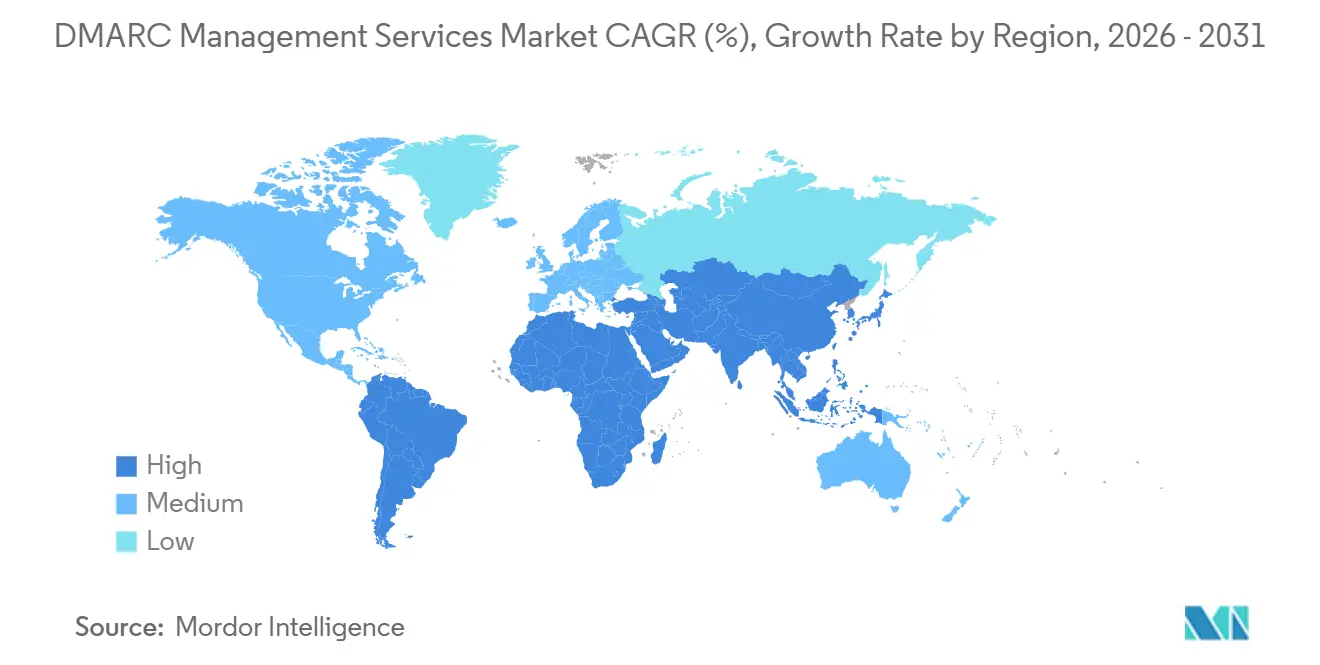
- By geography, North America held 36.78% of the DMARC management services market share in 2025, while Asia-Pacific is projected to expand at a 13.21% CAGR through 2031.
Note: Market size and forecast figures in this report are generated using Mordor Intelligence’s proprietary estimation framework, updated with the latest available data and insights as of January 2026.
Global DMARC Management Services Market Trends and Insights
Drivers Impact Analysis*
| Driver | (~) % Impact on CAGR Forecast | Geographic Relevance | Impact Timeline |
|---|---|---|---|
| Rising Email-Based Phishing, Spoofing, and Domain Impersonation Threats | +4.2% | Global | Short term (≤ 2 years) |
| Increasing Adoption of DMARC Enforcement Policies | +2.8% | North America and Europe, spill-over to Asia-Pacific | Medium term (2-4 years) |
| Growing Complexity of Enterprise Email Ecosystems | +1.9% | Global, concentrated in North America | Medium term (2-4 years) |
| Increasing Multi-Domain and Multi-Brand Management Requirements | +1.3% | North America and Europe | Long term (≥ 4 years) |
| Growing Demand for Managed Cybersecurity Services | +1.1% | Global | Short term (≤ 2 years) |
| Expansion of Email Authentication Requirements Across Digital Communication Channels | +0.7% | North America and Europe | Medium term (2-4 years) |
| Source: Mordor Intelligence | |||
Rising Email-Based Phishing, Spoofing, and Domain Impersonation Threats
The FBI recorded USD 3.04 billion in business email compromise losses during 2025. This figure was 10% higher than the USD 2.77 billion reported for 2024, based on 21,442 complaints. Business email compromise commonly involves fraudulent wire instructions and vendor impersonation, which makes domain authentication relevant to financial controls. The Anti-Phishing Working Group recorded 971,181 phishing attacks in the first quarter of 2026, up from 853,244 in the fourth quarter of 2025. The volume of attacks increases the operational burden on security teams that must distinguish legitimate senders from fraudulent domains. The DMARC management services market benefits when organizations need continuous sender analysis, policy support, and incident handling rather than periodic record checks.
Increasing Adoption of DMARC Enforcement Policies
Mailbox-provider requirements have turned DMARC from an optional security practice into a practical sending requirement for many organizations. Google and Yahoo started applying bulk-sender requirements in February 2024, and Microsoft began enforcing comparable requirements for high-volume Outlook.com senders on May 5, 2025.[1] These requirements require a published DMARC record and aligned SPF and DKIM controls for domains that meet the volume threshold. PCI DSS v4.0 became mandatory in 2025, strengthening the case for compliance with phishing controls. A p=none policy provides visibility, but it does not prevent unauthorized messages from being sent from a domain. Managed providers can guide customers through quarantine and reject policies while protecting legitimate mail flows. The DMARC management services market gains recurring work through policy staging, sender validation, and compliance reporting.
Growing Complexity of Enterprise Email Ecosystems
Large organizations often use dozens of third-party applications to send messages through corporate domains. Marketing platforms, customer relationship tools, billing systems, human resources software, and customer support platforms each require proper authentication. SPF has a 10-lookup DNS limit, so a growing sender stack can cause authentication failures if not managed carefully. Germany's Federal Office for Information Security identified SPF configuration issues and the continued use of p=none policies as important email security weaknesses in its May 2025 guidance. The issue is more complex for organizations that have acquired businesses, operate subsidiaries, or manage separate brands. The DMARC management services market benefits from this complexity, as sender discovery and policy maintenance become ongoing security tasks. Providers in the DMARC management services market can shorten the path from monitoring to enforcement by automating these tasks.
Growing Demand for Managed Cybersecurity Services
Demand for outsourced security operations broadens the customer base for managed email-authentication services. Many domains publish DMARC records but remain in monitoring mode because internal teams lack the time or specialized skills to act on reporting data. This creates a recurring need for sender monitoring, alert triage, policy staging, and management reporting. Managed service providers can package these tasks alongside other security services for organizations that do not operate a dedicated email security team. Barracuda reported that analysts processed threats across more than 3.1 billion emails in January 2026, showing the scale of work that security teams face. DMARC telemetry can connect with security information and event management workflows, favoring services that combine domain authentication with continuing review and response.
Restraints Impact Analysis*
| Restraint | (~) % Impact on CAGR Forecast | Geographic Relevance | Impact Timeline |
|---|---|---|---|
| Complexity of DMARC Deployment Across Legacy and Third-Party Email Infrastructure | -2.1% | Global, pronounced in Asia-Pacific and South America | Medium term (2-4 years) |
| Availability of Low-Cost and Free DMARC Monitoring Tools | -1.6% | Global | Short term (≤ 2 years) |
| Limited In-House Awareness and Technical Expertise | -1.4% | Asia-Pacific, South America, and Africa | Medium term (2-4 years) |
| Risk of Legitimate Email Disruption During Policy Enforcement | -0.9% | Global | Short term (≤ 2 years) |
| Source: Mordor Intelligence | |||
Complexity of DMARC Deployment Across Legacy and Third-Party Email Infrastructure
Legacy mail servers, acquired infrastructure, and software-as-a-service communication tools can slow DMARC implementation. Each sending domain needs alignment across SPF, DKIM, and DMARC, while third-party providers may use shared IP addresses or have limited signing support. Organizations with 10 or more domains face this work across every domain-and-sender relationship. Valimail reported that 78% of tracked domains had published a DMARC record in 2026, but only 42% had moved to active enforcement. The gap shows that publication does not always result in effective protection, while multi-month projects can delay purchases when buyers underestimate the work involved. Providers in the DMARC management services market can reduce this barrier by improving sender discovery and managing SPF constraints.
Availability of Low-Cost and Free DMARC Monitoring Tools
Free and low-cost tools limit revenue opportunities for organizations with a single domain and simple sending arrangements. These offerings can provide basic record validation, aggregate-report parsing, and policy guidance. The competition is strongest where a customer only needs visibility and has limited operational complexity. Managed providers need to offer capabilities that free tools lack, including multi-domain governance, sender discovery, BIMI support, security operations integration, and remediation workflows. Free tools can expose hidden sender problems when an organization reviews DMARC reports, prompting buyers to seek paid help as their policy and infrastructure needs grow. The DMARC management services market can retain demand when its offerings focus on enforcement and ongoing operations.
*Our forecasts treat driver/restraint impacts as directional, not additive. The impact forecasts reflect baseline growth, mix effects, and variable interactions.
Segment Analysis
By Service Type: Monitoring Leads While Threat Detection Drives Value Migration
Monitoring and reporting services held 37.34% share in 2025. The segment provides aggregate-report parsing, sender visualization, and alignment diagnostics that reveal the systems sending on behalf of a domain. These functions typically initiate a corporate DMARC program and provide security teams with the evidence needed to identify legitimate senders. A large monitoring base also shows that many customers have not completed enforcement because none of the policies collect reports without directing recipient servers to quarantine or reject unauthorized mail. This position creates a practical path within the DMARC management services market for policy enforcement and optimization services that test legitimate senders, resolve alignment issues, and strengthen the policy.
Threat detection and incident response services are projected to expand at a 13.44% CAGR through 2031. Within the DMARC management services market, this category uses forensic DMARC data, threat intelligence, and lookalike-domain monitoring to identify misuse of a brand or domain, providing an operational response layer beyond routine reporting. Policy enforcement can require months of staged work as email environments change, supporting recurring revenue and compliance evidence for regulated organizations. Implementation and onboarding remain important for new deployments because they cover domain inventories, initial configuration, and policy design. EasyDMARC launched its Email Trust Platform in September 2026 with agentic observability, which reflects demand for continuous governance rather than one-time configuration.

By Organization Size: Enterprise Revenue Base and SME Growth Frontier
Large enterprises held 70.29% share in 2025. Their spending reflects multi-domain environments, larger email programs, and compliance duties related to HIPAA, SOX, PCI DSS v4.0, and the NIST Cybersecurity Framework 2.0. Large buyers in the DMARC management services market face greater exposure to brand impersonation and fraud because they operate customer-facing domains at scale. EasyDMARC reported that more than 80% of Fortune 500 companies had moved beyond monitoring by early 2026. Higher enforcement rates shift enterprise demand toward response retainers, BIMI projects, and integration with security operations centers, while DigiCert integrated Valimail monitoring into UltraDNS in June 2026 for enterprise portfolios.
Small and medium-sized enterprises are projected to expand at a 13.72% CAGR through 2031. These organizations often lack dedicated security staff, even when several cloud applications send customer emails through their domains. Affordable subscriptions and managed-service delivery have lowered the cost of professional deployment, with monthly pricing ranging from USD 49 to USD 499 per domain, shifting the purchase to an operating expense. Google, Yahoo, and Microsoft sender requirements have created defined reasons for smaller organizations to address authentication, while managed service providers can deploy and manage the service across multiple client domains. EasyDMARC reported that it supports more than 3,000 managed service provider partners, giving the DMARC management services market a broader pool of managed-service customers.
By End-User Industry: BFSI Anchors Demand While Healthcare Moves Faster
BFSI held 28.65% share in 2025. Financial institutions face business email compromise, payment redirection, and spoofing attacks that target consumer and corporate brands. The FBI reported USD 3.046 billion in business email compromise losses in 2025. Allure Security found that banking and finance brands faced more than 120 phishing and impersonation attacks per day in 2025. PCI DSS v4.0 provides a compliance basis for authentication controls, while multi-brand programs, subsidiary domains, and correspondent relationships support demand for managed enforcement services.
Healthcare and life sciences are projected to expand at a 12.89% CAGR through 2031. Valimail reported 57.42% enforcement in healthcare during 2026, above the global average, yet many domains remained without active protection.[2] The sector handles patient data under HIPAA, and the U.S. Department of Health and Human Services has identified business email compromise as a persistent threat to healthcare organizations. IT and telecommunications, government and public administration, retail and e-commerce, manufacturing, education, and media also create demand. Government users respond to formal directives, while retailers and media businesses need stronger brand protection, and educational institutions often manage large domains with limited security budgets, broadening the end-user base for the DMARC management services market.
Geography Analysis
North America held 36.78% share in 2025. The North American DMARC management services market combines a large enterprise base with obligations tied to CISA guidance, NIST Cybersecurity Framework 2.0, HIPAA, SOX, and PCI DSS v4.0. The USD 3.046 billion in business email compromise losses reported for 2025 gives organizations a clear financial reason to fund managed email authentication. U.S. Fortune 500 companies had enforcement rates above 80% in early 2026, indicating that mature buyers are shifting toward optimization and response services. Canada benefits from cross-border compliance needs, while South America remains earlier in its adoption cycle as multinationals extend global policies to regional domains.
Asia-Pacific is projected to expand at a 13.21% CAGR through 2031. Japan has a large opportunity because record publication has outpaced enforcement, with 37.2% DMARC adoption across JP domains in December 2025. TwoFive found 94.2% record adoption among Nikkei 225 firms in November 2025, but only 63.6% had an enforcement-level policy. India had 50% p=reject adoption among Forbes Asia-Pacific firms, while 83% of Fortune Southeast Asia 500 companies lacked p=reject protection.[3] The Asia-Pacific DMARC management services market remains dependent on multinational standards and mailbox provider requirements because it lacks a unified regional framework.
Germany had 67.2% DMARC record adoption in 2025, but only 17.5% of domains had a p=reject policy, illustrating the remaining enforcement gap in Europe. NIS2, GDPR, and DORA make email controls more relevant to governance for essential and critical entities. Germany's BSI called for organizations to implement SPF, DKIM, and DMARC in May 2025. The European DMARC management services market is supported by sector-specific requirements in the United Kingdom, France, Italy, and Spain, while the Middle East and Africa remain earlier-stage areas for outsourced cybersecurity adoption.
Competitive Landscape
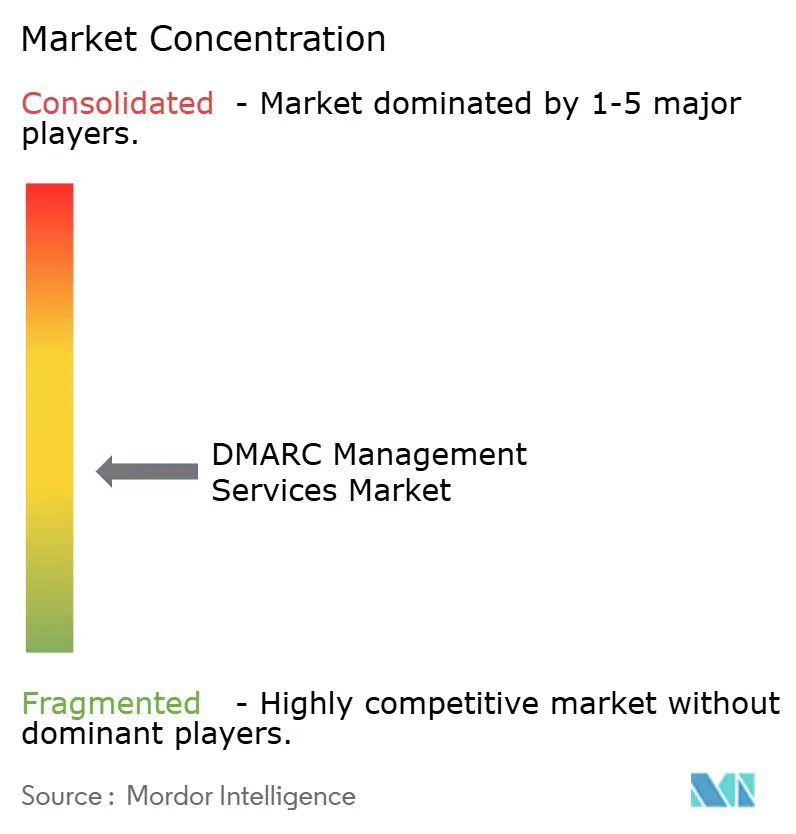
The DMARC management services market is moderately fragmented. Pure-play providers include DMARCian, PowerDMARC, EasyDMARC, Sendmarc, Fraudmarc, and DMARC Advisor, which compete through authentication depth, deployment support, managed service provider reach, and platform usability. Larger vendors such as Proofpoint and Mimecast package DMARC capabilities with inbound threat protection. Their broader product offerings create cross-sell opportunities and can strengthen retention, while specialists differentiate themselves through deeper sender visibility and policy enforcement.
Partnerships and integrations are important competitive tools. Red Sift became Cloudflare's preferred DMARC partner, extended its Microsoft Intelligent Security Association relationship through an OnDMARC integration with Microsoft Sentinel, and partnered with GMO GlobalSign in June 2026 to link DMARC enforcement with BIMI activation. DigiCert acquired Valimail in September 2025 and integrated Valimail monitoring into UltraDNS in June 2026. These moves bring DNS, authentication, certificates, and security operations closer together for enterprise buyers. The DMARC management services market is likely to reward providers that align with existing security and domain management workflows.
AI-supported operations are a key area of product differentiation in the DMARC management services market. PowerDMARC launched its Model Context Protocol server in May 2026, Red Sift introduced a Brand Trust AI Agent in its Spring 2026 release, and EasyDMARC launched its Email Trust Platform in September 2026 with agentic observability. Basic monitoring is under pressure from free tools, reducing the value of simple record checks. Providers are responding with AI-assisted sender discovery, multi-domain controls, threat intelligence, and remediation workflows. The strongest opportunities remain in managed services for small and medium-sized enterprises and Asia-Pacific enforcement projects.
DMARC Management Services Industry Leaders
-
Valimail, Inc.
-
Red Sift Ltd.
-
Proofpoint, Inc.
-
Validity, Inc.
-
EasyDMARC Inc.
- *Disclaimer: Major Players sorted in no particular order
Recent Industry Developments
- September 2026: EasyDMARC, trusted by more than 90,000 organizations across 130 countries, launched its Email Trust Platform on September 23, 2026, introducing agentic observability and a centralized operational model for email infrastructure. The platform enables continuous oversight of email infrastructure behavior, moving organizations from one-time DMARC configuration to active governance, a significant product-positioning shift toward autonomous managed services in a market previously defined by static monitoring tools.
- June 2026: DigiCert announced on June 18, 2026, the integration of Valimail DMARC monitoring capabilities directly into DigiCert UltraDNS, enabling one-click activation of DMARC monitoring for UltraDNS customers. By combining DNS management with email authentication monitoring in a single platform, DigiCert is converging two previously separate management workflows, a move that could meaningfully reduce the sales cycle for enterprise DMARC deployment by eliminating vendor procurement for a separate monitoring tool.
- June 2026: Red Sift and GMO GlobalSign announced a strategic partnership on June 15, 2026, making Red Sift OnDMARC available through the GlobalSign portfolio. The partnership provides organizations with an integrated path from DMARC enforcement to BIMI activation using a GlobalSign Verified Mark Certificate or Common Mark Certificate, reducing a process that previously required coordination across multiple vendors to a single-provider engagement.
- May 2026: PowerDMARC launched its Model Context Protocol server on May 11, 2026, enabling AI assistants and MCP-compatible clients to read and act on live DMARC account data. The capability allows customers and managed service providers to connect AI workflows directly to DMARC telemetry, marking one of the first instances of AI agent integration with live email authentication data in the managed services segment.
Global DMARC Management Services Market Report Scope
The DMARC Management Services Market comprises managed and professional services that assist organizations in implementing, monitoring, optimizing, and enforcing Domain-based Message Authentication, Reporting, and Conformance (DMARC) policies across their email ecosystems. These services help organizations strengthen email authentication, prevent domain spoofing, mitigate phishing and business email compromise (BEC) attacks, improve email deliverability, and maintain compliance with industry and regulatory requirements through ongoing monitoring, reporting, policy management, and threat response.
The DMARC Management Services Market Report is Segmented by Service Type (Implementation and Onboarding Services, Monitoring and Reporting Services, Policy Enforcement and Optimization Services, Threat Detection and Incident Response Services, Managed Authentication and Compliance Services, and Other Service Types), Organization Size (Small and Medium-Sized Enterprises, and Large Enterprises), End-User Industry (Banking, Financial Services, and Insurance [BFSI], IT and Telecommunications, Healthcare and Life Sciences, Government and Public Administration, Retail and E-Commerce, Industrial Manufacturing, Education and Research Institutions, Media and Entertainment, and Other End-User Industries), and Geography (North America, South America, Europe, Asia-Pacific, Middle East, and Africa). The Market Forecasts are Provided in Terms of Value (USD).
| Implementation and Onboarding Services |
| Monitoring and Reporting Services |
| Policy Enforcement and Optimization Services |
| Threat Detection and Incident Response Services |
| Managed Authentication and Compliance Services |
| Other Service Types |
| Small and Medium-Sized Enterprises |
| Large Enterprises |
| Banking, Financial Services, and Insurance (BFSI) |
| IT and Telecommunications |
| Healthcare and Life Sciences |
| Government and Public Adminstration |
| Retail and E-Commerce |
| Industrial Manufacturing |
| Education and Research Institutions |
| Media and Entertainment |
| Other End-User Industries |
| North America | United States |
| Canada | |
| South America | Brazil |
| Argentina | |
| Mexico | |
| Rest of South America | |
| Europe | United Kingdom |
| Germany | |
| France | |
| Italy | |
| Spain | |
| Rest of Europe | |
| Asia-Pacific | China |
| Japan | |
| India | |
| South Korea | |
| Australia | |
| Singapore | |
| Rest of Asia-Pacific | |
| Middle East | United Arab Emirates |
| Saudi Arabia | |
| Turkey | |
| Israel | |
| Rest of Middle East | |
| Africa | South Africa |
| Nigeria | |
| Egypt | |
| Rest of Africa |
| By Service Type | Implementation and Onboarding Services | |
| Monitoring and Reporting Services | ||
| Policy Enforcement and Optimization Services | ||
| Threat Detection and Incident Response Services | ||
| Managed Authentication and Compliance Services | ||
| Other Service Types | ||
| By Organization Size | Small and Medium-Sized Enterprises | |
| Large Enterprises | ||
| By End-User Industry | Banking, Financial Services, and Insurance (BFSI) | |
| IT and Telecommunications | ||
| Healthcare and Life Sciences | ||
| Government and Public Adminstration | ||
| Retail and E-Commerce | ||
| Industrial Manufacturing | ||
| Education and Research Institutions | ||
| Media and Entertainment | ||
| Other End-User Industries | ||
| By Geography | North America | United States |
| Canada | ||
| South America | Brazil | |
| Argentina | ||
| Mexico | ||
| Rest of South America | ||
| Europe | United Kingdom | |
| Germany | ||
| France | ||
| Italy | ||
| Spain | ||
| Rest of Europe | ||
| Asia-Pacific | China | |
| Japan | ||
| India | ||
| South Korea | ||
| Australia | ||
| Singapore | ||
| Rest of Asia-Pacific | ||
| Middle East | United Arab Emirates | |
| Saudi Arabia | ||
| Turkey | ||
| Israel | ||
| Rest of Middle East | ||
| Africa | South Africa | |
| Nigeria | ||
| Egypt | ||
| Rest of Africa | ||
Key Questions Answered in the Report
What is the DMARC management services market size?
The DMARC management services market was valued at USD 1.32 billion in 2025 and is forecast to reach USD 2.61 billion by 2031, at a 12.40% CAGR from 2026 to 2031.
What is driving demand for managed DMARC services?
Business email compromise losses, phishing volume, sender requirements from major mailbox providers, and the complexity of multi-platform email environments are increasing demand.
Which service type leads DMARC management services?
Monitoring and reporting services led with 37.34% share in 2025, while threat detection and incident response services are projected to grow fastest at a 13.44% CAGR through 2031.
Why do organizations need help moving from p=none to p=reject?
Organizations must identify every legitimate sender and maintain SPF and DKIM alignment before enforcement. Managed providers help reduce the risk of blocking valid email.
Which customer group is growing fastest?
Small and medium-sized enterprises are projected to expand at a 13.72% CAGR through 2031 as subscription services and managed service providers lower deployment barriers.
Which region is expected to grow fastest?
Asia-Pacific is projected to expand at a 13.21% CAGR through 2031, supported by large gaps between record publication and active enforcement in several economies.