
Managed Business Email Compromise Protection Market Size and Share
Market Overview
| Study Period | 2021 - 2032 |
|---|---|
| Market Size (2027) | USD 3.12 Billion |
| Market Size (2032) | USD 6.46 Billion |
| Growth Rate (2027 - 2032) | 15.67 % |
| Fastest Growing Market | Asia-Pacific |
| Largest Market | North America |
| Market Concentration | Medium |
Major Players *Disclaimer: Major Players sorted in no particular order Image © Mordor Intelligence. Reuse requires attribution under CC BY 4.0. | |
Managed Business Email Compromise Protection Market Analysis by Mordor Intelligence
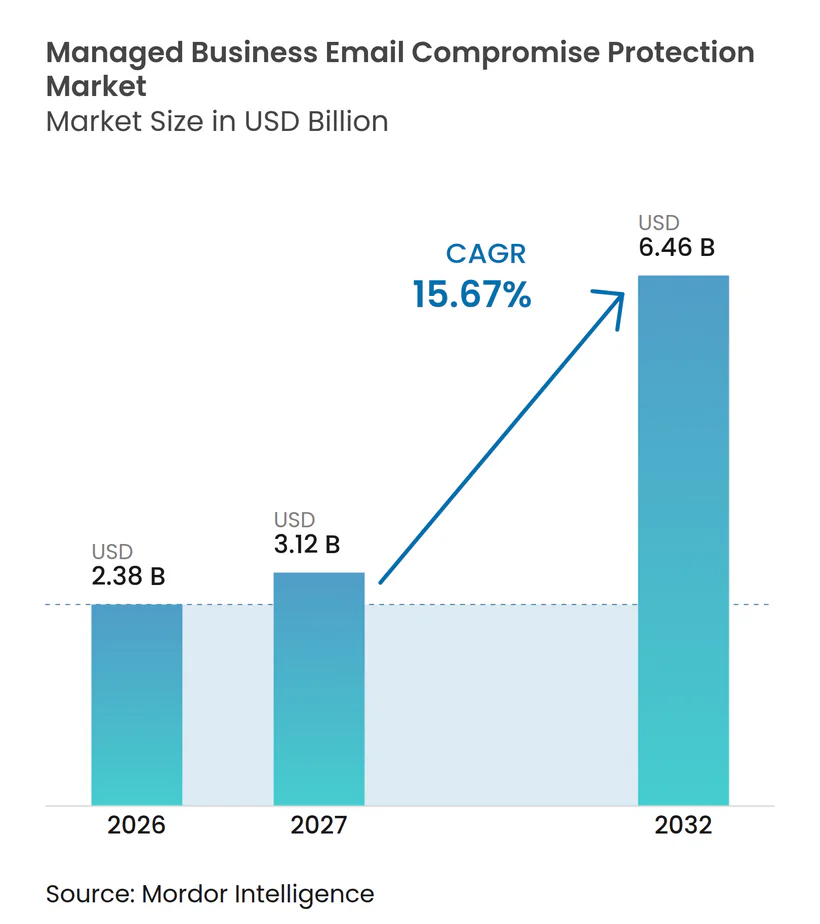
The managed business email compromise protection market size is projected to expand from USD 2.38 billion in 2026 to USD 2.38 billion in 2027, and to USD 6.46 billion by 2032, registering a CAGR of 15.67% from 2027 to 2032. Financial losses have shifted email compromise from a technical concern to a board-level risk, as payment diversion can cause immediate and material damage. Organizations are shifting from reactive filtering toward managed protection that combines behavioral detection, continuous monitoring, and post-delivery remediation. Cloud productivity platforms have widened the attack surface and increased the value of services that review tenant settings, identities, and messages together. Providers are also adapting their offerings as AI-generated impersonation makes conventional rules and manual review less reliable. Competition is increasingly shaped by acquisitions, API-based deployment, and the ability to deliver transparent alerts without creating a large volume of false positives.
Key Report Takeaways
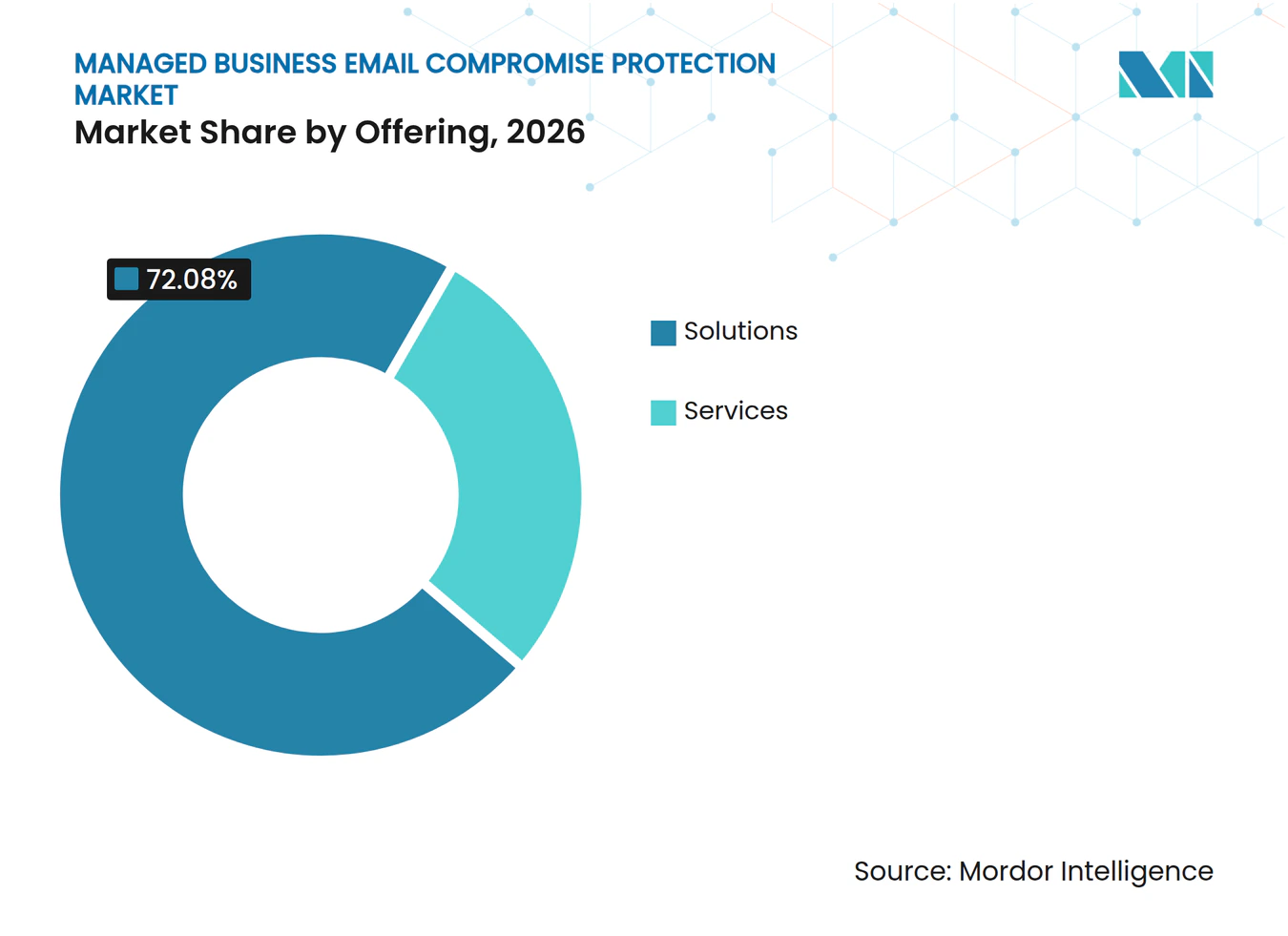
- By offering, Solutions held 72.08% of Managed business email compromise protection market revenue in 2026, while Services are projected to expand at a CAGR of 16.06% through 2032.
- By deployment model, Cloud-based deployment accounted for 70.32% of revenue in 2026 and is projected to grow at a 16.42% CAGR through 2032.
- By organization size, Large Enterprises held 62.39% of revenue in 2026, while SMEs are projected to expand at a CAGR of 16.19% through 2032.
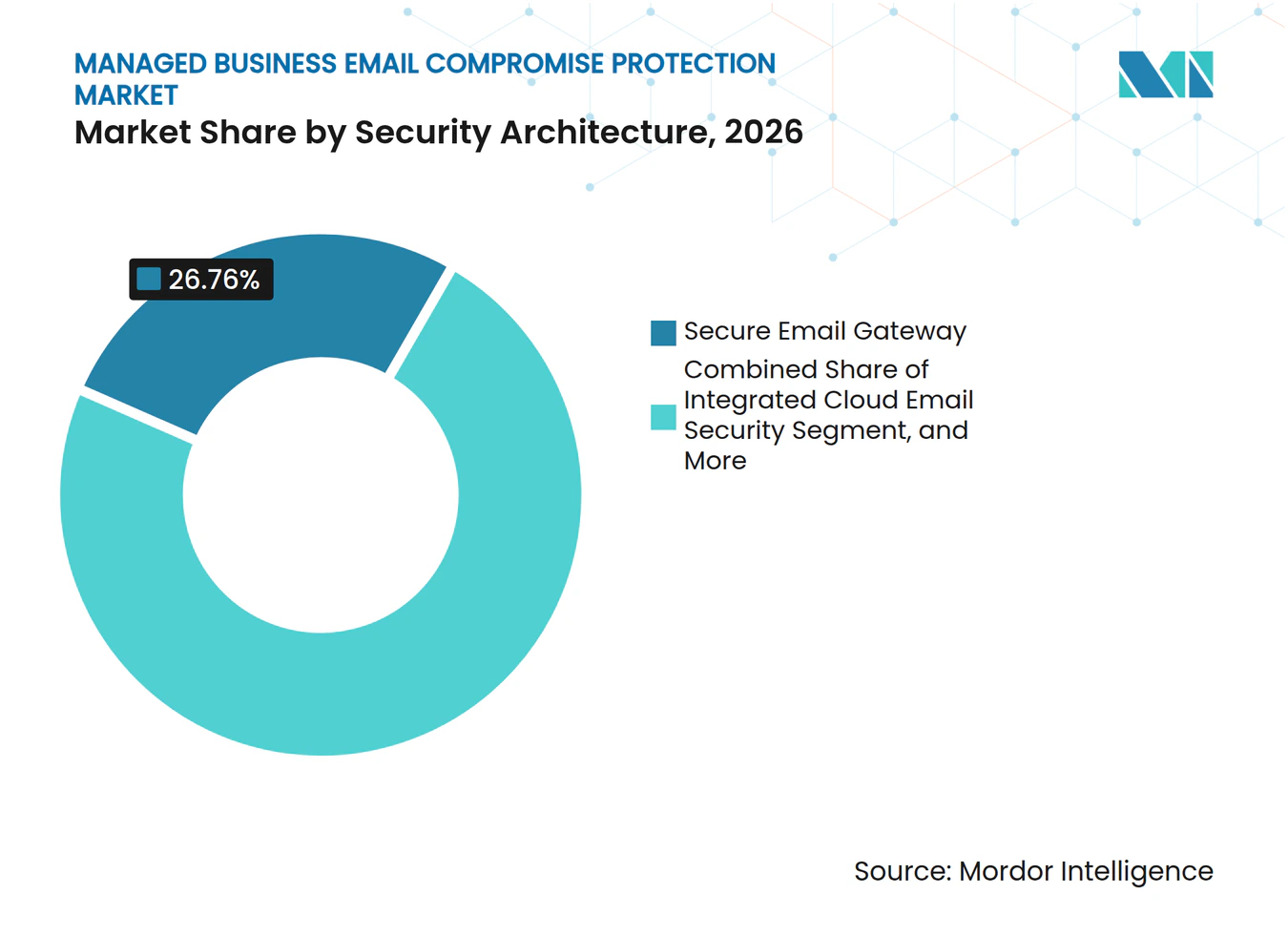
- By security architecture, Secure Email Gateway held 26.76% of revenue in 2026, while Integrated Cloud Email Security is projected to expand at a CAGR of 16.24% through 2032.
- By end-user industry, Information Technology and Telecommunications accounted for 25.82% of revenue in 2026, while Healthcare is projected to grow at a 16.83% CAGR through 2032.
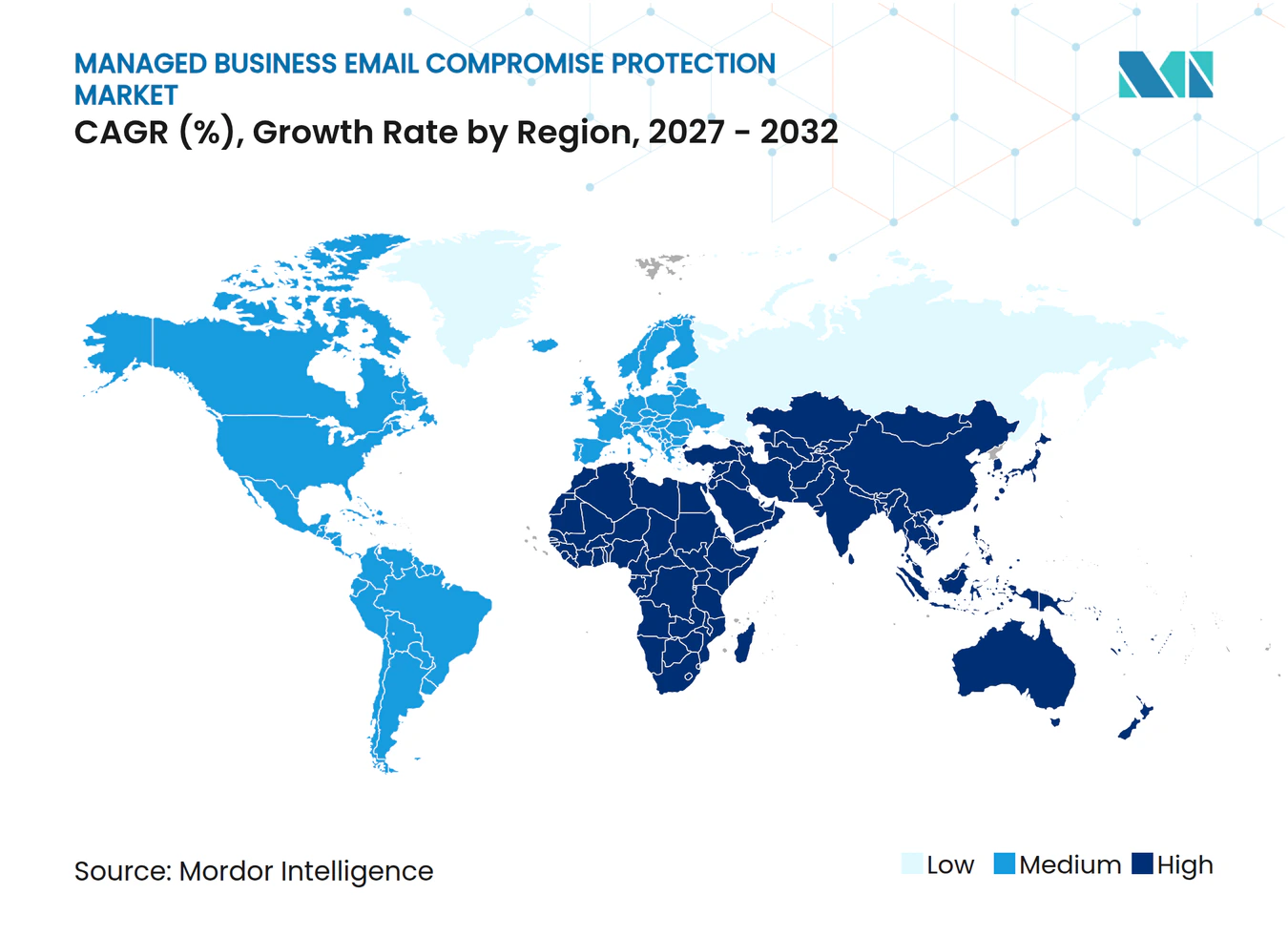
- By geography, North America held 43.18% of revenue in 2026, while Asia-Pacific is projected to expand at a CAGR of 16.31% through 2032.
Note: Market numbers in this report are based on Mordor Intelligence's proprietary estimation framework, which combines nine months of actuals with Q4 projections for base year 2026.
Market Trends and Insights
Drivers Impact Analysis of Managed Business Email Compromise Protection Market*
| Driver | (~) % Impact on CAGR Forecast | Geographic Relevance | Impact Timeline |
|---|---|---|---|
| Escalating Financial Losses From Business Email Compromise | +4.2% | Global | Short term (≤ 2 years) |
| Cloud Mailbox and Collaboration-Suite Expansion | +3.5% | Global, acceleration in Asia-Pacific and Europe | Medium term (2-4 years) |
| AI-Generated Impersonation and Conversation Hijacking | +2.5% | Global | Short term (≤ 2 years) |
| Regulatory and Cyber-Insurance Control Requirements | +1.8% | North America and EU, spill-over to Asia-Pacific core | Medium term (2-4 years) |
| Outsourcing of 24/7 Email Threat Monitoring to Managed Security Providers | +1.2% | Global, concentration in North America and Europe | Medium term (2-4 years) |
| API-Based Post-Delivery Detection and Automated Remediation | +0.8% | Global | Long term (≥ 4 years) |
| Source: Mordor Intelligence | |||
Escalating Financial Losses From Business Email Compromise
The rising cost of business email compromise has placed managed email protection on the board's risk discussions and shortened procurement cycles. The FBI recorded USD 3.05 billion in BEC losses from 24,768 complaints in 2025, up from USD 2.77 billion in 2024, and reported that 86% of related transactions used wire transfers or ACH. Vendor email compromise shows why verifying supplier identities before payment remains important. The use of legitimate vendor accounts can make basic sender checks less reliable. These patterns support demand for monitoring of supplier relationships, payment changes, and third-party domains. The managed business email compromise protection market benefits because buyers need coverage that links suspicious messages to financial workflows rather than treating each email as an isolated event.
Cloud Mailbox And Collaboration-Suite Expansion
The move to cloud-based productivity suites has redistributed email security risk rather than removing it. Proofpoint reported more than 321 million monthly active Microsoft 365 users and stated that more than 80% of Fortune 500 companies used Exchange Online as of September 2025. Cisco Talos documented active misuse of Microsoft 365 Exchange Online Direct Send in 2025, an exposure also described by several email security vendors in the supplied evidence. Cloud-based services can review inbox state, communication metadata, and identity signals after message delivery. This access allows providers to identify gaps in tenant configuration as well as malicious content. The managed business email compromise protection market, therefore, extends beyond gateway filtering into configuration governance for cloud mailboxes and collaboration accounts.
AI-Generated Impersonation And Conversation Hijacking
Generative AI has reduced the effort required to create credible impersonation messages and has weakened linguistic cues that users and rule-based filters once relied on. Okta documented VoidProxy in 2025 as a phishing-as-a-service platform that intercepted Microsoft 365 and Google Workspace authentication flows in real time.[1] The Canadian Center for Cyber Security found that BEC phishing accounted for 91% of more than 100 analyzed campaigns between 2023 and early 2025. The Anti-Phishing Working Group reported a 57% quarter-over-quarter increase in wire-transfer BEC attack volume in the third quarter of 2025. Behavioral models that assess relationship history, communication patterns, and payment context can detect attacks that look legitimate on the surface. This need for continuous model updates and human review supports managed delivery in the managed business email compromise protection market.
Regulatory And Cyber-Insurance Control Requirements
Email authentication and BEC controls are becoming formal requirements rather than optional security improvements. ENISA guidance for NIS2 risk management identifies controls, including encryption, multi-factor authentication, and secure communication practices relevant to email systems. DORA has applied to EU financial entities since January 2025 and requires an initial report for major ICT incidents within 4 hours. Rule 33-11216 requires registrants to disclose material cybersecurity incidents on Form 8-K within 4 business days after determining that an incident is material. Delinea found that threat detection requirements rose from 40% to 53% of cyber-insurance eligibility criteria year over year. The Managed business email compromise protection market benefits from these requirements, as managed providers can document controls, detection activities, and remediation steps for customers.
Restraints Impact Analysis of Managed Business Email Compromise Protection Market*
| Restraint | (~) % Impact on CAGR Forecast | Geographic Relevance | Impact Timeline |
|---|---|---|---|
| High False-Positive and Explainability Burden in AI Detection | -2.2% | Global | Short term (≤ 2 years) |
| Privacy and Data-Residency Constraints on Message and Relationship Analysis | -1.5% | EU, Asia-Pacific core, spill-over to Middle East and Africa | Medium term (2-4 years) |
| Budget Fragmentation Between Security, Finance, and Fraud-Prevention Functions | -0.9% | Global | Short term (≤ 2 years) |
| Dependence on Productivity-Suite APIs, Permissions, and Rate Limits | -0.6% | Global | Long term (≥ 4 years) |
| Source: Mordor Intelligence | |||
High False-Positive And Explainability Burden In AI Detection
AI-based BEC detection can create operational friction when a legitimate payment or executive message is quarantined without a clear reason. Finance teams and executive assistants may create workarounds after repeated false positives, reducing the effective coverage of a deployed service. Mimecast reported in 2025 that 48% of organizations said their detection controls did not stop rising BEC volumes at scale, while alert fatigue remained a problem. This combination shows why higher detection sensitivity alone does not guarantee user acceptance. Managed providers can differentiate through documented alert rationale and human-reviewed queues. However, maintaining that capability requires continued model tuning and limits rapid service scaling in the managed business email compromise protection market.
Privacy and Data-Residency Constraints on Message and Relationship Analysis
Behavioral detection requires historical metadata, communication patterns, and identity signals to establish a reliable baseline. Privacy rules in the EU, China, India, and other jurisdictions can restrict cross-border transfers of the data used for that analysis. These restrictions can fragment the data pool and reduce detection quality for customers who cannot fund local processing. SMEs are projected to grow at a CAGR of 16.19% through 2032, but their procurement options can be narrower in highly regulated jurisdictions. Providers can address this problem through regionally sovereign detection infrastructure. The capital required for multiple regional data environments can slow deployment across the managed business email compromise protection market.
*Our forecasts treat driver/restraint impacts as directional, not additive. The impact forecasts reflect baseline growth, mix effects, and variable interactions.
Managed Business Email Compromise Protection Market Segment Analysis
By Offering:
Solutions Lead Revenue While Services Change Delivery EconomicsSolutions held 72.08% of the managed business email compromise protection market revenue in 2026. The category includes gateway infrastructure, behavioral AI engines, email authentication tools, and data loss prevention platforms used by enterprise and mid-market customers. It captures initial deployment spending and recurring license renewals, while mature gateway replacement cycles provide a predictable revenue base as technology choices shift toward cloud-native products. Providers can use this installed base to introduce managed monitoring and remediation services. The managed business email compromise protection industry continues to depend on solutions as the foundation for most customer deployments.
Services are projected to expand at a CAGR of 16.06% through 2032. Buyers use these services for continuous monitoring, incident response, phishing simulations, and behavioral model maintenance. Many organizations lack the staff needed to operate a BEC detection environment around the clock, so managed contracts help retain coverage during security analyst shortages. This value is durable because BEC exposure remains high when internal security capacity is limited. The managed business email compromise protection market gives providers recurring revenue tied to operational outcomes rather than software use alone.


By Deployment Model:
Cloud Becomes the Default Protection LayerCloud-based deployment held 70.32% of revenue in 2026, and the managed business email compromise protection market size for this deployment model is projected to grow at a CAGR of 16.42% through 2032. It is the only deployment model that holds the leading share and the highest projected growth rate. API-native connections with Microsoft 365 and Google Workspace enable analysis after a message enters the inbox. Providers can review communication metadata, identity signals, and mailbox state that conventional MX-record-based inspection does not access, expanding the role of cloud services in BEC detection. It also supports faster implementation for organizations that use cloud productivity suites.
On-premises deployment remains relevant in regulated sectors such as government, defense, and financial services. These users may restrict cloud processing because of sovereignty or internal control requirements. Hybrid models combine on-premises Exchange environments with cloud mailboxes under one policy engine. This structure is common in large organizations that are moving users to cloud platforms in stages. The Managed business email compromise protection market still needs flexible architectures that can operate across mixed email environments.
By Organization Size:
Large Enterprises Lead While SMEs Create New Revenue PoolsLarge Enterprises held 62.39% of revenue in 2026. Their scale of vendor relationships, payment transactions, and security budgets supports multilayer deployments. A typical implementation combines a secure email gateway for pre-delivery inspection with an API-based behavioral engine for post-delivery and internal mail analysis. A managed service layer then provides around-the-clock monitoring and incident response, creating a separate revenue opportunity for providers. Large organizations also have a greater ability to adopt local processing where privacy requirements apply.
SMEs are projected to expand at a CAGR of 16.19% through 2032. Barracuda reported that smaller organizations often rely on basic email controls that cannot address sophisticated tactics such as conversation hijacking and vendor email compromise. Managed service providers can spread enterprise-grade detection infrastructure across many customer accounts. Per-mailbox pricing makes advanced protection more accessible for organizations without dedicated security operations teams, making this group an important source of growth. The managed business email compromise protection market also requires simple deployment, clear alerts, and reliable support for these customers.
By Security Architecture:
Platform Consolidation Favors Integrated CoverageSecure Email Gateway architecture held 26.76% of revenue in 2026. Its installed base remains substantial because many organizations use gateway controls in hybrid email environments. Gateway inspection is valuable for checking messages before delivery, but it has limited visibility into inbox changes, internal messages, and relationship context after delivery. Providers are maintaining gateway capabilities while connecting them to broader email security platforms. This approach allows customers to preserve established controls while adding behavioral detection.
Integrated Cloud Email Security is projected to grow at a CAGR of 16.24% through 2032. The architecture uses mailbox APIs to access post-delivery signals and inbox state that a gateway cannot observe. This technical advantage is moving BEC-specific buyers toward API-first protection, while email authentication and domain protection become standard managed service components as DMARC, DKIM, and SPF gain regulatory importance. Encryption and data loss prevention address risks posed by compromised accounts and exposure of outbound data. Security awareness and phishing simulation complete the Managed business email compromise protection industry stack by addressing user behavior with personalized training.


By End-User Industry:
Healthcare Grows As Information Technology And Telecommunications Lead SpendingInformation Technology and Telecommunications accounted for 25.82% of revenue in 2026. The sector has dense payment relationships, high API-driven transaction volumes, and workforces that depend heavily on digital communication. These characteristics make it a persistent target for payment diversion and account compromise. BFSI is the second-largest end-user segment because payment authorization workflows are central to the attack method. DORA requirements further focus spending on email security controls in financial institutions, while the Managed business email compromise protection market serves both sectors with tools that connect message analysis to identity and transaction risk.
Healthcare is projected to grow at a CAGR of 16.83% through 2032. Verizon reported that BEC accounted for 22% of healthcare cyber insurance claims, with a median incident cost of USD 94,924. The Indiana Executive Council on Cybersecurity reported that more than 57 million patients had data exposed across 642 large healthcare breaches reported to HHS in 2025.[2] Retail and E-Commerce, Manufacturing, Government and Defense, Education, Professional Services, Energy and Utilities, Transportation and Logistics, Hospitality and Travel, and other sectors account for the remaining demand. The Managed business email compromise protection market can address their needs through detection that aligns with payment volumes, digital dependence, and regulatory obligations.
Geography Analysis
North America Managed Business Email Compromise Protection Market
North America accounted for 43.18% of revenue in 2026, giving it the largest share of the managed business email compromise protection market. The region combines a high concentration of BEC-targeted payment workflows with a mature cyber-insurance market and extensive governance requirements. The United States accounts for most regional revenue, and FBI loss reporting continues to influence discussions on security and finance, while SEC disclosure rules have reinforced executive oversight of material cyber incidents. Canada is adding demand as public guidance raises awareness of adversary-in-the-middle phishing. Mexico is emerging as a hub for cross-border manufacturing payment flows.
APAC Managed Business Email Compromise Protection Market
Asia-Pacific is projected to grow at a CAGR of 16.31% through 2032. The region has lower protection maturity across several markets, creating demand for email authentication and managed monitoring. Proofpoint found that 7.4% of leading Japanese companies had DMARC set to project, while South Korea recorded 1.8% set to quarantine and none to reject. Red Sift reported DMARC enforcement readiness of 25% in Japan and 10.1% in South Korea, compared with 85.9% in the United States.[3] India is supporting institutional security investment through Digital India cybersecurity requirements, while China's data-localization rules support demand for sovereign cloud deployments.
EMEA and South America Managed Business Email Compromise Protection Market
Europe is the third-largest regional market, with Germany, the United Kingdom, and France holding the largest national revenue pools. Proofpoint's acquisition of Hornetsecurity demonstrates the importance of MSP-mediated services in the European SME segment. South America is expanding from a smaller base as multinational organizations align local controls with global payment protection standards. The Middle East, particularly Saudi Arabia and the United Arab Emirates, is creating new demand as financial services digitize, while Africa remains the smallest geographic segment but has longer-term potential as banking digitization advances in South Africa, Egypt, and Nigeria.
Competitive Landscape
Market Concentration
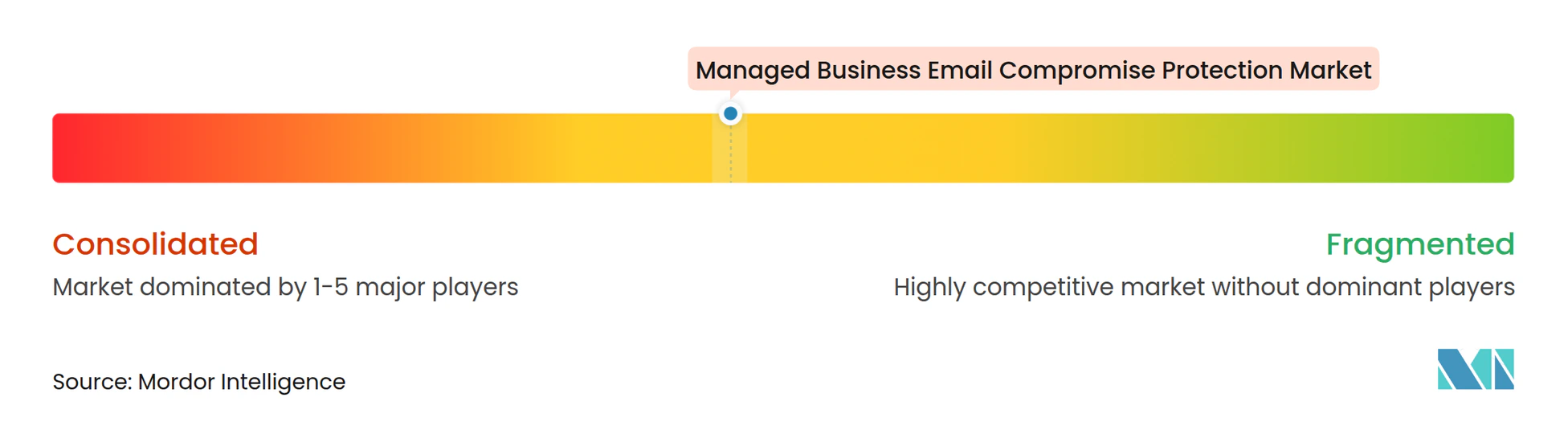
The managed business email compromise protection market is moderately consolidated among broad platform vendors and fragmented among specialized detection providers. Proofpoint, Mimecast, Cisco, and Microsoft operate across enterprise and mid-market accounts through established gateway bases and wider human-risk platforms. Abnormal Security and IRONSCALES compete through API-based behavioral detection and are extending their service capabilities. Providers are combining email telemetry with endpoint, identity, and cloud application signals to improve behavioral baselines and reduce false positives. Procurement decisions increasingly favor vendors that can demonstrate both operational transparency and dependable coverage.
Proofpoint completed its acquisition of Hornetsecurity for USD 1.8 billion in December 2025, expanding its access to the European MSP segment. Hornetsecurity brought approximately 125,000 customers, 12,000 MSP channel partners, and nearly USD 200 million in annual recurring revenue. Varonis agreed to acquire SlashNext for up to USD 150 million in September 2025, adding AI-native email security to its data security platform.[4] Sublime Security raised USD 150 million in a Series C round in October 2025 to support expansion into managed detection and response for socially engineered attacks, showing continued investment in independent detection technology. These moves show that the Managed business email compromise protection market is attracting both platform consolidation and investment in independent detection technology.
Opportunities are concentrated in sovereign-cloud managed protection for regulated Asia-Pacific and Middle East customers, MSP-delivered services for SMEs, and links between behavioral email detection and accounts-payable verification. Providers that limit false positives and explain their decisions clearly can build trust with finance teams and executive users. Scalable service operations are important because customers expect monitoring and remediation beyond normal business hours. Agentic AI approaches seek to reduce response times from hours to minutes, but they will need clear governance and controls.
Managed Business Email Compromise Protection Industry Leaders
-
Proofpoint, Inc.
-
Mimecast Limited
-
Microsoft Corporation
-
Cisco Systems, Inc.
-
Barracuda Networks, Inc.
- *Disclaimer: Major Players sorted in no particular order
Managed Business Email Compromise Protection Market Companies Covered in this Report
- Proofpoint, Inc.
- Mimecast Limited
- Microsoft Corporation
- Cisco Systems, Inc.
- Barracuda Networks, Inc.
- Check Point Software Technologies Ltd.
- Abnormal Security Corporation
- Broadcom Inc.
- Trend Micro Incorporated
- Fortinet, Inc.
- Google LLC
- Sophos Group plc
- Fortra LLC
- Cofense Inc.
- IRONSCALES, Inc.
- Cloudflare, Inc.
- Hornetsecurity GmbH
- Valimail, Inc.
- TitanHQ Limited
Recent Industry Developments in Managed Business Email Compromise Protection Market
- September 2026: Proofpoint introduced the Agentic Collaboration Security system at Protect 2026, combining intent-based detection, agentic investigation, and user risk agents into a unified architecture that extends managed BEC protection across email, collaboration tools, and agentic AI workflows.
- September 2026: Exclusive Networks announced a partnership with Mimecast to distribute email and collaboration threat protection, insider risk management, and data governance capabilities to customers in India. The partnership leverages Mimecast's platform, which processes 24 trillion behavioral signals annually, expanding managed BEC protection access in one of Asia-Pacific's fastest-growing markets.
- March 2026: Mimecast launched API-based email security globally, delivering secure email gateway-grade protection, URL inspection, malware sandboxing, and behavioral AI, without MX record changes, and reported that its detection models catch 3 times more BEC and credential-phishing attacks compared with traditional methods.
- March 2026: Abnormal AI launched Attune 1.0, a behavioral foundation model trained on more than 1 billion derived behavioral signals that powers 85% of detections across the Abnormal Behavior Platform, establishing a shared intelligence layer with direct implications for BEC and account takeover detection fidelity.
Global Managed Business Email Compromise Protection Market Report Scope
The Managed Business Email Compromise Protection Market comprises solutions and services that help organizations detect, prevent, and respond to business email compromise (BEC) attacks. These offerings use technologies such as artificial intelligence, machine learning, email authentication, behavioral analytics, and threat intelligence to identify fraudulent emails, impersonation attempts, unauthorized payment requests, and other social engineering threats.
The Managed Business Email Compromise Protection Market Report is Segmented by Offering (Solutions and Services), Deployment Model (Cloud-Based, On-Premises, and Hybrid Deployment), Organization Size (Small and Medium Enterprises and Large Enterprises), Security Architecture (Secure Email Gateway, Integrated Cloud Email Security, Email Authentication and Domain Protection, Email Encryption and Data Loss Prevention, and Security Awareness and Phishing Simulation), End-User Industry (Information Technology and Telecommunications, BFSI, Healthcare, Retail and E-Commerce, Manufacturing, Government and Defense, Education, Professional Services, Energy and Utilities, Transportation and Logistics, Hospitality and Travel, and Other End-User Industries), and Geography (North America, South America, Europe, Asia-Pacific, Middle East, and Africa). The Market Forecasts are Provided in Terms of Value (USD).
Segmentation Overview
| Solutions |
| Services |
| Cloud-Based |
| On-Premises |
| Hybrid Deployment |
| Small and Medium Enterprises |
| Large Enterprises |
| Secure Email Gateway |
| Integrated Cloud Email Security |
| Email Authentication and Domain Protection |
| Email Encryption and Data Loss Prevention |
| Security Awareness and Phishing Simulation |
| Information Technology and Telecommunications |
| BFSI |
| Healthcare |
| Retail and E-Commerce |
| Manufacturing |
| Government and Defense |
| Education |
| Professional Services |
| Energy and Utilities |
| Transportation and Logistics |
| Hospitality and Travel |
| Other End-User Industries |
| North America | United States |
| Canada | |
| Mexico | |
| South America | Brazil |
| Argentina | |
| Rest of South America | |
| Europe | Germany |
| United Kingdom | |
| France | |
| Italy | |
| Spain | |
| Russia | |
| Rest of Europe | |
| Asia-Pacific | China |
| India | |
| Japan | |
| South Korea | |
| Australia | |
| Rest of Asia-Pacific | |
| Middle East | Saudi Arabia |
| United Arab Emirates | |
| Turkey | |
| Rest of Middle East | |
| Africa | South Africa |
| Egypt | |
| Nigeria | |
| Rest of Africa |
| By Offering | Solutions | |
| Services | ||
| By Deployment Model | Cloud-Based | |
| On-Premises | ||
| Hybrid Deployment | ||
| By Organization Size | Small and Medium Enterprises | |
| Large Enterprises | ||
| By Security Architecture | Secure Email Gateway | |
| Integrated Cloud Email Security | ||
| Email Authentication and Domain Protection | ||
| Email Encryption and Data Loss Prevention | ||
| Security Awareness and Phishing Simulation | ||
| By End-User Industry | Information Technology and Telecommunications | |
| BFSI | ||
| Healthcare | ||
| Retail and E-Commerce | ||
| Manufacturing | ||
| Government and Defense | ||
| Education | ||
| Professional Services | ||
| Energy and Utilities | ||
| Transportation and Logistics | ||
| Hospitality and Travel | ||
| Other End-User Industries | ||
| By Geography | North America | United States |
| Canada | ||
| Mexico | ||
| South America | Brazil | |
| Argentina | ||
| Rest of South America | ||
| Europe | Germany | |
| United Kingdom | ||
| France | ||
| Italy | ||
| Spain | ||
| Russia | ||
| Rest of Europe | ||
| Asia-Pacific | China | |
| India | ||
| Japan | ||
| South Korea | ||
| Australia | ||
| Rest of Asia-Pacific | ||
| Middle East | Saudi Arabia | |
| United Arab Emirates | ||
| Turkey | ||
| Rest of Middle East | ||
| Africa | South Africa | |
| Egypt | ||
| Nigeria | ||
| Rest of Africa | ||
Key Questions Answered in the Report
What is the size of the managed business email compromise protection market?
The managed business email compromise protection market is valued at USD 2.38 billion in 2026 and is projected to reach USD 6.46 billion by 2032, at a CAGR of 15.67%.
What is driving demand for managed BEC protection?
Rising payment fraud losses, cloud email use, AI-enabled impersonation, and formal control requirements are increasing demand for continuous monitoring and remediation.
Which deployment model leads managed BEC protection adoption?
Cloud-based deployment held 70.32% of revenue in 2026 and is projected to grow at a CAGR of 16.42% through 2032.
Which organizations are adopting BEC protection services fastest?
SMEs are projected to expand at a CAGR of 16.19% through 2032 because managed service providers make advanced email security accessible without a dedicated security operations team.
Which end-user sector is growing fastest for BEC protection?
Healthcare is projected to grow at a CAGR of 16.83% through 2032, supported by exposure to financial fraud and significant data-security risks.
Which region is expected to grow fastest?
Asia-Pacific is projected to expand at a CAGR of 16.31% through 2032, supported by low email authentication maturity and growing institutional security investment.