
Business Email Compromise Protection Market Size and Share
Market Overview
| Study Period | 2020 - 2031 |
|---|---|
| Market Size (2026) | USD 1.87 Billion |
| Market Size (2031) | USD 4.41 Billion |
| Growth Rate (2026 - 2031) | 18.72 % |
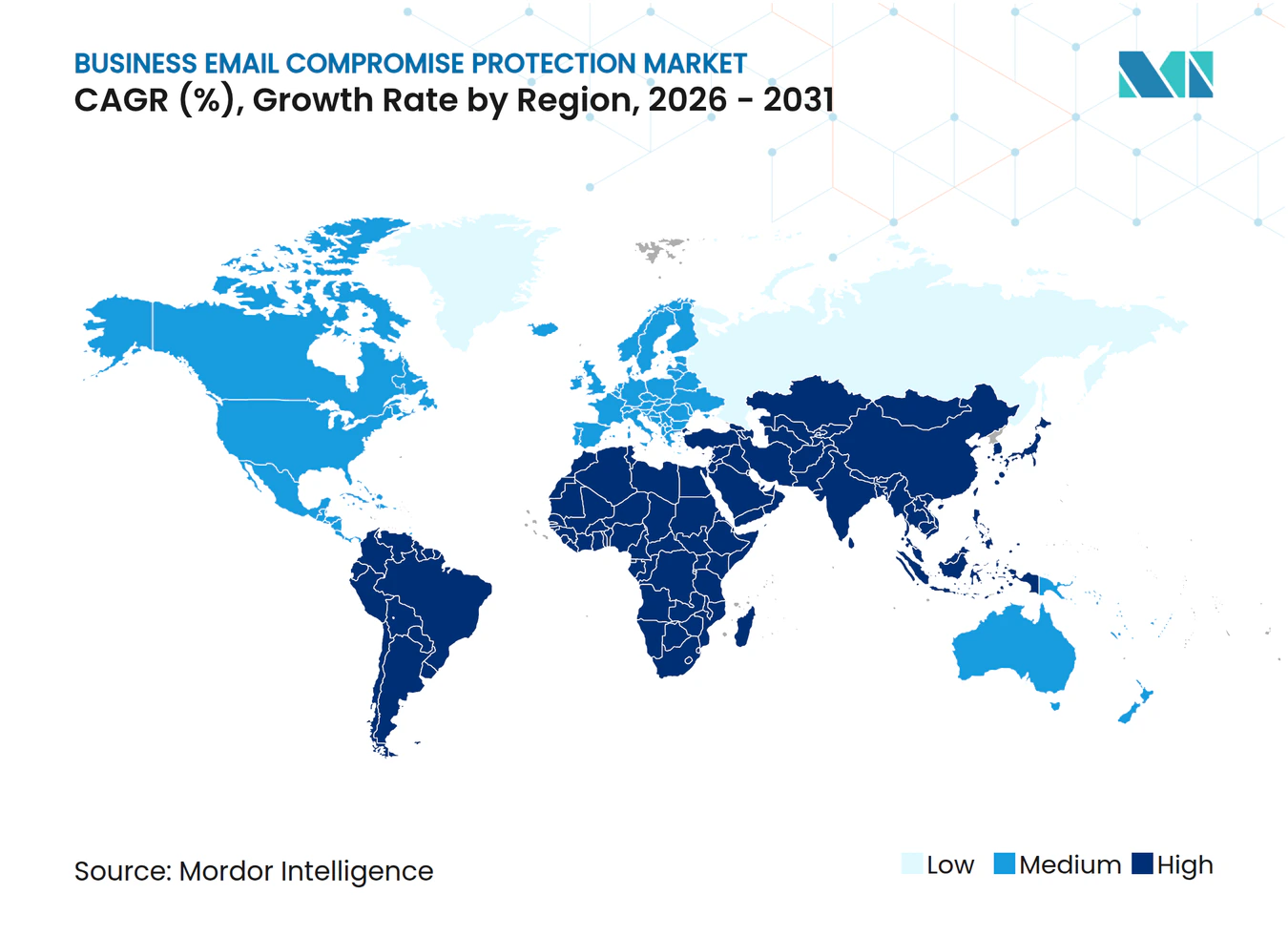
| Fastest Growing Market | Asia-Pacific |
| Largest Market | North America |
| Market Concentration | Medium |
Major Players *Disclaimer: Major Players sorted in no particular order Image © Mordor Intelligence. Reuse requires attribution under CC BY 4.0. | |
Business Email Compromise Protection Market Analysis by Mordor Intelligence
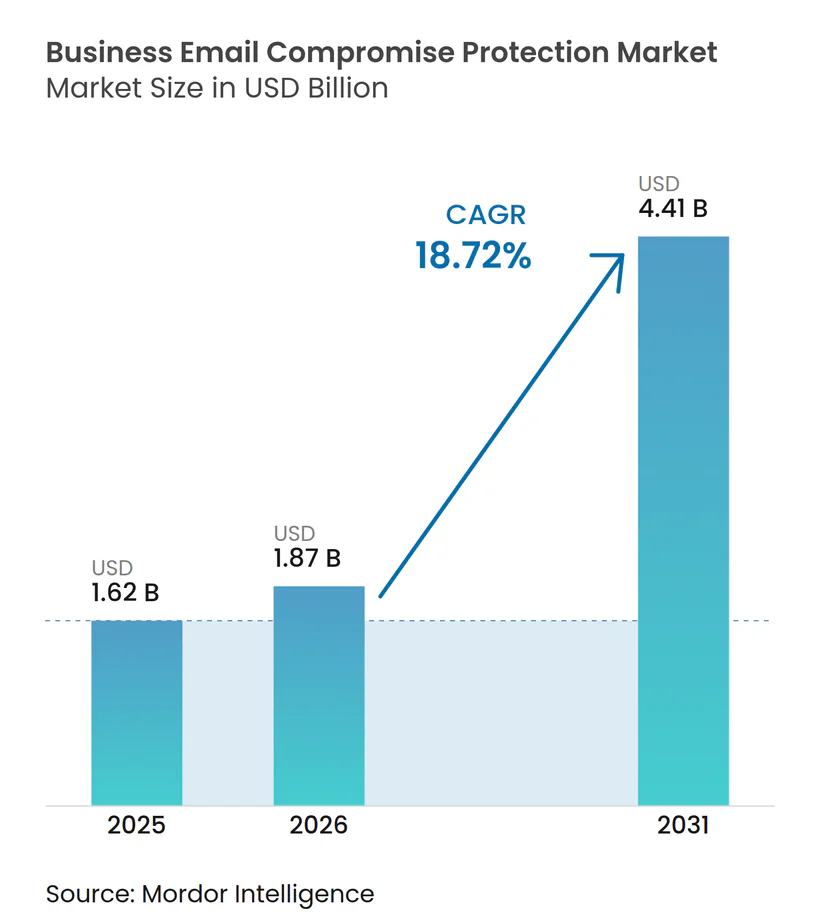
The business email compromise protection market size is projected to expand from USD 1.62 billion in 2025 to USD 1.87 billion in 2026, and to USD 4.41 billion by 2031, registering a CAGR of 18.72% from 2026 to 2031. Rising financial losses have made business email compromise protection a direct concern for finance, treasury, and security teams rather than a narrow email-security purchase. Attackers increasingly use impersonation, fabricated invoices, and stolen sessions to make fraudulent requests appear routine. Cloud email environments have widened the need for tools that inspect behavior without changing normal mail routing. Providers are responding with broader platform coverage, managed delivery models, and acquisitions that add intelligence and AI governance capabilities. These conditions support continued demand for the business email compromise protection market across organizations that need stronger payment verification and faster incident response.
Key Report Takeaways
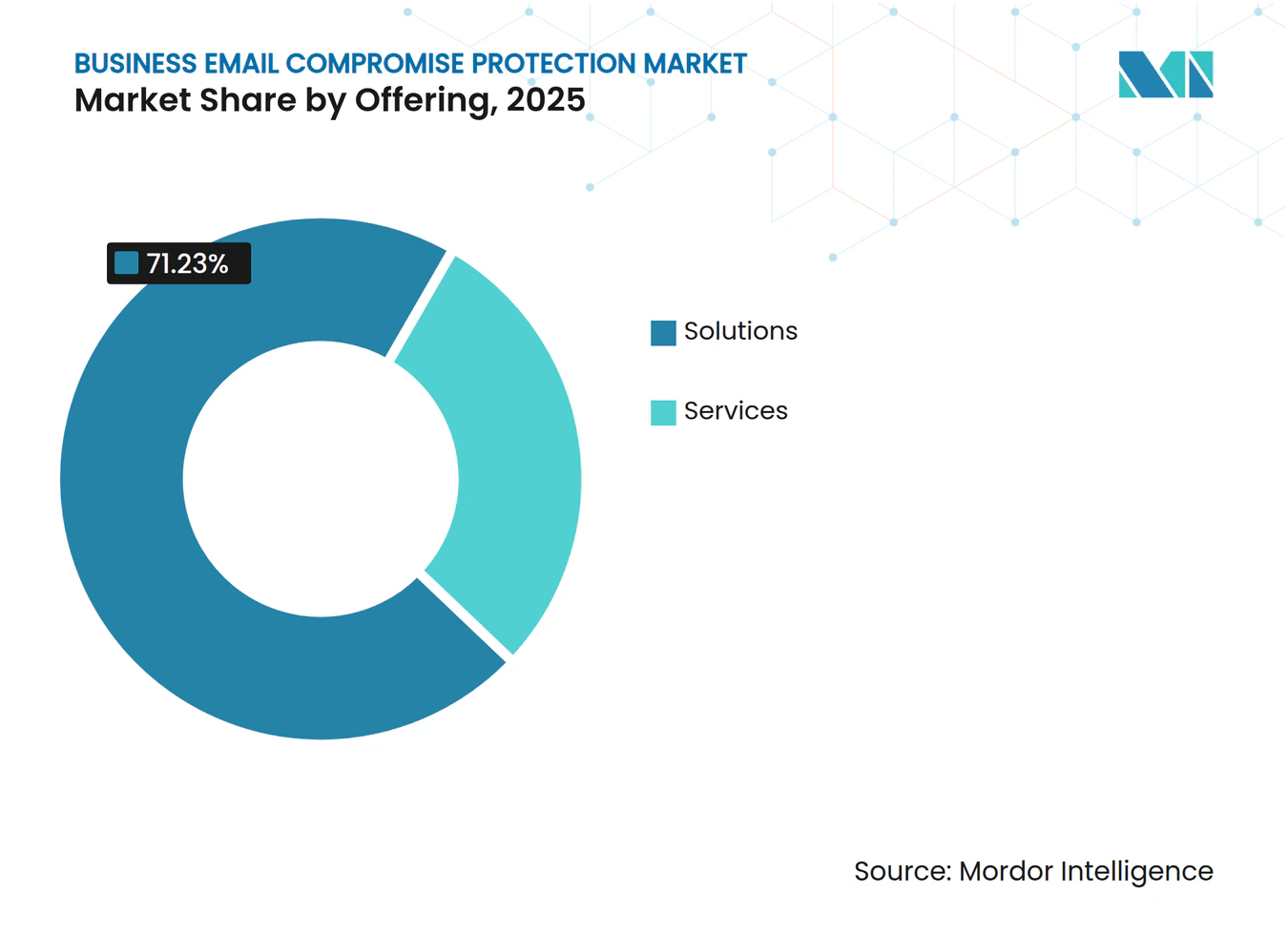
- By offering solutions, 71.23% of the business email compromise protection market share was held in 2025, while services are projected to expand at a 21.84% CAGR through 2031.
- By deployment mode, cloud accounted for 69.84% of revenue in 2025 and is projected to grow at a 23.61% CAGR through 2031.
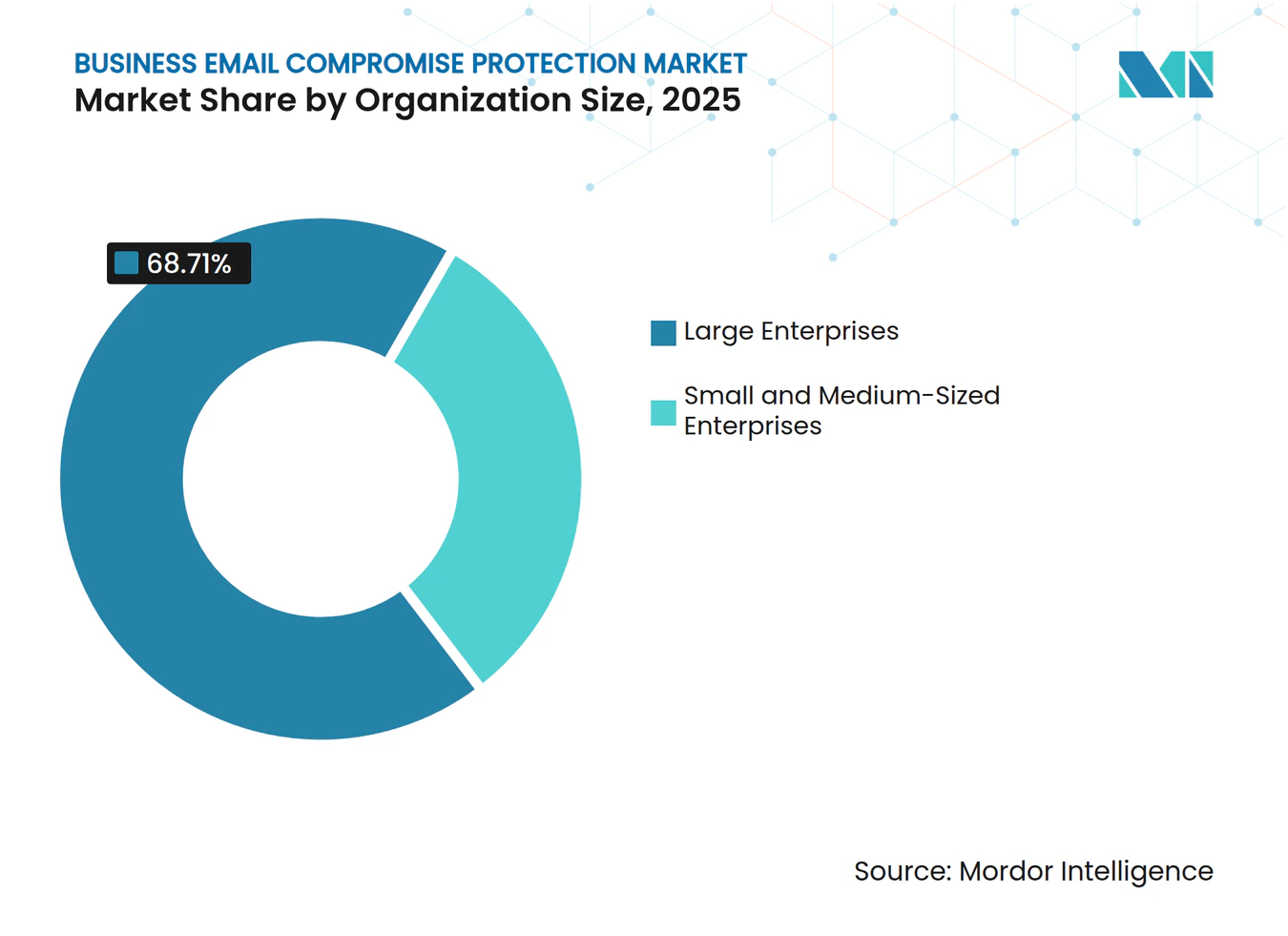
- By organization size, large enterprises accounted for 68.71% of revenue in the business email compromise protection market in 2025, while SMEs are projected to record the highest CAGR at 22.93% through 2031.
- By end user, BFSI held 29.43% of revenue in 2025, while healthcare and life sciences are projected to expand at a 21.58% CAGR through 2031.
- By geography, North America held 41.56% of revenue in the business email compromise protection market in 2025, while Asia-Pacific is projected to grow at a 22.73% CAGR through 2031.
Note: Market size and forecast figures in this report are generated using Mordor Intelligence’s proprietary estimation framework, updated with the latest available data and insights as of January 2026.
Market Trends and Insights
Drivers Impact Analysis of Business Email Compromise Protection Market*
| Driver | (~) % Impact on CAGR Forecast | Geographic Relevance | Impact Timeline |
|---|---|---|---|
| Escalating BEC Financial Losses and Recovery Costs | +5.4% | Global, with the highest documented losses in North America | Short term (≤ 2 years) |
| AI-Enabled Social Engineering and Impersonation | +4.2% | Global, accelerating in Asia-Pacific and Middle East and Africa | Medium term (2-4 years) |
| Cloud Email and Collaboration Adoption | +3.8% | Global, with growth centers in Asia-Pacific and South America | Short term (≤ 2 years) |
| Regulatory and Cyber-Insurance Control Requirements | +2.6% | North America and Europe, expanding into Asia-Pacific | Medium term (2-4 years) |
| Expansion of Vendor, Supplier, and Payment Ecosystems | +1.9% | North America, Europe, and Asia-Pacific | Medium term (2-4 years) |
| Higher Demand for Automated Post-Delivery Remediation | +1.5% | Global, with early adoption concentrated in North America | Short term (≤ 2 years) |
| Source: Mordor Intelligence | |||
Escalating BEC Financial Losses and Recovery Costs
The business email compromise protection market is driven by the scale of financial losses associated with payment-diversion attacks. The FBI IC3 recorded USD 3.046 billion in BEC losses across 24,768 complaints in 2025, compared with USD 2.77 billion in 2024.[1] This remained the 2nd-highest loss category in U.S. federal cybercrime reporting. Funds moving through intermediary banks in the United Kingdom and Hong Kong, followed by China, Mexico, and the UAE, can be harder to recover after a transfer. The cumulative global BEC exposure reported between October 2013 and December 2023 reached USD 55.5 billion. This loss profile allows security leaders to frame the business email compromise protection market as a means of preventing financial loss, which can bring treasury teams into the buying process.
AI-Enabled Social Engineering and Impersonation
AI-enabled social engineering is making it harder to distinguish a legitimate payment request from a fraudulent one. Microsoft documented a September 2026 campaign that delivered more than 1 million AI-assisted invoice-fraud emails to accounts payable teams. The campaign combined executive impersonation, fabricated ServiceNow invoices, and lookalike domains created shortly before use.[2] The Cloud Security Alliance also found that the Forg365 phishing-as-a-service platform combined AI-assisted multilingual lure drafting with adversary-in-the-middle token theft. These capabilities make it easier for attackers to adjust language and invoice details to a recipient’s role. The business email compromise protection market, therefore, favors controls that assess behavior, relationships, and payment context rather than relying only on known malicious messages.
Cloud Email and Collaboration Adoption
The move to cloud email and collaboration platforms is expanding the addressable market for business email compromise protection. API-based tools can monitor mailbox activity in Microsoft 365 and Google Workspace without adding a separate gateway to the mail path. KnowBe4’s Defend Graph API uses this model and provides real-time coaching in 13 languages. Sophos documented a 2025 FlowerStorm case in which the toolkit captured an authenticated Microsoft 365 session token and then changed inbox rules to intercept supplier communications. Such attacks bypass multi-factor authentication by using an already authenticated session. This makes direct analysis of mailbox activity and unusual payment communications more important as organizations move email operations to cloud platforms.
Regulatory and Cyber-Insurance Control Requirements
Compliance requirements are adding another reason to invest in the business email compromise protection market. PCI DSS v4.0 requirement 5.4.1 became enforceable on March 31, 2025, making email-authentication controls relevant to payment-industry audits. The NIS2 Directive reached its October 2024 transposition deadline, extending cybersecurity obligations to additional critical infrastructure sectors across Europe. The proposed HIPAA Security Rule, published in January 2025, also set stronger cybersecurity expectations for covered healthcare entities. Organizations with weak authentication can face scrutiny across several audit and risk programs. This pressure supports consolidated offerings that connect authentication, detection, investigation, and remediation.
Restraints Impact Analysis of Business Email Compromise Protection Market*
| Restraint | (~) % Impact on CAGR Forecast | Geographic Relevance | Impact Timeline |
|---|---|---|---|
| High False-Positive and Business-Process Friction Risk | -2.4% | Global | Short term (≤ 2 years) |
| Limited Visibility into Encrypted and Compromised-Account Traffic | -1.8% | Global | Medium term (2-4 years) |
| Budget Fragmentation Across Email, Identity, and Fraud Teams | -1.2% | North America and Europe | Medium term (2-4 years) |
| Shortage of Skilled Detection and Incident-Response Personnel | -0.9% | Global | Long term (≥ 4 years) |
| Source: Mordor Intelligence | |||
High False-Positive and Business-Process Friction Risk
False positives can slow legitimate work and limit confidence in the business email compromise protection market. Invoice amendments from unfamiliar supplier contacts and executive requests during M&A activity may look unusual even when they are legitimate. Manual review queues can delay payment approvals and create pressure to loosen detection settings. Looser settings can then weaken the coverage that the deployment was meant to provide. Abnormal AI reported that typical organizations encountered 462 advanced attacks each month per 1,000 mailboxes that bypassed Microsoft’s native controls, showing the difficulty of calibration.[3] Vendors are addressing this issue with explanation features that present the evidence behind a detection decision, helping administrators adjust controls without broadly reducing protection.
Limited Visibility Into Encrypted and Compromised-Account Traffic
A fully authenticated mailbox can limit the visibility of gateway-oriented defenses. Device-code phishing, token theft, and credential reuse allow attackers to send messages from a legitimate account. Microsoft made linkable token identifiers generally available in July 2025, which supports forensic review through Entra sign-in logs after an incident. That review may establish what happened after the fraud is completed, but it does not, by itself, stop a payment in progress. A 2025 study in Computers & Security found that machine-learning-based BEC detection remains constrained when it relies on known attack patterns and encounters novel messages lacking URLs, attachments, or other visible indicators. This limitation creates demand for the business email compromise protection market, but it can slow adoption when buyers expect a single tool to resolve every compromised-account scenario.
*Our forecasts treat driver/restraint impacts as directional, not additive. The impact forecasts reflect baseline growth, mix effects, and variable interactions.
Business Email Compromise Protection Market Segment Analysis
By Offering:
Solutions Lead Revenue as Services Scale Through Managed ChannelsSolutions held 71.23% of revenue in 2025. Organizations have favored purpose-built platforms when deployment speed and vendor consolidation affect the selection process. These platforms can combine email authentication, behavioral analysis, detection, and investigation in a single operating environment. The preference also reflects the need to protect payment, procurement, and executive workflows without requiring separate products for each control. The business email compromise protection market size for solutions remained larger because enterprises often begin with technology purchases. Established vendors can extend this position by connecting email controls to wider human-risk and security operations capabilities.
Services are projected to grow at a 21.84% CAGR through 2031, making them the fastest-growing offering. The ISC2 2025 workforce study found that 59% of respondents reported critical or significant skills needs, up from 44% in 2024. This shortfall supports managed arrangements that provide operational expertise alongside the technology. Proofpoint launched a dedicated MSP Platform unit in May 2026, using Hornetsecurity’s network of more than 12,000 channel partners across 120 countries.[4] The business email compromise protection industry is also blending software and service delivery through real-time user coaching. This overlap can make the distinction between a platform sale and a managed security engagement less clear over time.


By Deployment Mode:
Cloud Dominates as Hybrid Authentication Boundaries Attract ExploitationCloud deployments accounted for 69.84% of the business email compromise protection market revenue in 2025. Cloud was also the fastest-growing deployment mode, with a projected 23.61% CAGR through 2031. The model supports direct API connections to cloud email systems without requiring changes to SMTP relays. This can reduce implementation friction while allowing providers to assess mailbox activity and relationship patterns. Cloud’s revenue position reflects the wider movement of corporate mail environments to hosted platforms. It also gives providers a way to deliver protection updates without hardware changes at the customer site.
On-premises and hybrid environments remain relevant for regulated organizations with data-residency or control requirements. A 2025 survey found that 78% of organizations in heavily regulated sectors retained some email infrastructure on-premises, with data security identified as the primary barrier to a full migration. These mixed environments can create weak points where connectors bridge an on-premises relay and a cloud tenant. Abnormal AI’s 2025 Ghost-Sender research documented how such boundaries can bypass Enhanced Filtering controls. This can create spoofing paths that routine gateway monitoring does not detect. Providers serving these buyers must support cloud integration while accounting for the remaining on-premises elements.
By Organization Size:
Large Enterprises Anchor Revenue While SMEs Drive GrowthLarge enterprises accounted for 68.71% of the business email compromise protection market revenue in 2025. High-value treasury, procurement, and accounts payable activity makes these organizations attractive targets for payment-diversion fraud. Their security teams also have the resources to integrate email, identity, and fraud controls across several business functions. Large organizations often require detailed investigations and broader workflow coverage after a suspicious message is identified. The business email compromise protection market size associated with this group remains substantial because a single successful transfer can have a material financial impact. Larger deployments also help vendors build reference accounts and refine detection models across complex mail environments.
SMEs are projected to record a 22.93% CAGR through 2031. Cloud-delivered protection lowers the infrastructure burden and makes more advanced controls available through managed service providers. Apexanalytix reported that organizations with fewer than 1,000 employees had a 70% weekly probability of encountering at least 1 BEC attempt. This exposure can introduce payment fraud risks into business decisions, even when an SME has a small internal security team. Proofpoint introduced 365 Total Protection through its MSP Platform unit in May 2026 to serve this channel. The business email compromise protection industry can expand through these channels because service partners package implementation and ongoing monitoring with the software.

By End User:
BFSI Commands the Largest Share as Healthcare and Life Sciences AcceleratesBFSI held 29.43% of revenue in 2025. Financial institutions face direct exposure to payment-diversion fraud and operate under extensive fraud-control expectations. This combination can support greater adoption of more advanced products and longer security contracts. Treasury workflows, wire-transfer approvals, and supplier payments create clear use cases for behavioral detection and step-up verification. Government and public administration, IT and telecommunications, industrial manufacturing, retail and e-commerce, and other users form a broader demand base. Their needs vary with supply chain complexity, payment processes, and email authentication maturity.
The healthcare and life sciences industry is projected to grow at a 21.58% CAGR through 2031. HHS recorded 170 email-related healthcare breaches in 2025 affecting more than 2.5 million individuals.[5] The same research reported that nearly 3 in 4 breached organizations lacked DMARC or used monitoring-only settings. The proposed HIPAA Security Rule adds to the importance of protecting electronic protected health information. These conditions make the business email compromise protection market relevant to covered entities that need stronger authentication, detection, and incident-response practices.
Geography Analysis
North America Business Email Compromise Protection Market
North America held 41.56% of the business email compromise protection market revenue in 2025. The region had the highest documented BEC loss concentration, with USD 3.046 billion reported to the FBI IC3 in 2025. U.S. federal agencies operate under Binding Operational Directive 18-01, which requires DMARC deployment for government domains. This approach affects civilian procurement through government supply chains and contracting requirements. Canada has a parallel government-domain mandate. North America’s scale is supported by a large enterprise email base, but bundled platforms can place pressure on revenue per deployment.
Europe Business Email Compromise Protection Market
Europe is the 2nd-largest region in the business email compromise protection market. Germany, the United Kingdom, France, and Italy form the core demand base. The NIS2 Directive is supporting compliance-led purchases across a broader group of critical infrastructure organizations. Proofpoint completed its USD 1.8 billion acquisition of Hornetsecurity in December 2025 to expand its reach through Hornetsecurity’s partner network. The network covered more than 12,000 MSPs and more than 125,000 customers across 120 countries. The United Kingdom’s government guidance on DMARC and Germany’s cloud security certification requirements also influence enterprise email platform decisions.
APAC and MEA Business Email Compromise Protection Market
Asia-Pacific is projected to grow at a 22.73% CAGR through 2031, the fastest regional rate in the business email compromise protection market. Cloud adoption, AI-generated phishing, and weaker email-authentication baselines are supporting demand. China, India, and Japan lead adoption in the region. India’s IT services sector and digital programs create a strong basis for cloud-native protection deployments. FBI IC3 data identify Hong Kong and China-based banks as frequent intermediary stops in BEC fund flows. Middle East and Africa are emerging areas, with the UAE and Saudi Arabia as early adopters and South Africa leading early uptake on the continent.
Competitive Landscape
Market Concentration
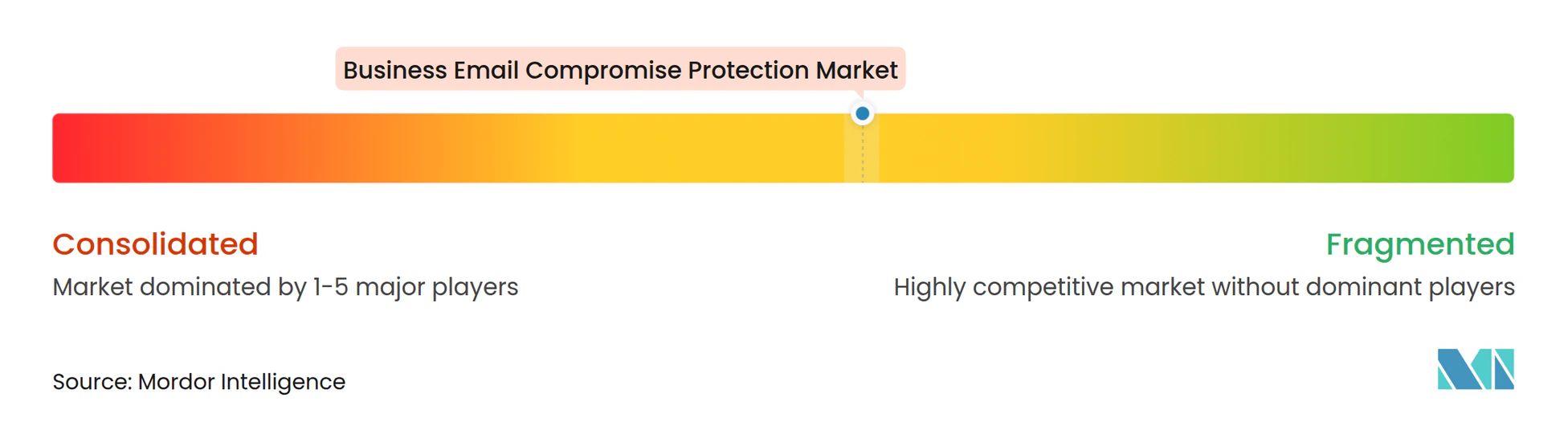
The business email compromise protection market shows moderate concentration. Proofpoint, Microsoft, Cisco, and Check Point hold a meaningful combined position through bundled cybersecurity offerings. Behavioral-AI specialists, including Abnormal AI, IRONSCALES, and Cofense, compete on focused detection and faster deployment. Abnormal AI stated that it protected more than 25% of the Fortune 500 through an API-based model that does not require gateway reconfiguration. The competitive field therefore includes broad platforms and specialized vendors serving a specific email-security gap. Buyers can compare bundled coverage against the implementation speed and detection focus of a specialist.
Proofpoint’s December 2025 acquisition of Hornetsecurity for USD 1.8 billion expanded its reach among SMEs and managed-service providers. Its February 2026 acquisition of Acuvity extended its position into AI security and governance across people, AI agents, and data. These moves broadened the company’s scope beyond inbox-level BEC detection. IRONSCALES released its Winter 2026 update, featuring Red Teaming, Phishing SOC, and Phishing Simulation agents, as well as deepfake protection for Microsoft Teams.[6] These actions show that providers are adding AI-enabled features while increasing the breadth of collaboration-channel coverage.
The business email compromise protection market also offers opportunities in vendor payment verification, collaboration platform analysis, and automated post-delivery remediation. Cloudflare reported a 20.4% reduction in phishing-detection misses between Q3 and Q4 2025 after integrating LLM-driven categorization into its email-security stack. This result indicates that detection quality can improve through ongoing model iteration. KnowBe4 launched Defend for Google Workspace in September 2026, extending API-based behavioral detection and real-time coaching to Gmail environments. Platform-native integration breadth is becoming as important as a standalone detection algorithm. Vendors that can connect detection, explanation, and remediation across email and collaboration tools can address a broader set of buyer needs.
Business Email Compromise Protection Industry Leaders
-
Abnormal Security Corporation
-
Cisco Systems, Inc.
-
Microsoft Corporation
-
Proofpoint, Inc.
-
Mimecast Limited
- *Disclaimer: Major Players sorted in no particular order
Business Email Compromise Protection Market Companies Covered in this Report
- Abnormal Security Corporation
- Cisco Systems, Inc.
- Microsoft Corporation
- Proofpoint, Inc.
- Mimecast Limited
- Agari Data, Inc.
- Area 1 Security, Inc.
- Barracuda Networks, Inc.
- Bitdefender SRL
- Check Point Software Technologies Ltd.
- Cofense, Inc.
- Cloudflare, Inc.
- Egress Software Technologies Ltd.
- Fortra, LLC
- Fortinet, Inc.
- Heimdal Security A/S
- IRONSCALES Ltd.
- KnowBe4, Inc.
- OpenText Corporation
- Sophos Limited
- Trellix, Inc.
- Trend Micro Incorporated
- Trustifi, Inc.
- Valimail, Inc.
- Virtru Corporation
- ZeroFox Holdings, Inc.
Recent Industry Developments in Business Email Compromise Protection Market
- September 2026: Proofpoint expanded Prism Investigator to Microsoft 365 for AI-driven investigation of email, Teams messages, and files without requiring prior archiving, and launched Human Communications Intelligence agents incorporating AI-governance signals into insider-risk investigations.
- September 2026: KnowBe4 launched Defend for Google Workspace, extending API-based behavioral detection and real-time point-of-risk coaching to Gmail environments. The solution became available on September 15, 2026, adding Google’s cloud platform to its existing Microsoft 365 coverage.
- February 2026: Proofpoint acquired Acuvity, an AI enterprise security and governance specialist, positioning it to govern agentic workspaces covering people, AI agents, and data alongside conventional email threats. Financial terms were not disclosed.
- December 2025: Proofpoint completed its acquisition of Hornetsecurity Group for USD 1.8 billion. Hornetsecurity generated USD 200 million in annual recurring revenue, growing 20% year over year, and operates across more than 120 countries through more than 12,000 MSPs.
Global Business Email Compromise Protection Market Report Scope
The business email compromise protection market encompasses email security solutions specifically designed to detect and prevent business email compromise (BEC) attacks, where adversaries impersonate executives, vendors, or trusted partners to fraudulently request payments or sensitive data. These solutions combine email authentication (SPF, DKIM, DMARC), domain and supplier monitoring, behavioral analytics, and user awareness controls to stop impersonation, lookalike domains, and compromised‑account attacks that bypass traditional anti‑phishing filters.
The Business Email Compromise Protection Market Report is Segmented by Offering (Solutions, and Services), Deployment Mode (Cloud, On-Premises, and Hybrid), Organization Size (Small and Medium-Sized Enterprises, and Large Enterprises), End User (Banking, Financial Services, and Insurance (BFSI), Government and Public Administration, IT and Telecommunication, Healthcare and Life Sciences, Industrial Manufacturing, Retail and E-Commerce, and Other End Users), and Geography (North America, South America, Europe, Asia-Pacific, and Middle East and Africa). The Market Forecasts are Provided in Terms of Value (USD).
Segmentation Overview
| Solutions |
| Services |
| Cloud |
| On-Premises |
| Hybrid |
| Small and Medium-Sized Enterprises |
| Large Enterprises |
| Banking, Financial Services, and Insurance (BFSI) |
| Government and Public Administration |
| IT and Telecommunication |
| Healthcare and Life Sciences |
| Industrial Manufacturing |
| Retail and E-Commerce |
| Other End Users |
| North America | United States | |
| Canada | ||
| South America | Brazil | |
| Mexico | ||
| Rest of South America | ||
| Europe | Germany | |
| United Kingdom | ||
| France | ||
| Italy | ||
| Rest of Europe | ||
| Asia-Pacific | China | |
| Japan | ||
| India | ||
| Rest of Asia-Pacific | ||
| Middle East and Africa | Middle East | United Arab Emirates |
| Saudi Arabia | ||
| Rest of Middle East | ||
| Africa | South Africa | |
| Rest of Africa | ||
| By Offering | Solutions | ||
| Services | |||
| By Deployment Mode | Cloud | ||
| On-Premises | |||
| Hybrid | |||
| By Organization Size | Small and Medium-Sized Enterprises | ||
| Large Enterprises | |||
| By End User | Banking, Financial Services, and Insurance (BFSI) | ||
| Government and Public Administration | |||
| IT and Telecommunication | |||
| Healthcare and Life Sciences | |||
| Industrial Manufacturing | |||
| Retail and E-Commerce | |||
| Other End Users | |||
| By Geography | North America | United States | |
| Canada | |||
| South America | Brazil | ||
| Mexico | |||
| Rest of South America | |||
| Europe | Germany | ||
| United Kingdom | |||
| France | |||
| Italy | |||
| Rest of Europe | |||
| Asia-Pacific | China | ||
| Japan | |||
| India | |||
| Rest of Asia-Pacific | |||
| Middle East and Africa | Middle East | United Arab Emirates | |
| Saudi Arabia | |||
| Rest of Middle East | |||
| Africa | South Africa | ||
| Rest of Africa | |||
Key Questions Answered in the Report
What is the business email compromise protection market size?
The business email compromise protection market size is projected to expand from USD 1.62 billion in 2025 to USD 1.87 billion in 2026, and to USD 4.41 billion by 2031, registering a CAGR of 18.72% from 2026 to 2031.
What is driving demand for BEC protection?
Reported BEC losses reached USD 3.046 billion across 24,768 FBI IC3 complaints in 2025, while AI-assisted impersonation and cloud email adoption are increasing the need for stronger controls.
Which deployment model leads demand for BEC protection?
Cloud held 69.84% of revenue in 2025 and is projected to grow at a 23.61% CAGR through 2031 because API-based protection can work directly with hosted email environments.
Which end-user sector leads adoption of BEC protection?
BFSI held 29.43% of revenue in 2025 because payment, treasury, and accounts-payable workflows have direct exposure to fraud.
Which region is growing fastest for BEC protection?
Asia-Pacific is projected to expand at a 22.73% CAGR through 2031, supported by cloud adoption, AI-generated phishing activity, and a developing email-authentication baseline.
Why are managed BEC protection services gaining traction?
Services are projected to grow at a 21.84% CAGR through 2031 as organizations address a shortage of in-house security skills through managed detection and response arrangements.