
Market Overview
| Study Period | 2021 - 2031 |
|---|---|
| Forecast Data Period | 2026 - 2031 |
| Historical Data Period | 2021 - 2024 |
| Growth Rate | 1.12 % |
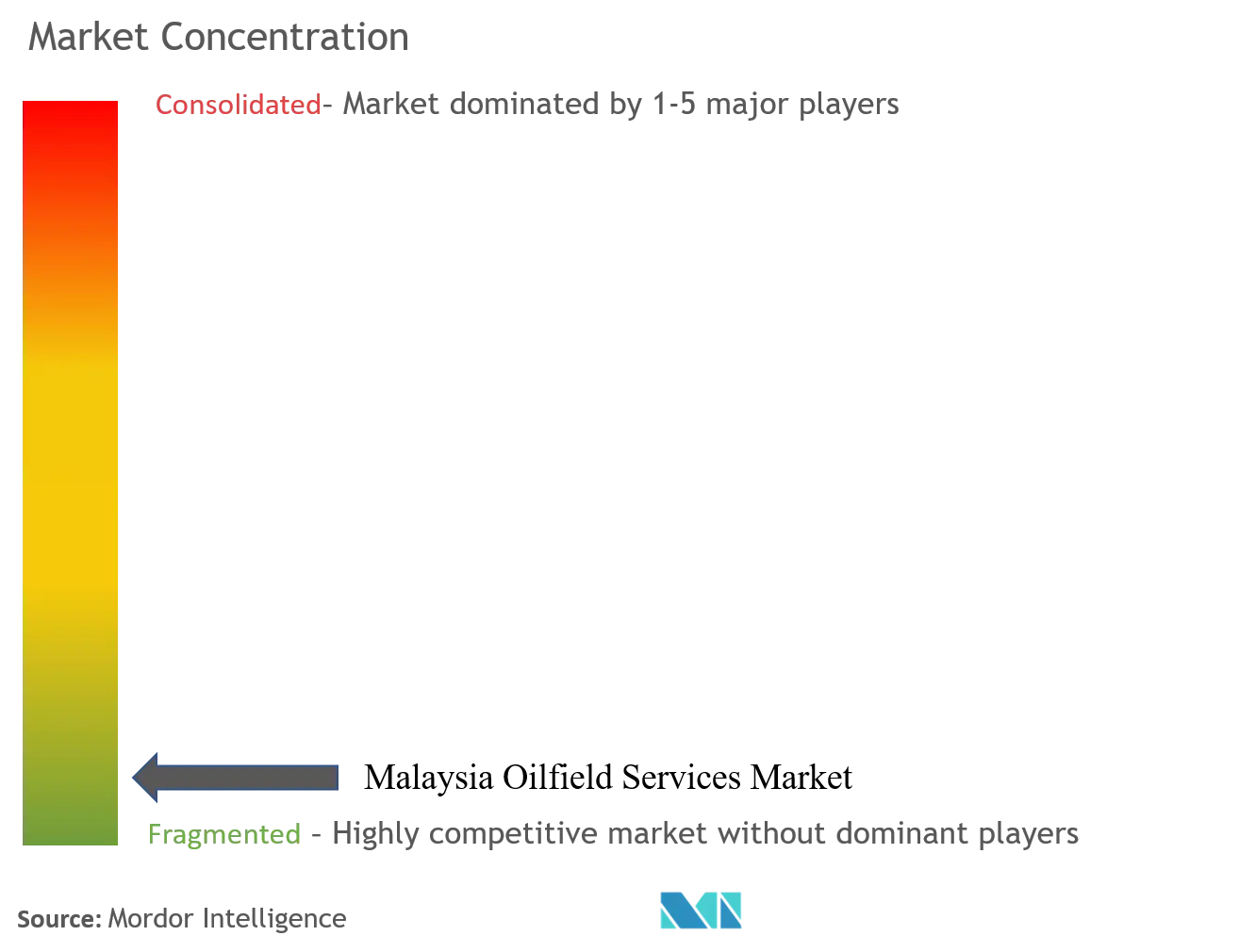
| Market Concentration | Low |
Major Players *Disclaimer: Major Players sorted in no particular order Image © Mordor Intelligence. Reuse requires attribution under CC BY 4.0. | |
Malaysia Oilfield Services Market Analysis by Mordor Intelligence
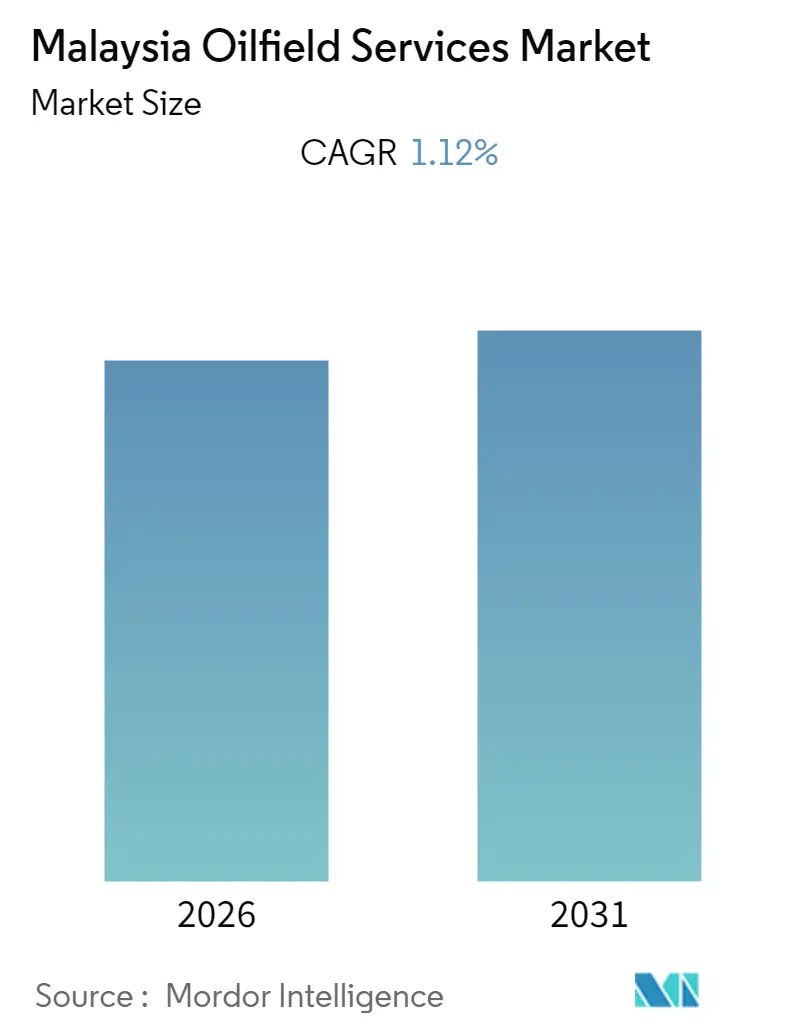
The Malaysia Oilfield Services Market size is expected to register a CAGR of 1.12% during the forecast period (2026-2031).
- Rising investments in the sector are expected to aid the growth of the market and is expected to act as a driver for the market in the forecast period. Investments are being made in the exploration and production of natural gas in the offshore location.
- New development in the oilfield services, like the advancements in the high-end self-adaptive inflow control completion technology, is expected to make the oil and gas production more viable and may provide an opportunity for market players.
- The completion services segment is expected to witness significant in the forecast period. Increasing investment and advancement in technology are expected to aid the growth of the market.
Note: Market size and forecast figures in this report are generated using Mordor Intelligence’s proprietary estimation framework, updated with the latest available data and insights as of 2026.
Malaysia Oilfield Services Market Trends and Insights
Rising Investments to Drive the Market
- In 2019, Petronas CAPEX spending was MYR 47.8 billion, of which 51% was allocated for upstream expenditure, which was slightly more than that of the 2018 level. Therefore, factors, such as upcoming exploration and development projects and increasing investments in upstream activities, are expected to drive the oil and gas market in Malaysia, over the forecast period. Growth in the Malaysia oil and gas market may have a positive cascading effect on the country's oilfield service market.
- In February 2020, Kasawari Gas Development Project is being developed by the Petronas and is located in the South China Sea, Malaysia. First gas from the field is expected during late 2020. The field is estimated to contain 3.2 trillion cubic feet (tcf) of natural gas resources and is expected to produce 660 million standard cubic feet per day (mmscfd) of gas and 3.5 million barrels of condensate per day. MMC Oil & Gas Engineering (MMCOG) was contracted to provide engineering design services for the facilities.
- In February 2020, the Hess Corporation reported the first gas from the North Malay Basin Phase II, and the production from Phase III is expected to start during the fourth quarter of 2021. According to Hess Corporation, North Malay Basin, located off peninsular Malaysia in the Gulf of Thailand, holds more than 1.5 trillion cubic feet of natural gas and more than 20 million barrels of condensate. A large basin of natural gas may incentivize a further increase in the investment in the basins' production, which could aid in the growth of the oilfield services market.
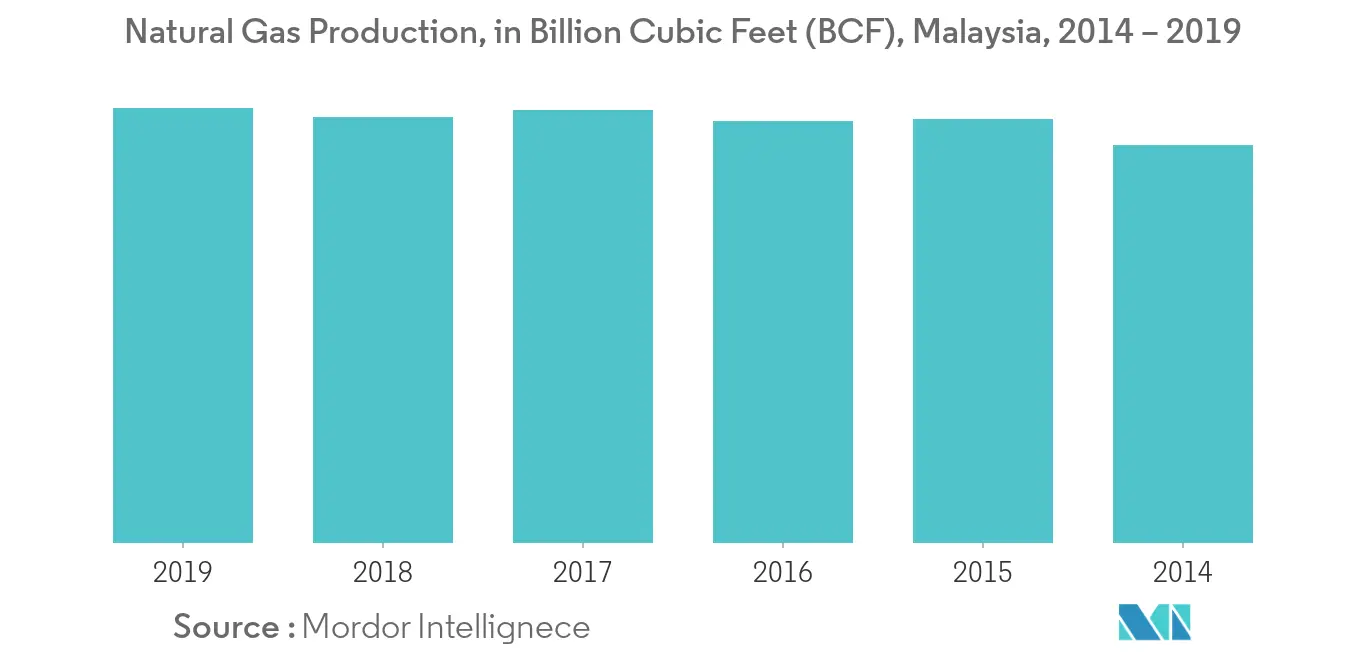
- Natural gas production in the country increased by 2.0%, to 7.63 billion cubic feet per day, in 2019 from 7.47 billion cubic feet per day in 2018. The increased investment sector is expected to aid the growth of natural gas, which is expected to boost the growth of oilfield services.
- Hence, rising investments are expected to drive the market in the forecast period.


Completion Services to Witness Significant Growth
- The majority of Malaysia's oil production comes from offshore fields in the Malay Basin in the West and the Sabah and Sarawak basins in the east. About 40% of the country's oil reserves are located in the Malay basin and tend to be light and medium sweet crude oil grades from shallow waters. However, in the past decade, more exploration and discovery of reserves have taken place in deepwater areas in eastern Malaysia. Deepwater areas require high quality and different completion services to reduce the production of water from the well, which helps the growth of the Malaysia oilfield services market.
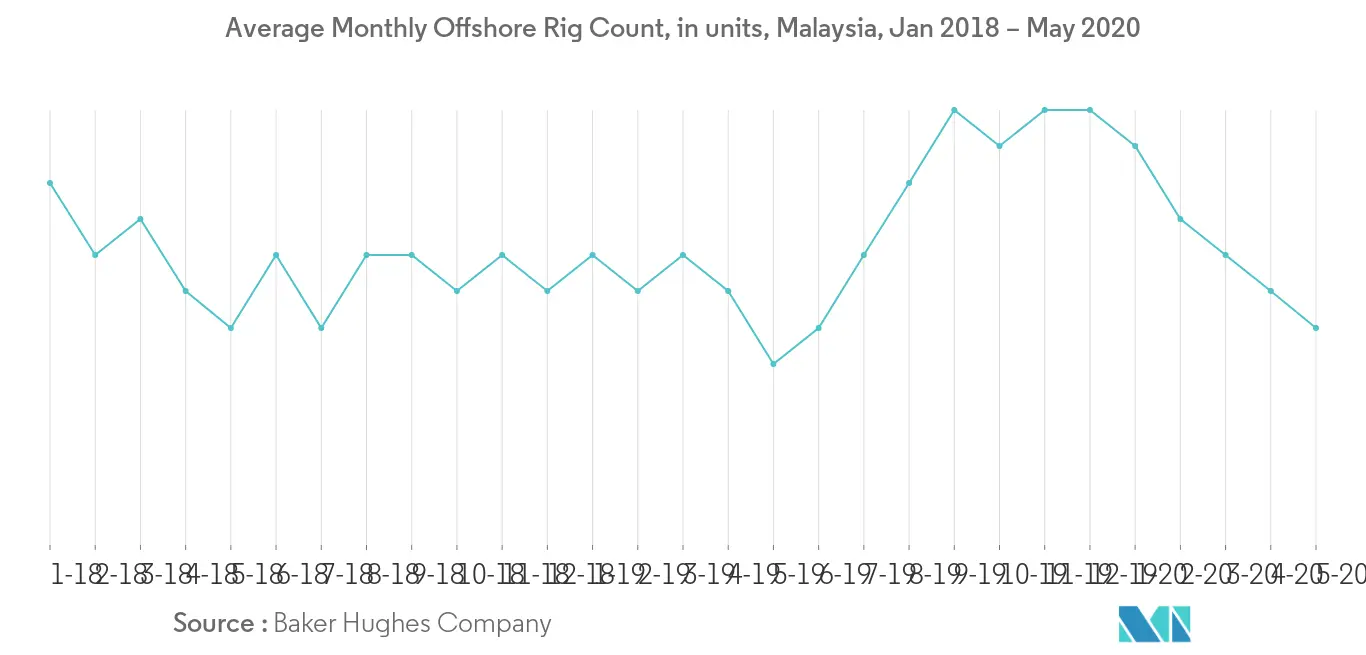
- The rig count in the country has increased significantly from an average of 7.66 units in 2018 to an average of 8.33 units in 2019. All of the rigs were used in the offshore operations in the country's exclusive economic zone (EEZ). An increase in the number of rigs in the country is expected to contribute to the growth of oilfield services positively.
- The completion services improvements have incorporated new paradigms in the sector like intelligent or smart well completion. Intelligent completions include permanent downhole sensors that transmit data to surface for local or remote monitoring in a digital well platform. These systems are being used in the offshore segment as a method to decrease the production of water from the wells.
- In 2019, Emerson Electric Co., in partnership with Metrol, a leader in battery-powered wireless well monitoring, has launched the Intelligent Multistage Completion Network and integrated upper and lower completions downhole solution that communicates wirelessly with instruments at the reservoir sand face, the physical interface between the formation and the wellbore. This is enabled by a new wireless interface that generates crucial zonal flow information and sand face monitoring in the lower completion. Further advancements in the market are expected to create more reliability and growth in the market.
- Production of crude oil in the country decreased significantly by 7.8% to 29.8 million tonnes in 2019 from 32.4 million tonnes in 2018. Increasing exploration and production in the country may aid the growth of crude oil production in the forecast period, which may help the growth of the oilfield services market.
- Hence, completion services are expected to witness growth in the forecast period due to investments in the sector, advances in technology, and increasing oil production.
Regulatory Landscape
Malaysia's upstream petroleum activities operate under the Petroleum Development Act 1974. Malaysia Petroleum Management (MPM) acts for PETRONAS to administer upstream resources and manage Petroleum Arrangement Contracts (PACs), primarily Production Sharing Contracts (PSCs), which define operator obligations and contracting requirements. Vendor participation is shaped by PETRONAS procurement and licensing frameworks, including registration via the PETRONAS License Management System (PLMS) using Standardised Work and Equipment Categories (SWEC), which affects eligibility for oilfield service tenders and call-off work.
Policy direction is informed by national frameworks such as the National Energy Policy 2022-2040 and the National Energy Transition Roadmap (NETR). The Thirteenth Malaysia Plan (RMK13), released in September 2025, explicitly integrates NETR and the National Gas Roadmap. Media reporting in February 2026 stated that the National Gas Roadmap is scheduled for Q3 2026 and is positioned as an overhaul of gas pricing, supply, and regulation, which is expected to raise near-term compliance and contracting-readiness needs for operators and service companies across upstream-linked gas value chains.
Value Chain Analysis
Malaysia's oilfield services value chain is centered on PETRONAS, via MPM, which governs upstream activity through PAC/PSC structures and sets operator and vendor ecosystem requirements. The service chain covers exploration (seismic and drilling), development (EPC, fabrication, completions), production (well intervention, integrity, chemicals, subsea inspection), and decommissioning, with a large domestic supplier base. Government statistics point to about 2,894 OGSE establishments (2023 reference year), with over 90% categorized as MSMEs, which makes subcontracting, specialist niche services, and adherence to PETRONAS licensing and category frameworks important to how work is allocated.
Operational demand is driven by offshore activity in the Malay, Sabah, and Sarawak basins, supported by centralized processing platforms and brownfield operations that require maintenance and facility improvement plans. Supply-chain exposure is elevated because Malaysia is a net crude importer, with domestic production meeting roughly 48% of national demand and about 38% of crude imports transiting the Strait of Hormuz, increasing sensitivity to logistics, insurance, and delivery disruptions. MIDA guidance in April 2026 also emphasized automation and digitalisation to sustain production across upstream facilities, alongside a rising decommissioning workload (scheduled abandonment of 130 wells and 50 facilities over the next three years), which affects service demand across inspection through abandonment execution.
Competitive Landscape
The Malaysia oilfield services market is partially fragmented. Some of the key players in this market are Schlumberger Ltd., Halliburton Company, Baker Hughes Company, Weatherford International plc, and Destini Berhad.
Malaysia Oilfield Services Industry Leaders
Schlumberger Ltd.
Halliburton Company
Baker Hughes Company
Weatherford International plc
Destini Berhad
- *Disclaimer: Major Players sorted in no particular order

Market Opportunities and Future Outlook
Near-term opportunity is tied to sustaining upstream activity while broadening service demand into rejuvenation, integrity, and lower-carbon adjacent work that is being formalized through national programs and operator activity plans. PETRONAS, through its Activity Outlook 2026-2028 released in January 2026, laid out a three-year view of Malaysian upstream, downstream, gas, and maritime activities, including themes such as fleet rejuvenation, lower-emission shipping investments, and LNG regasification capacity development. PETRONAS also communicated a production sustainment objective of about 2 million boe/d through 2028, supported by exploration, deepwater development, and enhanced oil recovery, which supports demand for drilling, completions, production optimization, and brownfield services linked to identified resource optimization projects (including Belud, Sepat, and Kurma Manis).
Energy transition policy and industrial capability programs create additional room for oilfield service companies to diversify offerings within oil and gas adjacency. NETR prioritizes levers such as energy efficiency, renewable energy, hydrogen, bioenergy, green mobility, and CCUS, while MPRC's National OGSE Industry Blueprint 2021-2030 targets building integrated energy services companies and regional champions, providing structured pathways for Malaysian service providers to scale capabilities and export services. National planning references cross-border and domestic connectivity initiatives, including ASEAN Power Grid initiatives and the SALAM undersea cable connection (Johor, Sabah, Sarawak), which reinforces demand for marine and offshore construction, inspection, and project execution competencies that overlap with existing oilfield services capabilities.
Recent Industry Developments
- July 2026: Reservoir Link Sdn Bhd received a letter of award from PETRONAS Carigali for a five-year contract to provide remedial sand control equipment and services, running until May 2031. The long-duration scope supports multi-well intervention and production optimization workflows in offshore operations and strengthens the company's recurring service revenue visibility under PETRONAS call-off contracting structures.
- June 2026: Elsa Energy Sdn Bhd secured a contract to deliver autonomous underwater vehicle (AUV) subsea structure inspection services for a major E&P company, effective from June 2026 to June 2027. The win highlights increasing adoption of higher-productivity inspection methods in offshore integrity management, shifting demand toward advanced subsea inspection capability and data-enabled inspection services.
- May 2026: Velesto Drilling Sdn Bhd secured a contract from Hibiscus Oil & Gas Malaysia for a jack-up rig to support a 2026 drilling campaign, covering eight plug and abandonment wells and one exploration well starting in May 2026. The mix of P&A and exploration work underlines parallel demand tracks in Malaysia for late-life asset services and selective exploration activity, supporting utilization for offshore drilling and associated well services.


Research Methodology Framework and Report Scope
Market Definition and Coverage
This market covers third-party services that support oil and gas upstream activities in Malaysia, starting from planning and drilling support through well completion, production support, and field maintenance that keeps wells producing.
Scope exclusions: We exclude pure equipment manufacturing sales, midstream transport services, downstream refining activities, and non-oilfield industrial services that are not tied to upstream field operations.
Segmentation Overview
- Service Type
- Drilling Services
- Completion Services
- Production Services
- Other Services
Data Sources, Market Sizing, and Validation
Desk Research
Desk work sets the outer frame for what is realistically spendable in Malaysia's upstream services and where that spend is going. We reference public sources such as Malaysia's Department of Statistics releases on the oil and gas services and equipment economy, Malaysia Petroleum Resources Corporation (MPRC) OGSE industry publications, and regulator and licensing information published by the national oil and gas authorities.
To translate this into market inputs, we also use annual reports, investor presentations, and press releases from operators and service contractors, along with reputable energy news coverage that captures tender awards, work program timing, and offshore campaign starts. Where available, paid subscriptions for company financials, shipment-level trade views, and contracts and tenders are used to cross-check revenue direction, project starts, and pricing signals. These examples are not exhaustive, and many other public and paid sources were referenced to collect data, validate assumptions, and clarify gaps.
Primary Interviews and Surveys
Primary discussions were used to confirm what portion of upstream activity in Malaysia is typically outsourced and how service scopes are packaged across drilling, completion, and production work. We spoke with a mix of operators, EPC and project managers, and service-side leaders who could comment on tender sizes, utilization patterns, and day-rate direction across offshore-heavy programs, and then we used those views to pressure-test the desk-based model assumptions.
Distribution of primary research fieldwork respondents
| Company type | Respondent position |
|---|---|
| Top tier: 31% | CXOs: 12% |
| Mid tier: 51% | Functional/Unit leaders: 37% |
| Smaller Players: 18% | Managers: 51% |
Market-Sizing & Forecasting
Sizing starts with a top-down build where national upstream activity signals are used to reconstruct the addressable services spend, then it is narrowed to Malaysia-only work scopes that are typically outsourced. To keep the result grounded, we corroborate totals using selective bottom-up approximations, such as sampled contract values, indicative day rates, and volume checks against active rigs and known offshore campaign counts.
Key inputs that shape the model include operator upstream spending direction, offshore project activity versus onshore work, rig count and utilization, typical scope splits across drilling, completion, and production support, and service pricing movements (including day rates and campaign-based pricing). When a variable is not consistently visible in public data, gaps are handled with interview-led ranges and then applied conservatively across service buckets rather than forcing a single point estimate.
For forecasting, scenario analysis is used so the outlook reflects how field development timing and maintenance cycles can shift year to year. Assumptions on activity levels and pricing are reviewed with primary respondents, and the forecast is adjusted when tender pipelines or program deferrals point to a different short-term path.
Data Validation & Update Cycle
Model outputs are checked against independent signals, including OGSE revenue direction, announced work programs, and visible contract awards, so the final number stays consistent with what the industry can execute in a year. We also run variance checks across service types, where unusual swings trigger a re-check of pricing, utilization, or scope allocation before conclusions are finalized.
Before sign-off, the work goes through multi-step internal review, and follow-up outreach is done when interview feedback conflicts with desk indicators. Reports are refreshed annually, and interim updates are done when material events occur, such as major project sanctioning, policy shifts, or sharp oil price moves that change operator spending plans. Right before delivery, we do a fresh pass to ensure the published view reflects the latest available signals.
Mordor Intelligence's Malaysia Oilfield Services Market Size Compared With Other Published Estimates
Published numbers for Malaysia oilfield services can look far apart because the underlying math often starts from different spend pools and then applies different rules for what qualifies as an oilfield service revenue line. Differences also come from how firms treat offshore campaign timing, pricing refresh cadence, and whether the estimate is built from activity indicators or from broader OGSE headline totals.
The main gap comes from whether broader OGSE output and construction-heavy scopes get pulled into the same bucket as upstream field services, where Mordor Intelligence counts only outsourced oilfield service activity linked to drilling, completion, and production work in Malaysia and keeps adjacent equipment manufacturing and non-upstream services outside the total.
Benchmark comparison
| Source | Market Size | Gaps in Research Methodology |
|---|---|---|
| Mordor Intelligence | USD 0.00 B (2024) | |
| Industry Association A | USD 0.00 B (2023) | Uses OGSE industry revenue as a proxy, which can include non-upstream services and equipment-linked activities, and it reflects financial-year reporting rather than a service-scope demand build. |
| National Statistics Release B | USD 0.00 B (2023) | Reports gross output for OGSE establishments across multiple sectors, which is broader than oilfield services and can mix upstream support with wider industrial and construction output. |
The spread in the table mainly reflects scope and timing choices, not just a different growth view. By keeping the spend pool tied to upstream oilfield service demand signals and then cross-checking with contract and activity indicators, the final number stays traceable to clear drivers that can be re-tested each update cycle.


Key Questions Answered in the Report
What is the current Malaysia Oilfield Services Market size?
The Malaysia Oilfield Services Market is projected to register a CAGR of 1.12% during the forecast period (2026-2031)
Who are the key players in Malaysia Oilfield Services Market?
Schlumberger Ltd., Halliburton Company, Baker Hughes Company, Weatherford International plc and Destini Berhad are the major companies operating in the Malaysia Oilfield Services Market.
What years does this Malaysia Oilfield Services Market cover?
The report covers the Malaysia Oilfield Services Market historical market size for years: 2020, 2021, 2022, 2023 and 2024. The report also forecasts the Malaysia Oilfield Services Market size for years: 2026, 2027, 2028, 2029, 2030 and 2031.
Page last updated on:


 Your data is secure and never sold or shared.


