
Application-to-Application Password Management (AAPM) Market Size and Share
Market Overview
| Study Period | 2021 - 2032 |
|---|---|
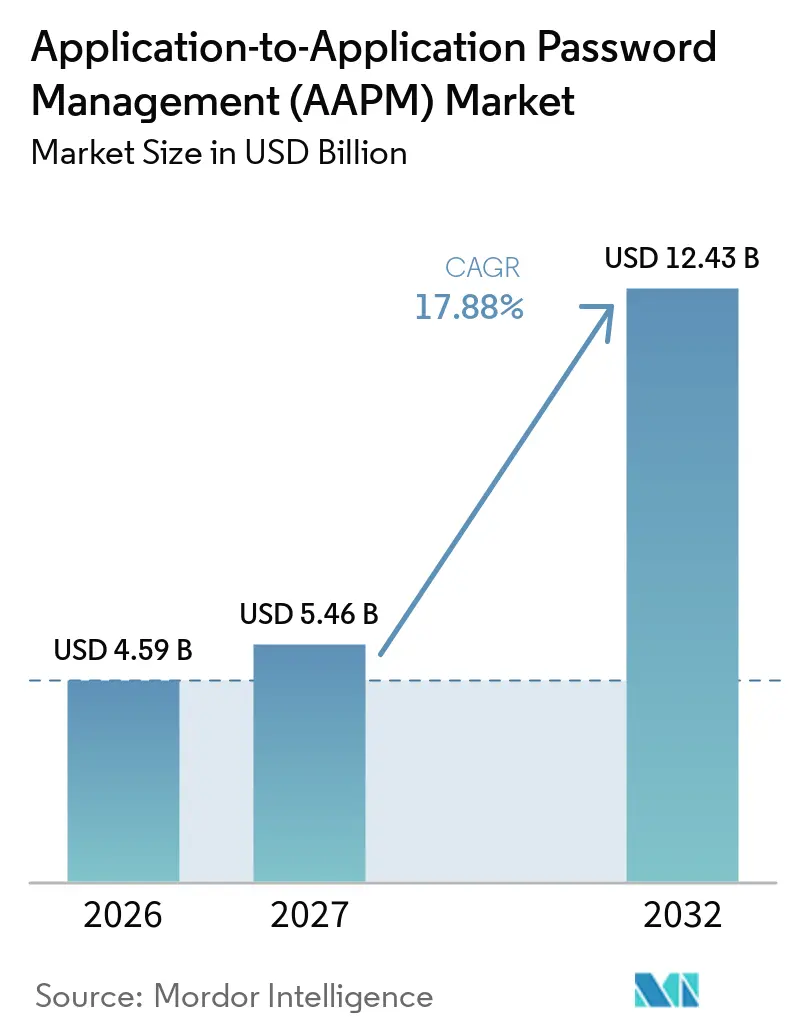
| Market Size (2027) | USD 5.46 Billion |
| Market Size (2032) | USD 12.43 Billion |
| Growth Rate (2027 - 2032) | 17.88 % |
| Fastest Growing Market | Asia-Pacific |
| Largest Market | North America |
| Market Concentration | Medium |
Major Players *Disclaimer: Major Players sorted in no particular order Image © Mordor Intelligence. Reuse requires attribution under CC BY 4.0. | |
Application-to-Application Password Management (AAPM) Market Analysis by Mordor Intelligence
The application-to-application password management (AAPM) market size is projected to be USD 4.59 billion in 2026, USD 5.46 billion in 2027, and reach USD 12.43 billion by 2032, growing at a CAGR of 17.88% from 2027 to 2032. The application-to-application password management (AAPM) market is moving away from static credentials embedded in code toward automated vault distribution, dynamic issuance, and controlled credential lifecycles. Cloud-native applications, microservices, containers, and multi-cloud operations create many machine-to-machine access points that are difficult to manage manually. The application-to-application password management market, therefore, sits within a wider shift toward identity-led security controls that can support auditability and reduce credential exposure. Platform consolidation, regulatory expectations, and demand for specialist deployment support are expected to shape vendor strategies and customer buying decisions. Product design will increasingly focus on discovery, credential rotation, policy enforcement, and evidence that security teams can use during compliance reviews, incident investigations, and enterprise risk assessments.
Key Report Takeaways
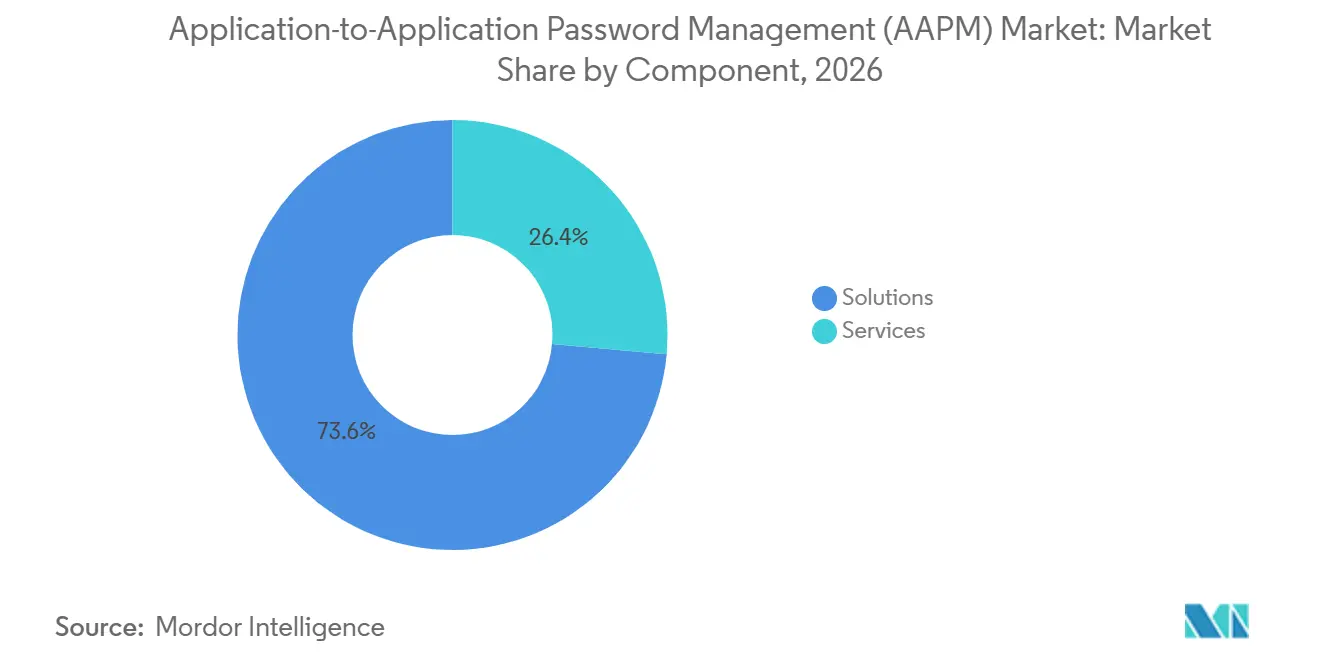
- By component, Solutions held 73.58% of the application-to-application password management (AAPM) market share in 2026, while Services are projected to expand at a CAGR of 21.76% through 2032.
- By deployment mode, Cloud-Based deployment accounted for 67.58% of the application-to-application password management (AAPM) market size in 2026 and is projected to expand at a CAGR of 22.81% through 2032.
- By organization size, Large Enterprises held 68.54% of 2026 revenue, while SMEs are projected to expand at a CAGR of 18.72% through 2032.
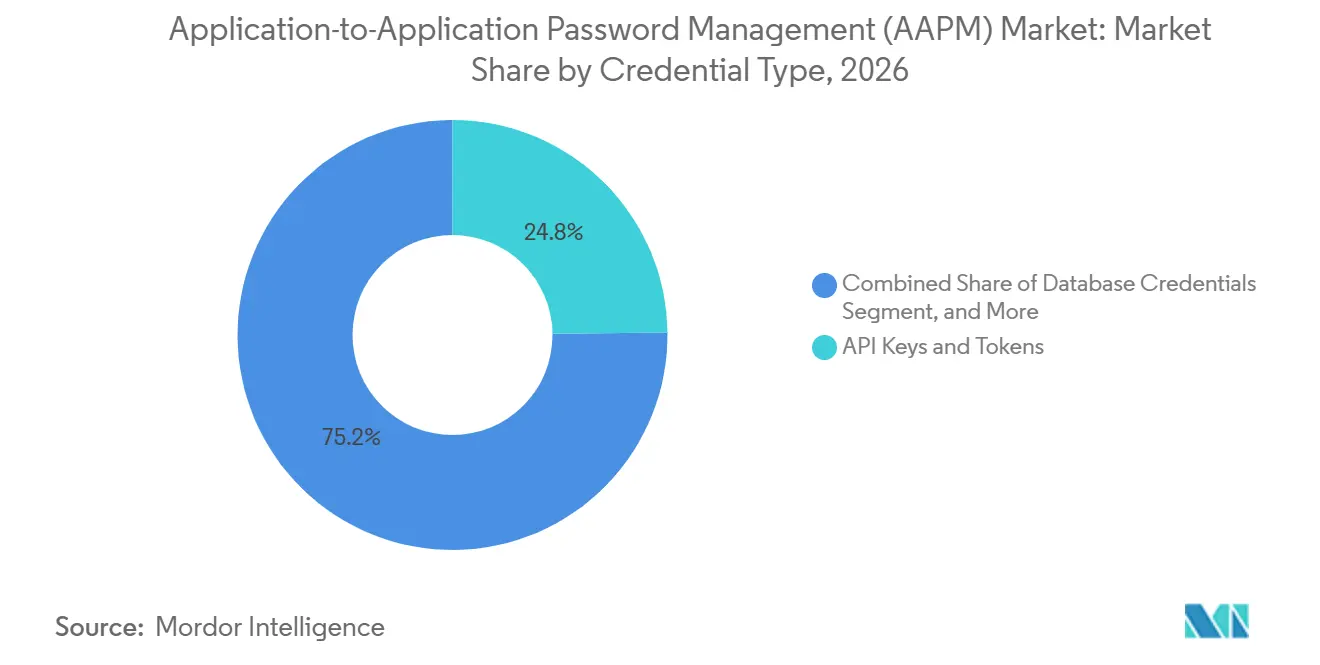
- By credential type, API Keys and Tokens accounted for 24.81% of 2026 revenue, while AI-Agent Credentials are projected to expand at a CAGR of 19.72% through 2032.
- By end-user industry, BFSI held 27.69% of 2026 revenue, while Government and Public Administration is projected to expand at a CAGR of 19.22% through 2032.
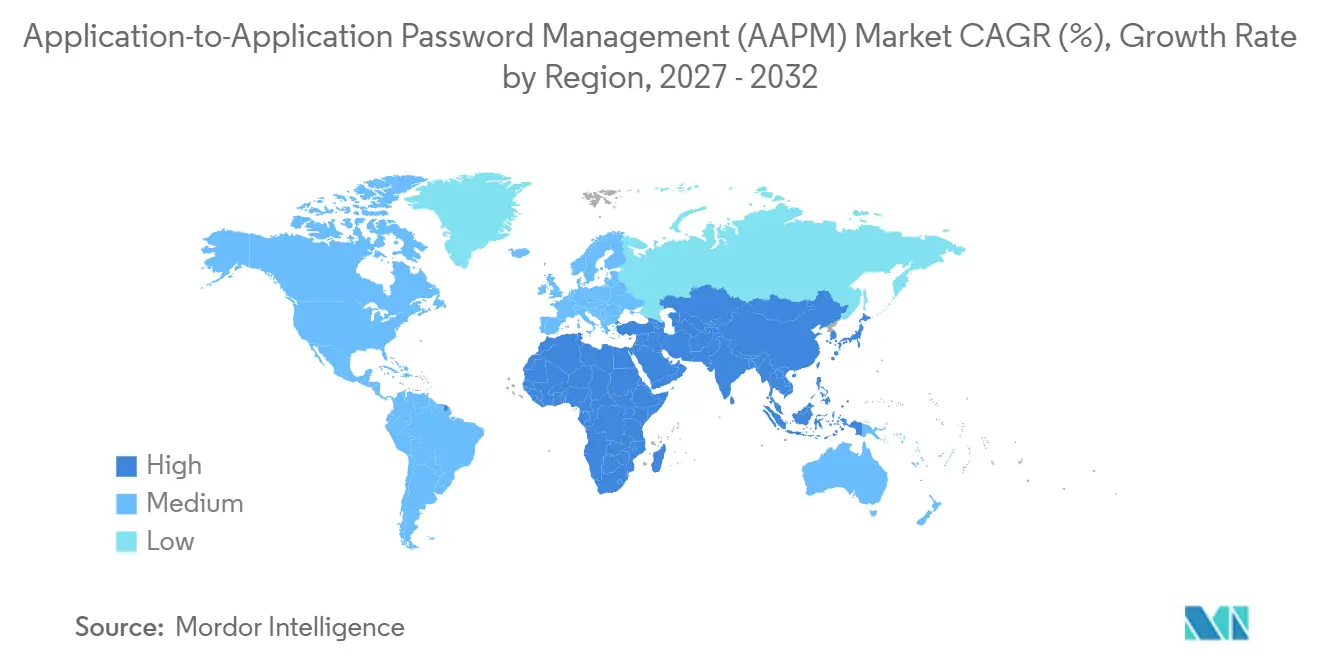
- By geography, North America held 41.64% of the application-to-application password management (AAPM) market in 2026 revenue, while Asia-Pacific is projected to expand at a CAGR of 21.93% through 2032.
Note: Market numbers in this report are based on Mordor Intelligence's proprietary estimation framework, which combines nine months of actuals with Q4 projections for base year 2026.
Market Trends and Insights
Drivers Impact Analysis of Application-to-Application Password Management (AAPM) Market*
| DRIVER | (~) % IMPACT ON CAGR FORECAST | GEOGRAPHIC RELEVANCE | IMPACT TIMELINE |
|---|---|---|---|
| Expansion of Cloud-Native Applications and APIs | +3.2% | Global, with peak demand in North America, Asia-Pacific, and Western Europe | Short term (≤ 2 years) |
| Proliferation of Non-Human Identities | +3.0% | Global, most acute in cloud-native and DevOps-heavy environments in North America and Asia-Pacific | Short term (≤ 2 years) |
| Zero-Trust Requirements for Machine-to-Machine Access | +2.7% | North America and Europe, extending to Asia-Pacific through regulatory alignment | Medium term (2-4 years) |
| Increasing Regulatory Pressure for Credential Lifecycle Control | +2.3% | North America, Europe, Asia-Pacific, with spillover to the Middle East | Medium term (2-4 years) |
| Application Credential Sprawl Across CI/CD and Automation Toolchains | +1.9% | Global, with highest impact in Asia-Pacific and North America DevOps-intensive environments | Short term (≤ 2 years) |
| AI Agent Credential Governance and Agent-to-Agent Access | +1.6% | North America, Europe, and Asia-Pacific, with early-stage global relevance | Long term (≥ 4 years) |
| Source: Mordor Intelligence | |||
Expansion of Cloud-Native Applications and APIs
Cloud-native application architectures are expanding the credential surface that organizations must govern. Each microservice, container, and serverless function can require its own identity and credential lifecycle. This places the application-to-application password management (AAPM) market beyond traditional privileged access boundaries. NIST updated Special Publication 800-228 in March 2026 with API risk categorization and lifecycle-stage security controls for cloud-native systems.[1] The guidance increases the importance of auditable controls for credentials used in cloud deployments. The application-to-application password management (AAPM) market can address this requirement through vaulted storage, automated rotation, and policy-based access.
Proliferation of Non-Human Identities
Service accounts, API tokens, OAuth credentials, SSH keys, CI/CD identities, and AI agents all require authenticated access. The Cloud Security Alliance reported that non-human identities outnumbered human identities by 45:1 on average and by 144:1 in cloud-native environments in 2026.[2] This volume reflects automation and DevOps practices rather than a short-term deployment cycle. The same study found that only 20% of organizations had formal API key offboarding and revocation processes, while 47% of non-human identities had not been updated for more than 1 year. These gaps make centralized governance more important for the application-to-application password management (AAPM) market. They also increase the value of tools that can consistently discover identities and revoke access.
Zero-Trust Requirements for Machine-to-Machine Access
Zero-trust practices require every application credential to be verified, scoped, and time-bound. This approach makes dynamic credentials more relevant than static application passwords. The January 2025 U.S. executive order directed federal agencies toward stronger authentication and cybersecurity practices across federal technology activity. NIST issued Special Publication 800-63-4 in July 2025 and addressed authenticator issuance, maintenance, and revocation. The Coalition for Secure AI also set out short-lived token and zero-standing-privilege principles for AI agents in 2026. The application-to-application password management (AAPM) market supports these practices by replacing long-lived secrets with credentials governed by policy and expiration.
Increasing Regulatory Pressure for Credential Lifecycle Control
Regulatory requirements are placing more attention on demonstrable credential lifecycle management. The European Commission states that the Digital Operational Resilience Act applies from January 2025 to cover financial entities and ICT service providers. DORA increases the importance of documented controls across digital touchpoints, including application interfaces. CISA and NIST published token protection recommendations in September 2026 for agencies and cloud service providers. These expectations bring security, finance, and board-level risk functions into application-to-application password management (AAPM) market evaluations. Vendors must therefore demonstrate lifecycle governance, validation, detection, and compliance evidence.
Restraints Impact Analysis of Application-to-Application Password Management (AAPM) Market*
| RESTRAINT | (~) % IMPACT ON CAGR FORECAST | GEOGRAPHIC RELEVANCE | IMPACT TIMELINE |
|---|---|---|---|
| Integration Complexity Across Legacy and Modern Application Estates | -2.1% | Global, most severe in Europe and Asia-Pacific where mainframe and on-premises systems are prevalent | Medium term (2-4 years) |
| Shortage of Secrets Management and Machine Identity Specialists | -1.7% | Global, most acute in South America, the Middle East, Africa, and Asia-Pacific emerging markets | Medium term (2-4 years) |
| Ownership Ambiguity Between Security, Platform Engineering, and Application Teams | -1.3% | Global | Short term (≤ 2 years) |
| False Positives and Governance Noise From Ephemeral and Shadow Identities | -0.9% | Global, heightened in organizations with advanced DevOps maturity | Long term (≥ 4 years) |
| Source: Mordor Intelligence | |||
Integration Complexity Across Legacy and Modern Application Estates
Adoption can slow when organizations connect credential tools to both legacy and cloud-native systems. Older banking systems, mainframe batch processes, and on-premises enterprise resource planning platforms may lack interfaces for dynamic credential retrieval. These environments often need middleware, wrappers, or proprietary protocol bridges. IBM announced zSecure Secret Manager in May 2026, with general availability from June, to support automated secrets and certificate lifecycle management for IBM z/OS through IBM Vault Self-Managed for Z and LinuxONE. The release shows why specialized integration layers remain necessary for complex estates. This work raises implementation time and can make services a major part of an application-to-application password management market deployment.
Shortage of Secrets Management and Machine Identity Specialists
Organizations need skills in secrets architecture, vault operations, machine identity governance, and DevSecOps integration. These capabilities are often divided across security, development, and platform teams. The Cloud Security Alliance reported that slow response processes can leave organizations unable to rotate or revoke exposed credentials quickly. Specialist scarcity can be more limiting in South America, the Middle East, Africa, and emerging Asia-Pacific markets. Managed service channels can help customers deploy and operate controls, but they do not eliminate the need for clear internal ownership. The application-to-application password management (AAPM) market, therefore, depends partly on products that make deployment, policy management, and routine operations more accessible.
*Our forecasts treat driver/restraint impacts as directional, not additive. The impact forecasts reflect baseline growth, mix effects, and variable interactions.
Application-to-Application Password Management (AAPM) Market Segment Analysis
By Component:
Solutions Dominate While Services Scale With ComplexitySolutions held 73.58% of the application-to-application password management (AAPM) market share in 2026. Vault platforms, discovery engines, rotation tools, and policy enforcement functions form the first layer of most customer deployments. Organizations commonly establish centralized credential storage and automated rotation before adding supporting services. HashiCorp released Vault Enterprise 2.0 in April 2026 with a SPIFFE secrets engine, workload identity federation, and Linux local account password rotation.[3] These functions extend application-to-application password management (AAPM) market coverage across cloud-native, hybrid, and on-premises environments.
Services are projected to expand at a CAGR of 21.76% through 2032. Migration work often involves replacing static secrets with dynamically issued credentials. Managed service demand also comes from organizations that operate multiple vaults but lack dedicated internal specialists. Delinea expanded its IBM relationship in November 2025 to make the Delinea Platform available through a managed channel. This approach shows how partners can package deployment support with platform access.
By Deployment Mode:
Cloud Momentum Reinforced by Hybrid AnchorsCloud-Based deployment accounted for 67.58% of the application-to-application password management (AAPM) market size in 2026. It is also projected to expand at a CAGR of 22.81% through 2032. SaaS delivery can reduce infrastructure work, support multi-region operations, and align with cloud identity systems. These characteristics suit DevSecOps teams that need credential services integrated with continuous delivery. The application-to-application password management market is increasingly shaped by cloud operating models rather than by point deployments.
Hybrid models remain important where data-residency requirements constrain where sensitive credentials can be stored. IBM introduced Vault Dedicated in beta on IBM Cloud in September 2026 as a fully managed, single-tenant Vault Enterprise option.[4] The service initially targeted Frankfurt and Dallas environments. On-premises delivery also retains relevance for air-gapped critical infrastructure and highly regulated operations. Those settings can require local control even when cloud-native tools lead overall adoption.
By Organization Size:
Large Enterprises Lead While SMEs AccelerateLarge Enterprises held 68.54% of 2026 revenue. Large organizations manage thousands of services, many pipelines, and multiple cloud accounts, which can make manual credential oversight impractical. Existing privileged access programs can also serve as a foundation for a broader rollout of application-to-application password management. Their procurement processes typically prioritize audit trails, role controls, and integration across several environments. This explains why large enterprises remain the principal source of revenue.
SMEs are projected to expand at a CAGR of 18.72% through 2032. SaaS-native vaults lower infrastructure requirements and can align pricing more closely with smaller technology budgets. Akeyless introduced SecretlessAI in July 2025 for AI agent and Model Context Protocol server credential security without on-premises vault components. Products with a simpler operating model can help smaller organizations adopt structured controls. ISO/IEC 27001 access-control expectations also support formal credential management evaluations.
By Credential Type:
API Tokens Are Pervasive While AI-Agent Credentials Redefine ScopeAPI Keys and Tokens accounted for 24.81% of 2026 revenue. Modern applications use them across microservices, software-as-a-service connections, open banking, and partner data exchange. Amazon Web Services introduced managed external secrets for SaaS credentials in November 2025 and added support for Cisco Security Platform and Netskope tokens in August 2026. These releases show how credential management is becoming part of routine cloud-service operations. API token governance remains a major requirement in the application-to-application password management (AAPM) market.
AI-Agent Credentials are projected to expand at a CAGR of 19.72% through 2032. AI agents need identities, delegated authority chains, and runtime authorization controls that differ from a standard service endpoint. The Coalition for Secure AI describes the need to link an agent identity to its code, model version, and task context. Service accounts, SSH keys, certificates, database credentials, cloud application credentials, CI/CD credentials, and application passwords remain separate exposure points. Certificate management follows established public key infrastructure practices under RFC 5280 and certificate authority baseline requirements.

By End-User Industry:
BFSI Anchors Demand While Government AcceleratesBFSI held 27.69% of 2026 revenue. Financial institutions operate payment systems, digital banking applications, and open banking interfaces that require auditable machine-to-machine access. DORA applied from January 2025 and heightened the need for documented ICT access controls among covered entities. Banking environments frequently span public cloud, private cloud, and on-premises infrastructure. This makes consistent credential control a central application-to-application password management (AAPM) market need.
Government and Public Administration is projected to expand at a CAGR of 19.22% through 2032. Federal zero-trust direction is making machine credential governance a security priority for public agencies and suppliers. The January 2025 executive order strengthened the policy direction for cybersecurity practices in federal technology activity. Healthcare and Life Sciences, Retail and E-Commerce, Telecommunications and Media, and Travel and Hospitality also face sector-specific control needs. HIPAA, PCI-DSS, and communications security requirements can each create a compliance-led path to adoption.
Geography Analysis
North America Application-to-Application Password Management (AAPM) Market
North America held 41.64% of the application-to-application password management (AAPM) market share in 2026. The region combines a large base of cloud-native enterprises, federal cybersecurity direction, and established privileged access management providers. The January 2025 U.S. executive order increased attention to stronger authentication and supplier cybersecurity practices. CISA and NIST issued token protection recommendations in September 2026 for agencies and cloud service providers. These actions place application credential governance in strategic security planning.
Europe and South America Application-to-Application Password Management (AAPM) Market
Europe is shaped by DORA, NIS 2, and GDPR requirements that support documented machine identity controls. Germany is an important source of regional demand, where security requirements and data sovereignty sustain hybrid and on-premises preferences. South America is an emerging application-to-application password management (AAPM) market, with Brazil supported by fintech activity and digital financial infrastructure. Segura rebranded from Senhasegura in March 2025 and reported a USD 25 million growth round led by Riverwood Capital.
APAC and MEA Application-to-Application Password Management (AAPM) Market
Asia-Pacific is projected to expand at a CAGR of 21.93% through 2032. Digital transformation, API traffic from software development centers, and zero-trust alignment are supporting demand in Japan, South Korea, Australia, and Singapore. China holds the largest regional revenue position, supported by cloud infrastructure and domestic technology platforms. India is the fastest-growing country in the region, where digital payments, offshore software development, and fintech adoption generate significant volumes of API credentials. The Middle East and Africa remain earlier-stage areas, where financial services, telecommunications, smart government, and mobile financial services are generating initial demand.
Competitive Landscape
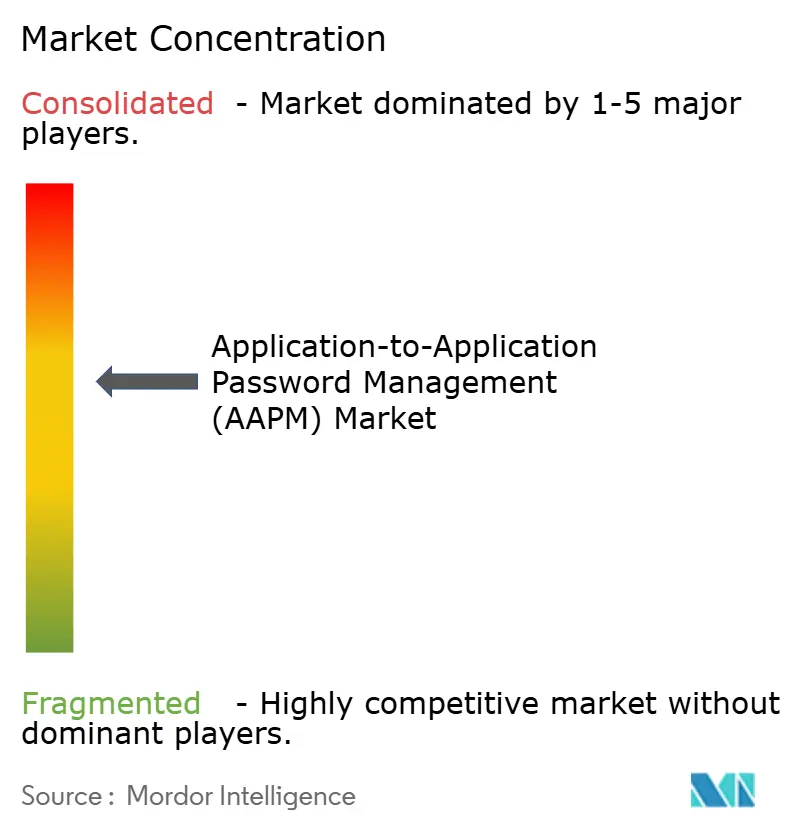
The application-to-application password management (AAPM) market has a moderately consolidated platform structure. Privileged access management vendors hold important positions, while cloud providers embed secret services in existing customer environments. Amazon Web Services, Microsoft Azure, and Google Cloud can benefit from their cloud identity and procurement relationships. Customers choose between integrated platform services and specialist products, while challengers reduce infrastructure demands or address emerging identity problems.
Consolidation is a central competitive pattern. Palo Alto Networks completed its acquisition of CyberArk in February 2026, positioning identity security as a core part of its security platform. The transaction had an equity value of USD 25 billion. HashiCorp released Vault Enterprise 2.0 in April 2026 with a SPIFFE secrets engine and workload identity federation. BeyondTrust expanded Identity Security Insights with Secrets Insights in August 2025 for visibility across hybrid and multi-cloud secrets estates.
Vendors also compete through vaultless delivery, AI-agent credential governance, and regional coverage. Akeyless released SecretlessAI in July 2025 for AI agent and Model Context Protocol server security. Delinea announced cloud-native security capabilities in April 2025, including Vault AI, automated rotation, and just-in-time authorization controls. Future differentiation will depend on agent identity governance, post-quantum key management, and tools suitable for SMEs without dedicated identity engineers. NIST API guidance and CISA token guidance favor suppliers that can provide documented security assurances for government and critical infrastructure buyers.
Application-to-Application Password Management (AAPM) Industry Leaders
-
CyberArk Software Ltd.
-
BeyondTrust Corporation
-
Delinea Inc.
-
Broadcom Inc.
-
One Identity LLC
- *Disclaimer: Major Players sorted in no particular order
Application-to-Application Password Management (AAPM) Market Companies Covered in this Report
- CyberArk Software Ltd.
- BeyondTrust Corporation
- Delinea Inc.
- Broadcom Inc.
- One Identity LLC
- HashiCorp, Inc.
- IBM Corporation
- Microsoft Corporation
- Amazon Web Services, Inc.
- Google LLC
- Akeyless Security Ltd.
- Keeper Security, Inc.
- Thales S.A.
- Keyfactor, Inc.
- DigiCert, Inc.
- Entrust Corporation
- WALLIX Group SA
- Fudo Security Sp. z o.o.
- ARCON TechSolutions Pvt. Ltd.
- Senhasegura, MT4 Tecnologia Ltda.
Recent Industry Developments in Application-to-Application Password Management (AAPM) Market
- October 2026: Google Cloud advanced Secret Manager's Kubernetes integration to generally available status, enabling automatic synchronization and rotation of secrets from Google Secret Manager into GKE cluster Kubernetes Secret objects, supporting cloud-native application credential delivery without static environment variables.
- September 2026: CISA and NIST jointly published an interagency report on protecting tokens and assertions from forgery, theft, and misuse, incorporating Joint Cyber Defense Collaborative input and providing federal agencies and cloud service providers with technical specifications for secrets management, token validation, and AI-credential breach detection at scale.
- September 2026: IBM launched Vault Dedicated in beta on IBM Cloud, providing customers access to HashiCorp Vault Enterprise capabilities through a fully managed, single-tenant deployment with no charge during the beta period.
- August 2026: AWS Secrets Manager expanded its managed external secrets capability to Cisco Security Platform API keys and Netskope API tokens, enabling automated credential rotation for third-party security platforms directly from the AWS console without custom rotation code.
Global Application-to-Application Password Management (AAPM) Market Report Scope
The application-to-application password management (AAPM) market covers solutions and services for discovering, vaulting, rotating, governing, monitoring, and revoking credentials for application-to-application, service-account, API, database, CI/CD, cloud, and AI-agent authentication. It includes credential vaulting, automated rotation, just-in-time access, dependency mapping, and credential governance.
The Application-to-Application Password Management (AAPM) Market Report is Segmented by Component (Solutions, and Services), Deployment Mode (Cloud-Based, On-Premises, and Hybrid), Organization Size (Large Enterprises, and Small and Medium Enterprises), Credential Type (Application-to-Application Passwords, Service Account Credentials, API Keys and Tokens, SSH Keys and Certificates, Database Credentials, Cloud and SaaS Application Credentials, AI-Agent Credentials, and Other Credential Types), End-User Industry (Banking, Financial Services, and Insurance (BFSI), Government and Public Administration, Healthcare and Life Sciences, Retail and E-Commerce, Telecommunications and Media, Travel and Hospitality, and End-User Industries), and Geography (North America, South America, Europe, Asia-Pacific, Middle East, and Africa). The Market Forecasts are Provided in Terms of Value (USD).
Segmentation Overview
| Solutions |
| Services |
| Cloud-Based |
| On-Premises |
| Hybrid |
| Large Enterprises |
| Small and Medium-Sized Enterprises |
| Application-to-Application Passwords |
| Service Account Credentials |
| API Keys and Tokens |
| SSH Keys and Certificates |
| Database Credentials |
| Cloud and SaaS Application Credentials |
| CI/CD and DevOps Credentials |
| AI-Agent Credentials |
| Banking, Financial Services, and Insurance (BFSI) |
| Government and Public Administration |
| Healthcare and Life Sciences |
| Retail and E-Commerce |
| Telecommunications and Media |
| Travel and Hospitality |
| Other End User Industries |
| North America | United States |
| Canada | |
| Mexico | |
| South America | Brazil |
| Argentina | |
| Rest of South America | |
| Europe | Germany |
| United Kingdom | |
| France | |
| Italy | |
| Rest of Europe | |
| Asia-Pacific | China |
| Japan | |
| India | |
| South Korea | |
| Australia | |
| Singapore | |
| Rest of Asia-Pacific | |
| Middle East | Saudi Arabia |
| United Arab Emirates | |
| Turkey | |
| Israel | |
| Rest of Middle East | |
| Africa | South Africa |
| Nigeria | |
| Egypt | |
| Rest of Africa |
| By Component | Solutions | |
| Services | ||
| By Deployment Mode | Cloud-Based | |
| On-Premises | ||
| Hybrid | ||
| By Organization Size | Large Enterprises | |
| Small and Medium-Sized Enterprises | ||
| By Credential Type | Application-to-Application Passwords | |
| Service Account Credentials | ||
| API Keys and Tokens | ||
| SSH Keys and Certificates | ||
| Database Credentials | ||
| Cloud and SaaS Application Credentials | ||
| CI/CD and DevOps Credentials | ||
| AI-Agent Credentials | ||
| By End-User Industry | Banking, Financial Services, and Insurance (BFSI) | |
| Government and Public Administration | ||
| Healthcare and Life Sciences | ||
| Retail and E-Commerce | ||
| Telecommunications and Media | ||
| Travel and Hospitality | ||
| Other End User Industries | ||
| By Geography | North America | United States |
| Canada | ||
| Mexico | ||
| South America | Brazil | |
| Argentina | ||
| Rest of South America | ||
| Europe | Germany | |
| United Kingdom | ||
| France | ||
| Italy | ||
| Rest of Europe | ||
| Asia-Pacific | China | |
| Japan | ||
| India | ||
| South Korea | ||
| Australia | ||
| Singapore | ||
| Rest of Asia-Pacific | ||
| Middle East | Saudi Arabia | |
| United Arab Emirates | ||
| Turkey | ||
| Israel | ||
| Rest of Middle East | ||
| Africa | South Africa | |
| Nigeria | ||
| Egypt | ||
| Rest of Africa | ||
Key Questions Answered in the Report
What is the application-to-application password management (AAPM) market size?
The application-to-application password management (AAPM) market size is projected to be USD 4.59 billion in 2026, USD 5.46 billion in 2027, and reach USD 12.43 billion by 2032, growing at a CAGR of 17.88% from 2027 to 2032.
Why are organizations adopting application credential management tools?
Cloud-native architectures and large non-human identity estates require automated storage, rotation, and lifecycle controls for machine credentials. These controls can also support audit evidence, consistent revocation processes, and a reduced reliance on passwords embedded within application code.
Which deployment model leads application-to-application password management adoption?
Cloud-Based deployment held 67.58% of 2026 revenue and is projected to expand at a CAGR of 22.81% through 2032. This delivery model is central to the application-to-application password management market.
Which end-user sector has the largest demand for application credential controls?
BFSI held 27.69% of 2026 revenue because regulated financial systems need auditable controls across payment, banking, and API environments.
Which region is expanding fastest for application credential security?
Asia-Pacific is projected to expand at a CAGR of 21.93% through 2032, supported by digital transformation, software development activity, and API use.
How are AI agents affecting credential security requirements?
AI agents need distinct identities, delegated authority controls, short-lived credentials, and runtime authorization linked to their task and operating context.