
Low Sugar Fruit Snacks Market Size and Share
Market Overview
| Study Period | 2021 - 2031 |
|---|---|
| Market Size (2026) | USD 3.28 Billion |
| Market Size (2031) | USD 6.02 Billion |
| Growth Rate (2026 - 2031) | 11.21 % |
| Fastest Growing Market | Asia-Pacific |
| Largest Market | North America |
| Market Concentration | Low |
Major Players *Disclaimer: Major Players sorted in no particular order Image © Mordor Intelligence. Reuse requires attribution under CC BY 4.0. | |
Low Sugar Fruit Snacks Market Analysis by Mordor Intelligence
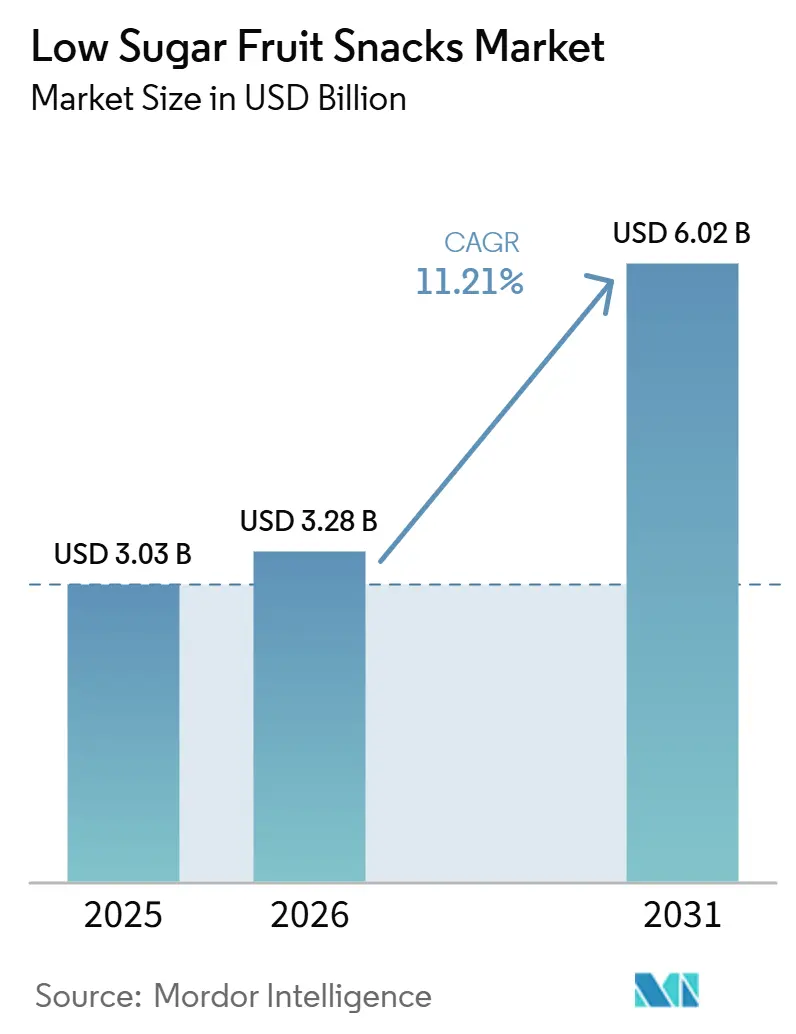
The Low Sugar Fruit Snacks Market size is expected to increase from USD 3.03 billion in 2025 to USD 3.28 billion in 2026 and reach USD 6.02 billion by 2031, growing at a CAGR of 11.21% over 2026-2031. The Low Sugar Fruit Snacks Market is being shaped by consumers who are replacing conventional sugary snacks with products that have no-added-sugar, reduced-sugar, and clean-label claims. Greater attention to metabolic health has strengthened this shift in the United States, the United Kingdom, and Australia, where shoppers increasingly link routine snack choices with their broader eating habits. Label reading has become more routine among millennial and Generation Z shoppers, and this behavior is also affecting snack choices for children. This extends demand from individual purchases to household buying decisions, including repeat purchases that are planned for lunchboxes and other everyday occasions. Companies are responding through cleaner formulations, functional ingredients, and formats suited to online and physical retail.
Key Report Takeaways
- By product type, fruit bars held 45.32% of the Low Sugar Fruit Snacks Market share in 2025, while dried fruit products are forecast to grow at a 12.38% CAGR through 2031.
- By nature, conventional products accounted for 75.48% of category value in 2025, while organic products are forecast to expand at a 13.27% CAGR through 2031.
- By distribution channel, supermarkets and hypermarkets represented 42.36% of the Low Sugar Fruit Snacks Market size in 2025, while online retail channels are forecast to advance at a 12.78% CAGR through 2031.
- By geography, North America held 36.56% of category value in 2025, while Asia-Pacific is forecast to grow at a 13.11% CAGR through 2031.
Note: Market size and forecast figures in this report are generated using Mordor Intelligence’s proprietary estimation framework, updated with the latest available data and insights as of January 2026.
Global Low Sugar Fruit Snacks Market Trends and Insights
Drivers Impact Analysis*
| Driver | (~) % Impact on CAGR Forecasts | Geographic Relevance | Impact Timeline |
|---|---|---|---|
| Growing Consumer Preference for Reduced-Sugar Snack Options | +2.8% | Global | Short term (≤ 2 years) |
| Increasing Government Initiatives Promoting Sugar Reduction | +1.6% | North America & EU; spill-over to APAC | Medium term (2-4 years) |
| Rising Demand for Convenient and Portion-Controlled Fruit Snacks | +1.8% | Global, strongest in North America & APAC urban centres | Short term (≤ 2 years) |
| Expanding Preference for Clean-Label and Allergen-Free Products | +1.4% | North America, Europe & APAC core | Medium term (2-4 years) |
| Advancements in Naturally Sweet Fruit Selection and Processing | +1.2% | North America & Europe (primary), APAC emerging | Long term (≥ 4 years) |
| Increasing Adoption of Shelf-Stable Fruit Products Across Modern Retail Channels | +0.9% | APAC & Emerging Markets; spill-over to MEA | Medium term (2-4 years) |
| Source: Mordor Intelligence | |||
Growing Consumer Preference for Reduced-Sugar Snack Options
Consumer interest in reduced-sugar snacks reflects continuing attention to metabolic health rather than a short-lived diet preference. Parents increasingly assess sugar content when buying snacks for children, which carries reduced-sugar preferences into regular household shopping. This broadens purchasing beyond individual adult consumption and can increase purchase frequency across income groups. The United States Food and Drug Administration rule for the “healthy” claim became effective on February 25, 2025. For fruit products, the rule sets an added-sugar limit of 2% of the Daily Value, and required compliance begins on February 25, 2028[1]Source: U.S. Food and Drug Administration, “Food Labeling, Nutrient Content Claims, Definition of Term ‘Healthy,’” Federal Register, federalregister.gov. Brands that complete formulation work before the deadline can use a clearer front-of-pack position than brands that reformulate later.
Increasing Government Initiatives Promoting Sugar Reduction
Government measures are making sugar reduction a more regular product-development requirement. The United Kingdom extended the Soft Drinks Industry Levy in November 2025, lowered the threshold from 5g to 4.5g per 100ml, and included milk-based drinks with added sugar[2]Source: UK Government, “Soft Drinks Levy Extended to Protect Children and Improve Health,” GOV.UK, gov.uk. The policy has a January 1, 2028, compliance date and is projected to remove 17 million daily calories from the national diet. Scotland restricted prominent placement and price promotions for high-fat, salt, and sugar products under its 2025 regulations, while the Welsh regulations took effect on March 26, 2026. The United Kingdom also issued voluntary guidance in August 2025 asking baby-food manufacturers to reduce sugar and salt in products for children up to 36 months by February 2027. These measures support demand for reformulated fruit snacks, especially where manufacturers already meet stricter nutrition expectations.
Rising Demand for Convenient and Portion-Controlled Fruit Snacks
Urban dual-income households and working adults favor single-serve snacks that need no preparation. Shelf-stable fruit snacks can be kept in lunchboxes, gym bags, carry-on luggage, and desks, where refrigerated products are less practical. This makes convenience and portion control important to the Low Sugar Fruit Snacks Market. Subscription services can shorten the movement from trial to repeat purchase because shoppers can reorder familiar products without returning to the shelf. A 2025 study found that fruit leathers with prebiotic fructooligosaccharide fibers could retain acceptable palatability while lowering added sugar. Fiber inclusion can therefore address the needs of reduced-sugar formulations while supporting a functional product position.
Expanding Preference for Clean-Label and Allergen-Free Products
Clean-label products have become a basic expectation for many health-focused snack shoppers, particularly in North America and Northern Europe. Allergen-free products can also open procurement channels in schools, airline catering, hospital retail, and corporate wellness programs. These channels may provide repeat demand that is less dependent on retail promotions and short-term price activity. Ingredient transparency is particularly important for digitally native brands that acquire consumers through social commerce. Companies can use clear ingredient lists and natural color sources to support both clean-label positioning and online product discovery. This approach gives the Low Sugar Fruit Snacks Market a route to compete on formulation transparency rather than only on shelf visibility.
Restraints Impact Analysis*
| Restraint | (~) % Impact on CAGR Forecasts | Geographic Relevance | Impact Timeline |
|---|---|---|---|
| High Natural Sugar Content in Dried Fruits | -1.7% | Global | Short term (≤ 2 years) |
| Reformulation Costs for Texture and Taste | -1.3% | North America and Europe, with spillover to Asia-Pacific | Medium term (2-4 years) |
| Consumer Scrutiny of Processed Fruit and Health Claims | -0.8% | North America and Europe | Medium term (2-4 years) |
| Fruit Harvest and Raw Material Price Volatility | -0.6% | South America and Asia-Pacific fruit-growing regions | Medium term (2-4 years) |
| Source: Mordor Intelligence | |||
Inherently High Natural Sugar Content in Dried Fruits
Dried fruit is a fast-growing format, but its natural fructose and glucose content can complicate low-sugar positioning. Dates, raisins, and sweetened cranberries contain 60g to 80g of total sugar per 100g in dried form. This creates a gap between no-added-sugar labeling and consumer attention to total sugar per serving. Current disclosure rules do not fully resolve that difference for shoppers who assess overall sugar intake. A 2025 scientific review identified vacuum impregnation, pulsed electric field treatment, and cold plasma processing as ways to reduce glycemic loading while preserving polyphenol content. Commercial use remains limited, so the natural-sugar issue continues to constrain much of the Low Sugar Fruit Snacks Market.
High Reformulation Costs While Maintaining Product Texture and Taste
Added sugar supports moisture control, binding, flavor delivery, and shelf life in fruit snacks. Reducing it can therefore affect several product characteristics at the same time, including the way a snack feels, tastes, and performs during storage. Gummies and fruit leathers are especially sensitive because buyers notice texture changes quickly and may not accept a product that does not meet familiar expectations. Reformulation needs can add research, development, ingredient qualification, and production work for each product variation. This places a greater burden on smaller brands with limited resources for repeated formulation trials and for changes across several product formats. It also concentrates the ability to develop cleaner products among better-funded manufacturers, even though smaller challengers often introduce new products most quickly.
*Our forecasts treat driver/restraint impacts as directional, not additive. The impact forecasts reflect baseline growth, mix effects, and variable interactions.
Segment Analysis
By Product Type: Fruit Bars Lead, Dried Formats Accelerate
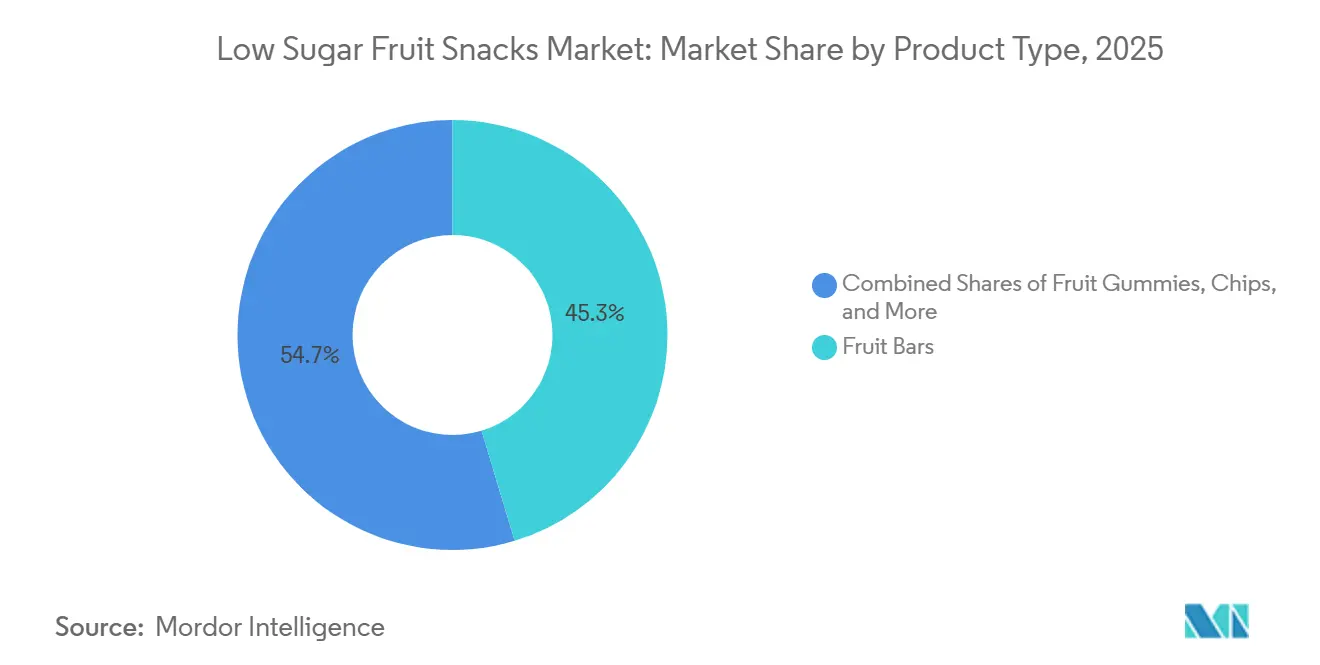
Fruit bars held 45.32% of the Low Sugar Fruit Snacks Market share in 2025, while dried fruit products are forecast to expand at a 12.38% CAGR from 2026 to 2031. Fruit bars benefit from their ability to use date-and-nut bases, compressed freeze-dried blends, and other ingredient combinations that can be adjusted for different consumer preferences. This flexibility helps brands serve different price points without changing the basic portable format or moving away from familiar bar purchasing habits. Their established placement in North American and European retail also supports continued sales and makes the format easier for shoppers to find. Dried fruit products are growing faster because freeze-dried formats offer a crisp texture and a lower-moisture profile that differs from conventional air-dried options. Freeze-dried variants preserve 90% to 98% of polyphenol and antioxidant content, which supports their nutrition-led appeal. A 2025 scientific review identified radiofrequency-assisted freeze-drying as a scalable option that could cut sublimation cycle times by 30% to 40%[3]Source: Małgorzata Nowacka et al., “Emerging Technologies in Dried Fruit Snacks, Nutritional Enrichment and Sustainable Production,” Comprehensive Reviews in Food Science and Food Safety, doi.org. Lower processing time could reduce costs for manufacturers that adopt the technology during the forecast period.
Fruit chips are gaining interest as a texture-focused alternative to conventional crisps. Vacuum-frying and air-drying can support lower-fat and reduced-sugar profiles while providing a familiar snack experience for consumers who value crunch. Gummies face a more difficult formulation task because sugar has a direct role in gel formation and cannot be removed without careful changes to the recipe. Functional additions such as probiotic cultures, prebiotic fibers, and vitamins allow manufacturers to support premium pricing after sugar reduction. These additions also give companies a reason to present gummies as products with more than one nutritional purpose. Functional positioning is changing gummies from a mainly sweet snack into a multi-benefit format. Baked snacks and fruit-blend snacks remain in the other category and reflect early work on broader texture choices. These products give companies another way to address shoppers who want variety without returning to conventional sugary snacks.



By Nature: Conventional Dominates, Organic Commands Premium Growth
Conventional products held 75.48% of category value in 2025, while organic formats are projected to grow at a 13.27% CAGR through 2031. Conventional products remain important because they are more accessible to price-sensitive households and benefit from private-label expansion in mainstream grocery. This gives conventional formats a continuing majority position through the forecast period and keeps them important for broad household access. Organic products are growing faster among consumers in the United States, Northern Europe, and urban Asia-Pacific markets. These buyers are willing to pay a 30% to 60% premium for certified-organic credentials. Certified supply chains create a barrier because brands cannot claim organic positioning without meeting certification requirements. That structure helps established operators protect their margins while supporting a differentiated value proposition.
The organic premium is also encouraging contract manufacturing investment in South America and Southeast Asia. These regions have certified-organic raw materials that can carry lower costs than supplies in mature Western markets, which makes them relevant to the future supply base. Greater supply-chain capacity can give more brands access to organic ingredients and can support a wider range of certified product offerings. It can also make the premium more manageable in mainstream retail over time. The Low Sugar Fruit Snacks Market is therefore likely to see organic growth move from a mainly premium-led pattern toward greater volume in the later forecast years. The change would not remove the value of certification, but it could widen access to certified products. Conventional products will still be supported by affordability and broad grocery distribution. The two nature segments will therefore serve distinct consumer needs rather than following the same pricing strategy.
By Packaging: Convenience Architecture Shapes Both Sales and Perception
Pouches held 38.52% of category value in 2025 and remain the leading packaging format in the Low Sugar Fruit Snacks Market. Their resealability, moisture-barrier performance, and use across dried fruit strips, freeze-dried clusters, and fruit bars support this position. Single-serve pouches usually contain 20g to 30g and allow companies to display sugar per pack clearly. This can help health-conscious shoppers assess portion size without changing a product’s formulation. Boxes and cartons are forecast to grow at a 12.68% CAGR from 2026 to 2031. Multi-count cartons suit children’s lunchbox occasions in North America and Europe. They also support institutional purchases by schools and corporate wellness programs seeking portion-controlled snacks. Cups and jars serve at-home and foodservice occasions, while compostable sachets and mono-material flexible structures are gaining interest at European grocery retailers.
Packaging shapes access to several sales settings at once in the Low Sugar Fruit Snacks Market. Carton variety packs can support higher basket values and subscription-eligible assortments in e-commerce. This gives them a role that differs from single-flavor pouches, even when both formats serve the same household. Pouches continue to offer a practical combination of portability, resealability, and product protection. Plant-based multilayer coatings may help pouches seek recyclable packaging credentials without reducing moisture-barrier performance. Brands pursuing European distribution may need to fund packaging upgrades while also paying for formulation work. This combined demand can concentrate packaging investment among companies with greater financial capacity.
By Distribution Channels: Physical Retail Anchors, Digital Channels Outpace
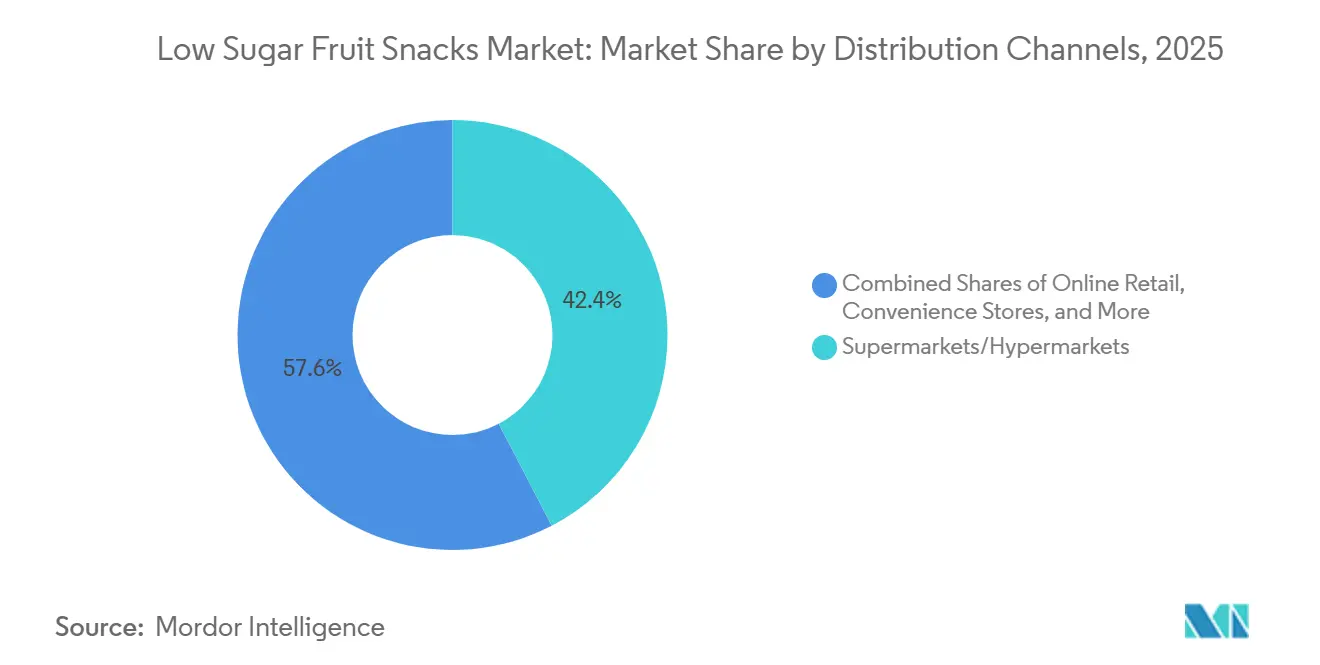
Supermarkets and hypermarkets accounted for 42.36% of the Low Sugar Fruit Snacks Market size in 2025, while online retail channels are forecast to grow at a 12.78% CAGR through 2031. Physical retail remains important because it supports impulse purchasing and high-volume sales for established brands. Major grocery stores are also expanding shelf space for organic fruit snack options. Online channels grow faster because shoppers can search directly for ingredient claims and specific dietary needs. This search behavior directs consumers to marketplaces, subscription services, and brand-operated stores. Digital channels allow challenger brands to reach customers without the trade spending required for supermarket placement. They also produce direct information on dietary preferences and flavor choices. That information can support faster product development than a retail-only model.
Convenience and specialty stores have a different role in the Low Sugar Fruit Snacks Market. They provide trial opportunities for freeze-dried and premium products at health-food retailers, airports, gyms, and other transit locations where shoppers often make immediate, occasion-based choices. In these settings, fruit snacks compete with protein bars and confectionery for occasion-led purchases. Other distribution channels include schools, healthcare facilities, and corporate wellness programs. These buyers are reviewing packaged-food criteria with greater attention to nutrition credentials. Brands that meet institutional requirements can develop recurring demand that does not depend on retail promotions. Physical stores will remain the sales base for broad household access. Online retail will continue to provide the faster channel for discovery, direct consumer relationships, and national expansion by smaller brands.
Geography Analysis
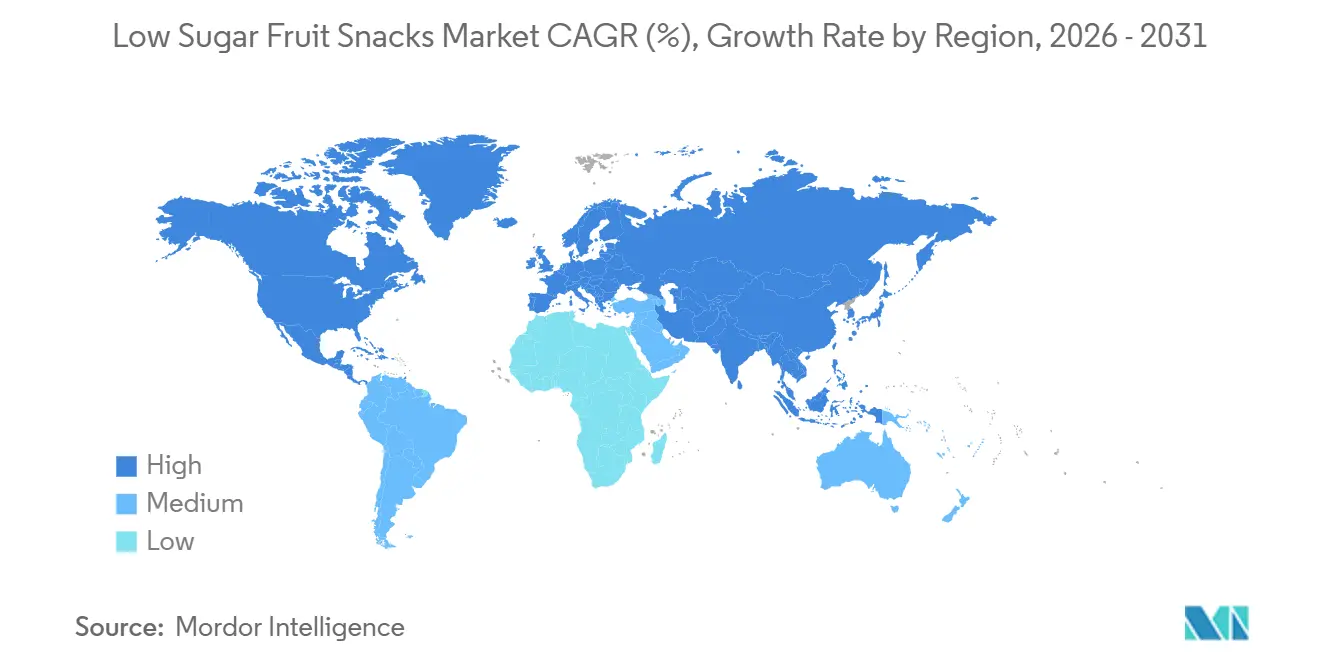
North America held 36.56% of category value in 2025. The region benefits from established health-snack retail networks and a mature direct-to-consumer environment. These channels give newer brands alternatives to traditional retail gatekeeping and allow them to test products with focused consumer groups. The United States is the main contributor, with California and Texas metropolitan markets showing strong adoption of fruit snack subscriptions. Canada supports organic and allergen-free demand. Mexico is seeing higher interest among urban middle-class consumers. Europe is the second-largest regional area. Germany, the United Kingdom, and France lead consumption, while Sweden and the Netherlands show strong organic fruit snack adoption. Retail maturity gives companies several possible ways to reach consumers in both North America and Europe. This includes supermarket placement, specialty retail, direct ordering, and multi-pack family purchases. The focus on health credentials is also more developed in these areas. That supports demand for clear sugar, ingredient, and certification information.
Asia-Pacific is forecast to grow at a 13.11% CAGR from 2026 to 2031, the fastest rate among regions in the Low Sugar Fruit Snacks Market. Urbanization, rising middle-class disposable income, and changing diets are supporting this growth across China, India, and Southeast Asia. China stands out for digital commerce, where branded fruit snacks are found through Tmall, JD.com, and social commerce. These channels let brands build national reach without equally extensive physical retail investment. In India, fortified low-sugar products are positioned for urban parents as a way to provide micronutrients. Vietnam, Indonesia, and Thailand are emerging as packaged snack spending rises with urbanization. Japan and South Korea remain premium markets that favor freeze-dried products, premium pouches, and certified-origin sourcing. The region therefore contains both value-led and premium purchasing settings. Digital discovery can help brands match formats and product claims to these different consumer needs. The ability to enter through e-commerce is especially relevant where physical distribution is still uneven. This makes channel selection closely linked to country-level market development.
South America is advancing at a moderate pace, with Brazil as the principal contributor and Argentina, Peru, Colombia, and Chile adding further demand. The region offers tropical ingredients such as açaí, guava, passion fruit, cupuaçu, and maracuja that can differentiate Low Sugar Fruit Snacks Market products for export. This sourcing base supports production for North American and European retail demand. The Middle East and Africa includes markets at different stages of development. The United Arab Emirates and Saudi Arabia are import-intensive premium snack markets where health-led products can achieve stronger price positions. South Africa leads development in organized African retail. Nigeria and Egypt are earlier-stage markets where urbanization and expanding modern trade support the conditions for branded health-snack adoption. Tropical fruit sourcing provides a clear link between regional agriculture and international product development. This can help suppliers offer different flavor profiles to markets that already know more conventional fruit formats. Import-focused Gulf markets provide a separate route for premium products. Earlier-stage African markets depend more on the continuing expansion of organized retail and modern trade.

Competitive Landscape
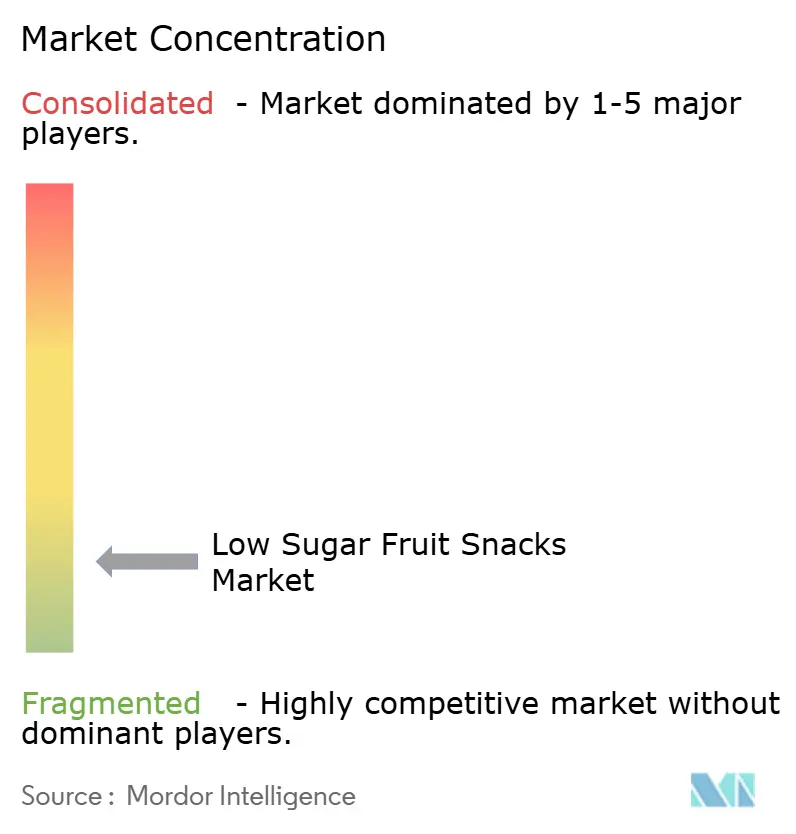
The Low Sugar Fruit Snacks Market is highly fragmented, with no single company holding decisive pricing authority. Branded multinationals use established distribution networks and retail investment to preserve shelf space. Specialist and challenger brands compete through transparent formulations, certified credentials, and direct-to-consumer speed. Functional additions such as probiotic cultures, prebiotic fibers, and vitamins are becoming an important way to support premiums. These features can also reduce the ease with which private labels substitute branded products. The acquisition of Kellanova by Mars, Incorporated was completed in December 2025 for USD 35.90 billion. The transaction brought Kellanova brands such as RXBAR and Special K together with Mars brands including Kind, creating greater retailer negotiating scale.
This greater scale may make shelf allocation more difficult for small operators that rely on co-manufacturing. Smaller brands still have opportunities in corporate wellness, healthcare, and aviation catering. They also have openings in functional products that support microbiome-focused or GLP-1-adjacent positioning. Underpenetrated Asia-Pacific and Middle East and Africa markets offer another path as modern retail develops faster than branded category supply. Emerging competitors in the Low Sugar Fruit Snacks Market often begin as direct-to-consumer or e-commerce businesses. They use social commerce to build product trial without paying conventional slotting fees. Direct customer information then helps them adjust formulas and product choices more quickly. This structure keeps the Low Sugar Fruit Snacks Market competitive even as larger companies increase their scale. The competitive balance therefore depends on both shelf access and the ability to reach buyers outside the store.
Processing technology can also support competitive differentiation in the Low Sugar Fruit Snacks Market. The 2025 scientific review on dried fruit processing reported that radiofrequency-assisted freeze-drying can reduce sublimation cycle times by 30% to 40%. Companies that commercialize such processes can improve efficiency while supporting product quality. Product development is also moving toward cleaner labels, more fiber, and functional benefits. Mars completed its Kellanova transaction after receiving 28 required global regulatory approvals. PIM Brands expanded the Welch’s Fusions range in January 2026 with Citrus Surge and Tropical Tornado varieties. Its earlier May 2025 Mango-Peach addition also extended the core Welch’s Fruit Snacks range
Low Sugar Fruit Snacks Industry Leaders
General Mills, Inc.
PIM Brands, Inc.
Nestlé S.A.
Dole Food Company, Inc.
Chaucer Foods Ltd
- *Disclaimer: Major Players sorted in no particular order

Recent Industry Developments
- June 2026: BranchOut Food announced a major expansion of its retail presence through the launch of five branded snack SKUs at a leading U.S. mass retailer beginning in September 2026. The rollout includes its best-selling Crunchy Pineapple Chips and Crunchy Mango Chips, along with three new products, BBQ Sweet Potato Sticks, Apple Cheddar Crunch, and Veggie Cheddar Crunch.
- March 2026: Meiji expanded its functional confectionery portfolio with the nationwide launch of Frubi by Fruit Juice Gummy Blueberry & Pomegranate, a beauty-focused fruit gummy made with 100% fruit juice and fortified with collagen, polyphenols, and Meiji's proprietary ceramide ingredient.
- February 2026: That's It. expanded its functional snacking portfolio by launching a new range of Fiber Fruit Bars featuring three variants with 2 g, 4 g, and 7 g of naturally derived fiber to cater to different consumer needs and age groups. The products, unveiled ahead of Expo West 2026 and rolling out through major retailers including Target, Walmart, and Sam's Club.


Global Low Sugar Fruit Snacks Market Report Scope
| Dried Fruit Products | Air-Dried |
| Freeze-Dried | |
| Fruit Bars | |
| Fruit Chips | |
| Fruit Gummies | |
| Others (Baked Snacks, Fruit blend snacks) |
| Conventional |
| Organic |
| Pouches |
| Boxes and Cartons |
| Cups and Jars |
| Others |
| Supermarkets/Hypermarkets |
| Convenience/Specialty Stores |
| Online Retail Stores |
| Other Distribution Channels |
| North America | United States |
| Canada | |
| Mexico | |
| Rest of North America | |
| Europe | Germany |
| United Kingdom | |
| France | |
| Italy | |
| Spain | |
| Netherlands | |
| Sweden | |
| Poland | |
| Belgium | |
| Rest of Europe | |
| Asia-Pacific | China |
| India | |
| Japan | |
| Australia | |
| South Korea | |
| Vietnam | |
| Indonesia | |
| Thailand | |
| Singapore | |
| Rest of Asia-Pacific | |
| South America | Brazil |
| Argentina | |
| Chile | |
| Peru | |
| Colombia | |
| Rest of South America | |
| Middle East and Africa | United Arab Emirates |
| Saudi Arabia | |
| South Africa | |
| Nigeria | |
| Egypt | |
| Morocco | |
| Turkey | |
| Rest of Middle East and Africa |
| Product Type | Dried Fruit Products | Air-Dried |
| Freeze-Dried | ||
| Fruit Bars | ||
| Fruit Chips | ||
| Fruit Gummies | ||
| Others (Baked Snacks, Fruit blend snacks) | ||
| Nature | Conventional | |
| Organic | ||
| Packaging | Pouches | |
| Boxes and Cartons | ||
| Cups and Jars | ||
| Others | ||
| Distribution Channels | Supermarkets/Hypermarkets | |
| Convenience/Specialty Stores | ||
| Online Retail Stores | ||
| Other Distribution Channels | ||
| By Geography | North America | United States |
| Canada | ||
| Mexico | ||
| Rest of North America | ||
| Europe | Germany | |
| United Kingdom | ||
| France | ||
| Italy | ||
| Spain | ||
| Netherlands | ||
| Sweden | ||
| Poland | ||
| Belgium | ||
| Rest of Europe | ||
| Asia-Pacific | China | |
| India | ||
| Japan | ||
| Australia | ||
| South Korea | ||
| Vietnam | ||
| Indonesia | ||
| Thailand | ||
| Singapore | ||
| Rest of Asia-Pacific | ||
| South America | Brazil | |
| Argentina | ||
| Chile | ||
| Peru | ||
| Colombia | ||
| Rest of South America | ||
| Middle East and Africa | United Arab Emirates | |
| Saudi Arabia | ||
| South Africa | ||
| Nigeria | ||
| Egypt | ||
| Morocco | ||
| Turkey | ||
| Rest of Middle East and Africa | ||


Key Questions Answered in the Report
What is the forecast value of low sugar fruit snacks by 2031?
The category is forecast to reach USD 6.02 billion by 2031, growing at an 11.21% CAGR from 2026.
Which product type leads sales of low sugar fruit snacks?
Fruit bars led with a 45.32% value share in 2025 because they can serve several price points and retail settings.
Which format is expected to grow fastest through 2031?
Dried fruit products are forecast to grow at a 12.38% CAGR, supported by demand for freeze-dried formats. Their crisp texture and lower-moisture profile distinguish them from conventional dried fruit choices.
Why are organic fruit snacks growing quickly?
Organic products are forecast to expand at a 13.27% CAGR as shoppers pay premiums for certified-organic credentials.
Page last updated on:





