
Low GWP Blowing Agents Market Size and Share
Market Overview
| Study Period | 2022 - 2032 |
|---|---|
| Market Size (2027) | USD 673.79 Million |
| Market Size (2032) | USD 995.99 Million |
| Growth Rate (2027 - 2032) | 8.13 % |
| Fastest Growing Market | Asia-Pacific |
| Largest Market | Asia-Pacific |
| Market Concentration | Medium |
Major Players *Disclaimer: Major Players sorted in no particular order Image © Mordor Intelligence. Reuse requires attribution under CC BY 4.0. | |
Low GWP Blowing Agents Market Analysis by Mordor Intelligence
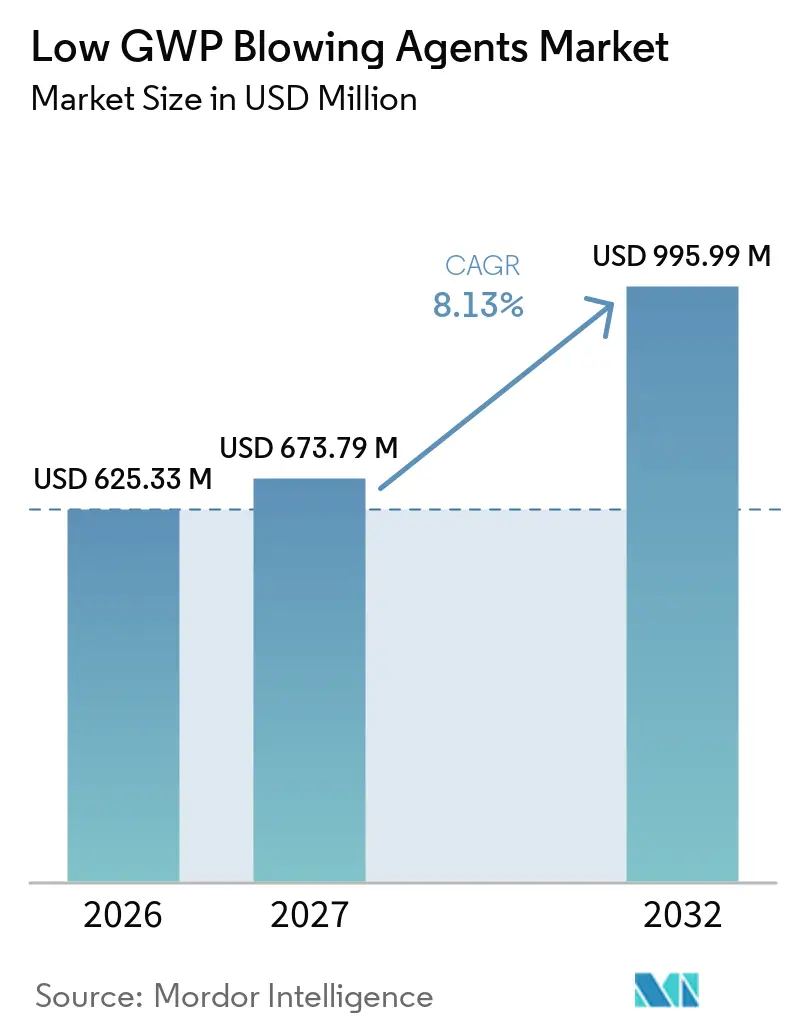
The Low GWP Blowing Agents Market size was valued at USD 625.33 million in 2026 and is estimated to grow from USD 673.79 million in 2027 to reach USD 995.99 million by 2032, at a CAGR of 8.13% during the forecast period (2027-2032). Regulatory requirements are moving foam manufacturers away from high-global-warming-potential hydrofluorocarbons, which is making compliant formulations a core purchasing requirement. The U.S. Environmental Protection Agency Technology Transitions Rule restricts foam applications using hydrofluorocarbons above a global warming potential of 150 from January 1, 2025, while distribution limits begin January 1, 2028. The European Union regulation has restricted hydrofluorocarbons above a global warming potential of 150 in foam manufacturing since January 2023 and sets a full fluorinated greenhouse gas foam ban for 2033. The low Global Warming Potential (GWP) blowing agents market is also supported by insulation requirements, appliance efficiency rules, and growing qualification work in Asia-Pacific. Suppliers that combine molecule supply with formulation assistance are better placed to address the technical and safety requirements that accompany these changes.
Key Report Takeaways
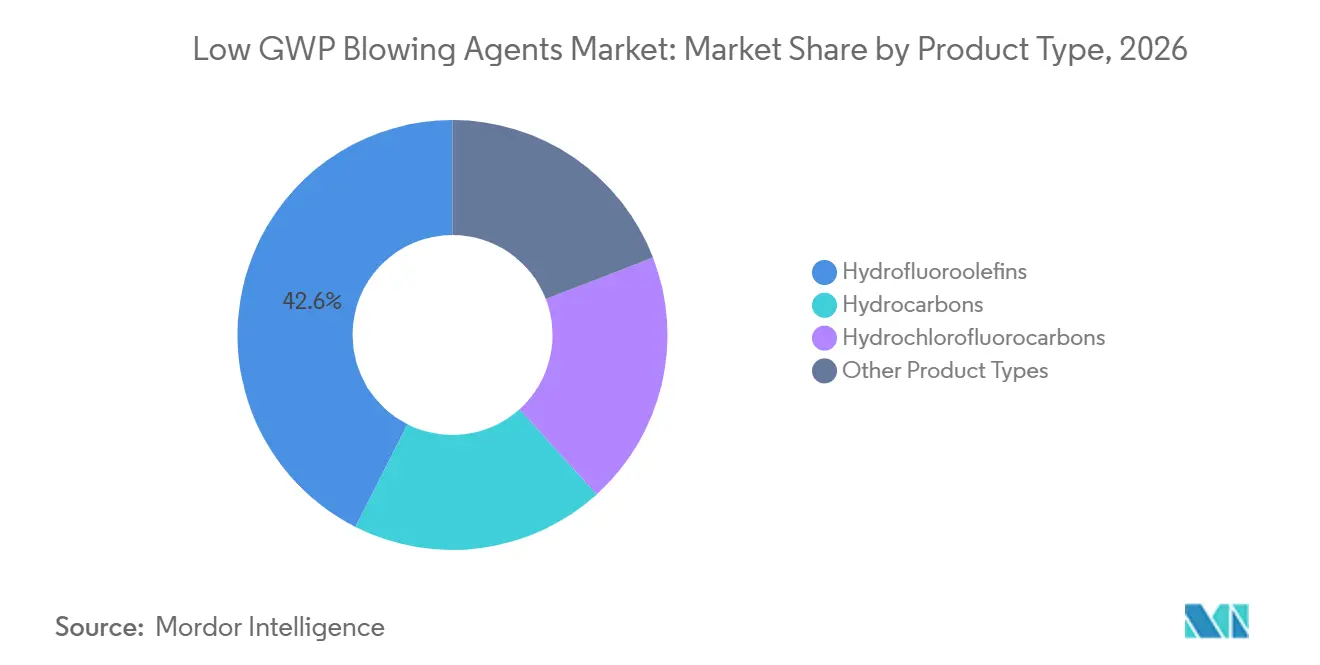
- By product type, hydrofluoroolefins held 42.56% of the low GWP blowing agents market share in 2026 and are forecast to advance at a 9.24% CAGR through 2032.
- By application, foam insulation held 44.82% of the low GWP blowing agents market share in 2026 and is forecast to advance at a 9.73% CAGR through 2032.
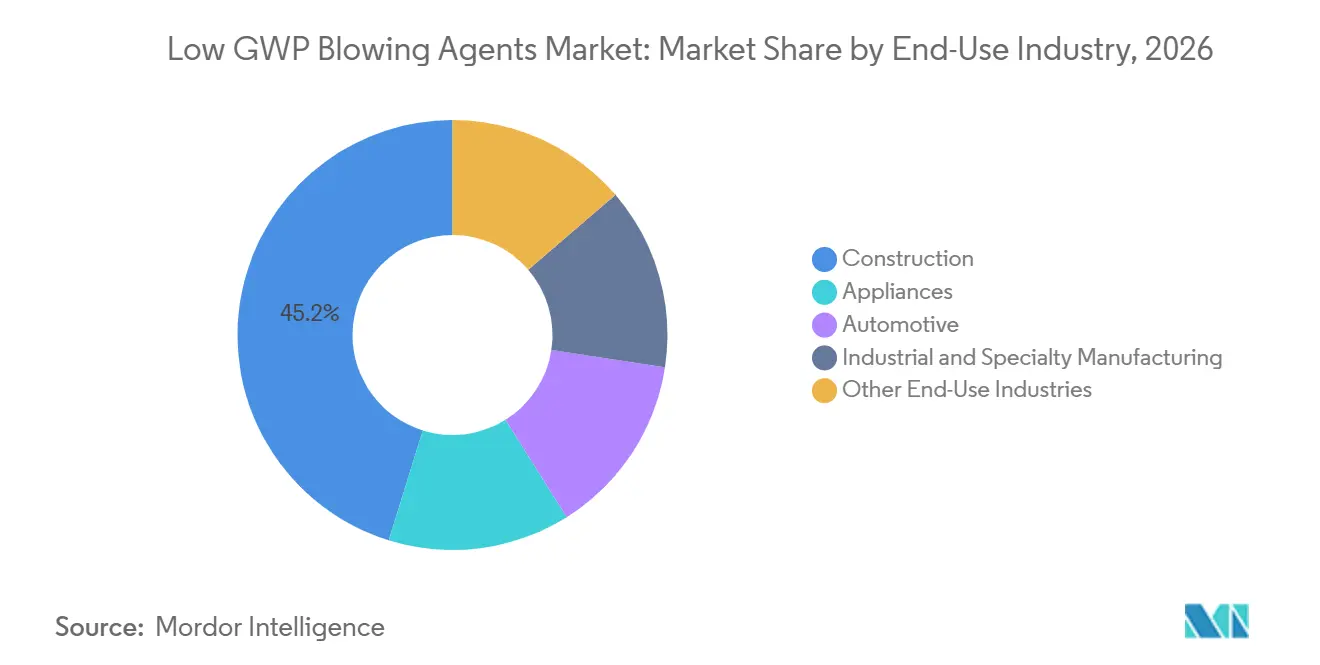
- By end-use industry, construction held 45.21% of the low GWP blowing agents market share in 2026 and is forecast to advance at a 10.17% CAGR through 2032.
- By geography, Asia-Pacific held 39.74% of the low GWP blowing agents market share in 2026 and is forecast to advance at a 10.06% CAGR through 2032.
Note: Market numbers in this report are based on Mordor Intelligence's proprietary estimation framework, which combines nine months of actuals with Q4 projections for base year 2026.
Global Low GWP Blowing Agents Market Trends and Insights
Drivers Impact Analysis*
| Driver | (~) % Impact on CAGR Forecast | Geographic Relevance | Impact Timeline |
|---|---|---|---|
| Kigali Amendment and HFC Phase-Down Compliance | +2.8% | Global | Short term (≤ 2 years) |
| Low GWP Building Energy Codes and Insulation Demand | +1.9% | North America & EU, spillover to APAC | Short term (≤ 2 years) |
| Appliance and Cold-Chain Energy-Efficiency Upgrades | +1.3% | APAC core, spillover to North America & EU | Medium term (2–4 years) |
| HFO Qualification as a Near-Drop-In Replacement for Legacy HFCs | +0.9% | Global | Short term (≤ 2 years) |
| Localization of HFO Production Capacity in Asia-Pacific and North America | +0.6% | Asia-Pacific & North America | Medium term (2–4 years) |
| Source: Mordor Intelligence | |||
Kigali Amendment and HFC Phase-Down Compliance
The Kigali Amendment and national phase-down rules are directing the low GWP blowing agents market toward lower-global-warming-potential chemistries. Non-Article 5 developed countries reached a 40% reduction below their hydrofluorocarbon baseline in 2024 and face a 70% reduction requirement in 2029. Article 5 Group 1 countries froze hydrofluorocarbon consumption in 2024 and will begin a 10% reduction step in 2029. In the United States, the Environmental Protection Agency rule turns the phase-down into a firm manufacturing requirement for covered foam applications[1]. Polyisocyanurate and extruded polystyrene producers face pressure because nonflammable alternatives are required for many applications. The compliance timetable is shortening the time available for formulation testing, procurement changes, and capacity planning.
Low GWP Building Energy Codes and Insulation Demand
Stronger building energy codes are increasing demand for high-performance insulation within the low GWP blowing agents market. California’s 2025 Building Energy Efficiency Standards apply to permit applications from January 1, 2026, and include stronger insulation performance requirements. These requirements increase attention to foam systems that can meet thermal targets while satisfying global warming potential limits. European building policy also supports demand for effective insulation materials as renovation and performance requirements continue to shape product selection. The European Fluorocarbons Technical Committee reports lower thermal conductivity for relevant fluorinated blowing-agent solutions than cyclopentane-blown alternatives[2]. The Polyisocyanurate Insulation Manufacturers Association states that spray polyurethane foam and extruded polystyrene producers require new formulations to meet the global warming potential ceiling. This combination of thermal and compliance needs favors suppliers that can support complete foam-system qualification.
Appliance and Cold-Chain Energy-Efficiency Upgrades
Appliance and cold-chain upgrades add another demand channel for the low GWP blowing agents market. The U.S. Department of Energy issued new commercial refrigeration conservation standards in January 2025 for vending-type refrigeration, service-over-counter equipment, and horizontal commercial freezers. These standards increase the value placed on insulation performance in refrigerated equipment. A 2025 scientific review found that advanced insulation and system redesign can reduce cold-chain refrigeration energy use by 25% to 86% relative to conventional systems. Honeywell International Inc. and Whirlpool Corporation have described work on refrigerator foam using hydrofluoroolefin chemistry and improved insulating performance. Equipment makers can therefore link insulation selection to both efficiency compliance and refrigerant-system performance. This creates recurring demand as refrigeration fleets and appliance product lines are updated.
HFO Qualification as a Near-Drop-In Replacement for Legacy HFCs
Hydrofluoroolefin qualification reduces some of the technical barriers to replacing older hydrofluorocarbon blowing agents. Honeywell International Inc. has commercialized Solstice LBA and Solstice GBA products for spray foam, boardstock, and appliance insulation applications. Their use in existing foam categories gives manufacturers an established route for evaluating compliance-oriented reformulations. The low GWP blowing agents market benefits when qualification activity reduces uncertainty over equipment compatibility and finished-foam performance. Producers still need to validate insulation, fire behavior, and dimensional stability for each system. This makes technical service important even where a molecule can be used with limited equipment changes. As compliant systems become established in North America and Europe, producers in Asia are under greater pressure to complete qualification work before local rules take effect.
Restraints Impact Analysis*
| Restraint | (~) % Impact on CAGR Forecast | Geographic Relevance | Impact Timeline |
|---|---|---|---|
| HFO Cost Premium and Limited Global Supply | -1.6% | Global, most acute in APAC developing markets | Medium term (2–4 years) |
| Hydrocarbon Flammability and Plant-Safety Investment | -0.8% | Global | Short term (≤ 2 years) |
| Reformulation Risk Across K-Factor, Fire Performance and Dimensional Stability | -0.5% | Global | Short term (≤ 2 years) |
| Source: Mordor Intelligence | |||
HFO Cost Premium and Limited Global Supply
The price premium for hydrofluoroolefins limits their use in cost-sensitive parts of the low GWP blowing agents market. The premium reflects multi-step fluorochemical synthesis, specialized production assets, and a limited number of commercial-scale suppliers. Arkema’s new capacity in Kentucky and The Chemours Company’s Zhejiang Juhua Group Co., Ltd. arrangement are intended to improve supply availability. Even with those investments, abrupt regulatory deadlines can create periods when qualification needs rise faster than accessible supply. A disruption at one of the few large synthesis sites could expose foam producers to cost and compliance risks. In Southeast Asia and South America, producers can continue to prefer lower-cost hydrocarbon options where regulation and customer requirements permit. Price remains a key factor in determining whether a compliant formulation can move beyond premium applications.
Hydrocarbon Flammability and Plant-Safety Investment
Cyclopentane and other hydrocarbons offer low global warming potential and lower cost, but their flammability creates a significant barrier. Facilities changing from nonflammable chemistries need explosion-proof electrical systems, ventilation upgrades, and fire suppression measures. These investments are especially relevant in Europe, where ATEX Directive 2014/34/EU establishes equipment requirements for explosive atmospheres. Oak Ridge National Laboratory reported that hydrocarbon emissions in high-pressure spray foam application can create explosive atmospheres. These finding limit hydrocarbon use in occupied-building spray foam work and directs demand toward nonflammable alternatives. Hydrocarbons remain more suitable for factory-controlled panel, boardstock, and appliance foam production. Safety costs and operational restrictions can narrow the initial cost advantage of hydrocarbon-based systems.
*Our forecasts treat driver/restraint impacts as directional, not additive. The impact forecasts reflect baseline growth, mix effects, and variable interactions.
Segment Analysis
By Product Type: Hydrofluoroolefins Lead Both Share and Growth
Hydrofluoroolefins accounted for 42.56% of the low GWP blowing agents market size in 2026 and are projected to advance at a 9.24% CAGR through 2032. Their low global warming potential, insulation performance, and nonflammability support use in spray polyurethane foam, polyisocyanurate, and applications facing a global warming potential ceiling of 150. The low GWP blowing agents industry is shifting toward these chemistries where safety rules prevent hydrocarbon use. Hydrocarbons, led by cyclopentane, remain widely used in appliance insulation and boardstock in cost-sensitive markets where enclosed manufacturing environments can manage flammability risks.
Hydrochlorofluorocarbons (HCFCs)are declining as national restrictions remove their remaining use in major foam-producing countries. China prohibited HCFC-141b in polyurethane foam production from July 1, 2026, according to technical guidance published by Wanhua Chemical Group Co., Ltd. The change directs producers toward hydrofluoroolefins, hydrofluorocarbons used as an interim option, and cyclopentane. Carbon dioxide and water-blown systems remain relevant for lower-performance insulation and commodity packaging foams, but they do not offer the thermal profile required in high-value building and appliance applications. Arkema introduced Foranext Continuum in September 2026 to support rigid polyurethane foam formulations using Forane FBA 1233zd, reflecting greater competition around integrated molecule and formulation packages.

By Application: Foam Insulation Has the Strongest Demand Profile
Foam insulation accounted for 44.82% of the low GWP blowing agents market size in 2026 and is projected to advance at a 9.73% CAGR through 2032. Building energy codes and global warming potential limits support demand for closed-cell spray polyurethane foam and polyisocyanurate boardstock with low thermal conductivity and dependable process performance. Hydrofluoroolefin-based systems offer a nonflammable choice for spray environments where hydrocarbon use is constrained. Polyisocyanurate Insulation Manufacturers Association (PIMA) reported that extruded polystyrene and spray polyurethane foam manufacturers required new formulations to achieve compliance.
Refrigeration and cold chain use require insulation with dependable thermal performance, and new U.S. commercial refrigeration standards are increasing attention to equipment efficiency. Packaging has a different demand pattern because global warming potential constraints are less acute and lower-cost carbon dioxide or hydrocarbon systems remain practical. Other uses include pipe-in-pipe insulation and marine foam, where stringent thermal performance can support demand. The transition differs by application because fire, handling, code compliance, and factory conditions are not the same. Suppliers must provide qualification support suited to each foam category.
By End-Use Industry: Construction Combines Compliance and Energy Performance Needs
Construction held 45.21% of low GWP blowing agents market share in 2026 and is projected to advance at a 10.17% CAGR through 2032. Rigid polyurethane foam, polyisocyanurate roofing, and spray foam depend on blowing agents that support code-compliant thermal performance, while commercial projects can link insulation performance to whole-building energy certifications. BASF introduced ELASTOSPRAY BMB in April 2026 for North American spray polyurethane foam systems with support for Environmental Product Declarations. The low GWP blowing agents market in construction is therefore shaped by compliance, thermal performance, and product documentation.
Appliances sustain demand as manufacturers update refrigerator and freezer insulation for efficiency requirements. Automotive use is expanding where rigid polyurethane foam supports lightweighting, battery insulation, and cabin acoustic applications, while BASF identified continued blowing-agent substitution as a growth factor in its polyurethane value chain. Industrial and specialty manufacturing includes cold storage, liquefied natural gas insulation, and specialty piping, which can require high thermal performance regardless of initial chemistry cost. Marine and aerospace applications add demand where specialized foam performance is needed.
Geography Analysis
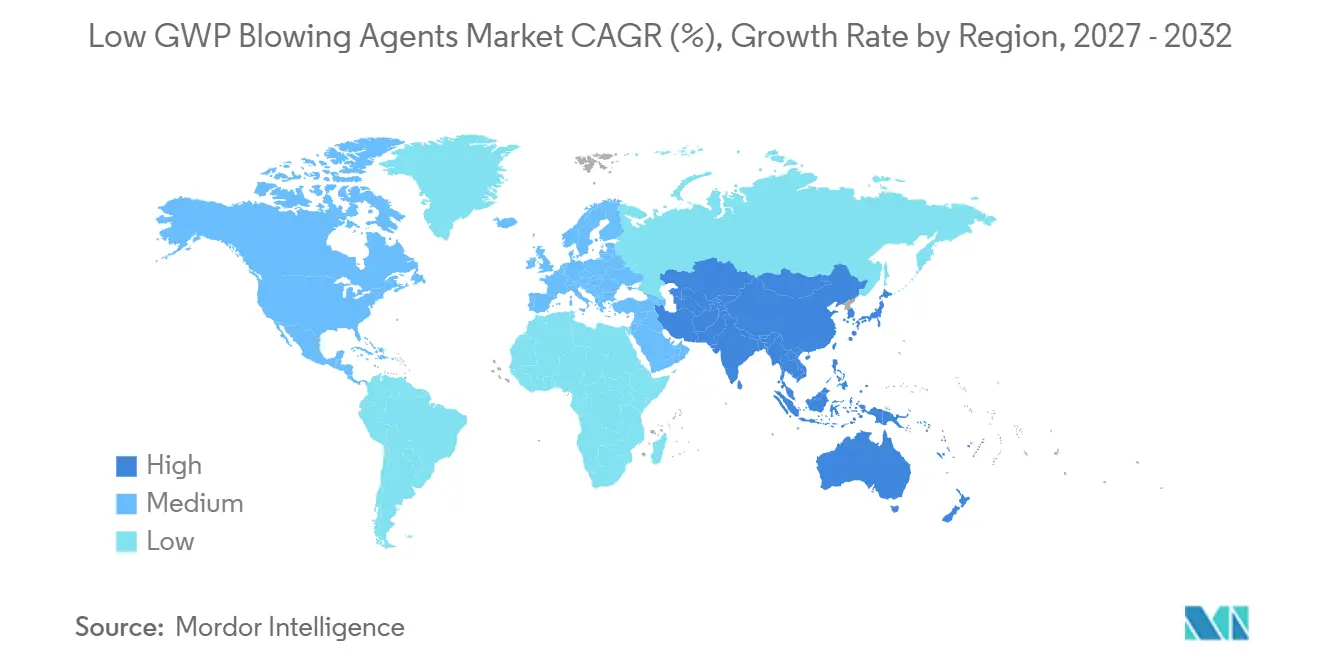
Asia-Pacific held 39.74% of the low GWP blowing agents market share in 2026 and is projected to advance at a 10.06% CAGR through 2032. China’s large polyurethane foam production base and its HCFC-141b prohibition from July 1, 2026, are creating a concentrated transition period. The low GWP blowing agents market in India is supported by urbanization and wider appliance penetration. Japan and South Korea remain important for high-performance refrigeration and automotive foam, while Vietnam and Thailand are emerging polyurethane foam production locations.
Europe has operated under the most advanced regional restrictions, with its global warming potential limit for foam manufacturing effective since January 2023. The regulation also sets a full fluorinated greenhouse gas foam ban for 2033. Germany, the United Kingdom, France, and Italy support demand through renovation activity and insulation needs, while Nordic countries have strong demand for effective building insulation. In South America, Brazil and Argentina froze hydrofluorocarbon consumption in 2024 and face a first reduction step in 2029. The Middle East and Africa are at an earlier transition stage, with Saudi Arabia and South Africa supporting construction and refrigeration demand, although price sensitivity and less immediate regulation limit the pace of change.
Competitive Landscape
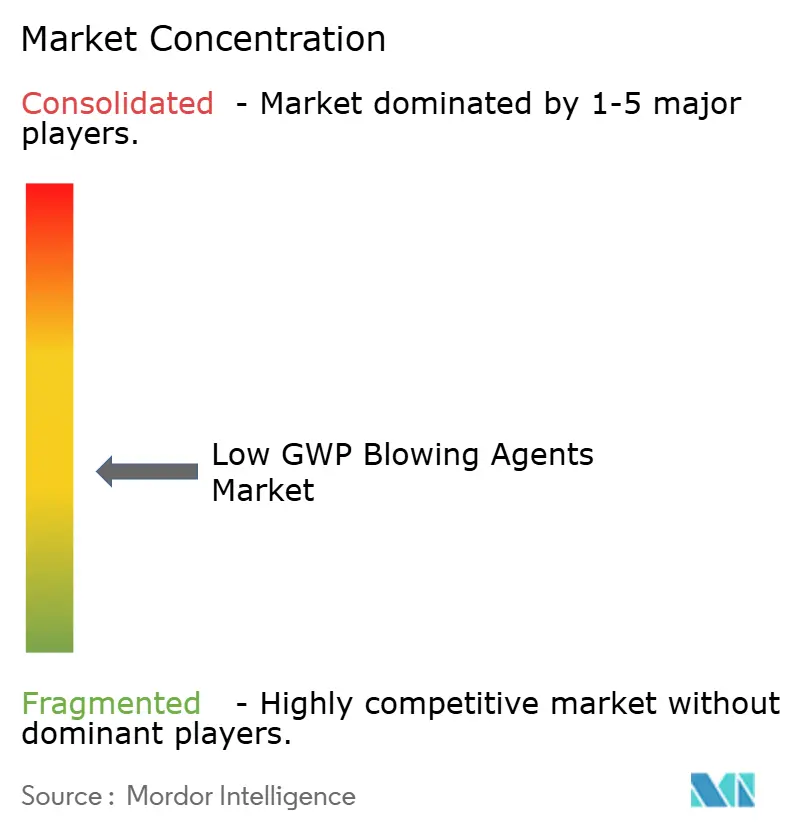
The low GWP blowing agents market is moderately concentrated, with the top five players including Honeywell International Inc., The Chemours Company, Arkema, AGC Inc., and BASF. High capital requirements, specialized synthesis expertise, and qualification work limit new participation. Honeywell International Inc. completed the spin-off of its Advanced Materials business as Solstice Advanced Materials in October 2025. Arkema commissioned its 15 kt annual capacity unit in Kentucky in August 2025, supporting supply for foam producers facing short compliance timelines.
The Chemours Company is expanding its supply position through its capacity arrangement with Zhejiang Juhua Group Co., Ltd. SINOCHEM LANTIAN CO., LTD. and Wanhua Chemical Group Co., Ltd. are building local qualification activity that can strengthen Chinese supply options. BASF, Huntsman International LLC, Wanhua Chemical Group Co., Ltd., and Nouryon compete at the polyurethane system level through formulation breadth and application support. FSI and Harp International Ltd. serve specialized regional distribution and formulation requirements where large producers have limited direct presence.
Competitive decisions in the low GWP blowing agents market are increasingly based on the range of qualified systems rather than molecule availability alone. Arkema launched Foranext Continuum in September 2026 to improve shelf stability and formulation consistency in rigid polyurethane foam systems containing Forane FBA 1233zd. BASF launched biomass-balance Autofroth polyurethane systems in February 2026 for North American appliance, construction, and marine uses. BASF’s ELASTOSPRAY BMB launch adds biomass-balance content to spray foam system offerings. Regulatory labeling and certification requirements in Europe favor suppliers with documented compliance records, while local Chinese capacity may increase price competition as domestic demand develops.
Low GWP Blowing Agents Industry Leaders
-
Honeywell International Inc.
-
The Chemours Company
-
Arkema
-
AGC Inc.
-
BASF
- *Disclaimer: Major Players sorted in no particular order
Recent Industry Developments
- September 2026: Arkema launched Foranext Continuum, a low-viscosity additive designed for rigid polyurethane foam formulations using its Forane FBA 1233zd blowing agent. The product improves formulation stability and supports manufacturers transitioning to low global warming potential foam technologies.
- June 2026: Solstice Advanced Materials and A-Gas signed a strategic agreement to expand access to lower GWP refrigerants made using reclaimed hydrofluorocarbons (HFCs) and hydrofluoroolefins (HFOs). Although focused primarily on refrigerants, the partnership strengthens supply-chain capabilities for HFO technologies, which are also used in low GWP foam-blowing applications.
Global Low GWP Blowing Agents Market Report Scope
Low GWP (global warming potential) blowing agents are substances used to create cellular structures in foam materials and support cooling applications while reducing potential greenhouse gas emissions compared with higher-GWP alternatives. They are used in insulation, refrigeration, packaging, and other applications where thermal performance and environmental impact are important considerations.
The Low GWP Blowing Agents Market is segmented by product type, application, end-use industry, and geography. By product type, the market is segmented into hydrofluoroolefins, hydrocarbons, hydrochlorofluorocarbons, and other product types. By application, the market is segmented into foam insulation, refrigeration and cold chain, packaging, and other applications. By end-use industry, the market is segmented into construction, appliances, automotive, industrial and specialty manufacturing, and other end-use industries. The report also covers the market size and forecasts for low GWP blowing agents across 15 countries. For each segment, the market sizing and forecasts have been done on the basis of value (USD).
| Hydrofluoroolefins |
| Hydrocarbons |
| Hydrochlorofluorocarbons |
| Other Product Types |
| Foam Insulation |
| Refrigeration and Cold Chain |
| Packaging |
| Other Applications |
| Construction |
| Appliances |
| Automotive |
| Industrial and Specialty Manufacturing |
| Other End-Use Industries |
| Asia-Pacific | China |
| India | |
| Japan | |
| South Korea | |
| ASEAN Countries | |
| Rest of Asia-Pacific | |
| North America | United States |
| Canada | |
| Mexico | |
| Europe | Germany |
| United Kingdom | |
| France | |
| Italy | |
| NORDIC Countries | |
| Rest of Europe | |
| South America | Brazil |
| Argentina | |
| Rest of South America | |
| Middle East and Africa | Saudi Arabia |
| South Africa | |
| Rest of Middle East and Africa |
| By Product Type | Hydrofluoroolefins | |
| Hydrocarbons | ||
| Hydrochlorofluorocarbons | ||
| Other Product Types | ||
| By Application | Foam Insulation | |
| Refrigeration and Cold Chain | ||
| Packaging | ||
| Other Applications | ||
| By End-Use Industry | Construction | |
| Appliances | ||
| Automotive | ||
| Industrial and Specialty Manufacturing | ||
| Other End-Use Industries | ||
| By Geography | Asia-Pacific | China |
| India | ||
| Japan | ||
| South Korea | ||
| ASEAN Countries | ||
| Rest of Asia-Pacific | ||
| North America | United States | |
| Canada | ||
| Mexico | ||
| Europe | Germany | |
| United Kingdom | ||
| France | ||
| Italy | ||
| NORDIC Countries | ||
| Rest of Europe | ||
| South America | Brazil | |
| Argentina | ||
| Rest of South America | ||
| Middle East and Africa | Saudi Arabia | |
| South Africa | ||
| Rest of Middle East and Africa | ||
Key Questions Answered in the Report
What is the size of the low GWP blowing agents market?
The low GWP blowing agents market size was valued at USD 625.33 million in 2026 and is estimated to grow from USD 673.79 million in 2027 to reach USD 995.99 million by 2032, at a CAGR of 8.13% during the forecast period (2027-2032).
What is driving demand for low GWP blowing agents?
Hydrofluorocarbon phase-down requirements, building energy codes, refrigeration efficiency rules, and demand for high-performance foam insulation are supporting adoption.
Which product type leads low GWP blowing agent demand?
Hydrofluoroolefins held a 42.56% share in 2026 and are projected to advance at a 9.24% CAGR through 2032.
Which application is projected to advance through 2032?
Foam insulation is projected to advance at a 9.73% CAGR through 2032.