
Liquid Shortening Market Size and Share
Market Overview
| Study Period | 2021 - 2031 |
|---|---|
| Market Size (2026) | USD 0.88 Billion |
| Market Size (2031) | USD 1.17 Billion |
| Growth Rate (2026 - 2031) | 5.78 % |
| Fastest Growing Market | Asia-Pacific |
| Largest Market | Asia-Pacific |
| Market Concentration | Low |
Major Players *Disclaimer: Major Players sorted in no particular order Image © Mordor Intelligence. Reuse requires attribution under CC BY 4.0. | |
Liquid Shortening Market Analysis by Mordor Intelligence
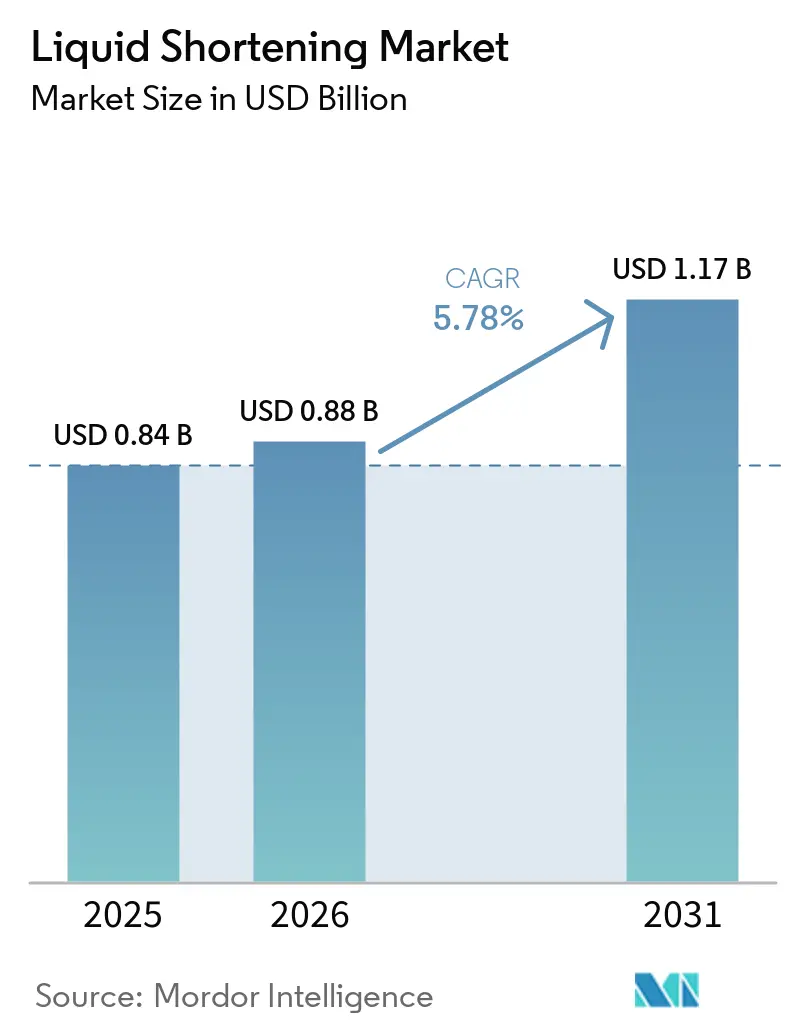
The liquid shortening market size was valued at USD 0.84 billion in 2025 and estimated to grow from USD 0.88 billion in 2026 to reach USD 1.17 billion by 2031, at a CAGR of 5.78% during the forecast period (2026-2031). The liquid shortening market is supported by the expansion of commercial bakeries, convenience food production, and industrial foodservice. Producers are adopting pumpable fats because these products support automated dosing and continuous mixing equipment. The removal of partially hydrogenated oils continues to drive reformulation activity, particularly in food supply chains that require compliant alternatives. Rising vegetable oil costs have heightened the importance of access to raw materials, procurement coverage, and formulation flexibility for suppliers in the liquid shortening market. Suppliers with oilseed processing, refining, and traceability capabilities are better positioned to serve large food manufacturers that must meet palm oil compliance requirements.
Key Report Takeaways
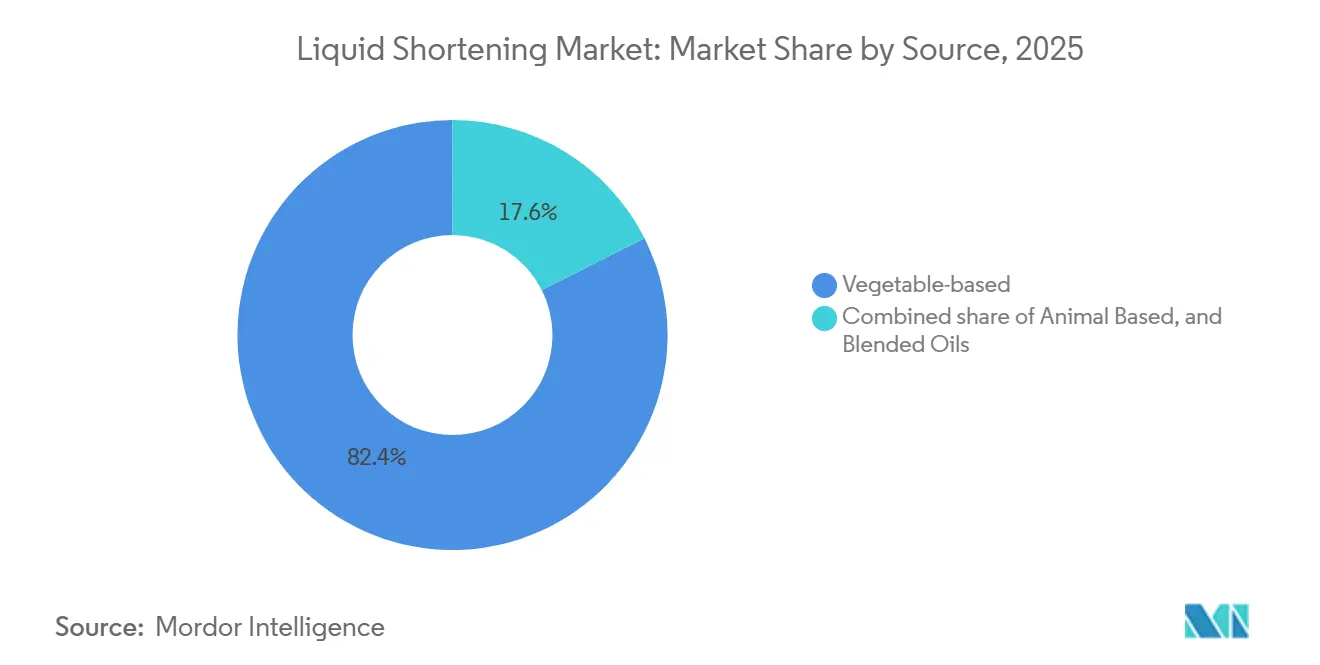
- By source, vegetable-based oils led the liquid shortening market with a share of 82.42% in 2025, while blended oils are anticipated to register the fastest CAGR of 6.81% during 2026-2031.
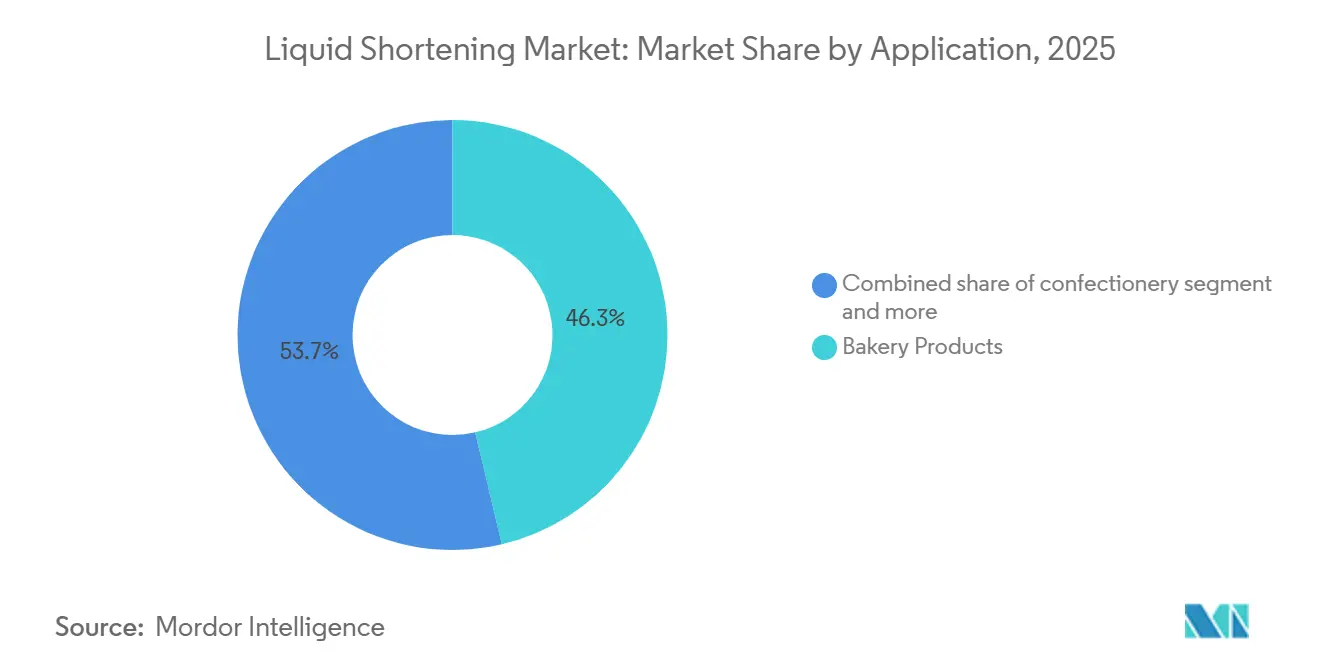
- By application, bakery products retained a 46.33% share in 2025, whereas ready-to-eat and prepared meals are forecast to expand at a 6.53% CAGR through 2031.
- By geography, Asia-Pacific led the liquid shortening market in 2025 with a 36.73% share, and is also projected to advance at a 6.43% CAGR through 2031.
Note: Market size and forecast figures in this report are generated using Mordor Intelligence’s proprietary estimation framework, updated with the latest available data and insights as of January 2026.
Market Trends and Insights
Drivers Impact Analysis of Liquid Shortening Market*
| Drivers | (~) % Impact on CAGR Forecast | Geographic Relevance | Impact Timeline |
|---|---|---|---|
| Rising demand from the commercial bakery industry | +1.5% | Global, with core concentration in North America, Europe, and Asia-Pacific | Short term (≤ 2 years) |
| Rising demand for high-performance frying solutions | +0.9% | North America and Asia-Pacific core, with spillover to Middle East and Africa and South America | Short term (≤ 2 years) |
| Growing adoption of non-hydrogenated and trans-fat-free formulations | +1.2% | North America and European Union primary, Asia-Pacific accelerating | Medium term (2-4 years) |
| Surging consumption of convenience and ready-to-eat foods | +0.8% | Global, with fastest traction in Asia-Pacific, Middle East, and urban South America | Medium term (2-4 years) |
| Expansion of industrial food processing and foodservice | +0.7% | Asia-Pacific, South America, and Middle East and Africa emerging markets | Long term (≥ 4 years) |
| Innovation in vegetable-based and blended oil formulations | +0.6% | Global, with Research and Development concentration in North America, Europe, and Southeast Asia | Long term (≥ 4 years) |
| Source: Mordor Intelligence | |||
Rising Demand from the Commercial Bakery Industry
Commercial bakeries continue to drive significant demand in the liquid shortening market. Solid block shortenings do not integrate easily with high-speed automated dosing systems. In contrast, pumpable liquid products connect directly to continuous mixing and weigh-batching equipment, reducing manual handling and ingredient losses. This advantage supports investments in liquid-shortening infrastructure across large bakeries in Europe, North America, and Southeast Asia. Manufacturers in India, Vietnam, and Indonesia are also adopting bulk liquid supply formats as organized food channels expand. High-performance frying requirements further strengthen demand, as industrial snack and foodservice lines need consistent flow, extended fry life, and oxidative stability. For bakery operators, liquid shortening delivers value through predictable processing rather than a simple change in ingredient format. Bulk delivery also reduces the need to store and manually break solid blocks before production. These operational benefits make liquid products more relevant as facilities increase throughput and standardize recipes across sites.
Growing Adoption of Non-Hydrogenated and Trans-Fat-Free Formulations
Regulation continues to shape product development in the liquid shortening market. In April 2024, the Food and Drug Administration finalized the revocation of prior sanctions related to the use of partially hydrogenated oils in certain foods or as a direct or indirect food substance[1]. Research based on scanner data found that compliance gaps persisted among some smaller retailers and private-label supply chains, creating opportunities for compliant suppliers. Early replacements based on fully hydrogenated oil blends created texture and stability challenges in some bakery applications. As a result, demand remains strong for stable, non-hydrogenated liquid formulations and vegetable-based blends that meet labeling requirements. Suppliers must preserve aeration, texture, and shelf stability while removing ingredients that are no longer acceptable. This technical requirement makes reformulation an ongoing process rather than a one-time regulatory response. It also favors suppliers that can tailor fats to specific bakery and prepared-food applications.
Surging Consumption of Convenience and Ready-To-Eat Foods
Ready-to-eat and prepared meals represent the fastest-growing application in the liquid shortening market. ADM reported that 87% of consumers choose ready-made meals when they do not want to cook, while 88% consider these meals a routine convenience option. Frozen entrées, ambient meal kits, and quick-service restaurant components require frying fats that remain stable and workable under industrial conditions. Liquid shortenings support both direct frying and the preparation of pastry-based frozen foods. These product requirements also support broader growth in industrial food processing and foodservice across emerging urban markets. Therefore, the liquid shortening market benefits from recurring production demand rather than occasional household use. Manufacturers require fats that deliver repeatable results across batches and preparation sites. This trend increases the value of application support, stable specifications, and reliable bulk supply. It also links demand to the capacity plans of prepared-food producers and foodservice suppliers.
Innovation in Vegetable-Based and Blended Oil Formulations
A blended oil can balance oxidative stability, smoke point, cold-flow behavior, and fatty acid composition more precisely than a single-origin oil. A 2026 study conducted by Multidisciplinary Digital Publishing Institute stated that enzymatically interesterified blends of soybean oil, high-oleic peanut oil, and crambe hard fat reduce saturated fat by 14% compared to commercial shortening while maintaining comparable structural properties in cookie fillings[2]. A scientific review also identifies enzymatic interesterification and fractionation as viable pathways for developing functional, trans-fat-free shortening alternatives. These methods give formulators options to reduce reliance on any single oil and meet specific bakery and frying requirements. Cargill’s March 2026 specialty fats expansion in Malaysia reflects commercial investment in these application-specific formulations. This development illustrates how product innovation is shifting from general-purpose shortening toward solutions designed for specific processing needs. Producers can differentiate these products based on frying behavior, filling texture, storage performance, and handling characteristics. Such differentiation gives producers a way to compete beyond commodity oil pricing.
Restraints Impact Analysis of Liquid Shortening Market*
| Restraint | (~) % Impact on CAGR Forecast | Geographic Relevance | Impact Timeline |
|---|---|---|---|
| Volatility in vegetable oil prices | -0.8% | Global, most acute in Asia-Pacific and Middle East and Africa import-dependent markets | Short term (≤ 2 years) |
| Stringent regulations on saturated fat and labeling requirements | -0.6% | North America and European Union primary, Asia-Pacific and South America increasing | Medium term (2-4 years) |
| Growing consumer shift toward clean label and processed ingredients | -0.5% | North America, Europe, and urban Asia-Pacific | Medium term (2-4 years) |
| Sustainability concerns around palm oil production | -0.4% | European Union core, with spillover to North America and Asia-Pacific supply-side markets | Long term (≥ 4 years) |
| Source: Mordor Intelligence | |||
Volatility in Vegetable Oil Prices
Vegetable oil price volatility remains an immediate commercial constraint on the liquid shortening market. The Food and Agriculture Vegetable Oil Price Index reached 192.0 points in June 2026, 23.3% above its June 2025 level. The increase in the index reflected the combined effect of higher palm and rapeseed oil quotations and broadly stable sunflower oil prices, which more than offset lower soy oil prices[3]. Producers without long-term coverage may face pressure from higher input costs and industrial customers that resist price increases. This pressure may encourage the use of blended and non-palm formulations when they provide a more manageable cost and supply profile. It may also make vertical integration and hedging more important competitive tools. Food manufacturers often require stable supply terms, as sudden cost changes can disrupt pricing for bakery, snack, and prepared meal products. Suppliers that offer multiple oil bases can respond more effectively when one input becomes scarce or expensive. As a result, procurement decisions increasingly consider supply resilience alongside product performance.
Sustainability Concerns around Palm Oil Production
Palm oil remains an important input for vegetable-based products in the liquid shortening market. The European Union Deforestation Regulation requires additional due diligence for relevant commodities and introduces stronger traceability expectations for palm-derived materials entering the European Union. These requirements increase costs and operational burdens for suppliers that lack verified source information. As a result, European buyers are showing greater interest in palm-reduced, palm-free, and certified formulations. This shift creates challenges for palm-dependent processors while giving flexible suppliers access to premium reformulation demand. Smaller regional processors face greater difficulty in meeting these expectations, as they have fewer resources to invest in traceability systems. Documentation, geolocation information, and supplier oversight can add complexity throughout the sourcing process. The burden becomes especially significant when palm derivatives pass through multiple stages of refining and formulation. This trend can strengthen the position of larger suppliers that already manage integrated material flows.
*Our forecasts treat driver/restraint impacts as directional, not additive. The impact forecasts reflect baseline growth, mix effects, and variable interactions.
Liquid Shortening Market Segment Analysis
By Source:
Blended Oils Gain Ground as Vegetable Dominance StabilizesVegetable-based products accounted for 82.42% of the liquid shortening market size in 2025. This position reflects the wide availability of soybean, canola, palm olein, and sunflower oils for commercial bakery, frying, and prepared-food production. Their functional range supports use across multiple processing conditions. Palm-derived products face greater scrutiny in Western markets due to deforestation-related compliance requirements. Canola and high-oleic sunflower variants are gaining attention as buyers seek different sourcing and nutritional profiles. Animal-based liquid shortenings remain a niche option in traditional frying applications in North America and South America. Manufacturers use them where lard-based fats provide flavor characteristics that vegetable alternatives do not replicate. The liquid shortening industry continues to rely on vegetable inputs because processors can manufacture them at an industrial scale.
Blended oils are forecasted to grow at a CAGR of 6.81% from 2026 to 2031. Producers combine base oils with high-oleic variants, interesterified fractions, and emulsifier systems to meet targeted performance requirements. These combinations can support fatty-acid targets while maintaining labeling compliance. Scientific research supports their potential to preserve structural and sensory performance with lower saturated-fat content. Interesterification and fractionation provide established routes for trans-fat-free alternatives. Blends can also reduce dependence on a single raw material when supply conditions change, making them relevant to manufacturers serving regulated export markets. The liquid shortening industry is using these systems to address both technical and procurement requirements. The commercial value depends on whether suppliers can deliver these benefits consistently at the volumes required by large food manufacturers. Development teams must evaluate each blend against the customer’s process conditions rather than assuming that a lower-cost oil substitution will be suitable. This creates a role for pilot testing and technical collaboration before a formulation moves into routine supply.

By Application:
Bakery Products Anchor Volume While Ready-to-Eat Foods Drive GrowthBakery products held 46.33% of the liquid shortening market size in 2025. Liquid shortenings play a central role in the production of bread, biscuits, laminated pastries, and cakes. Their pumpability supports automated bakery lines and enables consistent ingredient dosing. Confectionery producers use liquid shortenings in enrobing, molding, and filling applications where controlled crystallization is critical. Snack and savory product manufacturers require stable fats for continuous deep-frying operations. These applications are particularly important in North America and Southeast Asia. Frozen desserts and ice cream manufacturers use liquid palm fractions and blended oils to support texture at low temperatures. As a result, suppliers often compete based on the fit between their formulations and customers’ equipment. Bakery volume remains important because the category combines broad usage with the need for efficient and repeatable production.
Ready-to-eat and prepared meals are forecasted to expand at a CAGR of 6.53% through 2031. This growth is linked to repeated consumer use of convenient meal formats. Manufacturers use liquid shortenings as frying media for pre-fried components and to support pastry systems in frozen meals. Product consistency remains important because these foods move through refrigerated and frozen distribution systems. Quick-service restaurants require stable fats across high-volume preparation cycles, while industrial food manufacturers need products that are easy to handle and formulate. These requirements keep the liquid shortening market closely tied to the expansion of convenience-food manufacturing. A product that performs under controlled factory conditions can reduce variation in fried and pastry-based foods. This makes application knowledge as important as broad product availability in this segment.
Geography Analysis
APAC Liquid Shortening Market
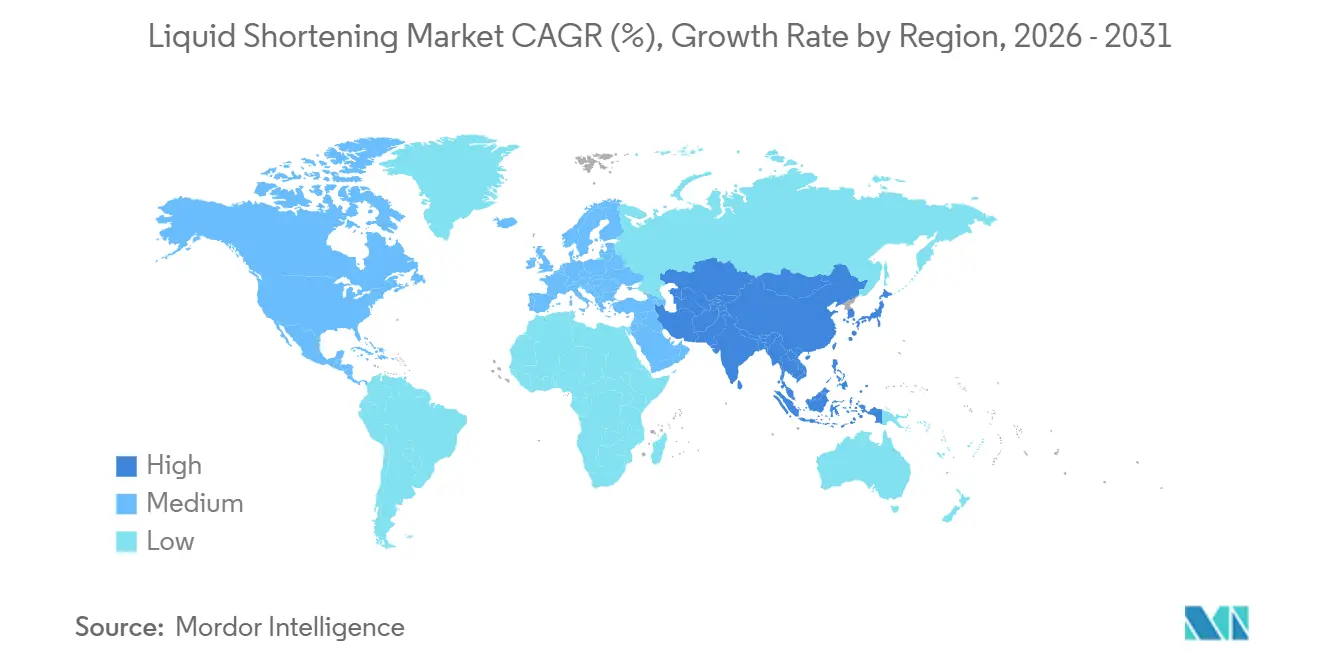
Asia-Pacific accounted for 36.73% of the liquid shortening market size in 2025 and is forecast to grow at a CAGR of 6.43% through 2031. This position reflects the expansion of food processing, rapid urbanization, and rising demand for non-hydrogenated alternatives. China, India, and Southeast Asian countries remain central to regional demand. India’s trans-fat limit continues to support reformulation in bakery shortening and vanaspati applications. Indonesia’s biodiesel policy may tighten palm oil availability for food applications while supporting investment in downstream refining. Cargill’s planned refinery investment in Lampung reflects continued interest in Indonesia’s downstream palm oil value chain.
North America and Europe Liquid Shortening Market
North America is the second-largest regional area in the liquid shortening market. High per-capita bakery and foodservice consumption supports demand, along with an established cold chain. Industrial bakeries and quick-service restaurant chains use non-hydrogenated liquid frying shortenings in high volumes. Specialty customers are also adopting high-oleic formulations. Europe has a mature bakery and confectionery base, along with strict sustainability-linked sourcing expectations. Buyers in the region are shifting toward certified and palm-reduced formulations as European Union traceability requirements take effect. This shift creates a procurement environment distinct from regions where price and local availability have greater influence. Suppliers that can document their inputs and offer alternatives have a clearer route to European customers. The region, therefore, remains important for premium and compliance-led product development.
South America and MEA Liquid Shortening Market
South America and the Middle East and Africa are smaller but growing regions in the liquid shortening market. Brazil has a developed fast-food culture and an expanding food-processing sector, which support commercial demand for liquid shortening products. The Gulf Cooperation Council has large foodservice and institutional catering operations that require consistent industrial supplies. Import-dependent markets remain more exposed to vegetable oil cost volatility, which can increase interest in blended formulations that offer supply flexibility. The liquid shortening market also rewards suppliers that can adjust formulations quickly for local customers. Local demand patterns also vary across bakery, quick-service restaurant, institutional catering, and packaged food channels. A formulation that meets regional expectations for handling and finished-food quality can help a supplier build longer customer relationships in the liquid shortening market.
Competitive Landscape
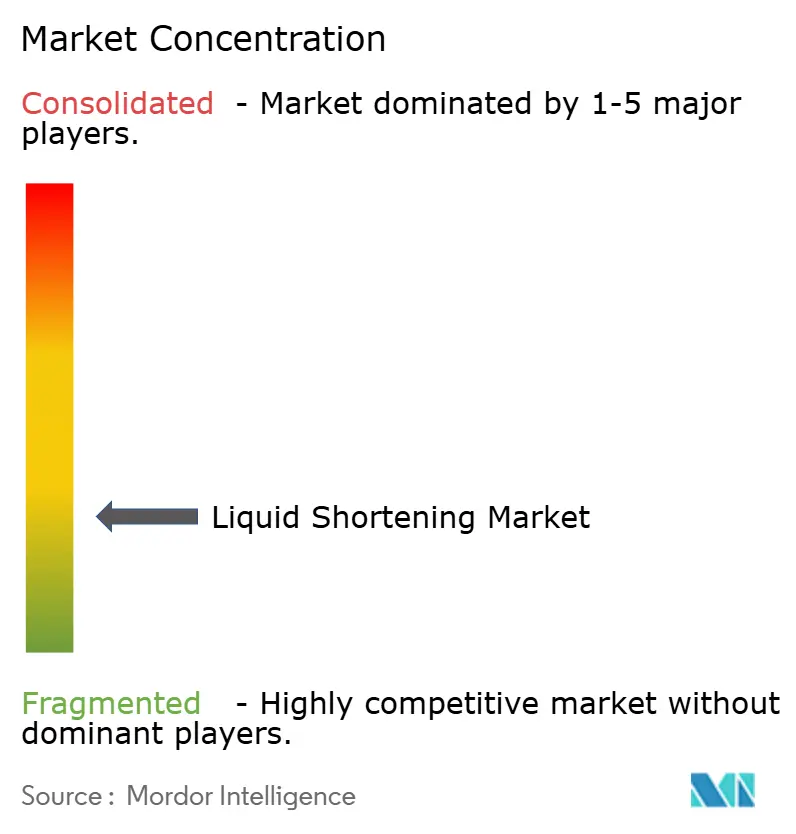
The liquid shortening market is highly fragmented. Cargill, AAK, Bunge, and Golden Agri-Resources operate as vertically integrated participants with access to upstream materials, refining, and formulation capabilities. Their scale helps them manage raw material volatility through procurement, hedging, and forward contracts. Cargill is expected to expand its Port Klang specialty fats facility in March 2026 and introduce Cargill Bakefry and Cargill Bakefill for frying and filling applications. AAK expects specialty solutions to support its 2025 performance, aligning with demand for premium reformulation products. Compliance readiness for European Union and Indian requirements is becoming increasingly important in supply agreements with large food manufacturers.
Regional producers and specialty formulators compete through technical service, customer proximity, and lower minimum order sizes. Ventura Foods and Catania Oils benefit from domestic supply advantages in North American foodservice and industrial bakery channels. Palm-free alternatives, such as oleogel systems and interesterified multi-oil blends, have demonstrated technical feasibility. However, producing them at a cost comparable to palm-derived products remains difficult at a commercial scale. A 2025 United States patent application is expected to describe a palm-free vegetable fat composition for confectionery and bakery fillings. These developments indicate continued research activity in palm-free fats. The liquid shortening market retains opportunities for suppliers that can scale these formulations without compromising performance or cost competitiveness.
Golden Agri-Resources plans to direct its 2026 spending toward replanting and downstream processing capacity, supporting the availability of palm-derived ingredients. The company also plans to add three methane-capture plants during 2025, strengthening its sustainability program. Bunge expects its refined and specialty oils segment to remain weaker in most regions, except Asia, during the first quarter of 2025. This outlook shows how biofuel policy uncertainty can influence vegetable oil flows and the food ingredient supply balance. For shortening suppliers, such changes can alter the relative availability and pricing of soybean, rapeseed, and other vegetable oils. This dynamic makes portfolio flexibility important when developments outside food manufacturing affect the cost of key inputs. Companies with broader refining and formulation capabilities can shift their product mix more readily than suppliers focused on a narrow set of raw materials. This advantage is especially relevant when customers require continuity of supply without changes in the performance of their finished foods.
Liquid Shortening Industry Leaders
-
Cargill, Incorporated
-
Ventura Foods
-
Catania Oils
-
AAK AB
-
Bunge Limited
- *Disclaimer: Major Players sorted in no particular order
Liquid Shortening Market Companies Covered in this Report
- Marina Foods Inc,
- Spectra Foods
- AAK AB
- Cargill, Incorporated
- Stover & Company
- Ventura Foods
- PASTORELLI FOODS LLC
- Catania Oils
- American Vegetable Oils, Inc
- Bakers Authority
- Bunge Limited
- Perfecta
- Golden Agri-Resources Ltd.
- Puratos Group
- Versa
- First Street
- Kirkland
- Manildra Group
- Vantage Specialty Chemicals, Inc.,
- Oasis
Recent Industry Developments in Liquid Shortening Market
- April 2026: AAK published its Annual Report 2025, incorporating a CSRD-compliant Sustainability Statement. The report marks the company’s first integrated disclosure under the Corporate Sustainability Reporting Directive and highlights solid performance, driven by growth in specialty solutions and disciplined cost management.
- March 2026: Cargill expanded its edible oil plant in Port Klang, Malaysia, by adding a new multi-million-dollar specialty fats production line. This line is the first in Cargill's edible oils network to deploy specialty fats processing technology. The facility introduced Cargill Bakefry for high-performance frying and Cargill Bakefill for fillings, along with low-trans cocoa butter replacers, strengthening Cargill's position in the Asia-Pacific specialty fats market.
- February 2026: Golden Agri-Resources announced a targeted capital expenditure of up to USD 300 million for 2026, primarily allocated to replanting programs, expansion of downstream processing plants, and enhancements to downstream facilities. The investment signals the company’s continued focus on strengthening palm-derived ingredient supply chains for fats and oils markets.
Global Liquid Shortening Market Report Scope
Liquid shortening refers to a pourable fat product used primarily in commercial and industrial food preparation to improve texture, consistency, moisture retention, and overall product quality across a wide range of food applications. The liquid shortening market is segmented by source, application, and geography. By source, the market is segmented into vegetable-based, animal-based, and blended oils. By application, the market is segmented into bakery products, confectionery, snacks and savory, frozen desserts and ice cream, ready to eat and prepared meals, and other applications. Based on geography, the market is classified into North America, Europe, South America, Asia-Pacific, and the Middle East and Africa. The Market Forecasts are Provided in Terms of Value (USD).
Segmentation Overview
| Vegetable-based |
| Animal-based |
| Blended Oils |
| Bakery Products |
| Confectionery |
| Snacks and Savory |
| Frozen Desserts and Ice Cream |
| Ready to Eat and Prepared Meals |
| Other Applications |
| North America | United States |
| Canada | |
| Mexico | |
| Rest of North America | |
| Europe | Germany |
| United Kingdom | |
| Italy | |
| France | |
| Spain | |
| Netherlands | |
| Poland | |
| Belgium | |
| Sweden | |
| Rest of Europe | |
| Asia-Pacific | China |
| India | |
| Japan | |
| Australia | |
| Indonesia | |
| South Korea | |
| Thailand | |
| Singapore | |
| Rest of Asia-Pacific | |
| South America | Brazil |
| Argentina | |
| Colombia | |
| Chile | |
| Peru | |
| Rest of South America | |
| Middle East and Africa | South Africa |
| Saudi Arabia | |
| United Arab Emirates | |
| Nigeria | |
| Egypt | |
| Morocco | |
| Turkey | |
| Rest of Middle East and Africa |
| By Source | Vegetable-based | |
| Animal-based | ||
| Blended Oils | ||
| By Application | Bakery Products | |
| Confectionery | ||
| Snacks and Savory | ||
| Frozen Desserts and Ice Cream | ||
| Ready to Eat and Prepared Meals | ||
| Other Applications | ||
| By Geography | North America | United States |
| Canada | ||
| Mexico | ||
| Rest of North America | ||
| Europe | Germany | |
| United Kingdom | ||
| Italy | ||
| France | ||
| Spain | ||
| Netherlands | ||
| Poland | ||
| Belgium | ||
| Sweden | ||
| Rest of Europe | ||
| Asia-Pacific | China | |
| India | ||
| Japan | ||
| Australia | ||
| Indonesia | ||
| South Korea | ||
| Thailand | ||
| Singapore | ||
| Rest of Asia-Pacific | ||
| South America | Brazil | |
| Argentina | ||
| Colombia | ||
| Chile | ||
| Peru | ||
| Rest of South America | ||
| Middle East and Africa | South Africa | |
| Saudi Arabia | ||
| United Arab Emirates | ||
| Nigeria | ||
| Egypt | ||
| Morocco | ||
| Turkey | ||
| Rest of Middle East and Africa | ||
Key Questions Answered in the Report
What is the projected size of the liquid shortening market by 2031?
The liquid shortening market is projected to reach USD 1.17 billion by 2031, increasing from USD 0.84 billion in 2025 to USD 0.88 billion in 2026.
What is the expected CAGR of the liquid shortening market during 2026–2031?
The market is forecast to grow at a CAGR of 5.78% during the 2026–2031 period.
Which source segment held the largest share of the liquid shortening market in 2025?
The Vegetable-based oils segment dominated the market in 2025, accounting for 82.42% of the market share.
Which application segment accounted for the largest share of the liquid shortening market in 2025?
Bakery Products represented the largest application segment in 2025, holding 46.33% of the market.
Which region led the liquid shortening market in 2025?
Asia-Pacific was the largest regional market in 2025, accounting for 36.73% of revenue.