
Market Overview
| Study Period | 2020 - 2031 |
|---|---|
| Forecast Data Period | 2026 - 2031 |
| Base Year Market Size (2025) | USD 412.49 Million |
| Market Size (2026) | USD 429.06 Million |
| Market Size (2031) | USD 536.82 Million |
| Growth Rate (2026 - 2031) | 4.58 % |
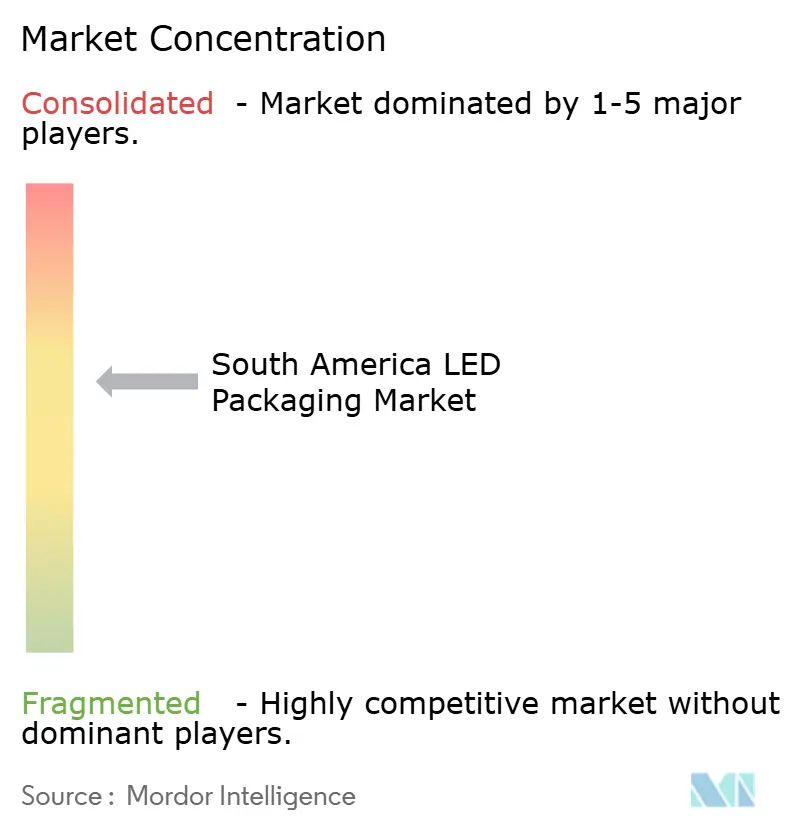
| Market Concentration | Medium |
Major Players *Disclaimer: Major Players sorted in no particular order Image © Mordor Intelligence. Reuse requires attribution under CC BY 4.0. | |
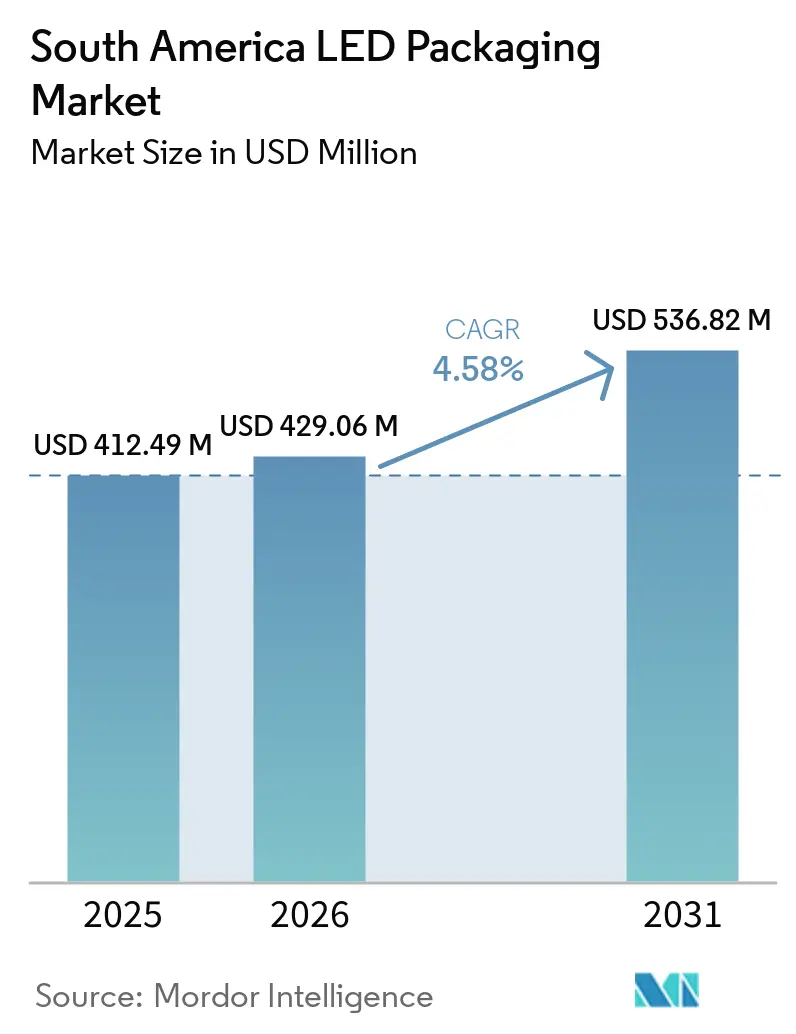
South America LED Packaging Market Analysis by Mordor Intelligence
The South America LED packaging market size was valued at USD 412.49 million in 2025 and is estimated to expand from USD 429.06 million in 2026 to reach USD 536.82 million by 2031, at a CAGR of 4.58% during the forecast period (2026-2031). Mandatory lighting efficiency rules, municipal retrofit programs, and vehicle electrification support demand for higher-performing packages. Public-lighting upgrades create steady demand for mid-power surface-mount device packages because many municipalities still operate older systems. Automotive and display applications are shifting procurement toward products with tighter thermal, optical, and reliability requirements. Import dependence continues to shape pricing, inventory decisions, and supplier selection across the region. Suppliers with certified products, regional stock, and technical support are better positioned to serve local procurement cycles.
Key Report Takeaways
- By packaging architecture, surface-mount device packages held 31.48% of the South America LED packaging market in 2025, while mini-LED display packages are projected to expand at a 6.18% CAGR through 2031.
- By power class, mid-power packages accounted for 30.51% of revenue in 2025, while ultra-high-power packages are projected to expand at a 5.37% CAGR through 2031.
- By emission type, visible LED packages accounted for 88.73% of revenue in 2025, while ultraviolet LED packages are projected to grow at a 5.19% CAGR through 2031.
- By material chemistry, substrates held 34.49% of revenue in 2025, while phosphors and coatings are projected to expand at a 5.21% CAGR through 2031.
- By application, general lighting held 54.19% of revenue in 2025, while automotive lighting is projected to expand at a 5.56% CAGR through 2031.
- By geography, Brazil held 59.24% of regional revenue in 2025, while Colombia is projected to expand at a 5.48% CAGR through 2031.
Note: Market size and forecast figures in this report are generated using Mordor Intelligence’s proprietary estimation framework, updated with the latest available data and insights as of January 2026.
Market Trends and Insights
Drivers Impact Analysis of South America LED Packaging Market*
| Driver | (~) % Impact on CAGR Forecast | Geographic Relevance | Impact Timeline |
|---|---|---|---|
| Energy-Efficiency Mandates and LED Retrofit Economics | +1.4% | Brazil, Colombia, Argentina | Short term (≤ 2 years) |
| Smart-City and Public-Lighting Modernization | +1.0% | Brazil, Colombia | Medium term (2-4 years) |
| Automotive Electronics and Electrification | +0.8% | Brazil, Argentina, Colombia | Medium term (2-4 years) |
| Mini-LED and High-Density Display Adoption | +0.6% | Brazil, Rest of South America | Medium term (2-4 years) |
| UV LED Disinfection and Specialty Sensing | +0.4% | Brazil, Colombia, Argentina | Long term (≥ 4 years) |
| Regional Electronics Assembly and Import Substitution | +0.3% | Brazil | Long term (≥ 4 years) |
| Source: Mordor Intelligence | |||
Energy-Efficiency Mandates and LED Retrofit Economics
Brazil’s 2026 efficiency rules make compliance a major near-term driver of demand for the South America LED packaging market. Resolution CGIEE 2/2026 set minimum luminous efficacy thresholds for LED lamps and luminaires through 2 mandatory implementation stages. The framework phases out noncompliant products over a 5-year period and sets clear performance targets for product designers. The government stated that the measure could save up to 432 TWh by 2040. That level of saving was presented as equivalent to the electricity consumption of 14 million Brazilian households over the same period.[1] INMETRO Portaria 231/2026 also consolidated requirements for power factor, flicker, harmonics, ENCE labeling, and QR codes, raising the specification baseline for packages entering Brazilian supply chains.
The rules create a replacement cycle for installed products that cannot support compliant luminaire designs. This demand is less discretionary than ordinary replacement purchases because it follows published transition requirements. Mid-power and high-power packages can benefit from fixture redesigns that meet higher efficacy thresholds. The change favors suppliers that already maintain applicable conformity documentation and can support design qualification. It also narrows the role of low-efficacy commodity arrays in formal procurement. As deadlines approach, the South America LED packaging market may see shorter procurement windows as buyers move to secure qualified components.
Smart-City and Public-Lighting Modernization
Public-private partnerships for lighting modernization provide a substantial component of the demand base in Brazil. ABCIP reported 146 active public-lighting partnership contracts by mid-2025, covering 173 municipalities and serving 57 million people. The contracts totaled BRL 32 billion (USD 5.52 billion) at the average exchange rate for 2025 cited in the source. A 2026 industry analysis found that only 19.6% of Brazil’s public luminaires had been converted to LED. The remaining installed base keeps general lighting demand active for a long period.
The same analysis stated that full conversion of unretrofitted Brazilian public luminaires could yield BRL 5 billion (USD 862 million) in annual energy savings using the exchange rate provided in the source. Bogotá is also advancing a smart-lighting pilot on Calle 85 that combines LED luminaires with cameras, sensors, and adaptive control. Networked systems require thermal control, photometric stability, and dependable driver interfaces. These requirements make basic package selection less suitable for many smart-city projects. The South America LED packaging market, therefore, gains value from modernization projects even when the number of poles changes slowly. Suppliers that support system-level qualification can have an advantage in municipal projects.
Automotive Electronics and Electrification
Vehicle electrification is increasing the LED content required in exterior, interior, and indicator lighting. BYD’s Camaçari plant in Brazil targets 50% local content by the end of 2026 and an annual capacity of 300,000 vehicles. The first phase of the project is reported to involve BRL 5.5 billion (USD 1.1 billion). This local production plan increases the addressable opportunity for suppliers with distribution or assembly partnerships in Brazil. Automotive applications require closer binning, thermal performance, and reliability testing than many general-lighting applications. Those factors reduce the extent to which procurement can depend only on unit price.
Seoul Semiconductor put its high-voltage opto-semiconductor technology into mass production with 4 global automakers across the Americas. The technology supports 12 V single-chip LED operation, reduces driver component counts by more than 10%, and lowers power consumption by 10% per vehicle. Lumileds introduced the LUXEON Altilon SMD-A for automotive forward lighting in 2025, and the product began appearing in 2026 model-year vehicle designs. These product changes show that package architecture is becoming a functional choice in vehicle lighting. Higher power classes and tighter performance tolerances can support revenue per vehicle. Automotive sourcing in the South America LED packaging market is consequently less exposed to the pricing pattern seen in basic general lighting.
Mini-LED and High-Density Display Adoption
Premium display launches are bringing mini-LED package requirements into South American consumer electronics channels. Samsung launched a mini-LED television lineup in Brazil in August 2026. TCL SEMP also introduced QD-Mini LED curved monitors for gaming and home office users in Brazil that same month. These displays use high-density backlights with more exacting luminous flux and color-binning requirements than edge-lit LCD products. Their panels require chip-scale or flip-chip packaging that maintains optical consistency across multiple local dimming zones. The South America LED packaging market gains from this higher package density, even when premium display unit volumes remain lower than mass-market television volumes.
Brazilian LED module imports under NCM 8539.51.00 rose 12% between 2024 and the first 10 months of 2025. This trade pattern is consistent with more demand for premium display components, although it does not identify individual package formats. A 65-inch mini-LED television can use tens of thousands of LED dies in miniaturized formats. That package count is much higher than in an edge-lit design of comparable screen area. The result is higher package revenue per display surface area. Mini-LED demand also supports the use of narrow-band phosphors and closely controlled encapsulation materials. These requirements create a distinct technical opportunity for suppliers serving the South America LED packaging market.
Restraints Impact Analysis of South America LED Packaging Market*
| Restraint | (~) % Impact on CAGR Forecast | Geographic Relevance | Impact Timeline |
|---|---|---|---|
| Import-Cost and Foreign-Exchange Volatility | -1.2% | Brazil, Argentina, Rest of South America | Short term (≤ 2 years) |
| Low-Power SMD Price Erosion | -0.7% | Brazil, Colombia, Argentina | Short term (≤ 2 years) |
| Thermal-Management Constraints in High-Power Packages | -0.4% | Brazil, Colombia | Medium term (2-4 years) |
| Patent and Qualification Barriers for Advanced Packages | -0.3% | Brazil, Colombia, Argentina | Long term (≥ 4 years) |
| Source: Mordor Intelligence | |||
Import-Cost and Foreign-Exchange Volatility
The region depends heavily on imported dies, substrates, encapsulants, and finished LED packages from China, Taiwan, Japan, and South Korea. Brazil’s import duties, ICMS, and PIS/Cofins taxes increase the landed cost of packaged components. Exchange-rate movements add another layer of uncertainty for buyers who procure in foreign currency. The Brazilian real’s depreciation episodes can change the economics of deliveries between order and receipt. Argentina’s peso instability and import restrictions make longer purchasing cycles especially difficult. These conditions limit the predictability of the South America LED packaging market for suppliers and local customers.
Brazilian imports of LED lamps and luminaires reached USD 461.5 million in the first 10 months of 2025. The figure illustrates the scale of external dependence in the lighting supply chain. Argentina’s inflation and sporadic import restrictions can disrupt package orders and render volume planning unreliable. Local stockholding reduces delivery risk but adds financing and carrying costs for distributors. Those costs are harder to absorb in low-margin component categories. Smaller suppliers may therefore avoid making inventory commitments at scale. Import dependence continues to favor established distributors that can manage certified inventory and currency exposure.
Low-Power SMD Price Erosion
In mid-power SMD packages, the broader low-cost SMD category continues to face sustained margin pressure. Chinese packaging suppliers continue to target South American distribution channels with lower-priced offerings. General lighting is the principal outlet for these packages and allows substitution where basic performance requirements are met. This makes standardized formats more vulnerable to price competition than specialized automotive or ultraviolet products. Compliant, high-efficacy packages can command a temporary premium as rules change. That advantage becomes narrower as more suppliers qualify equivalent offerings.
The large public-lighting retrofit pipeline attracts suppliers that compete mainly on import price. This can reduce the value captured by brands that emphasize photometric consistency and longer service life. The difference between nominal compliance and higher product quality can become more pronounced in low-bid procurement. For manufacturers, performance validation and after-sales support become important ways to defend their position. The South America LED packaging market remains exposed to price erosion, where buyers have little need for technical differentiation. Premium suppliers must therefore target applications where heat, reliability, or optical precision matter to the final system.
*Our forecasts treat driver/restraint impacts as directional, not additive. The impact forecasts reflect baseline growth, mix effects, and variable interactions.
South America LED Packaging Market Segment Analysis
By Packaging Architecture:
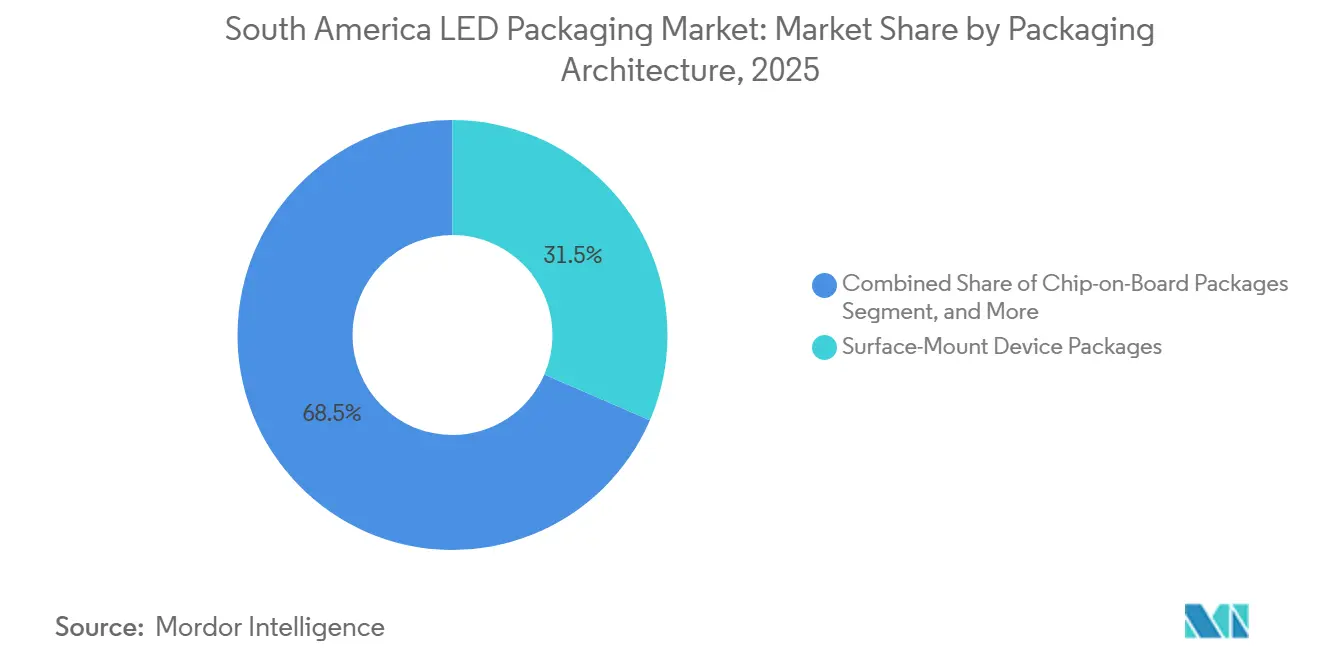
SMD Volume Leadership and Mini-LED Mix ChangeSurface-mount device packages accounted for 51.48% of the South America LED packaging market in 2025, reflecting their broad use in general lighting, signage, and consumer electronics. Standardized form factors, luminaire compatibility, and low unit cost support their use in Brazil’s municipal programs and Colombia’s street-lighting projects. The format is familiar to regional assemblers and distributors, so it will remain the volume leader even as premium architectures gain value share. Mini-LED display packages are projected to expand at a 6.18% CAGR from 2026 to 2031, supported by Samsung and TCL launches that require compact, tightly binned backlight packages. Their higher-density arrays increase the number of packages used per display area and are shifting the South America LED packaging market toward higher-value designs, specialized material inputs, and more exacting optical requirements.
Chip-on-board packages serve industrial and specialty lighting where uniform beams and consolidated thermal management outweigh per-chip cost, including horticulture fixtures and stadium floodlighting. Chip-scale and flip-chip formats support compact automotive and consumer electronics designs where space, thermal control, and optical uniformity are important. Polymatech established a chip-on-board packaging hub in Singapore with USD 25 million in committed investment, which can improve supply availability for South American distributors. Glass-on-board, dual-in-line, and through-hole packages continue to play smaller roles in premium niches, legacy indicators, and low-frequency switching applications. Surface-mount alternatives are reducing demand for legacy formats, while automotive and horticulture requirements are expected to gradually expand the use of advanced architecture.

By Power Class:
Mid-Power Volume and Ultra-High-Power Premium DemandMid-power packages from 0.5 W to 1 W accounted for 30.51% of regional revenue in 2025, making them the principal volume class for commercial, residential, linear-lamp, and panel-light applications. Mid-power SMD arrays provide the light output and efficiency required in many municipal and commercial specifications. Brazil’s large installed base of these fixtures sustains high shipment volumes despite pressure from lower-cost alternatives. The South America LED packaging market size for mid-power packages remains linked to ongoing replacement and retrofit activity. Ultra-high-power packages exceeding 3 W are projected to grow at a 5.37% CAGR from 2026 to 2031, driven by stadium lighting, machine vision, and high-flux automotive headlamps.
Ultra-high-power applications require thermal control, reliable high-current output, and demanding automotive qualification, which supports higher selling prices. Lumileds stated in February 2026 that global LED headlamp adoption was approaching 80% and that modular light engines are projected to account for 50% of solutions by 2027. Modular light engines can increase package count and unit value in vehicle headlamp assemblies. High-power packages from 1 W to 3 W serve outdoor architectural and sports lighting, including projects connected with Brazil’s stadium and infrastructure programs. Low-power packages remain important for indicators, decorative lighting, and backlighting, but commodity competition is constraining their revenue contribution as the mix gradually shifts toward high-flux formats.
By Emission Type:
Visible LED Scale and UV LED SpecializationVisible LED packages held 88.73% of regional revenue in 2025, supported by the scale of general lighting, automotive lighting, signage, consumer electronics, and display backlights. Phosphor-converted white LEDs serve a wide range of color temperatures and fixture specifications. This large installed base will keep visible devices as the primary revenue source across the forecast period. Mini-LED televisions and gaming monitors add a higher-value visible-light tier because local-dimming zones require tightly controlled packaging. Commercial and hospitality buyers are also specifying higher color rendering and tunable color temperatures, which extends demand beyond basic efficiency compliance.
Ultraviolet LED packages are projected to grow at a 5.19% CAGR from 2026 to 2031, driven by healthcare disinfection, water treatment upgrades, and industrial sensing in Brazil and Colombia. UV-C systems avoid mercury handling associated with conventional germicidal lamps, while clinical and water-treatment buyers require documented spectral performance and photon-dose delivery. Healthcare upgrades in infection control, sterile processing, diagnostics, and treatment create demand for packages with stable output and defined technical performance. Infrared LED packages support security cameras, proximity detection, and remote sensing, with urban safety spending providing a smaller but stable demand base. Together, ultraviolet and infrared uses give the South America LED packaging market exposure to specialized applications where reliability and compliance are important, including environments that require defined optical output and documented product performance.
By Material Chemistry:
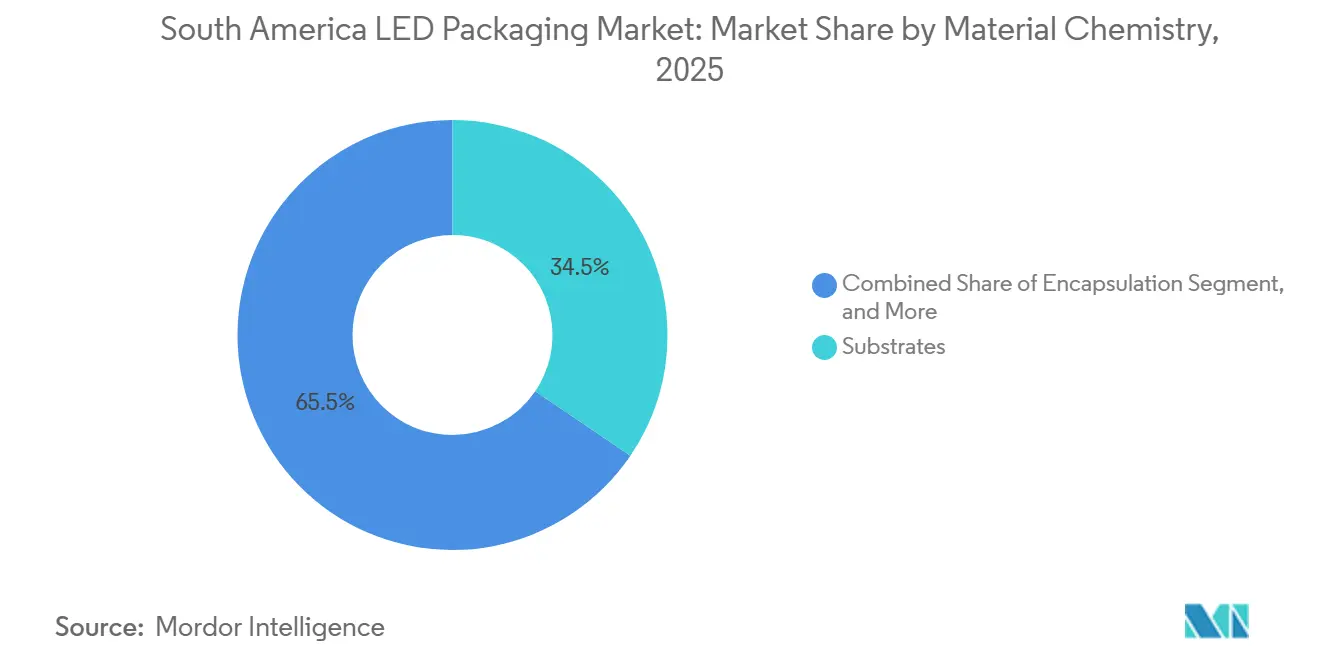
Substrate Scale and Phosphor Value ExpansionSubstrates held 34.49% of regional material chemistry revenue in 2025 because they are essential across nearly every package architecture. Aluminum-core metal-core printed circuit board substrates are widely used in outdoor and automotive applications, while ceramic substrates support ultra-high-power and ultraviolet packages with higher thermal demands. This broad use makes substrates the foundation of the South America LED packaging industry. Encapsulation materials are the second-largest category and remain important to package service life in hot and demanding applications. High-refractive-index silicone materials support mini-LED and flip-chip configurations that require optical performance and durability.
Phosphors and coatings are projected to expand at a 5.21% CAGR from 2026 to 2031, supported by demand for wider color gamut, stronger color rendering, and tunable white output. Mini-LED and quantum-dot-enhanced displays require narrow-band phosphors with tight spectral control, favoring suppliers with advanced phosphor engineering capabilities. Specialty lighting also requires materials that maintain output and color consistency during use. Bonding and die-attach materials gain importance as flip-chip and chip-scale designs remove wire bonds and shift demand toward advanced solder pastes and sintered-silver compounds. Automotive and ultraviolet packages require stable attachment materials at higher current and thermal loads, changing the relative value of material groups without eliminating demand for established inputs.
By Application:
General-Lighting Volume and Automotive Value GrowthGeneral lighting accounted for 54.19% of the South America LED packaging market in 2025, supported by municipal street-light retrofits, commercial fit-outs, and residential replacement cycles. Brazil’s large stock of public luminaires, yet to be upgraded, provides a long-duration volume pipeline. Higher minimum efficacy requirements also support demand for compliant packages in new and replacement fixtures. Lower unit prices do not alter the segment’s role as the volume anchor for regional package shipments. Automotive lighting is projected to expand at a 5.56% CAGR from 2026 to 2031 as OEM electrification, greater LED content per vehicle, and local electric-vehicle production increase demand.
Advanced vehicle lighting integrates driver-assistance and styling functions and requires stronger reliability assurance than standard lighting. Seoul Semiconductor’s high-voltage technology supports 12 V single-chip operation and fewer driver components. Display and backlighting demand is increasing due to the launches of premium televisions and gaming monitors in Brazil, while consumer electronics and industrial demand are linked to activity in Manaus and São Paulo. Horticultural lighting, machine vision, and medical phototherapy require product-specific technical validation, making buyers less likely to switch suppliers solely on price. The South America LED packaging market consequently combines broad general-lighting demand with smaller automotive and specialty applications that support higher value per package.
Geography Analysis
Brazil LED Packaging Market
Brazil held 59.24% of the South America LED packaging market share in 2025. Its position reflects regulatory depth, manufacturing infrastructure, and population scale. Electricity prices increased by 32.4% in 2025, reducing the payback period for commercial and municipal retrofit projects. Public-lighting partnerships tracked by ABCIP totaled BRL 32 billion (USD 5.52 billion) at the stated 2025 exchange rate. Brazil’s Ministry of Mines and Energy also launched a BRL 150 million (USD 25.86 million) project at the stated 2025 exchange rate, for LED public lighting modernization.[2] These programs support sustained component purchases across large and smaller municipalities.
Campinas, Fortaleza and Manaus LED Packaging Market
INMETRO Portaria 231/2026 and CGIEE Resolution 2/2026 provide a longer regulatory runway for procuring compliant packages. Luminaire manufacturers must update product lines as efficacy requirements become more stringent. Smart-city pilots in Campinas and Fortaleza combine connected street lighting with environmental sensors and electric-vehicle charging kiosks. These projects set technical expectations for future procurement in other states. Brazil also has component integration activity in the Manaus Free Trade Zone and the São Paulo-Curitiba industrial corridor. Even so, imported dies, substrates, and encapsulants remain central to the supply chain. The country will remain the main demand center for the South America LED packaging market throughout the forecast period.
South America LED Packaging Market
Colombia is projected to expand at a 5.48% CAGR from 2026 to 2031. Bogotá’s Calle 85 pilot uses LED poles with cameras, sensors, panic buttons, and adaptive brightness control. A council proposal values the modernization of 105,949 luminaires at USD 250 million. EMCALI began a program to modernize 101,037 luminaires in Cali for COP 450 billion (USD 107 million) at the exchange rate stated in the source. Argentina remains constrained by currency controls and irregular import conditions despite automotive and industrial demand. Chile has a niche for ultra-high-power industrial lighting in mining, while Peru and Ecuador contribute to street-lighting demand. Paraguay’s Law 7546/2025 established a national policy for producing and assembling electrical and electronic equipment
Competitive Landscape
The South America LED packaging market is moderately concentrated among technology leaders and fragmented in volume-oriented segments. Japanese and Korean suppliers set benchmarks in automotive, ultraviolet, and high-flux applications. Their positions depend on patent portfolios, optical performance, and lengthy OEM qualification processes. Nichia and ams-OSRAM signed a broad patent cross-license agreement in October 2025 that covers thousands of LED and laser patents, including sophisticated LED packages and matrix headlamp modules. The agreement reinforces barriers for suppliers without access to equivalent intellectual property and technical capabilities.
San’an Optoelectronics and Inari Amertron Berhad announced the acquisition of Lumileds Holding B.V. in August 2025 for USD 239 million. The transaction gives San’an access to Lumileds customer relationships and the Nichia-led cross-licensing alliance.[3] Inari’s manufacturing capabilities in Malaysia can support cost-optimized packaging for some mid-tier volume applications. Lumileds also continues to develop automotive packages that address thermal and assembly requirements. These moves may affect how regional buyers compare price, access to technology, and continuity of supply.
Chinese and Taiwanese mid-tier suppliers compete aggressively in the general-lighting SMD package market. Their cost position creates strong pressure in standardized applications. The opportunity for differentiated suppliers lies in locally stocked and technically validated mid-power and high-power products. Long testing and qualification cycles can reward companies that establish regional distribution hubs and local testing partnerships.
South America LED Packaging Industry Leaders
-
ams-OSRAM AG
-
NICHIA CORPORATION
-
MLS Co., Ltd.
-
Seoul Semiconductor Co., Ltd.
-
EVERLIGHT ELECTRONICS CO., LTD.
- *Disclaimer: Major Players sorted in no particular order
South America LED Packaging Market Companies Covered in this Report
- NICHIA CORPORATION
- ams-OSRAM AG
- Lumileds Holding B.V.
- Seoul Semiconductor Co., Ltd.
- EVERLIGHT ELECTRONICS CO., LTD.
- MLS Co., Ltd.
- Foshan NationStar Optoelectronics Co., Ltd.
- Stanley Electric Co., Ltd.
- Toyoda Gosei Co., Ltd.
- Lextar Electronics Corporation
- Edison Opto Corporation
- Prolight Opto Technology Corporation
- Dominant Opto Technologies Sdn. Bhd.
- Citizen Electronics Co., Ltd.
- Bridgelux, Inc.
- Epistar Corporation
- Refond Optoelectronics Co., Ltd.
- Jufei Optoelectronics Co., Ltd.
- Cree LED (SMART Global Holdings)
- Harvatek Corporation
- Broadcom Inc.
Recent Industry Developments in South America LED Packaging Market
- August 2026: Samsung launched its latest mini-LED television lineup in the Brazilian market, intensifying pull-through demand for high-density mini-LED backlight packages. The launch accelerates South America’s rotation from standard SMD arrays toward tightly binned, miniaturized package formats suited to high local-dimming-zone display designs.
- August 2026: TCL SEMP unveiled QD-Mini LED curved monitor models at gamescom latam 2026 in Brazil, targeting gaming and professional display segments. The product line uses quantum-dot-enhanced mini-LED backlighting requiring narrow-band phosphors and chip-scale LED packages with tight optical uniformity specifications.
- July 2026: Bogotá’s Distrito launched an active pilot of its AIoT-enabled smart street lighting system on Calle 85, deploying LED luminaires integrated with AI cameras, panic buttons, and environmental sensors. The pilot serves as the reference model for the city’s planned full LED-IoT network deployment by the end of 2026.
- June 2026: Brazil’s CGIEE published Resolution CGIEE 2/2026 establishing the country’s first minimum LED efficacy standards, with a 2-stage transition schedule and projected cumulative energy savings of up to 432 TWh through 2040. The regulation creates a non-discretionary replacement cycle for noncompliant LED packages across the region’s largest market.
South America LED Packaging Market Report Scope
The South America LED Packaging Market refers to the market for packaged light-emitting diode (LED) components manufactured, assembled, supplied, and sold for integration into lighting, automotive, display, consumer electronics, industrial, and other specialty applications across South America. LED packaging encompasses the technologies and materials used to house and protect LED semiconductor dies, provide electrical and thermal interfaces, manage optical output, and enable integration into end-use systems.
The South America LED Packaging Market Report is Segmented by Packaging Architecture (Surface-Mount Device Packages, Chip-on-Board Packages, Chip-Scale Packages, Flip-Chip LED Packages, Dual In-Line and Through-Hole Packages, Integrated Module Device Packages, Glass-on-Board Packages, and Mini-LED Display Packages), Power Class (Low Power, Mid Power, High Power, and Ultra-High Power), Emission Type (Visible LED Packages, Infrared LED Packages, and Ultraviolet LED Packages), Material Chemistry (Substrates, Encapsulation, Bonding/Die-Attach, and Phosphors/Coatings), Application (General Lighting, Automotive Lighting, Display and Backlighting, Consumer Electronics, and Industrial and Speciality), and Geography (Brazil, Argentina, Colombia, and Rest of South America). The Market Forecasts are Provided in Terms of Value (USD).
Segmentation Overview
By Packaging Architecture
| Surface-Mount Device Packages |
| Chip-on-Board Packages |
| Chip-Scale Packages |
| Flip-Chip LED Packages |
| Dual In-Line and Through-Hole Packages |
| Integrated Module Device Packages |
| Glass-on-Board Packages |
| Mini-LED Display Packages |
By Power Class
| Low Power (Below 0.5 W) |
| Mid Power (0.5-1 W) |
| High Power (1-3 W) |
| Ultra-High Power (Above 3 W) |
By Emission Type
| Visible LED Packages |
| Infrared LED Packages |
| Ultraviolet LED Packages |
By Material Chemistry
| Substrates |
| Encapsulation |
| Bonding / Die-Attach |
| Phosphors / Coatings |
By Application
| General Lighting |
| Automotive Lighting |
| Display and Backlighting |
| Consumer Electronics |
| Industrial and Specialty |
By Geography
| Brazil |
| Argentina |
| Colombia |
| Rest of South America |
| By Packaging Architecture | Surface-Mount Device Packages |
| Chip-on-Board Packages | |
| Chip-Scale Packages | |
| Flip-Chip LED Packages | |
| Dual In-Line and Through-Hole Packages | |
| Integrated Module Device Packages | |
| Glass-on-Board Packages | |
| Mini-LED Display Packages | |
| By Power Class | Low Power (Below 0.5 W) |
| Mid Power (0.5-1 W) | |
| High Power (1-3 W) | |
| Ultra-High Power (Above 3 W) | |
| By Emission Type | Visible LED Packages |
| Infrared LED Packages | |
| Ultraviolet LED Packages | |
| By Material Chemistry | Substrates |
| Encapsulation | |
| Bonding / Die-Attach | |
| Phosphors / Coatings | |
| By Application | General Lighting |
| Automotive Lighting | |
| Display and Backlighting | |
| Consumer Electronics | |
| Industrial and Specialty | |
| By Geography | Brazil |
| Argentina | |
| Colombia | |
| Rest of South America |
Key Questions Answered in the Report
What is the South America LED packaging market size?
The South America LED packaging market was valued at USD 412.49 million in 2025 and is estimated at USD 429.06 million in 2026. It is forecast to reach USD 536.82 million by 2031.
What is driving LED package demand in South America?
Efficiency rules in Brazil, public-lighting modernization, automotive electrification, and premium mini-LED displays support demand for higher-performing packages.
Which LED package architecture leads regional demand?
Surface-mount device packages led with 51.48% of revenue in 2025 because they are widely used in general lighting, signage, and consumer electronics.
Which application is expected to expand fastest through 2031?
Automotive lighting is projected to expand at a 5.56% CAGR through 2031, supported by electric-vehicle production and greater LED content per vehicle.
Which country leads regional revenue?
Brazil held 59.24% of regional revenue in 2025, supported by public-lighting programs, manufacturing capacity, and energy-efficiency regulations.
What limits regional LED package suppliers?
Imported components, currency volatility, price erosion in standardized SMD products, and qualification barriers for advanced products constrain suppliers.