
Laser Range Finder And Laser Designator Market Size and Share
Market Overview
| Study Period | 2019 - 2030 |
|---|---|
| Market Size (2025) | USD 5.45 Billion |
| Market Size (2030) | USD 7.80 Billion |
| Growth Rate (2025 - 2030) | 7.43 % |
| Fastest Growing Market | Asia Pacific |
| Largest Market | North America |
| Market Concentration | Medium |
Major Players *Disclaimer: Major Players sorted in no particular order Image © Mordor Intelligence. Reuse requires attribution under CC BY 4.0. | |

Laser Range Finder And Laser Designator Market Analysis by Mordor Intelligence
The laser range finder and laser designator market size reached USD 5.45 billion in 2025 and is on course to attain USD 7.80 billion by 2030, progressing at a 7.43% CAGR. Robust defense-modernization programs, rising procurement of precision-guided munitions (PGMs), and the steady shift toward autonomous combat and surveillance platforms sustain demand across land, air, sea, and emerging dual-use civilian applications.[1]Source: Boeing, “Boeing Awarded $6.9 B for Small Diameter Bomb II Production,” Defense News, defensenews.com The convergence of compact fiber-laser architectures with eye-safe 1.5 µm wavelengths broadens addressable opportunities beyond strictly military domains, while steady SWaP-C improvements allow integration on smaller unmanned platforms. Regional defense budget growth, particularly in the Asia-Pacific, supplements long-established North American spending and creates a more geographically balanced order pipeline. Competitive intensity remains moderate because leading prime contractors emphasize technology differentiation and export-control compliance over price competition. In contrast, new entrants leverage niche innovations in battery thermal management and atmospheric transmission to penetrate high-growth segments.
Key Report Takeaways
- By product type, laser range finders held 64.55% of the laser range finder and laser designator market share in 2024; laser designators are advancing at an 8.45% CAGR through 2030.
- By platform, vehicle-mounted systems led with 34.20% revenue share in 2024, while airborne platforms are forecasted to expand at a 9.65% CAGR to 2030.
- By range capability, medium-range solutions accounted for 47.85% of the laser range finder and laser designator market size in 2024; long-range systems are growing fastest at a 10.54% CAGR over the outlook period.
- By end user, defense and military applications held a 72.45% share in 2024, whereas homeland security use cases are projected to rise at a 9.85% CAGR through 2030.
- By geography, North America commanded 40.90% of 2024 revenues, but Asia-Pacific is poised for an 8.95% CAGR, the fastest regional expansion to 2030.
Note: Market size and forecast figures in this report are generated using Mordor Intelligence’s proprietary estimation framework, updated with the latest available data and insights as of January 2026.
Market Trends and Insights
Drivers Impact Analysis of Laser Range Finder And Laser Designator Market*
| Driver | (~)% Impact on CAGR Forecast | Geographic Relevance | Impact Timeline |
|---|---|---|---|
| Rising defense budgets for precision-guided munitions | +2.1% | North America, Europe, Middle East | Medium term (2-4 years) |
| Modernization of soldier systems with compact modules | +1.8% | North America, Europe, Asia-Pacific | Short term (≤ 2 years) |
| Demand from unmanned systems integration | +1.5% | Global with early US adoption | Medium term (2-4 years) |
| Eye-safe 1.5 µm lasers unlocking civilian uptake | +1.2% | Global civil and commercial sectors | Long term (≥ 4 years) |
| SWaP-C fiber-laser designators for drone swarms | +0.9% | Asia-Pacific core; expansion to Middle East and Africa | Medium term (2-4 years) |
| LIDAR-rangefinder hybrids for autonomous logistics | +0.7% | North America and Europe; emerging in Asia-Pacific | Long term (≥ 4 years) |
| Source: Mordor Intelligence | |||
Rising defense budgets for precision-guided munitions
Escalating investments in precision strike capability underpin long-term growth for the laser range finder and laser designator market. US Special Operations Command (USSOCOM) accelerated laser-guided weapon purchases in 2025, reflecting a broader doctrinal shift prioritizing accuracy over volume. Boeing’s USD 6.9 billion Small Diameter Bomb II production contract conveys the scale of near-term demand for designator-enabled munitions. European defense initiatives under the Sky Shield framework likewise emphasize guided engagement, signaling multi-national alignment on advanced targeting. Middle Eastern procurement of layered missile defenses further illustrates how precision-oriented doctrines are diffusing beyond NATO. As premium-priced designator systems enable terminal guidance, manufacturers maintain pricing power even while competition grows.
Modernization of soldier systems with compact modules
Global infantry programs now expect integrated laser targeting within weight budgets that once excluded such electronics. The US Army’s Integrated Visual Augmentation System pairs data-fused optics with man-portable range-finding modules, setting a benchmark that allied forces seek to emulate. Leonardo’s Type 163 designator shows how SWaP gains yield devices that are light enough for extended foot patrols while retaining professional-grade beam quality. As fiber-laser efficiencies advance, battery loads decline, allowing additional electronic subsystems without increasing combat load. Ruggedization to MIL-STD-810F boosts system value by ensuring consistent performance across deserts, tropics, and arctic regions. Collectively, these improvements drive sustained procurement of soldier-borne range finders and designators.
Demand from unmanned systems integration
Unmanned aerial, surface, and ground vehicles increasingly require onboard range finding for autonomous navigation and cooperative engagement. The US Army’s Typhon deployment illustrates how precision fires now depend on networked drones that validate targets in real time. Fiber-laser designators that weigh less than 2 kg enable swarm architectures in which individual drones share targeting data across mesh networks. Counter-UAS trials in Saudi Arabia confirmed that AI-equipped lasers can detect, track, and cue effectors against small aerial threats.[2]Source: Rheinmetall Canada, “Red Sands III Counter-UAS Demo,” asdnews.com Because autonomous missions often occur in RF-contested environments, deterministic laser ranging becomes mission-critical for navigation where GNSS signals are unreliable.
Eye-safe 1.5 µm lasers unlocking civilian uptake
Transitioning to 1.5 µm wavelengths eliminates stringent safety restrictions that previously constrained civilian adoption. Automotive LIDAR exploits higher permissible power levels to enhance detection range while satisfying Class 1 eye safety standards.[3]Source: “Evolution of Laser Technology for Automotive LiDAR, an Industrial Viewpoint,” Nature Communications, nature.com Construction and mining operators adopt handheld range-finders that outperform tape or total-station instruments in dusty environments. InGaAs detector cost declines, driven by telecom-grade volumes, further reduce system price points for commercial buyers. Sharing common components across defense and civil products delivers scale economies that benefit all users. Over the long term, civilian demand diversifies revenue away from cyclical defense budgets, providing greater resilience for suppliers.
Restraints Impact Analysis of Laser Range Finder And Laser Designator Market*
| Restraint | (~)% Impact on CAGR Forecast | Geographic Relevance | Impact Timeline |
|---|---|---|---|
| High acquisition and maintenance costs | −1.4% | Global, strongest in emerging markets | Short term (≤ 2 years) |
| Export-control restrictions | −0.9% | Global; acute among non-allied customer bases | Medium term (2-4 years) |
| Urban aerosol attenuation at 1.064 µm | −0.6% | Polluted megacities worldwide | Long term (≥ 4 years) |
| Battery thermal-runaway risks in extreme climates | −0.4% | Middle East, Arctic, Tropical deployments | Medium term (2-4 years) |
| Source: Mordor Intelligence | |||
High acquisition and maintenance costs
Professional-grade systems retail between USD 50,000 and USD 200,000 per unit, limiting purchases among cost-sensitive militaries and first-responder agencies. Annual maintenance contracts, typically priced at 15% to 20% of hardware value, further elevate the total cost of ownership. Specialized optics and fiber amplifiers demand factory-level calibration that many local depots cannot support. Budget-restricted customers, therefore, delay upgrade cycles or choose lower-spec alternatives, constraining short-term shipment volumes. Cost pressures are most acute in homeland-security deployments, where financial justification must extend beyond purely tactical considerations.
Export-control restrictions
US ITAR and EAR regulations classify most designator subsystems under Category XII, requiring extensive licensing and end-user certification. The 2024 BIS interim rule expanding semiconductor controls complicates multi-continental supply chains and lengthens delivery timelines by 6–12 months. Prospective buyers in non-aligned nations increasingly turn to domestic or Chinese suppliers to circumvent these hurdles, reducing addressable export revenue for Western vendors. Compliance overhead also inflates administrative costs, diminishing price competitiveness even in permissible markets.
*Our forecasts treat driver/restraint impacts as directional, not additive. The impact forecasts reflect baseline growth, mix effects, and variable interactions.
Laser Range Finder And Laser Designator Market Segment Analysis
By Product Type:
Range Finders Maintain Leadership While Designators AccelerateLaser range finders captured 64.55% of the laser range finder and laser designator market share in 2024, reflecting their essential role across infantry, vehicular, and industrial measurement scenarios. They deliver immediate line-of-sight distance data without necessitating weapon guidance authorization, making them ubiquitous on tripods, binoculars, and vehicle fire-control systems. Hybrid modules that blend range-finding with targeting help consolidate payloads, yet cost-sensitive civilian customers still favor range-only models. However, designators are advancing at an 8.45% CAGR as PGMs proliferate and man-portable deep-strike missions demand terminal illumination. Over the forecast horizon, system integrators will embed common laser pump assemblies across both product classes, allowing inventory standardization and lowering sustainment costs.
Second-order growth factors include eye-safe beam migration, which lifts civil restrictions on range-finder distribution, and ongoing miniaturization that permits integration into soldiers’ heads-up displays. The market size of the laser range finder and laser designator for designator-equipped modules is expected to expand at a higher multiple than range-finder-only units because premium functionality commands more substantial margins. Yet range-finders will continue to dominate installed base metrics because every designator inherently includes distance-measuring capability, keeping the category’s footprint broad even as revenue mix shifts.



By Platform:
Vehicle Systems Dominate but Airborne Drones Drive GrowthVehicle-mounted platforms held a 34.20% revenue share in 2024, supported by standardized power buses, rugged housings, and decades of integration doctrine. They remain foundational for armored-vehicle fire control, forward-observation posts, and border-patrol trucks in homeland-security roles. Conversely, airborne applications, especially Group I-III unmanned aircraft, are forecasted to register a 9.65% CAGR through 2030 as militaries deploy increasingly autonomous drone swarms. The laser range finder and laser designator market size for airborne payloads is projected to nearly double over the outlook window, driven by escalating need for lightweight, stabilized gimbal pods that can loiter and engage targets without human intervention.
Handheld systems remain indispensable for dismounted forward observers, but adoption plateaus as soldier-worn integrated optics absorb standalone range-finding functions. Naval vessels require sealed, salt-fog-resistant enclosures that escalate per-unit price, keeping volumes modest yet margins strong. Fixed ground installations, used for perimeter monitoring and test-range instrumentation, will grow in line with narcotics-interdiction and critical-infrastructure mandates but will lag the airborne trajectory.
By Range Capability:
Medium-Range Dominance Gives Way to Long-Range MomentumMedium-range solutions accounted for 47.85% of the laser range finder and laser designator market size 2024, balancing size, power consumption, and cost for typical battlefield engagements. They fit seamlessly on infantry vehicles, rotary-wing aircraft, and tripod-mounted fire-direction centers. Long-range categories (>20 km) are scaling at a 10.54% CAGR, fueled by stand-off strike doctrines that seek to outrange enemy ADS threats. Thermal-tolerant 2 kW fiber amplifiers, recently demonstrated in +50 °C desert trials, mitigate beam-quality degradation that once limited extreme-range performance. Short-range products will continue to serve close-quarters combat and construction surveying, but face cannibalization as software-selectable beam divergence enables a single unit to cover multiple bands.
Emerging research focuses on atmospheric compensation algorithms that pre-distort wavefronts anticipating urban aerosol scattering, preserving beam intensity across longer slant paths. This innovation further blurs traditional range-tier boundaries, allowing warfighters to engage high-value targets from safer stand-off distances without resorting to larger caliber kinetic assets.


By End User:
Homeland Security Outpaces Commercial UptakeDefense and military end users delivered 72.45% of 2024 revenues, capitalizing on stable procurement pipelines and defined budgeting cycles that favor multi-year framework orders. Yet homeland security agencies show the fastest expansion, registering a 9.85% CAGR through 2030 as border-control forces, coast guards, and critical infrastructure operators co-opt defense-grade lasers for persistent surveillance. Civil authorities increasingly integrate beam-forming sensors into counter-drone networks that protect airports, refineries, and mass-gathering venues from small UAS incursions.
Although pure commercial industries, such as construction, mining, and mapping, are price sensitive, eye-safe wavelength migration pares down regulatory barriers and total cost of ownership. Over time, mass-market LIDAR volumes will subsidize lower component prices, but in the near term, homeland security procurement will remain the principal non-military driver. This segment offers defense contractors a smoother export-license path relative to lethal weapons, expanding accessible revenue without significant redesign.
Geography Analysis
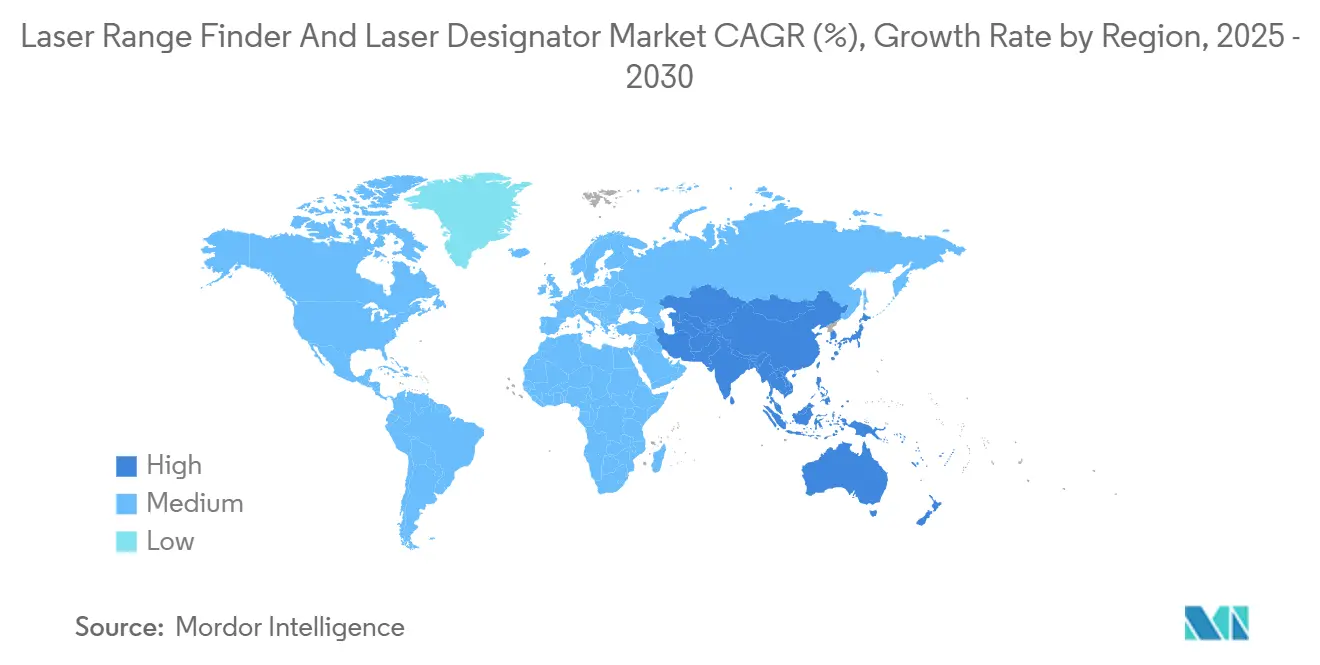
North America Laser Range Finder and Laser Designator Market
North America’s 40.90% revenue share in 2024 stemmed from US Department of Defense allocations that exceeded the combined defense outlays of the next seven nations. Programs such as the Small Diameter Bomb II and Typhon long-range fires include embedded designator packages, ensuring recurring demand for maintenance and capability upgrades. SOCOM prototype solicitations for hand-held target marking devices reinforce near-term opportunities in soldier-borne segments. Canada augments regional volume through NORAD modernization, while Mexico prioritizes border-security detection systems.
APAC Laser Range Finder and Laser Designator Market
Asia-Pacific is the fastest-growing territory, forecasted at an 8.95% CAGR. India’s Defence Research and Development Organisation tested solid-state laser weapons for short-range air defense, underpinning a domestic supply chain that could pivot into export markets. Japan’s counter-UAS initiatives led by Mitsubishi Heavy Industries place designators on interceptor drones, providing public-sector proof points that private companies may replicate. South Korean prototypes such as Cheongwang demonstrate advanced beam-steering under extreme humidity, while Chinese fiber-laser breakthroughs in thermal invariance extend operational windows. These dynamics collectively drive the region's laser range finder and laser designator market, aided by consistent budget expansion and elevated geopolitical tensions.
Europe Laser Range Finder and Laser Designator Market
Europe maintains steady momentum through multilateral procurement and collaborative R&D. The European Sky Shield Initiative aligns requirement standards for designator-enabled missile defenses, effectively pooling budgets across 19 participating nations. Bilateral programs, including the UK-Germany Trinity House deep-strike missile, stipulate laser terminal guidance modules to ensure sub-meter accuracy at 2,000 km, reinforcing continental demand. Naval modernization within the Mediterranean, exemplified by Franco-Italian FREMM frigate retrofits, integrates deck-mounted range-finders for helicopter approach and UAV launch-and-recovery support. Collectively, these programs keep Europe’s market position resilient despite slower macroeconomic growth.

Competitive Landscape
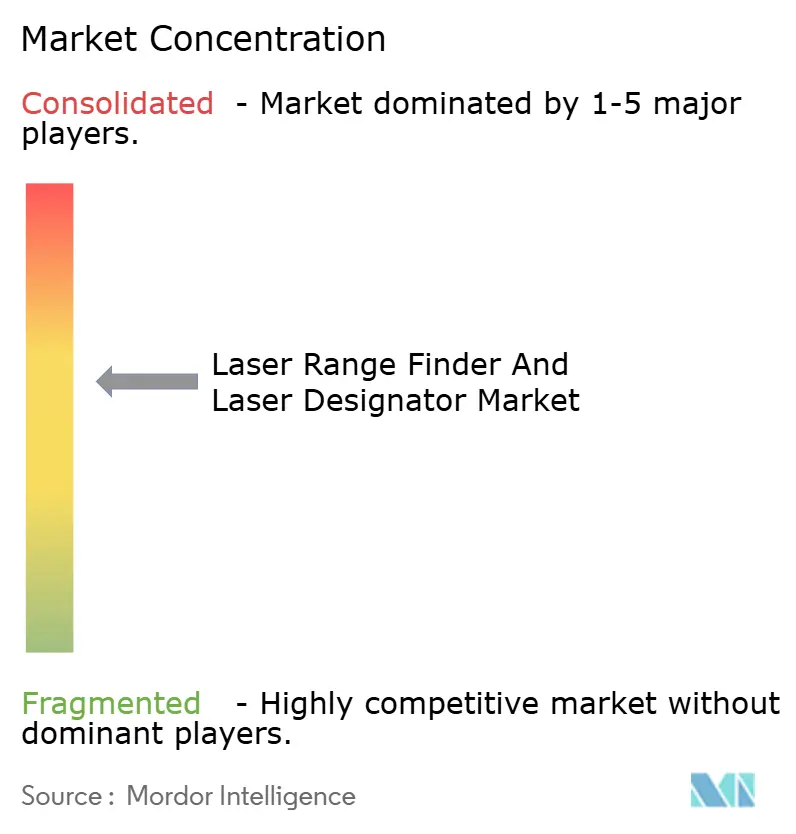
The laser range finder and laser designator market is moderately concentrated, with prime contractors such as Leonardo, Elbit Systems, Northrop Grumman, and Raytheon Technologies dictating technology roadmaps through patented fiber-laser cavities and eye-safe beam control algorithms. Their portfolios span soldier-portable systems, stabilized airborne pods, and high-energy multi-kilowatt naval demonstrators. Differentiation now centers on software-defined functionality that allows real-time waveform adaptation, plus open-architecture interfaces that speed platform integration. Export-control frameworks shield incumbents from low-cost competition but simultaneously limit geographic diversification.
Chinese state-backed suppliers have progressed from reverse-engineering to indigenous design, enabling compliant buyers to sidestep US license delays. European mid-tier firms collaborate on naval laser turrets that will enter serial production within five years, underscoring a shift toward co-development rather than single-nation tendering. Start-ups targeting civil markets introduce disruptively low-cost micro-LIDAR units, though few can yet meet ruggedization and survivability thresholds demanded by defense buyers. Consolidation is plausible as legacy primes seek autonomy-software expertise, while automotive lidar vendors eye defense spin-outs to diversify cyclical passenger-car exposure.
Laser Range Finder And Laser Designator Industry Leaders
Northrop Grumman Corporation
RTX Corporation
Thales Group
Elbit Systems Ltd.
L3Harris Technologies, Inc.
- *Disclaimer: Major Players sorted in no particular order
Laser Range Finder And Laser Designator Market Companies Covered in this Report
- Northrop Grumman Corporation
- RTX Corporation
- Thales Group
- Elbit Systems Ltd.
- LUMIBIRD SA
- Leonardo S.p.A.
- L3Harris Technologies, Inc.
- Lockheed Martin Corporation
- BAE Systems plc
- Kongsberg Gruppen ASA
- Teledyne FLIR LLC (Teledyne Technologies Incorporated)
- Safran SA
- Rheinmetall AG
- Aselsan A.S.
- Israel Aerospace Industries Ltd.
- CILAS SAS
- JENOPTIK AG

Recent Industry Developments in Laser Range Finder And Laser Designator Market
- July 2025: The Ukrainian R-34-T UAV, equipped with advanced laser designation technology, was approved for operational deployment. This development highlights a growing trend in the defense technology market, addressing the increasing demand for PGMs and innovative unmanned systems to enhance combat efficiency and reduce risks in modern warfare operations.
- January 2025: Elbit Systems Deutschland strategically delivered its advanced Rattler XR laser target designators to the Bundeswehr, addressing compatibility issues during joint operations. With features like high laser output, spillover alarms, and open communication architecture, the system enhances interoperability and ensures precise target designation, marking a significant technological advancement for the defense market.


Global Laser Range Finder And Laser Designator Market Report Scope
| Laser Range Finder |
| Laser Designator |
| Handheld |
| Vehicle-Mounted |
| Airborne |
| Naval |
| Ground-Based Fixed Installation |
| Short Range (Less than 5 km) |
| Medium Range (5 to 20 km) |
| Long Range (More than 20 km) |
| Defense and Military |
| Homeland Security |
| Commercial |
| North America | United States | |
| Canada | ||
| Mexico | ||
| Europe | United Kingdom | |
| France | ||
| Germany | ||
| Italy | ||
| Russia | ||
| Rest of Europe | ||
| Asia-Pacific | China | |
| India | ||
| Japan | ||
| South Korea | ||
| Rest of Asia-Pacific | ||
| South America | Brazil | |
| Rest of South America | ||
| Middle East and Africa | Middle East | Saudi Arabia |
| Israel | ||
| United Arab Emirates | ||
| Rest of Middle East | ||
| Africa | South Africa | |
| Rest of Africa | ||
| By Product Type | Laser Range Finder | ||
| Laser Designator | |||
| By Platform | Handheld | ||
| Vehicle-Mounted | |||
| Airborne | |||
| Naval | |||
| Ground-Based Fixed Installation | |||
| By Range Capability | Short Range (Less than 5 km) | ||
| Medium Range (5 to 20 km) | |||
| Long Range (More than 20 km) | |||
| By End User | Defense and Military | ||
| Homeland Security | |||
| Commercial | |||
| By Geography | North America | United States | |
| Canada | |||
| Mexico | |||
| Europe | United Kingdom | ||
| France | |||
| Germany | |||
| Italy | |||
| Russia | |||
| Rest of Europe | |||
| Asia-Pacific | China | ||
| India | |||
| Japan | |||
| South Korea | |||
| Rest of Asia-Pacific | |||
| South America | Brazil | ||
| Rest of South America | |||
| Middle East and Africa | Middle East | Saudi Arabia | |
| Israel | |||
| United Arab Emirates | |||
| Rest of Middle East | |||
| Africa | South Africa | ||
| Rest of Africa | |||


Key Questions Answered in the Report
How fast is the laser range finder and laser designator market expected to grow to 2030?
The global laser range finder and laser designator market is projected to expand at a 7.43% CAGR, reaching USD 7.80 billion by 2030.
Which platform segment is growing the quickest?
Airborne systems, largely driven by drone-swarm and counter-UAS adoption, are forecasted for a 9.65% CAGR through 2030.
What share do defense applications hold today?
Defense and military buyers command 72.45% of 2024 revenues, retaining the majority stake in new procurements.
Why are eye-safe 1.5 µm systems important?
They meet Class 1 safety standards, allowing higher output power for civilian and automotive uses while protecting human eyesight.
Which region shows the highest future growth?
Asia-Pacific leads with an 8.95% CAGR, supported by defense modernization across India, Japan, South Korea, and China.
What is the key restraint hampering adoption?
High acquisition and lifecycle maintenance costs remain the primary hurdle for budget-constrained militaries and civilian agencies.
Page last updated on:


 Your data is secure and never sold or shared.


