
Landing String Equipment Market Size and Share
Market Overview
| Study Period | 2021 - 2031 |
|---|---|
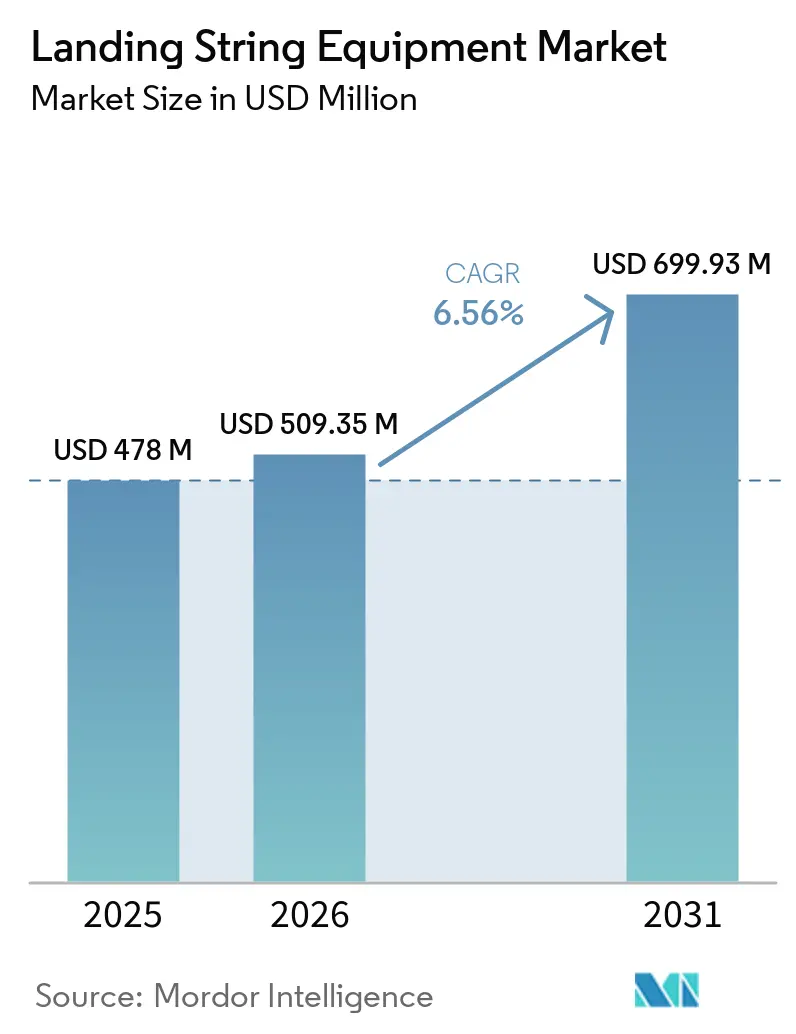
| Market Size (2026) | USD 509.35 Million |
| Market Size (2031) | USD 699.93 Million |
| Growth Rate (2026 - 2031) | 6.56 % |
| Fastest Growing Market | Asia-Pacific |
| Largest Market | North America |
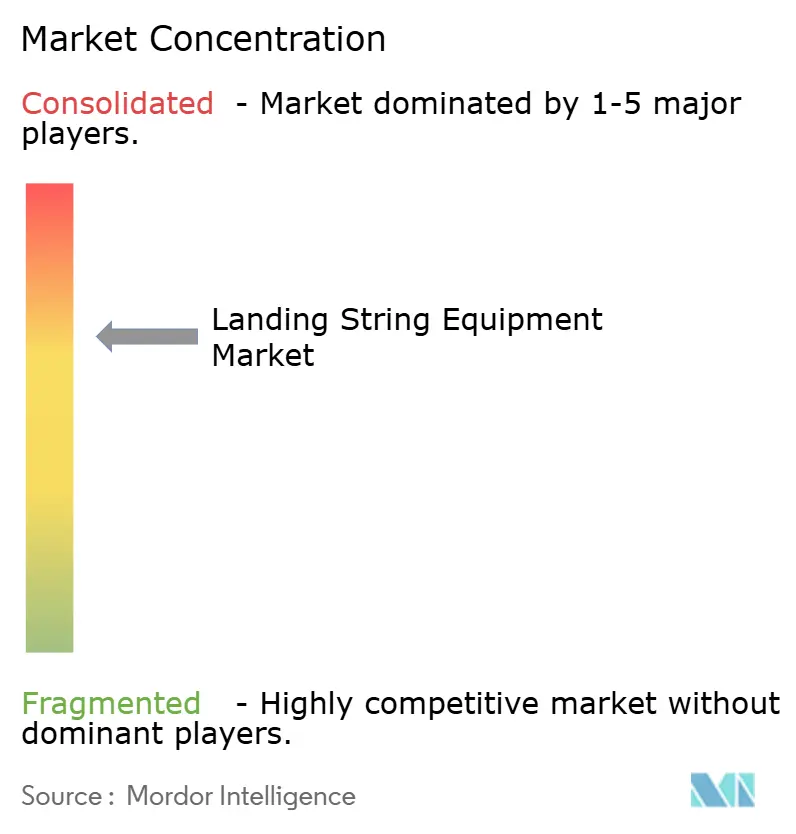
| Market Concentration | Medium |
Major Players *Disclaimer: Major Players sorted in no particular order Image © Mordor Intelligence. Reuse requires attribution under CC BY 4.0. | |
Landing String Equipment Market Analysis by Mordor Intelligence
The Landing String Equipment Market size is expected to grow from USD 478 million in 2025 to USD 509.35 million in 2026 and is forecast to reach USD 699.93 million by 2031 at 6.56% CAGR over 2026-2031. The landing string equipment market is linked to offshore field development because these systems support completion strings, well barriers, and emergency disconnection from floating rigs. Higher activity in deepwater projects is increasing demand for equipment that can operate under heavier loads and higher pressures. The move toward 20,000-psi Paleogene wells in the Gulf of Mexico requires assemblies that differ from legacy 15,000-psi systems. This creates a replacement and qualification need for suppliers that can document pressure, fatigue, and sealing performance. Sanctioned projects in Brazil, West Africa, the Gulf of Mexico, and Southeast Asia support demand visibility through the forecast period.
Key Report Takeaways
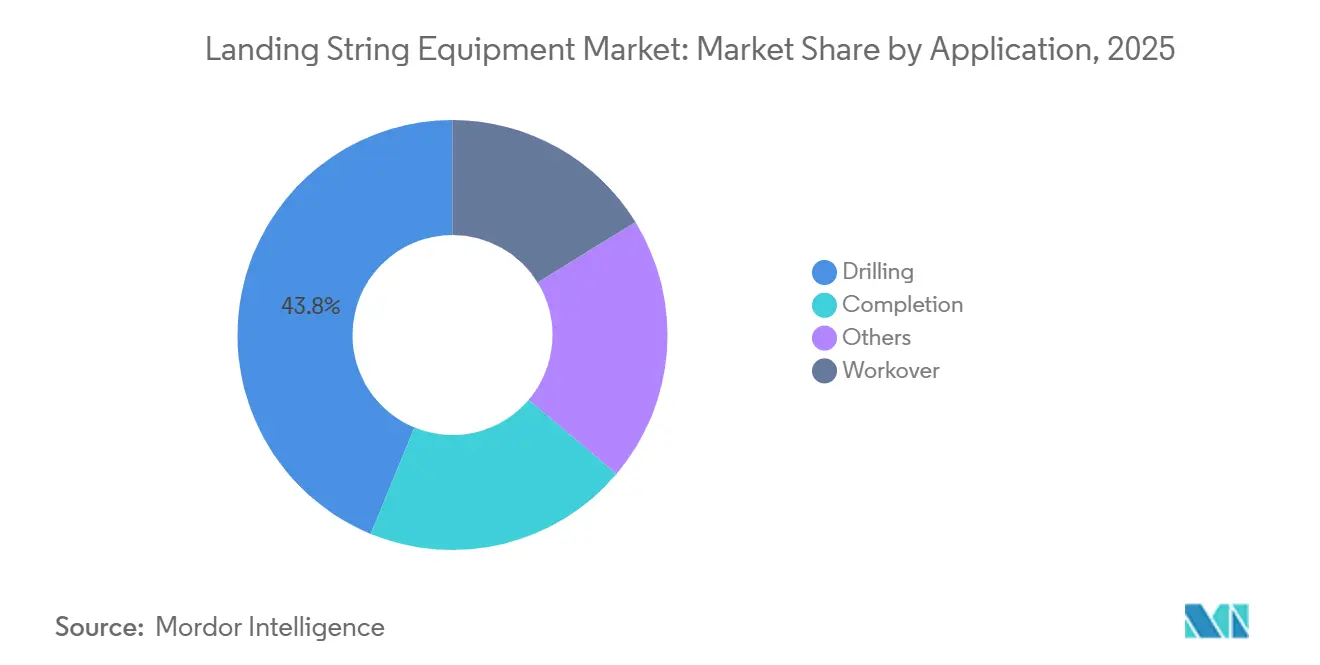
- By application, drilling held 43.8% of landing string equipment revenue in 2025, while completion is forecast to expand at a 7.5% CAGR through 2031.
- By component type, landing joints held 25.5% of revenue in 2025, while subsea test trees are forecast to expand at a 7.8% CAGR through 2031.
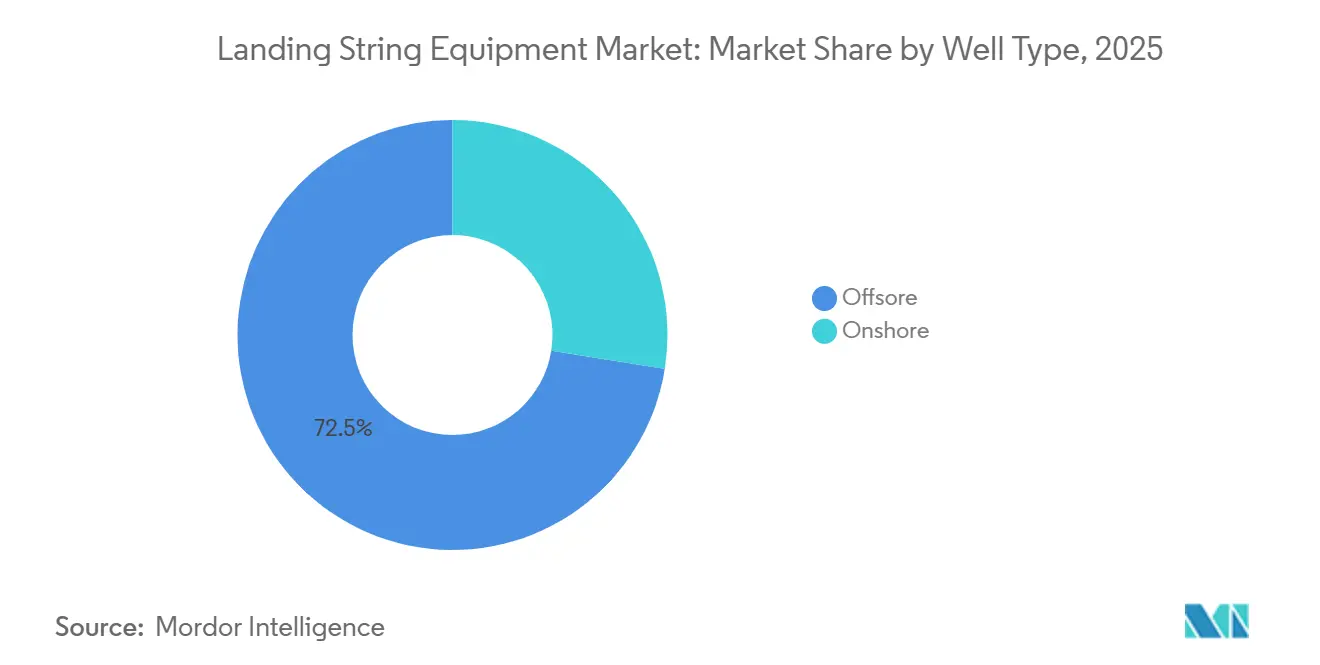
- By well type, offshore operations held 72.5% of demand in 2025 and are forecast to expand at a 7.4% CAGR through 2031.
- By technology, direct-hydraulic systems held 36.7% of the technology mix in 2025, while electrohydraulic systems are forecast to expand at an 8.3% CAGR through 2031.
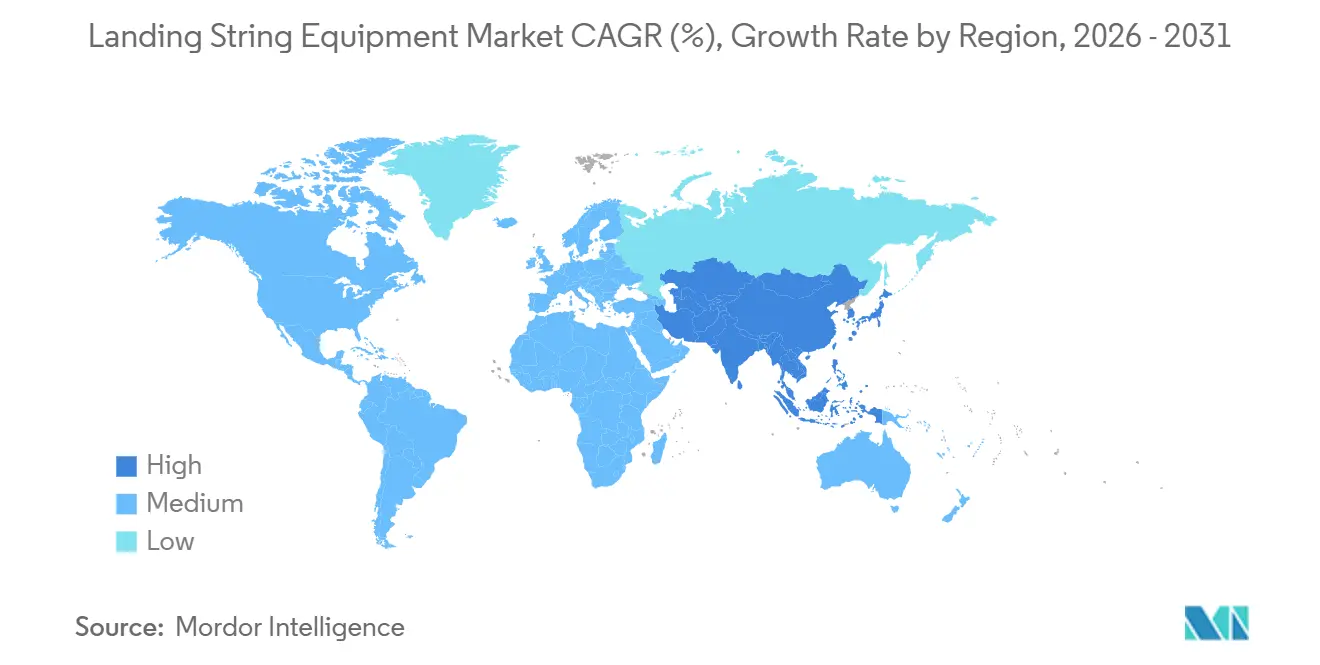
- By geography, North America held 36.3% of revenue in 2025, while Asia-Pacific is forecast to expand at a 7.9% CAGR through 2031.
Note: Market size and forecast figures in this report are generated using Mordor Intelligence’s proprietary estimation framework, updated with the latest available data and insights as of January 2026.
Global Landing String Equipment Market Trends and Insights
Drivers Impact Analysis*
| Driver | (~) % Impact on CAGR Forecast | Geographic Relevance | Impact Timeline |
|---|---|---|---|
| Deepwater And Ultra-Deepwater Development | +1.8% | Global, with intensity in Gulf of America, Brazil, and West Africa | Medium term (2-4 years) |
| Rising HP/HT And 20,000-Psi Well Designs | +1.1% | Gulf of America, North Sea, Malaysia | Medium term (2-4 years) |
| Reduced Rig Time Through Umbilical-Less Intervention | +0.7% | Norwegian Continental Shelf, Gulf of America, West Africa | Short term (≤ 2 years) |
| Higher Well-Control And Barrier-Integrity Requirements | +0.5% | North Sea, Gulf of America, global deepwater | Medium term (2-4 years) |
| Higher-Capacity Casing And Completion Loads | +0.4% | Gulf of America, Brazil pre-salt | Short term (≤ 2 years) |
| Digital Monitoring And Electrohydraulic Control | +0.7% | Global, with early adoption in deepwater basins | Long term (≥ 4 years) |
| Source: Mordor Intelligence | |||
Deepwater and Ultra-Deepwater Development
Deepwater development is widening the operating base for the landing string equipment market. Deepwater and ultra-deepwater wells represented 70% of new recoverable resources discovered in 2025, while representing 19% of new-field wells drilled. This relationship directs capital toward floating-rig projects, where landing strings are required for construction, completion, and intervention work. Latin America, Africa, and Asia-Pacific together accounted for two-thirds of more than 37 high-impact wells scheduled for 2026. The broader group of active basins reduces the historical dependence of the landing string equipment market on the Gulf of Mexico and Brazil. Suppliers with service coverage in several regions can support new completions and later workover campaigns across this larger project base.
Rising HP/HT and 20,000-psi Well Designs
Higher-pressure well designs are changing the technical requirements of the landing string equipment market. Chevron’s Anchor development reached first oil in 2026 as the first commercial 20,000-psi-rated HP/HT subsea production system. Baker Hughes supplied the 20K subsea trees, which were the first at this rating to receive API 17D compliance qualification. Pressure-containing sections for that equipment require 70% more material than comparable 15,000-psi equipment. Each assembly used in a 20K program must satisfy fatigue and scalability requirements under API Technical Report 1PER15K-1.[1] TechnipFMC’s 2026 iEPCI award for BP’s Tiber project shows that 20K procurement is moving into a repeatable project category.[2] Providers that have completed qualification work before tendering have an advantage in this part of the landing string equipment market.
Reduced Rig Time Through Umbilical-Less Intervention
Umbilical-less intervention reduces the top-side equipment needed for some offshore operations. Conventional subsea intervention uses hydraulic power units and umbilical reels that take deck space and add work during mobilization. Halliburton’s Remote Operated Control System removes the umbilical and can reduce deck operations by up to 75%.[3] The system set a deepwater record for umbilical-less tubing hanger installation at 8,458 feet. Smaller equipment packages can be standardized across fields, which can lower storage needs and shorten preparation periods. Halliburton’s 2026 framework agreement with Shell for deployment in the Norwegian Continental Shelf, West Africa, and the Gulf of Mexico indicates that this approach is moving into contracted field use.
Higher Well-Control and Barrier-Integrity Requirements
Well-control rules are increasing the documentation and design requirements for the landing string equipment market. Norway’s NORSOK D-010:2021 framework has proposed AC:2024 amendments that address shear-seal valve qualification and coiled-tubing shearing scenarios.[4] In the United States, 30 CFR Part 250 requires BOP shear rams that can cut landing string components under the maximum anticipated surface pressure. These requirements affect slip-proof sections, connection geometry, and valve actuation timing. Multi-well completion programs also require barrier schematics under NORSOK D-010 and ISO 16530 for each re-run of a system. Suppliers with API 17G qualification packages and fatigue-test records can meet these requirements with less project-specific preparation. Compliance therefore supports repeat service work for established suppliers in the landing string equipment market.
Restraints Impact Analysis*
| Restraint | (~) % Impact on CAGR Forecast | Geographic Relevance | Impact Timeline |
|---|---|---|---|
| High Qualification And Fatigue-Test Costs | -0.7% | Global | Medium term (2-4 years) |
| Limited Availability Of High-Yield Tubulars And Specialized Connections | -0.6% | Global, concentrated in North American and European supply chains | Medium term (2-4 years) |
| Offshore Rig, Vessel, And Crew Dependence | -0.5% | Global, with exposure in Asia-Pacific and West Africa | Medium term (2-4 years) |
| Long Lead Times For Project-Specific Systems | -0.4% | Global, concentrated in ultra-deepwater basins | Long term (≥ 4 years) |
| Source: Mordor Intelligence | |||
High Qualification and Fatigue-Test Costs
Qualification expenses can limit the number of suppliers entering the landing string equipment market. HP/HT qualification includes friction-weld assessment, finite-element analysis, full-scale fatigue cycling, combined-load testing, and sour-service material evaluation under NACE MR0175. The work requires test frames that apply tension and pressure together. SPE documentation describes this work as a multiyear process with spending in the tens of millions. Superior Energy Services deployed FASTR 3.0 in the Gulf of Mexico in June 2025 after a 7-year development and qualification program that also faced supply chain disruptions. Smaller service firms face a heavier burden when pursuing HP/HT work. This favors providers that already hold qualified inventories and established operating records.
Limited Availability of High-Yield Tubulars and Specialized Connections
Material availability can delay equipment delivery for the landing string equipment market. Premium tubulars require 165-ksi specified minimum yield strength steel and slip-proof sections designed for BOP shareability. These materials are sourced from a limited group of accredited mills in North America and Europe. FASTR 3.0 experienced material delivery delays that were linked to supply chain disruptions. Demand rises at the same time across 20K subsea trees, casing programs, and other high-pressure equipment. Operators and service providers with long-term alloy steel agreements and material traceability can reduce exposure to spot purchasing. ISO 10423 renewal cycles add importance to documented material supply.
*Our forecasts treat driver/restraint impacts as directional, not additive. The impact forecasts reflect baseline growth, mix effects, and variable interactions.
Segment Analysis
By Application: Completion Campaigns Reshape the Revenue Mix
Drilling held 43.8% of landing string equipment revenue in 2025. This segment reflects the foundational role of landing strings in running heavy casing during deepwater well construction. Paleogene and pre-salt programs approach 3-million-pound hook load thresholds, making high-capacity systems a project requirement. FASTR 3.0 set a 2.849-million-pound hook load record while running 16-in. casing to 24,000 feet in the Gulf of Mexico in June 2025. Workover work also supports demand in mature fields across the Gulf of Mexico, Brazil, and the North Sea. Equipment retrieval and re-run campaigns continue after initial well construction is complete.
The landing string equipment market size for completion work benefits from batch subsea campaigns that concentrate activity over shorter operating periods. SLB received an award for up to 35 ultra-deepwater completions in Brazil’s Santos Basin, with work beginning in mid-2026. The work uses electric completions technology for real-time reservoir information. Large contracts create concentrated demand for equipment, field personnel, and qualified operating packages. Completion growth makes the application mix less dependent on drilling than it was during the 2020 to 2025 offshore investment recovery.

By Component Type: Subsea Test Trees Commanding Investment
Landing joints accounted for 25.5% of component revenue in 2025. Landing joints form the load-bearing structure of an assembly across drilling, completion, and intervention work. The share held by landing joints reflects this role in every application type. Material specifications of 165-ksi yield strength are becoming more common in 20K and ultra-deepwater pre-salt work. These upgrades raise the value of a landing joint used in demanding programs. Lubricator valves, retainer valves, and shear subs provide pressure containment and environmental protection functions. Shear subs require renewed engineering attention because BOP shearing limits are being recalculated for 20K work.
Subsea test trees are forecast to grow at a 7.8% CAGR through 2031. Subsea test trees systems combine emergency disconnect, wellbore shut-in, and large-bore access in a qualified module. SLB’s SenTREE HP has a 6.375-in. large bore and dual ball-flapper barriers that can cut 2-in. coiled tubing OD in an emergency. Integrated dual-barrier systems reduce the need to assemble separate functions at the well-site. Interventek’s Revolution-7 combines shear and seal functions in 1 valve rotation and is qualified to API 17G third edition. This design reduces component count and redress time. The landing string equipment market is therefore placing more value on modules that bring several well-controlled functions into one system.
By Well Type: Offshore Character Remains Dominant
Offshore operations held 72.5% of the landing string equipment market share in 2025. They are also forecast to grow at a 7.4% CAGR through 2031. Deepwater and ultra-deepwater wells dominate new recoverable resources discovered in 2025, despite representing 19% of new-field wells. The resource mix keeps investment focused on programs that depend on floating rigs and subsea completion systems. Water depths beyond 3,000 m need higher-pressure ratings and more extensively qualified component sets. That raises the value of each offshore assembly in the landing string equipment market.
Onshore work remains a smaller but continuing source of demand. High-pressure fields in North America, the Middle East, and China use these assemblies for deep gas completions in HP/HT carbonate formations. Mechanical systems have a clearer role in these settings than in complex offshore programs. CNOOC’s engineering subsidiary deployed a self-developed hydraulic-controlled landing string at a 500 m water depth in the South China Sea. The deployment shows the growth of domestic capability for deepwater completion tools in China. It may affect the position of international equipment providers operating in the region.
By Technology: Electrohydraulic Systems Redefine Operating Benchmarks
Direct-hydraulic systems held 36.7% of the technology mix in 2025. Direct-hydraulic systems installed base and field record support use in moderate-depth completions. They remain cost-effective where umbilical length and response time do not limit operations. Electrohydraulic systems are forecast to grow at an 8.3% CAGR through 2031. Electrohydraulic systems addressed response-time and umbilical-length limits in multi-zone and ultra-deepwater wells. Halliburton launched its Turing electro-hydraulic control system in September 2025, and it manages up to 12 interval control valve zones through 3 control lines. The system pairs those controls with real-time reservoir monitoring through the DataSphere permanent monitoring suite.
Umbilical-less systems are also gaining importance in high-value offshore programs. Halliburton’s ROCS and the Halliburton-Optime Subsea eROCS deployments in the Norwegian Continental Shelf demonstrate operation without conventional umbilicals. Mechanical systems still serve shallow-water and onshore applications. In higher-value offshore work, the economics of rig time support more capable control systems. SLB’s SenTURIAN electrohydraulic operating system can provide up to 50% rig-time savings during handling on dynamically positioned vessels. Emergency shutdown requirements under NORSOK D-010 also support programmable systems that can disconnect a landing string in under 15 seconds. The landing string equipment industry is therefore shifting toward control architectures that combine equipment handling with real-time operational control.
Geography Analysis
The Gulf of Mexico remains important because of its deepwater project activity and Lower Tertiary resources. Chevron’s Anchor reached first oil in 2026 as the first commercial 20,000-psi-rated HP/HT subsea system. BP’s Kaskida was approved in March 2026 with an estimated USD 5 billion capital commitment and needs 20K-rated completion equipment. TechnipFMC’s January 2026 award for BP’s Tiber project confirms the progression of 20K equipment procurement. Tiebacks to existing Gulf infrastructure support completion and intervention work between greenfield developments in the landing string equipment market.
Asia-Pacific is forecast to grow rapidly through 2031, making it the fastest-growing regional part of the landing string equipment market. Gas-focused deepwater development is a central factor in Indonesia, Malaysia, and Vietnam. Shell made a final investment decision for Malikai Phase 3 in Sabah, which targets a 60% production increase to 40,000 bopd by Q3 2028. A new group of deepwater gas projects across Indonesia, Malaysia, and Brunei targets 28 trillion cubic feet and combined capital expenditure above USD 20 billion. CNOOC commissioned the Haiyang Shiyou 292 deepwater multifunctional marine engineering vessel in August 2026. These developments support local completion and workover capability across the region.
Europe is supported by tieback and redevelopment work on the Norwegian Continental Shelf. Equinor awarded NOK 6 billion, equivalent to USD 560 million, in subsea contracts for 4 tieback projects in July 2026. South America remains a structural demand center because Petrobras’s P-78 FPSO began Búzios operations in December 2025 as the 7th production unit. Its multi-year ultra-deepwater completion program supports landing string equipment market demand through 2031. Middle East and Africa are also emerging through new offshore activity. Angola signed deepwater exploration agreements with Shell, Chevron, and TotalEnergies in September 2026. Baker Hughes also secured a subsea contract from Azule Energy for 17 deepwater subsea trees and controls for Angola’s Greater PAJ development.
Competitive Landscape
The landing string equipment market is moderately concentrated around SLB, Halliburton, Baker Hughes, and Expro. These companies compete in the landing string equipment market through subsea test tree portfolios, electrohydraulic controls, and long-term operator contracts. SLB’s SenTREE and SenTURIAN offerings focus on modular use in deepwater configurations. Halliburton’s Veto, Dash, and ROCS offerings focus on removing umbilicals and extending remote control. These are different technical approaches to the same deepwater completion and intervention programs. Expro extended a Gulf of Mexico contract for up to 5 years in June 2026, including use of its Solus shear and seal valve.
Qualification history is an important competitive factor in the landing string equipment market. Baker Hughes supplied the 20K trees for Chevron’s Anchor development, which established a record of API 17D-compliant use at that pressure rating. That record is relevant to later Lower Tertiary procurement. Interventek launched its Revolution-7 in April 2026 as an API 17G third-edition-qualified in-riser system with a 20,000-psi variant. The system combines shear and seal actions in 1 valve rotation. Halliburton’s Shell framework agreement provides another example of operators adopting umbilical-less systems across several regions. Providers that completed qualification investment earlier can offer a more established package when a project moves to procurement.
Opportunity remains in autonomous intervention for mature subsea fields where conventional infrastructure is harder to justify for plug and abandonment or workover work. Halliburton’s SCILS and Optime Subsea’s OTHOS are in early commercial use in this area. Domestic Chinese capability is also advancing after CNOOC’s deployment of a hydraulically controlled landing string at 500-m water depth. This could affect international supplier pricing in Asia-Pacific while raising local quality expectations. Vallourec and Tenaris supply premium tubulars for high-load assemblies. Their long-term supply positions are becoming more important where alloy steel availability is constrained. API 17G third edition and API Spec 16B requirements continue to guide product development across the landing string equipment market.
Landing String Equipment Industry Leaders
-
SLB N.V.
-
Halliburton Company
-
NOV Inc.
-
Expro Group Holdings N.V.
-
TechnipFMC PLC
- *Disclaimer: Major Players sorted in no particular order
Recent Industry Developments
- July 2026: TechnipFMC was awarded multiple subsea contracts by Equinor, valued between USD 250 million and USD 500 million, for the Omega Sør, Brime, and Tyrihans Nord brownfield tieback projects offshore Norway. NOV and Tenaris received separate scopes for flexible pipelines and linepipe.
- June 2026: TechnipFMC was awarded a large iEPCI contract, valued between USD 500 million and USD 1 billion, by Vår Energi for the Ofelia and Gjøa Nord subsea projects in the North Sea, targeting first oil within two years using TechnipFMC's integrated execution model.
- May 2026: Baker Hughes extended two multi-year contracts with Equinor for integrated drilling and well services, along with wireline intervention on the Norwegian Continental Shelf, deploying autonomous well construction and advanced reservoir mapping technologies.
Global Landing String Equipment Market Report Scope
Landing string equipment refers to the specialized heavy-duty pipes, valves, and safety assemblies used in oil and gas operations to run, land, and support heavy casing, liners, or completion strings into a wellbore. The landing string equipment market encompasses the global industry for specialized downhole and subsea tools used to run, test, and complete offshore oil and gas wells.
The global landing string equipment market is segmented by application, component type, well type, technology, and geography. By application, the market is divided among drilling, workover, completion, and others. By component type, the market is segmented into landing joints, subsea test trees, lubricator valves, retainer valves, shear subs, and others. By well type, the market is segmented into onshore, and offshore. By technology, the market is segregated into mechanical systems, direct-hydraulic systems, electrohydraulic systems, umbilical-less systems, and others. By geography, market is segmented into North America, South America, Europe, Asia-Pacific, Middle East and Africa. The report also covers the market size and forecasts for the global busbar market across 26 countries in key regions. For each segment, the market sizing and forecasts have been provided on the basis of value (USD).
| Drilling |
| Workover |
| Completion |
| Others |
| Landing Joints |
| Subsea Test Trees |
| Lubricator Valves |
| Retainer Valves |
| Shear Subs |
| Others |
| Onshore |
| Offsore |
| Mechanical Systems |
| Direct-Hydraulic Systems |
| Electrohydraulic Systems |
| Umbilical-Less Systems |
| Others |
| North America | United States |
| Canada | |
| Mexico | |
| Europe | Germany |
| France | |
| Italy | |
| Spain | |
| United Kingdom | |
| Poland | |
| Russia | |
| Rest of Europe | |
| Asia-Pacific | China |
| India | |
| Japan | |
| South Korea | |
| Australia | |
| Indonesia | |
| Vietnam | |
| Thailand | |
| Rest of Asia-Pacific | |
| South America | Brazil |
| Argentina | |
| Chile | |
| Rest of South America | |
| Middle East and Africa | Saudi Arabia |
| United Arab Emirates | |
| Egypt | |
| South Africa | |
| Morocco | |
| Rest of Middle East and Africa |
| By Application | Drilling | |
| Workover | ||
| Completion | ||
| Others | ||
| By Component Type | Landing Joints | |
| Subsea Test Trees | ||
| Lubricator Valves | ||
| Retainer Valves | ||
| Shear Subs | ||
| Others | ||
| By Well Type | Onshore | |
| Offsore | ||
| By Technology | Mechanical Systems | |
| Direct-Hydraulic Systems | ||
| Electrohydraulic Systems | ||
| Umbilical-Less Systems | ||
| Others | ||
| By Geography | North America | United States |
| Canada | ||
| Mexico | ||
| Europe | Germany | |
| France | ||
| Italy | ||
| Spain | ||
| United Kingdom | ||
| Poland | ||
| Russia | ||
| Rest of Europe | ||
| Asia-Pacific | China | |
| India | ||
| Japan | ||
| South Korea | ||
| Australia | ||
| Indonesia | ||
| Vietnam | ||
| Thailand | ||
| Rest of Asia-Pacific | ||
| South America | Brazil | |
| Argentina | ||
| Chile | ||
| Rest of South America | ||
| Middle East and Africa | Saudi Arabia | |
| United Arab Emirates | ||
| Egypt | ||
| South Africa | ||
| Morocco | ||
| Rest of Middle East and Africa | ||
Key Questions Answered in the Report
What is the projected value of landing string equipment by 2031?
The landing string equipment market size is forecast to reach USD 699.83 million by 2031, at a 6.56% CAGR from 2026 to 2031.
Which application is growing fastest for landing string equipment?
Completion is the fastest-growing application, with a forecast CAGR of 7.5% through 2031.
Which component has the highest growth outlook?
Subsea test trees have the highest component growth outlook, with a forecast CAGR of 7.8% through 2031.
Why are 20,000-psi wells important to equipment suppliers?
They require separately qualified assemblies that meet pressure, fatigue, and sealing requirements beyond legacy 15,000-psi systems.
Which region has the strongest growth forecast?
Asia-Pacific has the highest regional growth forecast, with a 7.9% CAGR through 2031.
Which technology is expanding fastest?
Electrohydraulic systems are forecast to grow at an 8.3% CAGR through 2031 because they support complex multi-zone and ultra-deepwater work.