
KYC Remediation Services Market Size and Share
Market Overview
| Study Period | 2020 - 2031 |
|---|---|
| Market Size (2026) | USD 3.49 Billion |
| Market Size (2031) | USD 6.32 Billion |
| Growth Rate (2026 - 2031) | 12.61 % |
| Fastest Growing Market | Asia-Pacific |
| Largest Market | North America |
| Market Concentration | Medium |
Major Players *Disclaimer: Major Players sorted in no particular order Image © Mordor Intelligence. Reuse requires attribution under CC BY 4.0. | |
KYC Remediation Services Market Analysis by Mordor Intelligence
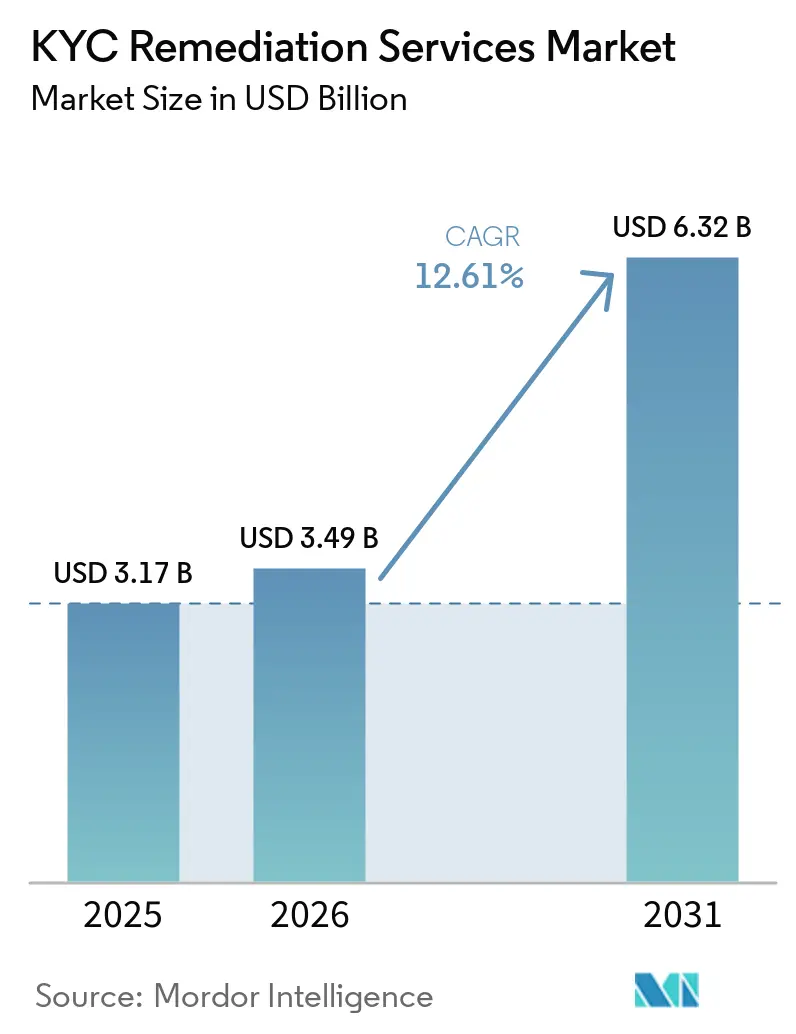
The KYC remediation services market size is expected to increase from USD 3.17 billion in 2025 to USD 3.49 billion in 2026 and reach USD 6.32 billion by 2031, growing at a CAGR of 12.61% over 2026-2031. Regulatory scrutiny, older customer files, and scalable technology-supported delivery are keeping demand strong across the KYC remediation services market. Outsourcing is becoming more relevant where institutions need to update records without adding large internal teams. New rules are making remediation a continuing operating requirement instead of a short-term response to a review. Providers that combine skilled analysts, reliable data, and auditable workflows are better placed to win larger programs. Execution remains difficult because experienced analysts are scarce, ownership data is uneven, and automated workflows face governance requirements.
Key Report Takeaways
- By service type, full back-book remediation held 37.39% of the KYC remediation services market revenue in 2025, while targeted and risk-based portfolio remediation is projected to expand at a CAGR of 15.21% through 2031.
- By delivery model, offshore delivery accounted for 51.78% of revenue in 2025, while onshore delivery is projected to record the highest CAGR of 14.23% through 2031.
- By customer type, nonfinancial corporate and commercial entities held 41.23% of revenue in 2025, while funds, trusts, SPVs, and other complex legal structures are projected to expand at a CAGR of 15.67% through 2031.
- By geography, North America held 36.77% of the KYC remediation services market revenue in 2025, while Asia-Pacific is projected to grow at a CAGR of 16.38% through 2031.
Note: Market size and forecast figures in this report are generated using Mordor Intelligence’s proprietary estimation framework, updated with the latest available data and insights as of January 2026.
Global KYC Remediation Services Market Trends and Insights
Drivers Impact Analysis*
| DRIVER | (~) % IMPACT ON CAGR FORECAST | GEOGRAPHIC RELEVANCE | IMPACT TIMELINE |
|---|---|---|---|
| Rising Expectations for Defensible KYC Files | +2.8% | Global, highest in North America and Europe | Short term (≤ 2 years) |
| Back-Book and Periodic-Review Backlogs | +2.3% | Global, most acute in North America and Europe | Short term (≤ 2 years) |
| Risk-Based and Event-Driven Review Models | +1.8% | North America, Europe, United Kingdom | Medium term (2-4 years) |
| Digital Banking, Fintech, and Payment Portfolios | +1.5% | Asia-Pacific core, with spillover to South America and Middle East and Africa | Medium term (2-4 years) |
| Automation for Data Enrichment and Documents | +1.2% | Global | Medium term (2-4 years) |
| Cross-Border Ownership and Entity Verification | +0.9% | Europe, North America, and Asia-Pacific cross-border hubs | Long term (≥ 4 years) |
| Source: Mordor Intelligence | |||
Rising Regulatory Expectations for Current and Defensible KYC Files
The regulatory environment is a central source of demand for the KYC remediation services market in 2026. AMLA Regulation (EU) 2024/1620 took effect on July 1, 2025, and gives the European Anti-Money Laundering Authority direct supervisory responsibility for 40 cross-border financial groups. Directive (EU) 2024/1640 required member-state implementation by the end of 2026, prompting coordinated back-book reviews at cross-border institutions, while the Financial Conduct Authority became the sole AML supervisor for certain professional-services sectors on January 1, 2026. Its expectations include sound customer-review cycles, enhanced due diligence evidence, and complete audit trails. The Financial Action Task Force’s fifth evaluation round assesses practical effectiveness, which increases the need for measurable remediation outcomes rather than policy documentation alone. The EU AML Regulation requires refreshes within 12 months for high-risk relationships and within 5 years for standard-risk relationships, favoring providers that can maintain continuous, defensible review processes.[1]
Growth of Back-Book Remediation and Periodic-Review Backlogs
Many tier-1 institutions hold KYC files created before the current standards for beneficial ownership, source of funds, and enhanced due diligence. In 2025, the Financial Conduct Authority fined Nationwide GBP 44 million (USD 56.5 million), Barclays GBP 43 million (USD 55.2 million), and Monzo GBP 21 million (USD 27 million) for AML-control deficiencies. These actions showed that supervisors assess the quality and speed of remediation as well as the existence of a compliance program. The Financial Conduct Authority’s April 2026 review also found weaknesses in relationship-purpose documentation and review scheduling. Backlogs often grow after mergers, system changes, and rapid customer growth, because records created under different rules cannot easily move into normal review cycles. Files that were updated in format but not substance can return to scope when standards change, extending remediation work and supporting recurring provider relationships in the KYC remediation services market.
Increasing Adoption of Risk-Based and Event-Driven Review Models
Financial institutions are moving from fixed review cycles toward reviews triggered by risk and customer events. Capgemini launched its perpetual KYC sandbox in April 2025 with 5 technology partners, including Encompass Corporation and WorkFusion, to help banks test event-driven processes and make the case to management and regulators. The European Banking Authority’s 2026 Work Programme emphasized that AML and KYC controls should form part of broader governance and that third-party data providers require oversight. Under a risk-based approach, high-risk customers may receive annual reviews while standard-risk files are refreshed after defined events. Providers must therefore link monitoring systems, case management, customer data, and trained analysts, which raises the entry barrier for smaller firms. The KYC remediation services market benefits from longer, more integrated contracts because ongoing monitoring continues after the first remediation population is cleared.
Expansion of Digital Banking, Fintech, and Payment Customer Portfolios
Digital-first institutions that scaled onboarding from 2019 to 2024 often prioritized speed over later regulatory defensibility. Many are now reviewing those files as regulators apply stronger scrutiny to non-bank financial entities. Australia’s AML/CTF Tranche 2 amendment took effect on July 1, 2026, bringing lawyers, accountants, real-estate agents, and trust and company service providers into beneficial-ownership and customer-identification requirements. Brazil’s BCB Resolução nº 501/2025 and Mexico’s amended LFPIORPI expanded beneficial-ownership monitoring to new reporting entities. These changes create first-time outsourcing opportunities beyond banks, particularly where legacy review capacity is limited. When a fintech is acquired by a traditional bank, the combined customer book can require a consolidated review, increasing individual provider mandates across the KYC remediation services market.[2]
Restraints Impact Analysis*
| RESTRAINT | (~) % IMPACT ON CAGR FORECAST | GEOGRAPHIC RELEVANCE | IMPACT TIMELINE |
|---|---|---|---|
| Fragmented Data Sources and Registry Coverage | -1.9% | South America, Middle East and Africa, and Asia-Pacific emerging markets | Medium term (2-4 years) |
| Shortage of Experienced KYC and Due Diligence Analysts | -1.6% | Global, most acute in North America and Europe | Medium term (2-4 years) |
| Resistance to Repeated Documentation Requests | -1.2% | Global, most pronounced in retail-heavy markets | Short term (≤ 2 years) |
| AI Explainability, Privacy, and Governance Risks | -0.8% | Europe and United Kingdom | Medium term (2-4 years) |
| Source: Mordor Intelligence | |||
Fragmented Data Sources and Inconsistent Registry Coverage
Beneficial-ownership verification depends on corporate registries, company filings, and beneficial-interest databases whose quality, completeness, and accessibility differ widely across jurisdictions. In South America, the Middle East, and sub-Saharan Africa, registry information can be incomplete or unavailable via automated connections, necessitating manual collection and lengthening review timelines. Trusts, foundations, and nominee-ownership arrangements can lack centralized records even in regulated jurisdictions. The Financial Action Task Force recognized this weakness in revised Recommendation 24 and called for several verification approaches. Multi-jurisdiction programs can consequently face data-quality risks that cannot be fully priced at contract outset, leading to extended timelines and performance disputes.[3] This constraint favors established data networks, such as KYCnow’s access to over 380 million international corporate records for more than 400 European clients, over newer providers in the KYC remediation services market.
Shortage of Experienced KYC and Enhanced Due Diligence Analysts
The shortage of trained KYC and enhanced due diligence analysts limits the speed at which programs can expand. Market growth, complex rules, and the judgment needed for difficult cases are outpacing the supply of qualified analysts. Training can build capacity, but analysts need 6-12 months to handle complex-entity files with limited supervision. AI-assisted summaries can improve output, yet validation and explainability work under the EU AI Act still draws on senior compliance resources. High-volume back-book programs can take 18-36 months even when fully outsourced, because analyst availability can be a greater limit than documents or technology. Providers are responding through training, certification, retention efforts, and human-in-the-loop AI tools, though the constraint can keep operating margins under pressure in the KYC remediation services market.
*Our forecasts treat driver/restraint impacts as directional, not additive. The impact forecasts reflect baseline growth, mix effects, and variable interactions.
Segment Analysis
By Service Type: Back-Book Programs Anchor Demand as Risk-Based Remediation Accelerates
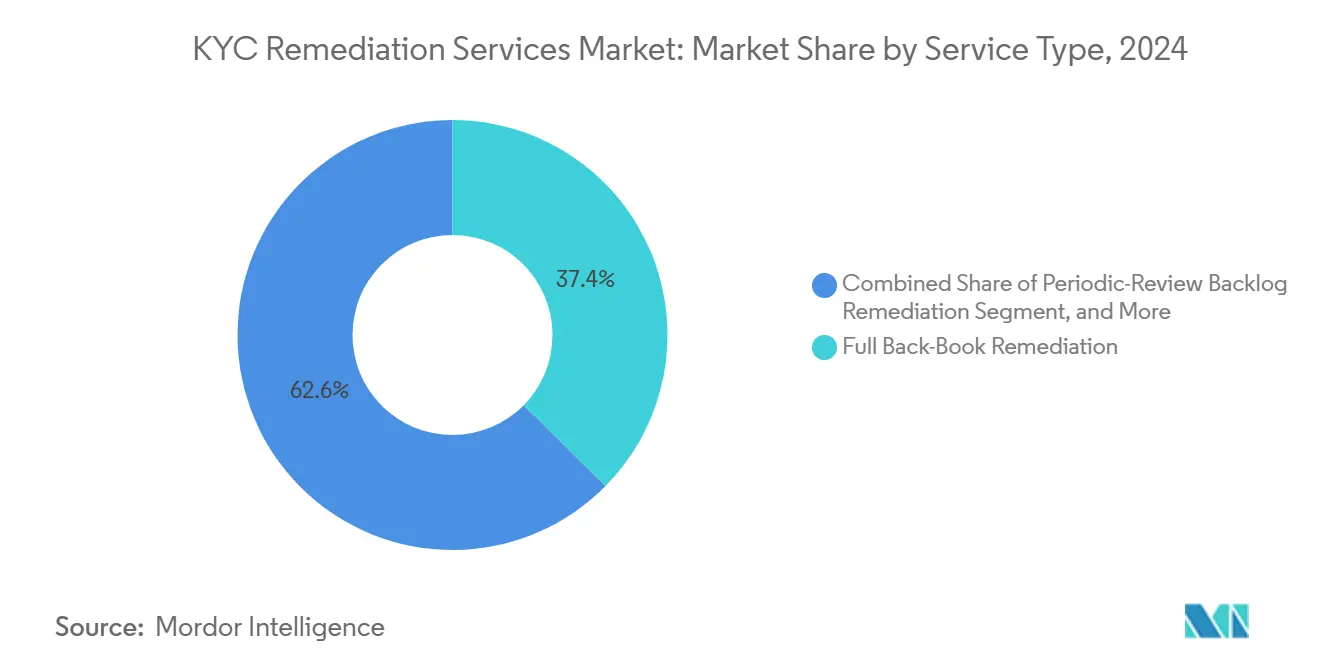
Full back-book remediation held 37.39% of the KYC remediation services market share in 2025. It reflected older files at tier-1 and mid-market institutions that did not meet current periodic-review expectations. The Financial Conduct Authority’s April 2026 review found weaknesses in customer-review cycles and relationship-purpose documentation. These findings support structured back-book programs. Periodic-Review Backlog Remediation addresses files outside the normal review schedule.
Individual and event-driven file remediation addresses defined customer events and higher-risk cases. Other Service Types include advisory scoping, quality-assurance sampling, and analyst training. Targeted and Risk-Based Portfolio Remediation is projected to grow at a CAGR of 15.21% from 2026 to 2031. Encompass Corporation launched EC Review in February 2026 for low-risk corporate records through registry checks. Risk-prioritized work can shorten projects, support renewals, and run alongside back-book programs.[4]

By Delivery Model: Offshore Capacity Leads, Onshore Delivery Signals a Structural Shift
Offshore delivery accounted for 51.78% of revenue in 2025. High-volume back-book programs support this model in India, the Philippines, and Malaysia. Genpact, Infosys, TCS, and Wipro operate KYC-related teams across these locations. Offshore teams provide staffing scale for large customer-file populations. The model remains relevant where policies permit sensitive work outside a client’s home country.
It can also support follow-the-sun execution for global institutions. Nearshore Delivery offers closer time-zone alignment at a lower cost than domestic delivery, while Blended Delivery allocates cases based on risk and supervisory sensitivity. Onshore Delivery is projected to expand at a CAGR of 14.23% from 2026 to 2031. EU data-transfer restrictions and Australia’s Tranche 2 expansion can limit offshore placements. Wipro launched a hub at Gujarat International Finance Tec-City in March 2026 to serve institutions with Indian data residency preferences.[5]
By Customer Type: Corporate Entities Drive Volume, Complex Structures Lead the Growth Curve
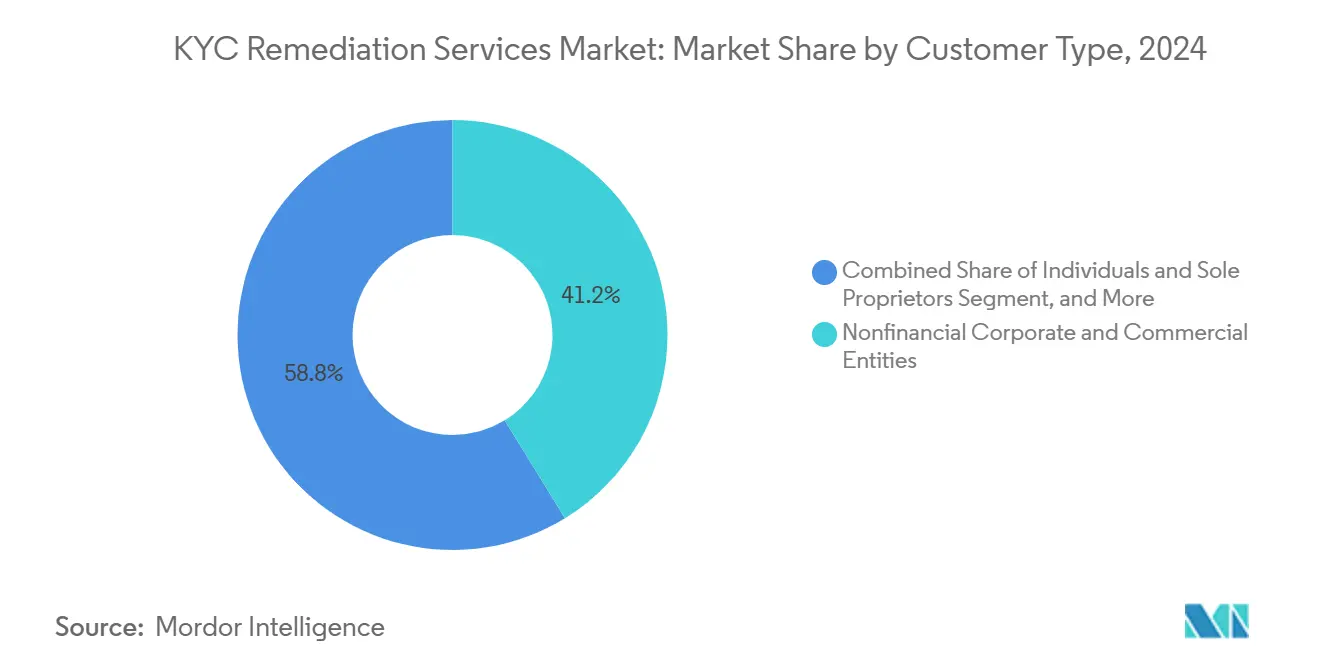
Nonfinancial corporate and commercial entities held 41.23% of the KYC remediation services market revenue in 2025. Banks must verify entities across varied ownership structures. Corporate files require beneficial-ownership mapping to the ultimate individual level. They also need director checks, source-of-funds evidence, and ownership-change monitoring. These requirements make corporate files more resource-intensive than many retail records.
Individuals and sole proprietors represented a smaller share because their files are simpler and more suitable for automation. Financial Institutions and Correspondent Relationships require enhanced due diligence and risk-rating updates across jurisdictions. Funds, Trusts, SPVs, and Other Complex Legal Structures are projected to grow at a CAGR of 15.67% from 2026 to 2031. Older files can lack records for ownership chains, trust deeds, and beneficiary schedules. Providers need entity-resolution tools and investigative analysts to manage these records at scale.
Geography Analysis
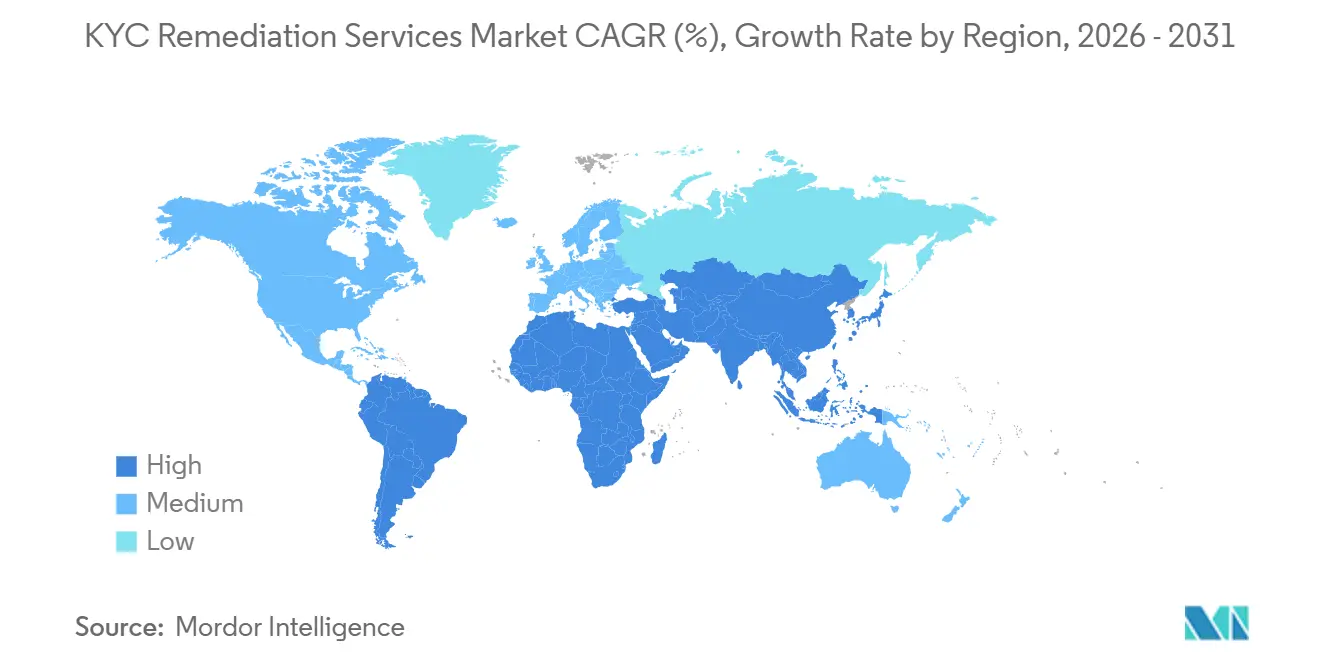
North America held 36.77% of the KYC remediation services market share in 2025. Large compliance programs at U.S. and Canadian tier-1 banks supported this position. The U.S. Department of Justice imposed a USD 3.1 billion AML penalty on TD Bank in October 2024. The action encouraged peer institutions to assess older files and strengthen back-book review plans. FinCEN’s 2026 AML/CFT rules extend customer-identification obligations to investment advisers. Genpact, Cognizant, Accenture, and TCS have established delivery relationships with major North American banks.[6]
Europe has a varied demand profile because national transitions are occurring alongside EU harmonization. Companies House identity verification for directors and beneficial owners became mandatory in November 2025, with a 12-month transition for existing registrations. BaFin is applying greater scrutiny to KYC refresh cycles under the Geldwäschegesetz. AMLA’s draft customer due diligence standards are expected to support consistent documentation requirements by July 2027. France, Italy, and Spain are secondary demand centers for large universal banks with multinational portfolios.
Asia-Pacific is projected to grow at a CAGR of 16.38% from 2026 to 2031, the fastest regional rate in the KYC remediation services market. Australia’s Tranche 2 reforms and tighter Indian KYC rules for payment operators and digital lenders support regional growth. South America, the Middle East, and Africa provide further targeted opportunities after Brazil and Mexico expanded beneficial-ownership obligations in 2025. UAE and Saudi Arabian authorities also strengthened corporate due diligence expectations in line with Recommendation 24.
Competitive Landscape
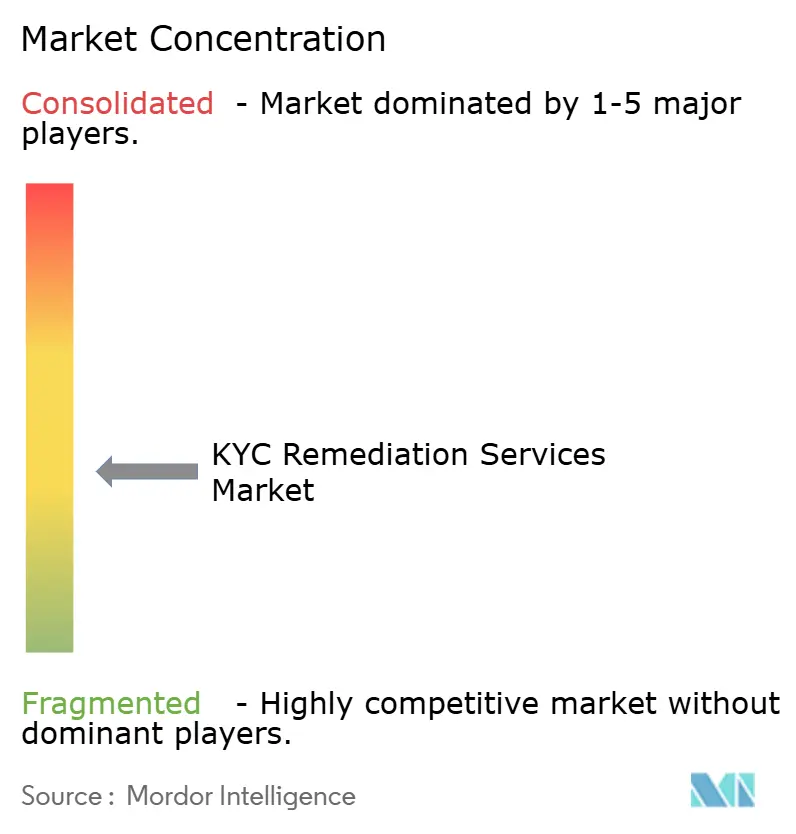
The KYC remediation services market is moderately fragmented, though large IT services and professional-services firms hold strong positions in scaled managed delivery. Their advantages include global staffing, established client relationships, and funding for AI-supported tools. Capgemini acquired Delta Capita B.V. and WNS in 2025, expanding regulatory advisory capacity and delivery scale. Genpact reported USD 250 million in financial crime compliance revenue in 2025. It launched the Banking Analyst Suite in July 2026, beginning with level-1 AML alert investigations within governance guardrails.
The Genpact suite is intended to extend into KYC, fraud, and customer due diligence workflows. It includes data isolation, explainability, and audit-trail capabilities. Larger providers are moving toward contracts linked to quality, throughput, and documented outcomes. Talent constraints make this model more valuable to clients who need measurable and governed capacity. The shift favors providers with both technology and specialist delivery teams.
Specialist firms compete through focused product capability. Encompass Corporation completed a BNP Paribas-led financing round in September 2025 and launched EC Review in February 2026 for back-book risk workflows using live registry data. smartKYC received the Most Innovative KYC Investigation and Due Diligence award in 2026 for its multilingual due diligence capability. Providers that improve throughput while keeping clear supervisory audit trails can support longer relationships and premium pricing.
KYC Remediation Services Industry Leaders
-
Accenture plc
-
Capgemini SE
-
Cognizant Technology Solutions Corporation
-
Deloitte Touche Tohmatsu Limited
-
Ernst and Young Global Limited
- *Disclaimer: Major Players sorted in no particular order
Recent Industry Developments
- September 2026: Bendigo and Adelaide Bank (ASX: BEN) announced plans to cut more than 100 roles, with functions assessed for outsourcing to Infosys and Genpact. This move reflects accelerating demand from Australian financial institutions for managed KYC and back-office compliance delivery following the AML/CTF Tranche 2 expansion effective July 1, 2026.
- July 2026: Genpact launched the Banking Analyst Suite, with its first module, the Transaction Monitoring Analyst, using agentic AI to automate level-1 AML alert investigations within Bank Secrecy Act governance guardrails. The suite is designed to extend across KYC, fraud, and customer due diligence workflows, with built-in data isolation, explainability, and audit-trail capabilities.
- July 2026: Accenture Federal Services was awarded a USD 18.48 million contract by the U.S. Department of the Treasury for Enterprise Case Selection and Enterprise Anomaly Detection Foundation Services modernization, with a potential value of USD 75.11 million if all options are exercised. The contract supports AML-adjacent financial crime detection infrastructure for a major government regulatory client.
- March 2026: Wipro launched a hub in Gujarat International Finance Tec-City (GIFT City), India, anchored in AI-powered financial services transformation spanning regulatory technology, risk, compliance, and digital banking services. The hub positions Wipro as an onshore-adjacent compliance delivery partner for global financial institutions subject to Indian data-residency preferences.
Global KYC Remediation Services Market Report Scope
The KYC remediation services market includes professional services and managed solutions that help financial institutions and other regulated entities update, reverify, and enhance customer due diligence (CDD) files to meet evolving regulatory requirements. It covers periodic reviews, enhanced due diligence (EDD) for high-risk customers, beneficial ownership reverification, and remediation of legacy onboarding gaps identified through regulatory examinations or internal audits. Providers, including the Big Four firms, specialized compliance consultancies such as Cognitive Compliance and Lysis Group, and BPO vendors, manage remediation programs through triage, risk tiering, customer outreach, document collection, file completion, and management information (MI) tracking. They leverage offshore and nearshore delivery centers for cost efficiency while maintaining onshore oversight for regulatory interactions and quality assurance, supporting compliance with anti-money laundering/combating the financing of terrorism (AML/CFT) regulations, Financial Action Task Force (FATF) recommendations, and jurisdiction-specific KYC mandates.
The KYC Remediation Services Market Report is Segmented by Service Type (Full Back-Book Remediation, Periodic-Review Backlog Remediation, Targeted and Risk-Based Portfolio Remediation, Individual and Event-Driven File Remediation, and Other Service Types), Delivery Model (Onshore Delivery, Nearshore Delivery, Offshore Delivery, and Blended Delivery), Customer Type (Individuals and Sole Proprietors, Nonfinancial Corporate and Commercial Entities, Financial Institutions and Correspondent Relationships, and Funds, Trusts, SPVs, and Other Complex Legal Structures), and Geography (North America, South America, Europe, Asia-Pacific, and Middle East and Africa). The Market Forecasts are Provided in Terms of Value (USD).
| Full Back-Book Remediation |
| Periodic-Review Backlog Remediation |
| Targeted and Risk-Based Portfolio Remediation |
| Individual and Event-Driven File Remediation |
| Other Service Types |
| Onshore Delivery |
| Nearshore Delivery |
| Offshore Delivery |
| Blended Delivery |
| Individuals and Sole Proprietors |
| Nonfinancial Corporate and Commercial Entities |
| Financial Institutions and Correspondent Relationships |
| Funds, Trusts, SPVs, and Other Complex Legal Structures |
| North America | United States | |
| Canada | ||
| South America | Brazil | |
| Argentina | ||
| Mexico | ||
| Rest of South America | ||
| Europe | Germany | |
| United Kingdom | ||
| France | ||
| Italy | ||
| Spain | ||
| Russia | ||
| Rest of Europe | ||
| Asia-Pacific | China | |
| Japan | ||
| India | ||
| South Korea | ||
| Australia | ||
| Rest of Asia-Pacific | ||
| Middle East and Africa | Middle East | Saudi Arabia |
| United Arab Emirates | ||
| Rest of Middle East | ||
| Africa | South Africa | |
| Egypt | ||
| Rest of Africa | ||
| By Service Type | Full Back-Book Remediation | ||
| Periodic-Review Backlog Remediation | |||
| Targeted and Risk-Based Portfolio Remediation | |||
| Individual and Event-Driven File Remediation | |||
| Other Service Types | |||
| By Delivery Model | Onshore Delivery | ||
| Nearshore Delivery | |||
| Offshore Delivery | |||
| Blended Delivery | |||
| By Customer Type | Individuals and Sole Proprietors | ||
| Nonfinancial Corporate and Commercial Entities | |||
| Financial Institutions and Correspondent Relationships | |||
| Funds, Trusts, SPVs, and Other Complex Legal Structures | |||
| By Geography | North America | United States | |
| Canada | |||
| South America | Brazil | ||
| Argentina | |||
| Mexico | |||
| Rest of South America | |||
| Europe | Germany | ||
| United Kingdom | |||
| France | |||
| Italy | |||
| Spain | |||
| Russia | |||
| Rest of Europe | |||
| Asia-Pacific | China | ||
| Japan | |||
| India | |||
| South Korea | |||
| Australia | |||
| Rest of Asia-Pacific | |||
| Middle East and Africa | Middle East | Saudi Arabia | |
| United Arab Emirates | |||
| Rest of Middle East | |||
| Africa | South Africa | ||
| Egypt | |||
| Rest of Africa | |||
Key Questions Answered in the Report
What is the KYC remediation services market size?
The KYC remediation services market size is expected to increase from USD 3.17 billion in 2025 to USD 3.49 billion in 2026 and reach USD 6.32 billion by 2031, growing at a CAGR of 12.61% over 2026-2031.
What is driving demand for KYC remediation services?
Stronger AML supervision, legacy customer-file backlogs, and requirements for current beneficial-ownership evidence are increasing demand. The KYC remediation services market also depends on reliable data access, trained analysts, and workflows that give institutions clear audit evidence.
Which KYC remediation service is growing fastest?
Targeted and Risk-Based Portfolio Remediation is projected to grow at a CAGR of 15.21% through 2031.
Which delivery model leads KYC remediation work?
Offshore Delivery held 51.78% of revenue in 2025, while Onshore Delivery is projected to grow fastest at a CAGR of 14.23%.
Which customer type has the highest projected growth?
Funds, Trusts, SPVs, and Other Complex Legal Structures is projected to expand at a CAGR of 15.67% through 2031.
Which region is growing fastest for these services?
Asia-Pacific is projected to record the highest regional CAGR of 16.38% through 2031.