
Kubernetes Identity Security Market Size and Share
Market Overview
| Study Period | 2020 - 2031 |
|---|---|
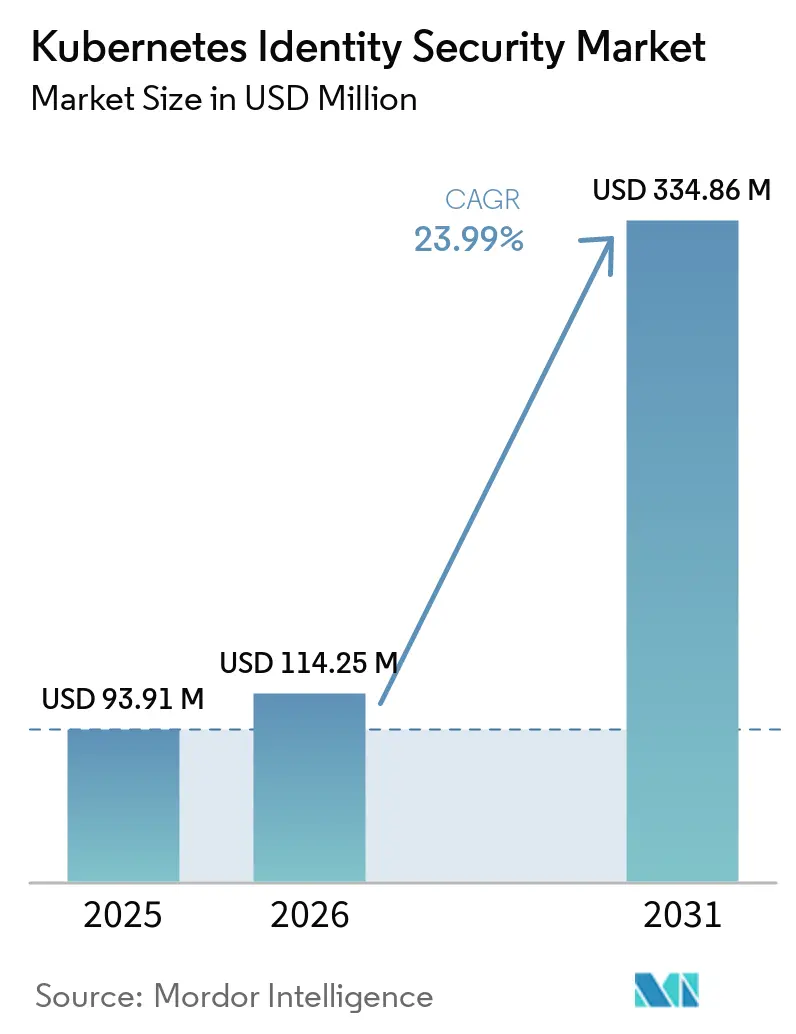
| Market Size (2026) | USD 114.25 Million |
| Market Size (2031) | USD 334.86 Million |
| Growth Rate (2026 - 2031) | 23.99 % |
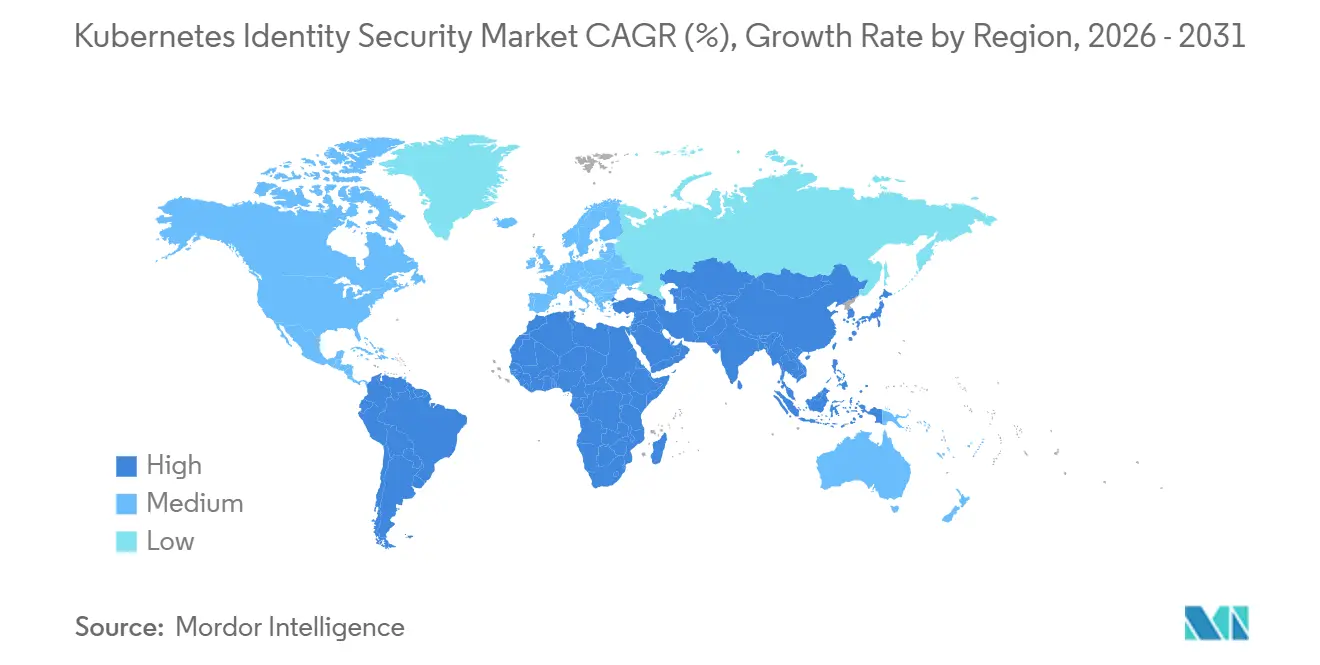
| Fastest Growing Market | Asia-Pacific |
| Largest Market | North America |
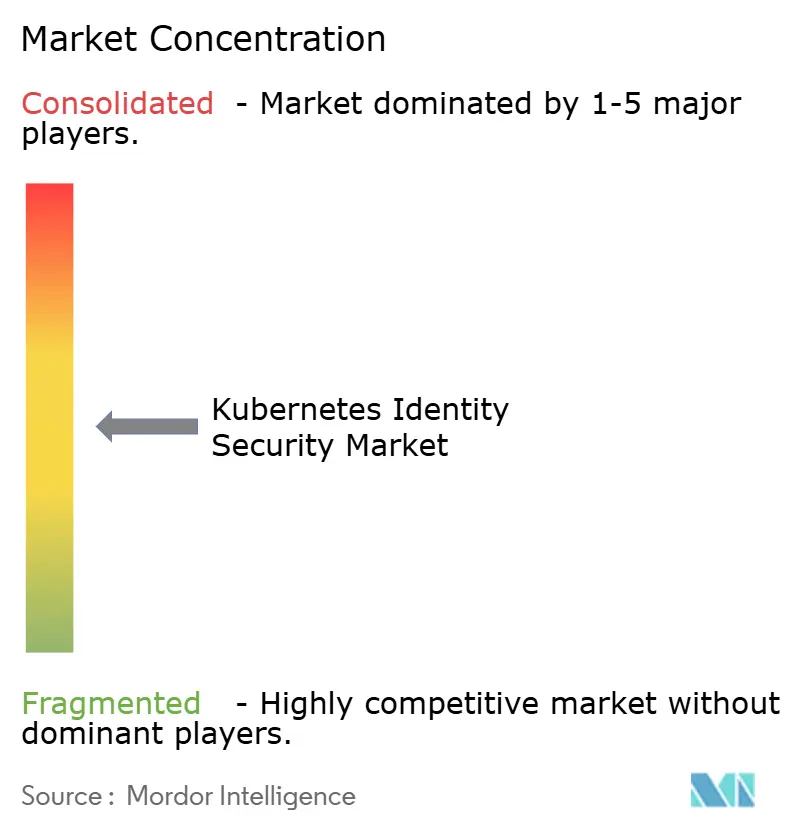
| Market Concentration | Medium |
Major Players *Disclaimer: Major Players sorted in no particular order Image © Mordor Intelligence. Reuse requires attribution under CC BY 4.0. | |
Kubernetes Identity Security Market Analysis by Mordor Intelligence
The Kubernetes identity security market size is expected to increase from USD 93.91 million in 2025 to USD 114.25 million in 2026 and reach USD 334.86 million by 2031, growing at a CAGR of 23.99% over 2026-2031. The Kubernetes identity security market is expanding as Kubernetes becomes a standard production platform and organizations move access controls closer to workloads. Production adoption creates more service accounts, certificates, policies, and machine identities that require lifecycle management. Security teams are also adapting their controls for AI agents, which need narrowly scoped access during each task. Zero-trust programs are driving demand for procurement in regulated and public-sector environments, while embedded identity features in managed Kubernetes services are putting pressure on specialist vendors. The Kubernetes identity security market, therefore, offers opportunities for providers that combine workload identity, policy management, operational support, and controls that work across cloud and on-premises clusters.
Key Report Takeaways
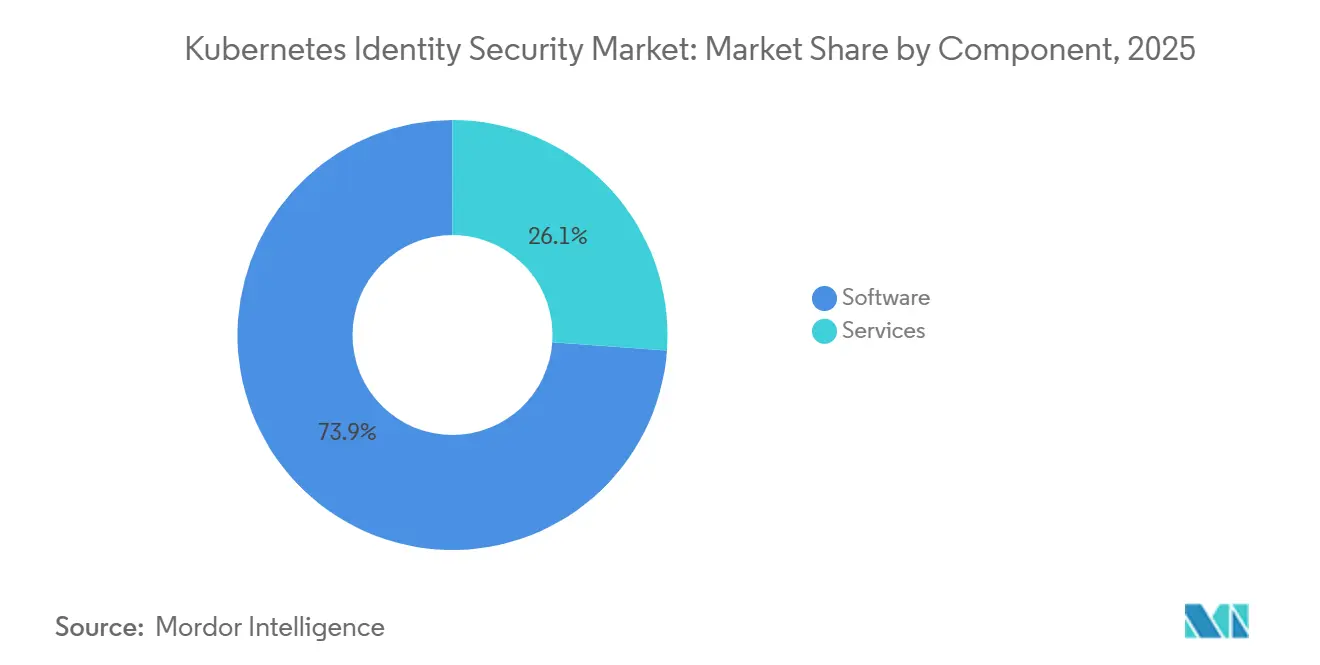
- By component, software held 73.86% of the Kubernetes identity security market revenue in 2025, while services are forecast to grow at a CAGR of 27.92% through 2031.
- By deployment mode, cloud-based solutions accounted for 58.49% of revenue in 2025 and are projected to expand at a CAGR of 26.78% through 2031.
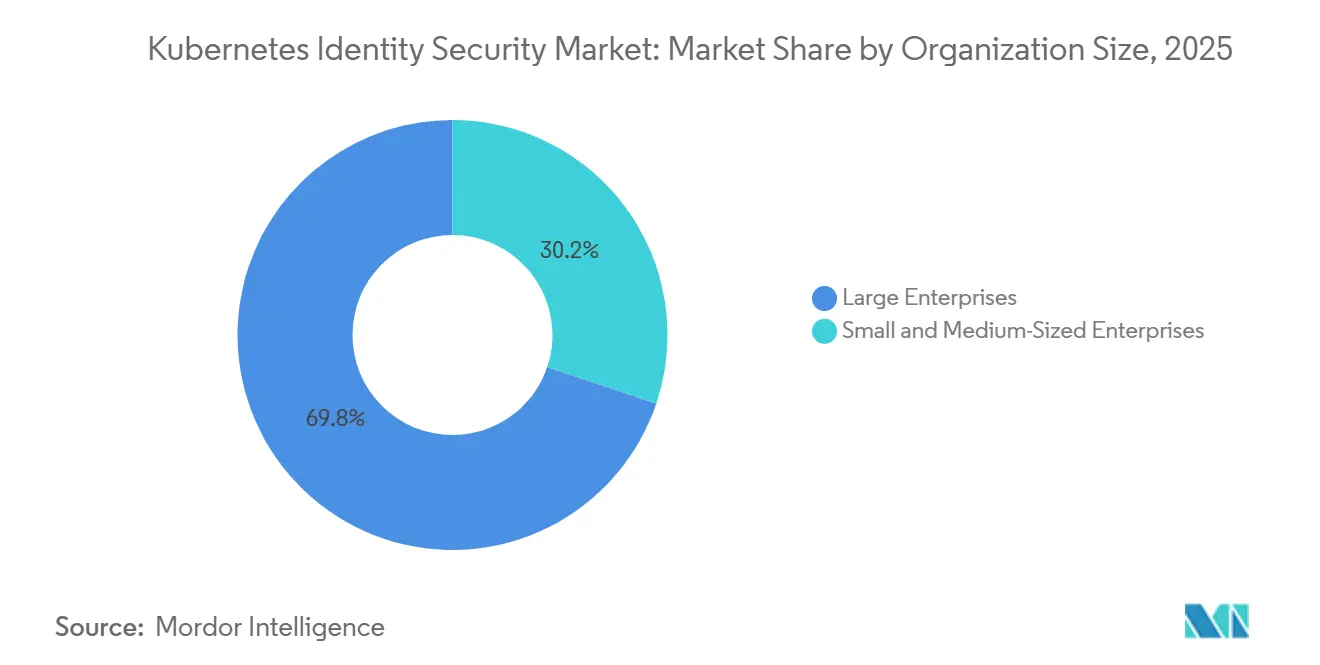
- By organization size, large enterprises held 69.83% of revenue in the Kubernetes identity security market in 2025, while small and medium-sized enterprises are forecast to grow at a CAGR of 27.36% through 2031.
- By end user, IT and telecommunications accounted for 27.31% of revenue in 2025, while the government and public administration industry is projected to expand at a CAGR of 26.62% through 2031.
- By geography, North America held 37.28% of revenue in the Kubernetes identity security market in 2025, while Asia-Pacific is forecast to grow at a CAGR of 26.79% through 2031.
Note: Market size and forecast figures in this report are generated using Mordor Intelligence’s proprietary estimation framework, updated with the latest available data and insights as of January 2026.
Global Kubernetes Identity Security Market Trends and Insights
Drivers Impact Analysis*
| DRIVER | (~) % IMPACT ON CAGR FORECAST | GEOGRAPHIC RELEVANCE | IMPACT TIMELINE |
|---|---|---|---|
| Expansion of Kubernetes and Cloud-Native Workloads | +5.0% | Global, strongest in North America and Asia-Pacific | Short term (≤ 2 years) |
| Growing AI Workloads and AI-Agent Identity Requirements | +4.5% | Global, with early gains in North America and Europe | Short term (≤ 2 years) |
| Adoption of Zero-Trust and Least-Privilege Security | +4.2% | North America and Europe, expanding to core Asia-Pacific markets | Medium term (2-4 years) |
| Growth in Workload and Machine Identities | +3.8% | Global | Medium term (2-4 years) |
| Expansion of Multi-Cloud and Hybrid Kubernetes Environments | +3.2% | Global, strongest in North America, core Asia-Pacific markets, and Europe | Medium term (2-4 years) |
| Increasing Adoption of Short-Lived and Federated Credentials | +2.5% | North America and Europe, extending to Middle East and Africa and South America | Long term (≥ 4 years) |
| Source: Mordor Intelligence | |||
Expansion of Kubernetes and Cloud-Native Workloads
The Kubernetes identity security market benefits from the broader shift of production systems to Kubernetes. The Cloud Native Computing Foundation reported that 82% of container users ran Kubernetes in production in 2025, up from 66% in 2023. The same survey found that 98% of respondents had adopted cloud-native technologies, which reinforces Kubernetes as a central operating layer for modern applications. Each new cluster increases the number of service accounts, roles, and workload connections that must be governed. The Kubernetes identity security market addresses this operational need through policy engines, secrets platforms, and identity brokers integrated into deployment workflows. As more development and deployment work is cloud-native, the relevant security boundary shifts from the network edge to the workload and its runtime identity.
Growing AI Workloads and AI-Agent Identity Requirements
AI workloads are increasing the need for controls that govern nonhuman access within container environments. The Cloud Native Computing Foundation found that, in 2025, 66% of organizations that host generative AI models use Kubernetes for inference workloads. This usage adds AI agents to the set of identities that can request access to infrastructure and interact with production resources. The Kubernetes identity security market is addressing this requirement with identity policies that limit permissions to a defined task and time period. Akeyless announced the general availability of Agentic Runtime Authority in September 2026, describing it as real-time permission enforcement for AI agents. Teleport also introduced delegated agentic identity in its Beams public beta during June 2026, allowing credentials to be scoped at execution rather than granted as broad standing access. These releases show why workload identity products are being extended to cover autonomous systems as well as people and services.
Adoption of Zero-Trust and Least-Privilege Security
Zero-trust requirements are making identity a more direct buying criterion for Kubernetes deployments. NIST Special Publication 800-207A presents a zero-trust architecture model for cloud-native applications operating across multiple locations.[1] The model places identity-based policy controls at the center of access decisions for applications that operate across clusters and clouds. The U.S. Department of Defense issued Directive-Type Memorandum 25-003 on July 17, 2025, establishing a Zero Trust Portfolio Management Office and a Chief Zero Trust Officer role. The Kubernetes identity security market gains from this direction because every pod and service account needs a verifiable identity before a least-privilege policy can be enforced reliably. OIDC federation, hardened role-based access controls, and mutual transport-layer security can support those requirements across regulated workloads.
Growth in Workload and Machine Identities
Workload identities are proliferating with containers, continuous integration pipelines, service meshes, and automated certificate management. This growth makes long-lived credentials harder to manage and raises the need for systems that can issue, rotate, and audit short-lived access tokens. The Kubernetes identity security market supports using federated credentials and cryptographically attested workload identities in place of stored secrets. The CA/Browser Forum adopted Ballot SC-081v3, effective March 15, 2026, reducing the maximum validity period for public TLS certificates from 398 days to 200 days.[2] The schedule will reduce the period to 100 days in March 2027 and 47 days in March 2029, increasing the need for automated certificate lifecycle practices. This change favors platforms that can manage certificate renewal and policy enforcement across large Kubernetes fleets.
Restraints Impact Analysis*
| RESTRAINT | (~) % IMPACT ON CAGR FORECAST | GEOGRAPHIC RELEVANCE | IMPACT TIMELINE |
|---|---|---|---|
| Complexity of Kubernetes RBAC and Identity Policy Management | -2.5% | Global | Short term (≤ 2 years) |
| Shortage of Kubernetes, Cloud, and Identity Security Skills | -2.0% | Global, most acute in South America, Middle East, and Africa | Short term (≤ 2 years) |
| Fragmentation Across Kubernetes, Cloud IAM, and Enterprise Identity Platforms | -1.5% | Global | Medium term (2-4 years) |
| Availability of Native Kubernetes and Cloud-Provider Identity Capabilities | -1.2% | North America and Europe, where managed Kubernetes penetration is highest | Short term (≤ 2 years) |
| Source: Mordor Intelligence | |||
Complexity of Kubernetes RBAC and Identity Policy Management
Kubernetes role-based access control gives teams detailed control, but it is difficult to manage as clusters and application teams multiply. Role bindings, ClusterRoles, and service account permissions can accumulate without consistent reviews. Kubernetes permissions also operate at the application platform layer, which makes it difficult to translate business access rules into concise technical policies. The Kubernetes identity security market must solve policy drift across multiple clusters without adding unnecessary burden to security teams. Providers can reduce this barrier through guided policy authoring, visibility into existing role assignments, and controls that identify overly broad permissions. Within the Kubernetes identity security market, unified policy management remains important where organizations use Kubernetes, cloud identity services, and enterprise identity platforms together.
Shortage of Kubernetes, Cloud, and Identity Security Skills
The shortage of people with Kubernetes, cloud identity, cryptography, and policy-as-code skills can slow implementation even when budgets are available. Organizations often need to connect identity platforms to deployment pipelines, clusters, and existing access systems. The Kubernetes identity security market presents a related opportunity in professional and managed services, as some customers cannot operate these controls independently. Services are projected to grow at a CAGR of 27.92% through 2031, reflecting demand for deployment, configuration, and ongoing policy operations. Netand launched HIWARE for K8S in March 2026 for Korean enterprises moving from on-premises security environments to Kubernetes-based access controls. This type of product can help organizations adopt Kubernetes-native access management with a lower internal skills requirement.
*Our forecasts treat driver/restraint impacts as directional, not additive. The impact forecasts reflect baseline growth, mix effects, and variable interactions.
Segment Analysis
By Component: Software Leads Revenue While Services Expands Faster
Software held 73.86% of revenue in 2025. The segment includes workload identity platforms, policy engines, secrets management software, and identity brokers embedded in continuous integration and continuous deployment pipelines. These tools form the initial operating layer for organizations that need to issue identities, enforce permissions, and observe access activity. Policy-as-code tools, OIDC brokers, and certificate authorities that align with the SPIFFE and SPIRE standards are part of this software layer. Software demand remains tied to the need for consistent control across clusters, developers, workloads, and cloud environments that may operate under separate operational teams.
Services are forecast to grow at a CAGR of 27.92% from 2026 to 2031, making it the fastest-growing component. Professional services cover deployment, OIDC federation design, SPIFFE and SPIRE implementation, and role-based access control rationalization. Managed services can take responsibility for certificate lifecycle management and policy enforcement where internal teams are limited. The Kubernetes identity security market size for services is growing because many buyers require ongoing operational support beyond the initial platform license. Small and medium-sized organizations can use managed delivery to access specialist skills without building a full internal Kubernetes security team or maintaining continuous coverage for changing policy requirements.
By Deployment Mode: Cloud-Based Solutions Lead Across Enterprise Environments
Cloud-based solutions held 58.49% of revenue in 2025. The segment benefits from managed Kubernetes services, including Amazon Elastic Kubernetes Service, Google Kubernetes Engine, and Azure Kubernetes Service. Cloud identity integration supports federation and short-lived credentials, which can reduce reliance on stored access keys. The Cloud Native Computing Foundation and SlashData reported that 34% of developers deployed to hybrid cloud by the first quarter of 2026, compared with 22% in 2021.[3] This shift supports demand for access controls that work across cloud and hybrid environments without requiring separate identity practices for every cluster.
Cloud-based solutions are also forecast to grow at a CAGR of 26.78% through 2031. Amazon Web Services introduced Amazon EKS IAM condition keys in April 2026, enabling organizations to apply controls for private API endpoints, encryption keys, and approved Kubernetes versions through service control policies.[4] Such native features can improve baseline governance while also increasing pressure on specialist vendors to offer broader cross-platform functions. On-premises deployment remains relevant for classified government workloads and environments with data residency requirements. Hybrid deployments continue to matter in financial services and healthcare, where organizations balance cloud scalability with requirements for local infrastructure, sensitive data controls, and established enterprise identity systems.
By Organization Size: Large Enterprises Hold the Largest Position While SMEs Gain Ground
Large enterprises accounted for 69.83% of revenue in 2025, representing the largest organization-size share in the Kubernetes identity security market. These organizations often operate multiple clusters across multiple cloud providers and have sizable access control surfaces. Their requirements include multi-cluster governance, policy drift detection, automated certificate management, and controls aligned with regulatory obligations. Large enterprises also have the scale to support dedicated Kubernetes security programs and formal access reviews. These conditions make centralized identity governance a core part of their production platform operations.
Small and medium-sized enterprises are forecast to grow at a CAGR of 27.36% through 2031. Managed Kubernetes services reduce infrastructure administration requirements, while cloud-native identity services lower the initial cost of workload governance. These organizations can establish OIDC federation and Kubernetes service account token practices while building new cloud-native application stacks. The Kubernetes identity security market benefits when vendors offer developer-focused pricing by cluster or workload rather than requiring broad enterprise licensing. The Cloud Native Computing Foundation and SlashData reported that Kubernetes use among Indian backend developers reached 42% by the first quarter of 2026. Growing developer adoption in such markets can broaden the customer base for accessible identity platforms.
By End User: IT and Telecommunication Leads While Government Adoption Accelerates
IT and telecommunication held 27.31% of revenue in 2025, making it the largest end-user group. This sector operates extensive internal developer platforms and production infrastructure that need Kubernetes-specific access governance. Its procurement priorities include secure developer access, workload identity, and consistent policies across distributed environments. The Kubernetes identity security market serves this demand with controls for clusters, continuous integration pipelines, and service-to-service communication. IT and telecommunication providers also face a direct need to maintain availability while limiting privileged access to production systems.
The government and public administration industry is forecast to grow at a CAGR of 26.62% through 2031. Zero-trust programs, cloud compliance requirements, and classified application environments support this expansion. The U.S. Department of Defense directive issued in 2025 gives federal agencies and defense contractors a formal policy basis for zero-trust governance. Banking, financial services, and insurance also require controls over privileged access to containerized production workloads. Healthcare and life sciences, retail and e-commerce, transportation and logistics, energy and utilities, manufacturing, media and entertainment, and education use Kubernetes for a range of operational applications. Smaller users in these groups can begin with open-source identity controls and later add commercial governance functions as their workloads grow.
Geography Analysis
North America held 37.28% of the Kubernetes identity security market share in 2025. The Kubernetes identity security market in the region benefits from a large base of cloud-native adopters, specialist vendors, systems integrators, and public-sector security requirements. The United States is the largest national market because federal requirements for cloud-native identity controls create consistent procurement demand. The Department of Defense zero-trust memorandum issued in 2025 supports this policy direction across defense-related cloud programs. Canada and Mexico add demand through technology services activity and cross-border alignment with U.S. enterprise requirements.
Europe represents the second-largest regional cluster, with the United Kingdom and Germany anchoring regional demand for identity governance across cloud, hybrid, and on-premises settings. Data residency requirements sustain hybrid controls where public cloud deployment is not suitable for every workload. Russia remains within the report coverage but follows a separate path shaped by domestic cloud infrastructure and limited participation in global vendor ecosystems. The Kubernetes identity security market in Europe continues to see demand for portable controls that do not depend on a single cloud environment.
Asia-Pacific is forecast to grow at a CAGR of 26.79% from 2026 to 2031, the fastest rate among regions. The Kubernetes identity security market size in the region is supported by developer growth and broader adoption of managed Kubernetes across financial services, manufacturing, and public workloads. The Cloud Native Computing Foundation and SlashData reported that India had 2.25 million cloud-native developers in the first quarter of 2026, representing 11% of the global total. Japan’s cloud-native community reached nearly 1 million developers by July 2026, with 71% using at least 1 cloud-native technology or practice. China remains distinct because domestic cloud providers offer Kubernetes services with proprietary identity integration. South America, the Middle East, and Africa are smaller markets, with Brazil, the United Arab Emirates, Saudi Arabia, South Africa, and Nigeria serving as important demand centers through fintech, telecommunications, government, and financial services activity.
Competitive Landscape
The Kubernetes identity security market is moderately concentrated at the platform level and remains fragmented among specialists. Amazon Web Services, Microsoft, Google, Palo Alto Networks, IBM, and Red Hat have broad enterprise relationships that support the adoption of Kubernetes access controls. Specialist vendors compete through workload identity, privileged access, certificate operations, and cross-cluster policy management. Palo Alto Networks completed its acquisition of CyberArk in February 2026 for approximately USD 25 billion.[5] The transaction places identity security alongside network security and security operations within its broader platform, signaling the growing importance of machine identity and privileged access for AI-era infrastructure.
Delinea completed its acquisition of StrongDM in March 2026, combining privileged access management with just-in-time authorization for Kubernetes clusters, pipelines, databases, and AI agent workflows. This move expands its ability to address runtime access rather than only standing administrative permissions. Okta signed a definitive agreement to acquire Axiom Security in August 2025 to accelerate its roadmap for just-in-time access governance for databases and Kubernetes. Palo Alto Networks and Okta announced an expanded partnership in July 2025 that integrated identity threat protection, Okta AI, and Cortex SecOps capabilities, signaling a move to combine access, risk context, and security operations.
Technology remains the central competitive lever in the Kubernetes identity security market. Red Hat made its zero-trust workload identity manager generally available on OpenShift using SPIFFE and SPIRE standards. The Cloud Native Computing Foundation announced Kyverno’s graduation in March 2026, confirming the role of the project in Kubernetes-native policy enforcement. Commercial differentiation is increasingly tied to unified governance of human, workload, and AI-agent identities, cross-cluster trust management, and access-aware incident response. Providers in the Kubernetes identity security market that build on native Kubernetes and cloud identity functions are better positioned as foundational capabilities become more widely available.
Kubernetes Identity Security Industry Leaders
-
Palo Alto Networks, Inc.
-
CyberArk Software Ltd.
-
Amazon Web Services, Inc.
-
Microsoft Corporation
-
Google LLC
- *Disclaimer: Major Players sorted in no particular order
Recent Industry Developments
- September 2026: Akeyless announced the general availability of Agentic Runtime Authority, an intent-based access control layer for AI agents that enforces real-time permissions on top of its SecretlessAI credential-protection platform. The solution governs over 220 billion machine identity interactions for Fortune 500 organizations and extends that governance to a new identity class, the AI agent.
- July 2026: Teleport expanded its Identity Security platform with Beams Session Summaries, Agentic Classifiers, and Risk Scoring. The capabilities summarize and classify SSH, Kubernetes, and database sessions by risk level and map actions to the MITRE ATT&CK framework.
- April 2026: Amazon Web Services introduced IAM condition keys for Amazon EKS. The controls enable organizations to require private API endpoints, customer-managed encryption keys, and approved Kubernetes versions through service control policies.
- March 2026: The Cloud Native Computing Foundation announced Kyverno’s graduation, recognizing the Kubernetes-native policy engine’s production use and community development.
- March 2026: Delinea completed its acquisition of StrongDM, combining enterprise privileged access management with just-in-time runtime authorization for Kubernetes clusters, pipelines, databases, and AI agent workflows.
Global Kubernetes Identity Security Market Report Scope
The kubernetes identity security market encompasses solutions that manage and protect workload identities, service accounts, and authentication/authorization mechanisms within Kubernetes environments. This market focuses on securing how applications and services authenticate to each other and to cloud resources through Kubernetes-native identity constructs like service accounts, RBAC policies, and workload identity federation. Solutions in this market prevent identity-based attacks by ensuring least-privilege access, securing service account tokens, implementing pod identity isolation, and integrating with cloud provider IAM systems to eliminate hardcoded secrets and prevent privilege escalation through compromised workloads.
The Kubernetes Identity Security Market Report is Segmented by Component (Software, and Services [Proffesional Services, and Managed Services]), Deployment Mode (Cloud-Based, On-Premises, and Hybrid), Organization Size (Large Enterprises, and Small and Medium-Sized Enterprises), End Use Industry (Government and Public Administration, Industrial Manufacturing, Retail and E-Commerce, Energy and Utilities, IT and Telecommunication, Healthcare and Life Sciences, Banking, Financial Services, and Insurance (BFSI), and Other End Use Industries), and Geography (North America, South America, Europe, Asia-Pacific, Middle East, and Africa). The Market Forecasts are Provided in Terms of Value (USD).
| Software | |
| Services | Proffesional Services |
| Managed Services |
| Cloud-Based |
| On-Premises |
| Hybrid |
| Large Enterprises |
| Small and Medium-Sized Enterprises |
| Government and Public Administration |
| Industrial Manufacturing |
| Retail and E-Commerce |
| Energy and Utilities |
| IT and Telecommunication |
| Healthcare and Life Sciences |
| Banking, Financial Services, and Insurance (BFSI) |
| Other End Use Industries |
| North America | United States |
| Canada | |
| South America | Brazil |
| Mexico | |
| Rest of South America | |
| Europe | United Kingdom |
| Germany | |
| France | |
| Rest of Europe | |
| Asia-Pacific | China |
| Japan | |
| India | |
| South Korea | |
| Rest of Asia-Pacific | |
| Middle East | Israel |
| United Arab Emirates | |
| Saudi Arabia | |
| Rest of Middle East | |
| Africa | South Africa |
| Nigeria | |
| Rest of Africa |
| By Component | Software | |
| Services | Proffesional Services | |
| Managed Services | ||
| By Deployment Mode | Cloud-Based | |
| On-Premises | ||
| Hybrid | ||
| By Organization Size | Large Enterprises | |
| Small and Medium-Sized Enterprises | ||
| By End Use Industry | Government and Public Administration | |
| Industrial Manufacturing | ||
| Retail and E-Commerce | ||
| Energy and Utilities | ||
| IT and Telecommunication | ||
| Healthcare and Life Sciences | ||
| Banking, Financial Services, and Insurance (BFSI) | ||
| Other End Use Industries | ||
| By Geography | North America | United States |
| Canada | ||
| South America | Brazil | |
| Mexico | ||
| Rest of South America | ||
| Europe | United Kingdom | |
| Germany | ||
| France | ||
| Rest of Europe | ||
| Asia-Pacific | China | |
| Japan | ||
| India | ||
| South Korea | ||
| Rest of Asia-Pacific | ||
| Middle East | Israel | |
| United Arab Emirates | ||
| Saudi Arabia | ||
| Rest of Middle East | ||
| Africa | South Africa | |
| Nigeria | ||
| Rest of Africa | ||
Key Questions Answered in the Report
What is the size of the Kubernetes identity security market?
The Kubernetes identity security market size is expected to increase from USD 93.91 million in 2025 to USD 114.25 million in 2026 and reach USD 334.86 million by 2031, growing at a CAGR of 23.99% over 2026-2031.
What is driving adoption of Kubernetes identity and access management?
Production Kubernetes use, zero-trust programs, larger machine identity estates, and AI workloads are increasing the need for workload-level access controls across production clusters and connected development pipelines.
Which component leads Kubernetes IAM spending?
Software held 73.86% of revenue in 2025, while services is forecast to grow faster at a CAGR of 27.92% through 2031.
Why are cloud-based Kubernetes IAM solutions growing?
Cloud-based solutions held 58.49% of revenue in 2025 and benefit from managed Kubernetes adoption, identity federation, and short-lived credentials.
Which region is growing fastest for Kubernetes IAM?
Asia-Pacific is projected to grow at a CAGR of 26.79% through 2031, supported by expanding cloud-native developer communities and managed Kubernetes deployment.
What is the main implementation challenge for Kubernetes IAM?
Role-based access control complexity and shortages of Kubernetes and identity security skills can slow deployment and increase the need for managed services.