
Knowledge-Based Authentication (KBA) Market Size and Share
Market Overview
| Study Period | 2021 - 2032 |
|---|---|
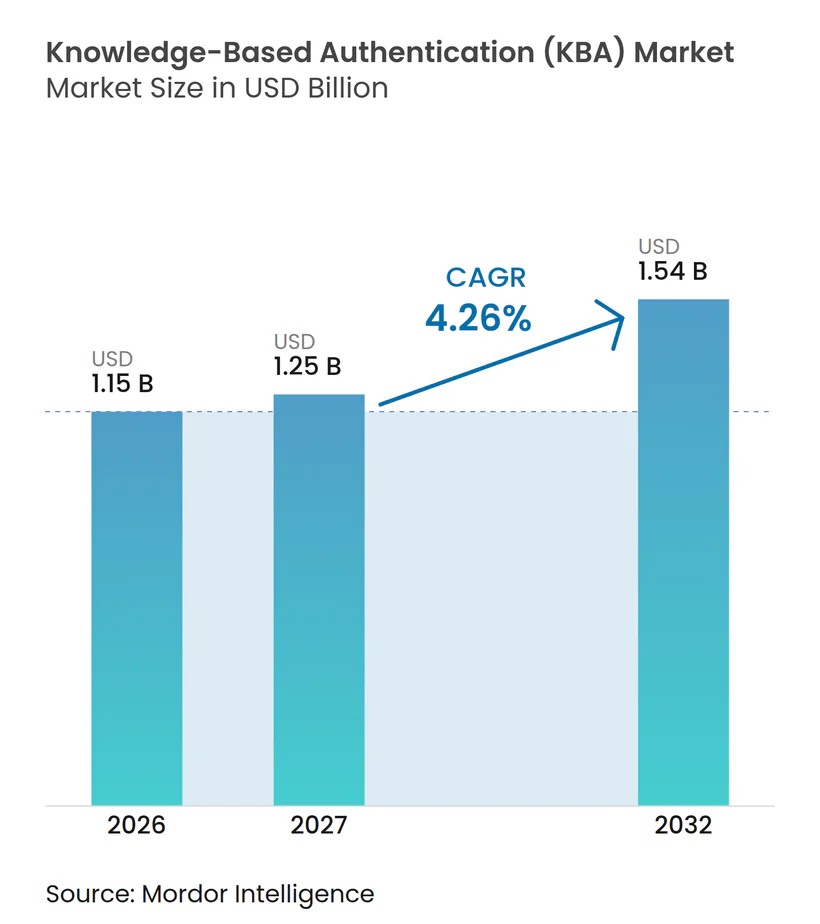
| Market Size (2027) | USD 1.25 Billion |
| Market Size (2032) | USD 1.54 Billion |
| Growth Rate (2027 - 2031) | 4.26 % |
| Fastest Growing Market | Asia-Pacific |
| Largest Market | North America |
| Market Concentration | Medium |
Major Players *Disclaimer: Major Players sorted in no particular order Image © Mordor Intelligence. Reuse requires attribution under CC BY 4.0. | |
Knowledge-Based Authentication (KBA) Market Analysis by Mordor Intelligence
The Knowledge-based authentication market size is projected to be USD 1.15 billion in 2026, USD 1.25 billion in 2027, and reach USD 1.54 billion by 2032, at a CAGR of 4.26% from 2027 to 2032. The Knowledge-based authentication market continues to benefit from the need to control account takeover and establish identity during remote interactions. Its role is changing from a standalone control to one verification signal within a wider identity decision. Dynamic questions, cloud delivery, and more varied data sources support that transition. At the same time, privacy requirements, breaches, and alternatives such as biometrics and passkeys limit the use of static questions. The Knowledge-based authentication market therefore has opportunities where organizations need an additional corroboration layer, particularly in regulated onboarding and voice-based service journeys.
Key Report Takeaways
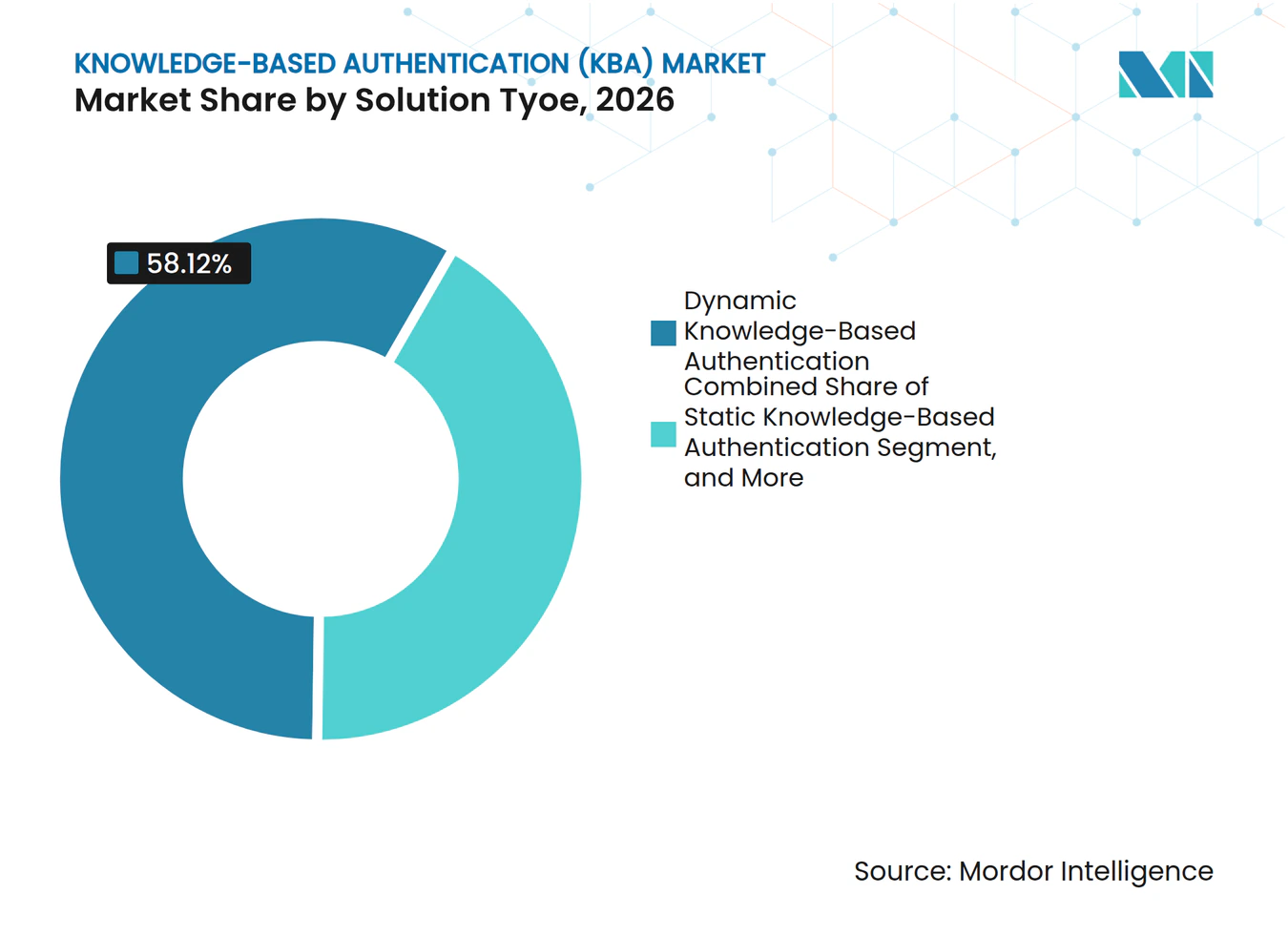
- By solution type, dynamic KBA held 58.12% of the Knowledge-based authentication market share in 2026, and the segment is expected to expand at a CAGR of 4.86 through 2031.
- By deployment, cloud-based delivery held 67.78% of revenue in 2026, and the segment is expected to expand at a CAGR of 4.83% through 2032.
- By data source, credit bureau data accounted for 33.18% of revenue in the knowledge authentication market in 2026, while multi-source data aggregation is projected to expand at a 5.41% CAGR through 2032.
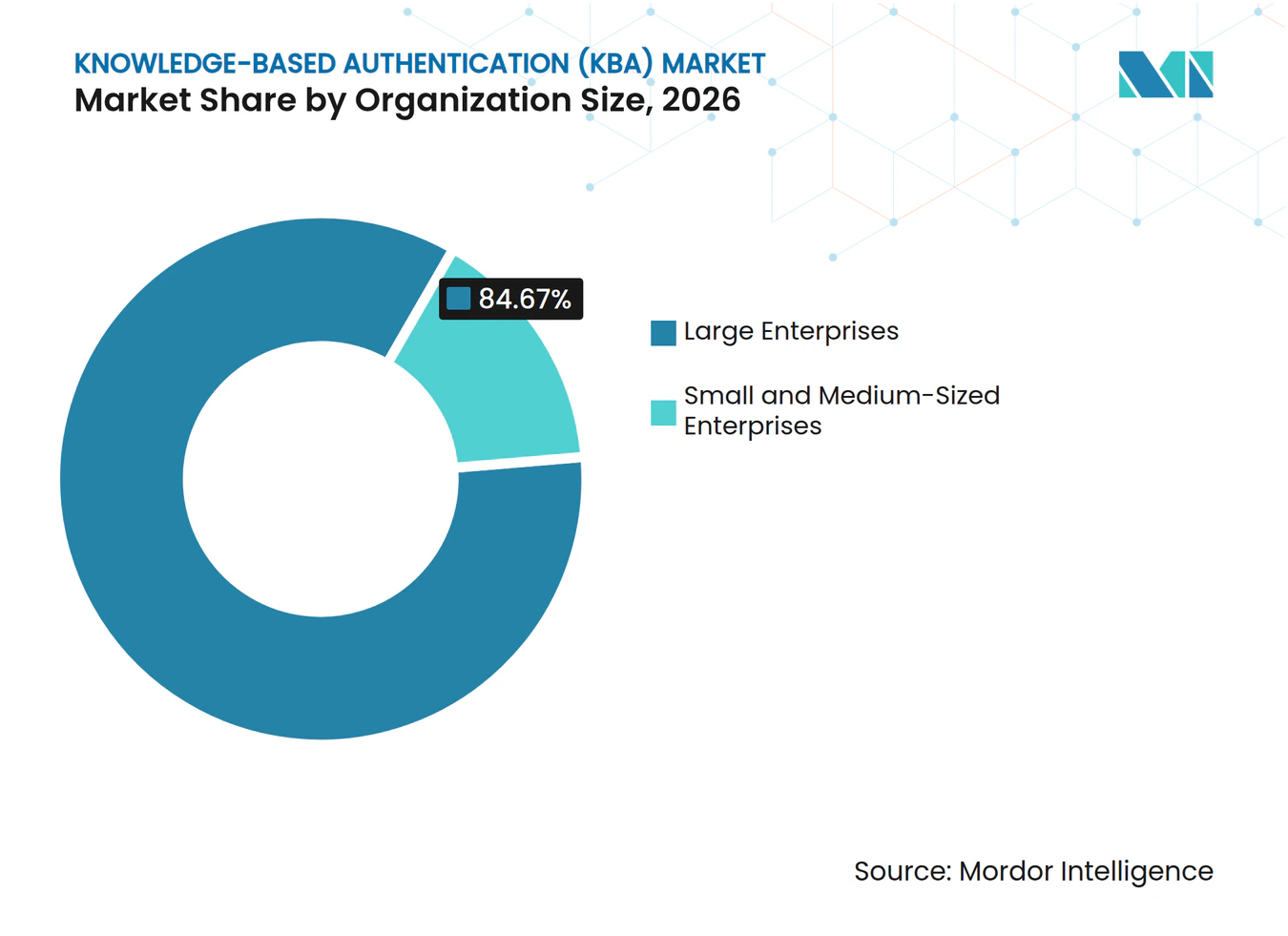
- By organization size, large enterprises accounted for 84.67% of revenue in 2026, while SMEs are projected to grow at a 4.67% CAGR through 2032.
- By end-user industry, BFSI accounted for 44.38% of revenue in 2026, while retail and e-commerce are projected to expand at a 5.49% CAGR through 2032 in the KBA market.
- By geography, North America held 43.06% of revenue in 2026, while Asia-Pacific is projected to expand at a 5.28% CAGR through 2032.
Note: Market size and forecast figures in this report are generated using Mordor Intelligence’s proprietary estimation framework, updated with the latest available data and insights as of January 2026.
Market Trends and Insights
Drivers Impact Analysis of Knowledge-Based Authentication (KBA) Market*
| Driver | (~) % Impact on CAGR Forecast | Geographic Relevance | Impact Timeline |
|---|---|---|---|
| Escalating Account Takeover and Identity Fraud | +1.2% | Global, concentrated in North America and Europe | Short term (≤ 2 years) |
| Regulatory Demand for Stronger Identity Verification | +0.9% | Global, with early gains in North America, the European Union, India, and China | Medium term (2-4 years) |
| Growth of Digital Account Opening and Remote Onboarding | +0.7% | Global, with Asia-Pacific as a core region and spillover to South America | Medium term (2-4 years) |
| Expansion of Non-Credit Data for Dynamic Questions | +0.5% | Asia-Pacific core, with spillover to the Middle East and Africa | Long term (≥ 4 years) |
| Need for Low-Friction Authentication in High-Volume Journeys | +0.4% | North America and the European Union | Short term (≤ 2 years) |
| Reuse of Identity Data Across Authentication Workflows | +0.3% | North America and Europe | Long term (≥ 4 years) |
| Source: Mordor Intelligence | |||
Escalating Account Takeover and Identity Fraud Reinforces Dynamic KBA
Account takeover fraud accounted for 3.14% of suspected digital fraud globally in 2025, up 37%, while associated transaction volume increased by 13%. This threat keeps the Knowledge-based authentication market relevant for account opening, recovery, and customer service checks. Dynamic KBA can draw on information that is not easily reproduced from a leaked password or identifier. In the United States, high-risk financial services calls originating from mobile devices increased by 41% from 2024 to 2025, underscoring the need for additional checks in voice channels. Buyers are consequently placing greater weight on question freshness and the ability to change challenges when fraud conditions change. Static question sets face greater pressure because breaches and social engineering can expose the personal details that support them.
Regulatory Demand for Stronger Identity Verification Creates Bifurcated Conditions
Regulation is strengthening verification requirements while narrowing the situations where KBA can operate alone. NIST SP 800-63-4 treats knowledge-based verification as a supplementary identity-proofing method rather than a standalone authenticator in federal digital identity programs.[1] That position supports dynamic KBA, where it corroborates another identity signal in regulated onboarding. India’s KYC Amendment Directions took effect on January 1, 2026, tightening customer due diligence obligations for regulated entities. China’s National Network Identity Authentication Public Service Management Measures took effect on July 15, 2025, establishing a national platform for encrypted identity credentials.[2] In Europe, the Digital Identity Regulation requires member states to provide digital identity wallets by the end of 2026, placing wallet-based credentials at the center of many higher-assurance flows.
Digital Account Opening and Remote Onboarding Increase Deployment Volume
Suspected fraud at new-account creation reached 8.3% in 2025, compared with 4.3% at login, making the first interaction a high-risk point in the customer journey. This pattern supports using KBA as one check when an organization establishes a remote customer relationship. Cloud delivery allows providers to refresh data connections and question sets without relying on an on-premise release cycle. Mitek integrated MiVIP with Ping Identity’s PingOne DaVinci in March 2026, making verified-identity capabilities available through a no-code connector. This approach allows organizations to introduce a corroboration step at selected points in an identity workflow. Financial institutions also remain subject to customer due diligence obligations, sustaining demand for automated verification during account opening. The Knowledge-based authentication market benefits when these requirements are met through a modular service rather than a separate, fixed application.
Non-Credit Data Expands the Dynamic Question Pool
Credit bureau information led the data-source category in 2026, but dependence on a single record type limits coverage of thin-file and underbanked consumers. Telecommunications records, utility data, government registries, and first-party data can supply more diverse corroboration inputs. Monthly billing cycles can make telecommunications and utility information more current than credit files in some cases. Equifax introduced Identity Proofing in Kount 360 in September 2025, combining email, device, biometric, and synthetic-identity signals with its fraud capabilities. Japan’s OpenID Foundation published revised private-sector digital identity verification guidance in August 2026, identifying government registry data as a source of corroboration. The Knowledge-based authentication market can therefore serve broader populations when vendors pair bureau records with authoritative, relationship-based data.
Restraints Impact Analysis of Knowledge-Based Authentication (KBA) Market*
| Restraint | (~) % Impact on CAGR Forecast | Geographic Relevance | Impact Timeline |
|---|---|---|---|
| Exposure of Static Answers Through Breaches and Social Engineering | -1.5% | Global, with the highest exposure in North America and Europe | Short term (≤ 2 years) |
| Declining User Trust in Security Questions | -1.0% | North America and the European Union | Medium term (2-4 years) |
| Privacy and Consent Constraints on Personal Data Reuse | -0.7% | European Union, Asia-Pacific, and Canada | Medium term (2-4 years) |
| Substitution by Biometrics, Passwordless Authentication, and Behavioral Analytics | -0.6% | Global, with early displacement in North America and the European Union | Long term (≥ 4 years) |
| Source: Mordor Intelligence | |||
Exposure of Static Answers Through Breaches and Social Engineering Undermines Legacy KBA
A static KBA is vulnerable when the information used in the answers has already been exposed or can be collected through social engineering. NIST’s current federal guidance does not permit knowledge questions as a standalone authenticator, reinforcing the compliance limits of legacy implementations. Fraudsters can also attempt to persuade contact-center agents to bypass challenge flows. The reported 41% increase in high-risk mobile-origin calls to U.S. financial institutions shows why voice-channel controls need more than a fixed question list. This restraint does not remove demand for corroboration, but it redirects buyers toward real-time risk assessment and dynamic questions. It also creates reputational pressure on the Knowledge-based authentication market, as buyers may associate the category with compromised static practices.
Declining User Trust in Security Questions Raises Conversion Costs
Customers often view security questions as difficult, repetitive, or unsafe when the information appears broadly available. In a 2025 survey across 18 countries, 62% of respondents described ease of authentication as very important when choosing a digital provider. Friction can lead to abandonment at a point where an organization is trying to enroll or retain a customer. Trulioo reported in October 2025 that its identity capabilities reduced manual reviews by 12% at a financial services customer. Retail and e-commerce face this issue particularly acutely because consumers expect the rapid completion of routine transactions. The Knowledge-based authentication market is responding through silent corroboration and step-up models that show a challenge only when other signals indicate elevated risk.
*Our forecasts treat driver/restraint impacts as directional, not additive. The impact forecasts reflect baseline growth, mix effects, and variable interactions.
Knowledge-Based Authentication (KBA) Market Segment Analysis
By Solution Type:
Dynamic Formats Lead the Transition From Static QuestionsDynamic KBA accounted for 58.12% of 2026 revenue, reflecting a shift away from fixed prompts that attackers can anticipate or obtain from breached records. This share gives dynamic formats the leading position in the Knowledge-based authentication market. They can approve, deny, or escalate an interaction based on current risk, rather than applying the same challenge to every user. NIST guidance supports that move by limiting the role of standalone knowledge questions in federal authentication. Static KBA remains in lower-risk password resets and older enterprise workflows. Hybrid KBA provides an interim option for organizations that have not yet completed an identity platform migration.
Dynamic KBA is especially relevant in BFSI, where out-of-wallet questions can supplement liveness checks and other identity evidence. Experian acquired AtData in February 2026, adding a large real-time email data network to its identity and fraud capabilities. That move reflects a broader search for data to corroborate questions beyond traditional credit files. Large buyers increasingly use KBA as a signal in an identity workflow rather than purchasing a standalone product. API-first suppliers can compete where buyers want this modular integration. The Knowledge-based authentication industry consequently depends more on data quality, risk scoring, and workflow compatibility than on a fixed library of questions.



By Deployment:
Cloud Delivery Makes KBA a Composable ServiceCloud-based deployment accounted for 67.78% of revenue in 2026, making it the largest delivery model. This position reflects the operational value of continuous fraud model updates, API delivery, and integration with identity orchestration platforms. The KBA market size for cloud delivery is supported by organizations that want to place a corroboration signal at a specific point in the decision path. On-premise systems remain relevant for institutions with strict data residency rules and government organizations that cannot send identity data to third-party cloud services. Hybrid deployment provides a middle path for European financial institutions, balancing data minimization with the need for timely orchestration. These options keep deployment choice linked to both risk and regulatory requirements.
Mitek’s March 2026 PingOne DaVinci integration illustrates how verified identity services can be inserted through a no-code connector. Buyers are paying more attention to response speed, question freshness, and native workflow integration. That shifts differentiation away from proprietary question databases alone. Pay-per-verification pricing also lowers the barrier to entry for smaller organizations. SMEs are projected to expand at a 4.67% CAGR through 2032 as these services become easier to procure. The Knowledge-based authentication market is therefore becoming more accessible to buyers who do not have enterprise credit data agreements or specialized integration teams.
By Data Source:
Multi-Source Aggregation Broadens CoverageCredit bureau data held 33.18% of revenue in 2026, retaining the leading data-source position because it supports out-of-wallet questions in regulated deployments. Its dominance also exposes providers to thin-file exclusion and breach-related risks. Multi-source aggregation is projected to expand at a 5.41% CAGR through 2032 as vendors combine telecommunications, utility, government, and first-party records. Credit bureau data’s leading share illustrates the enduring value of established consumer files. At the same time, newer combinations can provide more current or more inclusive corroboration. Telecommunications and utility records can change monthly as billing relationships update.
China’s 2025 measures created a national identity platform with encrypted credentials, supporting a more formal digital identity infrastructure. First-party customer data may offer institutions a clearer legal basis than data purchased from third parties when used for authentication. The European Union’s Implementing Regulation 2025/1566 sets out reference standards for identity attribute verification under eIDAS. Those standards give authoritative sources greater weight in high-assurance proofing. Suppliers are thus extending data relationships rather than relying only on credit coverage. The Knowledge-based authentication market can support more use cases when its questions can be drawn from multiple sources.
By Organization Size:
Cloud Pricing Widens Access While Enterprises Consolidate SpendingLarge enterprises accounted for 84.67% of 2026 revenue because they can obtain extensive data agreements and fund complex compliance integrations. Their scale also helps them absorb the cost of full identity-orchestration platforms. SMEs are projected to expand at a 4.67% CAGR through 2032 as cloud APIs and pay-per-verification pricing reduce procurement barriers. Socure launched Hosted Flows in October 2025, allowing customers to create branded verification journeys without engineering resources. This supports smaller financial institutions and midmarket buyers that need a more direct route to deployment. Customer due diligence requirements also apply across covered institutions, not only the largest firms.
Enterprise customers are also reducing the number of separate identity tools they manage. Equifax’s Kount 360 launch combined multiple identity and fraud signals into a single offering. This bundling can limit the opportunity for a provider offering KBA alone. It also shifts some standalone demand toward SMEs and midmarket organizations that want a specific service at a lower commitment. Operational cost remains important because false positives create manual review work in step-up flows. The Knowledge-based authentication industry must therefore demonstrate both fraud value and a manageable operational workload.

By End-User Industry:
BFSI Anchors Demand as Retail and E-Commerce ExpandsBFSI accounted for 44.38% of 2026 revenue, making it the largest end-user group. KYC, AML, and customer due diligence obligations create verification needs across account opening, transactions, recovery, and customer support. Retail and e-commerce are projected to expand at a 5.49% CAGR through 2032 as merchants add checks for high-value orders, account changes, and return fraud. Healthcare uses KBA as a corroboration layer in telehealth onboarding and prescription-management workflows. Government agencies may use it in lower-assurance benefit enrollment and registration processes. These use cases show that the Knowledge-based authentication market extends beyond traditional financial services checks.
Telecommunications providers use KBA for subscriber verification during SIM swaps and high-value account changes. Those interactions matter because a fraudulent SIM transfer can enable downstream takeover of financial accounts. In October 2026, OneSpan expanded its e-signature roadmap to include identity verification, AI authentication, and digital wallet integration. This type of development broadens demand for identity corroboration in electronic-agreement workflows. Across verticals, KBA is most durable when another method is not practical or when a transaction requires additional confirmation. The KBA market remains linked to the value of verified identity rather than to a single end-user sector.
Geography Analysis
North America Knowledge-Based Authentication (KBA) Market
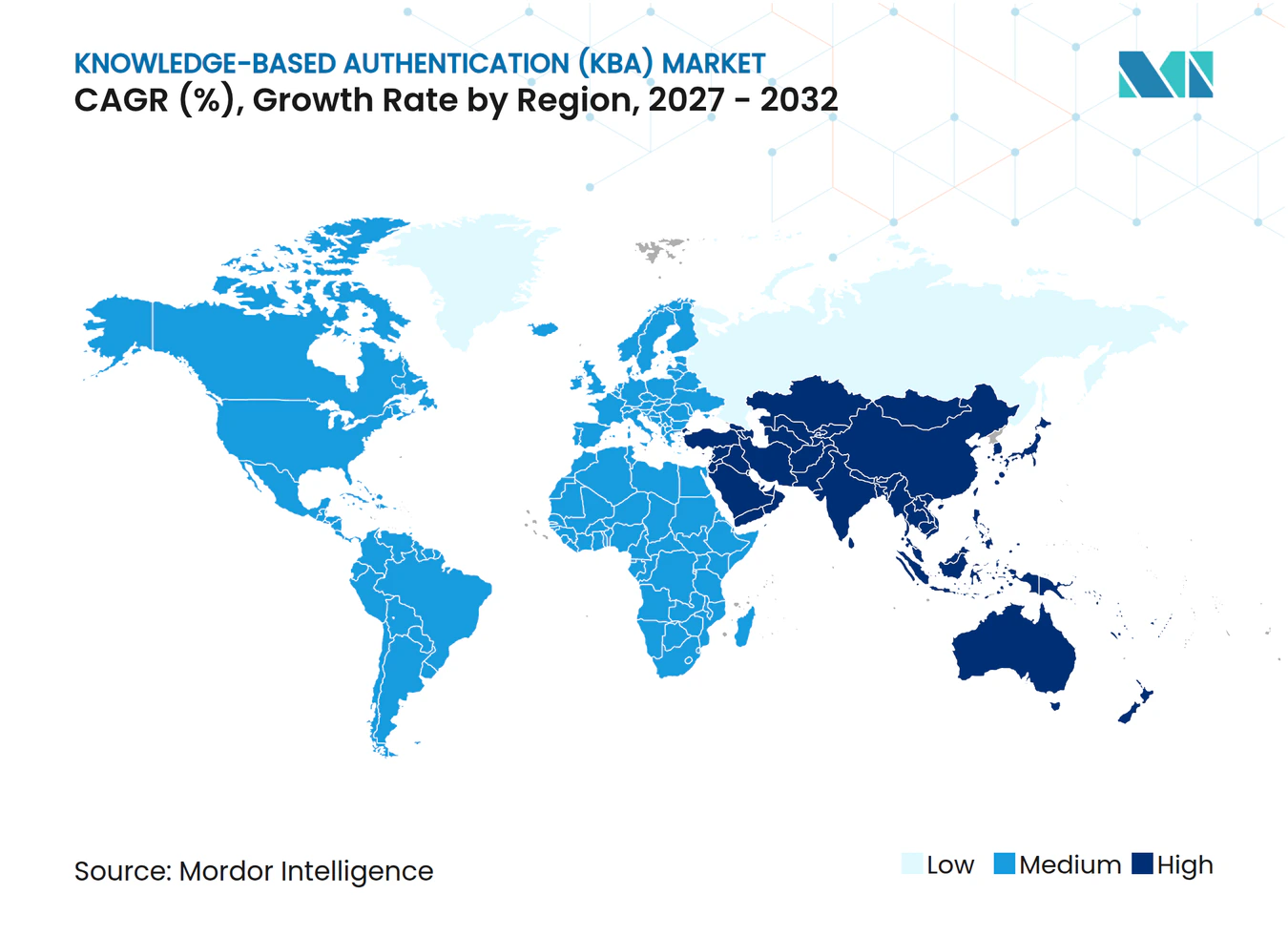
North America held 43.06% of revenue in 2026, giving the region the largest Knowledge-based authentication market share. Its position is supported by the presence of major credit data and risk information providers, including Experian, Equifax, TransUnion, and LexisNexis Risk Solutions. The United States has a strong demand from financial institutions that need automated checks during account opening. Canada shares many features of the U.S. data and regulatory model. Mexico offers expansion potential as digital banking reaches more underbanked consumers. Experian’s acquisition of AtData in February 2026 added email intelligence to its regional identity-data capabilities.
Europe Knowledge-Based Authentication (KBA) Market
Europe is the second-largest regional market and operates under both stronger verification expectations and strict personal-data rules. GDPR data minimization can limit the reuse and transfer of consumer data used to create questions. Regulation (EU) 2025/2518 strengthened procedural rules for cross-border GDPR enforcement. The EU Digital Identity Wallet program is reshaping onboarding around credential-based verification.[3] KBA consequently serves as a fallback for people who are not enrolled in a wallet or when another corroboration step is needed. Mitek added SEPBLAC-compliant video-verification enhancements for Spain in February 2026, reflecting regional attention to deepfake and injection-attack risks.
APAC, South America and MEA Knowledge-Based Authentication (KBA) Market
Asia-Pacific is projected to expand at a 5.28% CAGR through 2032, making it the fastest-growing geography in the KBA market. India’s Aadhaar and Singapore’s Singpass provide structured national identity systems that can support dynamic corroboration. China’s national identity framework also increases the relevance of structured identity credentials. Japan’s Digital Agency published digital identity guidance in September 2025 with a risk-tiered approach to authentication assurance.[4] South America, the Middle East, and Africa remain earlier-stage regions where banking and telecommunications lead adoption. Their prospects depend on the maturity of identity registries, data access, and digital financial services.
Competitive Landscape
Market Concentration
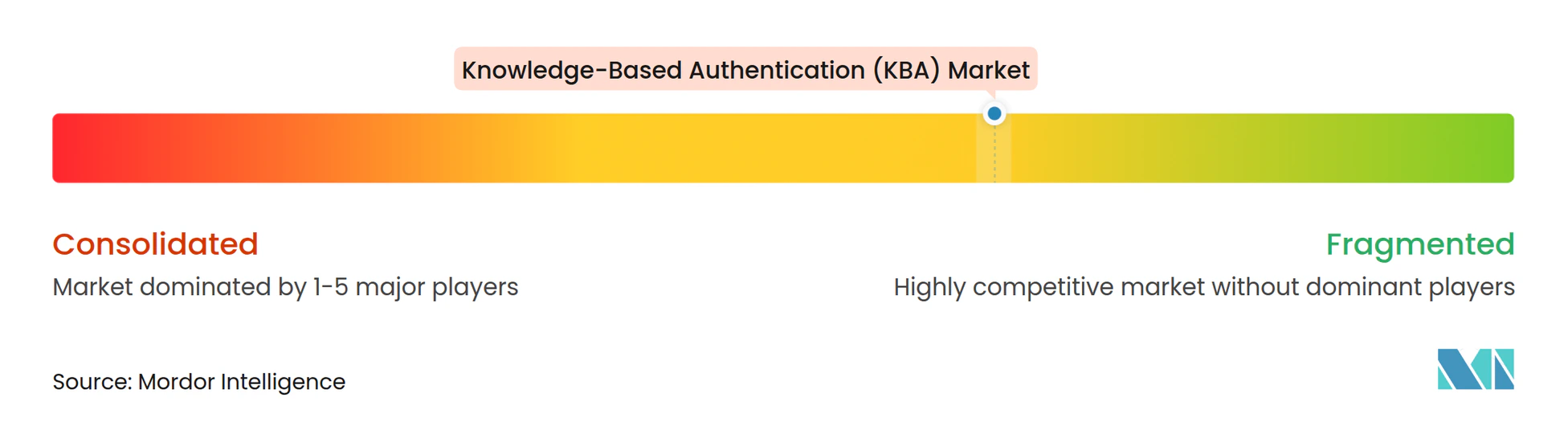
The Knowledge-based authentication market is moderately fragmented. Credit data incumbents, including Experian, Equifax, TransUnion, and LexisNexis Risk Solutions, have advantages in the data needed for dynamic question generation. Digital identity platforms such as Jumio, Socure, Trulioo, and Mitek compete through workflow integration, geographic coverage, and a wider range of fraud signals. The leading approaches differ between strengthening data assets and bundling KBA with identity proofing, biometrics, documents, and behavioral signals. Vendors that can show alignment with NIST’s knowledge-based verification provisions have an advantage with federally regulated buyers. The competitive focus has shifted toward deciding when to request a challenge rather than presenting one by default.
Experian’s February 2026 acquisition of AtData expanded its email and activity-data resources for fraud and identity decisions. LexisNexis Risk Solutions completed its IDVerse acquisition in February 2025, adding document authentication and deepfake detection capabilities. Mitek’s PingOne DaVinci integration made identity verification available within a no-code orchestration environment. These moves show that vendors are competing to offer broader identity decisions, not only KBA prompts. Buyers can select KBA as an added corroboration signal within a multi-factor decision. That model favors providers with both usable data and integration capability.
Opportunities remain among thin-file consumers, credit-invisible groups, voice-channel use cases, and SMEs seeking per-verification pricing. BioCatch launched DeviceIQ in March 2026 to combine behavioral, device, transactional, and application signals in one product. Pindrop brought real-time interaction risk intelligence to the FICO Marketplace in May 2026, enabling risk signals to inform fraud decisions. Such tools can reduce the number of interactive KBA challenges in continuous-authentication settings. They can also trigger dynamic questions when the risk level is high enough to justify user friction. The Knowledge-based authentication market competes with these alternatives while also benefiting from their ability to identify the events where corroboration is appropriate.
Knowledge-Based Authentication (KBA) Industry Leaders
-
GB Group plc
-
Equifax Inc.
-
LexisNexis Risk Solutions Inc.
-
TransUnion LLC
-
OneSpan Inc.
- *Disclaimer: Major Players sorted in no particular order
Knowledge-Based Authentication (KBA) Market Companies Covered in this Report
- GB Group plc
- Veratad Technologies, LLC
- Experian Information Solutions, Inc.
- Equifax Inc.
- TransUnion LLC
- LexisNexis Risk Solutions Inc.
- Mitek Systems, Inc.
- OneSpan Inc.
- BioCatch Ltd.
- Socure, Inc.
- Jumio Corporation
- Veriff OÜ
- Trulioo Information Services Inc.
- IDnow GmbH
- Signicat AS
- iDenfy UAB
- FacePhi Biometria, S.A.
- Daon, Inc.
- SecureAuth Corporation
- Plurilock Security Inc.
- Pindrop Security, Inc.
- Sift Science, Inc.
- Callsign, Inc.
- HYPR Corp.
- OneLogin, Inc.
- AuthX, Inc.
- Veridium Ltd.
- BehavioSec AB
- Entrust Corporation
Recent Industry Developments in Knowledge-Based Authentication (KBA) Market
- October 2026: OneSpan expanded its e-signature platform roadmap to incorporate identity verification, AI-driven authentication, and digital wallet integration, broadening its addressable market into multi-industry electronic agreement workflows requiring bound identity corroboration beyond traditional banking contexts.
- September 2026: Pindrop launched BotStopper technology as a standalone enterprise product detecting AI voice agents in real time using its Pulse deepfake-detection engine. At 1 healthcare organization, bot activity fell 94.3% within 4 months, protecting over USD 15.1 million in HSA balances from bot-driven account takeover.
- September 2026: Jumio completed the worldwide rollout of its selfie.DONE reusable identity product to both EMEA and Asia-Pacific, enabling previously verified users to re-authenticate with a selfie rather than a KBA challenge, illustrating the shift toward biometric step-down authentication for trusted, enrolled identities.
- July 2026: Socure launched Remote Verifier, providing real-time identity verification through live agents for the fewer than 1% of consumers not instantly confirmed through automated signals, customized for public-sector workflows with launch partner Allocore.
Global Knowledge-Based Authentication (KBA) Market Report Scope
The Knowledge-Based Authentication Market refers to the global market for solutions and services that verify an individual's identity by asking questions or validating information based on personal, historical, or contextual data associated with that individual. These solutions use static knowledge-based authentication (KBA), which relies on predefined information, dynamic KBA, which generates questions using external data sources, and hybrid KBA approaches that combine multiple verification methods. The market includes technologies that leverage credit bureau data, non-credit public records, telecommunications and utility records, government and identity registry data, first-party customer data, and multi-source data aggregation to support identity verification, fraud prevention, account recovery, and secure access to digital services.
The Knowledge-Based Authentication Market Report is Segmented by Solution Type (Static KBA, Dynamic KBA, and Hybrid KBA), Deployment (Cloud-Based, On-Premise, and Hybrid Deployment), Data Source (Credit Bureau Data, Non-Credit Public Records, Telecommunications and Utility Records, Government and Identity Registry Data, First-Party Customer Data, and Multi-Source Data Aggregation), Organization Size (Large Enterprises and Small and Medium-Sized Enterprises), End-User Industry (BFSI, Telecommunications, Retail and E-Commerce, Healthcare, Government and Public Sector, and Other End-User Industries), and Geography (North America, South America, Europe, Asia-Pacific, Middle East, and Africa). The Market Forecasts are Provided in Terms of Value (USD).
Segmentation Overview
| Static Knowledge-Based Authentication |
| Dynamic Knowledge-Based Authentication |
| Hybrid Knowledge-Based Authentication |
| Cloud-Based |
| On-Premise |
| Hybrid Deployment |
| Credit Bureau Data |
| Non-Credit Public Records |
| Telecommunications and Utility Records |
| Government and Identity Registry Data |
| First-Party Customer Data |
| Multi-Source Data Aggregation |
| Large Enterprises |
| Small and Medium-Sized Enterprises |
| BFSI |
| Telecommunications |
| Retail and E-Commerce |
| Healthcare |
| Government and Public Sector |
| Other End-User Industries |
| North America | United States |
| Canada | |
| Mexico | |
| South America | Brazil |
| Argentina | |
| Chile | |
| Colombia | |
| Rest of South America | |
| Europe | United Kingdom |
| Germany | |
| France | |
| Italy | |
| Spain | |
| Russia | |
| Rest of Europe | |
| Asia-Pacific | China |
| Japan | |
| India | |
| South Korea | |
| Australia | |
| Singapore | |
| Rest of Asia-Pacific | |
| Middle East | Saudi Arabia |
| United Arab Emirates | |
| Turkey | |
| Rest of Middle East | |
| Africa | South Africa |
| Nigeria | |
| Egypt | |
| Kenya | |
| Rest of Africa |
| By Solution Type | Static Knowledge-Based Authentication | |
| Dynamic Knowledge-Based Authentication | ||
| Hybrid Knowledge-Based Authentication | ||
| By Deployment | Cloud-Based | |
| On-Premise | ||
| Hybrid Deployment | ||
| By Data Source | Credit Bureau Data | |
| Non-Credit Public Records | ||
| Telecommunications and Utility Records | ||
| Government and Identity Registry Data | ||
| First-Party Customer Data | ||
| Multi-Source Data Aggregation | ||
| By Organization Size | Large Enterprises | |
| Small and Medium-Sized Enterprises | ||
| By End-User Industry | BFSI | |
| Telecommunications | ||
| Retail and E-Commerce | ||
| Healthcare | ||
| Government and Public Sector | ||
| Other End-User Industries | ||
| By Geography | North America | United States |
| Canada | ||
| Mexico | ||
| South America | Brazil | |
| Argentina | ||
| Chile | ||
| Colombia | ||
| Rest of South America | ||
| Europe | United Kingdom | |
| Germany | ||
| France | ||
| Italy | ||
| Spain | ||
| Russia | ||
| Rest of Europe | ||
| Asia-Pacific | China | |
| Japan | ||
| India | ||
| South Korea | ||
| Australia | ||
| Singapore | ||
| Rest of Asia-Pacific | ||
| Middle East | Saudi Arabia | |
| United Arab Emirates | ||
| Turkey | ||
| Rest of Middle East | ||
| Africa | South Africa | |
| Nigeria | ||
| Egypt | ||
| Kenya | ||
| Rest of Africa | ||
Key Questions Answered in the Report
What is the size of the knowledge-based authentication market?
The knowledge-based authentication market is projected to be USD 1.15 billion in 2026, USD 1.25 billion in 2027, and USD 1.54 billion by 2032, at a 4.26% CAGR from 2027 to 2032.
Why is dynamic KBA used more than static KBA?
Dynamic KBA held 58.12% of 2026 revenue because it can use current risk and varied data sources instead of fixed questions.
Which deployment method is most used for KBA?
Cloud-based deployment held 67.78% of 2026 revenue, supported by API delivery and identity-orchestration integration.
Which organizations use KBA most often?
BFSI was the largest end-user group with 44.38% of 2026 revenue because identity checks are needed across onboarding, transactions, recovery, and support.
Which region leads demand for knowledge-based authentication?
North America led with 43.06% of 2026 revenue, while Asia-Pacific is projected to have the fastest expansion at a 5.28% CAGR through 2032.
How is KBA changing as biometric and passwordless tools expand?
KBA is increasingly used as a targeted corroboration step during higher-risk events instead of a default standalone authentication method.