
Kingdom Of Saudi Arabia (KSA) HVAC Market Size and Share
| Study Period | 2019 - 2030 |
| Forecast Data Period | 2025 - 2030 |
| Historical Data Period | 2019 - 2023 |
| Market Size (2025) | USD 3.47 Billion |
| Market Size (2030) | USD 4.63 Billion |
| CAGR (2025 - 2030) | 5.90% |
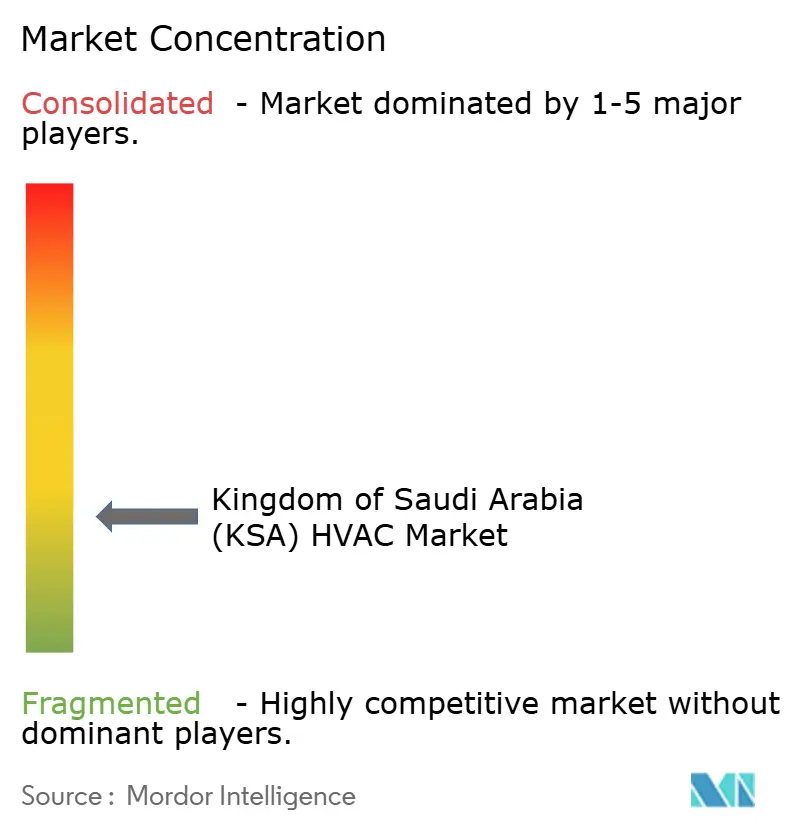
| Market Concentration | Low |
Major Players *Disclaimer: Major Players sorted in no particular order |
Kingdom Of Saudi Arabia (KSA) HVAC Market Analysis by Mordor Intelligence
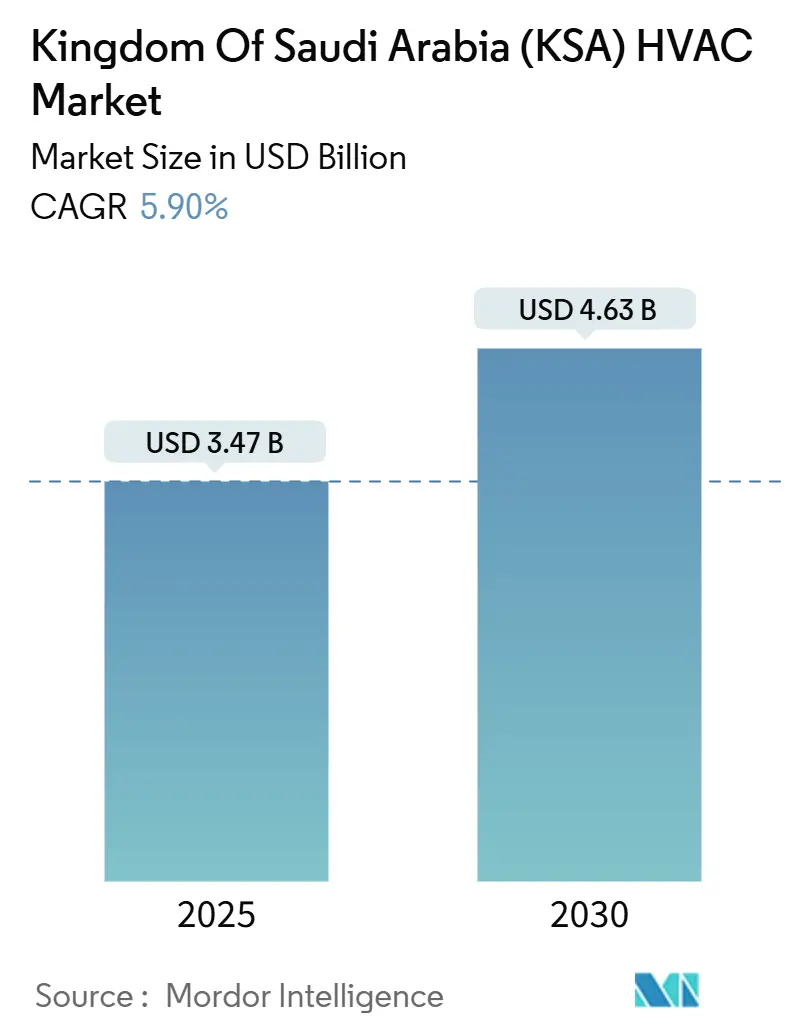
The Kingdom Of Saudi Arabia HVAC Market size is estimated at USD 3.47 billion in 2025, and is expected to reach USD 4.63 billion by 2030, at a CAGR of 5.90% during the forecast period (2025-2030).
- HVAC is a comprehensive system designed to create and maintain comfortable indoor environmental conditions in residential, commercial, and industrial spaces. Heating is the first component, which involves warming interior spaces during cold weather through various methods such as furnaces, heat pumps, and radiant heating systems. These technologies convert energy into heat, distributing warmth evenly throughout a building to ensure occupant comfort and prevent temperature-related issues.
- The Kingdom of Saudi Arabia (KSA) is characterized by a harsh desert climate featuring extremely high temperatures and low annual rainfall. With summer temperatures often soaring above 50°C (122°F), the demand for effective cooling solutions becomes paramount. This extreme heat drives the necessity for HVAC systems, particularly in urban areas where population density is high and commercial activities are concentrated.
- In addition to the climate, rapid urbanization and economic growth in KSA are significant factors propelling the HVAC market. As cities expand and new developments arise, the integration of advanced HVAC systems in residential, commercial, and industrial buildings is essential. The government’s Vision 2030 initiative aims to diversify the economy and enhance infrastructure, further increasing the demand for efficient HVAC solutions that can support modern living standards and sustainability goals.
- The rising energy costs in Saudi Arabia have become a significant concern, primarily driven by several interrelated factors. The global surge in energy prices, influenced by geopolitical tensions and supply chain disruptions, has directly affected the domestic market. As KSA relies heavily on oil and gas, fluctuations in these commodities have resulted in increased costs for consumers and businesses alike. This situation compels many to seek more energy-efficient solutions, thus boosting the demand for HVAC systems that can optimize energy consumption.
- Additionally, several macroeconomic factors like stringent government regulations, policies, and initiatives drive the growth of the studied market. Saudi Arabia's Vision 2030 aims to diversify the economy and reduce dependence on oil. A key aspect of this initiative is investment in infrastructure and urban development, which directly fuels the HVAC market. The demand for efficient and sustainable HVAC systems is increasing as new cities, such as NEOM, are being developed with advanced technologies that emphasize energy efficiency and environmental sustainability.
- The Saudi Energy Efficiency Program (SEEP) promotes energy-saving technologies across various sectors. This initiative encourages the use of high-efficiency HVAC systems, which not only reduce energy consumption but also lower operational costs for businesses and households. The program includes standards and regulations that HVAC manufacturers must adhere to, which stimulates innovation and advancements in the HVAC industry.
- The NIDLP is part of the Vision 2030 strategy, aimed at boosting local industries and logistics capabilities. This program supports the growth of the HVAC market by promoting local manufacturing of HVAC components and systems, thereby reducing import dependencies and fostering job creation. Additionally, it encourages partnerships between local and international firms, enhancing technological transfer and expertise in the HVAC sector.
- The HVAC market in KSA faces several challenges that can hinder its growth. The installation and maintenance of HVAC systems can be quite expensive. The initial capital required for advanced technology and energy-efficient systems may deter smaller businesses and residential users from making investments. Many consumers are concerned about the long-term return on investment, particularly in a market where energy prices fluctuate. This reluctance to invest in new HVAC systems can slow market growth.
- The HVAC industry in KSA faces complex regulations that can pose significant barriers. Compliance with local building codes and environmental regulations can be cumbersome for manufacturers and service providers. Moreover, the lack of standardized regulations across different regions within KSA can create confusion and lead to increased operational costs. Companies often struggle to navigate these regulatory environments, which can hinder their ability to innovate and expand.
Kingdom Of Saudi Arabia (KSA) HVAC Market Trends and Insights
The Economic Development and Construction Activities are Anticipated to Drive the Demand for the Studied Market
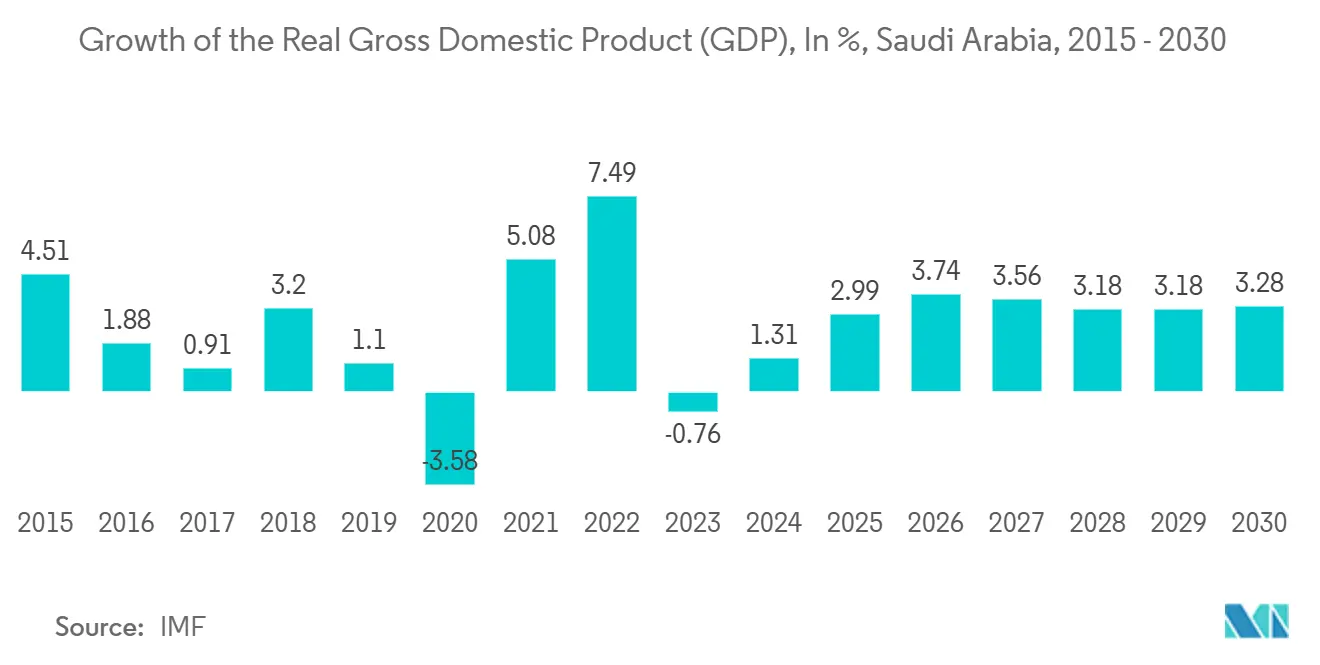
- The Kingdom of Saudi Arabia (KSA) has been experiencing a significant surge in construction activities, particularly in the realm of infrastructure and urban development. This boom is not only reshaping the urban landscape but is also stimulating various related sectors, notably the HVAC market. The growth of the gross domestic product (GDP) in Saudi Arabia is anticipated to drive the growth of the studied market. According to the International Monetary Fund (IMF), in 2024, the growth of the real gross domestic product (GDP) in Saudi Arabia stood at about 1.31%.
- One of the most influential drivers of construction activities in KSA is the ambitious Vision 2030 initiative. Launched in 2016, this strategic framework aims to diversify the kingdom’s economy away from oil dependency and to develop public service sectors such as health, education, infrastructure, recreation, and tourism. Under Vision 2030, the government has earmarked substantial investments in mega-projects, including NEOM, a futuristic city designed to be a hub for innovation and sustainability. This focus on large-scale projects not only stimulates construction activities but also creates a ripple effect in associated industries, including HVAC, as the demand for energy-efficient and advanced climate control systems grows in new constructions.
- Additionally, KSA has actively sought to attract foreign investment as part of its economic diversification efforts. The government has implemented various reforms to create a more conducive business environment, such as easing regulations and offering incentives to foreign investors. This influx of capital has led to a surge in construction projects across the kingdom, from commercial buildings to infrastructure developments. Additionally, the establishment of economic zones and special development programs has further stimulated construction activities. With more foreign companies entering the market, there is an increased demand for advanced construction technologies and services, including HVAC systems, which are crucial for modern buildings.
- The National Industrial Development and Logistics Program (NIDLP) is a key government initiative aimed at enhancing the industrial and logistics sectors in KSA. This program focuses on developing a robust industrial base, which includes promoting manufacturing capabilities in various sectors, including HVAC. By fostering local manufacturing of HVAC systems and components, the NIDLP not only boosts local economies but also reduces dependency on imports. This initiative aligns with the broader goals of Vision 2030, as it encourages innovation and efficiency in the construction industry, resulting in increased demand for HVAC solutions in new developments.
- The Saudi Green Initiative emphasizes environmental sustainability and aims to tackle climate change by reducing carbon emissions and promoting renewable energy. As part of this initiative, the government is encouraging the adoption of energy-efficient technologies in construction projects. For the HVAC market, this translates into a growing demand for sustainable cooling and heating solutions that comply with new environmental standards. The emphasis on green building practices is leading to increased investments in HVAC systems that utilize renewable energy sources and advanced technologies, driving growth within the market.
The Air Conditioning Equipment Sector is Anticipate to Hold a Major Market Share
- The air conditioning equipment segment in Saudi Arabia is experiencing robust growth, driven by a complex interplay of market dynamics and strategic national developments. Climate is the primary catalyst for this expansion, with the kingdom experiencing extreme temperatures that regularly exceed 50°C during summer months. The harsh desert environment creates an unprecedented demand for advanced cooling solutions across residential, commercial, and industrial sectors. This climatic challenge necessitates sophisticated air conditioning technologies that can provide efficient and reliable cooling in extreme conditions.
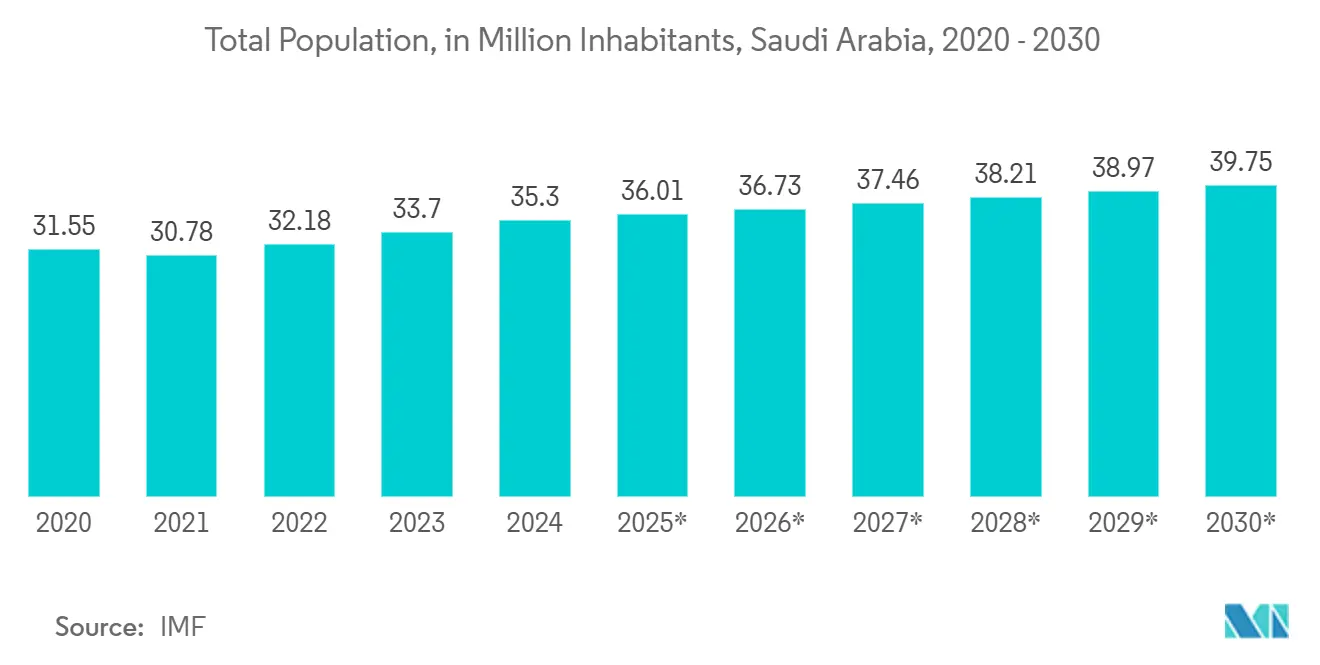
- Rapid urbanization and population growth represents another critical market driver transforming the HVAC landscape. According to the International Monetary Fund (IMF), in 2024, Saudi Arabia's total population amounted to 35.3 million inhabitants, an increase from 38.97 million inhabitants in 2023.
- Saudi Arabia's ambitious urban development projects, including NEOM, The Line, and numerous smart city initiatives, are creating massive infrastructure requirements that inherently demand robust cooling systems. These mega-projects are not just constructing buildings but are designing entire urban ecosystems that require integrated, energy-efficient climate control solutions. The scale of these developments implies a substantial and sustained demand for advanced air conditioning equipment over the next decade.
- Population growth and demographic transformation constitute a significant market driver. Saudi Arabia's young and rapidly expanding population, coupled with increasing household formation rates, is generating unprecedented demand for residential cooling solutions. The median age in the kingdom is relatively young, with a growing middle class that prioritizes comfort and technological sophistication in home environments. This demographic trend translates directly into increased purchasing power and willingness to invest in high-performance air conditioning systems that offer superior energy efficiency and smart technology integration.
- Economic diversification efforts under Vision 2030 are creating substantial opportunities in the HVAC sector. As the kingdom transitions from oil dependency to a more diversified economic model, sectors like tourism, manufacturing, and technology are experiencing substantial growth. Each of these emerging sectors requires robust cooling infrastructure, thereby creating a multiplier effect on air conditioning equipment demand. Data centers, industrial facilities, hospitality developments, and commercial complexes are all driving significant investment in advanced HVAC technologies.
- Furthermore, local content requirements and industrial localization policies (Saudization) are reshaping the HVAC equipment landscape. By providing incentives for domestic manufacturing and technology transfer, these policies are encouraging international HVAC manufacturers to establish local production facilities. This approach not only stimulates economic diversification but also creates a more competitive and innovative local market for air conditioning equipment.
Competitive Landscape
The Kingdom of Saudi Arabia (KSA) HVAC market is fragmented, with specialized players and regional conglomerates operating across various segments. While multiple large multinational companies dominate certain high-value segments, numerous regional and niche players contribute to the overall competition, making the market highly diverse. This competition is driven by the wide range of applications for HVAC equipment, allowing both small and large companies to coexist and thrive in the market.
Several leading companies in the Kingdom of Saudi Arabia (KSA) HVAC market include Mitsubishi Electric Corporation, Carrier Corporation, LG Electronics Inc., Daikin Industries, Ltd., Panasonic Corporation, and many others. With strong brand recognition and extensive regional operations, these companies command a significant market share. Their strengths include innovation, a broad solutions portfolio, and robust distribution networks. To maintain their competitive edge and broaden their market reach, these leaders frequently pursue strategic acquisitions and partnerships.
In the Kingdom of Saudi Arabia (KSA) HVAC market, companies that prioritize innovation in heating, ventilation, and air conditioning equipment are more likely to succeed. As industries increasingly seek advanced solutions, HVAC equipment is set to become a key differentiator. Additionally, expanding service offerings and enhancing customer support will be essential for building long-term relationships and securing repeat business. Firms that invest in emerging markets and tailor their products to regional needs can gain a competitive advantage in this fragmented landscape.
Kingdom Of Saudi Arabia (KSA) HVAC Industry Leaders
-
Daikin Industries Ltd.
-
Carrier Global Corporation
-
LG Electronics Inc.
-
Panasonic Corporation
-
Mitsubishi Electric Corporation
- *Disclaimer: Major Players sorted in no particular order
Recent Industry Developments
- September 2024: In a bid to enhance energy efficiency and reduce household consumption, a Saudi government agency rolled out a nationwide initiative to replace outdated air conditioners. Named "Estbdal" (Arabic for "Replacement"), the program is spearheaded by the Saudi Energy Efficiency Centre, in partnership with various government entities. The initiative has garnered support from over 30 retailers, 350 showrooms, and four manufacturing plants across Saudi Arabia.
- July 2024: The Saudi Standards, Metrology and Quality Organization (SASO) presented research at the 20th International Conference on Artificial Intelligence Applications and Innovations (AIAI). The presented paper detailed the development of an artificial-intelligence (AI) model called ANNS that can simulate energy efficiency tests for air conditioners and predict their performance before physical testing is conducted. The ANNS model, reviewed by experts from the General Directorate of Laboratories, can verify test results in minutes compared to the days required for traditional retesting methods. This aims to save time and resources and increase research capacity.
- March 2024: Midea launched the MARS series R290 commercial heat pump, which has earned the Ultra-High-Temperature Hot Water Performance Certification from Intertek, signifying energy efficiency and robust performance. The use of the eco-friendly R290 refrigerant highlights the series' commitment to sustainability and lower environmental impact.
Kingdom Of Saudi Arabia (KSA) HVAC Market Report Scope
HVAC is a comprehensive system designed to create and maintain comfortable indoor environmental conditions in residential, commercial, and industrial spaces. Heating is the first component, which involves warming interior spaces during cold weather through various methods such as furnaces, heat pumps, and radiant heating systems. These technologies convert energy into heat, distributing warmth evenly throughout a building to ensure occupant comfort and prevent temperature-related issues.
Ventilation represents the critical process of exchanging indoor and outdoor air, ensuring proper air circulation, removing pollutants, controlling humidity, and maintaining air quality. This aspect of HVAC involves mechanical and natural ventilation techniques that introduce fresh air, filter contaminants, and regulate oxygen levels. Proper ventilation is essential for preventing the buildup of harmful gases, reducing moisture-related problems, and creating a healthy indoor environment.
Air Conditioning focuses on cooling and dehumidifying interior spaces during warm weather. Modern air conditioning systems use refrigeration cycles to remove heat and moisture from the air, creating a comfortable and controlled climate. These systems range from central air conditioning units to ductless mini-splits, providing precise temperature management and improving overall indoor comfort. The integration of these three components- heating, ventilation, and air conditioning- creates a sophisticated environmental control system that adapts to changing weather conditions and occupant needs.
The study tracks the revenue accrued through the sale of HVAC product types by various players in the Kingdom of Saudi Arabia (KSA). The study also tracks the key market parameters, underlying growth influencers, and major vendors operating in the industry, which supports the market estimations and growth rates over the forecast period. The study further analyses the overall impact of macroeconomic factors on the market. The report's scope encompasses market sizing and forecasts for the various market segments.
The Kingdom of Saudi Arabia (KSA) HVAC Market is Segmented by product type (heating equipment [heat pumps (air source, ground source), furnaces (gas, electric, oil), boilers (condensing, non-condensing), unit heaters, and others (radiators & baseboard heaters, solar water heating systems)], ventilation equipment [air handling units (AHUs), energy recovery ventilators (ERVs)/heat recovery, ventilators (HRVs), exhaust and supply fans, dehumidifiers/humidifiers], air conditioning equipment [unitary air conditioners, variable refrigerant flow (VRF) systems, chillers (air-cooled, water-cooled), fan coil units (FCUs), and others (window and portable air conditioners)]) and end-user industry (residential, commercial, and industrial). The market sizes and forecasts are provided in terms of value (USD) for all the above segments.
| Heating Equipment | Heat Pumps (Air Source, Ground Source) | |
| Furnaces (Gas, Electric, Oil) | ||
| Boilers (Condensing, Non-condensing) | ||
| Unit Heaters | ||
| Others (Radiators & Baseboard Heaters, Solar Water Heating Systems) | ||
| Ventilation Equipment | Air Handling Units (AHUs) | |
| Energy Recovery Ventilators (ERVs) / Heat Recovery Ventilators (HRVs) | ||
| Exhaust and Supply Fans | ||
| Dehumidifiers / Humidifiers | ||
| Air Conditioning Equipment | Unitary Air Conditioners | Split Air Conditioners |
| Packaged Terminal ACs (PTACs) | ||
| Rooftop Packaged Units (RTUs) | ||
| Variable Refrigerant Flow (VRF) Systems | ||
| Chillers (Air-Cooled, Water-Cooled) | ||
| Fan Coil Units (FCUs) | ||
| Others (Window and Portable Air Conditioners) | ||
| Residential |
| Commercial |
| Industrial |
| By Product Type | Heating Equipment | Heat Pumps (Air Source, Ground Source) | |
| Furnaces (Gas, Electric, Oil) | |||
| Boilers (Condensing, Non-condensing) | |||
| Unit Heaters | |||
| Others (Radiators & Baseboard Heaters, Solar Water Heating Systems) | |||
| Ventilation Equipment | Air Handling Units (AHUs) | ||
| Energy Recovery Ventilators (ERVs) / Heat Recovery Ventilators (HRVs) | |||
| Exhaust and Supply Fans | |||
| Dehumidifiers / Humidifiers | |||
| Air Conditioning Equipment | Unitary Air Conditioners | Split Air Conditioners | |
| Packaged Terminal ACs (PTACs) | |||
| Rooftop Packaged Units (RTUs) | |||
| Variable Refrigerant Flow (VRF) Systems | |||
| Chillers (Air-Cooled, Water-Cooled) | |||
| Fan Coil Units (FCUs) | |||
| Others (Window and Portable Air Conditioners) | |||
| By End-User | Residential | ||
| Commercial | |||
| Industrial | |||
Key Questions Answered in the Report
How big is the Kingdom Of Saudi Arabia HVAC Market?
The Kingdom Of Saudi Arabia HVAC Market size is expected to reach USD 3.47 billion in 2025 and grow at a CAGR of 5.90% to reach USD 4.63 billion by 2030.
What is the current Kingdom Of Saudi Arabia HVAC Market size?
In 2025, the Kingdom Of Saudi Arabia HVAC Market size is expected to reach USD 3.47 billion.
Who are the key players in Kingdom Of Saudi Arabia HVAC Market?
Daikin Industries Ltd., Carrier Global Corporation, LG Electronics Inc., Panasonic Corporation and Mitsubishi Electric Corporation are the major companies operating in the Kingdom Of Saudi Arabia HVAC Market.
What years does this Kingdom Of Saudi Arabia HVAC Market cover, and what was the market size in 2024?
In 2024, the Kingdom Of Saudi Arabia HVAC Market size was estimated at USD 3.27 billion. The report covers the Kingdom Of Saudi Arabia HVAC Market historical market size for years: 2019, 2020, 2021, 2022, 2023 and 2024. The report also forecasts the Kingdom Of Saudi Arabia HVAC Market size for years: 2025, 2026, 2027, 2028, 2029 and 2030.
Kingdom Of Saudi Arabia (KSA) HVAC Market Report
Statistics for the 2025 Kingdom Of Saudi Arabia (KSA) HVAC market share, size and revenue growth rate, created by Mordor Intelligence™ Industry Reports. Kingdom Of Saudi Arabia (KSA) HVAC analysis includes a market forecast outlook for 2025 to 2030 and historical overview. Get a sample of this industry analysis as a free report PDF download.