
Market Overview
| Study Period | 2021 - 2031 |
|---|---|
| Forecast Data Period | 2026 - 2031 |
| Base Year Market Size (2025) | USD 4.04 Billion |
| Market Size (2026) | USD 4.42 Billion |
| Market Size (2031) | USD 6.90 Billion |
| Growth Rate (2026 - 2031) | 9.33 % |
| Market Concentration | Medium |
Major Players *Disclaimer: Major Players sorted in no particular order Image © Mordor Intelligence. Reuse requires attribution under CC BY 4.0. | |
Japan Travel Retail Market Analysis by Mordor Intelligence
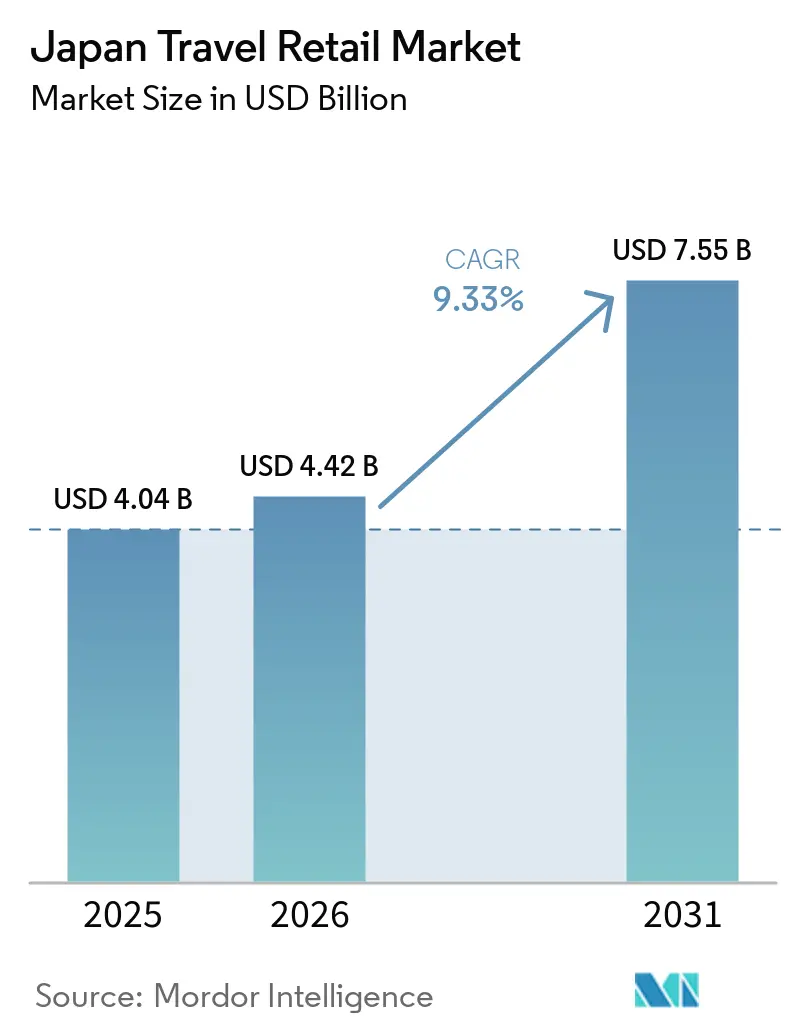
The Japan Travel Retail Market size is expected to increase from USD 4.04 billion in 2025 to USD 4.42 billion in 2026 and reach USD 6.90 billion by 2031, growing at a CAGR of 9.33% over 2026-2031.
The growth path is supported by expanded duty-free floor space at Haneda and Narita and by Kansai International Airport’s completed Terminal 1 renovation, which increases the commercial mix and throughput capacity[1]. Inbound demand accelerated in 2025 as arrivals and per capita spending strengthened, while operators recalibrated assortments toward high-margin exclusives to hedge currency and mix shifts[2]. Regulatory changes will reframe checkout and customs in November 2026 as Japan moves to an airport refund tax-free model, removing packaging rules and purchase caps for consumables while adding validation steps at exit points. Channel control remains central because airports concentrate traffic and still handle the bulk of high-value transactions in the Japan travel retail market.
Key Report Takeaways
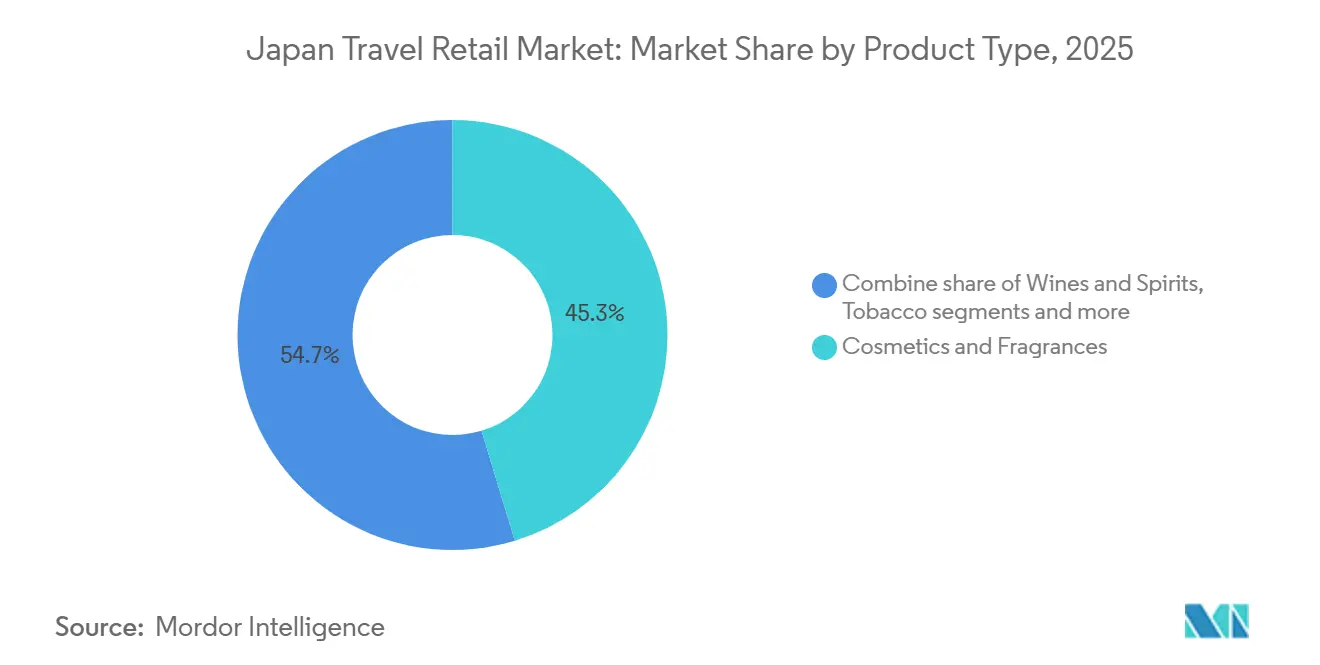
- By product type, cosmetics and fragrances led with 45.31% revenue share in 2025, while wines and spirits are forecast to expand at an 11.12% CAGR through 2031.
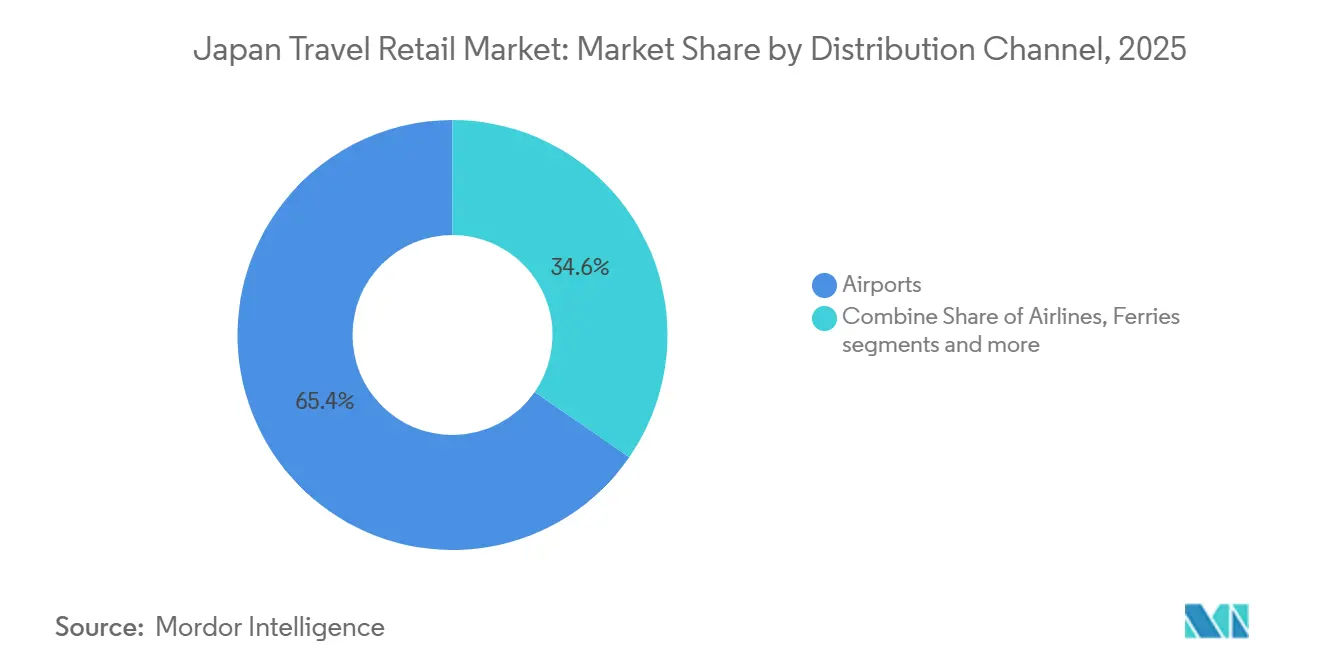
- By distribution channel, the airports segment held 65.35% of the Japan travel retail market share in 2025, while airports are projected to grow at a 10.58% CAGR to 2031.
- By geography, Kanto accounted for 53.31% of market value in 2025, while Kansai or Kinki is projected to post the fastest growth at a 9.82% CAGR through 2031.
Note: Market size and forecast figures in this report are generated using Mordor Intelligence’s proprietary estimation framework, updated with the latest available data and insights as of January 2026.
Japan Travel Retail Market Trends and Insights
Drivers Impact Analysis*
| Driver | (~)% Impact on CAGR Forecast | Geographic Relevance | Impact Timeline |
|---|---|---|---|
| World-leading luxury brand store openings in Japan | 1.8% | Global, with spillover to Kanto (Tokyo Ginza), Kansai (Osaka), and airport gateways (Haneda T2/T3, KIX T1) | Medium term (2–4 years) |
| Rising duty-free spend by Chinese & Korean travellers | 2.5% | National, with the highest gains in Kanto (Haneda), Kansai (KIX, Expo corridor), and Kyushu (Fukuoka proximity) | Short term (≤ 2 years) |
| Airport retail-space expansion & refurbishment at Haneda, Narita, Kansai | 2.2% | Asia-Pacific core, with primary concentration in Kanto (Haneda/Narita catchment) and Kansai (KIX Expo preparation) | Medium term (2–4 years) |
| Digital tax-refund kiosks & cash-less payments are boosting conversion | 1.3% | National rollout; early gains concentrated in metropolitan gateways (Tokyo, Osaka, Nagoya Centrair) | Short term (≤ 2 years) |
| Limited-edition Japanese whisky boom in global collector circles | 1.0% | Global export markets (United States, China, France); domestic airport duty-free (Narita, Haneda, KIX) capture secondary premiums | Long term (≥ 4 years) |
| Osaka–Kansai Expo 2025 and other mega-events are driving one-off visitor spikes | 0.6% | Kansai/Kinki epicentre; secondary dispersion to Chugoku (Hiroshima), Chubu (Nagoya), and Tokyo metropolitan | Short term (≤ 2 years) |
| Source: Mordor Intelligence | |||
World-leading luxury brand store openings in Japan
Global operators expanded in 2025 as Avolta entered Japan with a 500 square meter food and beverage concession at Kansai International Airport, which adds recognized culinary brands and strengthens cross-channel engagement. Kansai’s Terminal 1 program continues into summer 2026 with a planned slate of 23 stores that includes first airport boutiques for Gentle Monster and Moncler, which target premium traffic around Expo 2025[3]. Lotte Duty Free renovated its Tokyo Ginza flagship in October 2024 and introduced a Korean fashion zone and a curated House of Suntory whisky offering by allocation, which aligns with demographic shifts toward younger and digitally engaged shoppers[4]. Airport landlords deepen ties with luxury brands through co-financed boutique buildouts and exclusive placements that create scarcity and commit prime frontage to select operators for long leases. This clustering effect concentrates ultra-high net worth spending in priority terminals and elevates the role of airports within the Japan travel retail market.
Rising duty-free spend by Chinese & Korean travellers
South Korean arrivals led in 2024 and recorded year-on-year growth that changed the mix at key gateways, which raised demand for value-focused products and Korean language services at retail touchpoints. Korean card spending in Japan expanded through 2025, with department stores and duty-free clusters targeting this cohort with tailored counters and curated assortments to support higher frequency trips. Chinese demand turned more volatile in late 2025 as a travel advisory and currency pressure weighed on per-transaction spending and reduced luxury basket sizes at select hubs. Operators pivoted with localized experiences and more consumables to preserve conversion while strengthening their focus on United States and European high-value travelers to diversify exposure. This rebalancing helps stabilize performance in the Japan travel retail market as visitor flows shift and as traffic patterns favor independent travelers over large tour groups.
Airport retail-space expansion & refurbishment at Haneda, Narita, Kansai
Narita advanced a multiyear consolidation that will raise gate counts and drive capacity toward 75 million passengers in the early 2030s, which supports long-term retail intensification on the landside and airside. Haneda added gates and commercial space in 2026 to reduce congestion around Terminal 3 and continues to evaluate processing improvements that enable late-night services and better dwell capture. Kansai completed a major renovation in March 2025 that expanded international capacity and installed a large walk-through duty-free zone, which validated higher revenue capture through improved passenger flow. Automation in registers and backroom replenishment improved speed to shelf and reduced stockouts, which lifted both conversion and average ticket for targeted categories. These changes improve yield per square meter and reinforce the airports’ primacy within the Japan travel retail market.
Digital tax-refund kiosks & cashless payments are boosting conversion
Digital refund workflows and cashless payment acceptance improve throughput at peak times and reduce cashier workload, which helps move high-intent travelers through checkout with fewer delays. Airports rolled out contactless pickup features that integrate with pre-order platforms and mobile wallets, which increased convenience for Chinese and Korean travelers who prefer app-based journeys. Broad acceptance of Alipay and WeChat Pay complements card rails and draws spend from mobile-first customers who often plan purchases before arrival. The November 2026 shift to an airport refund model will standardize the refund point at the exit border and reduce paperwork in stores, which can reallocate staff time to selling and clienteling. These steps enhance conversion in the Japan travel retail market and support consistent execution across terminals that handle late-night and irregular operations.
Restraints Impact Analysis*
| Restraint | (~)% Impact on CAGR Forecast | Geographic Relevance | Impact Timeline |
|---|---|---|---|
| Yen volatility is squeezing margins on imported inventory | -1.5% | National, with acute pressure on luxury-brand sourcing (Kanto metros, Kansai KIX) and duty-free operators holding EUR/USD inventory | Short term (≤ 2 years) |
| Strict customs allowances on alcohol & tobacco purchases | -0.9% | Global compliance (all airports); enforcement concentrated at Narita, Haneda departure gates, and maritime entry points | Long term (≥ 4 years) |
| Acute airport-retail labour shortages are curbing store hours | -1.2% | National crisis, most severe at Narita (16% workforce decline), Haneda Terminal 3, and regional airports (Hokkaido, Kyushu) | Medium term (2-4 years) |
| Grey-market price arbitrage is eroding brand price integrity | -0.7% | Global (daigou networks); domestic concentration in Tokyo Ginza, Osaka Shinsaibashi, and online resale platforms | Long term (≥ 4 years) |
| Source: Mordor Intelligence | |||
Yen volatility is squeezing margins on imported inventory.
Exchange rate swings tightened gross margins for operators carrying imported luxury inventory that had been purchased at prior currency levels, which forced shifts toward more resilient consumables. Haneda reported a lower luxury share through late 2025 that reflected price sensitivity and allocation discipline by brands to manage gray market risks. Some boutiques deferred fit-out expansions as the arbitrage gap to Europe and the United States narrowed, which diluted impulse splurges by price-aware travelers. Payment cost structures added to pressure as cross-border card fees compounded discounts and promotions that retailers used to keep traffic moving. Operators responded by emphasizing bundled sets and airport exclusives in categories like cosmetics to defend volume while accepting lower average transaction values in the near term.
Strict customs allowances on alcohol & tobacco purchases
Japan limits duty-free alcohol to three 760 milliliter bottles and tobacco to 200 cigarettes, which caps bulk buying and pushes high-frequency shoppers to distribute purchases across trips. The general goods threshold triggers duties and consumption tax on overage, which can redirect luxury splurges to downtown boutiques where sales staff guide refund procedures in calmer settings. Enforcement tightened with stronger penalties for false declarations and stepped up inspections that created friction during peak departures. Differences with other hubs like Incheon and Changi influence route shopping as some travelers plan large liquor and tobacco purchases in markets with more accommodating limits. The 2026 switch to an airport refund model will standardize validation at exit points, which may reduce downtown speed advantages and consolidate spirits purchases airside.
*Our forecasts treat driver/restraint impacts as directional, not additive. The impact forecasts reflect baseline growth, mix effects, and variable interactions.
Segment Analysis
By Product Type: Premiumization rewrites the spirits playbook
Cosmetics and fragrances captured 45.31% of 2025 product revenue and remained the anchor category for frequent buyers, while wines and spirits are forecast to grow at an 11.12% CAGR through 2031 as premiumization deepens. Airport operators raised the visibility of curated whisky and high-end spirits with allocation-based counters and education-led displays that translate scarcity into full price sell-through. The cosmetics mix leaned into airport-exclusive sets and giftable formats that raise average tickets while sustaining a broad penetration rate among shoppers from China and South Korea. Jewelry and watches faced tighter allocations from select brands, which pushed some buyers toward daily queues and reshaped spend toward accessories and footwear within budget thresholds. The Japan travel retail market benefits from this spread of premium and entry options because it supports conversion across diverse spending profiles and trip purposes.
The Japan travel retail market size for wines and spirits is projected to expand at an 11.12% CAGR between 2026 and 2031, which is driven by collector demand and brand storytelling that reward limited releases. Duty-free teams rely on lotteries, pre-order windows, and pick-up lockers to manage high-demand bottles while preserving fairness and regulating crowds near gates. Cosmetics and fragrances continue to anchor volume with sets designed for gifting and self-care, which helps offset volatility in large-ticket luxury when currency or policy shifts weigh on value perception. Food and confectionery sustain high purchase frequency and deliver predictable throughput that supports inventory turns in late-night operations, even if revenue contribution trails premium categories. This product mix helps the Japan travel retail industry balance margin and volume while protecting unit economics through cycles.

By Distribution Channel: Airports entrench dominance, yet downtown duty-free tests limits
Airports commanded 65.35% of channel share in 2025 and are forecast to grow at a 10.58% CAGR through 2031, underpinned by throughput gains and more efficient layouts that steer all passengers past core retail. Haneda set new records for international passengers in 2025, which reinforced airside dominance for liquor, tobacco, and luxury categories where duty exemption and convenience matter most. Kansai’s walk-through flagship raised sales after its renovation due to improved queue management, faster scanning, and better adjacencies that encourage last-minute purchases. Airlines complement ground retail through pre-order exclusives and in-flight allocations that offer premium and collaboration items to captive premium cabins. These factors help consolidate spending in the Japan travel retail market within airport territories and reduce leakage to off-airport locations.
The Japan travel retail market size for airports is projected to expand at a 10.58% CAGR between 2026 and 2031 as operators scale digital pre-order and locker pickup for time-sensitive travelers. Downtown duty-free will shift under the 2026 airport refund regime since cash refunds at the counter will give way to customs validation at departure, which erodes speed advantages for city stores. Ferries and rail-linked convenience concepts add incremental channels but remain constrained by customs procedures, floor space, and lower high-ticket conversion compared with airside. Vertical integrations by airport affiliates that wholesale and retail across multiple airports capture margin at several points and translate loyalty programs into higher repeat purchase rates. These moves reinforce the central role of airports in the Japan travel retail industry while other channels adapt to the refund shift and ongoing staffing constraints.
Geography Analysis
Kanto accounted for 53.31% of the 2025 market value as Haneda and Narita together concentrated international flows, which positioned the region for sustained retail capture despite slot ceilings. The area benefits from dense downtown duty-free clusters that funnel tourists between city shopping and airport pickup options that are synchronized with flight schedules. Visitor profiles now include more repeat travelers who pair Tokyo with regional circuits, which broadens spend beyond the capital while keeping airside purchases strong. The November 2026 refund system may redirect some downtown transactions back toward airside, which supports core categories that retain duty exemption in airports. These changes keep Kanto at the center of the Japan travel retail market while the mix of travelers evolves.
Kansai or Kinki is projected to be the fastest growing region at a 9.82% CAGR through 2031 as the renovated Kansai International Airport and Expo 2025 lift throughput and command attention from global brands. The region’s airport added walk-through formats and upgraded services that support late-night operations and smooth departure peaks during event windows. Department stores and downtown boutiques collaborate with airports by aligning launches and exclusives that keep visitors engaged across the trip lifecycle. Kyushu and Okinawa capture short break traffic from South Korea and leverage ferry links, which supplement airside sales with maritime routes and offshore duty-free operations. This spread channels new and repeat travelers into the Japan travel retail market across multiple gateway types in western Japan.
Hokkaido, Chubu, and other regions add diversity to itineraries as seasonal events and outdoor attractions bring more winter and shoulder season traffic that engages local retail formats. Regional airports and rail networks enhance access and support pop-up retail partnerships that tie into local specialties and craft beverage brands. Duty-free operators tailor inventory to seasonal profiles to reduce stockouts and align shelf space with time-sensitive categories. The Japan travel retail market benefits as travelers spend more time in secondary cities and then complete big-ticket purchases at departure hubs. This pattern reduces concentration risk and supports a more even distribution of retail revenue across the country’s tourism map.
Regulatory Landscape
Japan travel retail operates under a tightly governed duty-free and consumption-tax framework administered primarily by the National Tax Agency (NTA), with tourism retail guidance and supporting materials from the Japan Tourism Agency (JTA) under MLIT. A key inflection point is the tax-free system reform effective November 1, 2026, which moves Japan from an in-store consumption-tax exemption process to a refund method that requires customs confirmation of export before the tax amount is refunded.
Under the November 2026 refund method, shoppers pay tax-included prices at purchase and receive refunds only after export validation. This requires tax-free operators and authorized refund service providers to implement systems for purchase record management, data provision, and receipt of customs confirmation information. The separate shipment method for tax-free goods was abolished on March 31, 2025, tightening procedural consistency and pushing more transactions toward standardized, digitally supported workflows linked to traveler verification and customs processes.
Value Chain Analysis
The Japan travel retail value chain starts with brand owners and authorized distributors across luxury, beauty, tobacco, confectionery, and spirits, then moves through importers and wholesalers, including operator-affiliated trading arms. Retailing is executed by concessionaires across airports, airlines, and selected downtown and other channels.
Airport operators and their retail subsidiaries shape the commercial layer through tenders, store design standards, security and customs interfaces, and passenger-flow planning. This is one reason airports dominate revenue (65.35% share in 2025) and capture most high-value conversions. On execution, digital compliance and throughput are tightening the links across the chain, since POS and refund-processing must exchange purchase and validation data under the November 2026 refund method. Airports are also adopting more automated, passenger-friendly layouts such as walk-through duty-free zones, while logistics and service enablers including inventory replenishment and packaging are being supported by digital platforms like JTB Corporation and MOMOA's Baggage GO (launched in October 2025) to improve tourist logistics, alongside operator consolidation moves that centralize buying, data, and merchandising across store networks.
Competitive Landscape
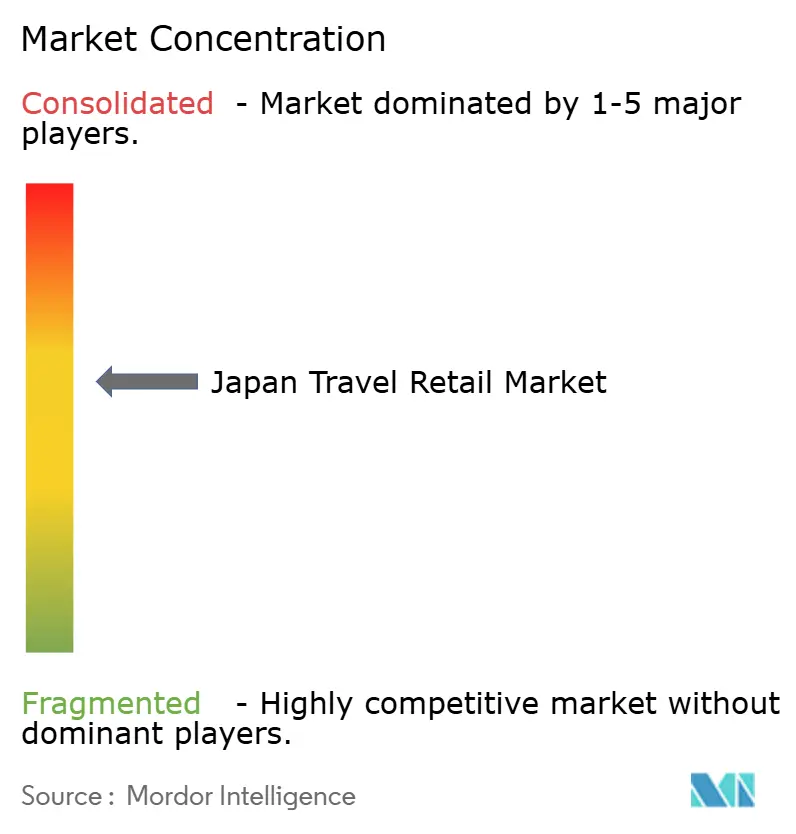
The Japan travel retail market features moderate fragmentation with no single operator above 15% share, which encourages partnerships between airport companies and global travel retailers to secure brand allocations. Kansai Airports worked with Lagardère Travel Retail to deliver a large walk-through duty-free concept that brings multi-category depth and consistent merchandising in a single path. Avolta entered the market in 2025 with a food and beverage footprint that leverages the company’s digital platforms and loyalty to engage travelers who pre-plan purchases and dining. Japan Airport Terminal expanded wholesale and retail links across multiple airports to drive scale benefits and coordinate assortments with operational innovations like robotized replenishment. These moves increase bargaining power with luxury houses and help accelerate rollouts that anchor premium experiences across the Japan travel retail market.
Lotte Duty Free’s Tokyo Ginza store upgraded its floors to balance domestic and inbound demand with Korean fashion and whisky curation that maps to younger and high-intent shopper profiles. DFS Group concentrated on Okinawa’s offshore model and invested in luxury brand spaces that suit the island's shopper needs and align with tourist flows. Airlines amplified retail access through pre-order for allocation of bottles and collaboration goods that can be collected airside or onboard for premium cabins. Technology adoption enabled rapid replenishment and improved availability, which cut lost sales and increased conversion across categories that drive margins. Environmental credentials influence tenders as airport groups highlight carbon accreditation tiers, which carry weight for investors and brand partners.
The portfolio breadth of leading operators provides resilience across cycles as food and beverage, convenience, and luxury cross-subsidize each other under single concession frameworks. Operators that run loyalty ecosystems and own wholesale channels capture data and margin at multiple points, which feeds better category planning and tailored promotions. Staffing tightness remained a constraint, which accelerated trials of low-touch formats that simplify souvenir and essentials sales while preserving service in premium departments. These dynamics point to steady competitive intensity and a premium leaning assortment strategy that aligns with international traffic trends. The net result is a contest for space, brand exclusivity, and digital convenience that defines leadership in the Japan travel retail market.
Japan Travel Retail Industry Leaders
-
Japan Airport Terminal Co. Ltd.
-
NAA Retailing (Fa-So-La)
-
JALUX Inc.
-
ANA Trading Duty Free
-
DFS Group
- *Disclaimer: Major Players sorted in no particular order
Market Opportunities and Future Outlook
The November 2026 shift to a refund-based tax-free model creates near-term whitespace for payment, refund, and compliance technology that links retailers, authorized refund service providers, and customs validation at departure points. Evidence of active buildout includes ITOCHU Corporation's February 2026 strategic alliance with Smart Technologies and Resources to deploy digital systems supporting the upcoming refund framework, and the December 2025 partnership between J&J Tax Free and GMO Payment Gateway to develop a digital platform aligned to the same policy change. For operators, this shifts competition toward frictionless data capture, queue management, and refund orchestration, not only duty-free selling.
Airport redevelopment and capacity-led retail redesign also open space for new store formats, category adjacencies, and non-traditional touchpoints that help address staffing constraints and peak-hour congestion. Kansai International Airport completed the final phase of Terminal 1 renovation in June 2026, expanding international retail space and adding new outlets around a walk-through duty-free core, which supports more consistent passenger capture and higher throughput selling. Parallel pilots reinforce a similar direction, including Panasonic Holdings and Narita International Airport Corporation field trials of mobile robot vending services at Narita in March 2025, which targets incremental revenue capture in high-traffic zones without major fixed-footprint construction, complementing concession-led growth.
Recent Industry Developments
- June 2026: NAA Retailing Corporation, JALUX, and Braskem jointly announced the introduction of shopping bags with 95% biomass certification at Fa-So-La duty-free stores in Narita International Airport, with rollout starting in July 2026. The move strengthens sustainability credentials in airport tenders and brand partnerships while standardizing packaging across a high-volume hub.
- April 2026: JAL-DFS changed its company name to JALUX Travel Retail while maintaining the store brand JAL DUTYFREE. The rebranding consolidates the business under JALUX's travel retail identity, supporting tighter integration of merchandising and customer engagement across its duty-free footprint.
- June 2024: Nikka Whisky announced a JPY 6 billion (USD 38 million) investment to expand storage capacity by 10% to support long-cycle maturation needs. The added capacity underpins supply for premium Japanese whisky allocations that are a high-margin driver in airport duty-free spirits.
Research Methodology Framework and Report Scope
Market Definition and Coverage
Japan travel retail is defined as retail sales made to travelers through travel-linked outlets, where the purchase is tied to a journey and the shopper is a passenger or visitor.
Scope exclusions: Local neighborhood retail that is not travel-triggered, plus hotel minibars and restaurants, are excluded from this sizing.
Segmentation Overview
- By Product Type
- Fashion & Accessories
- Jewelry & Watches
- Wines & Spirits
- Food & Confectionery
- Cosmetics & Fragrances
- Tobacco
- Other Product Types (Stationery, Electronics, etc.)
- By Distribution Channel
- Airports
- Airlines
- Ferries
- Other Channels (Railway Stations, Border Shops, Downtown)
- By Geography
- Hokkaido
- Tohoku
- Kanto
- Chubu
- Kansai/Kinki
- Chugoku
- Shikoku
- Kyushu & Okinawa
Data Sources, Market Sizing, and Validation
Desk Research
For the base structure of the model, we started with Japan travel and retail signals that can be checked consistently each year. Public sources such as Japan National Tourism Organization (JNTO) visitor statistics, Japan Tourism Agency releases, airport operator traffic publications, and customs and trade tables helped us set realistic demand lanes for who is traveling and when. We also reviewed Ministry of Land, Infrastructure, Transport and Tourism (MLIT) aviation summaries and International Air Transport Association (IATA) traffic references where they were useful for directional checks.
On the business side, we used company annual reports, investor presentations, and relevant press coverage to understand store footprints, major concession periods, and category emphasis (for example, cosmetics versus confectionery). A paid subscription for company financials and intelligence and a shipment-level import export database were used selectively to cross-check supplier exposure and product flow signals that can influence assortment and pricing. This list of desk research sources is illustrative, and many other public documents and references were used for data collection, validation, and clarification.
Primary Interviews and Surveys
Primary discussions were run with travel retail operators, brand-side sales teams, travel channel distributors, and a mix of airport and transport-linked stakeholders who see conversion and basket behavior. We used these inputs to confirm what counts as a travel retail purchase in practice, to sanity-check category shares, and to fine-tune assumptions on passenger mix, spend per traveler, and the role of pre-order and pickup formats across Japan.
Distribution of primary research fieldwork respondents
| Company type | Respondent position |
|---|---|
| Top tier: 29% | CXOs: 16% |
| Mid tier: 51% | Functional/Unit leaders: 30% |
| Smaller Players: 20% | Managers: 54% |
Market-Sizing & Forecasting
Market sizing was built using a top-down and bottom-up logic, where the travel flow in Japan is first reconstructed through passenger and visitor volumes and then translated into retail value using spend behavior. In practice, we mapped the main travel nodes and channels (airports, airlines, ferries, and other travel-linked formats) and then applied category-level purchase incidence and average selling price direction to convert traffic into revenue.
The model is sensitive to a few practical inputs that can be checked over time, including international and domestic passenger counts, inbound visitor mix by origin, duty-free allowance and policy shifts, category mix movement (especially fragrances and cosmetics, food and confectionery, and wine and spirits), and price inflation for common travel retail baskets. Because not every operator discloses channel sales cleanly, selective bottom-up approximations were used as checks, including sampled store counts by terminal, typical sales productivity ranges shared in interviews, and channel-level sanity checks on category splits. For forecasting, we used scenario analysis anchored to travel capacity recovery, yen movement expectations, and airport concession expansion timing, and then confirmed the reasonableness of the scenarios through follow-up expert views on shopper conversion and ASP progression.
Data Validation & Update Cycle
Outputs were checked against independent signals such as passenger traffic trends, tourism arrivals, and major airport retail expansion announcements, and then reviewed for year-on-year jumps that did not match the travel context. Where variance was high, assumptions on conversion, category weighting, or currency timing were revisited, and respondents were re-contacted when the gap was large enough to change the outcome.
Before sign-off, the model goes through multi-step internal review so arithmetic, logic, and scope alignment are consistent across chapters. The report is refreshed annually, and interim updates are added when material events occur, such as sudden travel restrictions, major terminal openings, or policy changes that impact duty-free purchasing. Right before delivery, we run a final update pass so clients receive the latest view available at that time.
Mordor Intelligence's Japan Travel Retail Market Size Versus Other Published Estimates
Published market sizes for Japan travel retail can differ even when they sound like the same topic, because teams often count different selling locations, use different travel baselines, and apply their own currency and price assumptions. We focused on making the inputs traceable to travel volumes and traveler shopping behavior, and then linked those inputs to the channels where travel retail actually happens.
Some published figures fold in broader tourism-linked retail that is not necessarily purchased during a journey. In Mordor Intelligence, the value is counted only when sales are tied to travel retail channels such as airports, airlines, ferries, and similar travel-linked outlets, and then validated against passenger trends and category-level spend checks.
Benchmark comparison
| Source | Market Size | Gaps in Research Methodology |
|---|---|---|
| Mordor Intelligence | USD 4.04 B (2025) | |
| Industry Association A | USD 4.70 B (2025) | Uses a wider tourism-retail lens that can include downtown visitor shopping not linked to travel nodes, which lifts totals when domestic retail spillover is counted as travel spend. |
| Global Consultancy B | USD 3.60 B (2025) | Leans on conservative passenger recovery and a tighter duty-free-only definition, and it applies fixed spend per traveler without adjusting enough for category mix and yen-linked pricing. |
The spread in the table is mostly explained by what gets treated as a travel-triggered purchase and how spend per traveler is updated through the year. By tying the estimate to passenger volumes, channel coverage, and interview-tested shopping rates, the final number stays easy to follow and simpler to recreate when new traffic and policy data comes out.
Key Questions Answered in the Report
What is the current size and growth outlook for the Japan travel retail market?
The Japan travel retail market size is USD 4.42 billion in 2026 and is projected to reach USD 6.90 billion by 2031 at a 9.33% CAGR.
Which product categories are leading and growing fastest in Japan travel retail?
Cosmetics and fragrances led with a 45.31% share in 2025, while wines and spirits are forecast to grow at an 11.12% CAGR through 2031.
How dominant are airports in Japan’s travel retail sales?
Airports held 65.35% of sales in 2025 and are projected to grow at a 10.58% CAGR to 2031, supported by terminal upgrades and walk-through formats.
Which regions are most important for Japan travel retail performance?
Kanto accounted for 53.31% of the value in 2025, while Kansai or Kinki is projected to be the fastest-growing region at a 9.82% CAGR through 2031.
How will the 2026 airport refund model affect Japan travel retail?
The November 2026 transition centralizes tax refund validation at the airport and removes packaging rules and purchase caps for consumables while adding new exit confirmation steps.