
Japan Mechanical, Electrical, and Plumbing (MEP) Services Market Size and Share
Market Overview
| Study Period | 2020 - 2031 |
|---|---|
| Forecast Data Period | 2026 - 2031 |
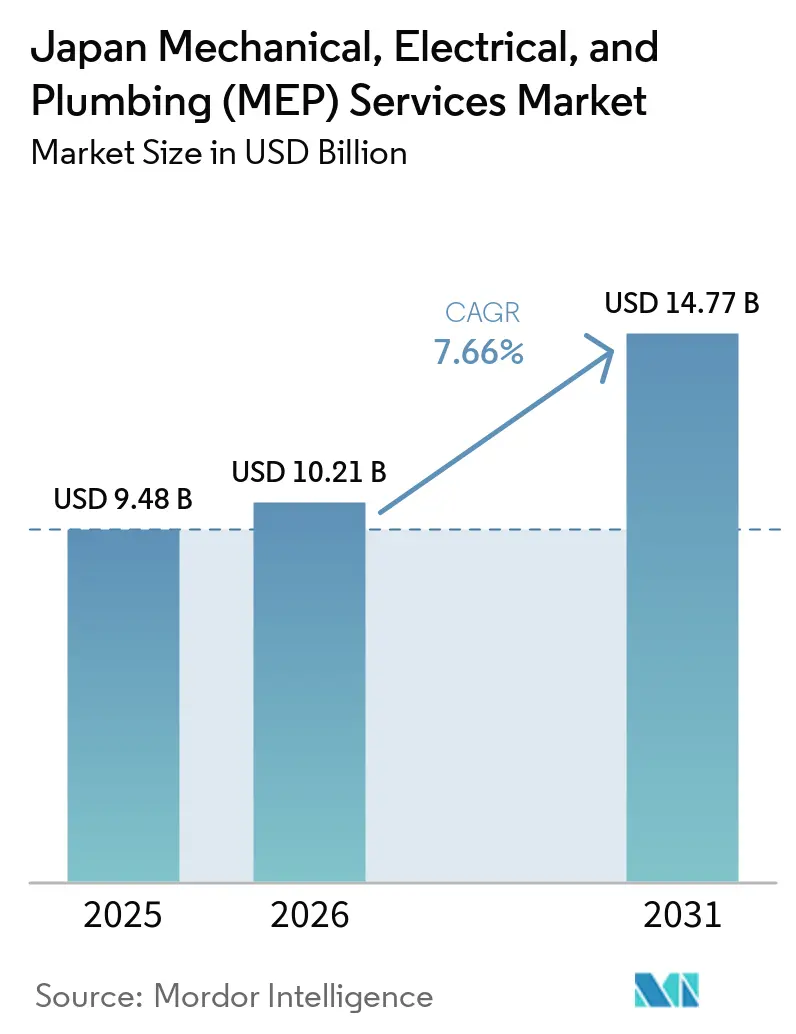
| Base Year Market Size (2025) | USD 9.48 Billion |
| Market Size (2026) | USD 10.21 Billion |
| Market Size (2031) | USD 14.77 Billion |
| Growth Rate (2026 - 2031) | 7.66 % |
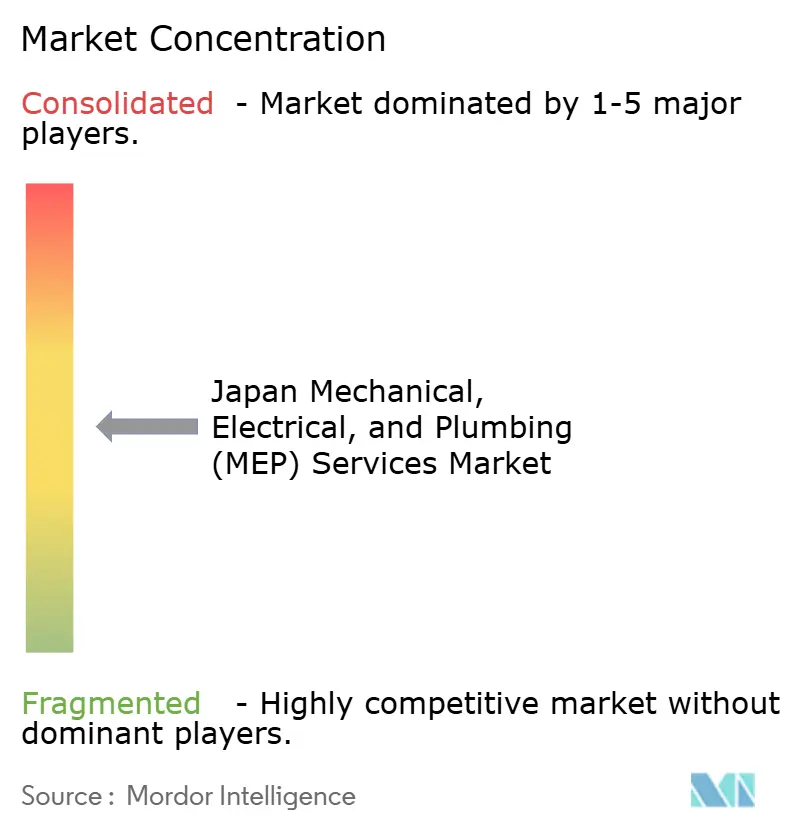
| Market Concentration | Medium |
Major Players *Disclaimer: Major Players sorted in no particular order Image © Mordor Intelligence. Reuse requires attribution under CC BY 4.0. | |
Japan Mechanical, Electrical, and Plumbing (MEP) Services Market Analysis by Mordor Intelligence
The Japan Mechanical, Electrical, And Plumbing Services Market size is expected to grow from USD 9.48 billion in 2025 to USD 10.21 billion in 2026 and is forecast to reach USD 14.77 billion by 2031 at 7.66% CAGR over 2026-2031.
The Japan MEP services market is being supported by data center construction, building upgrades, and policies that favor electrified building systems. Aging offices, homes, and public facilities require replacement of HVAC, electrical, plumbing, and control systems, which supports recurring work throughout the installed base. New semiconductor plants and data centers require specialized cooling, power distribution, piping, resilient backup systems, testing, and controls, which favors contractors with relevant technical capabilities and documented delivery experience on complex facilities. Higher equipment prices and a shortage of skilled workers limit delivery capacity, so firms are selecting projects carefully, planning procurement earlier, and using prefabrication to reduce site labor across construction, commissioning, maintenance, retrofit, and managed services. Policy requirements for energy performance are also shifting demand toward heat pumps, smart controls, lifecycle maintenance, and long-term service contracts that connect building upgrades with operating performance.
Key Report Takeaways
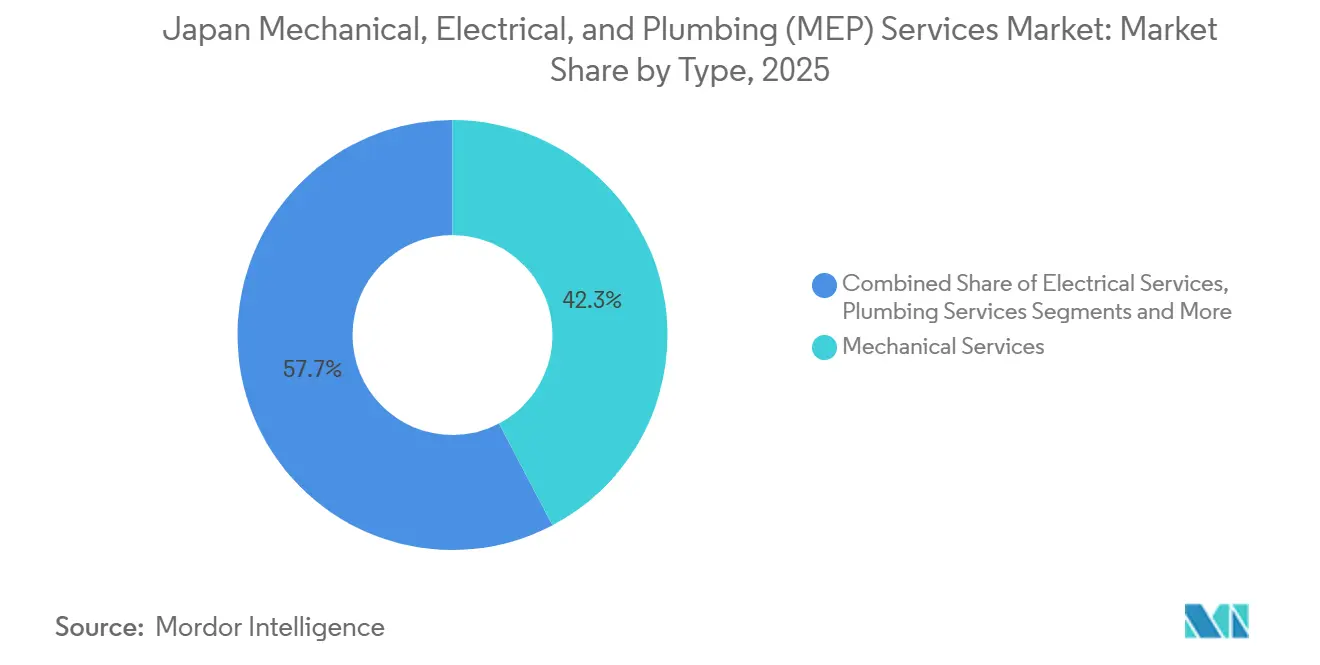
- By type, mechanical services held 42.3% of the Japan MEP services market share and accounted for the largest portion of the Japan MEP services market size in 2025, while integrated MEP services are forecast to grow at an 8.21% CAGR through 2031.
- By service type, maintenance, repair, and retrofit held 37.7% of the Japan MEP services market share and accounted for the largest portion of the Japan MEP services market size in 2025, while managed and performance-based services are forecast to grow at an 8.45% CAGR through 2031.
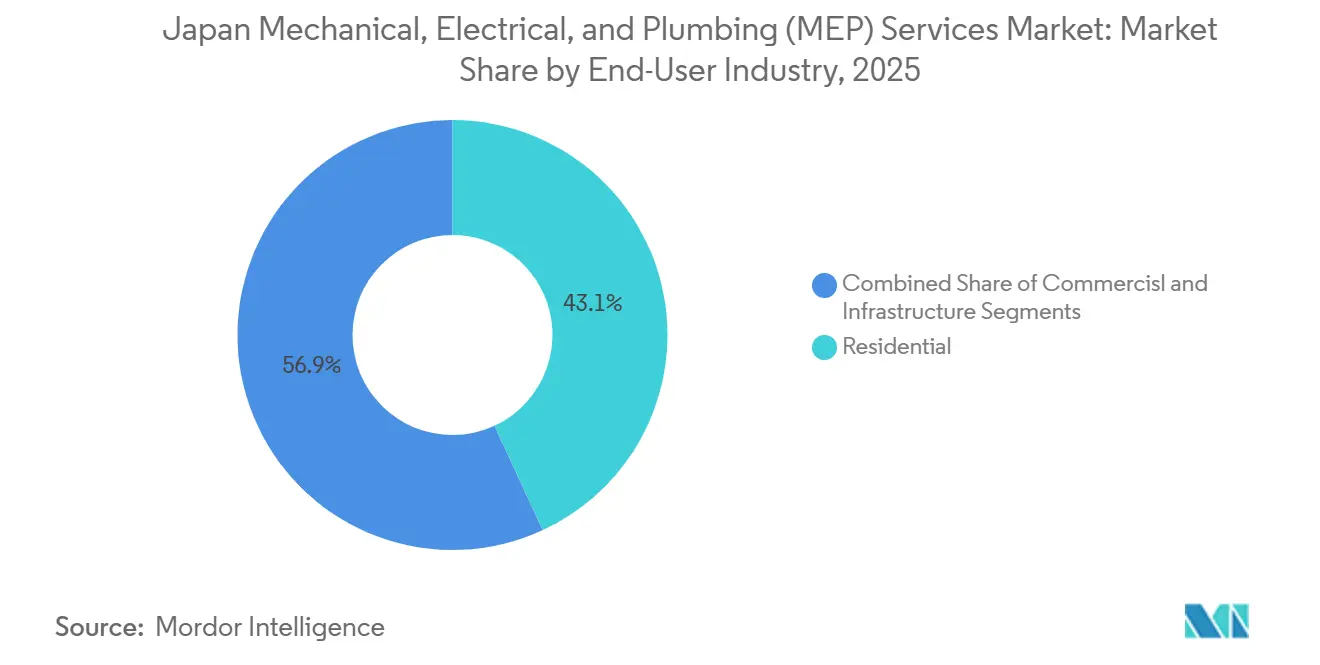
- By end-user industry, residential users held 43.1% of the Japan MEP services market share and accounted for the largest portion of the Japan MEP services market size in 2025, while commercial users are forecast to grow at an 8.77% CAGR through 2031.
- By geography, Tokyo held 40.5% of the Japan MEP services market share and accounted for the largest portion of the Japan MEP services market size in 2025, while Osaka is forecast to grow at a 8.95% CAGR through 2031.
Note: Market size and forecast figures in this report are generated using Mordor Intelligence’s proprietary estimation framework, updated with the latest available data and insights as of January 2026.
Japan Mechanical, Electrical, and Plumbing (MEP) Services Market Trends and Insights
Drivers Impact Analysis*
| Drivers | (~) % Impact on CAGR Forecast | Geographic Relevance | Impact Timeline |
|---|---|---|---|
| AI And Data Center Expansion | +1.8% | Tokyo, Osaka, Hokkaido, Chiba corridor, with spillover to Kyushu and Tohoku | Short term (≤ 2 years) |
| Aging Building Modernization | +1.5% | National, with concentration in Tokyo CBD, Osaka Nakanoshima, and Nagoya Sakae | Medium term (2-4 years) |
| Semiconductor And Advanced Manufacturing Investment | +1.2% | Kumamoto, Hiroshima, Hokkaido, and Iwate, with spillover to Kyushu | Long term (≥ 4 years) |
| Building Decarbonization And Electrification | +1.0% | National, with early gains in Tokyo, Osaka, and energy-efficient new-build clusters | Medium term (2-4 years) |
| Labor-Saving Building Automation | +0.8% | National, with commercial concentration in Tokyo, Osaka, and Fukuoka | Medium term (2-4 years) |
| Healthcare And Institutional Infrastructure Investment | +0.7% | National, including Kobe, Nagoya, and the National Hospital Organization network | Long term (≥ 4 years) |
| Source: Mordor Intelligence | |||
AI and Data Center Expansion Driving Demand for High-Capacity Electrical, Cooling, and Backup Power Systems
AI infrastructure is creating near-term demand for complex electrical and cooling work in the Japanese MEP services market. Dense AI computing equipment needs higher-capacity power systems and more advanced cooling than conventional data center equipment. Direct liquid cooling requires chilled-water piping, heat exchangers, electrical distribution equipment, and coordinated system design. This work raises the share of project value tied to mechanical, electrical, and plumbing systems rather than general building work. Sanki Engineering reported that building HVAC and sanitary orders rose 81.8% in the fiscal year ended March 2026, supported by data center projects. Contractors with verified experience in critical environments are better placed to deliver these systems reliably[1].
Aging Building Stock Generating Recurring Demand for MEP Replacement and Modernization
Aging commercial and residential buildings provide a sustained replacement base for the Japanese MEP services market. More than 70% of the national office floor area was more than 20 years old, which leaves a large installed base of HVAC, electrical, plumbing, and control equipment approaching replacement. Nikken Sekkei completed an MEP-focused renovation of its 57-year-old Osaka building that achieved ZEB Ready certification and reduced annual carbon dioxide emissions by 137 tonnes. The project shows how energy upgrades can extend the economic life of existing buildings. Renovation accounted for 32% of construction investment in 2023, compared with 21% in 2001, indicating that renewal has become a larger part of construction activity. The Building Energy Conservation Act requirements that took effect in April 2025 also make energy upgrades more important for building owners[2].
Semiconductor and Advanced Manufacturing Investment Driving Specialized MEP for High-Specification Facilities
Semiconductor investment is increasing demand for specialized industrial work in the Japanese MEP services market. Cleanrooms need closely controlled temperature and humidity, vibration-managed piping, and systems for handling process water and waste. Tower Semiconductor announced a capacity expansion in Japan in July 2026 with support from the Ministry of Economy, Trade, and Industry, or METI. The project adds to a pipeline of advanced manufacturing facilities that require high-specification HVAC and utility systems. These sites favor specialists who can meet cleanroom requirements and coordinate complex installation sequences. They also create multi-year order opportunities because construction, equipment installation, testing, and maintenance are carried out over several stages[3].
Building Decarbonization Policies Accelerating Electrification of Heating and Energy-Intensive Building Systems
Building decarbonization is expanding replacement demand across the Japanese MEP services market. Japan’s 7th Strategic Energy Plan supports broader electrification across buildings, transport, and industry. METI opened applications in March 2026 for the 2026 high-efficiency water heater program, which supports heat pump water heaters and related equipment. The 2026 Housing Energy Conservation Campaign also covers high-efficiency HVAC equipment and thermal window improvements. These programs support projects that combine heating, ventilation, electrical upgrades, and controls. As buildings move from gas-based systems toward electric heat pumps, contractors gain more work in electrical connections and building control systems.
Restraints Impact Analysis*
| Restraints | (~) % Impact on CAGR Forecast | Geographic Relevance | Impact Timeline |
|---|---|---|---|
| Skilled-Trade Shortages And Aging Workforce | -1.5% | National, with acute shortages in Tokyo and Osaka | Long term (≥ 4 years) |
| Rising Equipment And Material Prices | -1.2% | National, with greater pressure in the Tokyo data center corridor and the Kumamoto semiconductor cluster | Short term (≤ 2 years) |
| Weaknesses in Selected Conventional New-Build Segments | -0.8% | National, with residential new-build contraction in regional cities | Medium term (2-4 years) |
| Complex Seismic, Safety, And Energy Requirements | -0.6% | National, with greater relevance in Tokyo, Osaka, and Tokai | Long term (≥ 4 years) |
| Source: Mordor Intelligence | |||
Skilled-Trade Shortages and Aging Construction Workforce Constraining MEP Contractor Capacity
A shortage of skilled tradespeople limits the delivery capacity of the Japan MEP services market. Workers aged over 55 accounted for 36.7% of the construction labor force in 2025, while people under 29 represented 11.7%. The construction engineering job openings-to-applicants ratio reached 5.64 in 2025. Contractors, therefore, face tighter competition for site supervisors, electricians, pipefitters, and commissioning specialists. The shortage is most difficult for complex projects that need several skilled trades at the same time. Prefabrication can reduce on-site labor, but it cannot fully remove the need for qualified installation and testing teams.
Rising Equipment and Material Prices Increasing Overall MEP Project Costs
Equipment and material inflation is affecting project economics in the Japan MEP services market. Electrical switchgear, controls, panel boards, cooling equipment, and steel pipe are central inputs for MEP projects. Longer lead times for generators and other critical equipment force contractors to order earlier in the project cycle. This increases exposure when contracts are fixed-price or schedules change. The pressure is strongest on data center and semiconductor projects because they need large quantities of specialized equipment. Firms with disciplined procurement and strong supplier relationships are better able to protect delivery schedules and margins.
*Our forecasts treat driver/restraint impacts as directional, not additive. The impact forecasts reflect baseline growth, mix effects, and variable interactions.
Segment Analysis
By Type: Mechanical Services Leads While Integrated MEP Services Records the Fastest Growth
Mechanical services captured 42.3% of the Japan MEP services market share in 2025. HVAC, cooling, ventilation, and sanitary systems carry much of this demand in data centers, cleanrooms, hospitals, and large commercial buildings. These buildings need dependable temperature and humidity control, which keeps mechanical work central to project spending. Plumbing work is increasingly coordinated with mechanical systems where data centers need precision chilled-water distribution. The Japan MEP services market size for mechanical services is also supported by electrical connections and controls that allow these systems to operate safely.
Integrated MEP services are forecast to grow at an 8.21% CAGR through 2031. Semiconductor and data center clients increasingly prefer one provider to coordinate mechanical, electrical, and plumbing work from design through commissioning. This structure reduces interface failures and gives clients a clearer point of responsibility during delivery. Tokyo Tatemono adopted prefabricated MEP methods at the Zeus OSA1 hyperscale data center in Osaka in January 2026 to reduce site labor needs and stabilize schedules. Integrated contractors can then extend their work into maintenance and performance management.

By Service Type: Maintenance, Repair, and Retrofit Leads While Managed Services Gain Momentum
Maintenance, repair, and retrofit held 37.7% of the Japan MEP services market share in 2025. Older offices, homes, public buildings, and industrial facilities need recurring work to keep equipment safe, reliable, and energy efficient. Replacement work includes heat pumps, ventilation, electrical panels, pumps, pipes, and building management controls. Each upgrade also creates future demand for inspection, repair, monitoring, and eventual replacement. The Japan MEP services market size for this service type is supported by lifecycle spending after equipment installation.
Managed and performance-based services are forecast to grow at an 8.45% CAGR through 2031. Buyers are adopting contracts that connect payment with energy performance, equipment uptime, or clear operating outcomes. Service providers can use continuous monitoring to identify faults before they disrupt a building or critical facility. METI’s data center efficiency measures increase attention to power use and operational efficiency, while Daikin’s semi-custom system lowers control-system engineering effort. These changes broaden the case for contracts that combine maintenance, software, monitoring, and energy management.
By End-User Industry: Residential Users Lead While Commercial Users Grow Fastest
Residential users held 43.1% of the Japan MEP services market share in 2025. Japan’s large housing stock requires replacement water heaters, HVAC equipment, ventilation, wiring, plumbing, and energy upgrades. The 2026 Housing Energy Conservation Campaign supports high-efficiency water heaters, air-conditioning equipment, ventilation, and thermal improvements. These measures broaden the range of projects available to homeowners and local contractors. They also create opportunities for equipment suppliers and service providers to secure maintenance work after installation.
Commercial users are forecast to grow at an 8.77% CAGR through 2031. Data centers, office redevelopment, pharmaceutical facilities, and hospitals are creating more demanding commercial requirements. Mitsubishi Estate launched the CIRCLES∞ renovation office series in July 2026, starting a full MEP renovation in Tokyo and planning an Osaka project. Commercial projects need coordinated systems that reduce energy use while supporting tenant comfort, digital operations, and resilience. Healthcare work adds demand for redundant electrical supply, medical gas, specialized HVAC, and ongoing compliance support.
Geography Analysis
Tokyo held 40.5% of the Japan MEP services market share in 2025, making it the largest city-level opportunity. Its headquarters, redevelopment sites, and critical digital infrastructure support large electrical and cooling contracts. Demand extends into Chiba, where data center projects can be located close to major power infrastructure. NTT DATA is developing the 250 MW TKY11 campus in Chiba, requiring electrical, mechanical, plumbing, commissioning, and maintenance work. Contractors with specialized engineers and supplier access are well placed to serve this demanding project environment.
Osaka is forecast to grow at a 8.95% CAGR through 2031, the fastest rate among the listed city markets. Its redevelopment pipeline is centered on commercial space, district heating and cooling, and energy-efficient buildings. The expanded Osaka Station network creates long-term MEP opportunities in connected buildings and related support systems. Labor availability remains a constraint because major projects require several specialized trades. The Japan MEP services market size in Osaka is supported by redevelopment, although delivery capability will determine project timing.
Nagoya benefits from commercial construction and the shift toward automotive electrification. The Landmark Nagoya Sakae complex, completed in early 2026, incorporated district heating and cooling and received CASBEE S-rank certification. Other regions are gaining from semiconductor projects in Kumamoto, Hiroshima, Hokkaido, and Iwate. Tower Semiconductor’s July 2026 Japan expansion supports regional demand for cleanroom HVAC, utility piping, and electrical systems.
Competitive Landscape
The Japan MEP services market has moderate concentration. Takasago Thermal Engineering, Shinryo Corporation, Sanki Engineering, Dai-Dan, Kinden, and Nippon Densetsu Kogyo compete for technically demanding projects. These firms have stronger positions in critical cooling, cleanrooms, electrical systems, and integrated delivery. Their technical capacity supports higher-value work in data centers, semiconductor facilities, hospitals, and major redevelopment projects. The wider contractor base remains fragmented in local renovation and standard plumbing work.
Strategic moves focus on workforce capacity, prefabrication, and digital service delivery. Kinden completed its full acquisition of Kodensha in 2026, strengthening its electrical engineering workforce and technical portfolio. NTT Facilities disclosed a modular MEP frame system in July 2026 that uses design for manufacture and assembly, or DfMA, for chilled-water piping and electrical bus ducts. The approach reduces on-site labor needs and improves repeatability on hyperscale data center projects. Daikin’s semi-custom building management system reduced engineering hours by 50%, strengthening its position in controls and performance-based services.
Equipment suppliers are extending their role through connected controls and service platforms. Daikin, Hitachi Building Systems, Mitsubishi Electric, and Johnson Controls combine equipment with building management and energy data capabilities. Established specialists retain an advantage because energy and safety compliance requires quality systems and experience in regulated facilities. Smaller contractors can compete in local retrofit work, but may find it harder to secure complex data center, semiconductor, and hospital projects.
Japan Mechanical, Electrical, and Plumbing (MEP) Services Industry Leaders
-
Takasago Thermal Engineering Co., Ltd.
-
Shinryo Corporation
-
Sanki Engineering Co., Ltd.
-
Taisei Corporation
-
Dai-Dan Co., Ltd.
- *Disclaimer: Major Players sorted in no particular order
Recent Industry Developments
- October 2026: JERA partnered with Dell and a UK AI cloud provider to build a USD 15 billion data center adjacent to JERA's Chiba thermal power station. The project requires advanced electrical distribution, liquid cooling, and plumbing systems.
- September 2026: Kobe City selected a contractor for the New Nishi Citizens’ Hospital project, which requires high-redundancy electrical distribution, medical gas plumbing, and hospital-grade HVAC.
- July 2026: Tower Semiconductor announced a Japan capacity expansion supported by METI. The cleanroom project requires high-precision HVAC and ultrapure-water plumbing systems.
Japan Mechanical, Electrical, and Plumbing (MEP) Services Market Report Scope
| Mechanical Services |
| Electrical Services |
| Plumbing Services |
| Integrated MEP Services |
| Design and Engineering |
| Installation, Testing, and Commissioning |
| Maintenance, Repair, and Retrofit |
| Managed / Performance-Based Services |
| Residential |
| Commercial |
| Infrastructure |
| Tokyo |
| Osaka |
| Nagoya |
| Rest of Japan |
| By Type | Mechanical Services |
| Electrical Services | |
| Plumbing Services | |
| Integrated MEP Services | |
| By Service Type | Design and Engineering |
| Installation, Testing, and Commissioning | |
| Maintenance, Repair, and Retrofit | |
| Managed / Performance-Based Services | |
| By End-User Industry | Residential |
| Commercial | |
| Infrastructure | |
| By City | Tokyo |
| Osaka | |
| Nagoya | |
| Rest of Japan |
Key Questions Answered in the Report
What is the projected value of Japan MEP services in 2031?
The Japan MEP services market is projected to reach USD 14.77 billion by 2031, growing at a 7.66% CAGR from 2026. Replacement work, data center construction, semiconductor facilities, and electrification programs support the forecast.
Which MEP service type held the largest share in Japan?
Maintenance, repair, and retrofit led service types with a 37.7% share in 2025. Its position reflects recurring demand from aging offices, homes, public facilities, and industrial buildings.
Which end-user group is growing fastest for MEP services in Japan?
Commercial users are forecast to grow at an 8.77% CAGR through 2031. Data centers, office redevelopment, pharmaceutical facilities, and hospitals are the main sources of specialized commercial demand.
Why are data centers important to MEP contractors in Japan?
They need high-capacity power, advanced cooling, piping, controls, testing, and maintenance. These requirements increase the value of integrated technical delivery and favor experienced specialist contractors.
Which Japanese city is expected to record the fastest growth?
Osaka is expected to grow at a 8.95% CAGR through 2031. Redevelopment, district heating and cooling expansion, and energy-efficiency upgrades are supporting the city’s project pipeline.
What is the main constraint on MEP project delivery in Japan?
A shortage of skilled tradespeople limits capacity for installation, commissioning, and maintenance, particularly on complex projects. Equipment inflation and long procurement lead times also create planning and cost pressure.