
Market Overview
| Study Period | 2021 - 2031 |
|---|---|
| Forecast Data Period | 2026 - 2031 |
| Base Year Market Size (2025) | USD 1.5 Billion |
| Market Size (2026) | USD 1.57 Billion |
| Market Size (2031) | USD 1.96 Billion |
| Growth Rate (2026 - 2031) | 4.56 % |
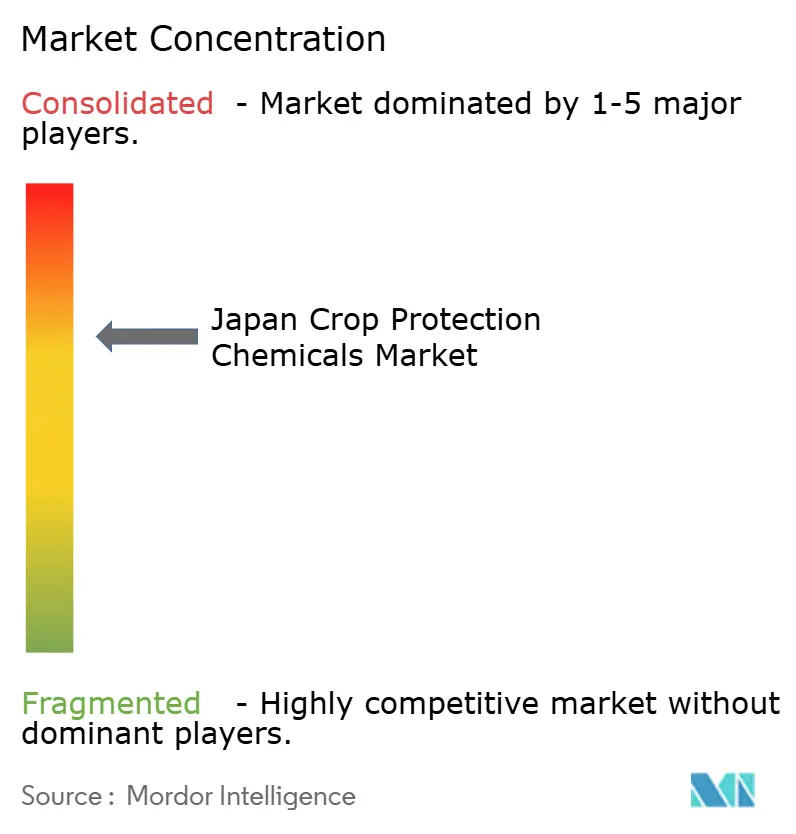
| Market Concentration | Medium |
Major Players *Disclaimer: Major Players sorted in no particular order Image © Mordor Intelligence. Reuse requires attribution under CC BY 4.0. | |
Japan Pesticides Market Analysis by Mordor Intelligence
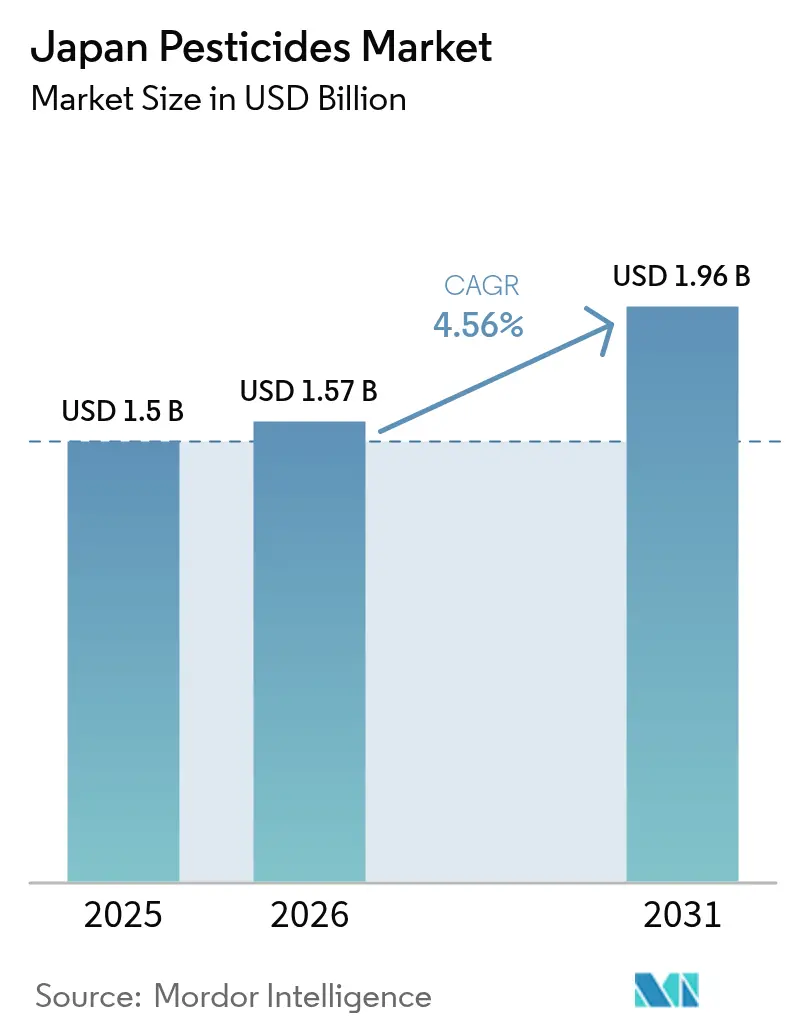
The Japan pesticides market size is expected to grow from USD 1.5 billion in 2025 to USD 1.57 billion in 2026 and is forecast to reach USD 1.96 billion by 2031 at 4.56% CAGR over 2026-2031. This projection highlights the steady transition of a mature farming sector toward data-driven, low-residue solutions, precision delivery systems, and increased deployment of biologically active ingredients. Behind the headline CAGR lies a confluence of drivers: government incentives that reward pesticide-risk reduction, climate variability that elevates pest pressure, a rapidly aging farming population that embraces labor-saving technologies, and continuous innovation in microencapsulation and drone-ready formulations. Competitive strategies are shifting toward portfolio diversification and cross-border expansion as local demand plateaus, while supply-chain resilience has become a boardroom priority after ingredient shortages exposed dependencies on imported raw materials.
Key Report Takeaways
- By origin, synthetic products captured 70.40% of the Japan pesticides market share in 2025, whereas bio-based solutions are advancing at a 8.75% CAGR through 2031.
- By type, herbicides led with 44.95% revenue share in 2025, while miticides are projected to post the fastest 8.36% CAGR to 2031.
- By crop type, fruits and vegetables accounted for 29.85% of the Japan pesticides market size in 2025, and horticultural and ornamental crops are poised to grow at a 7.05% CAGR through 2031.
- By application, foliar spraying held a 50.35% share of the Japan pesticides market in 2025, whereas aerial and drone application is scaling at a 9.08% CAGR to 2031.
- By formulation, liquid concentrates commanded 47.45% of the Japan pesticides market in 2025, while microencapsulated products are recording a 7.34% CAGR to 2031.
Note: Market size and forecast figures in this report are generated using Mordor Intelligence’s proprietary estimation framework, updated with the latest available data and insights as of 2026.
Market Trends and Insights
Drivers Impact Analysis of Japan Pesticides Market*
| Driver | (~) % Impact on CAGR Forecast | Geographic Relevance | Impact Timeline |
|---|---|---|---|
| Government initiatives and policies for Sustainable Food | +1.2% | National, with early adoption in Hokkaido and Kyushu regions | Medium term (2-4 years) |
| Rising pest pressure driven by climate volatility | +0.8% | National, with acute impact in southern prefectures | Short term (≤ 2 years) |
| Accelerated adoption of labor-saving herbicides by aging farmers | +0.6% | Rural areas nationwide, concentrated in rice-growing regions | Medium term (2-4 years) |
| Rapid uptake of bio-based pesticides | +0.7% | National, with premium adoption in organic farming clusters | Long term (≥ 4 years) |
| Expansion of drone-enabled precision spraying | +0.4% | National, with early deployment in large-scale farming operations | Medium term (2-4 years) |
| Growth of protected horticulture complexes boosting fungicide demand | +0.3% | Urban periphery and controlled environment agriculture zones | Long term (≥ 4 years) |
| Source: Mordor Intelligence | |||
Government initiatives and policies for Sustainable Food
Japan’s MIDORI Strategy mandates a 50% reduction in risk-weighted chemical pesticide use by 2050 and allocates JPY 2.2683 trillion (USD 15.1 billion) for subsidizing farmers who halve synthetic applications.[1] The combination of direct payments, expedited approvals for low-dose actives, and labeling incentives is pushing the Japan pesticides market toward higher efficacy per hectare and wider use of biocontrol agents. Suppliers that align portfolios with these guidelines are securing preferential registration, while export-oriented firms leverage Japan’s elevated standards to differentiate in international markets. The policy pressure also accelerates research into micro-dosed formulations that maintain yield while satisfying residue targets, a focal point for domestic innovators.
Rising pest pressure driven by climate volatility
Weather volatility is intensifying migrant pest influx, notably the brown planthopper that now reaches Kyushu under favorable wind currents more frequently. The phenomenon compresses spray windows and forces farmers to adopt broad-spectrum or sequential applications, strengthening demand within the Japan pesticides market. High-resolution S-18 climate modelling data enable region-tailored product positioning, while manufacturers incorporate predictive pest analytics into advisory platforms to secure growers’ loyalty.
Accelerated adoption of labor-saving herbicides by aging farmers
With the average farmer age at 67 years, manual weeding in rice paddies is no longer viable. Subsidized smart-farming programs bundle herbicide products with autonomous tractors and precision sprayers, lifting herbicide volume and fostering brand stickiness. Companies offering integrated weed-control packages are having faster market penetration, though the trend is tempered by herbicide-resistant weeds that require rotational chemistry strategies.
Growth of protected horticulture complexes boosting fungicide demand
Japan maintains a vast area of greenhouse space, and its Next Generation Greenhouse Program favors high-yield hydroponics with tight disease control requirements. Fungicide formulations with low volatilization and prolonged residual activity suit recirculating systems, giving originators a premium pricing corridor. Tailored integrated pest-management protocols align with energy-efficient greenhouse targets, deepening collaboration between chemical providers and equipment vendors.
Restraints Impact Analysis of Japan Pesticides Market*
| Restraint | (~) % Impact on CAGR Forecast | Geographic Relevance | Impact Timeline |
|---|---|---|---|
| Stringent registration and MRL compliance timelines | -0.9% | National, with stricter enforcement in export-oriented regions | Short term (≤ 2 years) |
| Heightened consumer scrutiny of chemical residues | -0.6% | Urban markets and premium agricultural zones | Medium term (2-4 years) |
| Escalating herbicide-resistant weed populations | -0.4% | Rice-growing regions and intensive cropping systems | Long term (≥ 4 years) |
| Intermittent shortages of critical formulation additives | -0.3% | National, with acute impact on specialty formulation producers | Short term (≤ 2 years) |
| Source: Mordor Intelligence | |||
Stringent registration and MRL compliance timelines
The Ministry of Health, Labour and Welfare cut cabbage methomyl residue limits from 0.7 mg/kg to 0.5 mg/kg, and 141 new substances entered regulatory scrutiny in 2024. These shifts raise toxicology study costs, delay product launches, and weigh on smaller registrants in the Japan pesticides market. Companies respond by pooling data across global subsidiaries and prioritizing dual-use chemistries designed for Japan and European Union alignment to amortize dossiers.
Heightened consumer scrutiny of chemical residues
Echinochloa crus-galli var. formosensis and Alopecurus aequalis now resist multiple sites of action. Rotation of new modes of action raises per-acre cost and prompts growers to incorporate mechanical or biological controls, diluting herbicide growth. Research and Development pipelines fast-track proprietary actives but must navigate the lengthy domestic approval gauntlet.
*Our forecasts treat driver/restraint impacts as directional, not additive. The impact forecasts reflect baseline growth, mix effects, and variable interactions.
Japan Pesticides Market Segment Analysis
By Origin:
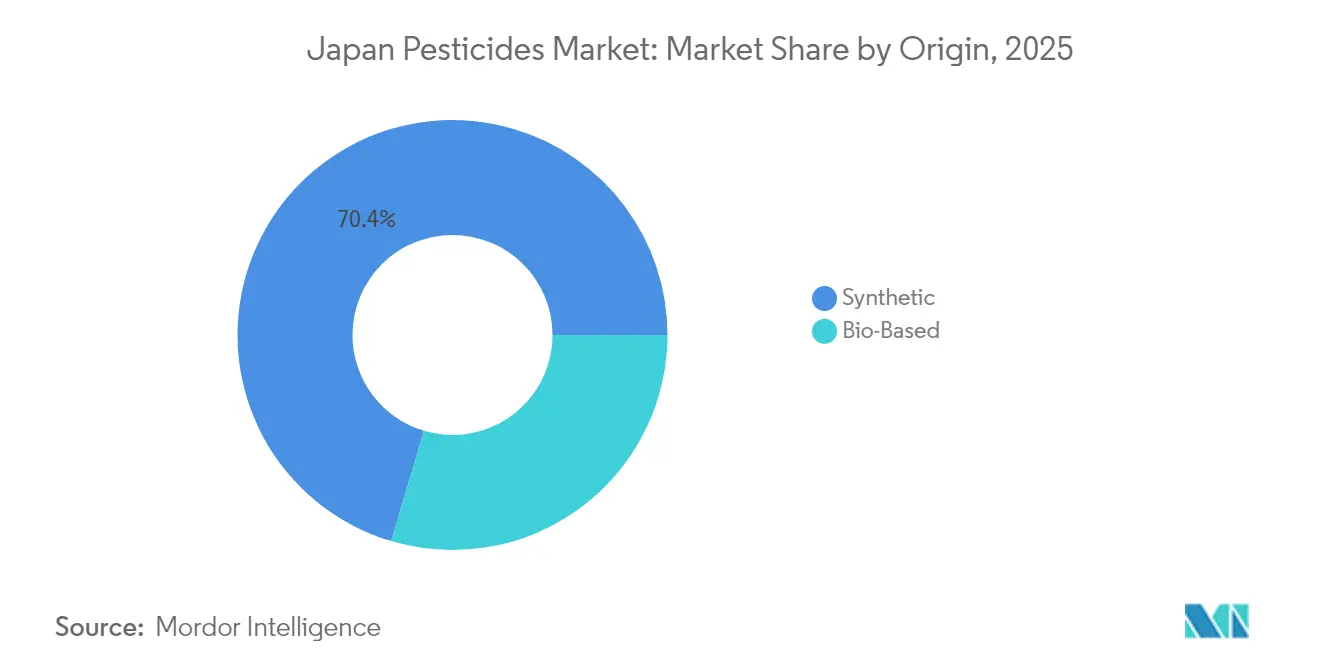
Bio-based solutions accelerate diversificationSynthetic-based pesticides retained a 70.40% grip on the Japan pesticides market share in 2025 due to proven efficacy, ease of storage, and broad-spectrum performance valued by aging growers. Bio-based products are climbing at a 8.75% CAGR on the back of regulatory accelerators and consumer pull. Farmers cutting synthetic volume by 50% unlock direct payment eligibility, reinforcing the appeal of biological alternatives. At the same time, multinationals are licensing microbial actives from local startups to hedge against synthetic dependency.
The bio-based pesticides foster co-formulations that blend low-dose chemistry with living organisms, delivering robust control at reduced toxic-load indices. This hybrid strategy positions suppliers to satisfy MIDORI targets without compromising yield. Regulatory frameworks under MAFF's Strategy for Sustainable Food Systems provide preferential treatment for biological products, including expedited registration processes and financial incentives that are reshaping competitive dynamics between synthetic and bio-based segments.

By Type:
Herbicide stewardship dictates growth trajectoryHerbicides secured 44.95% of sales in 2025 as mechanization‐averse rice farmers adopted single-shot weed knockdown products. Yet herbicide resistance is a mounting risk that propels miticide and fungicide innovation. Miticides are accelerating at 8.36% CAGR, fueled by spider-mite outbreaks in greenhouse tomatoes and cucumbers. Fungicides maintain steady demand through greenhouse cultivation expansion, while insecticides face pressure from integrated pest management adoption and biological control alternatives. Nematicides represent a specialized segment serving high-value crops and protected cultivation systems requiring soil-borne pest control.
The herbicide segment confronts escalating resistance challenges, with multiple weed species, including Taiwan barnyardgrass, developing resistance to Groups 1 and 2 herbicides, necessitating rotation strategies and novel active ingredients. Kumiai Chemical's pyroxasulfone herbicide demonstrated 26% compound annual growth from 2013 to 2023, indicating market appetite for effective new chemistries. The National Agriculture and Food Research Organization's development of systematic herbicide control methods for invasive species demonstrates ongoing innovation in application techniques and resistance management strategies.
By Crop Type:
High-value crops set demand toneFruits and vegetables absorbed 29.85% of expenditures in 2025 as consumers paid premiums for visually perfect produce. Horticultural and ornamental crops, including cut flowers, are on track for a 7.05% CAGR under urban agriculture schemes and vertical farms. Grains and cereals maintain substantial volume despite declining acreage, while pulses and oilseeds benefit from crop diversification initiatives. Commercial crops, including tobacco and industrial applications, represent specialized market niches with specific regulatory and technical requirements.
Growers in controlled environments seek residue-free labels and uniform appearance, favoring biopesticides and micro-encapsulated fungicides that preserve shelf life. The Next Generation Greenhouse Program targets increased domestic vegetable production through modern facility agriculture, creating opportunities for fungicides and specialized formulations designed for enclosed growing systems. Hydroponics adoption is accelerating with technological advances, requiring crop protection products compatible with soilless growing media and recirculating nutrient systems.
By Application:
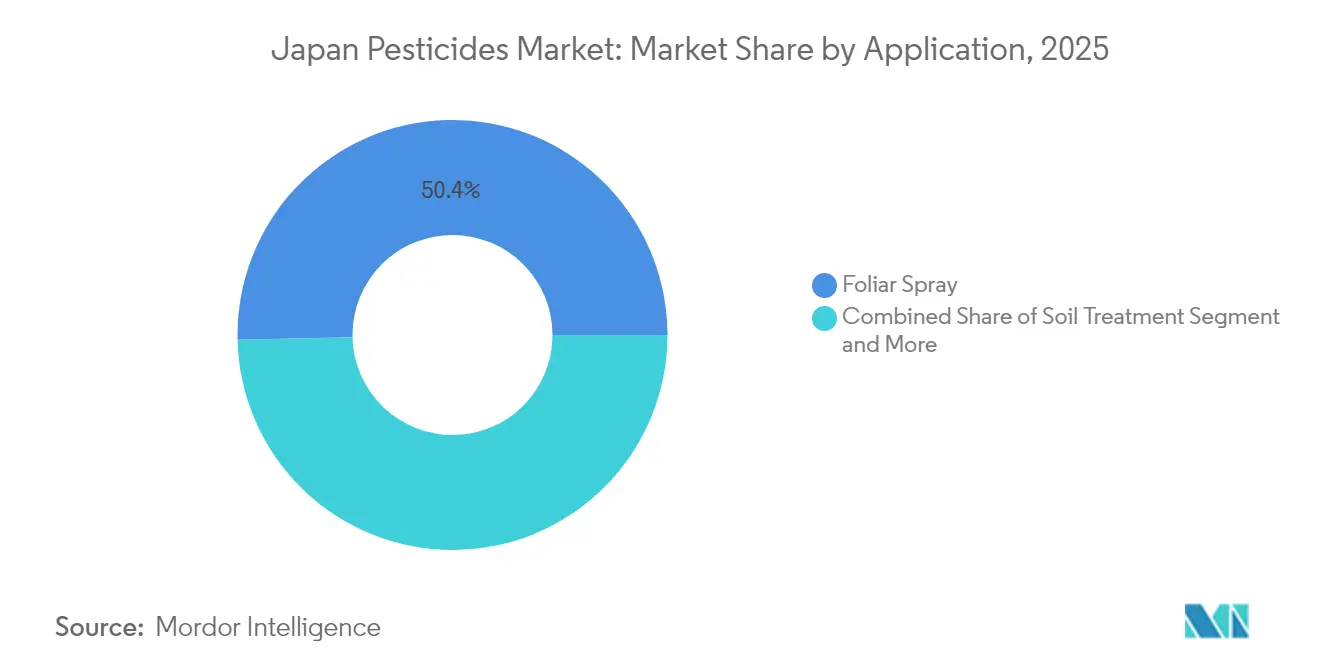
Drones reshape service ecosystemFoliar spray applications maintain dominance with a 50.35% market share in 2025, benefiting from established application infrastructure and farmer familiarity with conventional spraying equipment. Aerial and drone applications are experiencing explosive growth at a 9.08% CAGR through 2031, supported by technological partnerships and government initiatives promoting precision agriculture. Soil treatment and seed treatment methods serve specialized market segments, while chemigation offers efficient delivery for irrigated crops. The application mode landscape is evolving rapidly as aging farmers seek labor-saving alternatives and precision agriculture technologies mature.
OPTiM Corporation's Pinpoint Time Spraying service covered 26,000 hectares across 133 municipalities in fiscal 2024, demonstrating the commercial viability of drone-based application systems with over 94% user retention rates. Sumitomo Corporation's partnership with JA Miyagi Tome utilizing Nileworks drones achieves operational efficiency gains, completing hectare spraying in 10 minutes compared to conventional methods. The Ministry of Agriculture, Forestry, and Fisheries selected Terra Drone Corporation for Southeast Asian expansion projects, indicating government support for drone technology development and international market penetration.
By Formulation:
Controlled release fuels next-gen productsLiquid concentrates dominate the formulation landscape with a 47.45% share of the Japan pesticides market size in 2025, offering versatility and ease of application that appeals to diverse farming operations. Microencapsulated formulations are experiencing rapid growth at a 7.34% CAGR through 2031, driven by demand for controlled-release properties and reduced environmental impact. Wettable powders and granules serve traditional application methods, while suspension concentrates offer enhanced stability and handling characteristics. The formulation segment is experiencing technological innovation focused on improving efficacy, reducing drift, and extending residual activity.
Microencapsulation technology is advancing through research partnerships and patent development, with innovations in thermosensitive release properties and synergistic active ingredient combinations. Chemical and Pharmaceutical Bulletin. Yanmar developed agricultural spraying technology that reduces pesticide use by 40% while improving leaf coverage through two-stage spraying and leaf-turning mechanisms Yanmar Holdings. Patent activity in encapsulated fumigants and agricultural oil dispersion formulations demonstrates ongoing innovation in delivery systems designed to enhance efficacy while minimizing environmental impact.
Geography Analysis
Hokkaido’s expansive grain farms rely on herbicide programs integrated with autonomous machinery to offset labor scarcity. Central prefectures such as Niigata specialize in rice paddies that demand selective herbicides and fungicides to manage sheath blight. In contrast, Kyushu and Shikoku endure subtropical humidity that drives higher insect and mite pressure, boosting sales of miticides and bio-insecticides. Urban peripheries around Tokyo and Osaka harbor the majority of protected horticulture acreage, creating a hotspot for specialty fungicides adapted to high-humidity enclosures.
Southern prefectures experience the earliest onset of migrant pests, prompting swift uptake of drone services for rapid containment. Coastal regions leverage chemigation in winter vegetable tunnels, while mountainous areas explore pheromone trapping to protect smallholder citrus groves. Across all geographies, the Japan pesticides market is shaped by logistics advantages near ports such as Kobe and Yokohama, where formulation plants cluster to expedite import raw-material handling and outbound finished goods distribution.
Regional cooperation programs funded under the Climate Change Adaptation Act encourage prefectures to adopt localized best practices, from alternate wetting and drying irrigation in rice paddies to mesh-screen retrofits in greenhouses. Such initiatives reinforce technology diffusion and stimulate demand homogenization, yet microclimatic variation sustains differentiated product portfolios across the archipelago.
Regulatory Landscape
Japan regulates crop protection products primarily under the Agricultural Chemicals Regulation Act, which governs registration, sale, and use. Registration is administered by the Ministry of Agriculture, Forestry and Fisheries (MAFF), with technical screening handled through the Food and Agricultural Materials Inspection Center (FAMIC), and product registrations tied to the specific brand, formulation, and applicant.
Food-use compliance is enforced through the Food Sanitation Act and its Positive List System for pesticide residues, which restricts distribution of foods exceeding established maximum residue limits, and applies a 0.01 ppm default standard when no limit is set. Since the 2018 amendment to the Agricultural Chemicals Regulation Act, registered pesticides also undergo periodic re-evaluation using updated scientific knowledge, and MAFF finalized a procedural notification amendment in April 2025 covering re-evaluation processes for pesticides and substances containing identical active ingredients.
Competitive Landscape
The Japan pesticide market exhibits moderate concentration, with the top five suppliers capturing around 70% of revenue. Sumitomo Chemical Co., Ltd., leverages a pipeline of microbial actives and global licensing deals to reinforce domestic dominance while expanding in Europe through the acquisition of Philagro Holding S.A. and Kenogard S.A. Syngenta CropProtection AG (Syngenta Group) couples digital advisory platforms with blockbusters like azoxystrobin to anchor share among export-oriented vegetable growers. Bayer AG focuses on tailored seed treatment packages synchronized with drone delivery protocols, securing sticky revenue in maize and oilseed niches.
Mitsui Chemicals Agro, Inc. (Mitsui Chemicals, Inc.) channels advanced encapsulation Research and Development into patented formulations aimed at minimizing drift and operator exposure, differentiating in greenhouse crops. FMC Corporation capitalizes on diamide chemistry and long-residual insecticides, often bundling with resistance-management training modules to position itself as a stewardship leader. Smaller domestic firms, such as Nihon Nohyaku Co., Ltd. and Hokko Chemical Industry Co., Ltd., focus on specialty fungicides and export-oriented contract manufacturing.
Strategic alliances are proliferating as chemical vendors seek drone fleet data, e-commerce reach, and biological screening libraries. Intellectual-property enforcement remains stringent. Kumiai Chemical Industry Co., Ltd.’s 2024 legal actions to protect pyroxasulfone patents exemplify active defense of innovation rent within the Japan pesticides market. Supply-chain risk mitigation drives local warehousing and dual-sourcing, while carbon-footprint accounting begins to influence procurement tenders by cooperatives.
Japan Pesticides Industry Leaders
-
Sumitomo Chemical Co., Ltd.
-
Syngenta CropProtection AG (Syngenta Group)
-
Bayer AG
-
Mitsui Chemicals Agro, Inc. (Mitsui Chemicals, Inc.)
-
FMC Corporation
- *Disclaimer: Major Players sorted in no particular order
Japan Pesticides Market Companies Covered in this Report
- Sumitomo Chemical Co., Ltd.
- Syngenta CropProtection AG (Syngenta Group)
- Bayer AG
- Mitsui Chemicals Agro, Inc. (Mitsui Chemicals, Inc.)
- BASF SE
- FMC Corporation
- Nissan Chemical Corporation
- Nihon Nohyaku Co., Ltd (ADEKA Corporation)
- Kumiai Chemical Industry Co., Ltd
- UPL Limited
- OAT Agrio Co., Ltd
- Corteva Agriscience
- Hokko Chemical Industry Co., Ltd
- Nippon Soda Co., Ltd
- Ishihara Sangyo Kaisha, Ltd
Market Opportunities and Future Outlook
Policy-linked demand is creating whitespace for low-residue, risk-reduction portfolios and services that help growers document compliance. Japan's Green Food System Strategy sets chemical pesticide reduction targets (10% reduction by 2030 versus a 2019 baseline using a risk-conversion value, and 50% reduction by 2050), which raises the commercial appeal of bio-based actives, micro-dose chemistries, and integrated pest management (IPM) programs that reduce reliance on broad-spectrum spraying.
Opportunities are also forming in outcome-based and digital delivery models that combine agronomy with application execution. BASF introduced xarvio HEALTHY FIELDS in Japan as an outcome-based service model for rice weed control, reflecting a shift from product-only selling to performance-guaranteed offerings. On the supply side, manufacturers are aligning new active development and capacity planning with Japan registration pathways, including Sumitomo Chemical submitting registration applications in July 2026 for the new fungicide bifemetstrobin, and Nissan Chemical establishing new herbicide manufacturing capacity for Ryzonic (iptriazopyrid) at its Indian subsidiary, supporting pipeline continuity for Japan alongside other Asian markets.
Recent Industry Developments in Japan Pesticides Market
- July 2026: Sumitomo Chemical submitted registration applications in Japan for its new fungicide bifemetstrobin, positioned as an energy-production inhibitor for diseases including soybean rust. The filing points to continued late-stage innovation activity in Japan despite stringent data and MRL compliance requirements. It also supports portfolio shifts toward differentiated, higher-value fungicides aligned with intensive horticulture and export-quality production.
- February 2025: BASF initiated registration for its new insecticide active ingredient Prexio Active, targeting all four rice hopper species, with dossiers submitted across key Asia-Pacific markets including Japan as a launch geography. The company move reflects ongoing R&D investment focused on rice pest complexes that compress spray windows and strain existing chemistry. It also expands the set of novel actives competing for registration and shaping stewardship positioning in Japan.
- December 2024: Idemitsu Kosan acquired Agro-Kanesho for JPY 23 billion (USD 154 million), marking Idemitsu's entry into Japan crop protection. The deal expanded Idemitsu's agricultural inputs footprint by adding established pesticide products and channels. It also created a new strategic owner with energy and chemicals capabilities that can influence procurement, formulation scale-up, and distribution across Japan.
Japan Pesticides Market Report Scope and Research Methodology
Market Definition and Coverage
This market covers pesticides used in Japan to protect crops from insects, weeds, and diseases, counted as the value of crop protection products sold for agricultural use across major crop types and application methods.
Scope exclusions: We do not count pesticides used mainly for household, public health, or other non-agricultural pest control purposes.
Segments Covered in This Report
- By Origin
- Synthetic
- Bio-based
- By Type
- Herbicide
- Fungicide
- Insecticide
- Miticide
- Nematicide
- Other Types (Rodenticide, Bactericide, etc.)
- By Formulation
- Liquid Concentrates
- Wettable Powders
- Granules
- Microencapsulated
- Suspension Concentrates
- By Crop type
- Grains and Cereals
- Pulses and Oilseeds
- Fruits and Vegetables
- Commercial Crops
- Ornamental Crops
- Other Applications (Turfgrass Management, Forestry Seedlings, etc.)
- By Application
- Foliar Spray
- Soil Treatment
- Seed Treatment
- Chemigation
- Aerial / Drone Application
Data Sources, Market Sizing, and Validation
Desk Research
Desk research was used to set the factual backbone for Japan, and then to pressure test every assumption in the model. We relied on public agriculture and chemical regulation sources such as MAFF statistics and publications, the Japanese Pesticide Regulation framework and registered product lists, FAOSTAT for crop area and output context, and OECD agri-environment indicators for usage and policy signals.
Alongside these, we reviewed annual reports, investor decks, and press releases to understand portfolio mix and pricing direction. We also cross-checked import and export direction using customs and trade statistics. In a few places, paid subscriptions for company financials and for patent databases were used to confirm revenue exposure and innovation focus, for example changes in active ingredients and formulations. The sources named above are illustrative only, and additional documents were used for data collection, validation, and clarification during the work.
Primary Interviews and Surveys
Primary work focused on interviews and short surveys with stakeholders across the Japan crop protection chain, including manufacturers, distributors, agronomy advisors, and commercial growers. These discussions were used to validate demand drivers by crop season, confirm mix shifts between herbicides, insecticides, and fungicides, and refine pricing logic by formulation and application method. We then checked consistency across major production regions within Japan.
Distribution of primary research fieldwork respondents
| Company type | Respondent position |
|---|---|
| Top tier: 31% | CXOs: 15% |
| Mid tier: 54% | Functional/Unit leaders: 32% |
| Smaller Players: 15% | Managers: 53% |
Market-Sizing & Forecasting
Sizing starts from a top-down build where Japan crop demand is reconstructed from planted area, crop mix, and typical protection intensity, and then converted into value using category level price bands. To keep the model practical, we used a limited set of inputs that can be explained and re-checked, such as crop area trends, pest and disease pressure by season, shifts in formulation preference (liquid versus dry), the share of seed treatment versus foliar usage, and the pace of bio-based adoption versus synthetic usage.
Once that view is formed, results are corroborated with selective bottom-up approximations, including sampled price per liter or kilogram multiplied by plausible volumes. We also used channel checks on distributor movements and supplier revenue exposure to Japan. Where interview feedback showed missing pockets, such as specialty crops with higher intensity programs, the gap was filled using conservative penetration rates and then re-validated with field experts. Forecasts were developed using scenario analysis, where the base case reflects expected crop economics, policy direction, and product mix shifts that were repeatedly raised during primary discussions.
Data Validation & Update Cycle
Validation is done in steps so errors are caught early and not carried forward. We compare the market totals against independent signals, such as crop area changes, category mix logic, and price movement direction, and then investigate any outliers that do not match what stakeholders report on the ground.
Before sign-off, assumptions and calculations go through an internal analyst review, followed by targeted re-contacts when a variance is too large to explain through seasonality or mix. Reports are refreshed annually, and interim updates are triggered when there are material events that can change demand or pricing. Right before delivery, a final review pass is completed so clients receive the latest updated view.
Mordor Intelligence's Japan Crop Protection Pesticides Market Size Measured Against Other Published Estimates
Published market sizes for Japan pesticides can look far apart, even when the topic sounds similar, because the counting rules are not the same. Differences usually come from what is included as crop protection, what price point is used, and whether the value is measured at farm-gate, wholesale, or a broader consumption level.
By tracking category mix by pesticide type and refreshing conversion and pricing assumptions with Mordor Intelligence in the middle of the build, the estimate stays tied to agricultural crop protection use only, rather than wider agrochemical or economy-wide pesticide consumption totals. Another frequent gap is scope, where some sources fold in non-agricultural pest control or use a broader regional and retail pricing lens, which can inflate the headline number when compared on a like-for-like basis.
Benchmark comparison
| Source | Market Size | Gaps in Research Methodology |
|---|---|---|
| Mordor Intelligence | USD 1.50 B (2025) | |
| Trade Publisher A | USD 6.80 B (2025) | Uses a broader pesticides framing and may apply regional and crop coverage that includes a wider set of products, with less clarity on excluding non-agricultural uses and on whether pricing is closer to retail than agricultural wholesale. |
| Data Platform B | USD 10.30 B (2024) | Anchors the value on consumption and wholesale price constructs that can capture a wider market perimeter, and it is reported for a different year, which adds currency timing and price level differences versus an agriculture-only crop protection perimeter. |
The spread in the table is mainly explained by boundary choices and price layers, and then amplified by year alignment. When the scope is held to agricultural crop protection products and the assumptions are re-checked with field feedback, the outcome becomes easier to trace to clear drivers and repeatable steps.
Key Questions Answered in the Report
What is the current size of Japan crop protection chemicals?
Spending is USD 1.57 billion in 2026, with value forecast to climb to USD 1.96 billion by 2031 at a 4.56% compound annual growth rate.
Which product segment holds the largest share in Japan crop protection chemicals?
Herbicides lead with 44.95% revenue share in 2025, driven by demand for labor-saving weed control on aging farms.
How fast are bio-based pesticides expanding in Japan?
Bio-based solutions are advancing at a 8.75% compound annual growth rate through 2031 due to policy incentives and residue-free food demand.
Why are drones gaining popularity for spray applications in Japan?
Drone services reduce labor up to 80% and can treat a hectare in about 10 minutes, making them attractive for an older farming workforce.