
Italy Vinyl Wallpaper Market Size and Share
Market Overview
| Study Period | 2020 - 2031 |
|---|---|
| Forecast Data Period | 2026 - 2031 |
| Base Year Market Size (2025) | USD 80.25 Million |
| Market Size (2026) | USD 82.10 Million |
| Market Size (2031) | USD 91.99 Million |
| Growth Rate (2026 - 2031) | 2.30 % |
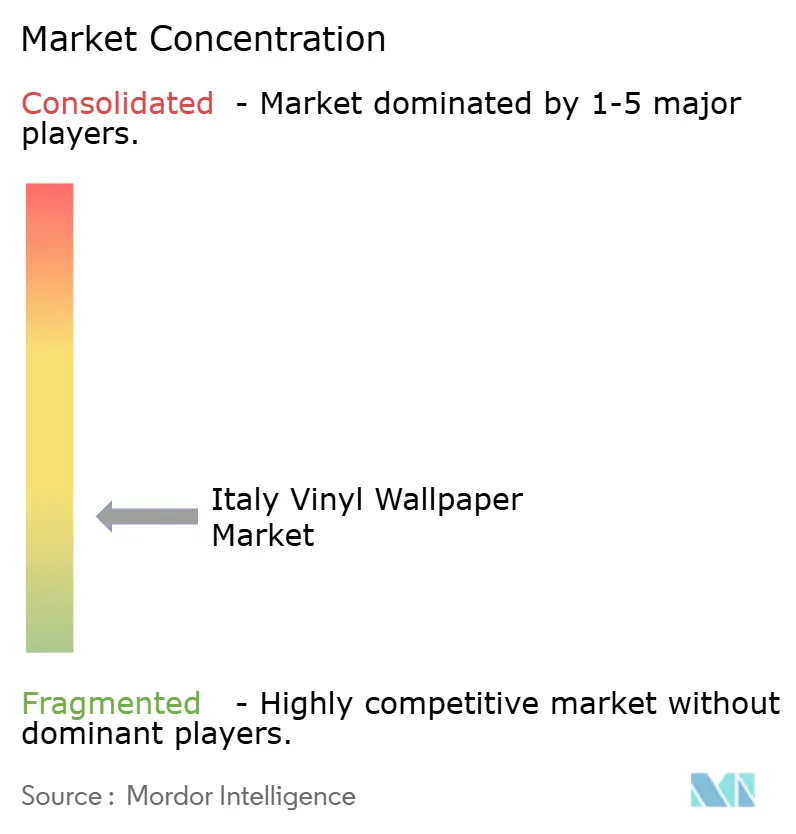
| Market Concentration | Low |
Major Players *Disclaimer: Major Players sorted in no particular order Image © Mordor Intelligence. Reuse requires attribution under CC BY 4.0. | |
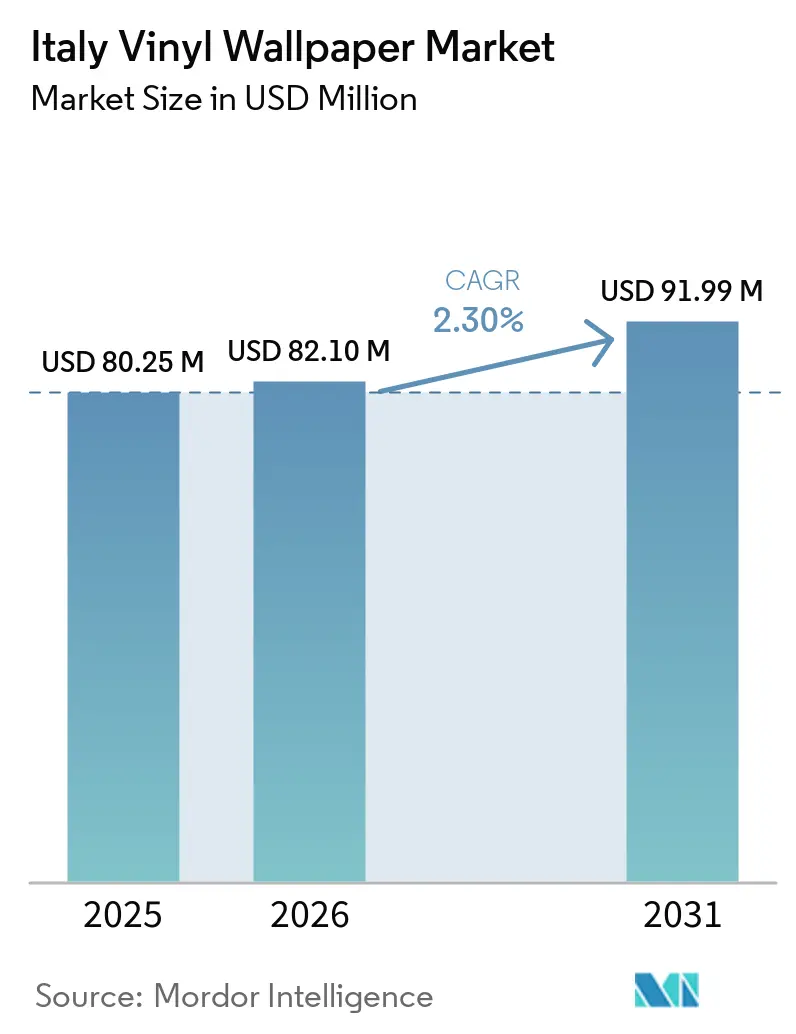
Italy Vinyl Wallpaper Market Analysis by Mordor Intelligence
The Italy vinyl wallpaper market was valued at USD 80.25 million in 2025, is estimated at USD 82.10 million in 2026, and is forecast to reach USD 91.99 million by 2031, growing at a 2.30% CAGR during 2026–2031. The market is recovering within a renovation environment that remains selective after the withdrawal of the Superbonus incentive. Housing renovation investment fell 18% in 2025, and ANCE expects only a 3.5% recovery in 2026. Demand is moving toward projects where design quality, durability, and a clear maintenance benefit can justify the initial cost. Premium residential remodeling and commercial refurbishment, therefore, offer more stable opportunities than broad, budget-led home improvement activity. Manufacturers are responding with customized formats, durable surfaces, and lower-impact material options that fit the needs of architects and project owners. Growth is expected to trail the broader Italian wallcovering category because nonwoven substrates continue to gain share from vinyl, while Italy's role as a production and export hub means much of its domestic output serves foreign rather than local demand.
Key Report Takeaways
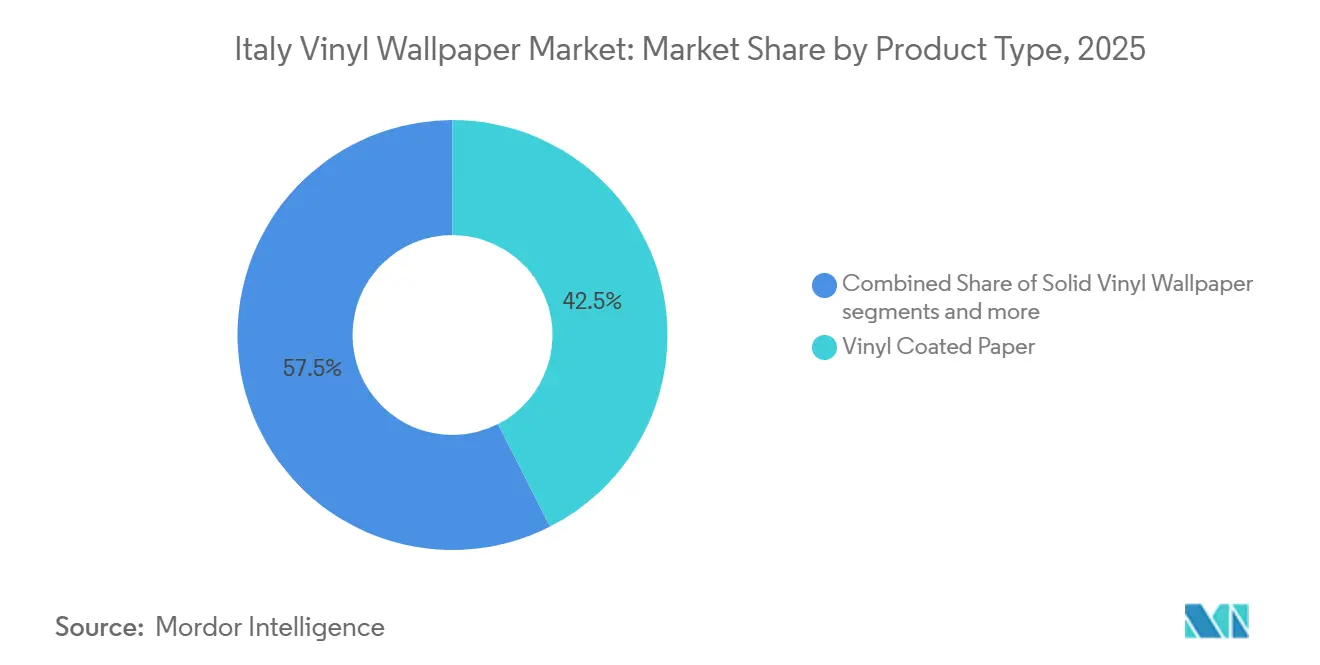
- By product type, vinyl coated paper accounted for the largest value share of the Italy vinyl wallpaper market, at 42.50% in 2025, while fabric backed vinyl is projected to grow at the fastest CAGR of 3.94% during 2026–2031.
- By installation type, traditional/non-self-adhesive wallpaper accounted for 71.00% of the market in 2025, while self-adhesive/peel-and-stick wallpaper is projected to grow at the fastest CAGR of 3.94% during 2026-2031.
- By application, renovation and remodeling accounted for 69.00% of the market in 2025, while new construction is projected to grow at the fastest CAGR of 3.22% during 2026-2031.
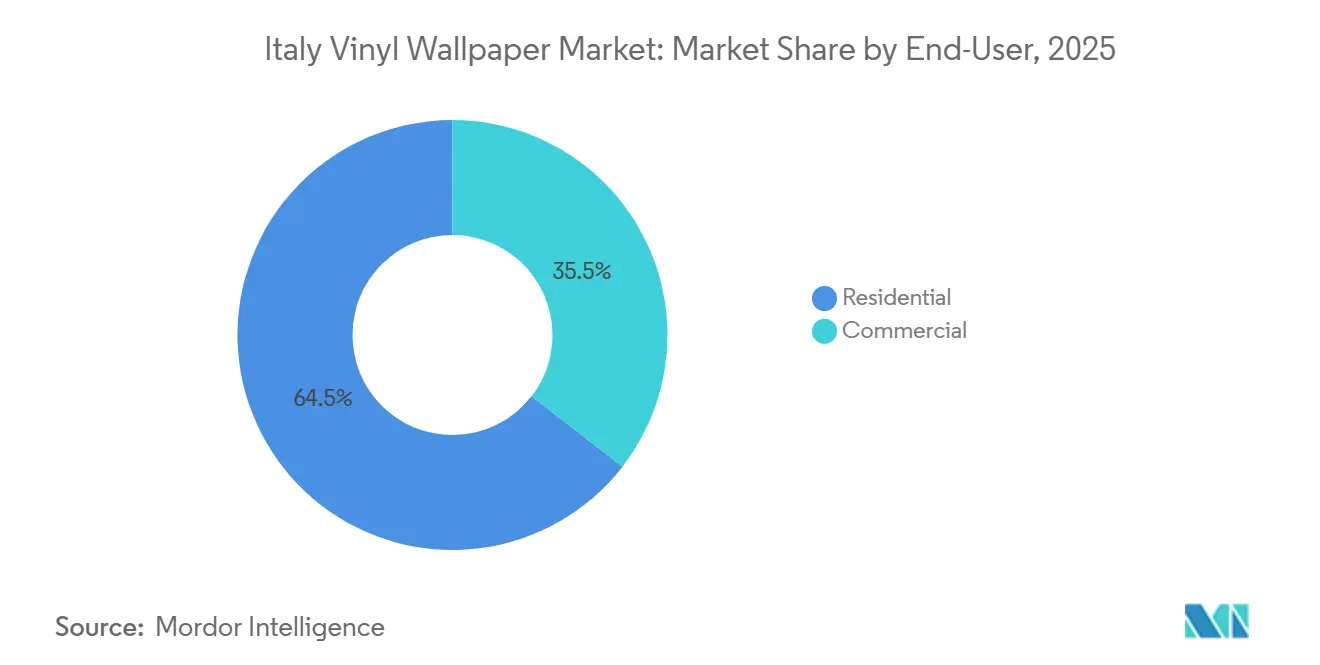
- By end user, residential accounted for 64.50% of the market in 2025, while commercial is projected to grow at the fastest CAGR of 3.42% during 2026-2031.
- By distribution channel, B2C channels accounted for 65.50% of the market in 2025, while B2B channels are projected to grow at the fastest CAGR of 3.35% during 2026-2031.
- By geography, North-West accounted for 37.00% of the market in 2025 and is projected to grow at the fastest CAGR of 3.68% during 2026-2031.
Note: Market size and forecast figures in this report are generated using Mordor Intelligence’s proprietary estimation framework, updated with the latest available data and insights as of January 2026.
Italy Vinyl Wallpaper Market Trends and Insights
Drivers Impact Analysis*
| Driver | (~) % Impact on CAGR Forecast | Geographic Relevance | Impact Timeline |
|---|---|---|---|
| Demand for Washable and Durable Wall Finishes | +0.8% | National, concentrated in the North-West and the North-East | Short term (≤ 2 years) |
| Digitally Printed and Customized Wallcoverings | +0.7% | National, with leading activity in the Milan design district | Medium term (2-4 years) |
| Premium Renovation and Interior-Design Spending | +0.6% | National, strongest in the North-West and Central Italy | Medium term (2-4 years) |
| Hospitality and Commercial Refurbishment Cycles | +0.5% | North-West and Central Italy, with spillover to the South and the Islands | Short term (≤ 2 years) |
| Bathroom and Wet-Area Vinyl Applications | +0.4% | National | Short term (≤ 2 years) |
| Italian Design Differentiation Through Made-in-Italy Production | +0.3% | National, with export leverage in European Union markets | Long term (≥ 4 years) |
| Source: Mordor Intelligence | |||
Premium Renovation and Interior-Design Spending
The Italy vinyl wallpaper market is supported by household spending that favors interior quality even when structural renovation budgets are under pressure. The end of the Superbonus scheme reduced the appeal of large structural projects, including insulation and HVAC upgrades. It also redirected some spending toward decorative work that can refresh a room with fewer disruptions. ANCE expects housing renovation investment to recover by 3.5% in 2026, after an 18% decline in 2025[1]https://www.bricomagazine.com/edilizia-a-picco-le-ristrutturazioni-nel-2025-atteso-rimbalzo-nel-2026. The extension of renovation tax deductions in the 2026 budget supports the timing of household improvement decisions. This setting favors vinyl wallcoverings where homeowners seek a durable, high-visibility finish rather than a complete rebuild.
Demand for Washable and Durable Wall Finishes
Washability and longevity remain central reasons for choosing vinyl in the Italy vinyl wallpaper market. Commercial-grade Type II vinyl can withstand 5,000 to 10,000 scrub cycles under ASTM testing, while standard emulsion paint can withstand fewer than 50 wash events. EN 15102 provides a European performance and CE-marking framework for wallcoverings placed on the market under the Construction Products Regulation[2]https://eur-lex.europa.eu/eli/reg/2011/305/oj. These requirements give architects and contractors a clear basis for comparing specified surfaces. Moisture-resistant formats also fit bathroom and other wet-area applications, where cleaning and surface performance matter more than low initial cost. Infrequent renovation cycles make this maintenance benefit more important for apartment owners and professional specifiers.
Digitally Printed Wallcoverings and Italian Design Differentiation
Digital printing is broadening the design options available in the Italy vinyl wallpaper market. SIRPI installed single-pass digital production lines with 3D printing capabilities in 2023 and commissioned a laminating plant in 2024. These investments support shorter production runs for custom projects and bespoke orders. Inkiostro Bianco uses digital printing on its d.ecodura organic bio-vinyl backing in the MATERIAPRIMA 2026 collection[3]https://www.archiproducts.com/en/inkiostro-bianco. Glamora also offers wall-filling customized formats instead of only repeating standard rolls. Italian producers can therefore compete on project-specific design and material choice instead of relying on price alone.
Hospitality and Commercial Refurbishment Cycles
Hotel refurbishment creates a practical demand base for the Italy vinyl wallpaper market because projects require durable, design-led finishes across rooms and shared spaces. Italy recorded EUR 2.5 billion in hotel investment in 2025, with value-add refurbishment and repositioning accounting for 45% of transactions[4].https://www.federturismo.it/it/i-servizi/news/595-news/news-2026/22097-ey-nel-2025-gli-investimenti-alberghieri-in-italia-sono-cresciuti-del-20.html High-end properties can accommodate contract-grade wallcoverings within their finishing budgets. Hotel operators also continue to invest in upgrades that can improve the guest experience and strengthen room positioning. The pattern extends beyond Milan and Venice to Florence, Rome, Sardinia, Puglia, and Sicily. This wider project pipeline supports demand for customized surfaces and professional installation.
Restraints Impact Analysis*
| Restraint | (~) % Impact on CAGR Forecast | Geographic Relevance | Impact Timeline |
|---|---|---|---|
| Paint as a Lower-Cost Substitute | -0.6% | National | Short term (≤ 2 years) |
| PVC Resin and Additive Cost Volatility | -0.5% | National, with sourcing pressure on North-East manufacturers | Medium term (2-4 years) |
| PVC Sustainability and Indoor-Air-Quality Concerns | -0.3% | National, with the strongest compliance pressure in the North-West | Long term (≥ 4 years) |
| Installer Availability and Project-Specific Application Complexity | -0.3% | National, most acute in the South and the Islands | Medium term (2-4 years) |
| Source: Mordor Intelligence | |||
Paint as a Lower-Cost Substitute
Paint remains the default option for budget-sensitive residential projects because installation is simpler and does not normally require specialist labor. This places the strongest pressure on mass-market wallpaper purchases and small cosmetic projects. The effect is less pronounced in hospitality, healthcare, and premium residential work, where surface durability and design detail carry greater weight. The Italy vinyl wallpaper market also faces an uneven supply of specialist installers, particularly in Southern Italy and the Islands. Professional installation remains important for high-specification formats because poor application can undermine the finished result. Producers can address this constraint by communicating lifecycle value through architects, contractors, and specialist retailers rather than competing only on upfront price.
PVC Resin and Additive Cost Volatility
PVC resin and additive costs can affect manufacturer margins and the final price of vinyl products. European PVC supply conditions became less stable as producers reduced capacity and import competition increased. At the same time, regulations are raising attention to material lifecycle data and indoor environmental quality. The revised Construction Products Regulation (EU) 2024/3110 introduces a framework for declaring the environmental performance of construction products, while wallcoverings are not among the priority products in the EU's 2025–2030 ecodesign working plan. The VinylPlus Product Label provides a route that aligns with BREEAM and Italy's Criteri Ambientali Minimi requirements. Producers that can document recycled content, low emissions, and Environmental Product Declarations are better placed to retain projects where sustainability criteria influence material selection.
*Our forecasts treat driver/restraint impacts as directional, not additive. The impact forecasts reflect baseline growth, mix effects, and variable interactions.
Segment Analysis
By Product Type: Vinyl Coated Paper Anchors Volume, While Fabric Backed Vinyl Leads Growth
Vinyl-coated paper held 42.50% of the Italy vinyl wallpaper market share in 2025, while fabric-backed vinyl is projected to grow at a 3.94% CAGR during 2026-2031. Vinyl-coated paper remains widely used in residential settings and mid-market commercial spaces. Its cost position and digital-print compatibility support broad demand. Fabric-backed vinyl serves hospitality and healthcare buyers who need wipe-resistant, contract-grade products. Its dual-layer construction also reduces the risk of tearing during professional installation. The difference reflects a split between volume-oriented decorative applications and demanding environments that prioritize product performance. Nonwoven vinyl and non-PVC nonwoven substrates continue to gain share in residential projects, limiting growth in vinyl-coated paper.
Solid vinyl wallpaper addresses premium homes and commercial settings where embossed textures and relief surfaces support a higher-value finish. Non-woven vinyl wallpaper has a role in lower-disruption projects because paste-the-wall formats simplify application. The paste-the-wall installation can reduce labor time by 25% compared with paste-the-paper formats. Other product types include glass-fiber-backed and specialty substrates for more specific performance needs. Zambaiti Parati has organized its offer around Z Waterproof, Z Acoustic, Z Pareti Vive, and Z Protection. This approach presents substrates as functional platforms that address moisture, acoustics, visual texture, and surface protection.



By Installation Type: Traditional Methods Lead, While Self-Adhesive Formats Grow Faster
Traditional/non-self-adhesive wallpaper accounted for 71.00% of the Italian vinyl wallpaper market share in 2025, while self-adhesive and peel-and-stick vinyl is projected to grow at a 3.94% CAGR during 2026–2031. Traditional application remains the usual choice for hospitality and high-specification residential projects. Architects, interior designers, and specialist contractors often regard professional installation as part of the quality standard. The method gives installers greater control over alignment, seams, and a consistent finish. It is also more closely associated with certified project delivery under EN 15102.
Self-adhesive products appeal to renters, short-term rental property owners, and homeowners seeking a removable decorative change. These formats reduce the disruption of installation and can suit small projects with limited downtime. Their moisture resistance and dimensional stability make vinyl an important material within the peel-and-stick category. Online room-visualization tools can also reduce uncertainty when users select a pattern remotely. The Italy vinyl wallpaper market is likely to retain traditional installation as the core format because contract work depends on professional application. Self-adhesive demand nonetheless broadens the addressable customer base for decorative and temporary uses.
By Application: Renovation Leads on Building Age, While New Construction Expands
Renovation and remodeling represented 69.00% of the Italy vinyl wallpaper market share in 2025, while new construction is projected to grow at a 3.22% CAGR during 2026-2031. More than 60% of Italian residential buildings predate 1981. This building base supports continuing demand for interior renewal. Vinyl wallcoverings allow owners to improve the appearance and cleaning performance of a room without beginning structural work. The format is particularly relevant when renovation budgets focus on visible upgrades that can support resale value or rental appeal.
New construction is supported by improving permit activity and institutional work that requires durable interior finishes. Authorized residential floor area increased by 5.7% and nonresidential permits increased by 11.1% in the third quarter of 2025. The PNRR and the Ministry of Tourism's M1C3 tax-credit program support projects in accommodation and public-facing buildings. These projects can require washable surfaces and documented performance. New builds therefore provide an additional demand source, even though renovation remains the larger application in the Italy vinyl wallpaper market.
By End User: Residential Demand Leads, While Commercial Projects Accelerate
Residential users held 64.50% of the Italian vinyl wallpaper market share in 2025, while commercial users are forecast to grow at a 3.42% CAGR during 2026-2031. Residential demand is tied to selective interior investment and to the need for surfaces that offer both visual change and easy cleaning. Bathrooms have a particular role because moisture-resistant substrates suit the performance needs of the room. Living rooms remain the largest application by area, where the visual effect of a feature wall can influence product choice. Children's rooms also support interest in peel-and-stick designs because those products can be removed or replaced more easily. These patterns allow vinyl to serve both durable room renovations and more temporary decorative projects.
Commercial demand is anchored in hospitality refurbishment and is also supported by healthcare applications. Hotel repositioning requires wall finishes that are durable, cleanable, and suitable for a distinct design concept. Healthcare settings place similar emphasis on non-porous and sanitizable surfaces. Italy's hotel investment volume rose to EUR 2.5 billion in 2025, and 45% of transactions were linked to value-add work. This activity gives commercial buyers a faster growth profile than residential users. It also strengthens the role of wallcoverings that can meet contract specifications and project-specific design requirements.
By Distribution Channel: B2C Retains Scale, While B2B Gains Momentum
B2C channels held 65.50% of the Italian vinyl wallpaper market share in 2025, while B2B channels are forecast to grow at a 3.35% CAGR during 2026–2031. B2C distribution includes specialist wallpaper stores, home centers, hypermarkets, online sellers, and local independent shops. These outlets remain important for household purchases and routine decorative work. Physical specialist stores retain a role in premium sales because customers can inspect texture, color, and material samples before committing to an interior scheme. Digital tools are increasing the relevance of online sellers by helping consumers visualize a design within a room. This blend of physical sampling and online selection reflects the different levels of risk involved in wallpaper purchases.
B2B demand rises as architects and developers take a larger role in hospitality and higher-value residential projects. Zambaiti Parati operates a dedicated Contract division that works with architecture studios and real estate developers on bespoke wallcoverings and digital panels. This model places the manufacturer within the specification process rather than only at the retail stage. It also supports custom orders that need coordination among designers, installers, and property owners. The Italy vinyl wallpaper market benefits when B2B channels consolidate such decisions. The shift does not eliminate B2C demand, but it gives professional channels greater influence over higher-value project work.
Geography Analysis
North-West accounted for 37.00% of the Italian vinyl wallpaper market share in 2025 and is projected to grow at the fastest CAGR of 3.68% during 2026–2031. Lombardy, Piedmont, Liguria, and Aosta Valley combine a large consumer base with a dense concentration of wallpaper producers, design studios, and architecture practices. Milan provides a particularly strong link between product launches and specifier adoption through its design ecosystem and Salone del Mobile. North-West producers include Zambaiti Parati, SIRPI, Glamora, WallPepper, and Inkiostro Bianco. Zambaiti Parati launched the Philipp Plein Vol. 2 collection in March 2026, demonstrating the use of international fairs and design events to support domestic and export distribution.
North-East Italy is the second-largest regional market, supported by Venice's concentration of luxury hotel refurbishments. Hotel and holiday-village guest spending increased by 9.5% in 2025, while overnight stays increased by 13.1%. Renovations at Danieli Venice, Hotel Excelsior Venice Lido, and Locanda Cipriani create demand for contract-grade interior finishes. Central Italy benefits from the hotel markets of Florence and Rome. Villa San Michele reopened in Florence after an 18-month renovation, and Hotel Savoy Florence completed a EUR 9 million refurbishment. These markets favor materials that can combine an individual design treatment with reliable performance.
Southern Italy and the Islands have lower vinyl wallcovering penetration than the northern regions. Specialist installer availability is more limited, which can constrain the use of technically demanding products. Resort investment in Sardinia, Puglia, and Sicily is gradually creating new project demand. The Italy vinyl wallpaper market can therefore gain from the spread of hospitality investment beyond its established northern centers. Renovations in these destinations also create a need for materials that resist moisture, cleaning, and heavy guest use. The regional opportunity depends on whether suppliers can support design selection, customized delivery, and reliable installation across a wider geography.
Competitive Landscape
The Italian vinyl wallpaper market is fragmented, with no supplier holding a dominant position across residential and contract channels. Domestic producers compete through design, sustainability credentials, and direct relationships with architects. European suppliers compete more actively in price-sensitive B2C channels. Industrie Emiliana Parati, Zambaiti Parati, Jv S.p.A., Tecnografica, WallPepper, SIRPI, Glamora, and Inkiostro Bianco are prominent Italian participants. Zambaiti Parati reported revenue of EUR 15 million for 2024, representing 4% year-over-year growth. This result shows that premium positioning can remain resilient when broader renovation volume is constrained.Italy is a net exporter of vinyl-type wallpaper: exports of plastic-coated wallpaper (HS 4814.20) reached USD 59.81 million in 2023, against imports of USD 9.94 million, with France, Belgium, the United States, and Germany as leading destinations.
Competition increasingly centers on customized production, material credentials, and collaboration with designers. SIRPI's 2023 digital-printing investment and 2024 laminating plant strengthen its ability to serve short-run and bespoke wallcovering projects. Inkiostro Bianco uses d.ecodura organic bio-vinyl within its 2026 collection, while WallPepper offers PVC-free options alongside standard vinyl products. These product moves respond to demand for material transparency without removing design choice. They also support project bids where environmental criteria influence the supplier decision.
Zambaiti Parati's M2026 Philipp Plein Vol. 2 collection is a further example of a fashion co-creation strategy that differentiates a wallcovering producer from lower-priced suppliers. The company also introduced specialized substrates through Project Chapter 2 at Salone del Mobile 2025. EN 15102 and CE Declaration of Performance requirements can make it harder for non-certified suppliers to access institutional and hospitality specifications. The most attractive space lies in lower-impact commercial wallcoverings and digitally customized small-batch products for boutique hotels. The Italy vinyl wallpaper market remains competitive because design quality alone is not sufficient without compliant materials, dependable delivery, and professional application.
Italy Vinyl Wallpaper Industry Leaders
Jv S.p.A.
Zambaiti Parati Srl
Industrie Emiliana Parati S.p.A.
Tecnografica S.p.A.
WallPepper Group S.r.l.
- *Disclaimer: Major Players sorted in no particular order

Recent Industry Developments
- June 2026: Inkiostro Bianco announced a renewed collaboration with Bressana and Knorr, releasing 2 new graphic sets in its artist-series format, expanding bespoke digital vinyl wallcovering options for premium residential and boutique hospitality clients.
- January 2026: Zambaiti Parati launched the Philipp Plein Vol. 2 collection at the Frankfurt trade fair, combining animalier graphics, three-dimensional textures, and 100% Made-in-Italy production. The launch extends the company's fashion co-creation strategy and strengthens its international distribution reach in the luxury wallcovering segment.


Italy Vinyl Wallpaper Market Report Scope
| Solid Vinyl Wallpaper |
| Vinyl Coated Paper |
| Fabric Backed Vinyl |
| Non-Woven Vinyl Wallpapers |
| Other Product Type |
| Traditional/Non Self-Adhesive |
| Self-Adhesive / Peel-and-Stick Vinyl Wallpaper |
| New Construction |
| Renovation and Remodeling |
| Residential | Living Room |
| Kitchen | |
| Bedroom | |
| Bathroom | |
| Kids Room | |
| Commercial |
| B2C Channels | Hypermarkets and Supermarkets |
| Specialty Wallpaper Stores | |
| Home Centers | |
| Online | |
| Local Shops (unorganized channels) | |
| Other Distribution Channels | |
| B2B Channels (Contractors and Installers, Interior Designers and Architects, Project Procurement and Institutional Sales) |
| North-West |
| North-East |
| Central |
| South |
| Islands (Sicily and Sardinia) |
| By Product Type/Construction Type | Solid Vinyl Wallpaper | |
| Vinyl Coated Paper | ||
| Fabric Backed Vinyl | ||
| Non-Woven Vinyl Wallpapers | ||
| Other Product Type | ||
| By Installation Type | Traditional/Non Self-Adhesive | |
| Self-Adhesive / Peel-and-Stick Vinyl Wallpaper | ||
| By Application | New Construction | |
| Renovation and Remodeling | ||
| By End User | Residential | Living Room |
| Kitchen | ||
| Bedroom | ||
| Bathroom | ||
| Kids Room | ||
| Commercial | ||
| By Distribution Channel | B2C Channels | Hypermarkets and Supermarkets |
| Specialty Wallpaper Stores | ||
| Home Centers | ||
| Online | ||
| Local Shops (unorganized channels) | ||
| Other Distribution Channels | ||
| B2B Channels (Contractors and Installers, Interior Designers and Architects, Project Procurement and Institutional Sales) | ||
| By Geography | North-West | |
| North-East | ||
| Central | ||
| South | ||
| Islands (Sicily and Sardinia) | ||


Key Questions Answered in the Report
What is the projected value of Italy's vinyl wallpaper sector by 2031?
It is estimated at USD 82.10 million in 2026 and is forecast to reach USD 91.99 million by 2031.
Which vinyl wallpaper product type has the largest demand in Italy?
Vinyl coated paper led product demand with a 42.5% share in 2025, supported by its cost position and compatibility with digital printing.
Why are commercial buyers increasing their use of vinyl wallcoverings?
Commercial demand is forecast to grow at 3.42% through 2031 because hotel, healthcare, and other project buyers value durable and washable interior finishes.
Which Italian region leads demand for vinyl wallcoverings?
North-West Italy led with 37% share in 2025 and is projected to grow at a 3.68% CAGR through 2031.
How does self-adhesive wallpaper differ from traditional formats?
Self-adhesive formats support removable and lower-disruption applications, while traditional formats remained the leading installation type with 71% share in 2025.
Page last updated on:


 Your data is secure and never sold or shared.


