
China Vinyl Wallpaper Market Size and Share
Market Overview
| Study Period | 2020 - 2031 |
|---|---|
| Forecast Data Period | 2026 - 2031 |
| Base Year Market Size (2025) | USD 0.72 Billion |
| Market Size (2026) | USD 0.77 Billion |
| Market Size (2031) | USD 1.10 Billion |
| Growth Rate (2026 - 2031) | 7.40 % |
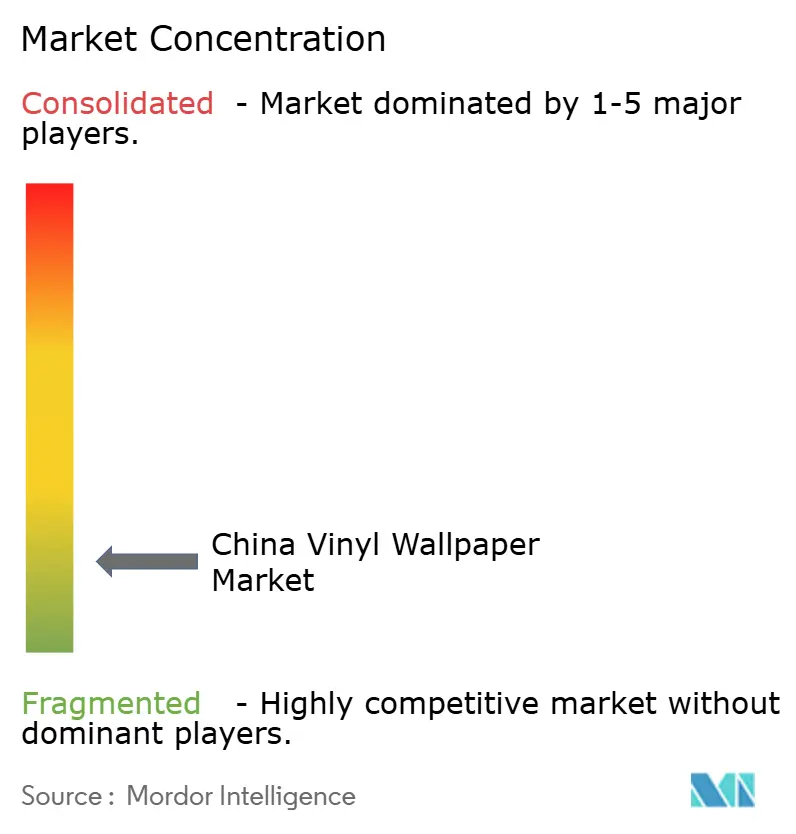
| Market Concentration | Low |
Major Players *Disclaimer: Major Players sorted in no particular order Image © Mordor Intelligence. Reuse requires attribution under CC BY 4.0. | |
China Vinyl Wallpaper Market Analysis by Mordor Intelligence
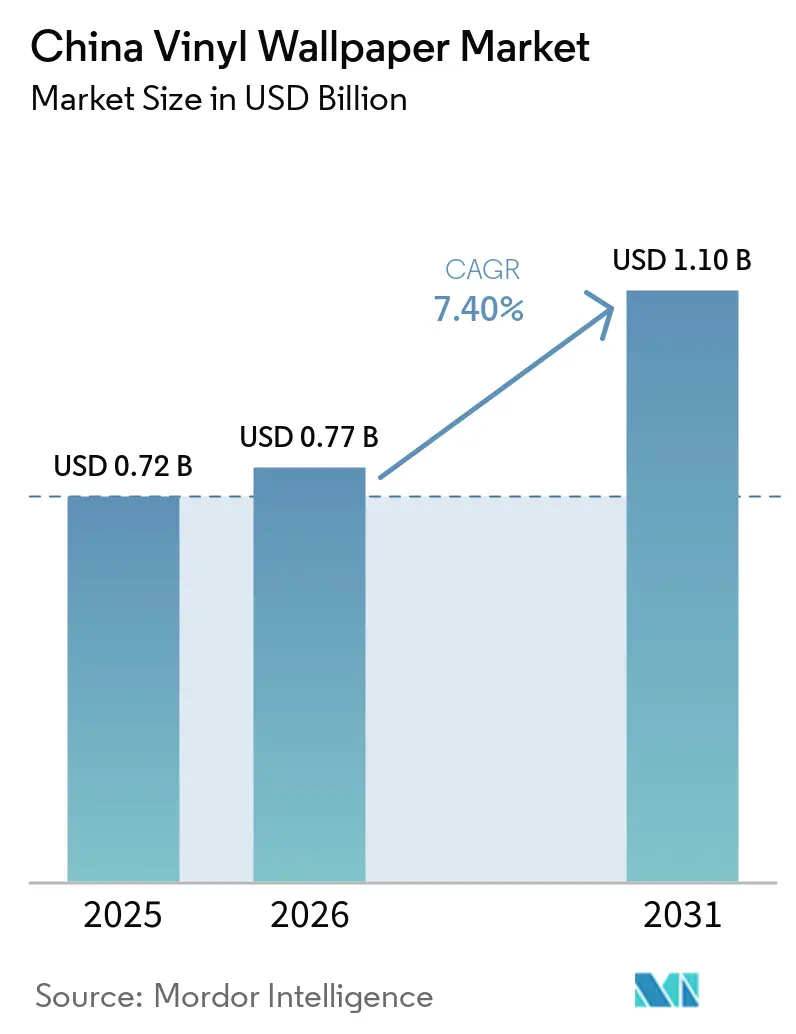
The China vinyl wallpaper market was valued at USD 0.72 billion in 2025, is estimated at USD 0.77 billion in 2026, and is forecast to reach USD 1.10 billion by 2031, growing at a 7.40% CAGR during 2026–2031. The China vinyl wallpaper market is supported by renovation activity in existing homes and by the need for durable wall finishes in commercial interiors. Policy support for the renewal of older residential compounds has strengthened the pool of projects that require interior finishes. The China vinyl wallpaper market also benefits when homeowners choose feature walls as a contained renovation purchase rather than repainting an entire home. Suppliers are responding with certified lower-emission products, broader design ranges, and faster fulfillment for customized orders. Compliance with harmful-substance and fire-safety requirements is becoming more important because it affects product development, project eligibility, and the cost position of smaller producers.
Key Report Takeaways
- By product type, vinyl-coated paper held 40% of the segment share in 2025, while fabric-backed vinyl is forecast to expand at a 7.7% CAGR through 2031.
- By installation type, traditional formats held 64% of the segment share in 2025, while self-adhesive wallpaper is forecast to grow at an 8% CAGR through 2031.
- By application, renovation and remodeling accounted for 55% of the segment share in 2025, while new construction is forecast to expand at an 8.3% CAGR through 2031.
- By end user, residential buyers accounted for 69% of the segment share in 2025, while commercial users are forecast to grow at a 7.8% CAGR through 2031.
- By distribution channel, B2C channels held 72% of the segment share in 2025, while B2B channels are forecast to grow at a 7.8% CAGR through 2031.
- By geography, East China held 37.1% of the segment share in 2025, while South Central China is forecast to grow at a 7.6% CAGR through 2031.
Note: Market size and forecast figures in this report are generated using Mordor Intelligence’s proprietary estimation framework, updated with the latest available data and insights as of January 2026.
China Vinyl Wallpaper Market Trends and Insights
Drivers Impact Analysis*
| Driver | (~) % Impact on CAGR Forecast | Geographic Relevance | Impact Timeline |
|---|---|---|---|
| Durability and washability in high-traffic and moisture-prone interiors | +1.2% | National, concentrated in East China and South Central China | Short term (≤ 2 years) |
| Residential renovation and replacement of paint with feature walls | +2.1% | National, with early gains in Shanghai, Beijing, Chengdu, and Chongqing | Medium term (2-4 years) |
| Digitally printed customization and short-run production | +1.0% | East China and the Pearl River Delta | Medium term (2-4 years) |
| Commercial hospitality, retail, healthcare, and office refurbishment | +0.8% | East China, South Central China, and South China | Long term (≥ 4 years) |
| E-commerce-led design discovery and direct-to-consumer selling | +0.9% | National, with platform strength in Tier 1 and Tier 2 cities | Short term (≤ 2 years) |
| Flexible OEM manufacturing and fast design turnaround in Chinese production clusters | +0.6% | Guangdong, Zhejiang, and Jiangsu | Long term (≥ 4 years) |
| Source: Mordor Intelligence | |||
Durability and Washability in High-Traffic and Moisture-Prone Interiors
The China vinyl wallpaper market draws support from the material’s resistance to moisture, abrasion, and staining. These characteristics are relevant in kitchens, bathrooms, children’s rooms, commercial corridors, and other interiors that require routine cleaning. Vinyl products can offer a practical alternative to paper-based and nonwoven options where repeated surface maintenance is expected. A 2026 study found that indoor VOC exposure in Chinese residences remained significant, with engineered wood products and furniture identified as leading contributors to that burden[1]. This evidence increases the importance of products that can document lower emissions and compliance with GB 18585-2023. Manufacturers that provide clear testing and compliance records can use the requirement to differentiate their products in health-sensitive rooms.
Residential Renovation and Replacement of Paint with Feature Walls
Residential renovation remains the central demand setting for the China vinyl wallpaper market because it creates work within existing housing rather than depending only on new home completions. The national urban-renewal framework issued in May 2025 targeted systematic upgrades to residential compounds built before 2000 through 2030[2]. More than 280,000 residential compounds were upgraded between 2019 and 2024, benefiting 48 million households. This renovation pipeline makes replacement and partial refurbishment more important for wallcovering suppliers. Feature walls allow households to add pattern and color without committing to a full-room treatment. The format fits projects where buyers want visible change while keeping spending and installation scope contained.
Digitally Printed Customization and Short-Run Production
Digital inkjet printing is changing the order economics available to manufacturers in Guangdong, Zhejiang, and Jiangsu. Wide-format UV and latex print-cut systems allow wallpaper producers to handle customized orders of 500 square meters or less[3]. This makes bespoke prints more accessible to boutique hospitality properties, retail managers, and individual buyers. The China vinyl wallpaper market gains from this shift because smaller orders can be served without the same commitment required by traditional screen printing. Short-run production also gives suppliers a way to test designs before placing larger production orders. Faster design cycles help manufacturers match seasonal demand and respond to changing visual preferences.
E-Commerce-Led Design Discovery and Direct-to-Consumer Selling
Online channels have shortened the path from design discovery to purchase in the China vinyl wallpaper market. Consumers can now compare patterns, view live-stream demonstrations, and use visualization tools without beginning with a showroom visit. IKEA launched on JD.com in August 2025, expanding its Chinese online presence after its earlier Tmall activity. Reuters reported that 1 in 5 new IKEA customers in China had previously come through Tmall. This shows the importance of large e-commerce platforms in the home-furnishing purchase journey. Wallpaper brands can benefit when these platforms increase consumer familiarity with online design selection and home-delivery expectations.
Restraints Impact Analysis*
| Restraint | (~) % Impact on CAGR Forecast | Geographic Relevance | Impact Timeline |
|---|---|---|---|
| Tightening limits on vinyl chloride, phthalates, formaldehyde, and TVOC | -0.7% | National, accelerated in Tier 1 cities | Short term (≤ 2 years) |
| Substitution by nonwoven, fabric, paint, wall cloth, and wall panels | -1.2% | National, strongest in East China and South China | Medium term (2-4 years) |
| PVC, plasticizer, adhesive, and energy-cost volatility | -0.5% | National, with supply concentration in Shandong and Xinjiang | Short term (≤ 2 years) |
| Fire-safety qualification and product-claim verification costs | -0.3% | National, with a public-sector procurement focus | Long term (≥ 4 years) |
| Source: Mordor Intelligence | |||
Tightening Limits on Vinyl Chloride, Phthalates, Formaldehyde, and TVOC
GB 18585-2023 came into effect on December 1, 2024, and applies harmful-substance limits to wallpapers across substrate types, including PVC and vinyl coatings. The standard requires producers to address compounds that include formaldehyde, heavy metals, and volatile organic carbon fractions. These requirements increase the development, testing, and documentation burden for the China vinyl wallpaper market. They are especially material for producers that relied on older formulations or lacked established compliance processes. Products intended for health-sensitive locations must satisfy both practical performance expectations and more demanding material disclosures. The result is a higher cost of entry and a more difficult path for suppliers that deferred investment in formulation work.
Substitution by Nonwoven, Fabric, Paint, Wall Cloth, and Wall Panels
Vinyl wallpaper competes with nonwoven products, fabric-based wall cloth, paint, wall panels, and other decorative wall finishes. Each alternative addresses a different buyer concern, including installation speed, material appearance, environmental positioning, or perceived durability. The China vinyl wallpaper market must therefore maintain a clear case around design flexibility, washability, and cost per square meter. Waterborne-coated nonwoven wallcoverings have a technical standard framework under T/ZZB 3860-2024, giving competing suppliers a basis for environmental and installation claims. Wall cloth also competes in projects where buyers prefer fabric texture or seamless finishes. Paint remains a familiar lower-complexity option, while wall panels can appeal where a rigid and fast-installed surface is preferred.
*Our forecasts treat driver/restraint impacts as directional, not additive. The impact forecasts reflect baseline growth, mix effects, and variable interactions.
Segment Analysis
By Product Type / Construction Type: Vinyl Coated Paper Leads, Fabric Backed Vinyl Accelerates
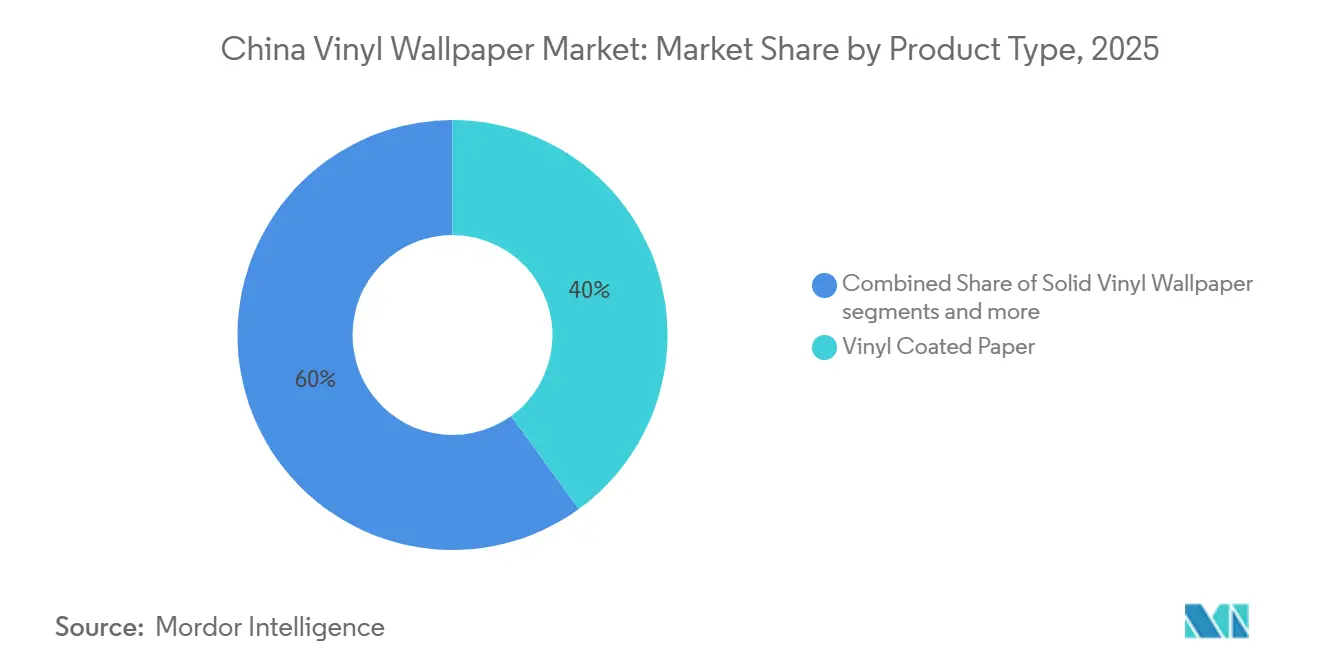
Vinyl coated paper held 40.0% of the segment share in 2025. Its printable paper substrate and protective PVC coating support high-definition patterns at accessible price points. This makes it suitable for residential renovation and light-commercial projects that require variety without a premium material cost. The segment benefits from a broad range of textures, decorative patterns, and photo-realistic mural options. Vinyl coated paper remains a common default when buyers need a balance of visual choice, washability, and price. Its role is closely tied to the existing-home renovation pool, where homeowners often select finishes room by room.
Fabric backed vinyl is projected to grow at a 7.70% CAGR during 2026–2031, making it the fastest-growing construction type. The China vinyl wallpaper market size for fabric backed vinyl is supported by its tensile strength and its ability to resist corner tearing during installation. These qualities matter in hospitality, healthcare, and office renovations where walls may be uneven, and surfaces are used heavily. Fabric backing also supports a more durable specification for long-cycle commercial projects. Solid vinyl continues to serve corridors and lobby areas where abrasion resistance can justify a higher material cost. Nonwoven vinyl, textured products, and digitally printed murals serve buyers seeking easier installation, personalized graphics, or more distinctive finishes.

By Installation Type: Traditional Formats Dominant, Self-Adhesive Gaining Structural Share
Traditional, paste-applied formats held 64.0% of the segment share in 2025. Contractors, interior designers, and property developers continue to use these formats in professional installation workflows. Paste application provides permanent adhesion and permits repositioning during installation. This is valuable where dimensional accuracy matters across large commercial wall surfaces. Traditional formats also remain familiar to installers and therefore fit established project practices. Their position reflects the continued importance of professional specification and installation in the category.
Self-adhesive wallpaper is forecast to expand at an 8.00% CAGR during 2026–2031. The China vinyl wallpaper market size for self-adhesive products is supported by urban renters who seek wall treatments that can be removed without damaging the surface. Social commerce makes this format easier to purchase because installation simplicity can turn online discovery into an immediate home-upgrade decision. Adhesive chemistry remains important because the system must meet harmful-substance requirements alongside the face film. Brands are improving adhesive formulations to support clean removal and reposition the product as a repeatable interior-refresh option. This gives the format a stronger use case than a one-time, price-led impulse purchase.
By Application: Renovation Holds Majority, New Construction Accelerates
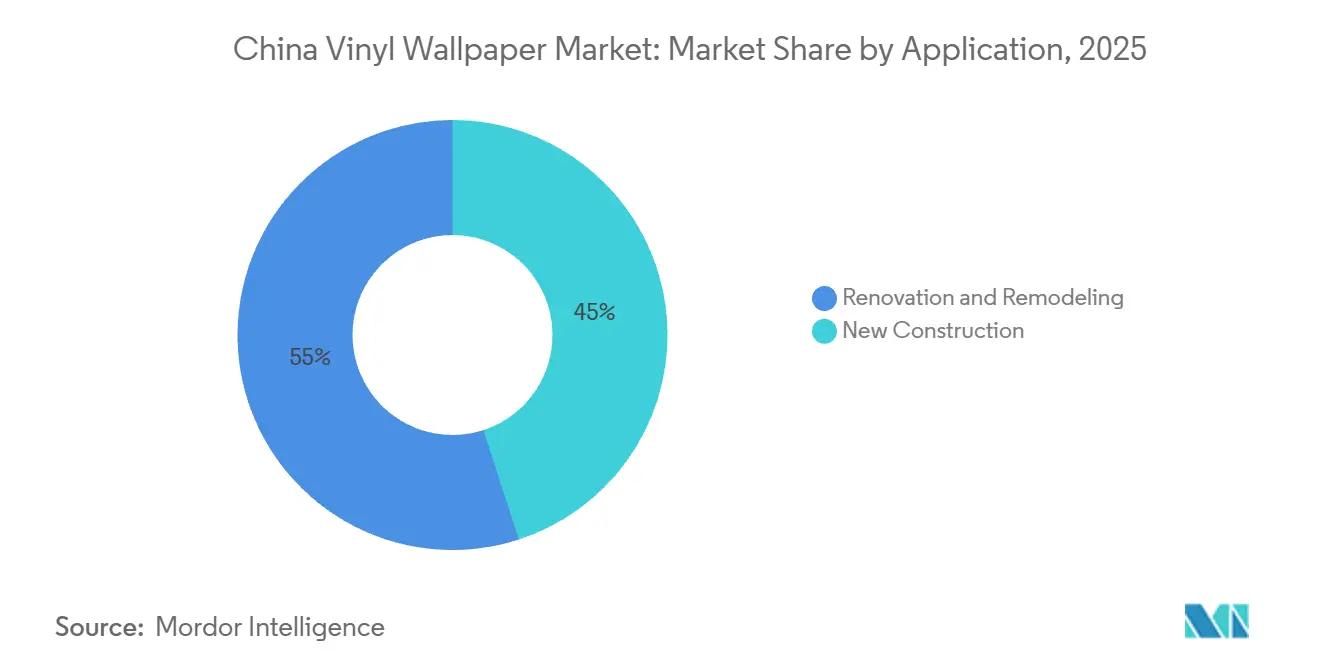
Renovation and remodeling held 55.0% of the segment share in 2025. Older urban housing creates a large base for replacement, partial remodeling, and aging-friendly interior upgrades. The May 2025 urban-renewal policy direction supports systematic work on compounds built before 2000. Renovation buyers often place more value on pattern variety and construction quality because they are replacing an existing surface. This setting favors mid-premium vinyl coated paper and fabric backed vinyl over basic alternatives. It also supports feature-wall purchases that provide a visible change without a full interior renovation.
New construction is forecast to grow at an 8.30% CAGR during 2026–2031. The China vinyl wallpaper market benefits from new residential projects that require finished interiors and can specify higher-performing surface materials at the design stage. New building requirements introduced in May 2025 included minimum floor height and sound-insulation provisions in residential construction. These conditions can support the selection of finishes that complement improved spatial and acoustic standards. New construction also offers a more standardized setting for specification, installation, and procurement than scattered home renovations. Its faster growth does not displace renovation, but it broadens the project base available to wallpaper suppliers.
By End User: Residential Leads, Commercial Segment Accelerates
Residential buyers accounted for 69.0% of the segment share in 2025. Living rooms and bedrooms remain the main design settings because homeowners use these rooms as the primary visual canvas during renovation. Kitchens and bathrooms favor solid vinyl and vinyl coated paper where washability matters. Children’s rooms are relevant to peel-and-stick products because caregivers may value removal without wall damage. Residential demand also reflects the appeal of feature walls and lower-scope upgrades. These uses keep households at the center of category demand even as commercial projects grow.
Commercial end users are forecast to grow at a 7.80% CAGR during 2026–2031. Hospitality, healthcare, retail, and office refurbishment create demand for heavier-duty vinyl in high-traffic areas. The China vinyl wallpaper market benefits when commercial buyers require antimicrobial, lower-emission, or fire-performance documentation alongside physical durability. Fabric backed vinyl is particularly relevant where installations need more tensile strength. Commercial products can often be manufactured on shared lines with residential products, with differentiation achieved through heavier face weights and post-process coatings. This production approach allows suppliers to serve both customer groups without requiring entirely separate manufacturing systems.
By Distribution Channel: B2C Dominates, B2B Channels Expand Fastest
B2C channels held 72.0% of the segment share in 2025. Online channels are becoming an important growth engine within this route because they offer broad visual choice and convenient delivery. Home-furnishing platforms can act as design-discovery points that lead consumers toward adjacent wallcovering purchases. IKEA’s JD.com launch in August 2025 added another large digital channel to the Chinese home-furnishing ecosystem[4]. Specialty wallpaper stores still matter when buyers want tactile access to samples. Their role is changing as visualization tools improve online selection rather than disappearing completely.
B2B channels are projected to expand at a 7.8% CAGR during 2026–2031. Contractors, architects, and interior designers increasingly include wallcovering selection within wider design-and-build packages. The Chinese vinyl wallpaper industry benefits when these buyers obtain mandates in healthcare, education, and hospitality projects. B2B activity can create larger and more repeatable orders than individual consumer purchases. Local stores and unorganized channels still provide reach in lower-tier cities where specialty retail and e-commerce fulfillment remain less developed. Distribution is therefore becoming more mixed, with consumer discovery online and project specification moving through professional channels.
Geography Analysis
East China held 37.1% of the segment share in 2025. Shanghai, Jiangsu, and Zhejiang form a dense area for interior-design firms, building-completion contractors, real-estate developers, and material suppliers. This concentration creates a consistent pipeline for specification and installation. Zhejiang MSD Group in Haining and multiple Shaoxing-based producers contribute to a regional manufacturing base for PVC and vinyl coated products. East China also provides a setting where residential renovation and commercial design activity can support a broad product mix. The region’s established design and production networks reinforce its position in the China vinyl wallpaper market.
South Central China is projected to expand at a 7.6% CAGR through 2031. Chengdu and Chongqing support demand through active housing development, interior fit-out requirements, and continued urban development. Ongoing housing development and urban construction in these cities expand the base for new construction and refurbishment wall-finishing work. The region also has a hospitality and tourism development footprint that can require more durable decorative surfaces.
North China maintains a stable role through office, public-sector, and residential compound refurbishment, especially around Beijing. The North China segment is supported by older housing districts targeted under the broader urban-renewal agenda. Southwest China, including Sichuan, Yunnan, and Guizhou, remains a secondary growth area supported by urbanization and domestic tourism infrastructure. Northeast China has a renovation opportunity linked to older housing stock. Northwestern China is paced more by government-led urbanization programs than by private real-estate cycles. These smaller regions benefit when national renovation support reaches lower-tier cities and expands the availability of home-improvement projects.
Competitive Landscape
The China vinyl wallpaper market is fragmented, with no single producer close to a dominant position. The supplier base is distributed across regional producers and many basic product suppliers. This structure reflects low barriers to entry in lower-tier products. Competition is based on design portfolio, brand recognition, product performance, certification, and distribution reach. Guangdong Yulan Group is a major producer with 13 automated production lines and an annual capacity of 7 million wallpaper rolls and 5 million square meters of wall cloth. Its January 2025 designation as a national Green Factory shows how manufacturing credentials can support participation in institutional and government-linked renovation work.
Yulan also introduced its Yuci pet-scratch-resistant seamless wall cloth in September 2025 for young urban households and pet owners. The company launched the product through a national factory-subsidy promotion that was available through physical stores and official online platforms. Its Zhuoyue 5 seamless wall cloth, introduced in September 2025, was designed for the new minimum 3.1-meter residential floor-height standard. These actions show a strategy built around product adaptation, targeted consumer use cases, and combined offline and online reach. UNIWAL Group used a different approach through an omni-channel expansion into Beijing’s soft-furnishing exhibition market in 2025. This combined showroom activity with digital commerce to reach professional and consumer buyers.
The China vinyl wallpaper market is shifting toward certification, fire performance, and digital design services rather than price alone. GB 8624-2025 is scheduled to take effect in January 2027 and will require renewed attention to fire-performance qualification for products used in public-sector projects. Suppliers that invest early in testing and documentation may gain access to a more limited institutional supplier pool. Zhejiang MSD Group used a VR showroom at IndoBuildTech in July 2026 to reach international B2B buyers through a digital trade format. Producers in Guangdong and Zhejiang can also use wide-format printing to complete brand-specific hotel, retail, and office installations at shorter lead times and lower minimum quantities.
China Vinyl Wallpaper Industry Leaders
-
Guangdong Yulan Group Co., Ltd.
-
Shanghai Oya Decoration Materials Co., Ltd.
-
Jiangsu Aishe Wallpaper Co., Ltd.
-
Rainbow Wallpaper Co., Ltd.
-
Beijing Oriental Grammy Wallpaper Co., Ltd.
- *Disclaimer: Major Players sorted in no particular order
Recent Industry Developments
- August 2025: IKEA launched on JD.com with an initial offering of 6,500 products and utilization of JD.com’s logistics network, adding a second major Chinese e-commerce platform after Tmall, further deepening the online home-furnishing ecosystem that drives vinyl wallpaper discovery and purchase.
- January 2025: China’s Ministry of Industry and Information Technology released its 2024 Green Manufacturing list, including Guangdong Yulan Group among national Green Factory designees, the first national-level environmental manufacturing certification for a major Chinese wallpaper producer and a credential that qualifies Yulan’s products for government and institutional procurement preference.
China Vinyl Wallpaper Market Report Scope
| Solid Vinyl Wallpaper |
| Vinyl Coated Paper |
| Fabric Backed Vinyl |
| Non-Woven Vinyl Wallpapers |
| Other Product Type |
| Traditional/Non Self-Adhesive |
| Self-Adhesive / Peel-and-Stick Vinyl Wallpaper |
| New Construction |
| Renovation and Remodeling |
| Residential | Living Room |
| Kitchen | |
| Bedroom | |
| Bathroom | |
| Kids Room | |
| Commercial |
| B2C Channels | Hypermarkets and Supermarkets |
| Specialty Wallpaper Stores | |
| Home Centers | |
| Online | |
| Local Shops (unorganized channels) | |
| Other Distribution Channels | |
| B2B Channels (Contractors and Installers, Interior Designers and Architects, Project Procurement and Institutional Sales) |
| East China |
| Southwestern China |
| North China |
| South Central China |
| Northeast China |
| Northwestern China |
| By Product Type/Construction Type | Solid Vinyl Wallpaper | |
| Vinyl Coated Paper | ||
| Fabric Backed Vinyl | ||
| Non-Woven Vinyl Wallpapers | ||
| Other Product Type | ||
| By Installation Type | Traditional/Non Self-Adhesive | |
| Self-Adhesive / Peel-and-Stick Vinyl Wallpaper | ||
| By Application | New Construction | |
| Renovation and Remodeling | ||
| By End User | Residential | Living Room |
| Kitchen | ||
| Bedroom | ||
| Bathroom | ||
| Kids Room | ||
| Commercial | ||
| By Distribution Channel | B2C Channels | Hypermarkets and Supermarkets |
| Specialty Wallpaper Stores | ||
| Home Centers | ||
| Online | ||
| Local Shops (unorganized channels) | ||
| Other Distribution Channels | ||
| B2B Channels (Contractors and Installers, Interior Designers and Architects, Project Procurement and Institutional Sales) | ||
| By Geography | East China | |
| Southwestern China | ||
| North China | ||
| South Central China | ||
| Northeast China | ||
| Northwestern China | ||
Key Questions Answered in the Report
What is the value of the China vinyl wallpaper sector in 2026?
The China vinyl wallpaper market size is USD 0.77 billion in 2026 and is forecast to reach USD 1.10 billion by 2031 at a 7.4% CAGR.
Which vinyl wallpaper product type leads demand in China?
Vinyl coated paper led with 40% share in 2025 because it combines broad print options with accessible pricing and practical surface protection.
Which installation format is growing fastest in China?
Self-adhesive wallpaper is forecast to grow at an 8% CAGR through 2031, supported by renters and online home-upgrade purchases.
Why is renovation important for vinyl wallcoverings in China?
Renovation and remodeling held 55% share in 2025, supported by upgrades to older residential compounds and demand for feature walls.