
Market Overview
| Study Period | 2020 - 2031 |
|---|---|
| Forecast Data Period | 2026 - 2031 |
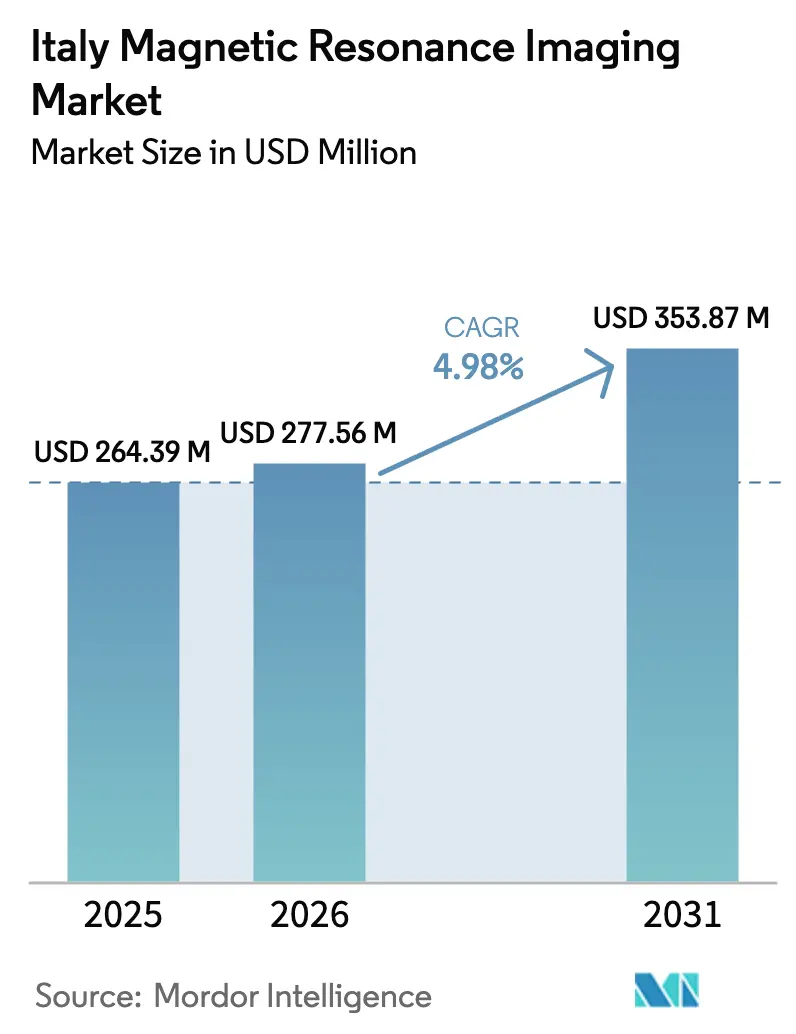
| Base Year Market Size (2025) | USD 264.39 Million |
| Market Size (2026) | USD 277.56 Million |
| Market Size (2031) | USD 353.87 Million |
| Growth Rate (2026 - 2031) | 4.98 % |
| Market Concentration | Medium |
Major Players *Disclaimer: Major Players sorted in no particular order Image © Mordor Intelligence. Reuse requires attribution under CC BY 4.0. | |
Italy Magnetic Resonance Imaging Market Analysis by Mordor Intelligence
Italy MRI market size in 2026 is estimated at USD 277.56 million, growing from 2025 value of USD 264.39 million with 2031 projections showing USD 353.87 million, growing at 4.98% CAGR over 2026-2031. Growth rests on three pillars: the National Recovery and Resilience Plan, the country’s rapidly aging demographic profile, and continuous technology upgrades that shorten scan times and broaden clinical indications. Rising incidence of cancer and neurodegenerative disorders keeps demand for high-resolution, non-ionizing imaging on an upward curve, while value-based procurement models encourage hospitals to replace helium-intensive equipment with energy-efficient platforms. Portable scanners widen geographic access in underserved regions, and AI-enabled workflow tools increase patient throughput, partially offsetting MRI workforce shortages.
Key Report Takeaways
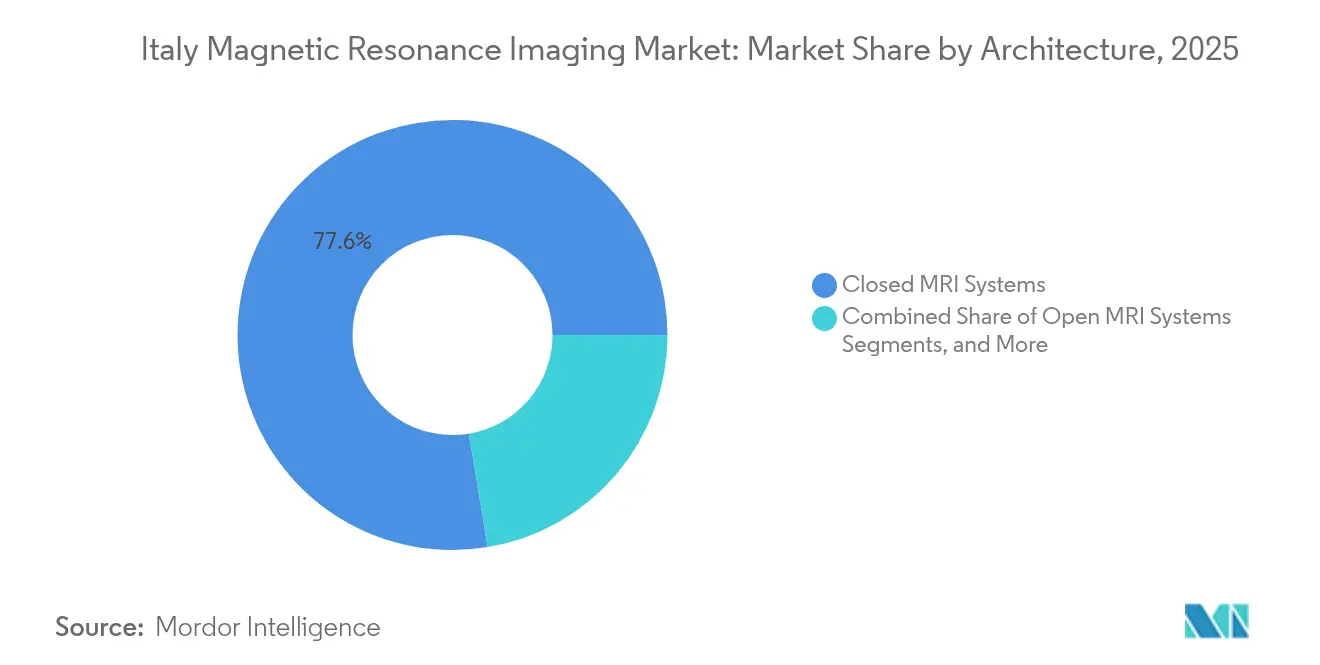
- By architecture, closed MRI systems led with 77.62% of Italy MRI market share in 2025; portable MRI systems are forecast to rise at a 5.32% CAGR through 2031.
- By field strength, mid-field (0.5–1.5 T) units controlled 47.65% of Italy MRI market size in 2025, whereas ultra-high field (>3 T) units are expected to expand at a 5.58% CAGR to 2031.
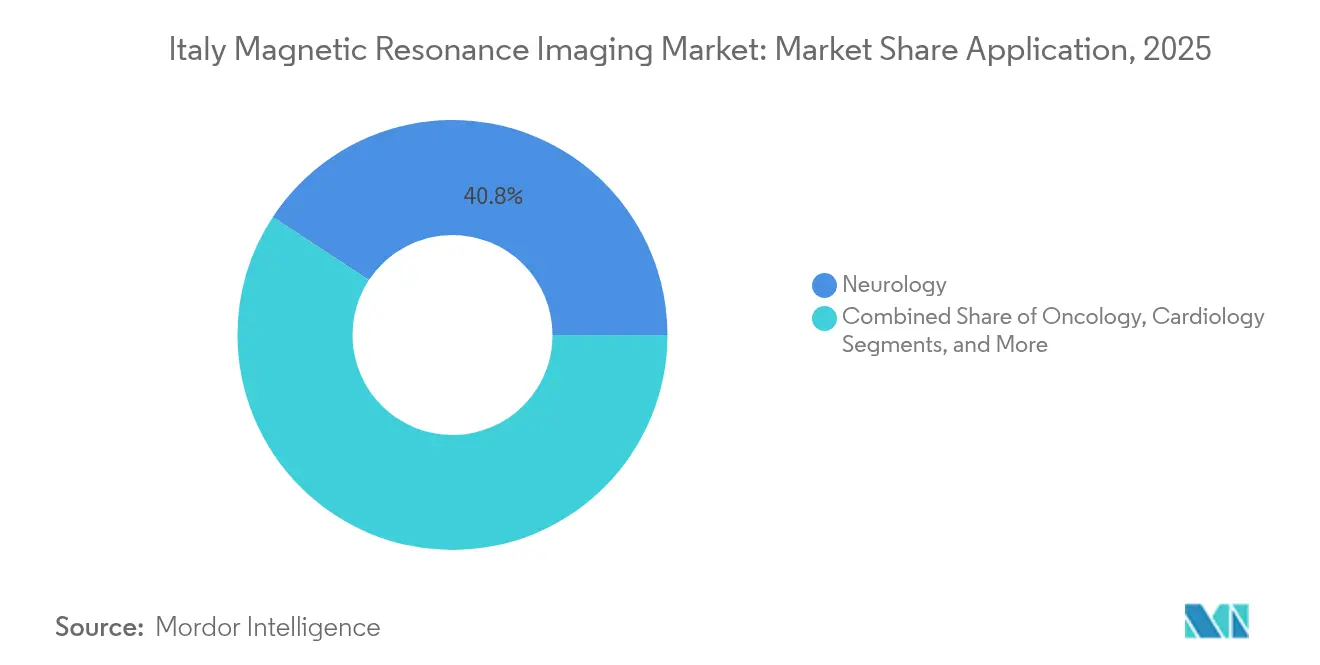
- By application, neurology captured 40.75% Italy MRI market share in 2025; oncology is on track for the fastest 5.93% CAGR through 2031.
- By end user, hospitals commanded 66.80% of the Italy MRI market size in 2025; diagnostic imaging centers are projected to grow at a 5.49% CAGR to 2031.
Note: Market size and forecast figures in this report are generated using Mordor Intelligence’s proprietary estimation framework, updated with the latest available data and insights as of 2026.
Italy Magnetic Resonance Imaging Market Trends and Insights
Drivers Impact Analysis*
| Driver | (~) % Impact on CAGR Forecast | Geographic Relevance | Impact Timeline |
|---|---|---|---|
| Rising chronic-disease imaging demand | +1.2% | National, concentrated in Northern regions | Medium term (2-4 years) |
| National Recovery & Resilience (PNRR) cap-ex for MRI upgrades | +1.8% | National, with priority to underserved Southern regions | Short term (≤ 2 years) |
| Technological breakthroughs in MRI | +0.9% | National, early adoption in major urban centers | Long term (≥ 4 years) |
| Steady growth in healthcare spending and modernization | +0.7% | National, regional variations in implementation | Medium term (2-4 years) |
| Expanding clinical indications for MRI | +0.8% | National, specialty centers leading adoption | Medium term (2-4 years) |
| Shift toward patient-centric, non-ionizing diagnostic alternatives | +0.6% | National, driven by patient awareness campaigns | Long term (≥ 4 years) |
| Source: Mordor Intelligence | |||
National Recovery & Resilience (PNRR) Cap-ex for MRI Upgrades
Italy’s EUR 194.4 billion PNRR channels unprecedented funds toward hospital equipment modernization, opening a short procurement window that favors immediate replacement of aging scanners [1]. Revised community‐hospital targets, cut from 1,350 to 936 because of construction-cost inflation, still translate into hundreds of new MRI installations. The complementary Piano Transizione 5.0 adds EUR 12.7 billion in tax credits for facilities that cut energy consumption by at least 3%, effectively subsidizing zero-boil-off magnets. Together, these measures accelerate purchasing decisions, especially in Southern regions that historically lagged in imaging capacity.
Rising Chronic-Disease Imaging Demand
Population aging to 24% above 65 years fuels MRI use across neurology, oncology, and cardiology. Alzheimer’s prevalence already tops 413,715 patients and drives neuroimaging protocols that add to scanner workloads. Annual cancer incidence reached 390,700 cases in 2022 and is poised for a further 15% increase by 2025, intensifying demand for precise staging and follow-up imaging. AI-based reconstruction tools cut scan time by as much as 30%, enabling higher daily volumes without compromising image quality.
Technological Breakthroughs in MRI
Innovation centers on helium-free magnets, zero-click planning, and ultra-high field research platforms. Siemens Healthineers introduced a virtually helium-free 1.5 T system that eases siting constraints and slashes lifecycle costs [2]. Philips and NVIDIA are co-developing foundational AI models that automate pathology detection to further improve turnaround times. At the University of Pisa, 7 T imaging demonstrated 84% vascular-parameter detection compared with digital subtraction angiography, underscoring the clinical potential of ultra-high field technology.
Expanding Clinical Indications for MRI
Whole-body protocols now guide metastatic prostate cancer management with higher sensitivity than conventional imaging and no contrast agent. AI-enhanced cardiac scans predict arrhythmia risk and fine-tune ablation strategies. MRI-compatible robotic tools enable real-time neurosurgical navigation, evidenced by early adoption at Ospedale San Raffaele in Milan.
Restraints Impact Analysis*
| Restraint | (~) % Impact on CAGR Forecast | Geographic Relevance | Impact Timeline |
|---|---|---|---|
| High equipment & lifecycle costs | -1.4% | National, acute in South | Short term (≤ 2 years) |
| Slow, fragmented reimbursement approvals | -0.8% | National, regional variations | Medium term (2-4 years) |
| Shortage of MRI-trained personnel | -1.1% | National, severe in peripheral areas | Long term (≥ 4 years) |
| Volatile helium & energy prices | -0.7% | National, affecting legacy systems | Short term (≤ 2 years) |
| Source: Mordor Intelligence | |||
High Equipment & Lifecycle Costs
New scanners range between USD 1 million and USD 3 million, while service contracts consume 8–12% of purchase price annually [3]. Helium refill prices have soared 250% over ten years, pushing annual outlays to USD 28,000–36,000 for older magnets. Energy audits in Italian radiology departments show MRI units account for 24% of daily departmental electricity at 214.6 kWh, eroding hospital budgets.
Shortage of MRI-Trained Technologists & Radiologists
More than 11,000 physicians quit the National Health Service from 2019–2022, leaving radiology departments understaffed. Technologist vacancies rose to 18.1% in 2024, nearly triple 2021 levels, prolonging patient wait times. Recruitment challenges are most acute in peripheral regions that offer fewer career development opportunities.
*Our forecasts treat driver/restraint impacts as directional, not additive. The impact forecasts reflect baseline growth, mix effects, and variable interactions.
Segment Analysis
By Architecture: Portable Innovation Challenges Traditional Dominance
Closed scanners kept 77.62% of Italy MRI market share in 2025, favored for image quality, multichannel coils, and high diagnostic confidence in oncology and neurology. The Italy MRI market size for portable units is modest today yet rising quickly; portable platforms are forecast to record a 5.32% CAGR between 2026-2031. Adoption is fastest in emergency departments and rural clinics where space and helium logistics restrict classic cylindrical designs. Manufacturers are integrating AI reconstruction to uplift image quality, shrinking the performance gap versus closed systems.
Portable scanners support Italy’s goal of equitable access, particularly in Calabria and Sicily, where patient travel distances exceed national averages. Esaote’s Magnifico Open and O-scan systems use permanent magnets and low acoustic noise to enhance user comfort. Hospitals also deploy mobile trailers to manage surges in oncology referrals. Market consolidation could intensify as global vendors acquire niche portable innovators to broaden their portfolio.

By Field Strength: Ultra-High Field Gains Momentum Despite Mid-Field Dominance
Mid-field (0.5–1.5 T) platforms commanded 47.65% of Italy MRI market size in 2025 and remain the workhorse for routine brain, spine, and joint imaging. The Italy MRI market share advantage stems from clinical versatility and relatively low operating costs. Nonetheless, ultra-high field (>3 T) systems are projected to grow at 5.58% CAGR, propelled by advanced neuro-oncology protocols and research funding flows to Lombardy and Tuscany.
At 7 T, clinicians achieve superior contrast-to-noise and microvascular visualization, helping detect cortical microbleeds and subtle hippocampal sclerosis. Cost remains the primary barrier, yet PNRR incentives could tip the business case for select academic centers. Mid-field scanners are not static; vendors are adding AI-driven sequences that mimic high-field resolution, keeping these systems relevant for community hospitals.
By Application: Oncology Acceleration Challenges Neurology Leadership
Neurology retained 40.75% Italy MRI market share in 2025, fueled by Alzheimer's surveillance and cerebrovascular assessments. Oncology is forecast to be the fastest-growing segment at a 5.93% CAGR through 2031, supported by the adoption of whole-body MRI in routine metastatic workups for prostate and breast cancer. Cardiac and musculoskeletal indications contribute steady volumes, aided by AI algorithms that cut acquisition times and automate reporting.
The Italy MRI industry sees oncology demand broaden beyond tertiary centers; private clinics now advertise total-body oncology scans bundled with AI triage reports. Synthetic MRI techniques that remove the need for gadolinium contrast attained 93% sensitivity in early malignancy detection. Health authorities encourage modality appropriateness, supporting MRI use in oncology pathways when clinically indicated.
By End User: Diagnostic Centers Capitalize on Outpatient Shift
Hospitals maintained a sturdy 66.80% revenue foothold in 2025, reflecting 24/7 emergency needs and multidisciplinary case management. Still, independent imaging centers will log the fastest 5.49% CAGR, buoyed by outpatient procedure migration policy and payer incentives for day-case diagnostics. Service differentiation revolves around same-day reporting, patient-friendly scheduling apps, and transparent pricing.
Outpatient penetration already reaches 48% of advanced imaging volumes nationally and is higher in metropolitan Milan and Rome. Hospitals are responding by spinning off imaging departments into revenue-sharing joint ventures to retain market share. Research institutes focus on experimental protocols and early-phase device trials, acting as key opinion leaders for the broader Italy MRI market.
Geography Analysis
Lombardy, Veneto, and Emilia-Romagna anchor the advanced tier of Italy MRI market development, benefiting from robust regional GDP and dense hospital networks. These regions capture the lion’s share of ultra-high field installations and act as launchpads for AI pilots with multinational vendors. Rome and Tuscany form the middle tier, balancing high research output with moderate funding constraints; flagship centers such as Ospedale San Raffaele routinely publish in peer-reviewed journals and host multinational clinical trials.
In contrast, Sicily, Calabria, and Campania still record lower scanner density per capita. The 2024 differentiated autonomy law may widen this North-South gap by delegating greater budget control to already well-funded regions. PNRR allocation criteria, however, assign higher weight to socioeconomic disadvantage, potentially channeling capital to Southern provinces for the first time in decades. Early evidence comes from Sardinia’s Aou Sassari, which introduced contrast-enhanced mammography with 3,000 patient accesses in six months, signaling readiness to adopt sophisticated imaging.
Mobile multi-screening units in Tuscany’s Valle del Serchio cut patient travel emissions by 97% and demonstrate how IT-enabled outreach can offset geographic disparities. Regional universities coordinate teleradiology pools that allow Northern subspecialists to read Southern studies overnight, mitigating personnel shortages. Over the forecast horizon, equitable Italy MRI market growth hinges on aligning equipment purchases with parallel investments in workforce and digital infrastructure.
Regulatory Landscape
Italy regulates MRI systems as medical devices under Regulation (EU) 2017/745 (MDR). CE marking is mandatory to place MRI systems on the market, and manufacturers must register devices in the BD/RDM national database administered by the Ministry of Health, regardless of EUDAMED status. The Ministry validates registration applications for economic operators and oversees compliance, while procurement remains highly decentralized across Italy's 20 regions and uses regional consortia such as Intercent-ER, ARCA, ESTAR, and SoReSa to shape tender specifications and award cycles. CND (Classificazione Nazionale Dispositivi Medici) codes underpin tender eligibility and reimbursement alignment.
Regulatory and procurement practices continue to emphasize traceability and interoperability as Italy expands digital health measures. Regional authorities retain considerable purchasing autonomy, which, combined with MDR alignment, maintains a steady gate for hospital-based imaging deployments.
Value Chain Analysis
Italy hosts a substantial domestic manufacturing base in Lombardy, Emilia-Romagna, and Veneto, complemented by global OEMs GE HealthCare, Philips, Siemens Healthineers, and Canon Medical Systems, with Esaote contributing in open and specialty platforms. Market access relies on local agents or distributors who navigate regional procurement rules and regulatory compliance, while long-term managed-service contracts are common to support public facilities.
Downstream activities focus on regional tenders and multi-site deployments, with post-sale installation, training, applications support, and multi-year service contracts forming a large portion of total value. Public modernization programs under the National Recovery and Resilience Plan (PNRR) and collaborations such as the Rome Technopole and the Sapienza Universita di Roma partnership drive capability building and standardization across imaging services.
Competitive Landscape
Market concentration remains moderate. Siemens Healthineers, GE HealthCare, and Philips collectively dominate premium bids through integrated hardware-software ecosystems and long-term managed-service contracts. Domestic champion Esaote leverages intimate local relationships and tailored service bundles to hold share in extremity and open systems. Bracco supplies contrast agents and is branching into AI analytics to diversify revenue streams.
Strategic initiatives increasingly center on value-based imaging. Siemens Healthineers’ EUR 55 million agreement with University Hospital Nantes—involving virtually helium-free scanners and outcome-linked pricing—sets a template likely to be replicated with Italian health authorities. Philips’ partnership with NVIDIA builds proprietary foundation models that promise zero-click protocols and automated triage, differentiating its offering beyond magnet strength.
Emerging disruptors include United Imaging, whose installation at Cobellis Clinic signals competitive pricing pressure in mid-field systems, and several AI software start-ups targeting scan planning and post-processing. Supply-chain resilience, particularly helium sourcing, has become a new battleground; vendors advertising negligible helium burn rates gain an edge as energy costs rise. Over the forecast period, competitive intensity will likely pivot from hardware performance toward ecosystem partnerships, workflow guarantees, and sustainability metrics.
Italy Magnetic Resonance Imaging Industry Leaders
-
GE Healthcare
-
Fujifilm Holdings Corporation
-
Koninklijke Philips NV
-
Siemens Healthcare AG
-
Canon Medical Systems Corporation
- *Disclaimer: Major Players sorted in no particular order

Market Opportunities and Future Outlook
Upgrading obsolete imaging fleets aligns with PNRR modernization funds, creating opportunities for 3T platforms and open-bore designs to improve patient comfort and throughput. AI-enabled workflow tools, faster reconstruction, and reduced helium dependency are visible priorities, while telemedicine and cloud-based diagnostics, facilitated by Agenas, expand remote interpretation and cross-regional access. Public-private partnerships focusing on high-performance standards, such as the Sapienza Universita di Roma and Confindustria Dispositivi Medici collaboration, anchor local technology innovation.
Private diagnostics will continue to attract self-pay and cross-border patients, supporting procurement of advanced MRI equipment. Market activity centers on oncology and whole-body MRI workflows, AI-assisted reconstruction, and scalable cloud pathways demonstrated in pilots and regional programs, anchored by public procurement frameworks and local pilots that translate into tangible gains in scanner utilization and access.
Recent Industry Developments
- January 2026: GE HealthCare installed a 3 Tesla SIGNA Hero MRI at Biomedical SpA in Genoa. The deployment expands access to high-field imaging in northern Italy and strengthens GE's footprint in hospital procurement cycles.
- September 2025: Centro di Medicina in Mestre operationally deployed GE SIGNA Champion 1.5T MRI with AI as part of a digitalization program. The integration supports workflow automation and enhances diagnostic throughput in the private care segment.
- June 2025: Consip Spa awarded a major public framework agreement ID 2785 for 3 Tesla MRI supply with Siemens Healthineers, Philips, and GE Medical Systems Italia. The framework secures multi vendor procurement for public hospitals, expanding access to high field MRI and reinforcing competition among leading vendors.
Research Methodology Framework and Report Scope
Market Definition and Coverage
For this methodology, the market covers the value of magnetic resonance imaging equipment sales in Italy, counted as revenues from MRI systems supplied to hospitals, imaging centers, and similar clinical settings.
Scope exclusions: The totals exclude imaging services revenue, facility construction costs, and broader hospital IT that is not specific to MRI.
Segmentation Overview
- By Architecture
- Closed MRI Systems
- Open MRI Systems
- By Field Strength
- Low Field (<0.5 T)
- Mid Field (0.5-1.5 T)
- High Field (1.5-3 T)
- Very-/Ultra-High (>3 T)
- By Application
- Neurology
- Oncology
- Cardiology
- Gastroenterology
- Musculoskeletal
- Other Applications
- By End User
- Hospitals
- Diagnostic Imaging Centers
- Research Institutes
Data Sources, Market Sizing, and Validation
Desk Research
Desk work starts by mapping the installed base, renewal needs, and public spending signals that influence MRI purchases in Italy. For this, we rely on public references such as OECD Health Statistics, Eurostat health expenditure tables, the Italian Ministry of Health publications, procurement and tender portals used by public bodies, and radiation and medical device guidance from European institutions where it informs imaging equipment planning.
We also use manufacturer annual reports, product brochures, hospital network announcements, and credible healthcare trade press to understand upgrade cycles and the technology mix (for example, shifting demand toward higher field strength systems and workflow improvements). Where available, we supplement with paid subscriptions that provide company financials and news tracking, and we cross-check import and export patterns through a shipment-level trade database when equipment flows help explain unusual year-to-year changes. These desk research sources are illustrative only, and many other references were reviewed for data collection, validation, and clarification.
Primary Interviews and Surveys
Primary work was used to pressure test demand drivers and pricing logic with people involved in buying, using, and maintaining MRI systems, including clinical leaders, radiology managers, procurement teams, and service partners. The interviews clarified how replacement decisions are handled in Italy, for example budget cycles, public tenders, and private investments, and they also helped align assumptions on field strength mix and typical configuration choices by care setting.
Distribution of primary research fieldwork respondents
| Company type | Respondent position |
|---|---|
| Top tier: 35% | CXOs: 13% |
| Mid tier: 47% | Functional/Unit leaders: 36% |
| Smaller Players: 18% | Managers: 51% |
Market-Sizing & Forecasting
Sizing begins with a top-down reconstruction of Italy MRI demand using healthcare capacity and utilization signals, which are then translated into annual system requirements and spending. Key inputs include installed base renewal timing, expected replacement cycles, public and private investment activity (including tender cadence), field strength mix shifts, and a realistic ASP range based on configuration and typical discounting in institutional buys. Where data is thin, assumptions are kept explicit and then tightened through interview feedback.
Those totals are corroborated using selective bottom-up approximations, such as rolling up a sample of supplier revenues tied to Italy, checking channel activity, and validating implied unit volumes by comparing them with procurement announcements and trade movements. For forecasting, we apply scenario analysis supported by short trend models, where variables like replacement backlog resolution, funding releases, and adoption of faster exam protocols drive the yearly demand pattern instead of forcing a straight-line CAGR. Any gaps in the roll-ups are handled by applying conservative penetration factors to uncovered channels, followed by a re-check of the implied units and price mix.
Data Validation & Update Cycle
Outputs are validated through triangulation across independent signals, and then outliers are reviewed one by one before sign-off. We compare results against related indicators, including procurement volumes, reported equipment upgrades by large hospital networks, and shifts in modality spend, and we re-contact experts when a variance cannot be explained by timing or scope.
Every report is refreshed on an annual cycle, with interim updates when material events occur, such as major funding releases, large tender waves, or sharp pricing changes. Before delivery, an analyst completes a final pass to re-check inputs, align currency treatment, and incorporate the latest public information that could move near-term estimates.
Mordor Intelligence's Italy Magnetic Resonance Imaging Market Size Compared With Other Published Estimates
Published market sizes for Italy MRI can differ even when they use similar wording, because the counted revenue pools are not always the same and the timing of price and volume assumptions varies by publisher. Differences also come from whether the values reflect equipment only, or if services and adjacent imaging categories are blended into the total.
In this study, the main gap driver is scope control, where the estimate is tied to MRI system revenues in Italy and is stress tested using procurement timing and field strength mix. This narrower equipment-only treatment is why the number sits away from broader diagnostics totals, which is a modeling choice applied by Mordor Intelligence.
Benchmark comparison
| Source | Market Size | Gaps in Research Methodology |
|---|---|---|
| Mordor Intelligence | USD 264.39 M (2025) | |
| Regional Consultancy A | USD 1.18 B (2026) | This figure appears to bundle a wider diagnostic imaging revenue pool, which can mix MRI equipment with services, maintenance, and sometimes other modalities, thereby inflating the addressable value compared with equipment sales only. |
| Trade Journal B | USD 292.00 M (2025) | The estimate is close in level, but it likely applies different ASP progression and field strength weighting, and it may not adjust as tightly for tender timing that shifts shipments between calendar years. |
Overall, the spread in published values is mostly explained by what gets counted as MRI market revenue and how quickly prices and mix are allowed to change year to year. By keeping variables traceable to unit needs, procurement cycles, and a clear equipment scope, the sizing steps remain repeatable and easier to reconcile when new information emerges.
Key Questions Answered in the Report
How big is the Italy Magnetic Resonance Imaging Market?
The Italy Magnetic Resonance Imaging Market size is expected to reach USD 277.56 million in 2026 and grow at a CAGR of 4.98% to reach USD 353.87 million by 2031.
Which architecture segment is growing fastest?
Portable MRI systems, aided by zero-helium designs, are set for a 5.32% CAGR through 2031.
Who are the key players in Italy Magnetic Resonance Imaging Market?
GE Healthcare, Fujifilm Holdings Corporation, Koninklijke Philips NV, Siemens Healthcare AG and Canon Medical Systems Corporation are the major companies operating in the Italy Magnetic Resonance Imaging Market.
What main challenge limits market growth?
High acquisition costs, personnel shortages, and helium price volatility are key hurdles that could shave up to 1.4 percentage points off CAGR forecasts.