
Market Overview
| Study Period | 2020 - 2031 |
|---|---|
| Forecast Data Period | 2026 - 2031 |
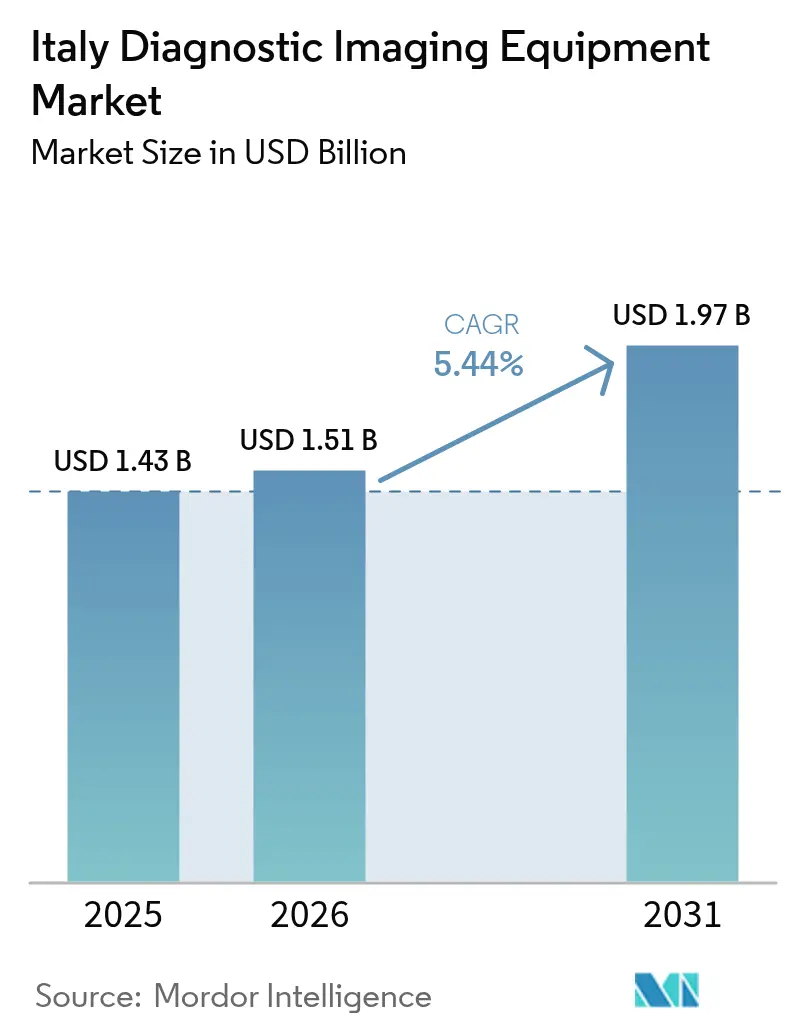
| Base Year Market Size (2025) | USD 1.43 Billion |
| Market Size (2026) | USD 1.51 Billion |
| Market Size (2031) | USD 1.97 Billion |
| Growth Rate (2026 - 2031) | 5.44 % |
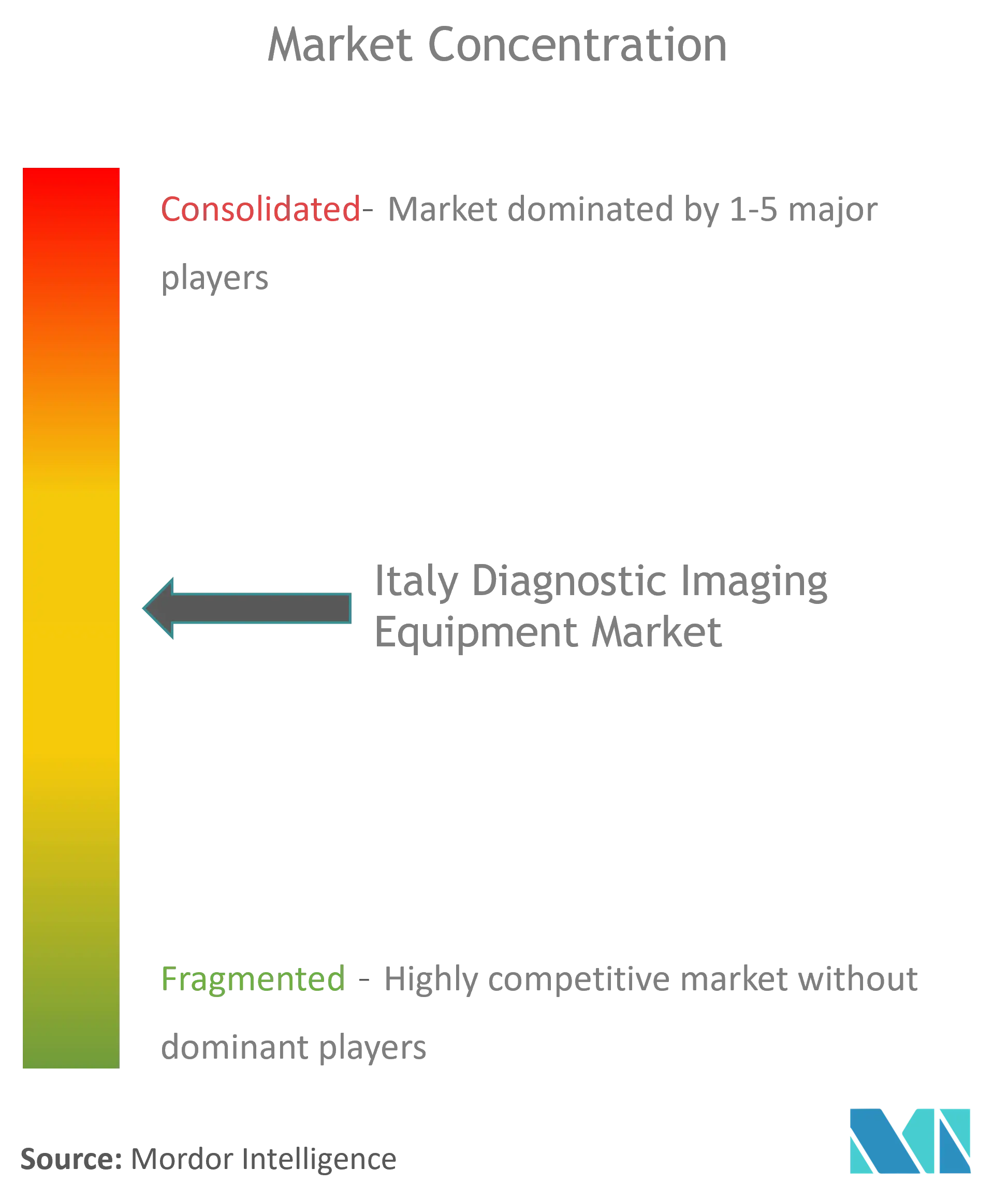
| Market Concentration | High |
Major Players *Disclaimer: Major Players sorted in no particular order Image © Mordor Intelligence. Reuse requires attribution under CC BY 4.0. | |
Italy Diagnostic Imaging Equipment Market Analysis by Mordor Intelligence
The Italy diagnostic imaging equipment market size was valued at USD 1.43 billion in 2025 and estimated to grow from USD 1.51 billion in 2026 to reach USD 1.97 billion by 2031, at a CAGR of 5.44% during the forecast period (2026-2031). Capacity upgrades financed by the National Recovery and Resilience Plan (PNRR) and private-sector investments are accelerating equipment replacement cycles and digital connectivity. Demand is reinforced by population aging, the high burden of oncological and cardiovascular diseases, and progressive adoption of artificial intelligence (AI) for image interpretation. Vendors respond with photon-counting CT, open-architecture MRI, and mobile X-ray systems that shorten exam times and fit emerging point-of-care workflows. Regional convergence policies and uniform national tariffs introduced in 2025 are expected to lift procedure volumes in historically underserved Southern provinces, while the hospitality of Italy’s sprawling private diagnostics network continues to attract self-pay and cross-border patients.
Key Report Takeaways
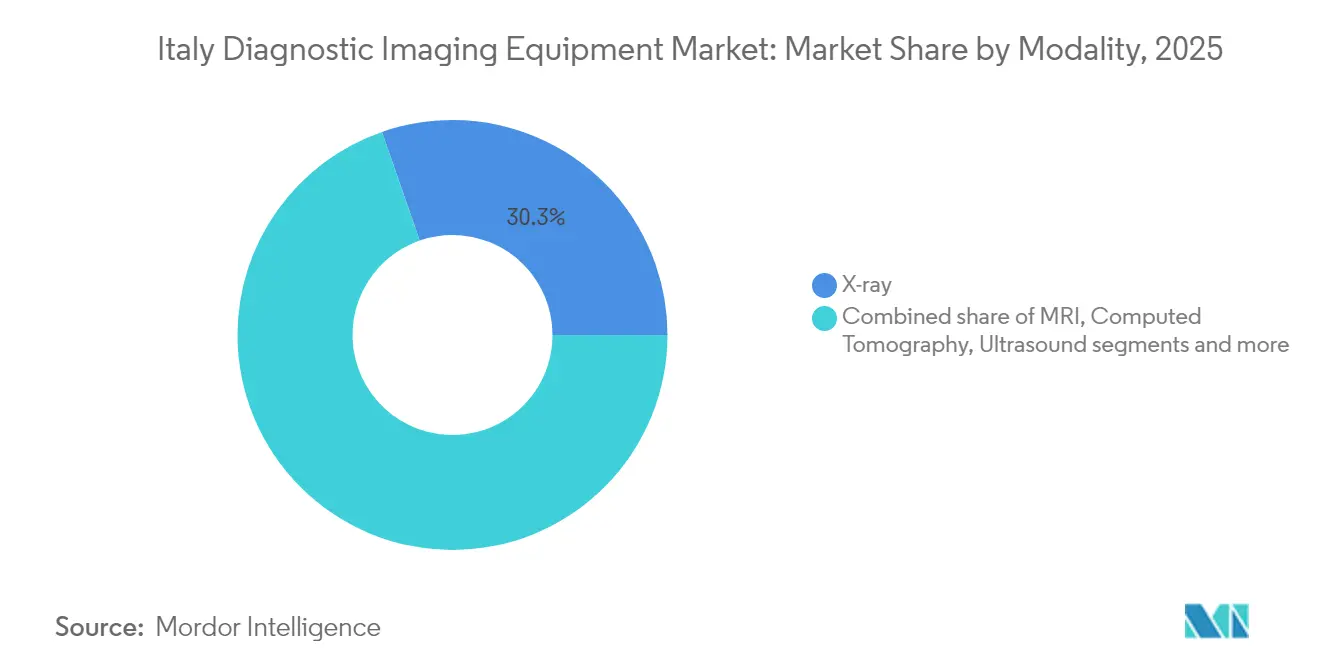
- By modality, X-ray led with 30.32% revenue share in 2025, whereas MRI is positioned to expand at a 7.17% CAGR to 2031.
- By portability, fixed systems held 81.12% of the Italy diagnostic imaging equipment market share in 2025; mobile and handheld systems are rising fastest at 6.79% CAGR.
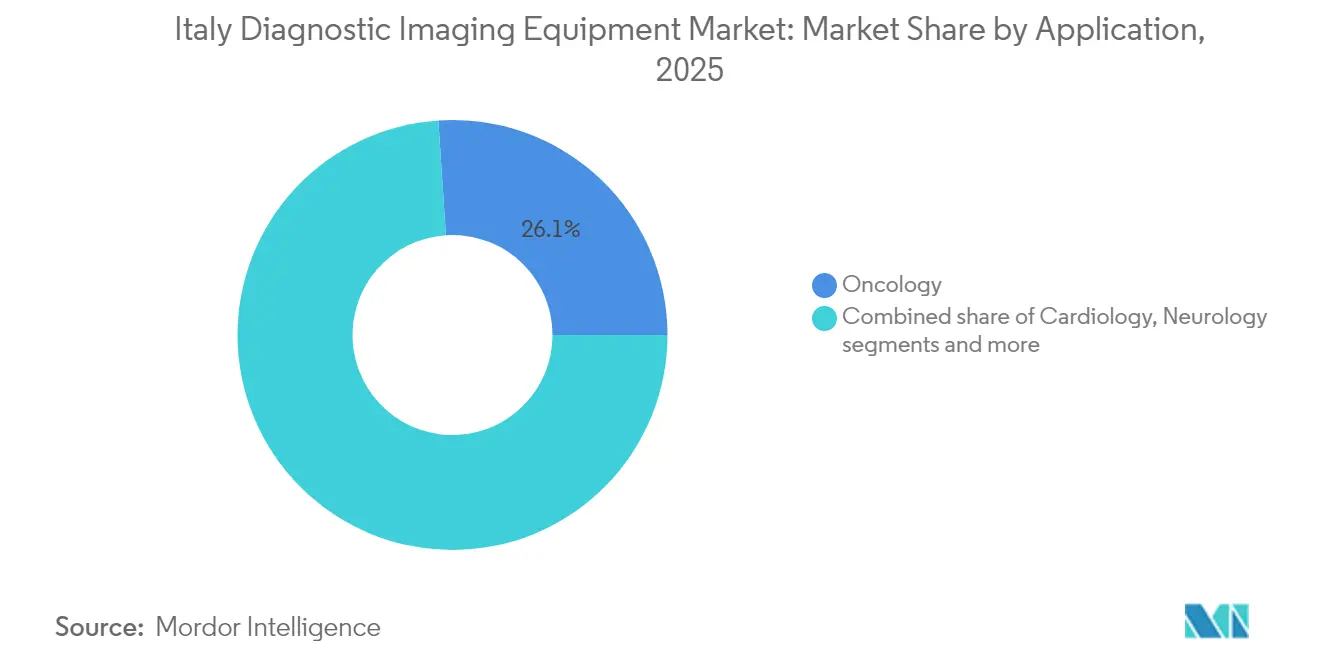
- By application, oncology accounted for 26.05% of the Italy diagnostic imaging equipment market size in 2025; cardiology is projected to grow at 7.15% CAGR through 2031.
- By end user, hospitals generated 68.92% of 2025 revenues, while diagnostic imaging centers exhibit the highest projected CAGR of 6.78%.
Note: Market size and forecast figures in this report are generated using Mordor Intelligence’s proprietary estimation framework, updated with the latest available data and insights as of 2026.
Italy Diagnostic Imaging Equipment Market Trends and Insights
Drivers Impact Analysis*
| Driver | (~) % Impact on CAGR Forecast | Geographic Relevance | Impact Timeline |
|---|---|---|---|
| Demographic aging and escalating chronic-disease incidence | +1.8% | National, higher in Northern regions | Long term (≥ 4 years) |
| Large-scale government & EU recovery funding for healthcare modernization | +1.2% | National, priority to Southern regions | Medium term (2-4 years) |
| Rapid technological breakthroughs in multimodal imaging | +0.9% | Global, early adoption in major Italian medical centers | Medium term (2-4 years) |
| Rising uptake of point-of-care, portable and mobile imaging platforms | +0.7% | National, accelerated in emergency and ICU settings | Short term (≤ 2 years) |
| Growing emphasis on precision, preventive and value-based care models | +0.6% | National, led by academic medical centers | Long term (≥ 4 years) |
| Expansion of private diagnostics and outpatient imaging networks | +0.4% | National, concentrated in Northern and Central Italy | Medium term (2-4 years) |
| Source: Mordor Intelligence | |||
Demographic Aging and Escalating Chronic-Disease Incidence
Citizens aged ≥65 are expected to climb from 24% to 34% by 2050, driving multi-modality follow-up for cancers, heart disease, and musculoskeletal conditions.[1] Hospital radiology departments report increasing examination complexity that favors higher-throughput CT scanners, wide-bore MRI, and iterative reconstruction software. Workflow automation and patient-comfort features gain priority as frail patients require longer positioning times. Vendors that combine low-dose protocols with rapid image reconstruction gain a competitive edge in the Italy diagnostic imaging equipment market.
Large-Scale Government & EU Recovery Funding for Healthcare Modernization
The PNRR sets aside funds to replace 3,100 legacy systems and digitalize 280 emergency departments, triggering a concentrated equipment buying cycle that benefits premium vendors able to guarantee cyber-secure interoperability. Southern hospitals receive above-average budget shares, narrowing the historic North–South technology gap. Public tenders favor systems offering AI-ready architectures, remote service diagnostics, and energy-saving standby modes, reinforcing high-spec replacements across the Italy diagnostic imaging equipment market.
Rapid Technological Breakthroughs in Multimodal Imaging
Academic hubs such as San Raffaele Hospital operate photon-counting CT and 3 T whole-body MRI to improve soft-tissue contrast and reduce radiation dose.[2] Multimodal fusion of PET with MRI is gaining traction in neuro-oncology and cardiac sarcoidosis. Early adopters cite lower repeat-scan rates and greater clinician confidence, pushing the Italy diagnostic imaging equipment market toward integrated hardware-software ecosystems.
Rising Uptake of Point-of-Care, Portable and Mobile Imaging Platforms
Bedside ultrasound, mobile DR X-ray carts, and battery-powered CT are now embedded in emergency protocols forged during the COVID-19 pandemic. Hospitals report shorter patient transfer times and reduced cross-infection risk, justifying capital outlays for compact consoles and wireless probes. Handheld ultrasound is spreading from emergency medicine into cardiology and obstetrics, adding incremental volumes to the Italy diagnostic imaging equipment market.
Restraints Impact Analysis*
| Restraint | (~) % Impact on CAGR Forecast | Geographic Relevance | Impact Timeline |
|---|---|---|---|
| High cost of imaging equipment & procedures | -0.8% | National, more pronounced in Southern regions | Long term (≥ 4 years) |
| Lengthy regulatory, reimbursement and public-tender procedures | -0.6% | National, bureaucratic delays in public sector | Medium term (2-4 years) |
| Persistent shortage of qualified radiologists and technologists | -0.5% | National, critical shortage in rural areas | Long term (≥ 4 years) |
| Regional disparities in imaging infrastructure utilization and access | -0.3% | North–South divide, rural–urban disparities | Long term (≥ 4 years) |
| Source: Mordor Intelligence | |||
High Cost of Imaging Equipment & Procedures
Out-of-pocket healthcare spending rose 10.3% in 2023, and 4.5 million citizens skipped care due to cost. Capital budgets in smaller hospitals lag behind recommended five-to-seven-year replacement cycles, suppressing demand for high-end MRI and hybrid scanners. Service contracts, software upgrades, and energy costs compound financial strain, limiting purchasing power in parts of the Italy diagnostic imaging equipment market.
Lengthy Regulatory, Reimbursement and Public-Tender Procedures
Italian public tenders can stretch beyond 18 months, delaying installations and eroding vendor margins. Multi-layer approval pathways for new procedure codes slow clinical adoption of advanced modalities such as photon-counting CT. Smaller facilities lack dedicated procurement staff, handing bargaining power to large university hospitals. The resulting inertia reduces near-term revenues in the Italy diagnostic imaging equipment market.
*Our forecasts treat driver/restraint impacts as directional, not additive. The impact forecasts reflect baseline growth, mix effects, and variable interactions.
Segment Analysis
By Modality: X-Ray Dominance Faces MRI Innovation Challenge
X-ray retained 30.32% share in 2025, underpinned by universal clinical use and economical operating costs. Digital radiography upgrades continue to replace film systems, securing steady replacement demand within the Italy diagnostic imaging equipment market. Advanced detectors and dose-reduction algorithms enhance image quality while easing regulatory compliance.
MRI, however, is set to grow at a 7.17% CAGR as open-bore systems reduce claustrophobia and 3 T platforms shorten scan times. Esaote’s Magnifico Open drove a 3.3% sales increase in 2023. Neuro-oncology, musculoskeletal sports injuries, and cardiac viability studies widen clinical indications, elevating the MRI slice of the Italy diagnostic imaging equipment market size for hospital and private settings alike.

By Portability: Fixed Systems Stability Challenged by Mobile Innovation
Fixed units held 81.12% of 2025 revenues, anchored by high-throughput CT, MRI, and angio suites that integrate with PACS and hospital information systems. PNRR budgets prioritize like-for-like replacements, ensuring short-term stability in this segment of the Italy diagnostic imaging equipment market.
Mobile and handheld devices are scaling at 6.79% CAGR. Wireless ultrasound probes and wheeled DR carts support surge capacity in ICUs and emergency departments. Their flexibility aligns with evolving care models such as hospital-at-home, expanding the Italy diagnostic imaging equipment market share for vendors that optimize weight, battery life, and image quality.
By Application: Oncology Leadership Meets Cardiology Growth Surge
Oncology accounted for 26.05% of total revenue in 2025. Multi-modality protocols spanning CT, MRI, PET/CT, and mammography underpin precision staging and therapy monitoring. Photon-counting CT at San Raffaele enhances lesion conspicuity and reduces follow-up scans, entrenching oncology’s command of the Italy diagnostic imaging equipment market.
Cardiology is projected to accelerate at 7.15% CAGR, propelled by calcium-scoring CT, stress perfusion MRI, and 3-D echocardiography. Reimbursement expansion for non-invasive ischemia testing and aging demographics drive hospitals to add advanced cardiac imaging suites, enlarging the Italy diagnostic imaging equipment market size allocated to heart care.
By End User: Hospital Dominance Faces Diagnostic Center Disruption
Hospitals contributed 68.92% of 2025 revenue, leveraging integrated care pathways, emergency coverage, and PNRR-funded upgrades. Clinical engineering departments align equipment cycles with risk-management protocols, supporting steady procurement within the Italy diagnostic imaging equipment market.
Diagnostic imaging centers, however, are rising at 6.78% CAGR. They offer rapid scheduling, subspecialty reading, and patient-friendly environments, siphoning elective volumes from public hospitals. Franchise models achieve scale economies in equipment leasing and teleradiology, tilting future demand in the Italy diagnostic imaging equipment industry toward outpatient settings.
Geography Analysis
Northern regions such as Lombardy, Veneto, and Emilia-Romagna command the largest portion of the Italy diagnostic imaging equipment market, buoyed by dense hospital networks, higher disposable income, and home-grown manufacturers like Esaote in Genoa. Early adoption of AI-enabled PACS and 3 T MRI supports procedure growth and keeps waiting lists below national averages. Cross-border patients from Switzerland and Austria add incremental volumes.
Central Italy, anchored by Rome and Florence, benefits from a balanced mix of university hospitals, military medical facilities, and private diagnostics hubs. The region hosts flagship installations of photon-counting CT and hybrid PET/MR, reinforcing its role as a clinical research corridor. Public-private partnerships enable joint investment in high-field MRI and advanced ultrasound laboratories, expanding the Italy diagnostic imaging equipment market for both sectors.
Southern Italy and the Islands historically lag in modality density, yet PNRR allocations now finance core replacements, RIS/PACS roll-outs, and mobile fleets that service rural catchments. Vendor strategies here emphasize lower-cost configurations, extended warranties, and workforce training that collectively enlarge the Italy diagnostic imaging equipment market base while narrowing the national care gap.
Regulatory Landscape
Diagnostic imaging equipment sold in Italy is regulated under the EU Medical Device Regulation (MDR) 2017/745 (and, where applicable for in-vitro diagnostics, IVDR 2017/746), with national implementation anchored by Legislative Decree No 137 of 5 August 2022. The Ministero della Salute is the competent authority, overseeing market surveillance and national administrative requirements that operate alongside EU-level obligations.
Market access depends on MDR conformity assessment pathways (including notified-body involvement where required), CE marking, and operator registration requirements linked to Eudamed, with the Ministry validating certain registration applications. In June 2023, the Ministry published decrees in the official gazette on clinical investigations, formalizing administrative timelines and submission terms for communications involving CE-marked devices and applications for non-CE-marked devices, which can affect evidence generation and the adoption cadence for newer imaging platforms.
Competitive Landscape
The Italy diagnostic imaging equipment market shows moderate concentration. Siemens Healthineers, GE HealthCare, and Philips jointly supply most multi-modality tenders, leveraging full-line portfolios, local service hubs, and financing arms. Siemens posted 7.6% imaging revenue growth in fiscal Q1 2025, while GE spearheads the EU-funded Thera4Care theranostics project, embedding SPECT-CT scanners with AI.
Philips invested EUR 1.7 billion in R&D and topped the 2024 European Patent Office league table with 594 medical technology filings. Its cloud-based enterprise imaging suite launched in Europe in 2025, bundling AI workflow tools that lock clients into subscription ecosystems. Canon Medical and Fujifilm compete in ultrasound and CT niches, often pairing with local distributors to penetrate community hospitals.
Domestic champion Esaote excels in dedicated MRI and premium ultrasound. Italian X-ray specialists Italray and Gilardoni supply cost-competitive DR rooms, while Bracco ramps contrast-agent output by USD 86 million to safeguard supply chains. Competitive levers increasingly revolve around AI-assisted interpretation, life-cycle service contracts, and sustainability credentials rather than raw hardware specifications, shaping procurement priorities across the Italy diagnostic imaging equipment market
Italy Diagnostic Imaging Equipment Industry Leaders
-
Fujifilm Holdings Corporation
-
Siemens Healthineers
-
Koninklijke Philips N.V.
-
Esaote SpA
-
GE HealthCare
-
Siemens Healthineers AG
- *Disclaimer: Major Players sorted in no particular order
Market Opportunities and Future Outlook
A central opportunity in Italy comes from the PNRR (Mission 6, Component 2, Investment 1.1) modernization program, which targets replacement of at least 3,100 large medical devices, with a completion deadline of June 2026. This procurement cycle creates a near-term window for multi-modality replacements (CT, MRI, angiography, mammography and ultrasound among others) bundled with cybersecurity, interoperability, and digital workflow readiness, especially when hospitals are also upgrading emergency-department digitalization and enterprise imaging connectivity.
Decentralized execution through regions and local health entities increases the focus on tender readiness, local service coverage, and integration capabilities with RIS/PACS and dematerialized clinical-document workflows. National tracking of large equipment through the Flusso informativo delle grandi apparecchiature sanitarie (classified via CND) supports a more structured refresh process, and it favors vendors able to provide compliant lifecycle documentation, uptime-focused service models, and AI-enabled workflow tools that help address radiology staffing constraints without expanding the report scope beyond capital equipment.
Recent Industry Developments
- March 2026: Esaote launched the MyLab E85 GTS and MyLab C30 GTS Edition ultrasound systems at ECR 2026, positioned for interventional radiology and image-guided therapies. The releases expand Esaote's higher-acuity ultrasound footprint and reinforce demand for systems designed for guided procedures and real-time workflow in hospitals and advanced imaging centers.
- October 2025: Siemens Healthineers completed the supply of two Gamma Camera/CT systems for the Nuclear Medicine department of Policlinico Duilio Casula in Cagliari under the PNRR Mission 6 program. The delivery shows how PNRR-funded tenders are translating into completed installations, supporting momentum for vendors able to execute complex, regulated deployments on public timelines.
- December 2024: Mindray launched the Resona A20 premium radiology ultrasound system in Italy, featuring Acoustic Fusion Matrix transducers and AI tools. The introduction adds competitive pressure in premium ultrasound and raises the baseline feature set expected in hospital radiology and private diagnostics procurement.
Research Methodology Framework and Report Scope
Market Definition and Coverage
For this study, the Italy diagnostic imaging equipment market covers the value of new imaging systems sold into Italy for clinical diagnosis, including major modalities used to create in vivo medical images in hospitals and imaging centers.
Scope exclusions: We exclude diagnostic imaging services, contrast media, most consumables, and separate service contracts or stand-alone software sold outside the equipment transaction.
Segmentation Overview
- By Modality
- MRI
- Computed Tomography
- Ultrasound
- X-Ray
- Nuclear Imaging (PET/SPECT)
- Fluoroscopy
- Mammography
- By Portability
- Fixed Systems
- Mobile and Hand-held Systems
- By Application
- Cardiology
- Oncology
- Neurology
- Orthopedics
- Gastroenterology
- Gynecology & Obstetrics
- Other Applications
- By End User
- Hospitals
- Diagnostic Imaging Centers
- Ambulatory Surgical Centers
- Other End Users
Data Sources, Market Sizing, and Validation
Desk Research
Desk work started by building a fact base on Italy healthcare capacity and imaging utilization, so the demand pool was grounded in real clinical activity. Public sources such as the Italian Ministry of Health, ISTAT health statistics, OECD Health Statistics, and European Commission health system publications helped shape installed base context, procedure volumes, and spending signals. Peer-reviewed radiology and nuclear medicine journals were also reviewed to understand modality mix shifts and how scanner replacement cycles typically unfold.
On the supply side, association websites and regulator materials, for example EU medical device rules and national procurement guidance, helped validate what counts as an imaging system sale versus adjacent items. Company annual reports, investor presentations, and reputable press were used to cross-check pricing direction, order timing, and demand drivers for Italy. Where needed, paid subscriptions focusing on company financials and a paid patent database were used to clarify product pipelines and the revenue exposure by modality. These desk sources are not exhaustive, and additional public references were reviewed to fill gaps and confirm assumptions.
Primary Interviews and Surveys
Primary work focused on interviews and short surveys with hospital imaging managers, radiology department stakeholders, procurement teams, distributors, and service partners who see replacement and upgrade activity firsthand. Conversations were used to confirm modality-level demand drivers in Italy, typical discounting versus list prices, public tender timing, and how much buying shifts between new systems and refurbished units. Where desk data was thin, we rechecked assumptions on average selling prices, installation lead times, and the share of purchases linked to capacity expansion versus replacement.
Distribution of primary research fieldwork respondents
| Company type | Respondent position |
|---|---|
| Top tier: 36% | CXOs: 12% |
| Mid tier: 47% | Functional/Unit leaders: 34% |
| Smaller Players: 17% | Managers: 54% |
Market-Sizing & Forecasting
Sizing was built using a top-down approach where Italy imaging demand is reconstructed from healthcare activity and equipment replacement needs, then translated into equipment revenue using realistic price and mix assumptions. The model starts with indicators such as imaging procedure volumes by modality, the installed base and age profile of scanners, replacement cycles, public tender activity, and observed shifts toward outpatient diagnostics. Input assumptions were turned into a value model by applying modality mix, unit placements, and average selling price ranges that reflect discounting and configuration differences.
Results were then corroborated using selective bottom-up checks, for example sampled unit shipment discussions through channels, a limited roll-up of supplier revenue exposure to Italy, and ASP times volume checks for key modalities to see whether totals stayed reasonable. When bottom-up signals did not cover part of the market, gaps were handled by using procurement cadence, replacement timing, and utilization growth to infer unit demand rather than forcing a full supplier roll-up. For forecasting, scenario analysis was used around public budget cycles, replacement backlog release, and capital spending appetite, and the final path was selected after aligning it with what primary respondents see in tenders and delivery pipelines.
Data Validation & Update Cycle
Validation was done by comparing model outputs against independent signals, such as national health spending direction, public procurement visibility, and modality-level utilization trends, and then checking that implied unit volumes and ASPs stayed realistic. Outliers were reviewed by rechecking assumptions, conversion factors, and year timing, and the model was adjusted only when a clear reason was found. Before sign-off, the work is reviewed in more than one analyst pass so calculation logic, scope boundaries, and year labels remain consistent.
Reports are refreshed annually, and interim updates are made when material events occur, such as major policy changes, procurement disruptions, or sharp currency and inflation moves that can affect pricing. Before delivery, we do a fresh review so the market size and key assumptions reflect the latest available public data and interview feedback.
Mordor Intelligence's Italy Diagnostic Imaging Equipment Market Sizing Compared With Other Published Estimates
Published market values for diagnostic imaging equipment in Italy can look different across sources, even when they sound like they cover the same topic. The main reasons are usually about what is counted as equipment revenue, which year is treated as the base, and how pricing and procurement timing are handled.
The table highlights that the biggest gaps typically come from scope choices and pricing logic, especially whether imaging services, service contracts, and separate software are blended into the equipment number, and whether list prices are used without Italy tender discounting. Some estimates also lean on aggressive replacement acceleration assumptions without checking scanner age mix and delivery lead times, which can lift short-term totals.
Benchmark comparison
| Source | Market Size | Gaps in Research Methodology |
|---|---|---|
| Mordor Intelligence | USD 1.43 B (2025) | |
| Trade Directory A | USD 1.87 B (2030) | Uses a different forecast horizon and may treat 2025 as a starting point but presents a later year total, which can be mistaken for a current size if the year label is not tracked carefully. |
| Industry Publisher B | USD 20.73 B (2025) | Appears to reflect diagnostic imaging services revenue rather than equipment only, which inflates the figure by mixing procedure-level spending with capital equipment sales. |
The table shows a wide spread largely because the counted revenue pool is not the same, and in Mordor Intelligence's model the value is limited to new diagnostic imaging equipment sold in Italy, with services, contrast media, and separate contracts excluded so the number stays tied to capital purchases.
Key Questions Answered in the Report
What government measure is most influential in refreshing Italy’s diagnostic imaging fleet?
The National Recovery and Resilience Plan is funneling dedicated funds into public hospitals, prompting rapid replacement of aging scanners with digitally connected, AI-ready systems.
Which imaging technologies are seeing the quickest clinical adoption because of artificial intelligence?
MRI and CT platforms integrated with automated post-processing and triage algorithms are gaining traction, as radiology departments seek to shorten report turnaround times and boost diagnostic confidence.
How are mobile and handheld imaging units changing day-to-day patient management?
Portable ultrasound and mobile X-ray carts let clinicians conduct exams at the bedside or in emergency bays, cutting patient transfers, easing infection-control protocols, and enabling faster treatment decisions.
Why are private diagnostic centers expanding their footprint across Italy?
Shorter appointment lead times, flexible opening hours, and tailored patient experiences are drawing referrals away from crowded hospital radiology suites, encouraging private operators to open additional sites.
In what way is the shortage of radiologists shaping equipment purchases?
Hospitals favor scanners with embedded automation, remote reading compatibility, and decision-support software to maximize productivity and help overextended clinicians handle rising exam volumes.
What impact do uniform national tariffs have on regional imaging access?
Standardized reimbursement rates are leveling the playing field between northern and southern provinces, prompting providers in underserved areas to invest in modern equipment and expand service capacity.