
IoT Connectivity Orchestration Market Size and Share
Market Overview
| Study Period | 2021 - 2032 |
|---|---|
| Market Size (2027) | USD 3.17 Billion |
| Market Size (2032) | USD 7.26 Billion |
| Growth Rate (2027 - 2032) | 18.03 % |
| Fastest Growing Market | Asia-Pacific |
| Largest Market | North America |
| Market Concentration | Medium |
Major Players *Disclaimer: Major Players sorted in no particular order Image © Mordor Intelligence. Reuse requires attribution under CC BY 4.0. | |
IoT Connectivity Orchestration Market Analysis by Mordor Intelligence
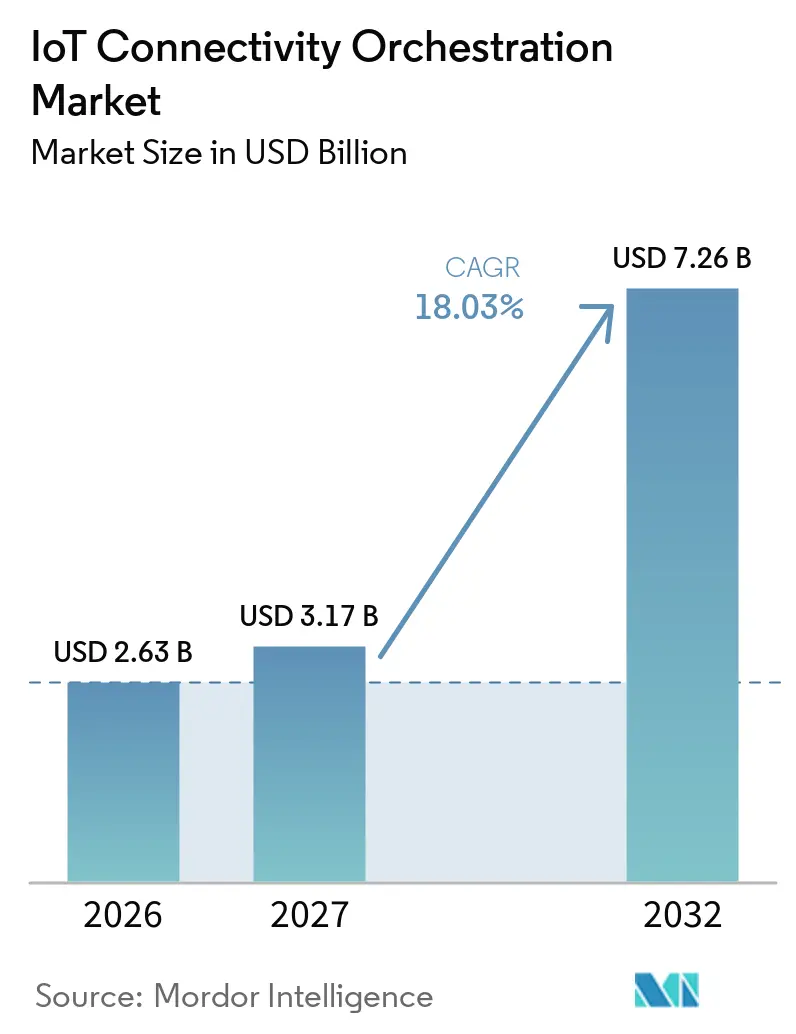
The IoT Connectivity Orchestration Market size is projected to expand from USD 2.63 billion in 2026 and USD 3.17 billion in 2027 to USD 7.26 billion by 2032, registering a CAGR of 18.03% between 2027 and 2032. The IoT connectivity orchestration market is becoming increasingly important as connected devices span operators, countries, and network types. Enterprises increasingly need a single control layer for provisioning, policy enforcement, lifecycle management, and switching between SIM and eSIM profiles. This need is strongest where device fleets span several jurisdictions and must remain operational under different national rules. Platform providers are responding with multi-operator tools, remote profile management, and support for cellular and satellite connectivity. Their offerings can help enterprises reduce manual work while retaining control over device policies and local network choices.
Key Report Takeaways
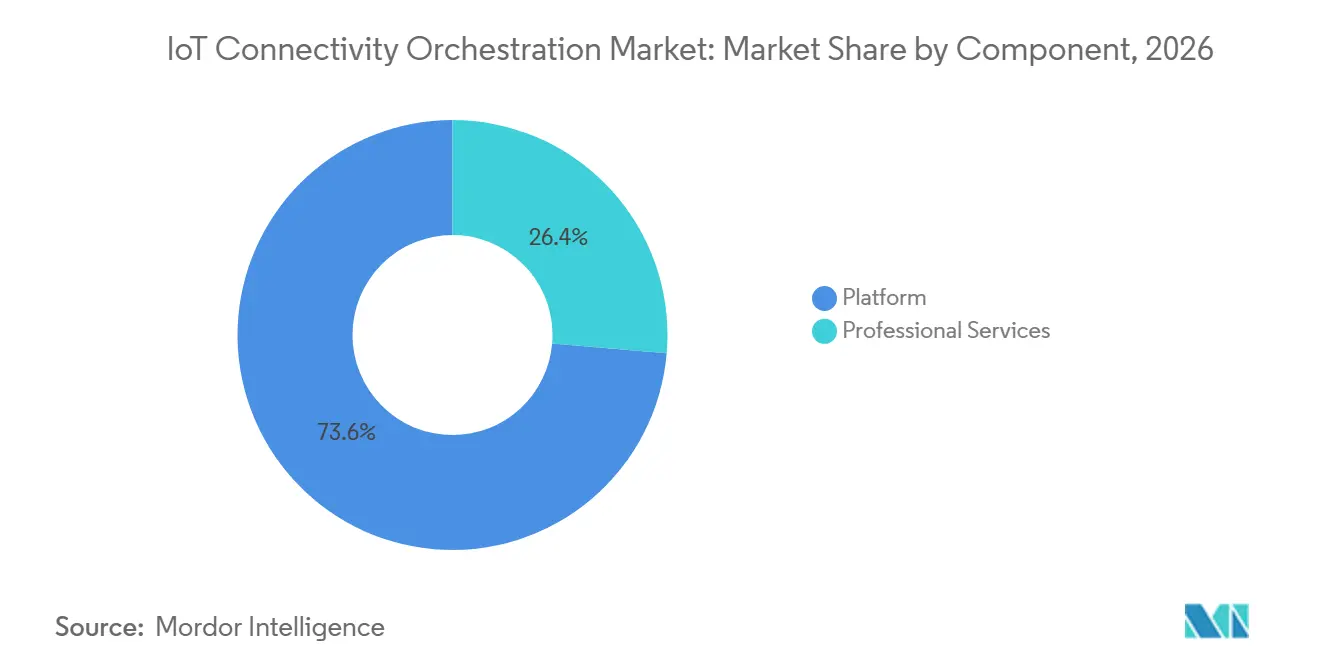
- By component, platform held 73.64% of the IoT connectivity orchestration market share in 2026 and is projected to expand at a 19.62% CAGR through 2032.
- By deployment type, cloud deployment accounted for 62.47% of the IoT connectivity orchestration market share in 2026, while hybrid deployment is projected to expand at a 19.78% CAGR through 2032.
- By enterprise size, large enterprises held 68.35% of the IoT connectivity orchestration market share in 2026, while small and medium-sized enterprises are projected to expand at a 19.64% CAGR through 2032.
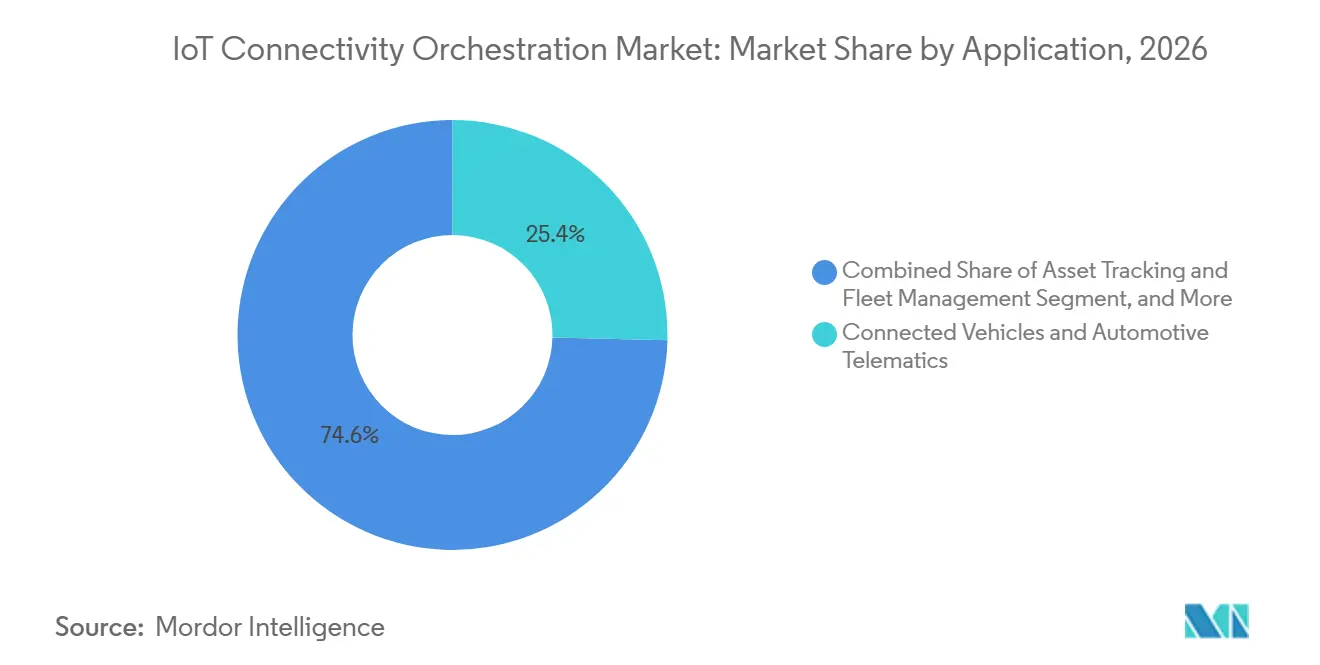
- By application, connected vehicles and automotive telematics accounted for 25.38% of the IoT connectivity orchestration market share in 2026, while the smart manufacturing and industrial automation segment is projected to expand at a 19.87% CAGR through 2032.
- By end-user, automotive accounted for 24.86% of the IoT connectivity orchestration market share in 2026, while manufacturing is projected to expand at a 19.72% CAGR through 2032.
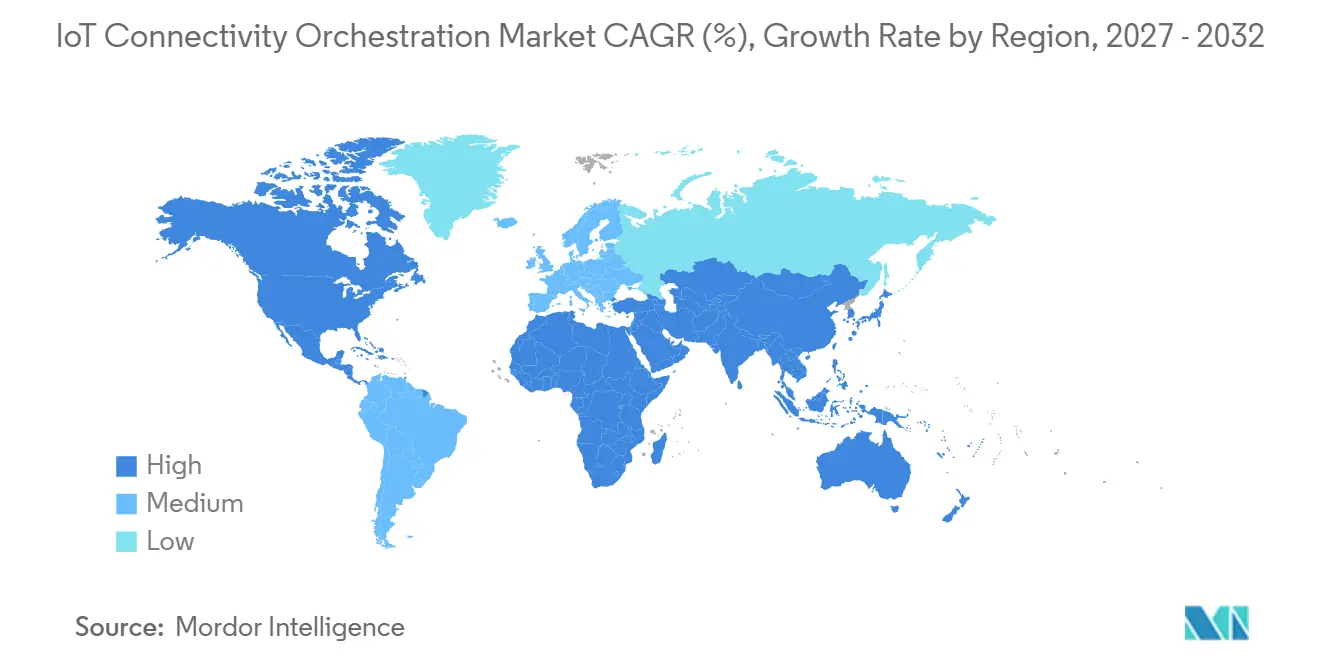
- By geography, North America accounted for 35.67% of the IoT connectivity orchestration market share in 2026, while Asia-Pacific is projected to expand at a 19.83% CAGR through 2032.
Note: Market numbers in this report are based on Mordor Intelligence's proprietary estimation framework, which combines nine months of actuals with Q4 projections for base year 2026.
Market Trends and Insights
Drivers Impact Analysis of IoT Connectivity Orchestration Market*
| Driver | (~) % Impact on CAGR Forecast | Geographic Relevance | Impact Timeline |
|---|---|---|---|
| Fragmentation of Mobile Operator and Connectivity Management Stacks | +4.5% | Global | Short term (≤ 2 years) |
| SGP.32 Remote SIM Provisioning Adoption for Constrained IoT Devices | +3.2% | Global | Medium term (2-4 years) |
| Expansion of Cross-Border Connected-Asset Deployments | +2.8% | Global, Asia-Pacific core, spill-over to Middle East and Africa | Medium term (2-4 years) |
| Demand for Single-SKU Device Manufacturing and Remote Localization | +2.1% | Global, manufacturing hubs in Asia-Pacific | Medium term (2-4 years) |
| Private 5G, 5G Standalone, and Edge-Integrated IoT Deployments | +1.6% | North America and Europe | Long term (≥ 4 years) |
| Cellular-Satellite Continuity for Low-Connectivity Environments | +0.9% | Global, Middle East, Africa, and remote Asia-Pacific | Long term (≥ 4 years) |
| Source: Mordor Intelligence | |||
Fragmentation of Mobile Operator and Connectivity Management Stacks
A global device fleet can involve several mobile network operators, eSIM formats, and connectivity management platforms. This fragmentation makes a common orchestration layer valuable for companies managing devices at enterprise scale. The IoT connectivity orchestration market benefits when buyers need consistent rules across different connectivity partners. A vendor-neutral platform can reduce the work needed to oversee profiles, usage policies, and device status. It can also help a business adapt when an operator changes its product offering or leaves a service category. The growing use of standardized eSIM architecture adds interoperability needs that individual operator platforms may not address on their own.
SGP.32 Remote SIM Provisioning Adoption for Constrained IoT Devices
The GSMA published SGP.32 v1.3 on May 28, 2026, setting out remote SIM provisioning requirements for IoT devices without user interfaces.[1] Such devices are widely used in industrial systems, utilities, and connected vehicles. SGP.32 combines remote profile management with a framework intended to support interoperability across the ecosystem. The standard can reduce the need for physical SIM replacement and manual device configuration. IDEMIA received full GSMA IoT Compliance Scheme certification for an SGP.32 eSIM solution in August 2025.[2] Tele2 IoT, IDEMIA, and Cisco later introduced a commercial end-to-end SGP.32 solution in March 2026.
Expansion of Cross-Border Connected-Asset Deployments
Trucking fleets, construction equipment, shipping containers, and connected vehicles must remain connected as they cross national boundaries. This operating requirement supports demand in the IoT connectivity orchestration market for tools that manage local profiles and network selection. Permanent-roaming limits can make a roaming-only model unsuitable in some locations. A provider that can coordinate local eSIM profiles may help enterprises manage these requirements without redesigning the entire device fleet. Cross-border deployments also place more value on visibility into usage, connectivity quality, and compliance status. Tata Communications and Cisco announced a 2025 collaboration to connect the MOVE platform with Cisco IoT Control Center for cross-border activation in transportation, logistics, and manufacturing.[3]
Demand for Single-SKU Device Manufacturing and Remote Localization
Manufacturers face extra procurement and inventory work when a device requires a different SIM configuration for each country. A single-device design with remotely managed profiles can simplify production planning and reduce delays before launch. The IoT connectivity orchestration market is therefore supported by platforms that enable profile selection after manufacturing. The GSMA SGP.32 framework allows a compatible eUICC to receive connectivity profiles through remote management. Giesecke+Devrient states that the specification supports remote profile management for devices without a user interface. emnify introduced factory-first connectivity in December 2025, placing SGP.32-ready profiles into devices during production.[4]
Restraints Impact Analysis of IoT Connectivity Orchestration Market*
| Restraint | (~) % Impact on CAGR Forecast | Geographic Relevance | Impact Timeline |
|---|---|---|---|
| Permanent-Roaming Restrictions and Inconsistent National Rules | -2.8% | Asia-Pacific, South America, Middle East | Short term (≤ 2 years) |
| Low IoT Connectivity ARPU and Margin Pressure | -1.9% | Global | Medium term (2-4 years) |
| Integration Complexity Across eSIM, CMP, MNO, Cloud, and ERP Layers | -1.2% | Global | Medium term (2-4 years) |
| Security, Data Sovereignty, and Operational Resilience Liability | -0.8% | Europe and Asia-Pacific | Medium term (2-4 years) |
| Source: Mordor Intelligence | |||
Permanent-Roaming Restrictions and Inconsistent National Rules
National rules for IoT roaming vary widely, complicating multinational device deployments. Some markets require local connectivity arrangements or impose stricter requirements on SIM registration and service authorization. This can increase the cost of entering new markets and prolong deployment planning. The IoT connectivity orchestration market must address these requirements through local profiles, local infrastructure, or suitable operator partnerships. Regulations can also narrow the addressable customer base for platforms without compliant connectivity options. The resulting operational burden is especially relevant to connected assets that frequently cross borders.
Low IoT Connectivity ARPU and Margin Pressure
Lower revenue per connection can reduce the funds available for connectivity upgrades and managed-service purchases. Enterprise customers may also scrutinize platform charges more closely when connectivity itself is priced as a commodity. This condition can limit the adoption of premium software tiers in the IoT connectivity orchestration market. It may encourage platform providers to focus on higher-value use cases, such as connected vehicles and remote patient monitoring. Lower-bandwidth applications, including smart metering and asset tracking, can remain more price-sensitive. Providers must show clear operational savings or service reliability to preserve pricing power in these deployments.
*Our forecasts treat driver/restraint impacts as directional, not additive. The impact forecasts reflect baseline growth, mix effects, and variable interactions.
IoT Connectivity Orchestration Market Segment Analysis
By Component:
Platform Software Leads as Professional Services ScalePlatform segment accounted for 73.64% of the IoT connectivity orchestration market in 2026 and is projected to grow at a 19.62% CAGR through 2032. Its position reflects the need for a persistent software layer that coordinates eSIM profiles, operator connections, and device policies. Organizations with large device fleets need consistent controls across several countries and connectivity providers. A platform can consolidate activation, monitoring, policy changes, and lifecycle tasks into a single operating environment. The IoT connectivity orchestration industry increasingly depends on this layer as enterprises move beyond basic connectivity purchasing.
Cisco IoT Control Center supports more than 270 million IoT SIM devices for more than 32,000 enterprises. Tata Communications announced in September 2025 that its MOVE platform covers more than 350 million eSIM operating systems across more than 200 countries. These deployments show why scale and proven interoperability are important considerations in purchasing. Professional services support configuration and migration when customers link orchestration tools with enterprise resource planning, operational technology, and cloud environments. They also help customers translate device requirements into practical workflows.
By Deployment Type:
Hybrid Deployment Gains Ground as Data Controls MatterCloud deployment held 62.47% of the total value in 2026. Cloud platforms reduce the infrastructure burden for organizations that need centralized access across distributed device fleets. They can allow customers to scale services without maintaining all connectivity-management infrastructure internally. 1NCE reported in January 2026 that it managed more than 40 million endpoints for 30,000 customers on its cloud-native IoT network. This delivery model is useful for enterprises seeking rapid deployment and broad geographic reach.
Hybrid deployment is projected to expand at a 19.78% CAGR through 2032 in the IoT connectivity orchestration market. It lets businesses retain selected data or policy functions within their own environment while using cloud services for provisioning and routing. This approach can be relevant where device identity data or policy information is subject to internal controls. It can support gradual modernization for businesses that already operate on-premises systems. The model remains relevant for organizations balancing centralized control with data-residency expectations.
By Enterprise Size:
Large Enterprises Lead While Small and Medium-Sized Enterprises AccelerateLarge enterprises accounted for 68.35% of the IoT connectivity orchestration market in 2026. They often operate multi-country fleets that require formal reliability, security, and compliance controls. Their procurement teams can evaluate complex platform contracts and integration requirements. Connected vehicle and utility programs commonly involve high device volumes and long service periods. Those characteristics favor providers with established infrastructure and operational support capabilities.
Small and medium-sized enterprises are projected to expand at a 19.64% CAGR through 2032. API-first platforms can make orchestration capabilities more accessible to companies without large internal connectivity teams. SGP.32 interoperability can reduce barriers that previously limited choice among connectivity providers. The IoT connectivity orchestration industry can reach a broader customer base by simplifying onboarding and standardizing integrations. Smaller customers will still need dependable support as they expand into new countries or add device categories.
By Application:
Connected Vehicles Lead While Smart Manufacturing Advances FastestConnected vehicles and automotive telematics accounted for 25.38% of the IoT connectivity orchestration market in 2026 across multiple markets. Vehicle programs need consistent connectivity for diagnostics, software updates, safety features, and customer-facing services throughout the vehicle lifecycle. Embedded SIM adoption has made remote profile management a practical requirement for many automotive programs across multiple countries. OEMs need to consider profile configuration and regional connectivity requirements during product planning before vehicles are shipped to each destination. These requirements make connectivity configuration part of product design and production planning, reducing later operational adjustments.
Smart manufacturing and industrial automation are projected to expand at a 19.87% CAGR through 2032. Factory systems need reliable communications between equipment, sensors, devices, and applications. Private cellular networks and edge environments can increase the connectivity settings that industrial operators must manage. This supports demand for centralized monitoring, policy management, and secure device activation. Asset tracking, smart metering, and connected healthcare devices also need dependable lifecycle controls.

By End-User:
Automotive Leads Revenue While Manufacturing Expands FastestAutomotive accounted for 24.86% of the IoT connectivity orchestration market in 2026. Connected vehicle programs combine substantial device volumes with recurring needs for remote management. OEMs need to activate devices, maintain service continuity, and adjust network profiles across several countries. Automotive customers also need tools that can coordinate connectivity with product launches and regional compliance requirements. These needs give the sector a leading position among end users.
Manufacturing is projected to expand at a 19.72% CAGR through 2032. Industry 4.0 programs bring together machinery, sensors, private 5G networks, and centralized software controls. Transportation, logistics, energy, utilities, and healthcare also create demand through large device estates or strict service requirements. Smart-meter programs demonstrate the scale at which utility operators can operate. The IoT connectivity orchestration industry can help these users coordinate monitoring, connectivity policies, and remote provisioning across dispersed assets.
Geography Analysis
North America IoT Connectivity Orchestration Market
North America accounted for 35.67% of the total value in 2026. The region has a large base of enterprise IoT programs, including connected vehicles, industrial systems, and logistics deployments. It also hosts several platform vendors that serve global customers. Terrestar launched a Canada-wide hybrid satellite IoT service in February 2026 using 3GPP Release 17 standards. Mexico can benefit as connected manufacturing assets move through North American automotive supply chains.
Europe and South America IoT Connectivity Orchestration Market
Europe remains important because industrial IoT deployments must operate within established data and privacy requirements. Germany, Italy, and France have major manufacturing bases that use connected equipment and automated systems. Enterprises may prefer architectures that support local data controls alongside cross-border connectivity. South America is shaped by Brazil’s permanent roaming enforcement, which increases the importance of local profile provisioning for cross-border fleets. The region’s operating conditions favor providers that can manage compliance with country-specific requirements.
APAC IoT Connectivity Orchestration Market
Asia-Pacific is projected to expand at a 19.83% CAGR through 2032. The region combines China’s industrial IoT scale, India’s smart-metering demand, Japan’s automation programs, and South Korea’s 5G Standalone deployment. Differences in national roaming, licensing, and SIM-registration rules make local operating capabilities important. KDDI and Soracom introduced SGP.32-compatible IoT SIMs in Japan in July 2026.
Competitive Landscape
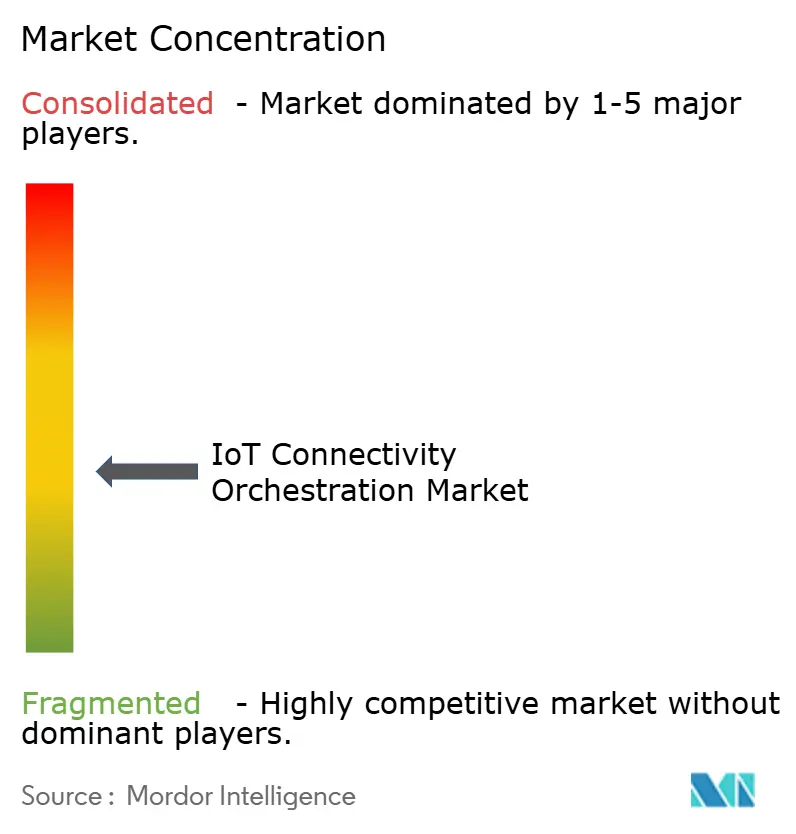
The IoT connectivity orchestration market is moderately fragmented. Large platform providers, operators, and IoT mobile virtual network operators compete across software, connectivity, eSIM capabilities, and support services. Cisco, Telefonica, Verizon, Vodafone, Aeris, and Deutsche Telekom have broad capabilities across operators and enterprises. Soracom, Eseye, Tata Communications, floLIVE, emnify, and 1NCE offer specialized approaches based on APIs, cloud delivery, and multi-operator services.
SGP.32 capability is becoming an important point of competition in the IoT connectivity orchestration market. Tele2 IoT, IDEMIA, and Cisco launched a commercial end-to-end SGP.32 solution in March 2026. The launch combined an eSIM, an orchestration platform, and global connectivity services. Deutsche Telekom introduced multi-orbit IoT roaming in February 2026, adding satellite links to its terrestrial IoT service. These moves show how established providers are extending orchestration capabilities through partnerships and broader network coverage.
The IoT connectivity orchestration market also has opportunities in precision agriculture, maritime operations, and cold-chain logistics. These use cases need reliable coverage, profile flexibility, and monitoring across wide operating areas. Challengers such as Giesecke+Devrient, BICS, and Mavoco can compete by offering specialized eSIM, connectivity, and device management capabilities. Competition will depend on combining standards-based eSIM provisioning with practical support for cellular, cloud, and satellite networks.
IoT Connectivity Orchestration Industry Leaders
-
Cisco Systems, Inc.
-
Aeris Communications, Inc.
-
KORE Group Holdings, Inc.
-
Eseye Limited
-
floLIVE Ltd.
- *Disclaimer: Major Players sorted in no particular order
IoT Connectivity Orchestration Market Companies Covered in this Report
- Cisco Systems, Inc.
- Aeris Communications, Inc.
- KORE Group Holdings, Inc.
- Eseye Limited
- floLIVE Ltd.
- Wireless Logic Group Limited
- 1NCE GmbH
- emnify GmbH
- Soracom, Inc.
- Telit Communications Limited (Telit Cinterion)
- Comarch S.A.
- Vodafone Group Plc
- Telefonica, S.A.
- Deutsche Telekom AG
- Tata Communications Limited
- Giesecke+Devrient GmbH
- Thales S.A.
- Kigen Limited
- 1GLOBAL Limited
- Onomondo ApS
- Hologram, Inc.
- Monogoto Ltd.
Recent Industry Developments in IoT Connectivity Orchestration Market
- July 2026: Soracom announced general availability of its Connectivity Hypervisor eSIM orchestration capability and SGP.32-compatible IoT eSIMs, enabling enterprises to manage multiple operator profiles through a single API-driven control plane with built-in fallback. The launch positions Soracom among the first IoT MVNOs offering full owner-controlled SGP.32 provisioning at commercial scale.
- June 2026: Aeris Communications renewed its IoT connectivity management agreement with KDDI Corporation under the Aeris IoT Accelerator platform, which manages 104 million IoT devices and 42 million connected vehicles globally. The platform enables single-SKU deployment and simplified billing across countries following post-acquisition investments in cloudification and system modernization. The agreement supports multinational deployments through a common operational framework.
- May 2026: The GSMA published SGP.32 v1.3 on May 28, 2026, the latest iteration of its IoT eSIM remote provisioning specification, formalizing the IP-based protocol for managing constrained IoT devices at scale. The release is expected to accelerate commercial adoption of SGP.32 across the automotive, industrial, and utility verticals through 2027.
- March 2026: Tele2 IoT, IDEMIA Secure Transactions, and Cisco launched the first commercial end-to-end SGP.32 IoT solution at Mobile World Congress in Barcelona, combining IDEMIA’s GSMA-certified eSIM, Cisco’s IoT Control Center with SGP.32 orchestration, and Tele2 IoT’s global connectivity. The solution enables businesses to provision and manage devices worldwide from a single platform and single eSIM SKU. It joins certified device credentials with centralized profile orchestration and worldwide service delivery.
Global IoT Connectivity Orchestration Market Report Scope
The IoT Connectivity Orchestration Market Report is Segmented by Component (Platform and Professional Services), Deployment Type (Cloud, On-Premises, and Hybrid), Enterprise Size (Large Enterprises, and Small and Medium-Sized Enterprises), Application (Asset Tracking and Fleet Management, Smart Manufacturing and Industrial Automation, Smart Metering and Utilities, Connected Vehicles and Automotive Telematics, Healthcare and Connected Medical Devices, and Other Applications), End-User (Manufacturing, Automotive, Transportation and Logistics, Energy and Utilities, Healthcare, and Other End-Users), and Geography (North America, South America, Europe, Asia-Pacific, Middle East, and Africa). The Market Forecasts are Provided in Terms of Value (USD).
Segmentation Overview
| Platform |
| Professional Services |
| Cloud |
| On-Premises |
| Hybrid |
| Large Enterprises |
| Small and Medium-Sized Enterprises |
| Asset Tracking and Fleet Management |
| Smart Manufacturing and Industrial Automation |
| Smart Metering and Utilities |
| Connected Vehicles and Automotive Telematics |
| Healthcare and Connected Medical Devices |
| Other Applications |
| Manufacturing |
| Automotive |
| Transportation and Logistics |
| Energy and Utilities |
| Healthcare |
| Other End-Users |
| North America | United States |
| Canada | |
| Mexico | |
| South America | Brazil |
| Argentina | |
| Rest of South America | |
| Europe | Germany |
| United Kingdom | |
| France | |
| Italy | |
| Spain | |
| Russia | |
| Rest of Europe | |
| Asia-Pacific | China |
| Japan | |
| India | |
| South Korea | |
| Australia | |
| Rest of Asia-Pacific | |
| Middle East | Saudi Arabia |
| United Arab Emirates | |
| Rest of Middle East | |
| Africa | South Africa |
| Nigeria | |
| Rest of Africa |
| By Component | Platform | |
| Professional Services | ||
| By Deployment Type | Cloud | |
| On-Premises | ||
| Hybrid | ||
| By Enterprise Size | Large Enterprises | |
| Small and Medium-Sized Enterprises | ||
| By Application | Asset Tracking and Fleet Management | |
| Smart Manufacturing and Industrial Automation | ||
| Smart Metering and Utilities | ||
| Connected Vehicles and Automotive Telematics | ||
| Healthcare and Connected Medical Devices | ||
| Other Applications | ||
| By End-User | Manufacturing | |
| Automotive | ||
| Transportation and Logistics | ||
| Energy and Utilities | ||
| Healthcare | ||
| Other End-Users | ||
| By Geography | North America | United States |
| Canada | ||
| Mexico | ||
| South America | Brazil | |
| Argentina | ||
| Rest of South America | ||
| Europe | Germany | |
| United Kingdom | ||
| France | ||
| Italy | ||
| Spain | ||
| Russia | ||
| Rest of Europe | ||
| Asia-Pacific | China | |
| Japan | ||
| India | ||
| South Korea | ||
| Australia | ||
| Rest of Asia-Pacific | ||
| Middle East | Saudi Arabia | |
| United Arab Emirates | ||
| Rest of Middle East | ||
| Africa | South Africa | |
| Nigeria | ||
| Rest of Africa | ||
Key Questions Answered in the Report
What is the size of the IoT connectivity orchestration market?
The IoT connectivity orchestration market is valued at USD 2.63 billion in 2026 and is projected to reach USD 7.26 billion by 2032, registering an 18.03% CAGR during 2027-2032. The outlook reflects rising demand for coordinated control of multi-country device fleets.
What is driving demand for IoT connectivity orchestration?
The IoT connectivity orchestration market is supported by multi-operator device fleets, SGP.32 remote SIM provisioning, cross-border deployments, and single-SKU manufacturing. These needs become more important when a device must comply with different national connectivity rules.
Which component leads IoT connectivity orchestration spending?
Platform software leads with 73.64% share in 2026 and is projected to expand at a 19.62% CAGR through 2032. Its role includes coordinating profiles, policies, lifecycle tasks, and operator connections within one operating environment.
Which application is expanding fastest?
Smart manufacturing and industrial automation is projected to expand at a 19.87% CAGR through 2032, supported by connected equipment and private cellular deployments. These operations need dependable monitoring, secure activation, and consistent policy management across industrial assets.
Which region is expected to expand fastest?
Asia-Pacific is projected to expand at a 19.83% CAGR through 2032, supported by industrial IoT, smart metering, automation, and 5G deployment. Different national rules in the region raise the importance of local operating capabilities and compliant profile management.
How do permanent-roaming rules affect connected device deployments?
They can require local profiles or local connectivity arrangements, increasing the value of platforms that manage compliance across countries. The IoT connectivity orchestration market must help users maintain service continuity while meeting country-specific requirements.