
Ink Solvent Market Size and Share
Market Overview
| Study Period | 2021 - 2031 |
|---|---|
| Market Size (2026) | USD 1.31 Billion |
| Market Size (2031) | USD 1.73 Billion |
| Growth Rate (2026 - 2031) | 5.59 % |
| Fastest Growing Market | North America |
| Largest Market | Asia-Pacific |
| Market Concentration | Medium |
Major Players *Disclaimer: Major Players sorted in no particular order Image © Mordor Intelligence. Reuse requires attribution under CC BY 4.0. | |
Ink Solvent Market Analysis by Mordor Intelligence
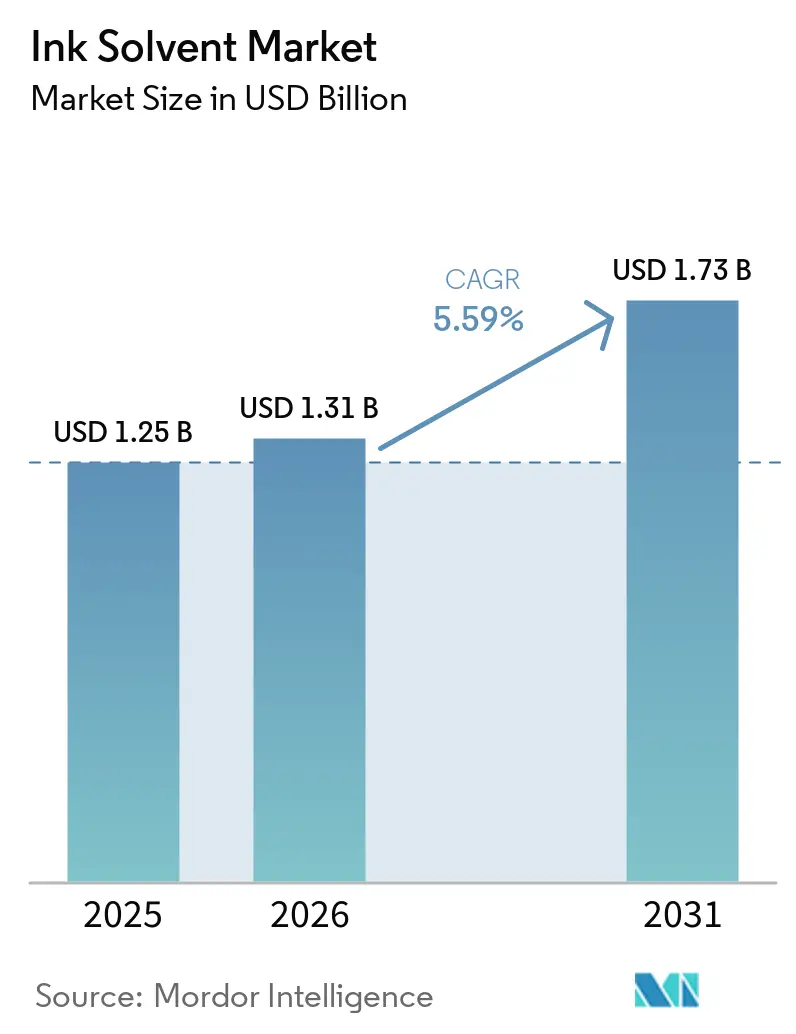
The ink solvent market size was valued at USD 1.25 billion in 2025 and is estimated to grow from USD 1.31 billion in 2026 to reach USD 1.73 billion by 2031, at a CAGR of 5.59% during the forecast period (2026-2031). Ink solvents support viscosity control, evaporation, resin compatibility, and adhesion in solvent-based printing systems. Demand is driven by growth in packaged consumer goods, personal care products, food and beverage sales, and e-commerce shipments. U.S. retail e-commerce sales reached USD 1,192.6 billion in 2024, up 8.1% from the prior year, supporting packaging print activity. Solvent-based flexographic and gravure printing remains important for flexible food-contact packaging, particularly where film adhesion and rapid drying are required. The ink solvent market faces pressure from emissions regulations, water-based and UV-curable alternatives, and higher raw material and energy costs, although packaging growth and bio-based reformulation continue to support demand.
Key Report Takeaways
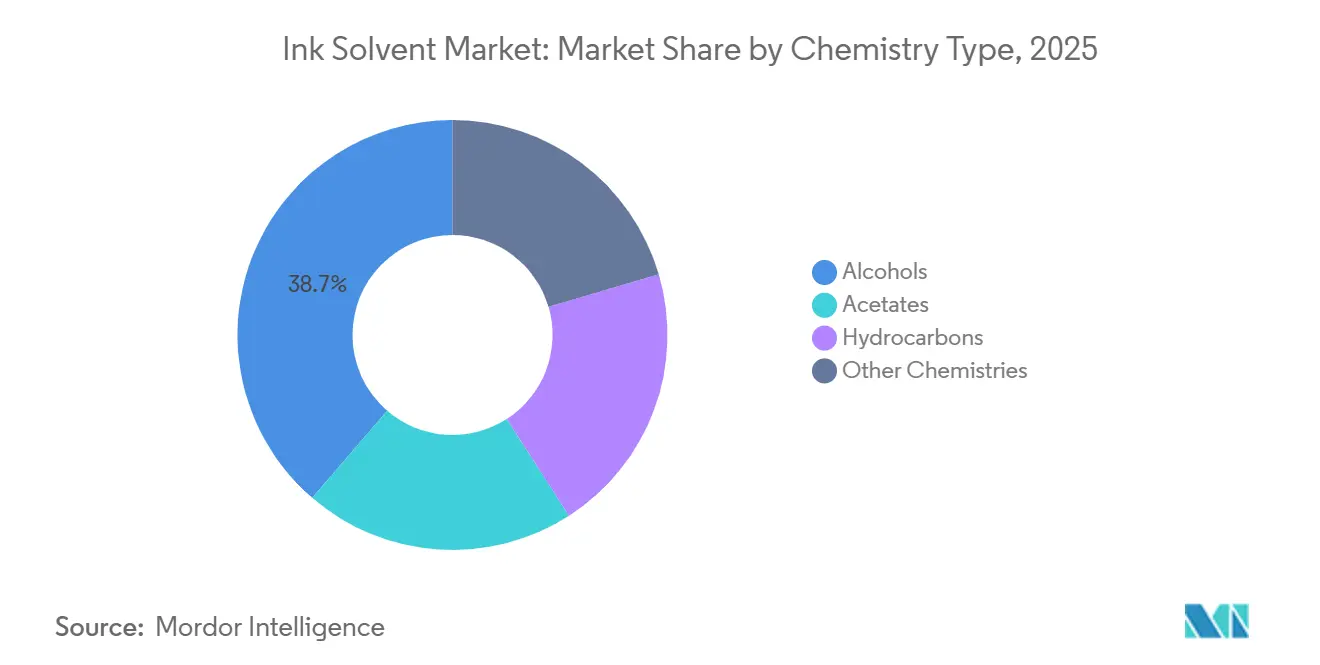
- By chemistry type, alcohols held 38.68% global share in 2025, while hydrocarbons are forecast to grow at a 6.13% CAGR through 2031.
- By product type, conventional solvents held 64.13% global share in 2025, while green and bio-based solvents are forecast to expand at a 6.32% CAGR through 2031.
- By process, flexographic printing accounted for 46.59% global share in 2025, while gravure is forecast to advance at a 6.41% CAGR through 2031.
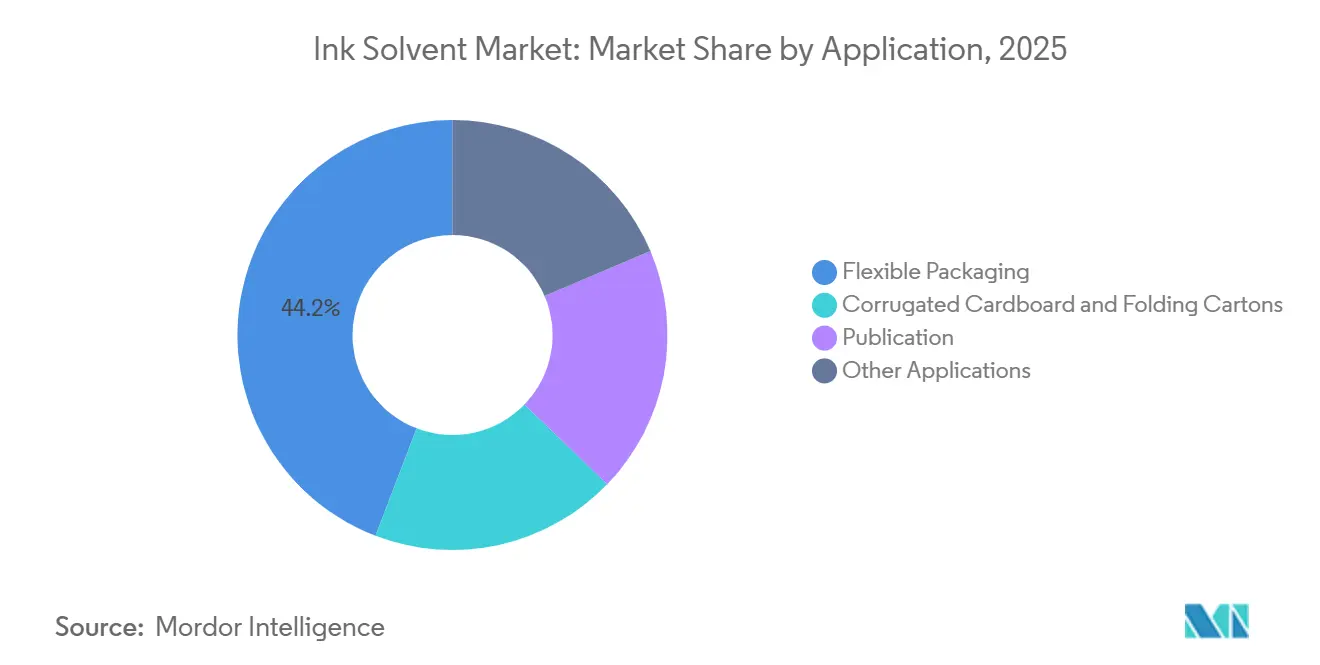
- By application, flexible packaging held 44.17% global share in 2025, while corrugated cardboard and folding cartons are forecast to grow at a 6.62% CAGR through 2031.
- By geography, Asia-Pacific accounted for 43.70% global share in 2025, while North America is forecast to grow at a 6.27% CAGR through 2031.
Note: Market size and forecast figures in this report are generated using Mordor Intelligence’s proprietary estimation framework, updated with the latest available data and insights as of January 2026.
Global Ink Solvent Market Trends and Insights
Drivers Impact Analysis*
| Drivers | (~) % Impact on CAGR Forecast | Geographic Relevance | Impact Timeline |
|---|---|---|---|
| Packaging Demand from E-Commerce and Consumer Goods | +1.5% | Global, with the strongest pull in Asia-Pacific and North America | Short term (≤ 2 years) |
| High-Speed Printing on Non-Porous Films and Foils | +1.2% | Asia-Pacific core, with spillover to North America and Europe | Medium term (2-4 years) |
| Growth of Flexible Packaging and Folding Cartons | +1.0% | Global, concentrated in China, India, ASEAN, and the United States | Medium term (2-4 years) |
| Expansion of Printing Capacity in Asia-Pacific | +0.7% | Asia-Pacific core, with upstream feedstock effects on global supply | Medium term (2-4 years) |
| Low-Volatile Organic Compound (VOC) and Bio-Based Solvent Reformulation | +0.8% | North America and the EU, with early adoption extending into the Asia-Pacific | Long term (≥ 4 years) |
| Source: Mordor Intelligence | |||
Packaging Demand from E-Commerce and Consumer Goods
Parcel growth is making packaging demand a more consistent source of demand for the ink solvent market than traditional print cycles. First-quarter 2026 U.S. retail e-commerce sales increased 9.8% from the same quarter of 2025. Faster fulfillment places greater emphasis on short production windows and quick print turnaround. These operating conditions continue to favor solvent-based inks on polyolefin and laminate films. More stock-keeping units also increase the number of packaging variants that converters must print, which increases press changeovers and replenishment needs, even as individual production runs become shorter. Food, personal care, and over-the-counter pharmaceutical packaging still require accurate multicolor printing and controlled color consistency. Alcohol and acetate blends remain relevant where printers need predictable evaporation and stable viscosity during these runs.
High-Speed Printing on Non-Porous Films and Foils
High-speed flexographic and gravure printing on Biaxially Oriented Polypropylene (BOPP), Polyethylene Terephthalate (PET), metalized polyester, and aluminum foil supports the ink solvent market because it requires controlled solvent performance. These substrates do not absorb ink the way paper and board do. Solvents must therefore support wetting, pigment transfer, drying, and film formation within a limited production window. Gravure presses can operate at 200-400 meters per minute, which increases the importance of evaporation balance. Ethyl acetate and n-propyl acetate remain useful in solvent blends because they help move pigment quickly to the substrate. Slower components can help prevent surface defects and support film coalescence. The removal of toluene from food-contact applications increases the need for compliant alcohol-acetate blends. Suppliers with documented food-contact compliance and Hazardous Air Pollutant (HAP)-free portfolios can meet stricter converter qualification requirements.
Growth of Flexible Packaging and Folding Cartons
Flexible packaging continues to replace rigid formats in food, beverage, and pharmaceutical applications, supporting the ink solvent market. This shift supports solvent demand because many high-speed flexible-film lines still require solvent-based ink performance. Corrugated cardboard and folding carton printing also benefit from e-commerce and brand-focused secondary packaging. Printed outer boxes increasingly carry product information, machine-readable features, and differentiated graphics, which can increase print complexity even when packaging formats remain conventional. EU packaging rules setting a 100 mg/kg heavy-metal limit, effective from January 1, 2026, are increasing attention to pigment and solvent combinations. Suppliers offering validated product documentation can reduce the compliance workload for converters.
Expansion of Printing Capacity in Asia-Pacific
Asia-Pacific remains the largest regional base for flexible packaging conversion and ink consumption in the ink solvent market. China, India, and ASEAN markets support demand through consumer goods production, food packaging, and e-commerce fulfillment. New regional capacity also shortens supply routes among chemical producers, ink makers, and converters, improving access to alcohols, acetates, and hydrocarbon grades used in local printing applications. BASF inaugurated its Zhanjiang Verbund site in China in March 2026 following an investment of EUR 8.7 billion (USD 9.5 billion)[1]BASF SE, “A Flagship for Chemical Production: BASF Inaugurates World-Scale Verbund Site in China,” BASF, basf.com.. The site produces basic, intermediate, and specialty chemicals that serve solvent-relevant value chains. Capacity additions can support local packaging producers while also increasing competition among regional suppliers. As a result, Asia-Pacific printing investment affects both demand growth and the supply structure of the ink solvent market.
Restraints Impact Analysis*
| Restraints | (~) % Impact on CAGR Forecast | Geographic Relevance | Impact Timeline |
|---|---|---|---|
| Volatile Organic Compound (VOC), Hazardous-Chemical, and Worker-Safety Regulation | -1.8% | EU and North America are primary, with China and ASEAN catching up | Short term (≤ 2 years) |
| Substitution by Water-Based, UV-Curable, and Digital Inks | -1.5% | Global, most acute in the EU and North America, and emerging in India and Southeast Asia | Long term (≥ 4 years) |
| Feedstock Price and Supply Volatility | -1.2% | Global, with concentrated effects in North America and the Asia-Pacific | Short term (≤ 2 years) |
| Source: Mordor Intelligence | |||
Volatile Organic Compound (VOC), Hazardous-Chemical, and Worker-Safety Regulation
Regulatory requirements are reducing the number of solvent grades printers can use without additional controls. The EU Industrial Emissions Directive sets a 100 mg C/Nm³ total VOC limit after abatement for qualifying printing operations. US EPA rules under 40 Code of Federal Regulations (CFR) Part 63, Subpart KK, apply maximum achievable control technology requirements to relevant printing and publishing operations[2]U.S. Environmental Protection Agency, “Monitoring Information by Industry, Printing and Publishing,” EPA Air Emissions Monitoring Knowledge Base, epa.gov.. China GB 38507-2020 limits toluene in food-packaging inks to 3% by mass. These rules are shifting the demand for formulation toward ethyl acetate, n-propyl acetate, isopropanol, and ethanol. Such grades can cost more than older aromatic or ketone alternatives, placing pressure on converter margins. Smaller printers may face higher compliance costs where they lack capital for abatement equipment and detailed compliance systems.
Substitution by Water-Based, UV-Curable, and Digital Inks
Water-based, UV-curable, and digital inks are strengthening their position in selected packaging applications. Paper-based packaging and recycled-content structures may be better suited to water-based systems. EU recyclability requirements also focus attention on ink residues and deinkability. Short packaging runs, more product variants, and frequent artwork changes strengthen the case for digital systems. Water-based alternatives are especially competitive in labels and corrugated secondary packaging. Solvent-based systems retain a stronger position in high-speed multicolor printing on non-porous laminates, where adhesion, residual solvent control, and color depth remain important.
*Our forecasts treat driver/restraint impacts as directional, not additive. The impact forecasts reflect baseline growth, mix effects, and variable interactions.
Segment Analysis
By Chemistry Type: Alcohols Lead While Hydrocarbons Gain Competitive Ground
Alcohols accounted for 38.68% of the ink solvent market share in 2025, maintaining the largest share. Their position reflects broad resin compatibility, rapid evaporation, and use in packaging ink systems. Ethanol, isopropanol, and n-propanol are used as carrier components in flexographic and gravure formulations. Isopropanol can limit gelation in nitrocellulose systems and can also adjust blend viscosity. These properties keep alcohols relevant beyond their role as basic diluents. Alcohol-based blends are particularly important where food-contact packaging requires a controlled solvent profile. Their regulatory position supports use in formulations designed to avoid hazardous air pollutants. Alcohol demand remains tied to flexible packaging output and the pace of reformulation away from aromatic solvents.
Hydrocarbons are the fastest-growing chemistry segment, with the ink solvent market size for hydrocarbons projected to grow at a 6.13% CAGR through 2031. Growth reflects a shift away from aromatic grades toward low-odor isoparaffinic fluids. These fluids are used in heat-set publication printing and specialty industrial printing. ExxonMobil's Isopar and Exxsol product platforms are designed for controlled evaporation, low aromatic content, and performance across a wide temperature range. The shift from aromatics to isoparaffins is primarily a compliant reformulation within the hydrocarbon category and does not necessarily eliminate all hydrocarbon demand from printing applications. Glycol ethers and diacetone alcohol remain smaller chemistry groups, but they support tail-solvent and slow-evaporation blending needs. Their role indicates that technical performance often depends on a balanced blend rather than a single solvent family.



By Product Type: Conventional Solvents Retain Scale Advantage as Bio-Based Solvents Scale Up Rapidly
Conventional solvents held 64.13% of the ink solvent market share in 2025. Established production infrastructure and broad availability support this position. These products are generally compatible with existing presses, dryers, and ink production equipment. Petroleum-derived grades have also retained a cost advantage over many bio-derived alternatives. Converters can continue using established processes without changing equipment or operating practices, making conventional products the practical choice for many high-output packaging operations. Their scale advantage remains important across markets where price, supply reliability, and approved formulations are purchasing priorities. Conventional grades account for the largest share of current output in the ink solvent industry.
Green and bio-based solvents are forecast to expand at a 6.32% CAGR through 2031 within the ink solvent market. Their growth is supported by regulatory requirements and expectations for renewable content in packaging supply agreements. Celanese and Siegwerk's 2026 collaboration on bio-based ethyl acetate demonstrates that some products can be adopted without reformulation. Drop-in compatibility can reduce adoption risk for conservative converter operations. Bio-based sourcing also requires evidence of feedstock origin and product traceability. The EU's packaging rules are increasing attention to recyclability and the design choices that affect it. Conventional solvent share may decline as larger brand owners include renewable-content requirements in supplier selection. The pace of this change depends on whether bio-based products can remain technically reliable and commercially competitive.
By Process: Flexographic Dominance Persists as Gravure Accelerates on Premium Laminate Demand
Flexographic printing accounted for 46.59% of the global market in 2025. It is widely used for flexible food packaging, labels, and corrugated pre-print applications. The process can handle multiple substrates and has lower capital requirements than gravure in many installations. These characteristics make flexography accessible to converters of different sizes. Food packaging and e-commerce-related demand for corrugated support continued the use of the process. Solvent-based flexographic inks remain relevant when non-porous substrates require fast drying and dependable adhesion. Screen printing and letterpress account for a smaller portion of ink solvent demand, with no major change in their position indicated for the forecast period.
Gravure is forecast to grow at a 6.41% CAGR through 2031. The ink solvent market size for gravure benefits from premium multicolor laminates and decorative films used in food, cosmetics, and pharmaceutical packaging. Gravure supports high color density and detailed image reproduction in long production runs, which remain important for packaging formats that require a consistent appearance at scale. New converter capacity in India and Southeast Asia includes gravure lines for mid- and premium-grade food packaging. Water-based gravure is developing, but solvent systems remain relevant where operating speed and reproduction quality are central requirements.
By Application: Flexible Packaging Commands Output While Corrugated Cartons Post the Fastest Growth
Flexible packaging accounted for a 44.17% global share in 2025, driven by high production output across food, beverage, personal care, and pharmaceutical applications. Polyolefin, polyester, and metalized film substrates often require strong adhesion and fast drying at press speeds, thereby supporting the continued use of solvent-based systems. Food and beverage packaging is the largest source of demand within flexible formats. Low-migration requirements also increase the importance of formulation control and reliable supplier documentation. Publication printing is a smaller application with declining demand due to a decline in print advertising output. Flexible packaging remains the largest application segment in the ink solvent market.
Corrugated cardboard and folding cartons are projected to grow at a 6.62% CAGR through 2031 in the ink solvent market. E-commerce is increasing corrugated box output, while retail brands are adding more graphics and information requirements to folding cartons. Digital printing is gaining use for shorter folding-carton runs, but solvent-based flexographic systems retain an advantage in high-output production. This keeps corrugated and folding cartons an important growth application for solvent suppliers. The segment also connects packaging demand directly with logistics growth and consumer goods distribution.
Geography Analysis
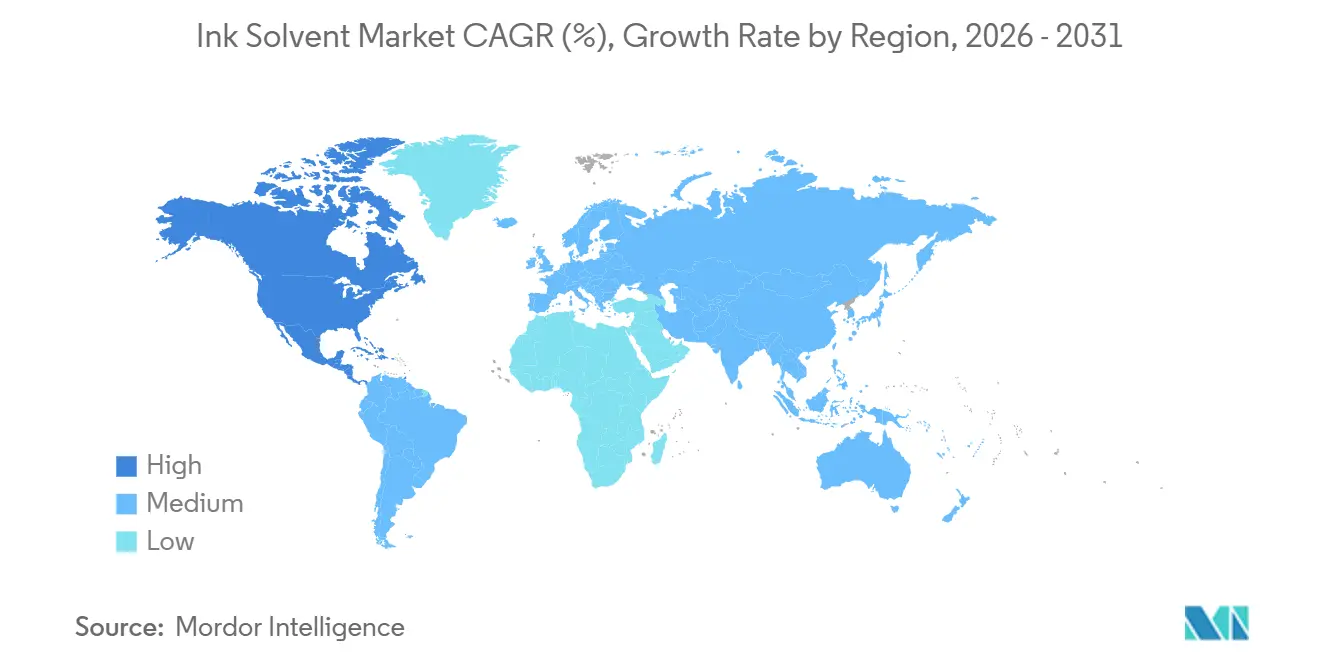
Asia-Pacific accounted for 43.70% of the global share in 2025. The region has a large concentration of flexible packaging converters serving the food, consumer goods, and e-commerce sectors. China, India, and ASEAN markets generate significant packaging demand and support local ink production. India's printing ink market grew by more than 12% in 2024, while Indonesia, the Philippines, Vietnam, and Thailand each recorded growth of more than 20% in the same year. BASF inaugurated its Zhanjiang site in China in March 2026 following an investment of EUR 8.7 billion (USD 9.5 billion), strengthening regional chemical supply across basic, intermediate, and specialty products. Japan and South Korea also demand high-purity alcohol and acetate grades for food and pharmaceutical packaging. Their compliance requirements support demand for certified products that meet domestic and international migration standards.
North America is forecast to advance at a 6.27% CAGR through 2031 in the ink solvent market. The regional ink solvent market benefits from e-commerce packaging demand and demand for low-migration, bio-based, and Hazardous Air Pollutants (HAP)-compliant formulations. Packaging converters in the United States, particularly in the Great Lakes corridor, are major buyers of specialty grades that comply with air quality regulations. State and local air requirements are also driving a shift away from aromatic and ketone-heavy blends. Clark County, Nevada, adopted EPA-aligned air rules for relevant printing operations in 2024, supporting the use of n-propyl acetate, isopropanol, and ethanol-based systems. Canada and Mexico provide additional demand through food packaging and export supply chains. Shared food-contact requirements increase the need for approved HAP-free solvent grades across the region.
Europe operates under a comprehensive emissions and packaging compliance framework. The EU Industrial Emissions Directive and Packaging and Packaging Waste Regulation are reshaping formulation choices. Western European converters prioritize solvent systems that support deinkability and recyclability requirements. Germany, the United Kingdom, France, and Italy have established converter capabilities for high-specification packaging. South America is expanding through food and agriculture-linked consumer goods, led by Brazil and Argentina. The Middle East and Africa are seeing incremental growth in printing capacity for fast-moving consumer goods packaging, with Saudi Arabia and South Africa serving as regional focal points, while imported solvents remain important for supply.

Competitive Landscape
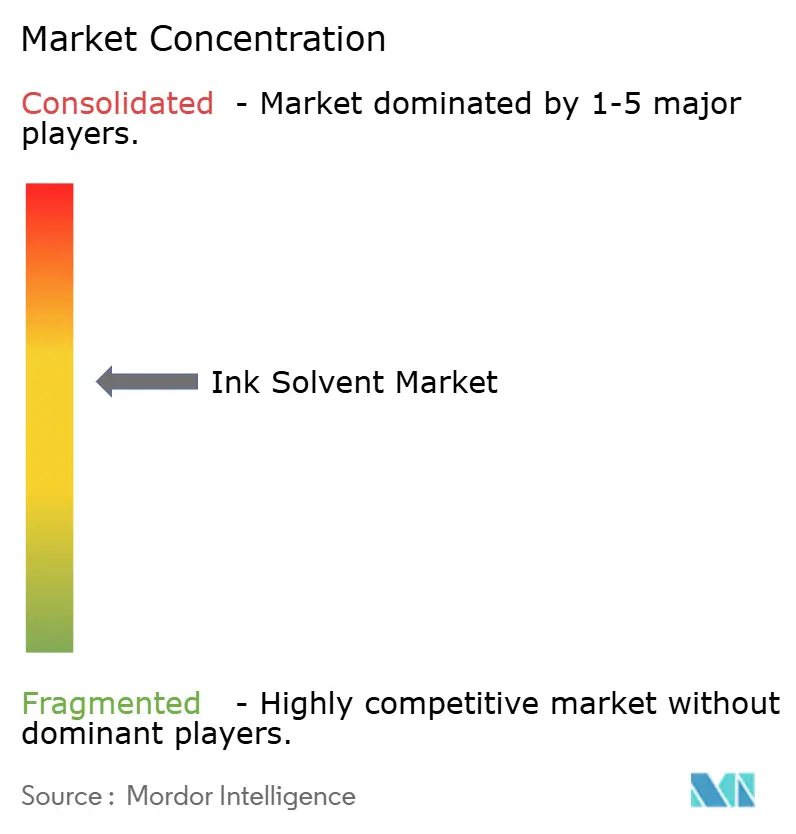
The ink solvent market is moderately consolidated. BASF, Dow, Eastman Chemical, Celanese, and INEOS hold scale advantages through access to feedstocks, broad product portfolios, and established supply networks. Their product ranges serve packaging converters across multiple regions. Integrated chemical manufacturing can lower production costs and improve supply coordination across solvent value chains. BASF's Zhanjiang site reflects the broader trend toward large, Asia-focused chemical facilities capable of serving multiple chemical product streams from a single manufacturing base. Large suppliers also have the resources to support documentation, regulatory testing, and long-term customer qualification factors that are important where food-contact packaging customers require consistent technical evidence.
Mid-tier and specialty suppliers compete through technical service, compliance documentation, and performance-grade products. Evonik, Solvay, Arkema, and Sasol are positioned in applications where purity and formulation support are material factors in purchasing decisions. ExxonMobil Product Solutions holds a strong position in hydrocarbon fluids through its Isopar and Exxsol platforms, which are suited for applications requiring narrow boiling ranges and very low aromatic content. Shrieve Chemical Company acquired Vertec BioSolvents in April 2026, demonstrating how specialty bio-solvent suppliers can gain broader distribution support. In June 2026, Evonik reported that more than 95% of its active siloxane-based coating and ink additive portfolio contained less than 0.1% of Substances of Very High Concern, indicating that regulatory purity can serve as a point of product differentiation.
Bio-refinery platforms in India and Brazil are increasingly relevant to competitive positioning in the ink solvent market. Sugarcane-to-ethanol-to-acetate routes can support the supply of food-grade bio-ethanol and bio-ethyl acetate, potentially reducing the historical cost premium associated with renewable solvent products. Celanese and Siegwerk's 50% bio-content ethyl acetate agreement is a direct example of commercial activity in this area. Siegwerk is also investing in North American capacity and operational efficiency, including support for solvent-based flexible packaging inks. Competition therefore extends beyond solvent quantity and price to include supply security, access to renewable feedstocks, process compatibility, and compliance documentation capabilities. The absence of a combined market share figure for leading suppliers supports the characterization of the market as semi-consolidated rather than highly concentrated.
Ink Solvent Industry Leaders
Evonik Industries AG
BASF
Celanese Corporation
Eastman Chemical Company
Exxon Mobil Corporation
- *Disclaimer: Major Players sorted in no particular order

Recent Industry Developments
- August 2026: Siegwerk announced capacity and efficiency investments across its North American network, including a new warehouse in Des Moines, Iowa, to support solvent-based ink operations for flexible packaging, and the addition of water-based and UV-based inkjet production capabilities in Morganton, North Carolina. These investments are part of Siegwerk's FORMULA 2030 strategy and are intended to strengthen supply resilience and meet growing regional packaging demand.
- June 2026: Celanese and Siegwerk announced a collaboration to supply bio-based ethyl acetate with 50% bio-content as a drop-in replacement solvent for existing printing ink formulations. This agreement marks the first commercial-scale deployment of certified bio-content acetate solvent in the packaging ink value chain without requiring reformulation or process changes.


Global Ink Solvent Market Report Scope
An ink solvent is a liquid chemical carrier used in printing inks to dissolve color pigments and resins, adjusting ink viscosity to ensure smooth flow through printers. Once the ink is applied to a surface, the solvent evaporates, leaving the solid color bonded to the material.
The ink solvent market is segmented by chemistry type, product type, process, application, and geography. By chemistry type, the market is segmented into alcohols, acetates, hydrocarbons, and other chemistries. By product type, the market is segmented into conventional, green, and bio-based. By process, the market is segmented into flexographic, gravure, and other processes. By application, the market is segmented into flexible packaging, corrugated cardboard and folding cartons, publication, and other applications. The report also covers market size and forecasts for the ink solvent across 15 countries in major regions. The market sizes and forecasts are provided in terms of value (USD).
| Alcohols |
| Acetates |
| Hydrocarbons |
| Other Chemistries |
| Conventional |
| Green and Bio-Based |
| Flexographic |
| Gravure |
| Other Processes |
| Flexible Packaging |
| Corrugated Cardboard and Folding Cartons |
| Publication |
| Other Applications |
| Asia-Pacific | China |
| India | |
| Japan | |
| South Korea | |
| ASEAN Countries | |
| Rest of Asia-Pacific | |
| North America | United States |
| Canada | |
| Mexico | |
| Europe | Germany |
| United Kingdom | |
| France | |
| Italy | |
| NORDIC Countries | |
| Rest of Europe | |
| South America | Brazil |
| Argentina | |
| Rest of South America | |
| Middle East and Africa | Saudi Arabia |
| South Africa | |
| Rest of Middle East and Africa |
| By Chemistry Type | Alcohols | |
| Acetates | ||
| Hydrocarbons | ||
| Other Chemistries | ||
| By Product Type | Conventional | |
| Green and Bio-Based | ||
| By Process | Flexographic | |
| Gravure | ||
| Other Processes | ||
| By Application | Flexible Packaging | |
| Corrugated Cardboard and Folding Cartons | ||
| Publication | ||
| Other Applications | ||
| By Geography | Asia-Pacific | China |
| India | ||
| Japan | ||
| South Korea | ||
| ASEAN Countries | ||
| Rest of Asia-Pacific | ||
| North America | United States | |
| Canada | ||
| Mexico | ||
| Europe | Germany | |
| United Kingdom | ||
| France | ||
| Italy | ||
| NORDIC Countries | ||
| Rest of Europe | ||
| South America | Brazil | |
| Argentina | ||
| Rest of South America | ||
| Middle East and Africa | Saudi Arabia | |
| South Africa | ||
| Rest of Middle East and Africa | ||


Key Questions Answered in the Report
What is current market size of Ink Solvent Market?
The ink solvent market size was valued at USD 1.25 billion in 2025 and is estimated to grow from USD 1.31 billion in 2026 to reach USD 1.73 billion by 2031, at a CAGR of 5.59% during the forecast period (2026-2031).
Which product category is growing fastest?
Green and bio-based solvents are forecast to grow at a 6.32% CAGR through 2031 as renewable-content requirements expand.
Which printing process uses the most ink solvents?
Flexographic printing held a 46.59% share in 2025. It is widely used for flexible packaging, labels, and corrugated pre-print applications.
Which application is growing fastest?
Corrugated cardboard and folding cartons are forecast to expand at a 6.62% CAGR through 2031, supported by e-commerce and branded secondary packaging.
Page last updated on:





