
Industrial Wax Market Size and Share
Market Overview
| Study Period | 2022 - 2032 |
|---|---|
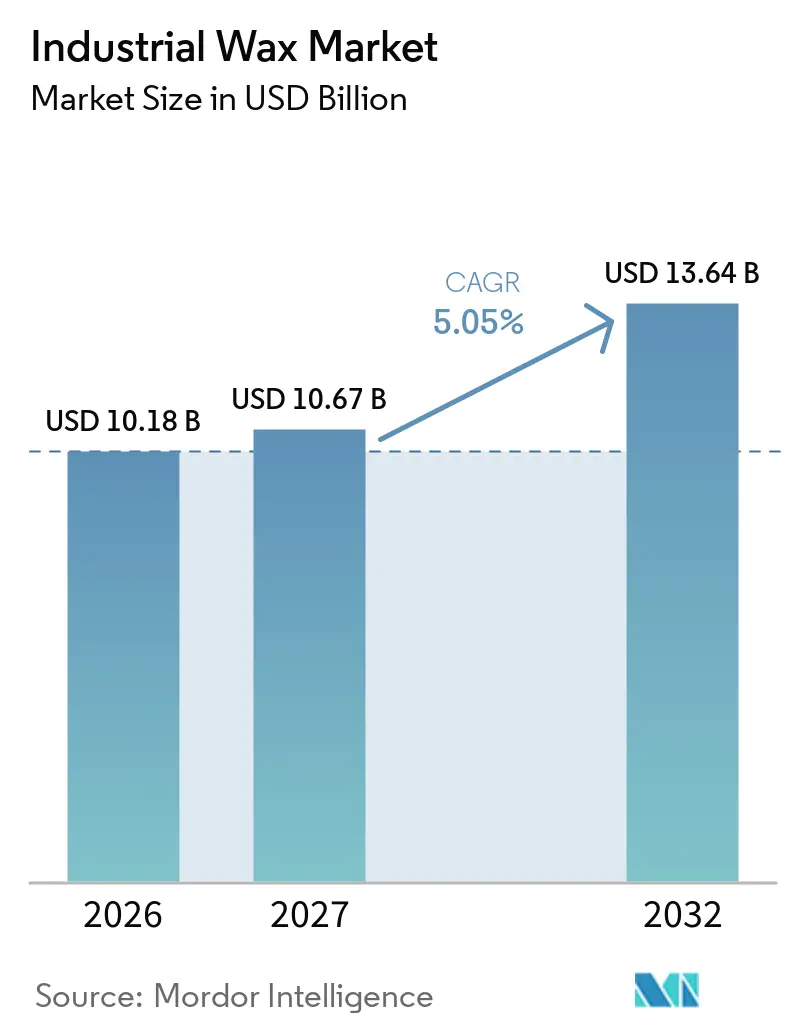
| Market Size (2027) | USD 10.67 Billion |
| Market Size (2032) | USD 13.64 Billion |
| Growth Rate (2027 - 2032) | 5.05 % |
| Fastest Growing Market | Asia-Pacific |
| Largest Market | Asia-Pacific |
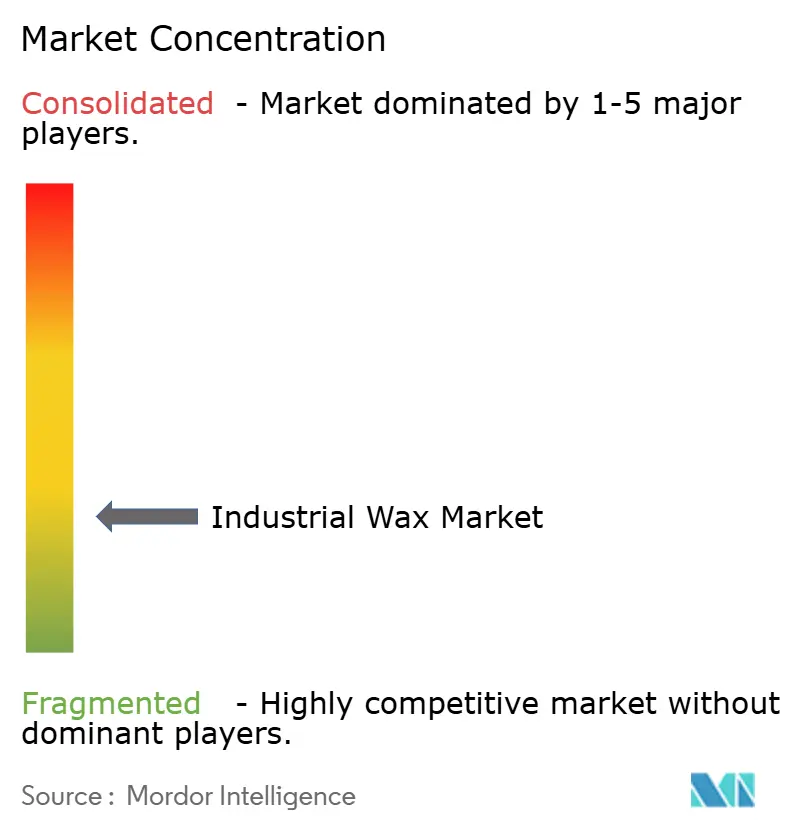
| Market Concentration | Low |
Major Players *Disclaimer: Major Players sorted in no particular order Image © Mordor Intelligence. Reuse requires attribution under CC BY 4.0. | |
Industrial Wax Market Analysis by Mordor Intelligence
The Industrial wax market size was valued at USD 10.18 billion in 2026 and is estimated to grow from USD 10.67 billion in 2027 to USD 13.64 billion by 2032, at a CAGR of 5.05% during the forecast period (2027-2032). The industrial wax market is supported by demand from corrugated packaging, premium candles, personal care products, water-compatible coatings, and alternatives made from renewable or synthetic feedstocks. Packaging users are seeking materials that meet food-contact requirements and align with evolving restrictions on fluorinated substances, which favors certain wax-based coatings. Growth is shifting toward functional grades with properties suited to water-based systems, cosmetics, printing, and protective coatings. Fossil-based materials remain central to supply, although specialty synthetic and bio-based products present opportunities for suppliers that can provide documented performance, traceability, and regulatory support.
Key Report Takeaways
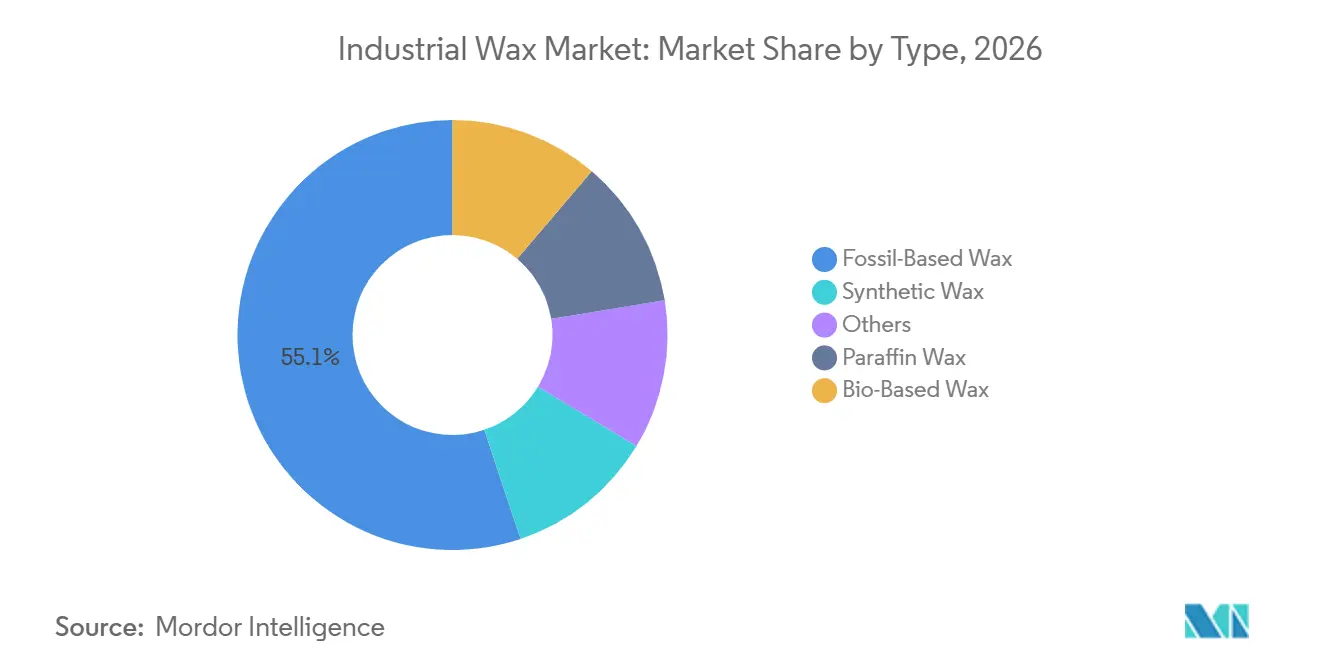
- By type, fossil-based wax held 55.14% of the Industrial wax market share in 2026, while synthetic wax is forecast to grow at a 5.47% CAGR through 2032.
- By form, solid wax held 68.23% of the Industrial wax market share in 2026, while emulsions and liquids are forecast to grow at a 5.73% CAGR through 2032.
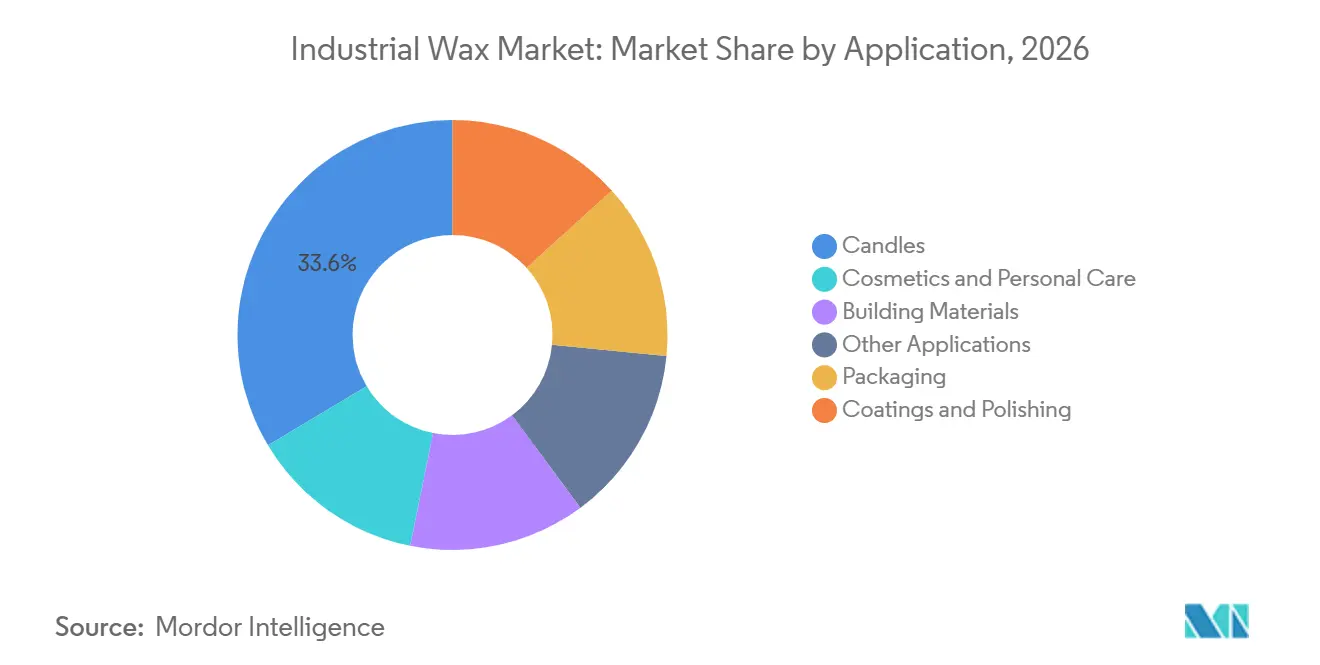
- By application, candles held 33.57% of the Industrial wax market share in 2026, while cosmetics and personal care are forecast to grow at a 5.92% CAGR through 2032.
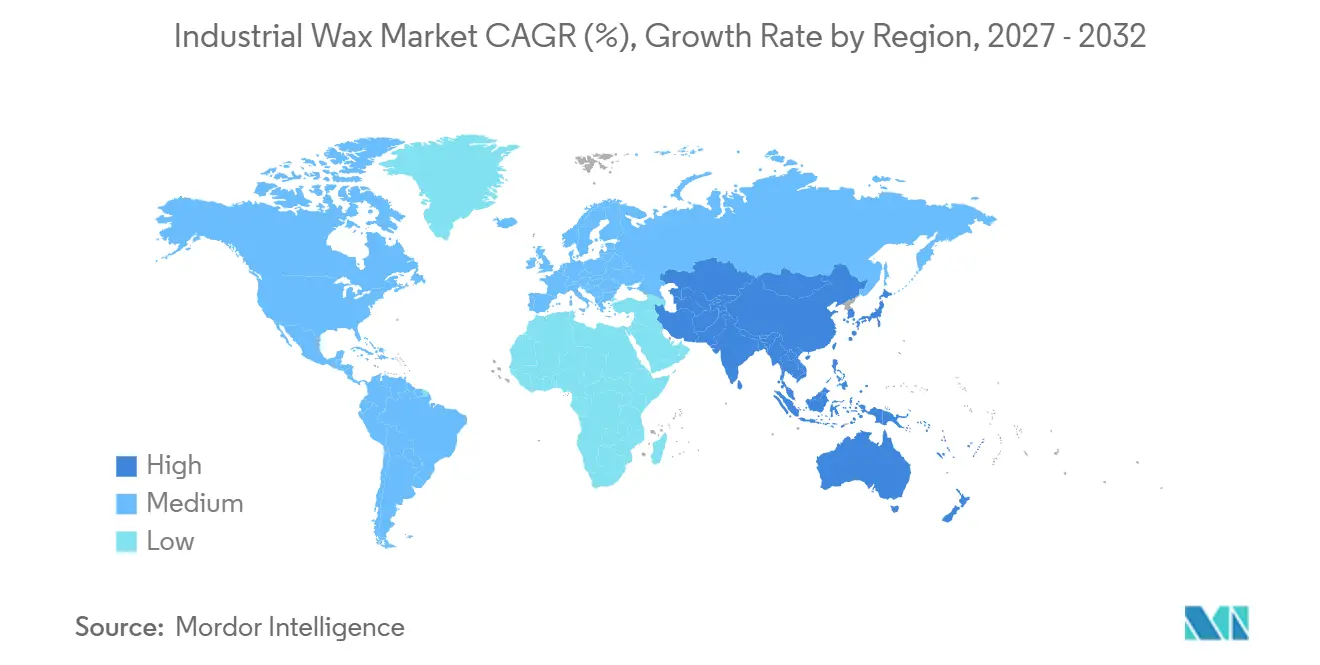
- By geography, Asia-Pacific held 43.20% of the Industrial wax market share in 2026 and is forecast to grow at a 5.68% CAGR through 2032.
Note: Market numbers in this report are based on Mordor Intelligence's proprietary estimation framework, which combines nine months of actuals with Q4 projections for base year 2026.
Market Trends and Insights
Drivers Impact Analysis of Industrial Wax Market*
| Drivers | (~) % Impact on CAGR Forecast | Geographic Relevance | Impact Timeline |
|---|---|---|---|
| E-Commerce-Led Demand for Wax-Coated Packaging | +0.9% | Global, with Asia-Pacific (APAC) as the core and spillover into North America and Europe | Short term (≤ 2 years) |
| Premium Candle and Wellness Product Consumption | +1.1% | North America and Europe, with growing adoption in APAC | Medium term (2-4 years) |
| Growth in Cosmetics and Personal Care Formulations | +1.3% | Global, with APAC growing fastest, and North America and Europe established | Long term (≥ 4 years) |
| Synthetic Wax Adoption in High-Performance Processing | +0.8% | North America, Europe, and APAC, including China and South Korea | Medium term (2-4 years) |
| Shift Toward Bio-Based and Renewable Wax Alternatives | +0.6% | Europe, North America, and emerging APAC markets | Long term (≥ 4 years) |
| Source: Mordor Intelligence | |||
Premium Candle and Wellness Product Consumption
Candle demand increasingly reflects use in aromatherapy, mindfulness, and sleep-oriented routines, rather than decorative use alone. Premium candle buyers place greater emphasis on burn performance, soot output, ingredient disclosure, fragrance retention, and wax origin, which can affect both grade selection and supplier qualification. These preferences can shift procurement toward fully refined, low-oil-content paraffin and traceable plant-based grades, rather than standard semi-refined materials used for less demanding applications. This procurement shift is relevant because the requested performance characteristics apply to both the wax formulation and supply chain consistency, including the ability to maintain the same burn and sensory profile across product runs. The industrial wax market therefore has an opportunity to serve a more differentiated candle supply chain, even where overall candle output remains tied to consumer spending and seasonal buying patterns. This creates demand for suppliers that can balance commodity-scale output with cleaner-burning and more clearly specified grades.
Growth in Cosmetics and Personal Care Formulations
Waxes support moisture retention, emulsion stability, active-ingredient encapsulation, and application performance in lipsticks, mascaras, sun-care sticks, skin-care emulsions, and depilatories. Manufacturing growth in China, India, Indonesia, and Vietnam supports demand from export-oriented beauty production and localized brand manufacturing, where producers require ingredients that perform across multiple product formats. The functional role of wax allows formulators to use it for texture, payoff, barrier properties, and stability, rather than treating it as a single-purpose ingredient. Research published in 2025 showed that supercritical carbon dioxide fractionation of bioethanol side streams can produce wax alternatives with thermal properties comparable to those of carnauba and beeswax[1]. BASF introduced Lamesoft OP Plus at in-cosmetics Global in April 2025, positioning it as a biodegradable, wax-based opacifier dispersion for personal care formulations requiring high natural-origin content. EU cosmetic product rules continue to require robust controls on product safety and labeling, underscoring the value of consistent ingredient documentation across regional product launches.
E-Commerce-Led Demand for Wax-Coated Packaging
E-commerce logistics and food delivery are supporting demand for wax-coated corrugated packaging in the industrial wax market. Wax coatings provide moisture resistance, grease barriers, and stacking strength for fresh produce and food-service delivery applications, where uncoated board can lose structural integrity during transit or refrigerated storage. These coatings are relevant to refrigerated distribution and other settings where moisture and grease resistance affect packaging condition, shape retention, and handling suitability. U.S. rules permit wax coatings in specified food-contact applications, subject to the conditions in 21 CFR 178.3710. The EU Packaging and Packaging Waste Regulation has drawn increased attention to recyclability and packaging design, making compatibility with paper-fiber recovery an important consideration for converters and material suppliers. BASF launched Joncryl Wax 30 in March 2025 for food-packaging inks and overprint varnishes, identifying food-contact compliance, rub resistance, and gloss as product attributes. This highlights the value suppliers can offer by providing technical support alongside the wax material, including guidance on coating performance in specific ink, varnish, and board systems.
Synthetic Wax Adoption in High-Performance Processing
Synthetic waxes are gaining relevance in higher-performance processing applications across the industrial wax market. Fischer-Tropsch and polyethylene grades are used where consistent molecular profiles, high melting points, low oil content, and repeatable processing behavior are important for controlled finished-product results. These properties support their use in coatings, adhesives, plastics, and emerging specialty applications such as 3D-printing support materials, photovoltaic encapsulants, and battery separator coatings. For these applications, material consistency is important, as variation in melting behavior, composition, or oil content can disrupt manufacturing conditions or product performance. Sasol launched SASOLWAX LC Spray 30 G in February 2025, stating that the micronized wax delivers a 32% reduction in product carbon footprint compared to standard variants under its lifecycle assessment approach. Documentation on carbon footprint and product composition can become a purchasing factor when customers must meet environmental reporting requirements, shifting value toward grades that combine technical consistency with usable product documentation. This is particularly relevant when customers require technical evidence for both procurement review and downstream reporting.
Restraints Impact Analysis of Industrial Wax Market*
| Restraints | (~) % Impact on CAGR Forecast | Geographic Relevance | Impact Timeline |
|---|---|---|---|
| Crude Oil and Gas Feedstock Price Volatility | -0.8% | Global, with North America and APAC exposed through refinery economics | Short term (≤ 2 years) |
| Environmental Compliance Costs for Petroleum-Based Waxes | -0.6% | Europe, North America, and APAC markets with rising enforcement | Medium term (2-4 years) |
| Limited Bio-Based Scale and Feedstock Supply Constraints | -0.5% | Global, with bio-based transitions concentrated in Europe and North America, and the carnauba supply linked to South America | Long term (≥ 4 years) |
| Source: Mordor Intelligence | |||
Crude Oil and Gas Feedstock Price Volatility
Paraffin wax production depends on slack wax from refinery lube oil dewaxing, so output is shaped by refinery economics as well as wax demand. Changes in crude oil prices can alter refinery decisions, affect the availability of by-product feedstocks, and complicate procurement planning for downstream users that need stable material costs. The International Energy Agency projected global oil supply growth of 2.5 million barrels per day in 2025, against a 700,000-barrel-per-day increase in demand, indicating a supply backdrop that could affect refinery operating decisions[2]. Synthetic wax producers can also face pressure when natural gas costs rise, meaning alternative wax types do not fully eliminate feedstock risk. This shared feedstock exposure limits buyers' ability to use one wax type as a complete hedge against another, narrowing procurement options during volatile periods. The industrial wax market remains exposed to cost changes that can affect both commodity and specialty grades, prompting buyers to seek shorter supply arrangements, more flexible sourcing, or greater use of alternative grades where technical specifications allow.
Environmental Compliance Costs for Petroleum-Based Waxes
Petroleum-derived waxes face growing compliance demands in markets with detailed chemical and product regulations. The EU Registration, Evaluation, Authorization and Restriction of Chemicals (REACH) framework includes restrictions on polycyclic aromatic hydrocarbons in products that may come into contact with skin. EU guidance also clarifies Classification, Labeling, and Packaging obligations for candles and wax melts, increasing the importance of hazard communication, labeling, and product information for affected producers. The EU packaging regulation also requires closer attention to recyclability for coated packaging, affecting how suppliers assess wax formulations used with paper and board. Smaller producers may find these legal, testing, and documentation requirements harder to absorb than integrated suppliers with established technical and regulatory teams. The industrial wax market may consequently favor suppliers that offer quality documentation and regulated product portfolios. Compliance capability can therefore shape competitive positioning even in applications where the underlying wax material is otherwise widely available.
*Our forecasts treat driver/restraint impacts as directional, not additive. The impact forecasts reflect baseline growth, mix effects, and variable interactions.
Industrial Wax Market Segment Analysis
By Type:
Fossil-Based Wax Remains the Largest Category While Synthetic Grades Gain GroundFossil-based wax held 55.14% of the industrial wax market share in 2026 and includes paraffin and microcrystalline grades used in candles, packaging coatings, cosmetics, and established industrial processes. Paraffin has long been supplied as a refinery-derived material, and its role in packaging and food-contact applications means it continues to attract attention from converters seeking moisture barriers and reliable process performance. The category retains a broad industrial role, as paraffin is approved for food-contact uses under US regulatory conditions. Microcrystalline wax is used in lip color, balms, and pharmaceutical pellets, where a finer crystalline structure, higher melting point, and strong fragrance retention are important. Fossil-based wax, therefore, remains central to the industrial wax market even as sustainability requirements increase.
Synthetic wax is the fastest-growing type, with a forecast CAGR of 5.47% from 2027 to 2032. Fischer-Tropsch wax meets application requirements for consistent molecular weight, low oil content, a defined melting profile, and repeatable processing behavior. These characteristics are relevant to coatings, plastics, 3D-printing support materials, photovoltaic encapsulation films, and lithium battery separator coatings, where performance consistency can justify a price premium. Bio-based waxes, including carnauba, rice bran, and sugarcane-derived materials, address clean-label and renewable-content demand but face supply limitations and a narrow base of commercially available feedstocks. The industrial wax market is moving toward higher-performance and renewable options, although the reliability of fossil-based material supply remains important.

By Form:
Solid Wax Retains Scale While Emulsions and Liquids ExpandSolid wax accounted for 68.23% of the industrial wax market share in 2026, supported by its use in candles, packaging coatings, mold release, polishes, and other applications that require predictable melting and handling. Existing melting equipment, dispensing systems, and process lines are often designed for solid wax, which creates practical switching costs for manufacturers. Physical handling, storage stability, and familiar melting behavior also support continued use in traditional applications, including facilities that have built their operations around batch melting and solid wax throughput. These factors help sustain the large installed base for solid formats, particularly where plants have optimized established production routines and do not require continuous liquid dosing. The industrial wax market is therefore unlikely to move away from solid wax quickly in established applications.
Emulsions and liquids are forecast to grow at a 5.73% CAGR from 2027 to 2032. Water-based wax systems help manufacturers replace solvent-borne formulations in paper coatings, textiles, wood finishes, adhesives, and related surface-treatment applications. They also support lower processing temperatures, tighter process control, and more consistent application in high-speed printing and flexible packaging lines. Advances in polymer-wax hybrid chemistry and nanoemulsion technology are improving film integrity and substrate adhesion, which have historically limited some emulsion formats. Pumpable and meterable formats are well-suited to continuous, automated production lines, particularly for plants installing digital process controls and seeking more consistent dosing, lower energy use, and reduced handling time.
By Application:
Candles Led Consumption While Cosmetics and Personal Care Grows FastestCandles accounted for 33.57% of the industrial wax market share in 2026, reflecting their role as the largest application for wax consumption. Premium and scented candles require improved burn performance, lower soot output, fragrance retention, and traceable wax sources. Packaging is another major application, as wax-coated corrugated board provides moisture resistance and grease-barrier performance in fresh-produce and food-service delivery uses, where transport conditions affect the strength of uncoated material. US Food and Drug Administration (FDA) rules permit specified wax coatings in food-contact applications, subject to defined limits and conditions. The industrial wax market benefits when converters seek packaging materials that meet food-contact requirements and comply with evolving restrictions on fluorinated coatings.
Cosmetics and personal care have the highest forecast CAGR at 5.92% through 2032. Waxes are used in lipsticks, balms, sun-care products, skin-care emulsions, and depilatory formulations, where they contribute to texture, stability, moisture retention, and application performance. BASF presented Lamesoft OP Plus in 2025 as a wax-based biodegradable opacifier dispersion with 92.3-98.5% natural-origin content. Coatings and polishing applications also benefit from demand for lower volatile organic compound (VOC), water-based systems, and protective surface performance, including scratch resistance and anti-blocking properties for print-quality packaging surfaces. Building materials, rubber, textiles, photovoltaic encapsulants, and electronics potting remain smaller applications with distinct performance requirements that are less directly tied to consumer demand cycles.
Geography Analysis
APAC Industrial Wax Market
Asia-Pacific held 43.20% of the industrial wax market share in 2026 and is forecast to grow at a 5.68% CAGR through 2032. The region has production capacity, petrochemical feedstock availability, and substantial manufacturing demand from packaging, cosmetics, textiles, adhesives, and other wax-consuming industries. China has integrated paraffin supply chains, while the region also imports specialty synthetic and microcrystalline waxes for higher-performance applications. India supports demand for packaging, personal care, and candle production, as well as established manufacturing clusters that require a steady supply of paraffin wax. Vietnam, Thailand, and Indonesia contribute to demand from e-commerce packaging and personal care manufacturing.
North America Industrial Wax Market
North America is the second-largest regional market, led by the United States. Shale-linked refinery operations provide slack wax feedstock, while mature end uses include candles, packaging, adhesives, personal care, and coatings. Restrictions on fluorinated barrier coatings are driving interest in food-safe wax alternatives for packaging, particularly among converters seeking materials that meet food-contact requirements. HF Sinclair's Sonneborn business is an important supplier of specialty microcrystalline waxes in the region. In July 2026, the company announced plans to spin off its Lubricants and Specialties segment, including Sonneborn, as a standalone public company.
Europe Industrial Wax Market
Europe has the most demanding regulatory environment for the industrial wax market. REACH, the EU Packaging and Packaging Waste Regulation, and evolving restrictions on fluorinated substances are increasing demand for documented, low-polycyclic aromatic hydrocarbon (PAH), bio-based, and synthetic options. Germany has a strong base in specialty wax applications, automotive coatings, precision adhesives, and premium cosmetics. The United Kingdom is an important market for specialty personal care waxes, while the Nordic countries support demand for renewable content in printing inks and wood coatings. Markets across Europe require stronger product documentation.
Competitive Landscape
The industrial wax market is fragmented. Integrated companies such as Exxon Mobil Corporation, Shell plc, and CNPC benefit from refinery access and lower feedstock exposure relative to wax-only suppliers. Specialty suppliers, including Clariant, Sasol, BASF, H&R Group, Evonik, and Croda International, compete through formulation expertise, regulatory documentation, and application-specific performance.
Decarbonization is becoming a commercial factor for suppliers serving technically demanding applications. Sasol stated that SASOLWAX LC100 enabled a 35% reduction in the cradle-to-gate product carbon footprint for Henkel adhesive formulations. BASF launched Joncryl Wax 30 in March 2025 for food-packaging inks and overprint varnishes, and introduced Lamesoft OP Plus for personal care formulations in April 2025.
Smaller specialists compete through alternatives that address supply and formulation needs. Koster Keunen introduced SynKos M-1063 as an alternative synthetic microcrystalline wax for cosmetic formulations. Rice bran wax, nanoemulsion technology, and wax microencapsulation offer pathways into printing inks, controlled-release agricultural uses, pharmaceuticals, and textiles, where functional performance is more important than commodity scale. Quality systems and bio-based certification can influence supplier selection where customers require documented materials and verified product consistency. The industrial wax market rewards suppliers that combine dependable supply with verified technical and regulatory support.
Industrial Wax Industry Leaders
-
Exxon Mobil Corporation
-
Sasol
-
Honeywell International Inc.
-
Shell plc
-
CNPC
- *Disclaimer: Major Players sorted in no particular order
Industrial Wax Market Companies Covered in this Report
- BASF
- BP p.l.c.
- Calumet, Inc.
- CALWAX
- CLARIANT
- CNPC
- Croda International Plc
- Dow
- Evonik Industries AG
- Exxon Mobil Corporation
- Gandhar Oil Refinery (India) Limited
- H&R GROUP
- HF Sinclair Corporation
- Honeywell International Inc.
- Koster Keunen
- Sasol
- Shell plc
Recent Industry Developments in Industrial Wax Market
- July 2026: HF Sinclair Corporation announced plans to separate its Lubricants & Specialties segment, including Sonneborn, one of the world's largest microcrystalline wax and petrolatum producers, into a standalone publicly traded company, reflecting a shift in how petroleum refiners value specialty wax assets in the industrial wax market.
- April 2025: Clariant launched Ceridust 1310, a micronized rice bran wax blend for printing-ink applications, with a melting point of 125°C and dosage requirements of 0.2-1% in ink systems. The product extended Clariant's Licocare RBW Vita portfolio, addressing volatility in the carnauba wax supply chain in the industrial wax market due to Brazil's seasonal harvesting and climate-related yield variability.
Global Industrial Wax Market Report Scope
Industrial wax refers to a class of petroleum-based, synthetic, or natural organic compounds used for moisture resistance, lubrication, coatings, and manufacturing processes. These materials are valued across industries for their ability to provide protective barriers, reduce friction between surfaces, and serve as functional additives in a wide range of production processes, including packaging, cosmetics, rubber, textiles, and adhesives manufacturing.
The industrial wax market is segmented by type, form, application, and geography. By type, the market is segmented into fossil-based wax, paraffin wax, bio-based wax, synthetic wax, and others. By form, the market is segmented into solid wax, emulsions and liquids, and others. By application, the market is segmented into candles, packaging, coatings and polishing, cosmetics and personal care, building materials, and other applications. The report also covers market sizes and forecasts for industrial wax across 15 countries in major regions. The market sizes and forecasts are provided in terms of value (USD).
Segmentation Overview
| Fossil-Based Wax |
| Paraffin Wax |
| Bio-Based Wax |
| Synthetic Wax |
| Others |
| Solid Wax |
| Emulsions and Liquids |
| Others |
| Candles |
| Packaging |
| Coatings and Polishing |
| Cosmetics and Personal Care |
| Building Materials |
| Other Applications |
| Asia-Pacific | China |
| India | |
| Japan | |
| South Korea | |
| ASEAN Countries | |
| Rest of Asia-Pacific | |
| North America | United States |
| Canada | |
| Mexico | |
| Europe | Germany |
| United Kingdom | |
| France | |
| Italy | |
| NORDIC Countries | |
| Rest of Europe | |
| South America | Brazil |
| Argentina | |
| Rest of South America | |
| Middle East and Africa | Saudi Arabia |
| South Africa | |
| Rest of Middle East and Africa |
| By Type | Fossil-Based Wax | |
| Paraffin Wax | ||
| Bio-Based Wax | ||
| Synthetic Wax | ||
| Others | ||
| By Form | Solid Wax | |
| Emulsions and Liquids | ||
| Others | ||
| By Application | Candles | |
| Packaging | ||
| Coatings and Polishing | ||
| Cosmetics and Personal Care | ||
| Building Materials | ||
| Other Applications | ||
| By Geography | Asia-Pacific | China |
| India | ||
| Japan | ||
| South Korea | ||
| ASEAN Countries | ||
| Rest of Asia-Pacific | ||
| North America | United States | |
| Canada | ||
| Mexico | ||
| Europe | Germany | |
| United Kingdom | ||
| France | ||
| Italy | ||
| NORDIC Countries | ||
| Rest of Europe | ||
| South America | Brazil | |
| Argentina | ||
| Rest of South America | ||
| Middle East and Africa | Saudi Arabia | |
| South Africa | ||
| Rest of Middle East and Africa | ||
Key Questions Answered in the Report
What is current market size of Industrial Wax Market?
The Industrial wax market size was valued at USD 10.18 billion in 2026 and is estimated to grow from USD 10.67 billion in 2027 to USD 13.64 billion by 2032, at a CAGR of 5.05% during the forecast period (2027-2032).
Which wax format is growing fastest?
Emulsions and liquids are forecast to grow at a 5.73% CAGR through 2032 as water-based systems gain use in coatings, printing, and packaging.
Which application is expanding fastest?
Cosmetics and personal care are projected to grow at a 5.92% CAGR through 2032 because waxes support performance across color cosmetics and skin-care formulations.
Which region leads industrial wax demand?
Asia-Pacific leads with a 43.20% share in 2026 and is also forecast to post the highest regional CAGR at 5.68% through 2032.