
Industrial Degreaser Market Size and Share
Market Overview
| Study Period | 2021 - 2031 |
|---|---|
| Market Size (2026) | USD 22.71 Billion |
| Market Size (2031) | USD 28.73 Billion |
| Growth Rate (2026 - 2031) | 4.81 % |
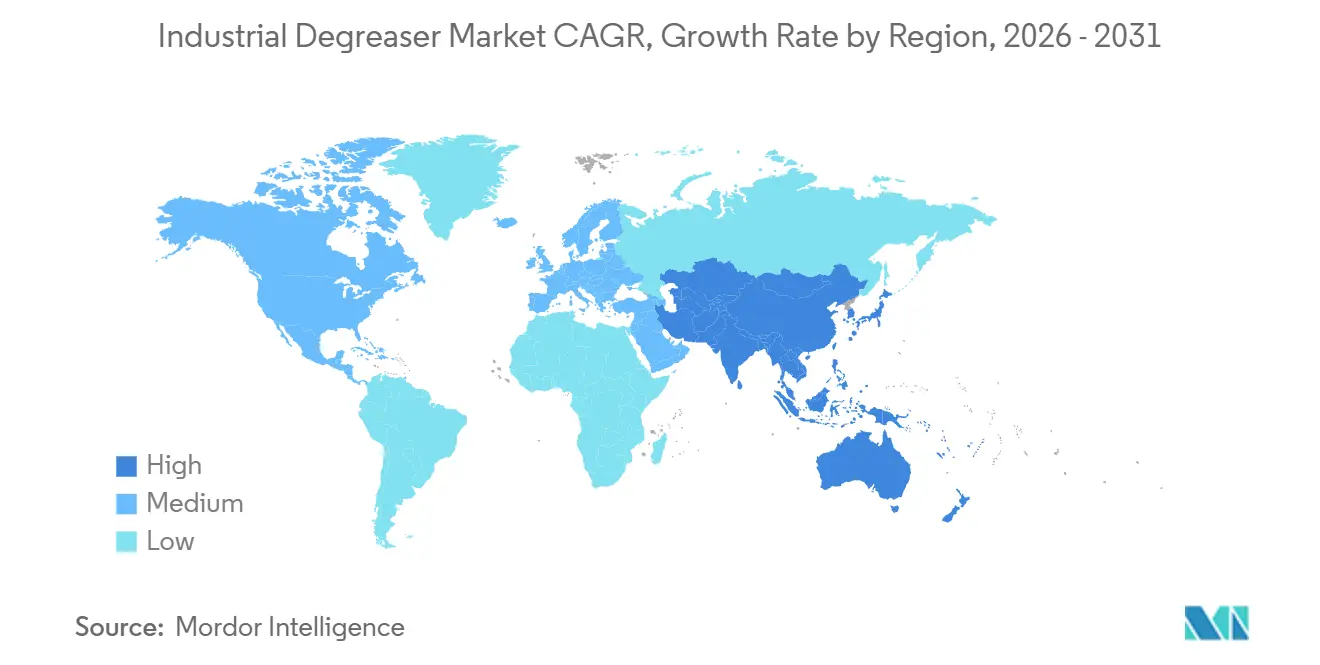
| Fastest Growing Market | Asia-Pacific |
| Largest Market | North America |
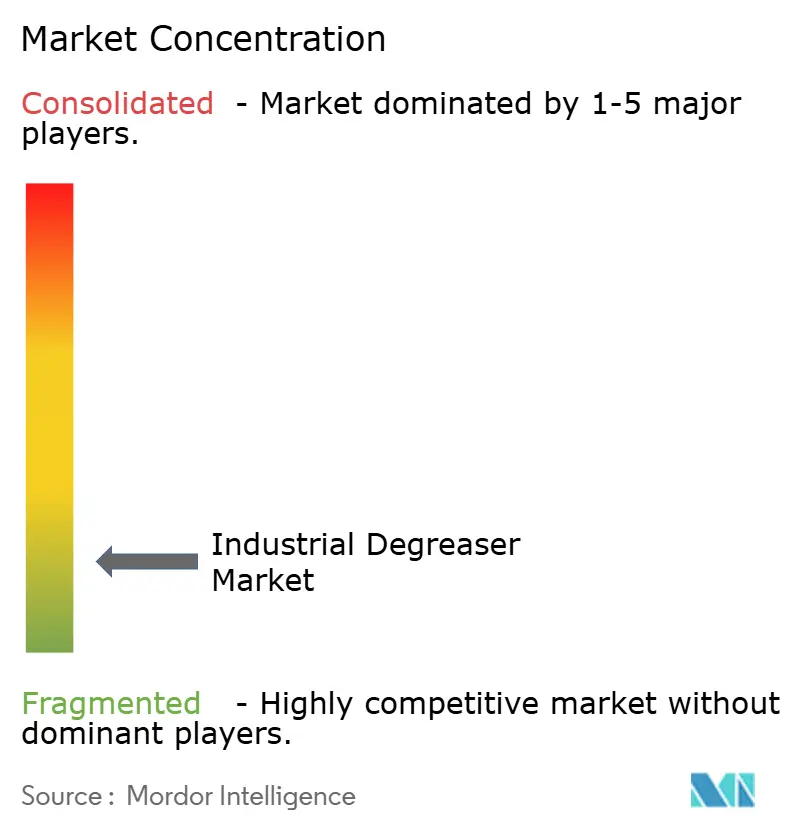
| Market Concentration | Low |
Major Players *Disclaimer: Major Players sorted in no particular order Image © Mordor Intelligence. Reuse requires attribution under CC BY 4.0. | |
Industrial Degreaser Market Analysis by Mordor Intelligence
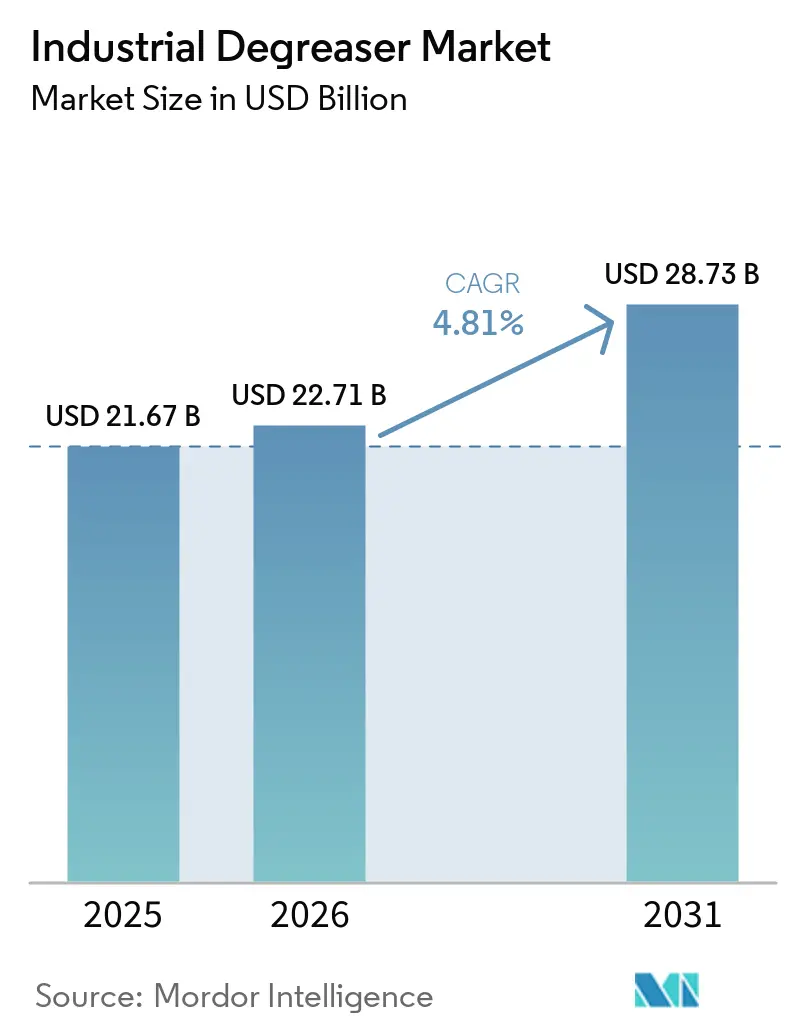
The Industrial Degreaser Market size was valued at USD 21.67 billion in 2025 and is estimated to grow from USD 22.71 billion in 2026 to reach USD 28.73 billion by 2031, at a CAGR of 4.81% during the forecast period (2026-2031). Industrial maintenance demand supports the industrial degreaser market because removing oil and grease can limit bearing wear, friction losses, and equipment failures. Regulatory restrictions on hazardous solvents are shifting procurement toward water-based and bio-based formulations. Higher-purity requirements in electric vehicle batteries, power electronics, and semiconductor processes are supporting demand for validated cleaning systems. Rising surfactant, solvent, energy, packaging, and logistics costs are increasing pressure on formulators that rely on third-party inputs. Larger suppliers can spread regulatory testing and registration costs across wider portfolios, while smaller formulators face more difficult product launch decisions.
Key Report Takeaways
- By type, water-based held 56.16% of the industrial degreaser market share in 2025 and is projected to advance at a 5.56% CAGR through 2031.
- By grade, liquid-based held 40.23% of the industrial degreaser market share in 2025, while bio-based is projected to advance at a 5.62% CAGR through 2031.
- By application, automotive held 32.37% of the industrial degreaser market share in 2025 and is projected to advance at a 6.01% CAGR through 2031.
- By geography, North America held 38.05% of the industrial degreaser market share in 2025, and Asia-Pacific is projected to advance at a 5.74% CAGR through 2031.
Note: Market size and forecast figures in this report are generated using Mordor Intelligence’s proprietary estimation framework, updated with the latest available data and insights as of January 2026.
Global Industrial Degreaser Market Trends and Insights
Drivers Impact Analysis*
| Driver | (~) % Impact on CAGR Forecast | Geographic Relevance | Impact Timeline |
|---|---|---|---|
| Industrial Equipment Maintenance and Downtime Reduction | +1.2% | Global, with concentration in North America & EU heavy manufacturing clusters | Medium term (2–4 years) |
| Automotive Production and Component Servicing | +1.0% | Global; APAC manufacturing core (China, South Korea, India) with strong North America contribution | Long term (≥ 4 years) |
| VOC and Hazardous-Solvent Substitution | +0.8% | North America & EU (regulatory-driven); APAC spillover via export-compliance requirements | Short term (≤ 2 years) |
| EV and Semiconductor Contamination-Control Requirements | +0.6% | APAC core (China, South Korea, Japan), with early gains in North America and Germany | Long term (≥ 4 years) |
| Pharmaceutical and High-Purity Manufacturing Expansion | +0.5% | Global, with early gains in United States, Germany, India, and Singapore | Medium term (2–4 years) |
| Low-Temperature Degreasing for Energy and Carbon Reduction | +0.4% | Global; early adoption concentrated in EU and Japan | Short term (≤ 2 years) |
| Source: Mordor Intelligence | |||
Industrial Equipment Maintenance and Downtime Reduction
Regular degreasing serves as a preventive maintenance activity in foundries, stamping plants, offshore energy facilities, and chemical processing sites. Grease and oil deposits can accelerate bearing wear, increase friction losses, and contribute to thermal failures in rotating equipment. Industrial energy-efficiency investment exceeded USD 200 billion annually in 2025, placing greater attention on equipment that runs with lower energy losses and fewer stoppages. Internet of Things (IoT)-enabled predictive maintenance platforms are increasing the visibility of equipment conditions across instrumented facilities. These systems can issue real-time alerts and support more precisely scheduled cleaning interventions. The industrial degreaser market, therefore, benefits when facilities perform more frequent maintenance events, even if the fluid volume used in each event remains stable.
Automotive Production and Component Servicing
Vehicle production requires degreasing during body-in-white fabrication, e-coat surface preparation, powertrain assembly, and transmission component cleaning. Global motor vehicle production exceeded 93 million units in 2023, and the recovery continued through 2024 and 2025. Quaker Houghton developed QUAKERCLEAN 680 Verband der Automobilindustrie (VDA) for low-residue and vacuum-drying applications, and the product carries automotive original equipment manufacturer approvals. Aftermarket and maintenance, repair, and operations channels also support demand because older vehicle fleets require parts washing and engine cleaning. Electric vehicle production adds cleaning requirements for battery modules and power electronics rather than removing the need for degreasing, supporting the industrial degreaser market. The July 2025 update to VDA 19.1 covered technical cleanliness requirements that apply to battery module housings and power electronics.
VOC and Hazardous-Solvent Substitution
The U.S. Environmental Protection Agency finalized its risk management rule for perchloroethylene in December 2024. The rule prohibited industrial and commercial cleaning uses of perchloroethylene by June 7, 2027, which requires affected facilities to qualify alternative chemistries within a limited period[1]U.S. Environmental Protection Agency, “Fact Sheet: 2024 Final Risk Management Rule for Perchloroethylene Under TSCA,” U.S. Environmental Protection Agency, epa.gov. California standards restrict volatile organic compound (VOC) content in aerosol degreasers sold in the state to below 10%. CRC Industries introduced its Chlor-Free Universal Degreaser in 2024 as a non-chlorinated heavy-duty aerosol product that it described as compliant with volatile organic compound requirements in all 50 states. In Europe, Regulation (EC) No 1907/2006 on the registration, evaluation, authorization, and restriction of chemicals continued to restrict hazardous solvents under its consolidated text of September 1, 2025. For the industrial degreaser market, these restrictions create replacement cycles that favor qualified water-based or bio-based products with documented compliance.
EV and Semiconductor Contamination-Control Requirements
Electric vehicle battery manufacturing requires close control of ionic residues on cell, electrode, and housing surfaces. Residual chloride and sulfate ions can contribute to hydrofluoric acid formation after contact with electrolyte, affecting electrochemical stability in lithium-ion cells. The July 2025 version of VDA 19.1 extended inspection and gravimetric particle-count frameworks to battery module housings and power electronics. Semiconductor manufacturing also requires high chemical purity. A Semiconductor Equipment and Materials International presentation from October 2025 stated that contamination targets for key trace metals had shifted from single parts per billion to parts per trillion. These conditions support a premium category in the industrial degreaser market for aqueous degreasers made in cleanroom-compatible manufacturing environments. Pharmaceutical and other high-purity manufacturing sites face similar documentation needs, while low-temperature cleaning can reduce energy use in suitable processes.
Restraints Impact Analysis*
| Restraint | (~) % Impact on CAGR Forecast | Geographic Relevance | Impact Timeline |
|---|---|---|---|
| Chemical Registration, Testing and Documentation Burden | -1.0% | North America & EU; growing complexity in APAC (China, India, South Korea) | Long term (≥ 4 years) |
| Feedstock and Specialty-Solvent Price Volatility | -0.8% | Global | Short term (≤ 2 years) |
| Validation Risk When Replacing Solvents in Critical Processes | -0.6% | Global, concentrated in pharmaceutical, aerospace, and precision electronics clusters | Medium term (2–4 years) |
| Wastewater Load and Effluent-Treatment Constraints | -0.5% | Global; most acute in water-stressed APAC manufacturing zones and EU effluent-regulated facilities | Medium term (2–4 years) |
| Source: Mordor Intelligence | |||
Chemical Registration, Testing and Documentation Burden
New products in the industrial degreaser market must meet overlapping requirements under the European Union regulation on chemicals, the Toxic Substances Control Act in the United States, GB/T standards in China, and country-level chemical inventories elsewhere. These frameworks require toxicological dossiers and biodegradability testing. They increasingly address microplastics and per- and polyfluoroalkyl substances (PFAS). For mid-sized formulators, registration expenses for each stock-keeping unit can limit product launch activity and narrow the markets they can serve. BASF can spread registration spending over a broad portfolio and multiple regions, while a regional formulator may bear substantial testing costs for a single bio-based product. This difference can concentrate new product launches among companies with stronger compliance resources and reduce choice in specialized applications.
Feedstock and Specialty-Solvent Price Volatility
Fatty alcohols, alkyl ethoxylates, and ethylene oxide derivatives are linked closely to petrochemical feedstock costs. Since the end of 2025, oil prices have risen close to 60%, and natural gas prices in Europe have increased by nearly 80%, according to Ecolab Inc. BASF announced price increases of up to 30% for selected home care, industrial and institutional, and industrial formulators' products in the Americas, effective April 1, 2026. BASF also announced price increases of up to 30% for these products in Europe in March 2026. Bio-based feedstocks such as coconut oil-derived surfactants and sugar-based amphoterics also reflect agricultural commodity cycles.
*Our forecasts treat driver/restraint impacts as directional, not additive. The impact forecasts reflect baseline growth, mix effects, and variable interactions.
Segment Analysis
By Type: Water-Based Formulations Lead on Regulatory Compliance
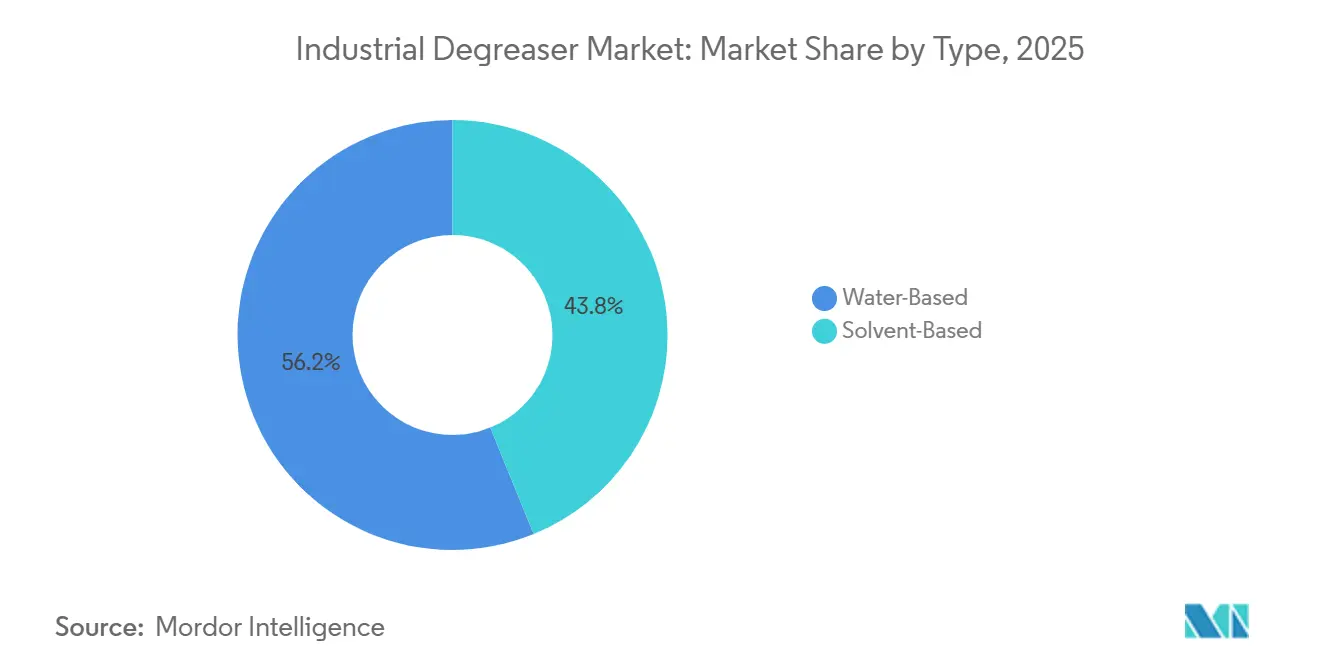
Water-based held 56.16% of the industrial degreaser market size in 2025 and is projected to advance at a 5.56% CAGR through 2031. Regulatory requirements, rather than environmental preference alone, supported this position. U.S. Environmental Protection Agency control techniques guidelines address volatile organic compound emissions from industrial cleaning solvents. Water-based formats also fit procurement requirements tied to environmental certifications and original equipment manufacturer specifications. The industrial degreaser market also benefits from automotive assembly plants that widely use aqueous spray-wash systems, creating a long-lived equipment base for water-based chemistry.
Solvent-based products remain relevant where fast drying, compatibility with electrostatic processes, or penetration into complex geometries is required. Their addressable use narrows when regulation removes solvent classes from commercial use. The industrial degreaser industry continues to shift toward products that meet lower volatile organic compound requirements without disrupting validated process conditions. This growth was concentrated in Asia-Pacific export-oriented manufacturing environments where multinational original equipment manufacturers apply consistent cleaning specifications across supply chains.


By Grade: Bio-Based Grades Reshape Procurement Priorities
Liquid-based grades held 40.23% of the industrial degreaser market share in 2025. Their use is supported by compatibility with automated parts washers, high-pressure spray applications, and fill-on-demand dispensing systems. Bio-based grades are projected to advance at a 5.62% CAGR through 2031. Environmental, Social, and Governance reporting requirements and government procurement incentives are supporting this growth. Soy-based and coconut oil-derived formulations are used in agricultural and construction equipment cleaning applications.
Petroleum-based grades face substitution pressure from chemical restrictions and supplier assessment programs. They retain demand in high-soil-load metalworking and heavy machinery applications where performance requirements remain demanding. Enzymatic formulations form an emerging group within bio-based grades. They can support heavy-duty degreasing at lower active-ingredient concentrations. This characteristic can improve per-unit economics when products carry compliance-related premiums. The industrial degreaser market is therefore accommodating both established liquid delivery systems and the gradual adoption of alternative active ingredients.
By Application: Automotive Leads Both Market Share and Growth
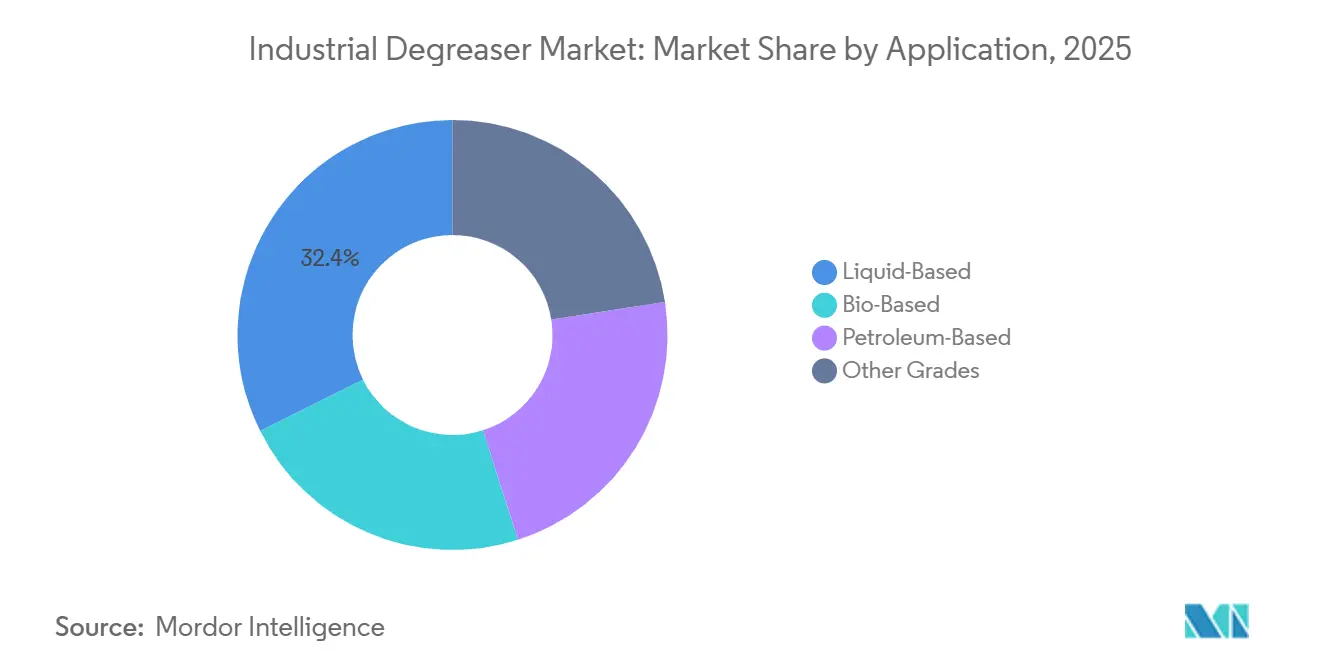
Automotive accounted for 32.37% of the industrial degreaser demand in 2025 and is projected to grow at a 6.01% CAGR through 2031. Industrial degreaser market demand in automotive production reflects repeated cleaning steps across body fabrication, painting preparation, powertrain production, and component servicing. Battery module housings and power electronics require aqueous deionized water rinsing processes to remove ionic residues. VDA 19.1 and International Organization for Standardization (ISO) 16232 set out technical cleanliness requirements relevant to these applications. Electric vehicle assembly can, therefore, require higher-purity aqueous cleaning formulations than conventional vehicle production.
Manufacturing and industrial machinery provides a broad base of demand from metalworking, stamping, forging, and equipment cleaning. Quaker Houghton reported that QH EXOMAX 154 delivered USD 194,000 in annual savings at an Ohio automotive parts manufacturer by eliminating borate buildup and biostability issues. Pharmaceutical operations require documented cleaning programs in controlled environments. ISO 14644-5:2025 specifies operational requirements for cleanrooms and associated controlled environments. Aerospace applications retain a need for precision solvent-based cleaning where aqueous systems do not provide residue-free drying for titanium and composite surface preparation.

Geography Analysis
North America held 38.05% of the industrial degreaser market size in 2025. The region includes automotive original equipment manufacturers, heavy machinery producers, pharmaceutical manufacturers, and aerospace companies that use high-intensity cleaning processes. California requirements for aerosol degreasers limit volatile organic compound content to below 10% for products sold in the state. Suppliers seeking broad U.S. distribution must account for this requirement. Mexico’s automotive manufacturing corridor supports maintenance, repair, and operations demand across integrated North American supply chains.
Europe’s industrial degreaser market demand is centered on Germany, the United Kingdom, France, and Italy, while the European Union chemicals framework reduced the addressable use of halogenated and chlorinated solvent-based products between 2020 and 2025. Henkel AG & Co. KGaA launched Bonderite C-AD 20202 in February 2026 for dip-process cleaning at 35 °C to 40 °C, compared with conventional process temperatures of 60 °C to 65 °C[2]Henkel AG & Co. KGaA, “Henkel Launches Bonderite C-AD 20202: Energy-Efficient Dip Degreasing for the Most Demanding Cleaning Requirements,” Henkel AG & Co. KGaA, henkel.com. AGCO/Fendt adopted the product in May 2025 at its Asbach-Bäumenheim site and saved 1,000 kilowatt-hours (kWh) per day while maintaining zinc phosphate coating quality. A Toyota Material Handling facility in Mjölby, Sweden, reported a 40% energy reduction after changing to a low-temperature aqueous degreaser for hose cleaning in early 2025.
Asia-Pacific is projected to advance at a 5.74% CAGR through 2031. China, India, South Korea, and the Association of Southeast Asian Nations manufacturing corridor support the industrial degreaser market demand through automotive, electronics, machinery, and battery production. China’s scale in automotive and electronics manufacturing supports absolute consumption, while India’s manufacturing investment supports demand in automotive, pharmaceutical, and electronics production. South Korea’s semiconductor and battery manufacturing base requires ultra-high-purity aqueous cleaners that meet Semiconductor Equipment and Materials International requirements. South America is centered on Brazil and Argentina, where automotive activity and agricultural equipment maintenance support demand, while the Middle East and Africa depend materially on oil and gas equipment maintenance. BASF’s 2026 distribution agreement with Brenntag covers cleaning products in South Africa, Nigeria, Ghana, Kenya, Uganda, Tanzania, and Ethiopia.

Competitive Landscape
The industrial degreaser market is highly fragmented, with the top five players including Ecolab Inc., 3M, Zep Inc., Henkel AG & Co. KGaA, and CRC Industries. BASF, Ecolab Inc., Henkel AG & Co. KGaA, and Quaker Houghton compete through formulation portfolios, technical application support, and process validation. This model can create switching barriers because customers evaluate chemical performance alongside operational outcomes. Quaker Houghton’s QH EXOMAX 154 case study reported USD 194,000 in annual savings at an Ohio automotive parts manufacturer. CRC Industries, ITW Pro Brands, NCH Corporation, Stepan Company, WD-40 Company, and Zep Inc. compete through application expertise, distribution reach, and established brands in specific industrial channels.
Henkel AG & Co. KGaA launched Bonderite C-AD 20202 in February 2026 to provide low-temperature performance for immersion and dip processes. The product addressed components with complex geometries and concealed cavities that require immersion cleaning. BASF implemented price increases of up to 30% in Europe and the Americas during 2026, citing higher raw material, logistics, packaging, and energy costs. Ecolab Inc. implemented a global 10%-14% energy surcharge on April 1, 2026, citing higher oil and European natural gas prices. These actions show how input-cost changes are reshaping price management across the industrial degreaser market.
Ecolab Inc. reported organic sales acceleration in its Global High-Tech and Life Sciences growth engines during the first quarter of 2026. Pharmaceutical and semiconductor cleaning applications require documented purity, technical support, and consistent process performance. Fermentation-derived biosurfactants such as rhamnolipids and sophorolipids represent an emerging alternative active-ingredient route. These materials can reduce reliance on petrochemical inputs and align with supplier selection criteria tied to Scope 3 emissions. The industrial degreaser market continues to favor suppliers that combine formulation expertise, compliance capability, and reliable service for critical processes.
Industrial Degreaser Industry Leaders
Ecolab Inc.
3M
Zep Inc.
Henkel AG & Co. KGaA
CRC Industries
- *Disclaimer: Major Players sorted in no particular order

Recent Industry Developments
- April 2026: Ecolab Inc. implemented a 10–14% global energy surcharge across its products and services from April 1, 2026, citing significant increases in oil and natural-gas prices. Higher energy costs increase operating expenses for industrial cleaning processes, encouraging users to adopt more energy-efficient degreasing solutions.
- February 2026: Henkel AG & Co. KGaA launched Bonderite C-AD 20202, a low-temperature surfactant for industrial dip degreasing that operates effectively at 35 °C–40 °C, compared with conventional processes at 60 °C–65 °C. This enables industrial users to reduce heating requirements and energy consumption during degreasing operations.


Global Industrial Degreaser Market Report Scope
Industrial degreasers are cleaning formulations designed to remove oils, grease, lubricants, carbon deposits, and other contaminants from industrial equipment and surfaces. They support maintenance, component preparation, and manufacturing processes by improving surface cleanliness and helping maintain equipment performance.
The Industrial Degreaser Market is segmented by type, grade, application, and geography. By type, the market is segmented into water-based and solvent-based. By grade, the market is segmented into liquid-based, petroleum-based, bio-based, and other grades. By application, the market is segmented into automotive, manufacturing and industrial machinery, pharmaceutical, aerospace, and other applications. The report also covers the market size and forecasts for industrial degreasers in 15 countries across major regions. For each segment, the market sizing and forecasts have been done on the basis of value (USD).
| Water-Based |
| Solvent-Based |
| Liquid-Based |
| Petroleum-Based |
| Bio-Based |
| Other Grades |
| Automotive |
| Manufacturing and Industrial Machinery |
| Pharmaceutical |
| Aerospace |
| Other Applications |
| Asia-Pacific | China |
| India | |
| Japan | |
| South Korea | |
| Rest of Asia-Pacific | |
| North America | United States |
| Canada | |
| Mexico | |
| Europe | Germany |
| United Kingdom | |
| France | |
| Italy | |
| Rest of Europe | |
| South America | Brazil |
| Argentina | |
| Rest of South America | |
| Middle East and Africa | Saudi Arabia |
| South Africa | |
| Rest of Middle East and Africa |
| By Type | Water-Based | |
| Solvent-Based | ||
| By Grade | Liquid-Based | |
| Petroleum-Based | ||
| Bio-Based | ||
| Other Grades | ||
| By Application | Automotive | |
| Manufacturing and Industrial Machinery | ||
| Pharmaceutical | ||
| Aerospace | ||
| Other Applications | ||
| By Geography | Asia-Pacific | China |
| India | ||
| Japan | ||
| South Korea | ||
| Rest of Asia-Pacific | ||
| North America | United States | |
| Canada | ||
| Mexico | ||
| Europe | Germany | |
| United Kingdom | ||
| France | ||
| Italy | ||
| Rest of Europe | ||
| South America | Brazil | |
| Argentina | ||
| Rest of South America | ||
| Middle East and Africa | Saudi Arabia | |
| South Africa | ||
| Rest of Middle East and Africa | ||


Key Questions Answered in the Report
What is the size of the industrial degreaser market?
The industrial degreaser market stands at USD 22.71 billion in 2026 and is projected to reach USD 28.73 billion by 2031.
What is driving demand for industrial degreasers?
The industrial degreaser market is supported by equipment maintenance, automotive production, hazardous-solvent substitution, and stricter cleanliness requirements in batteries and semiconductors.
Which type led the market demand in 2025?
Water-based held 56.16% of the revenue in 2025, supported by regulatory requirements and installed aqueous cleaning systems.
Which grade is projected to grow fastest through 2031?
Bio-based is projected to advance at a 5.62% CAGR through 2031.
Page last updated on:





