
Industrial Security Market Size and Share
Market Overview
| Study Period | 2020 - 2031 |
|---|---|
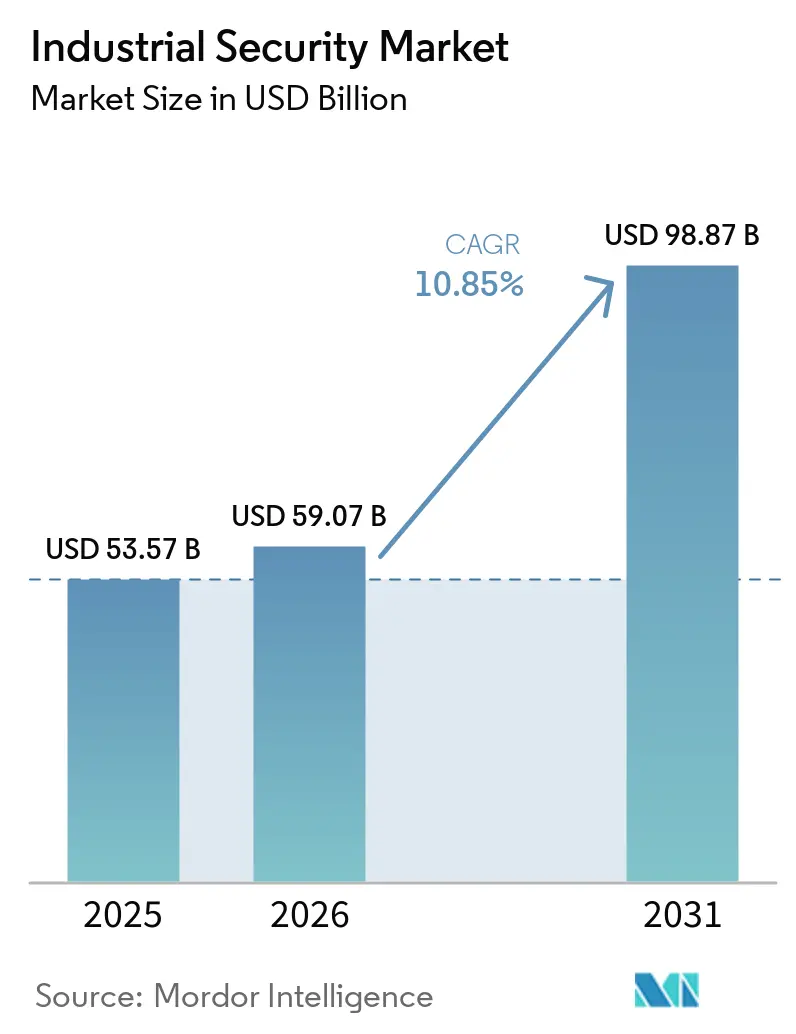
| Market Size (2026) | USD 59.07 Billion |
| Market Size (2031) | USD 98.87 Billion |
| Growth Rate (2026 - 2031) | 10.85 % |
| Fastest Growing Market | Asia-Pacific |
| Largest Market | Asia-Pacific |
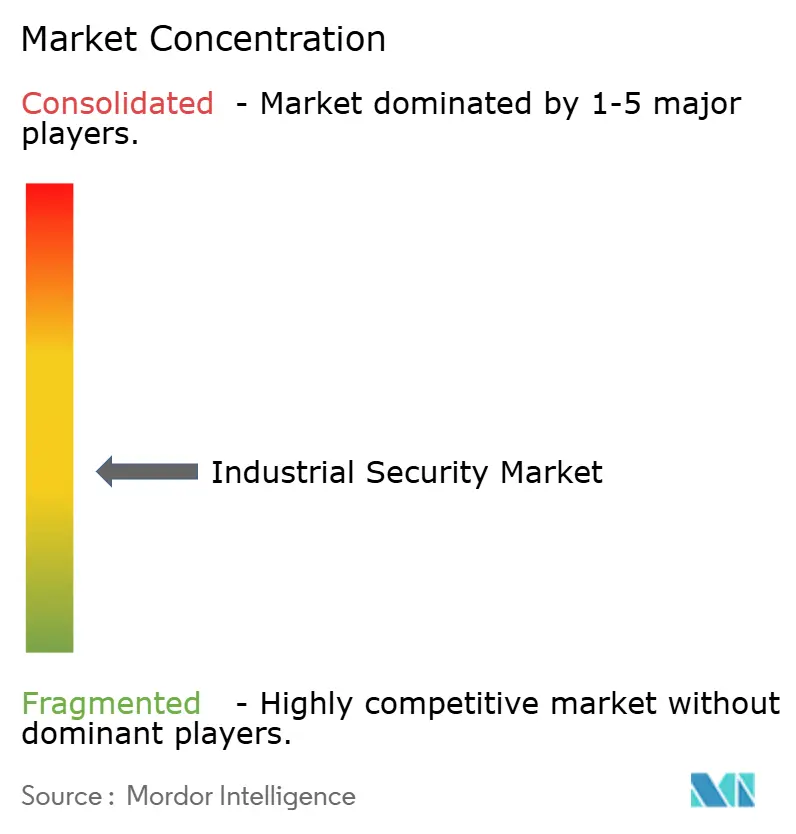
| Market Concentration | Medium |
Major Players *Disclaimer: Major Players sorted in no particular order Image © Mordor Intelligence. Reuse requires attribution under CC BY 4.0. | |
Industrial Security Market Analysis by Mordor Intelligence
The industrial security market size was valued at USD 53.57 billion in 2025 and estimated to expand from USD 59.07 billion in 2026 to reach USD 98.87 billion by 2031, at a CAGR of 10.85% during the forecast period (2026-2031). The industrial security market is being reshaped by the connection between plant systems and enterprise networks, which has weakened the assumption that operational technology remains isolated. Ransomware and state-linked activity now affect energy grids, factories, and water systems, making protection of industrial assets a more immediate spending priority. Regulatory requirements are also moving security decisions from individual sites to management teams and boards. The gap between threat exposure and active monitoring leaves room for new deployments across physical protection, network visibility, and response services. Competition is expanding across automation suppliers, Operational Technology (OT) cybersecurity specialists, physical security vendors, and managed service providers.
Key Report Takeaways
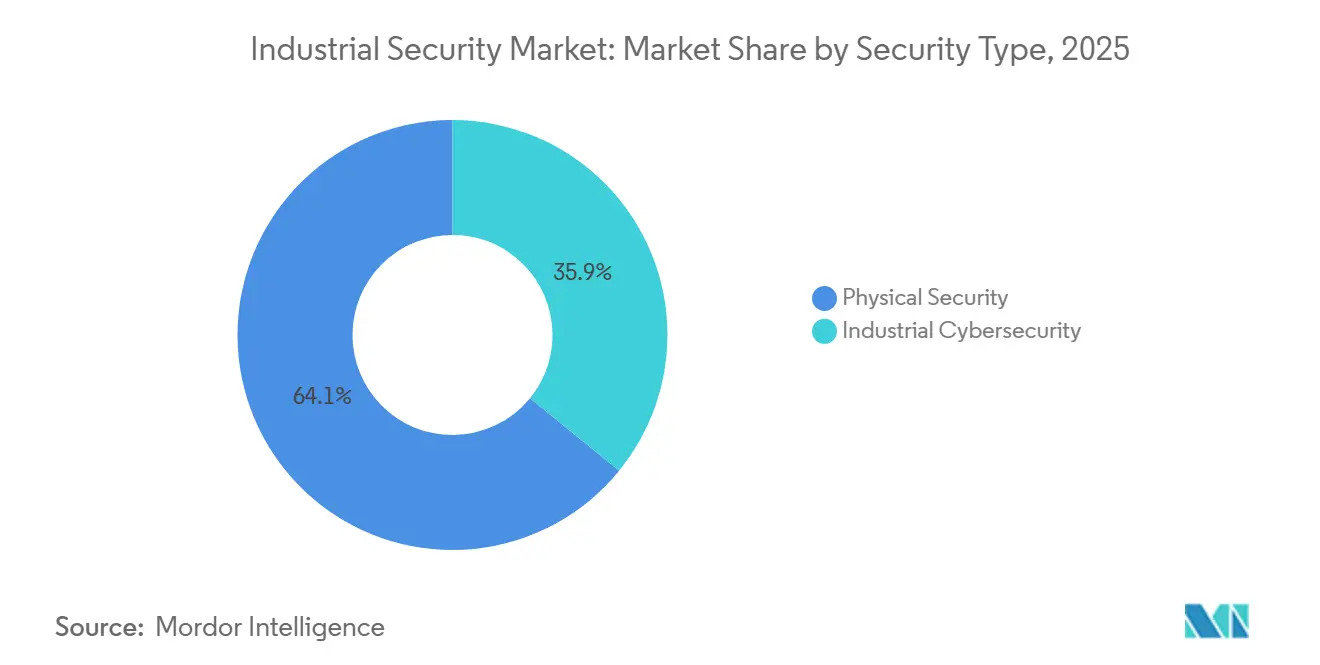
- By security type, physical security held a 64.12% share of the industrial security market in 2025, while industrial cybersecurity is projected to expand at a 12.54% CAGR through 2031.
- By offering, hardware accounted for 43.65% share of the industrial security market in 2025, while software is expected to expand at a 12.76% CAGR through 2031.
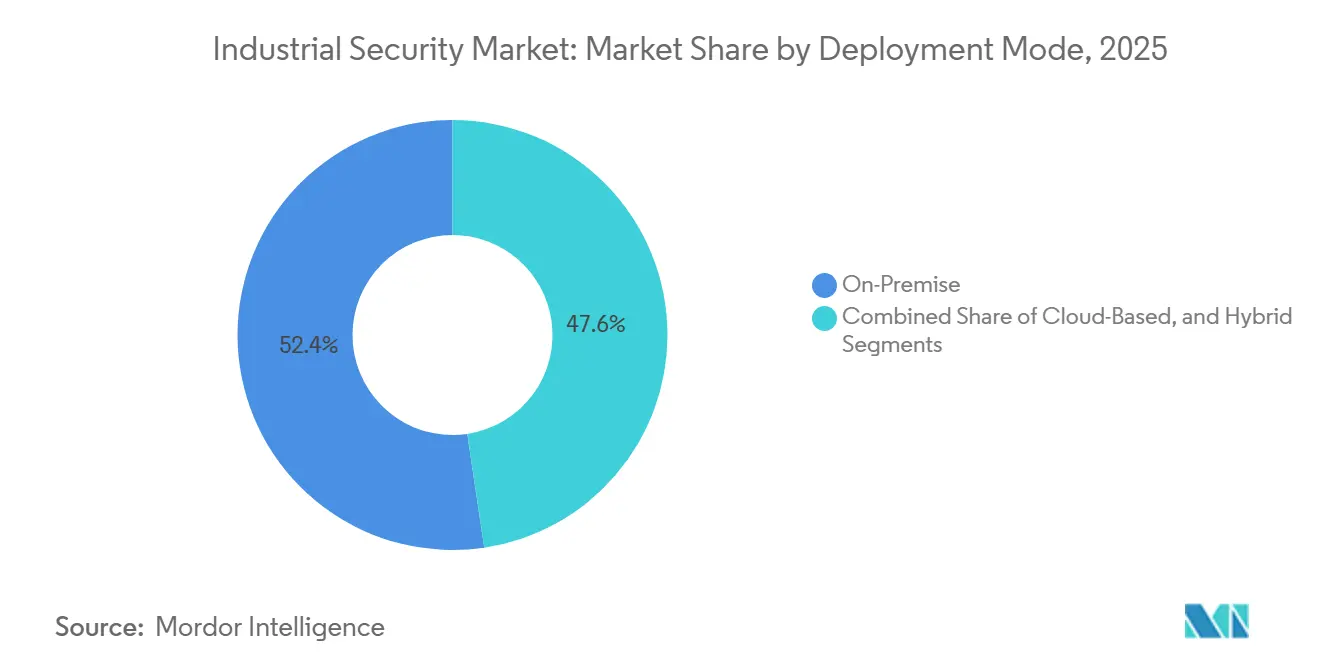
- By deployment mode, on-premises solutions held a 52.36% share of the industrial security market in 2025, while hybrid deployment is projected to grow at a 12.98% CAGR through 2031.
- By end-user industry, manufacturing accounted for 29.31% of revenue in 2025, while energy and utilities are expected to expand at a 12.31% CAGR through 2031.
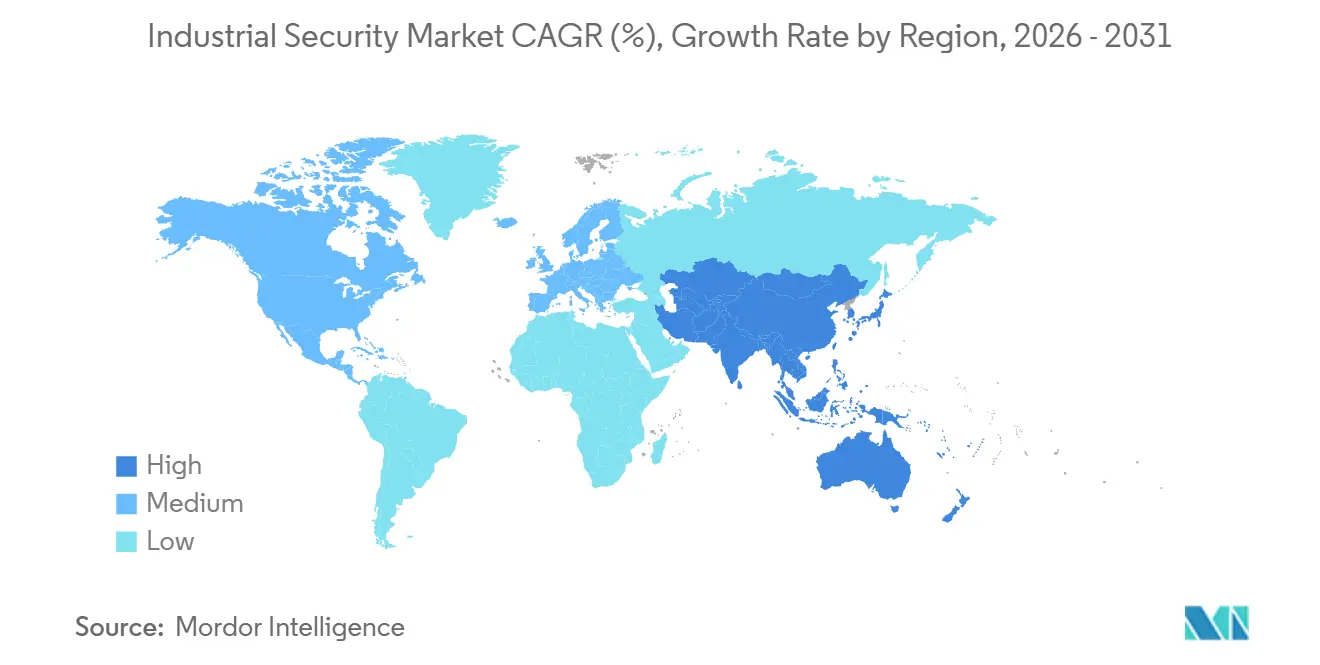
- By geography, Asia-Pacific held 31.72% share of the industrial security market in 2025 and is projected to expand at a 13.16% CAGR through 2031.
Note: Market size and forecast figures in this report are generated using Mordor Intelligence’s proprietary estimation framework, updated with the latest available data and insights as of January 2026.
Market Trends and Insights
Drivers Impact Analysis of Industrial Security Market*
| Driver | (~) % Impact on CAGR Forecast | Geographic Relevance | Impact Timeline |
|---|---|---|---|
| IT-OT Convergence and Industry 4.0 Modernization | +2.8% | Global, led by North America, Europe, and Asia-Pacific manufacturing hubs | Short term (≤ 2 years) |
| Ransomware and Cyber-Physical Attacks on Critical Infrastructure | +2.2% | Global, with concentrated impact in North America, Europe, and Asia-Pacific | Short term (≤ 2 years) |
| Mandatory Cybersecurity and Resilience Regulation | +1.9% | North America and Europe, expanding to Asia-Pacific and the Middle East | Medium term (2-4 years) |
| Expansion of IIoT, Edge Computing, and Remote Operations | +1.6% | Global, led by Asia-Pacific and North America | Medium term (2-4 years) |
| AI-Enabled Anomaly Detection and Unified Security Operations | +1.2% | Global, led by North America and Europe | Medium term (2-4 years) |
| Insurance, Board Accountability, and Operational Resilience Requirements | +0.8% | North America and Europe, with spillover to Asia-Pacific | Long term (≥ 4 years) |
| Source: Mordor Intelligence | |||
IT-OT Convergence and Industry 4.0 Modernization
The erosion of the OT air gap is increasing industrial security spending across connected factories. Manufacturers now connect historian servers, remote-monitoring platforms, and engineering workstations to networks that were once isolated. Each connection can serve as a route for lateral movement once an attacker gains access to enterprise IT. TXOne Networks reported that 96% of OT security incidents originated from IT-level compromises, underscoring the need for dedicated protection at the convergence boundary.[1] France 2030 and comparable smart manufacturing programs in the Asia-Pacific region are extending cloud connectivity and real-time analytics into production environments. These projects increase demand in the industrial security market for network segmentation, protocol inspection, and continuous monitoring.
Ransomware and Cyber-Physical Attacks on Critical Infrastructure
Ransomware has become an operational disruption risk rather than only a data theft issue for industrial operators. Dragos identified 119 ransomware groups targeting industrial organizations in 2025, up from 80 in 2024, and reported that these groups affected 3,300 organizations worldwide. Manufacturing represented more than two-thirds of the reported victims. The average dwell time for OT-specific ransomware reached 42 days in 2025, while organizations with comprehensive OT visibility reported a 5-day dwell time. CISA, the Federal Bureau of Investigation, the Department of Energy, and the National Security Agency warned in July 2026 that Iranian-affiliated actors were manipulating programmable logic controllers in United States water and energy sites. The attacks demonstrate why buyers in the industrial security market are prioritizing OT visibility, remote-access controls, and incident response.
Mandatory Cybersecurity and Resilience Regulation
Regulation is making cybersecurity spending more consistent across industrial operators. The NIS2 Directive took effect on October 18, 2024, and expanded cybersecurity risk-management duties for energy, manufacturing, water, and transport organizations. Germany's NIS2UmsuCG entered into force on December 6, 2025, and required affected companies to register with the Federal Office for Information Security by March 2026. IEC PAS 62443-2-2, published on March 11, 2025, set out a security protection scheme framework for industrial automation and control system asset owners. In the United States, IEC NERC CIP-015 will require internal network security monitoring for high-criticality bulk electric system operators within a 3-year compliance period. These measures create ongoing demand for products and services that support compliance with the industrial security market.
Expansion of IIoT, Edge Computing, and Remote Operations
IIoT sensors, edge nodes, and remote-monitoring systems are creating a distributed perimeter across industrial sites. Each internet-addressable device can create an entry point that requires protection. Dragos observed in the first quarter of 2026 that ransomware disruptions originating in enterprise IT routinely affected engineering systems, production planning, and OT visibility without specialized ICS malware. Remote wellhead automation, cellular metering, and private 5G networks increase the number of locations that must be subject to security controls. Operators need encrypted communications, zero-trust access, and protocol monitoring at these points. This need supports demand for industrial security market platforms that combine local enforcement with centralized oversight.
Restraints Impact Analysis of Industrial Security Market*
| Restraint | (~) % Impact on CAGR Forecast | Geographic Relevance | Impact Timeline |
|---|---|---|---|
| Legacy Equipment and Proprietary Industrial Protocols | -2.1% | Global, particularly severe in North America, Europe, and industrial Asia-Pacific | Long term (≥ 4 years) |
| OT-Skilled Cybersecurity Talent Shortage | -1.7% | Global | Medium term (2-4 years) |
| High Retrofit Cost, Downtime Risk, and Lifecycle Complexity | -1.3% | Global, with acute impact in energy and process industries | Long term (≥ 4 years) |
| Fragmented Multivendor Ecosystems and Interoperability Gaps | -0.9% | Global | Medium term (2-4 years) |
| Source: Mordor Intelligence | |||
Legacy Equipment and Proprietary Industrial Protocols
Legacy OT equipment limits the industrial security market opportunity because much of the installed plant infrastructure was built for physical isolation. Many SCADA systems, PLCs, and distributed control systems use Modbus, DNP3, and OPC DA protocols that predate current encryption and authentication practices. Patching often requires vendor involvement and may not be feasible during operations. Dragos found that 26% of ICS-CERT advisories in 2025 did not include a vendor patch or mitigation. ISA/IEC 62443 supports compensating controls through zones, conduits, unidirectional gateways, and data diodes.[2] However, brownfield retrofits require engineering work, planned downtime, and capital that operators may defer.
OT-Skilled Cybersecurity Talent Shortage
The industrial security market can face slower implementation when workers lack both OT and cybersecurity experience. Industrial control system protection requires knowledge of OT protocols, production engineering, and threat detection practices. The World Economic Forum reported that the cybersecurity skills gap increased by 8% in 2024, with the shortfall particularly acute in OT roles. TXOne Networks found that 46% of OT security personnel had operations or engineering backgrounds rather than IT security backgrounds. Cross-training can preserve production knowledge, but it takes time to develop specialized security capability. The shortage also supports managed monitoring and hosted detection services, while increasing total costs and asset owners' dependence on responses.
*Our forecasts treat driver/restraint impacts as directional, not additive. The impact forecasts reflect baseline growth, mix effects, and variable interactions.
Industrial Security Market Segment Analysis
By Security Type:
Cyber Threats Shift Budgets Toward OT and ICS SolutionsPhysical Security held 64.12% of revenue in 2025. The industrial security market continues to support this category through installed video surveillance, access control, intrusion detection, perimeter security, and security management systems. Manufacturing campuses, logistics hubs, and energy facilities continue to require these systems for site protection. Genetec reported that users increasingly combine video management and access control within unified platforms.[3] AI-based video analytics and intrusion detection are also becoming expected functions within physical security deployments. A refinery can combine perimeter analytics with access-control data to automate anomaly escalation. This approach can reduce manual review in security operations centers. Unified security management is shifting procurement toward platform-level decisions rather than isolated hardware purchases.
Industrial Cybersecurity is projected to expand at a 12.54% CAGR through 2031 within the industrial security market. OT and ICS security solutions, industrial network security, identity and access management, and threat detection are receiving a larger share of security capital expenditure. Honeywell expanded its OT Cybersecurity Suite in June 2026 with AI-powered Cyber Proactive Defense and a managed OT Security Operations Center. The company cited the World Economic Forum finding that only 20% of industrial organizations maintain dedicated OT security teams. Operators are seeking platforms that connect alerts from video analytics, access events, and OT network activity. IEC 62443 provides a recognized framework for deployments that must meet national compliance expectations. The industrial security industry is therefore bringing physical and cyber controls closer together within the same operating model.
By Offering:
Software Platforms Capture a Larger Share of Security BudgetsHardware accounted for 43.65% of the industrial security market size in 2025. Cameras, access readers, ruggedized network appliances, and OT security gateways remain necessary physical control points in industrial environments. These products must tolerate industrial temperature, humidity, and electromagnetic conditions. Software-only controls cannot replace hardware controls when direct enforcement at the asset or network level is required. The Security Industry Association reported that tariff effects and geopolitical conditions contributed to procurement delays in video surveillance and access control during March and April 2026. Industrial network appliances, OT-native firewalls, and ruggedized intrusion prevention systems are key hardware categories. They are designed to process proprietary industrial protocols without adding disruptive latency to control loops. Hardware demand in the industrial security market, therefore, remains tied to both physical security requirements and OT network protection.
Software is projected to expand at a 12.76% CAGR through 2031. AI-native platforms, cloud-delivered threat intelligence, and subscription-based OT visibility tools are shifting some security spending from capital purchases to recurring contracts. Claroty launched Claire in May 2026 as a CPS-native AI security agent that provides risk prioritization and remediation guidance for OT environments. A chemical plant can use such a tool to relate anomalous PLC behavior to access-control events and network communications. This can bring an attack sequence to analysts' attention without manual correlation. Services for assessment, managed detection, and incident response are expanding alongside software. Rockwell Automation added SecureOT Platform Managed Services and Managed Secure Remote Access in June 2026 for manufacturers without internal OT security capacity. The industrial security market is increasingly combining software platforms with vendor-operated support.
By Deployment Mode:
Hybrid Architectures Define the Next Deployment ModelOn-premises deployment accounted for 52.36% of revenue in 2025. This position reflects latency requirements, data sovereignty concerns, and a preference for local control among critical infrastructure operators. Oil and gas, chemicals, and nuclear-adjacent power generation retain strong local deployment preferences. Connecting production control networks to external cloud environments can require regulatory approval and can introduce additional exposure. NERC CIP-015 and sector-specific IEC 62443 security level requirements reinforce local architectures for highly critical assets. Local enforcement remains important where control decisions need immediate processing. It also allows operators to retain direct oversight of sensitive production data. On-premise systems will continue to serve the industrial security market where operational constraints take precedence over centralized analytics.
Hybrid deployment is projected to advance at a 12.98% CAGR through 2031. This design uses cloud platforms for threat intelligence, compliance reporting, and cross-site analytics while retaining on-site controls for real-time operations. Edge nodes can process OT telemetry locally, while cloud analytics identify patterns across a fleet of facilities. Cloud-based deployment is also attracting mid-sized manufacturing and food-and-beverage operators that lack on-site security expertise. TXOne Networks commercially launched SenninRecon and SenninOne in April 2026 to link OT discovery, governance, enforcement, and remediation. SenninRecon monitors more than 180 industrial protocols without disrupting production systems. The industrial security market is adopting a model in which security is designed around production constraints rather than generic IT operating procedures.

By End-User Industry:
Energy and Utilities Security Becomes a National Security PriorityManufacturing held 29.31% of the industrial security market in 2025. The sector contains a high concentration of OT assets and depends on continuous production. Dragos reported that more than two-thirds of global industrial ransomware victims in 2025 were manufacturers. Lost throughput, contract penalties, and supply-chain disruption can make downtime costly. Manufacturers are moving toward unified security operations centers that monitor IT and OT from a single platform. A consumer electronics producer can use this model to coordinate detection and containment across previously separate teams. Managed services can reduce the friction that enables incidents to cross the IT-OT boundary. These factors keep manufacturing at the center of demand in the industrial security market and reinforce its central role.
Energy and Utilities is projected to expand at a 12.31% CAGR through 2031. CISA and the Federal Bureau of Investigation warned in July 2026 of Iranian-affiliated exploitation of internet-connected PLCs in United States energy and water systems. Wind farms, solar dispatch systems, and battery energy storage systems distribute OT assets across wide areas. This distribution removes the single-site perimeter as a sufficient security boundary. Oil and gas facilities face related exposure from remote field assets with limited connectivity. Chemical and petrochemical facilities must consider process safety risks, including potential releases of H₂S and NH₃ due to actuator manipulation. Pharmaceutical and life sciences operators must protect validated platforms in accordance with 21 CFR Part 11 and EU Annex 11. Transportation, mining, water, wastewater, and food and beverage operators also require industrial security market protection tailored to their operational systems.
Geography Analysis
North America Industrial Security Market
North America is a significant revenue region for the industrial security market, supported by the density of critical infrastructure and the early adoption of OT cybersecurity frameworks. CISA issued advisories in July 2026 on Iranian-affiliated activity against United States energy and water systems. NERC CIP-015 will require internal network monitoring for high-criticality bulk electric system operators within a 3-year compliance period. Canada recorded one of the lowest percentages of ICS computers blocked from malicious activity across regions in the fourth quarter of 2025.[4] This result reflects mature security practices and active regulatory engagement. Mexico is developing a different demand profile as nearshoring expands OT-intensive industrial parks. New facilities often need security infrastructure from the start and under compressed implementation schedules.
APAC Industrial Security Market
Asia-Pacific accounted for 31.72% of regional revenue in 2025 and is projected to grow at a 13.16% CAGR through 2031. China and India are the main centers of industrial security market demand because industrialization, smart manufacturing programs, and power infrastructure are creating dense populations of OT assets. Japan and South Korea have domestic automation suppliers that embed security into their industrial product offerings. Yokogawa's OpreX IT/OT SOC is an example of automation-based security integration for industrial customers. South Korea's semiconductor and display facilities have high automation density and a substantial cost of production disruption. India benefits from manufacturing expansion under the Production Linked Incentive scheme and more active cybersecurity requirements for critical sectors.
EMEA and South America Industrial Security Market
The industrial security market in Europe has stronger compliance-driven demand, while South America, the Middle East, and Africa show differing levels of industrial maturity. Germany's NIS2UmsuCG became effective in December 2025, and the United Kingdom introduced the Cyber Security and Resilience Bill in November 2025. The bill proposed maximum penalties of GBP 17 million (USD 21.5 million) or GBP 100,000 (USD 126,000) per day in enforcement orders. Saudi Arabia's NEOM and Vision 2030 projects, the United Arab Emirates' infrastructure digitization, and South African utility modernization are supporting investment in the Middle East and Africa. South America recorded 20.4% of ICS computers with blocked malicious objects in the fourth quarter of 2025, which was 2.4 times the rate in Northern Europe. Chile established the Agencia Nacional de Ciberseguridad in 2025, while Brazil's oil and gas and manufacturing sectors are adding demand for physical and OT cybersecurity systems.
Competitive Landscape
The industrial security market is moderately fragmented across automation suppliers, OT cybersecurity specialists, physical security vendors, and network security providers. Honeywell, Siemens, Schneider Electric, ABB, Rockwell Automation, Emerson, Yokogawa, and Mitsubishi Electric integrate security within installed-base customer relationships. Claroty, Dragos, and TXOne Networks compete through OT asset visibility, threat detection, and incident response capabilities. Axis Communications, Hikvision, Dahua, Gallagher, and Motorola Solutions supply video surveillance, access control, and perimeter security solutions. Cisco, Fortinet, and Palo Alto Networks are developing OT-focused product lines, integrations, and protocol inspection capabilities. This structure creates competition across products, platforms, and managed services. Vendors with established automation relationships can combine security technology with operational process knowledge.
Rockwell Automation expanded its SecureOT portfolio in June 2026 with an OT Cybersecurity Assessment Suite, SecureOT Platform Managed Services, and Managed Secure Remote Access. The company linked these offerings to IEC 62443-4-1 Maturity Level 4 certified product engineering. Honeywell expanded its OT Cybersecurity Suite in June 2026 with Cyber Proactive Defense, governance and compliance capabilities, a portable scanner, a data diode, and a managed OT SOC service. Phoenix Contact offers certified OT network security products aligned with IEC 62443. Yokogawa uses an OpreX IT/OT SOC architecture to integrate automation and security operations. These strategies show how automation suppliers are seeking to capture revenue in the industrial security market through hardware, software, and recurring services.
Managed detection and response is an important opening in the industrial security market because many mid-sized operators lack dedicated OT security staff. Unified platforms that combine video, access, and OT network data are another area of competition. Industrial software and firmware supply chain protection is also receiving attention as regulatory requirements evolve. Claroty added Akamai, ColorTokens, Corsha, Elisity, and Zero Networks to its technology alliance program in June 2026. The ISA/IEC 62443 series is becoming a procurement requirement for vendors that serve regulated operators. Fortinet expanded its OT Security Platform in 2025 with OT-specific threat intelligence, ruggedized segmentation, 5G products, and automated compliance reporting.[5] AI-based OT anomaly detection and zero-trust industrial access are key areas of product differentiation.
Industrial Security Industry Leaders
-
Siemens AG
-
Honeywell International Inc.
-
Schneider Electric SE
-
ABB Ltd.
-
Rockwell Automation, Inc.
- *Disclaimer: Major Players sorted in no particular order
Industrial Security Market Companies Covered in this Report
- Siemens AG
- Honeywell International Inc.
- Schneider Electric SE
- ABB Ltd.
- Rockwell Automation, Inc.
- Gallagher Group Ltd.
- Motorola Solutions, Inc.
- Axis Communications AB
- Hikvision Digital Technology Co., Ltd.
- Dahua Technology Co., Ltd.
- Cisco Systems, Inc.
- Fortinet, Inc.
- Palo Alto Networks, Inc.
- Claroty Ltd.
- Dragos, Inc.
- TXOne Networks Inc.
- Emerson Electric Co.
- Yokogawa Electric Corporation
- Mitsubishi Electric Corporation
- Phoenix Contact GmbH & Co. KG
Recent Industry Developments in Industrial Security Market
- August 2026: Claroty established Claroty Public Sector LLC as an independent subsidiary in Arlington, Virginia, to serve United States federal, state, and local government clients, simultaneously achieving FedRAMP High In Process status for Claroty xDome for Government and receiving an eMASS Authority to Operate from the Defense Logistics Agency.
- July 2026: CISA published an updated advisory warning that Iranian-affiliated hackers had expanded their targeting to include Schneider Electric and Siemens PLCs, in addition to previously identified Rockwell Automation and Allen-Bradley devices, across critical infrastructure sectors in the United States, including water, wastewater, energy, and government facilities, causing operational disruption and financial losses.
- June 2026: Rockwell Automation expanded its SecureOT suite with 3 new offerings: OT Cybersecurity Assessment Suite, SecureOT Platform Managed Services, and Managed Secure Remote Access, all supported by IEC 62443-4-1 Maturity Level 4 certified product engineering.
- June 2026: Honeywell expanded its OT Cybersecurity Suite, adding Cyber Proactive Defense, Cyber Governance Risk and Compliance, Secure Media Exchange Portable Scanner, Data Diode, and a vendor-agnostic managed OT SOC service.
Global Industrial Security Market Report Scope
The industrial security market comprises hardware, software, and services designed to protect industrial facilities, operational technology (OT), industrial control systems (ICS), critical infrastructure, and industrial assets from physical and cyber threats. Industrial security solutions enable organizations to prevent unauthorized access, detect security incidents, protect industrial networks, secure production environments, and maintain operational continuity. The market includes physical security solutions and industrial cybersecurity solutions deployed across manufacturing facilities, energy infrastructure, oil and gas operations, chemical plants, mining sites, transportation infrastructure, and other industrial environments.
The Industrial Security Market Report is Segmented by Security Type (Physical Security (Video Surveillance Systems, Access Control Systems, Intrusion Detection Systems, Perimeter Security Systems, and Security Management Platforms), and Industrial Cybersecurity (OT/ICS Security Solutions, Industrial Network Security, Industrial Endpoint Security, Identity and Access Management (IAM), and Threat Detection and Response Solutions), Offering (Hardware, Software, and Services), Deployment Mode (On-Premise, Cloud-Based, and Hybrid), End-User Industry (Manufacturing, Energy and Utilities, Oil and Gas, Chemical and Petrochemical, Mining and Metals, Transportation and Logistics, Pharmaceuticals and Life Sciences, Food and Beverage, Water and Wastewater, and Other End-user Industries), and Geography (North America, South America, Europe, Asia-Pacific, and Middle East and Africa). The Market Forecasts are Provided in Terms of Value (USD).
Segmentation Overview
| Physical Security | Video Surveillance Systems |
| Access Control Systems | |
| Intrusion Detection Systems | |
| Perimeter Security Systems | |
| Security Management Platforms | |
| Industrial Cybersecurity | OT/ICS Security Solutions |
| Industrial Network Security | |
| Industrial Endpoint Security | |
| Identity and Access Management (IAM) | |
| Threat Detection and Response Solutions |
| Hardware |
| Software |
| Services |
| On-Premise |
| Cloud-Based |
| Hybrid |
| Manufacturing |
| Energy and Utilities |
| Oil and Gas |
| Chemical and Petrochemical |
| Mining and Metals |
| Transportation and Logistics |
| Pharmaceuticals and Life Sciences |
| Food and Beverage |
| Water and Wastewater |
| Other End-user Industries |
| North America | United States | |
| Canada | ||
| Mexico | ||
| South America | Brazil | |
| Argentina | ||
| Rest of South America | ||
| Europe | Germany | |
| United Kingdom | ||
| France | ||
| Italy | ||
| Spain | ||
| Rest of Europe | ||
| Asia-Pacific | China | |
| Japan | ||
| India | ||
| South Korea | ||
| Rest of Asia-Pacific | ||
| Middle East and Africa | Middle East | Saudi Arabia |
| United Arab Emirates | ||
| Turkey | ||
| Rest of the Middle East | ||
| Africa | South Africa | |
| Nigeria | ||
| Rest of Africa | ||
| By Security Type | Physical Security | Video Surveillance Systems | |
| Access Control Systems | |||
| Intrusion Detection Systems | |||
| Perimeter Security Systems | |||
| Security Management Platforms | |||
| Industrial Cybersecurity | OT/ICS Security Solutions | ||
| Industrial Network Security | |||
| Industrial Endpoint Security | |||
| Identity and Access Management (IAM) | |||
| Threat Detection and Response Solutions | |||
| By Offering | Hardware | ||
| Software | |||
| Services | |||
| By Deployment Mode | On-Premise | ||
| Cloud-Based | |||
| Hybrid | |||
| By End-user Industry | Manufacturing | ||
| Energy and Utilities | |||
| Oil and Gas | |||
| Chemical and Petrochemical | |||
| Mining and Metals | |||
| Transportation and Logistics | |||
| Pharmaceuticals and Life Sciences | |||
| Food and Beverage | |||
| Water and Wastewater | |||
| Other End-user Industries | |||
| By Geography | North America | United States | |
| Canada | |||
| Mexico | |||
| South America | Brazil | ||
| Argentina | |||
| Rest of South America | |||
| Europe | Germany | ||
| United Kingdom | |||
| France | |||
| Italy | |||
| Spain | |||
| Rest of Europe | |||
| Asia-Pacific | China | ||
| Japan | |||
| India | |||
| South Korea | |||
| Rest of Asia-Pacific | |||
| Middle East and Africa | Middle East | Saudi Arabia | |
| United Arab Emirates | |||
| Turkey | |||
| Rest of the Middle East | |||
| Africa | South Africa | ||
| Nigeria | |||
| Rest of Africa | |||
Key Questions Answered in the Report
How large is the industrial security sector?
The industrial security market size is estimated at USD 59.07 billion in 2026 and is projected to reach USD 98.87 billion by 2031 at a 10.85% CAGR.
What is driving demand for industrial security solutions?
IT and OT convergence, ransomware, regulation, IIoT expansion, and remote operations are increasing the need for protection.
Which security type has the largest share?
Physical Security held 64.12% of revenue in 2025, supported by video surveillance, access control, and perimeter protection.
Which offering is expected to expand the fastest?
Software is projected to expand at a 12.76% CAGR through 2031 as AI-enabled tools and subscription platforms gain use.
Which end-user sector is expected to expand the fastest?
Energy and Utilities is expected to expand at a 12.31% CAGR through 2031 because distributed assets increase OT exposure.
Which region is expected to expand the fastest?
Asia-Pacific is projected to expand at a 13.16% CAGR through 2031, supported by industrialization and critical infrastructure programs.