
Indonesia Prefabricated Product Logistics Market Size and Share
Market Overview
| Study Period | 2020 - 2031 |
|---|---|
| Forecast Data Period | 2026 - 2031 |
| Base Year Market Size (2025) | USD 366.86 Million |
| Market Size (2026) | USD 395.07 Million |
| Market Size (2031) | USD 570.17 Million |
| Growth Rate (2026 - 2031) | 7.61 % |
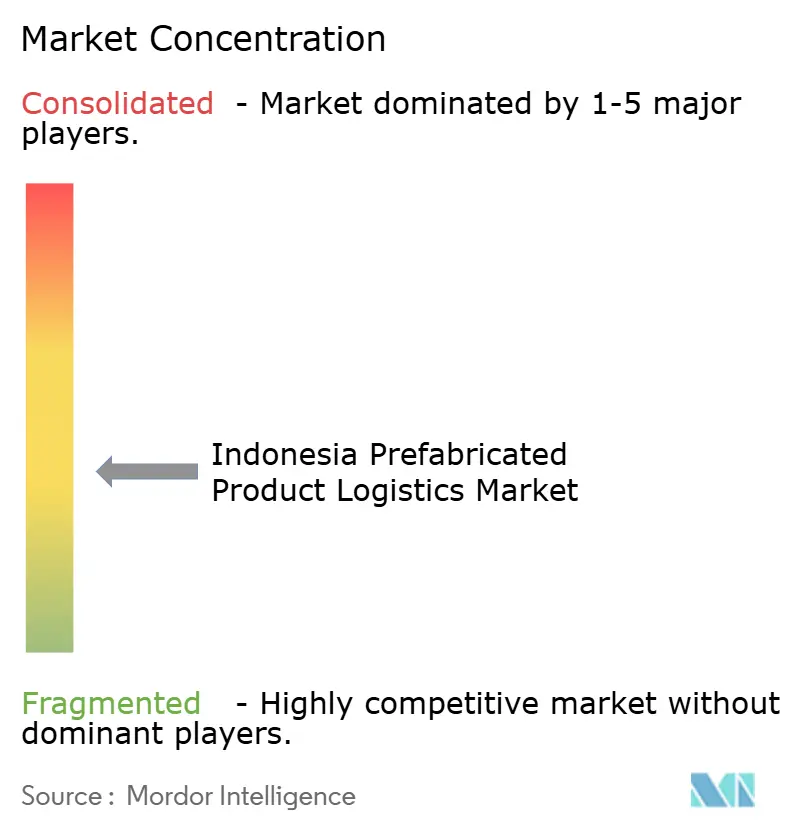
| Market Concentration | Medium |
Major Players
*Disclaimer: Major Players sorted in no particular order Image © Mordor Intelligence. Reuse requires attribution under CC BY 4.0. |
|
Indonesia Prefabricated Product Logistics Market Analysis by Mordor Intelligence
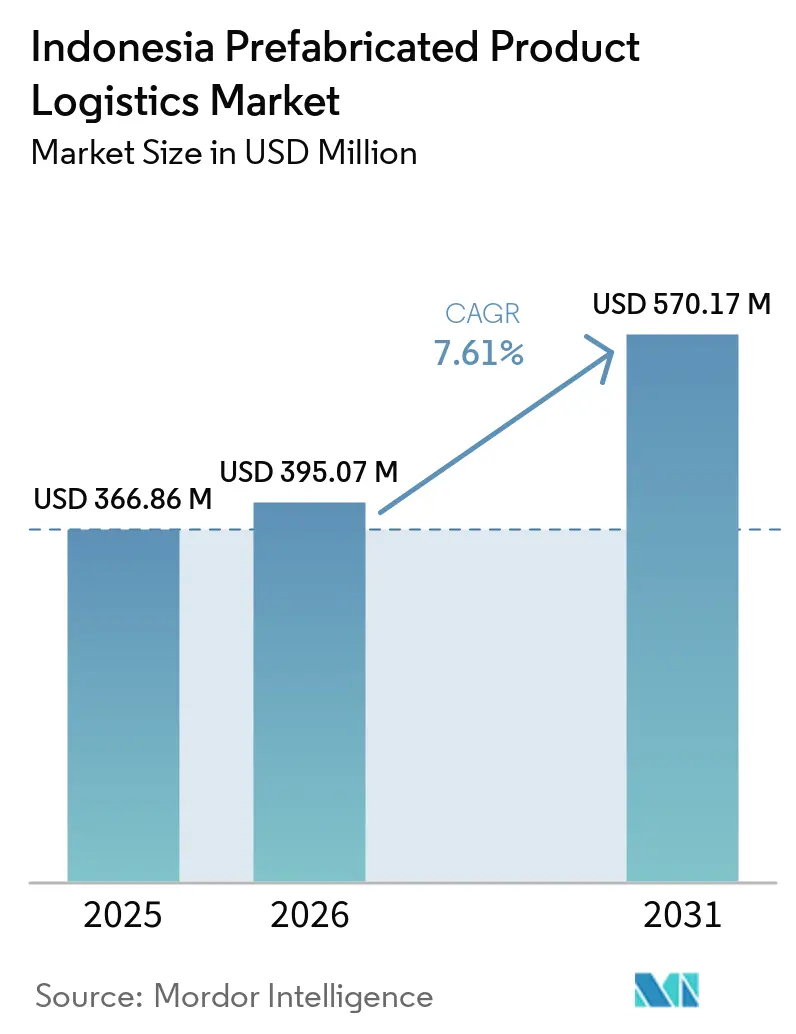
The Indonesia prefabricated product logistics market size was valued at USD 366.86 million in 2025 and estimated to grow from USD 395.07 million in 2026 to reach USD 570.17 million by 2031, at a CAGR of 7.61% during the forecast period (2026-2031).
Government infrastructure delivery supports freight demand for factory-built components across roads, dams, irrigation systems, and housing projects. The Ministry of Public Works allocated IDR 118.5 trillion (USD 7.07 billion) to infrastructure in 2026, and it had absorbed IDR 65.65 trillion (USD 3.91 billion) by August 2026, when physical progress reached 54.84%. The Indonesia prefabricated product logistics market also depends on service providers that can coordinate sea, road, warehousing, and site delivery across many islands. Flat-pack designs can improve container utilization and lower the freight burden on long inter-island routes. Competition centers on fleet capacity, heavy-lift access, warehouse coverage, and shipment visibility, while provincial clearances and higher cargo tariffs remain material constraints.
Key Report Takeaways
- By service, transportation led with a 65.20% of the Indonesia prefabricated product logistics market share in 2025, while value-added services recorded the highest projected CAGR at 9.60% through 2031.
- By product type, modular buildings held a 50.60% of the Indonesia prefabricated product logistics market size in 2025, while panelized and componentized systems recorded the highest projected CAGR at 9.40% through 2031.
- By application, residential buildings held a 54.70% of the Indonesia prefabricated product logistics market share in 2025, while commercial buildings recorded the highest projected CAGR at 9.15% through 2031.
Note: Market size and forecast figures in this report are generated using Mordor Intelligence’s proprietary estimation framework, updated with the latest available data and insights as of January 2026.
Indonesia Prefabricated Product Logistics Market Trends and Insights
Drivers Impact Analysis*
| Driver | (~) % Impact on CAGR Forecast | Geographic Relevance | Impact Timeline |
|---|---|---|---|
| Government Infrastructure Delivery and Industrial Relocation Pipeline | +2.1% | National, with the highest concentration in Java, East Kalimantan, and Eastern Indonesia corridors | Medium term (2-4 years) |
| Inter-Island Prefab Movement Efficiency Gains Versus Conventional Site Build | +1.5% | National, especially routes from Java to Kalimantan, Sulawesi, Papua, and Maluku | Medium term (2-4 years) |
| Expansion of Remote Mining, Energy, and Worker Camp Deployments | +1.2% | East Kalimantan, Papua Barat, Sulawesi, and Sumatra, with spillover to NTT and Maluku | Long term (≥ 4 years) |
| Carbon and Material-Waste Reduction Requirements in Controlled Factory Production | +0.8% | Java, with spillover to Batam and East Kalimantan | Long term (≥ 4 years) |
| Modularized Logistics Control Towers and Route Engineering for Oversized Loads | +0.6% | National, particularly secondary corridors in Kalimantan, Papua, and Nusa Tenggara | Medium term (2-4 years) |
| Distributed Micro-Factories Near Demand Clusters for Delivery-Time Reduction | +0.5% | East Java, Sulawesi, and East Kalimantan, with early activity in Kendari and Sorong | Long term (≥ 4 years) |
| Source: Mordor Intelligence | |||
Government Infrastructure Delivery and Industrial Relocation Pipeline
Infrastructure activity converted into demand for prefabricated freight rather than only raising construction output. Nine toll roads were scheduled to enter service in 2026, while railway reactivation work expanded demand for route-specific logistics planning. IKN Nusantara required an estimated 300,000 construction workers, while East Kalimantan could supply fewer than 1/3 of that workforce. This gap increased reliance on modules shipped from factories in Java through roll-on-roll-off services. Industrial relocation from crowded Java corridors to special economic zones in Batam, Sulawesi, and East Kalimantan created additional demand for modular production facilities. The Indonesia prefabricated product logistics market, therefore, gained cargo volumes at both the factory origin and the destination project site.[1]"Kemen PU Gandeng Pelaku Industri Perkuat Rantai Pasok Hijau Konstruksi,” Directorate General of Construction Development, dml.or.id
Inter-Island Prefab Movement Efficiency Gains Versus Conventional Site Build
The cost advantage of prefabrication depends on well-designed transport and high cargo density. Flat-pack designs carried 16 units in a 40-foot high-cube container, which was 2 times the density of pre-assembled rigid cabins. The same designs generated ocean freight savings of 15% or more on Kalimantan routes. Indonesia allocated IDR 524.98 billion (USD 31.32 million) to the sea-toll program within the IDR 4.74 trillion (USD 282.81 million) marine public service obligation for 2026. These routes served frontier, outermost, and remote areas where shipments had previously been less economical.[2]“2027 Infrastructure Development to Support 8 Percent Growth: Minister,” ANTARA News, en.antaranews.com Zero Over-Dimension Over-Load enforcement also favored flat-pack configurations over oversized pre-assembled units.
Expansion of Remote Mining, Energy, and Worker Camp Deployments
Remote energy projects created specialized demand for accommodation modules, offices, and support structures. The national 2025 to 2034 power plan includes 69.5 gigawatts of new generation capacity and requires supporting facilities at remote locations. BP Berau awarded Leighton Asia a contract for a 2-phase Phoenix Camp for 1,500 personnel at the Tangguh UCC Onshore Project in Papua Barat. This project showed how energy operators used modular accommodation in remote provinces. Units rated for 6 to 10 relocations can generate repeat freight work through disassembly, transport, and reassembly. The Indonesia prefabricated product logistics market benefits when operators can manage the full relocation cycle.
Distributed Micro-Factories Near Demand Clusters for Delivery-Time Reduction
Regional production hubs shortened the transport chain between factories and project sites. The Ministry of Transportation targets 80% of remote areas to be reachable within 14 days of shipment by 2029. Micro-factories in Sorong and Kendari formed part of the planned approach to remote-area access. Shorter road and coastal movements reduced delivery time and damage risk for sensitive panels. A Ministry of Public Works forum in March 2026 linked regional factory locations with green construction supply chains and lower transport emissions.[3]“Indonesia to Develop Makassar Port as New Export Hub,” ANTARA News, en.antaranews.com Logistics providers also developed hub-and-spoke cross-docking systems to consolidate cargo from regional producers.
Restraints Impact Analysis*
| Restraint | (~) % Impact on CAGR Forecast | Geographic Relevance | Impact Timeline |
|---|---|---|---|
| High Inter-Island Freight, Handling, and Escort Costs for Large Modules | -1.5% | National, most severe in Papua, Maluku, NTT, and secondary Eastern Kalimantan corridors | Medium term (2-4 years) |
| Fragmented Permitting and Oversized Cargo Clearance Across Provinces | -0.8% | National, concentrated in East Kalimantan, Papua, and North Sulawesi | Short term (≤ 2 years) |
| Limited Heavy-Lift Port, Road, and Bridge Readiness in Secondary Corridors | -0.6% | Eastern Indonesia, including Maluku, NTT, Papua, and outer Kalimantan corridors | Long term (≥ 4 years) |
| Demand Volatility and Capex Intensity of Specialized Prefab Logistics Networks | -0.4% | National, especially smaller logistics firms and niche project-cargo specialists | Medium term (2-4 years) |
| Source: Mordor Intelligence | |||
High Inter-Island Freight, Handling, and Escort Costs for Large Modules
Freight economics remained the main structural constraint for large, rigid modules. PELNI adjusted tariffs from July 1, 2026, raising rates for dry high-cube containers, general cargo, and oversized cargo. The change passed higher costs directly to shippers of prefabricated units. Charter barges for remote locations remained costly and sensitive to weather conditions. Zero Over-Dimension Over-Load compliance addressed earlier distortion from overloading, but fleet upgrades raised near-term costs for smaller operators. The Indonesia prefabricated product logistics market faced the greatest pressure, where low shipment volumes could not absorb these costs.
Fragmented Permitting and Oversized Cargo Clearance Across Provinces
Oversized shipments required approval from local transport offices, police escort authorities, and utility providers when cargo height conflicted with lines. Clearances had to be renewed at provincial boundaries, which delayed time-sensitive deliveries. National export approval changes under Permendag 5 and 6 of 2026 did not resolve domestic provincial fragmentation.[4]“Tantangan Logistik dalam Distribusi Rumah Instan ke Daerah Terpencil,” Sanwa Prefab Technology, sanwaprefab.co.id Operators with centralized route engineering could seek clearances across several jurisdictions at the same time. That capability reduced disruption to site schedules and became a competitive advantage. The Indonesia prefabricated product logistics market, therefore, rewarded firms with experience in complex corridors.
*Our forecasts treat driver/restraint impacts as directional, not additive. The impact forecasts reflect baseline growth, mix effects, and variable interactions.
Segment Analysis
By Service: Transportation Retains Dominance While Value-Added Services Gain Share
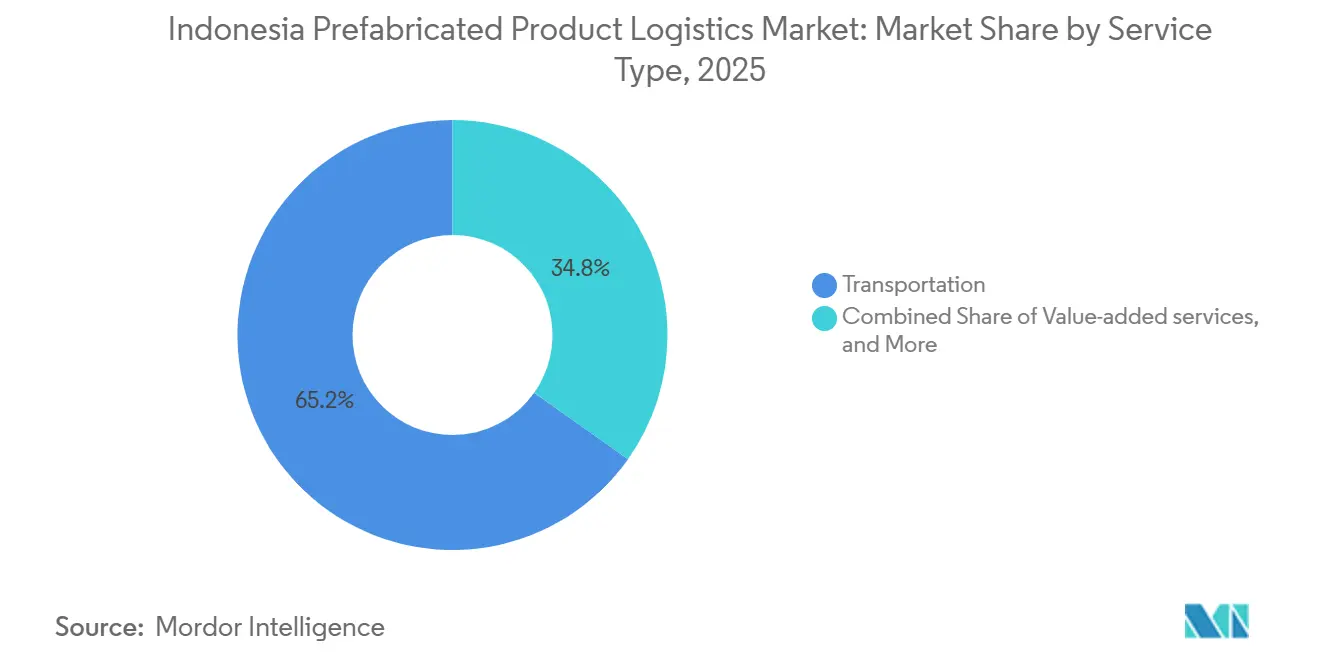
Transportation held 65.20% of the Indonesia prefabricated product logistics market share in 2025 and remained the revenue base for the sector. Sea and inland waterway services carried modules between islands through roll-on-roll-off and flat-rack vessels. These routes had limited alternatives across Indonesia’s archipelago. Road transport connected Java factories with ports and linked ports with inland project sites. Zero over-dimension overload rules encouraged dedicated flat-bed fleets designed for prefabricated loads.
Value-added services were the fastest-growing service segment at a 9.60% CAGR from 2026 to 2031. Warehousing and storage expanded through bonded logistics centers that staged modules before phased site delivery. Clients sought sequence-sorted delivery, site assembly coordination, and inventory visibility alongside transport. One notable example was CKB Logistics, which reported a 93.8% on-time delivery rate in 2024. PT Transcon Indonesia provided photographic documentation and real-time inventory visibility across 8 branches in 5 cities.



By Product Type: Modular Buildings Hold the Volume Lead While Panelized Systems Accelerate
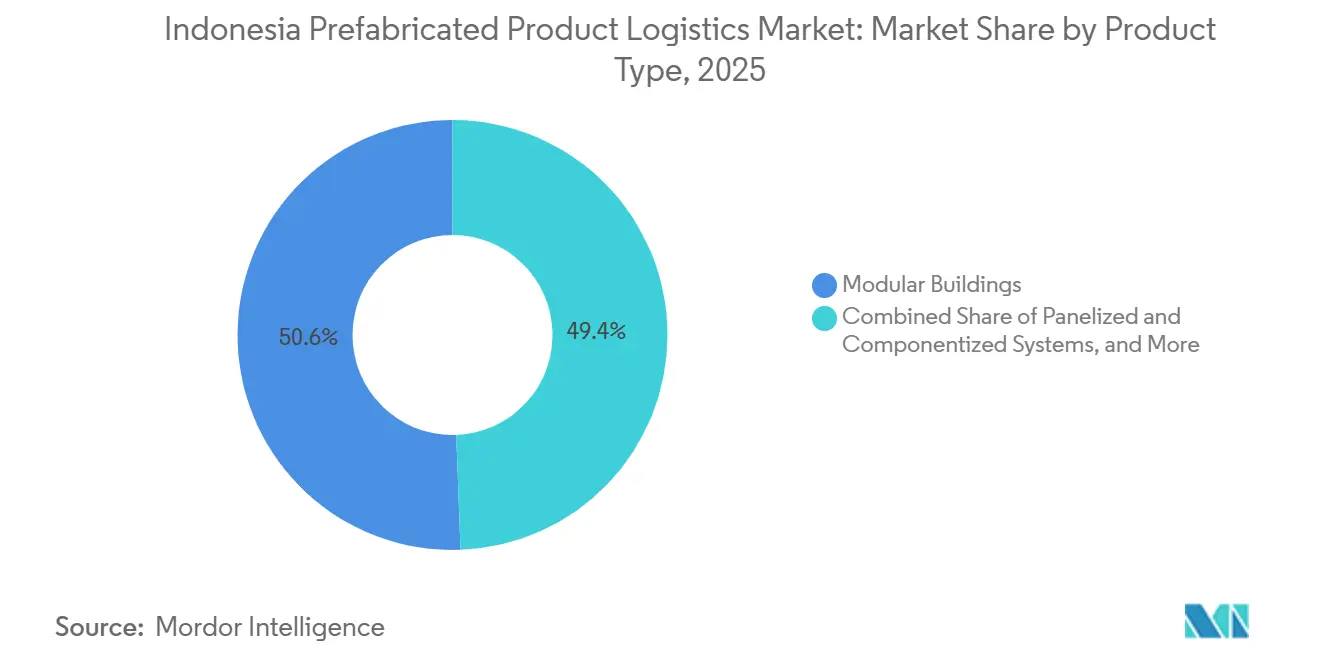
Modular buildings held 50.60% of the Indonesia prefabricated product logistics market size in 2025. Worker camps at mining, energy, and IKN sites supported this position. These shipments required specialized handling and generated higher revenue per movement than standard freight. Other prefab types include pre-stressed concrete beams, precast slabs, and steel structure kits for road and bridge work.
Panelized and componentized systems recorded the fastest projected CAGR at 9.40% from 2026 to 2031. Panels were stackable and compatible with containers. The 3 Million Homes program supported demand for transportable panels used by housing developers. In July 2026, a 1,200-tonne fabricated structural steel shipment left Dalian for Surabaya in 48 containers for an 18,000 square meter prefabricated cold-storage logistics park in East Java. Revised prefabrication standards and the SMART digital certification system affected product eligibility in public housing work. Government Regulation No. 16/2021 added green-building compliance for public structures above 5,000 square meters.
By Application: Residential Buildings Lead Demand While Commercial Buildings Deliver Faster Growth
Residential buildings held 54.70% of the Indonesia prefabricated product logistics market share in 2025. A 9.9 million-unit housing backlog and the 3 Million Homes program supported regular deliveries across distributed locations. Residential work favored frequent, smaller consignments and multi-drop delivery sequencing. This service pattern rewarded broad networks rather than only high-capacity hauling.
Commercial buildings recorded the fastest projected CAGR at 9.15% from 2026 to 2031. Data centers, hospitality facilities, and warehouses in Batam and Sulawesi special economic zones supported commercial demand. Other applications included industrial facilities, modular hospitals, schools, and disaster-relief structures. The Ministry of Public Works funded rehabilitation for 900 public schools and 1,000 religious schools in June 2026. Green-building rules increased the need for documented material traceability on large public projects. This application mix reduced reliance on a single type of construction project.
Geography Analysis
Java remained the origin hub for Indonesia prefabricated product logistics market flows because it housed the main manufacturing base. CKB Logistics expanded its network in 2025 with a 17,640 square meter warehouse in Cakung, North Jakarta, and facilities in Medan and Mataram. Tanjung Priok and Patimban strengthened Java’s role as a launch point for outer-island cargo. NYK Line’s Hyperion Leader made the first pure car and truck carrier call at Patimban’s automobile terminal in April 2026. Surabaya’s Tanjung Perak Port handled the 1,200-tonne prefabricated steel shipment for the East Java cold-storage project.
Kalimantan formed the largest growth corridor for the Indonesia prefabricated product logistics market. IKN construction and mining, nickel, coal, and liquefied natural gas projects supported freight demand. The Semayang Satellite Terminal in Balikpapan recorded 328 ship visits in 2025, a 33.33% year-over-year increase. Sarens completed a 103-tonne deodorizer lift at Interport Balikpapan in December 2025. Terminal Kijing received 4 harbor mobile cranes in 2025 to manage rising non-container cargo.
Sumatra and Eastern Indonesia held a smaller but strategically important position in the Indonesia prefabricated product logistics market. Samudera Indonesia launched a weekly Kuala Tanjung to Singapore liner service in May 2026, linking North Sumatra with regional transshipment hubs. Papua faced the highest freight costs but had urgent demand from the BP Tangguh Ubadari project. Makassar New Port used 300,000 of its 2 million TEU annual capacity, and the government sought to develop it as an export hub. This capacity created room for more eastern cargo activity.
Competitive Landscape
The Indonesia prefabricated product logistics market remained moderately fragmented, with no single operator leading every service mode and geography. Large providers competed through network coverage, capital investment, and digital shipment tools. Smaller specialists focused on corridor knowledge, heavy cargo handling, and project-specific certifications. Samudera Indonesia set USD 200 million in 2026 capital expenditure before revising the amount to USD 300 million for vessel procurement, Patimban development, and the Madura shipyard. This investment supported a more integrated offer from port activity to project delivery.
CKB Logistics held its Supply Chain Forum 2026 in June with Supply Chain Indonesia and the Directorate General of Customs and Excise. The event brought together logistics and regulatory stakeholders around resilient and digitalized supply chains. Samudera Indonesia also deployed hundreds of Internet of Things-enabled vehicles in 2026 for real-time fleet tracking. PT Transcon Indonesia used a software-based bonded logistics system with 24-hour inventory visibility and photographic documentation. These systems supported clients who needed traceable delivery records for green-building and carbon-related requirements.
Opportunities remained in route engineering for oversized cargo outside Java and bonded staging hubs near outer-island projects. PT Puninar Saranaraya received the Second-Best Bonded Logistics Center recognition at the Bea Cukai Marunda Awards 2026 for 2025 performance and regulatory compliance. Emerging providers included drone-cargo firms for components below 500 kilograms in roadless areas. Micro-factory operators also combined production and local logistics within a single contract. The Indonesia prefabricated product logistics market has space for companies that may solve these location-specific operating constraints.
Indonesia Prefabricated Product Logistics Industry Leaders
-
LV Logistics Group
-
Samudera Indonesia Group
-
PT ABM Investama Tbk (Including CKB Logistics)
-
Kamadjaja Group
-
PT Transcon Indonesia
- *Disclaimer: Major Players sorted in no particular order

Recent Industry Developments
- August 2026: Samudera Indonesia deployed 100 new tractor-head trucks as part of its fleet modernization initiative, expanding its land logistics capacity to meet rising domestic distribution demand across Indonesia's industrializing corridors.
- May 2026: PT Alfa Trans Raya, a subsidiary of CKB Logistics, launched the container vessel “Alfa Trans Tiga” at Tanjung Emas Port in Semarang. The vessel was the company’s largest-capacity vessel to date and targeted logistics services for the mining, energy, and mineral-processing industries in remote destinations across Eastern Indonesia.
- April 2026: NYK Line’s pure car and truck carrier (PCTC), Hyperion Leader, made its first-ever call at the automobile terminal of Patimban Port. NYK verified the call in collaboration with PT Patimban International Car Terminal, in which it held a 25% equity stake. This development established a new logistics gateway near Jakarta for vehicles and oversized cargo.
- February 2026: Samudera Indonesia allocated USD 200 million for capital expenditure in 2026, later revising the amount to USD 300 million. The investment covered the acquisition of three to five new container vessels and two chemical tankers, the development of the Patimban container terminal, and the construction of the Madura shipyard.


Indonesia Prefabricated Product Logistics Market Report Scope
| Transportation | Road |
| Rail | |
| Air | |
| Sea and Inland Waterways | |
| Warehousing and Storage | |
| Value-Added Services |
| Modular Buildings |
| Panelized and Componentized Systems |
| Other Prefab Types |
| Residential Buildings |
| Commercial Buildings |
| Others |
| By Service | Transportation | Road |
| Rail | ||
| Air | ||
| Sea and Inland Waterways | ||
| Warehousing and Storage | ||
| Value-Added Services | ||
| By Product Type | Modular Buildings | |
| Panelized and Componentized Systems | ||
| Other Prefab Types | ||
| By Application | Residential Buildings | |
| Commercial Buildings | ||
| Others |


Key Questions Answered in the Report
What was the value of Indonesia prefabricated product logistics in 2026?
The sector is valued at USD 395.07 million in 2026 and is estimated to reach USD 570.17 million by 2031.
What growth rate is projected through 2031?
The Indonesia prefabricated product logistics market registers a CAGR of 7.61% from 2026 to 2031.
Which service held the largest share in 2025?
Transportation held 65.20% of revenue in 2025, supported by indispensable inter-island sea and inland waterway movements.
Which product type grew fastest through 2031?
Panelized and componentized systems recorded the highest projected CAGR at 9.40%, supported by stackable and container-compatible designs.
What application led demand in 2025?
Residential buildings held 54.70% of demand in 2025, supported by housing needs and distributed delivery requirements.
What factors constrained inter-island module transport?
Higher freight and handling costs, provincial permits, and limited heavy-lift readiness constrained shipments, particularly on outer islands.
Page last updated on:





