
Indonesia Less Than-Truck-Load Market Size and Share
Market Overview
| Study Period | 2020 - 2031 |
|---|---|
| Forecast Data Period | 2026 - 2031 |
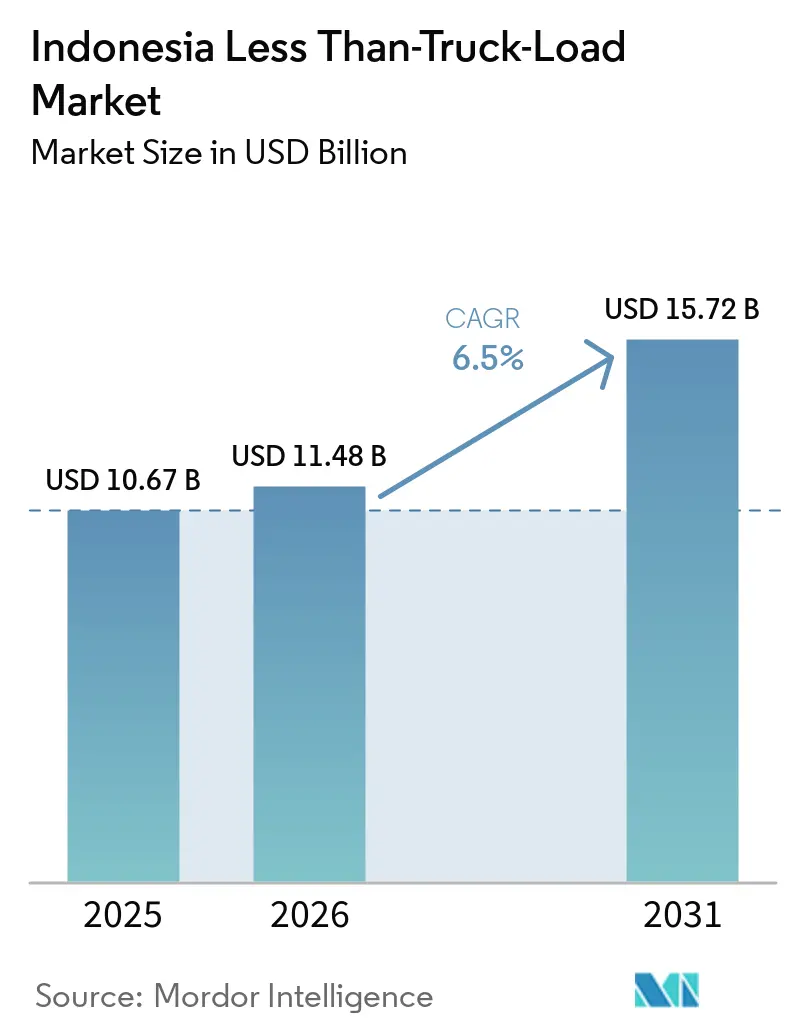
| Base Year Market Size (2025) | USD 10.67 Billion |
| Market Size (2026) | USD 11.48 Billion |
| Market Size (2031) | USD 15.72 Billion |
| Growth Rate (2026 - 2031) | 6.50 % |
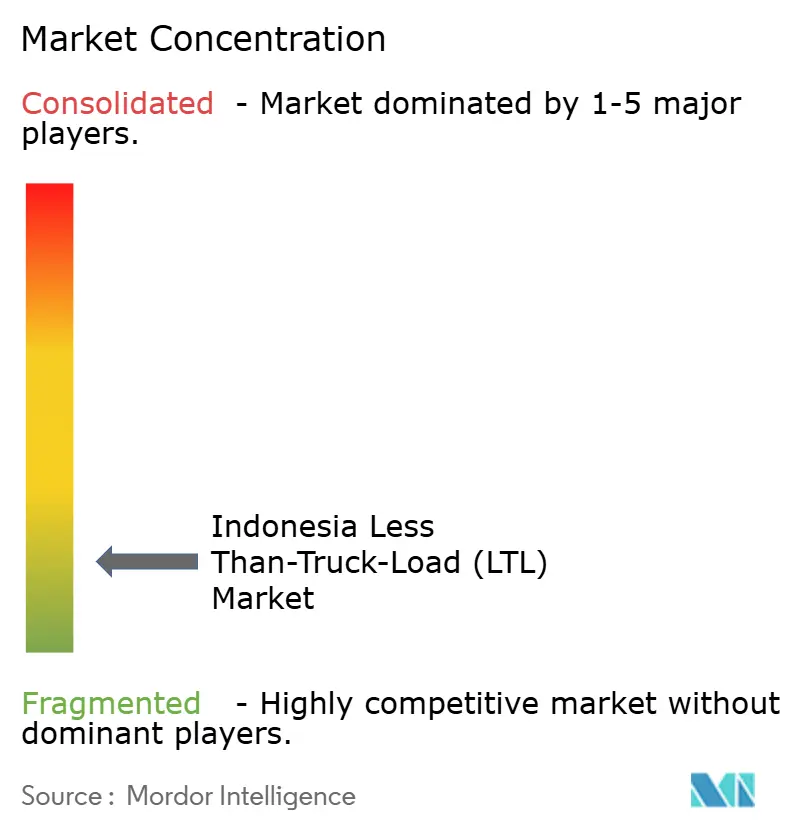
| Market Concentration | Low |
Major Players *Disclaimer: Major Players sorted in no particular order Image © Mordor Intelligence. Reuse requires attribution under CC BY 4.0. | |
Indonesia Less Than-Truck-Load Market Analysis by Mordor Intelligence
The Indonesia less than-truck-load (LTL) market size was valued at USD 10.67 billion in 2025, and is estimated to grow from USD 11.48 billion in 2026 to reach USD 15.72 billion by 2031, at a CAGR of 6.50% during the forecast period (2026-2031).
E-commerce orders, smaller shipment sizes, and regular replenishment activity across retail and manufacturing supply chains support demand. Inter-island trade also keeps consolidation services important because freight moves through road, port, and ferry connections. Transport and warehousing output expanded 8.04% year-over-year in the first quarter of 2026, which supported continued freight activity across Indonesia. Digital freight operators are improving load matching and route planning, which raises competitive pressure on carriers that depend on traditional networks. Fleet modernization, cold-chain compliance, and reliable documentation are becoming important ways for operators to protect service quality and win higher-value freight.
Key Report Takeaways
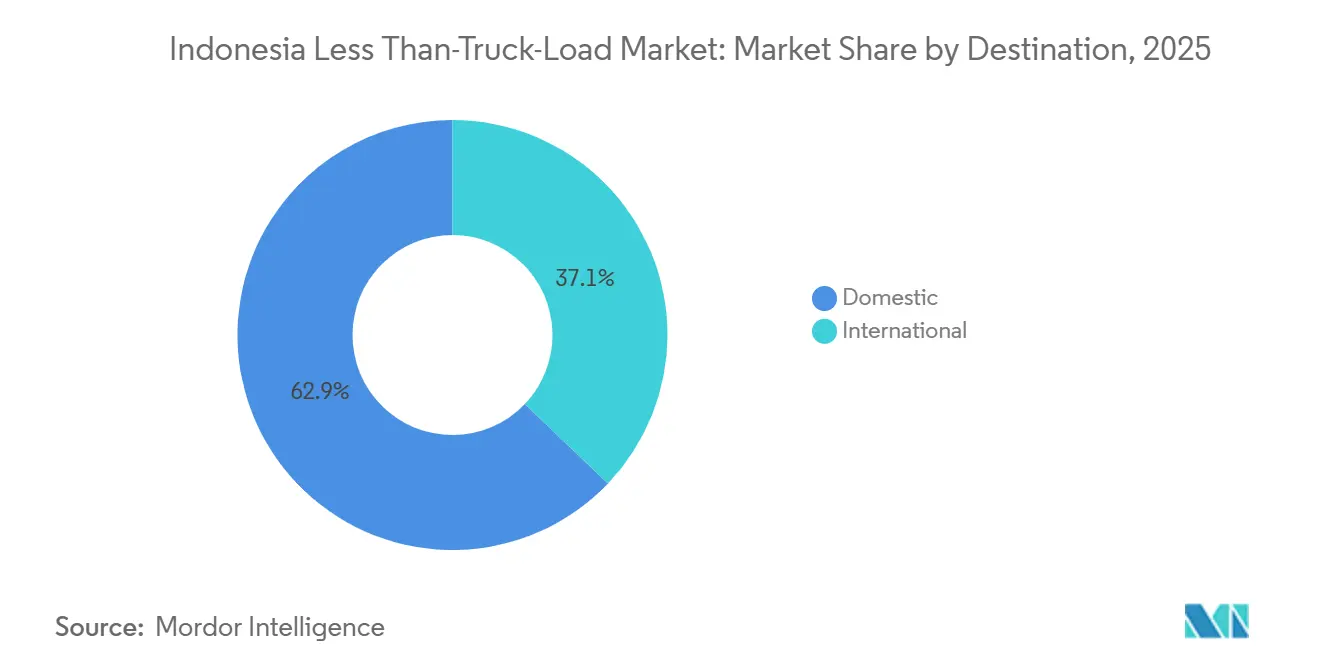
- By destination, domestic services held 62.87% of the Indonesia less than-truck-load (LTL) market share in 2025, while international services are forecast to grow at a 9.39% CAGR through 2031.
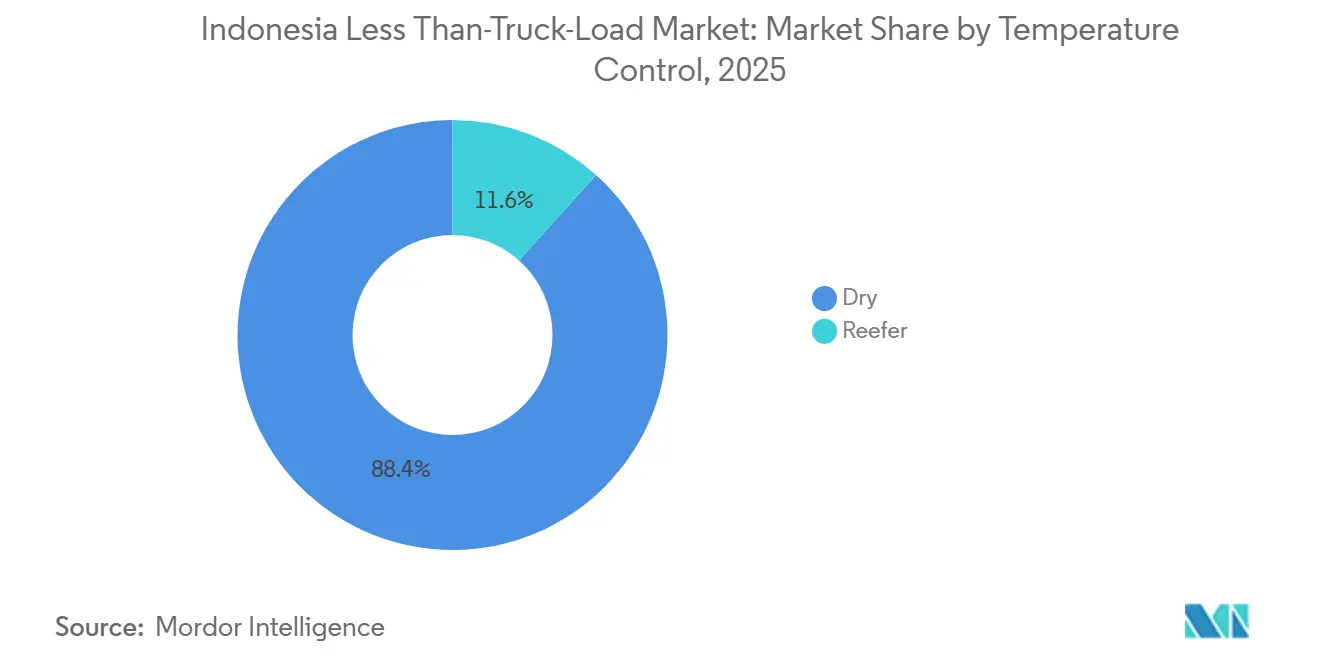
- By temperature control, dry services accounted for 88.36% of the Indonesia less than-truck-load (LTL) market size in 2025, while reefer services are forecast to expand at a 7.68% CAGR through 2031.
- By end-user industry, wholesale and retail trade held 34.25% of the Indonesia less than-truck-load (LTL) market share in 2025, while pharmaceuticals and biologics are forecast to grow at an 8.21% CAGR through 2031.
- By region, Java accounted for 58.64% of the Indonesia less than-truck-load (LTL) market size in 2025, while Sulawesi is forecast to grow at an 7.84% CAGR through 2031.
Note: Market size and forecast figures in this report are generated using Mordor Intelligence’s proprietary estimation framework, updated with the latest available data and insights as of January 2026.
Indonesia Less Than-Truck-Load Market Trends and Insights
Drivers Impact Analysis*
| Driver | (~) % Impact on CAGR Forecast | Geographic Relevance | Impact Timeline |
|---|---|---|---|
| E-Commerce And SME Shipment Density | +1.5% | Java urban centers, Sumatra tier-2 cities, and national marketplace hubs | Short term (≤ 2 years) |
| Digital Freight Aggregation And Route Optimization | +1% | National, with a concentration in Greater Jakarta and the Java corridor | Short term (≤ 2 years) |
| Domestic Inter-Island Distribution Requirements | +0.8% | National, with the largest incremental gains in Sulawesi, Kalimantan, and Eastern Indonesia | Medium term (2-4 years) |
| Pharmaceutical, Food, And Seafood Cold-Chain Expansion | +0.7% | Java, Eastern Indonesia, and export ports in Sulawesi and Sumatra | Medium term (2-4 years) |
| National Logistics Ecosystem And Digital Documentation | +0.5% | National, initially at 55 ports and 12 airports under the DJBC deployment | Medium term (2-4 years) |
| Zero-ODOL Fleet Formalization And Legal Payload Efficiency | +0.6% | National, with priority on the Trans-Java and Trans-Sumatra corridors | Long term (≥ 4 years) |
| Source: Mordor Intelligence | |||
E-Commerce And SME Shipment Density
Indonesia’s e-commerce economy has shifted freight demand from periodic bulk movements toward frequent consolidated shipments. This change favors Indonesia less than-truck-load (LTL) market because many merchants do not have enough volume for a dedicated truck. Fashion sellers, FMCG distributors, and smaller businesses need regular replenishment between urban centers and secondary cities. Short promotion cycles can shorten restocking windows to 24 to 72 hours, making predictable consolidated transport more valuable. BPS reported 8.04% year-over-year growth in transport and warehousing during the first quarter of 2026, which was consistent with higher freight activity. Operators with dense pickup and delivery networks are better placed to serve this recurring volume.
Digital Freight Aggregation And Dynamic Route Optimization
Digital platforms combine shipments from different customers and assign capacity across available routes. This operating model helps improve truck utilization and can reduce empty travel between freight hubs. The Indonesia less than-truck-load (LTL) market is therefore becoming more competitive for asset-only carriers that have limited visibility over load matching. Kargo Technologies has linked electric vehicle deployment with real-time operational visibility through its Kargo Nexus platform, illustrating the link between fleet technology and dispatch decisions. Lower operating costs can make price competition more intense when platforms use additional volume to improve utilization. Carriers that do not modernize dispatch tools may find it harder to retain small and medium-sized shippers that prioritize predictable pricing and shipment visibility.
Domestic Inter-Island Distribution Requirements
Indonesia’s geography makes consolidation central to domestic freight operations. Transfers between islands require connections between trucks, ports, and ferries, creating repeated opportunities to combine smaller loads. The Sea Toll program connects 115 ports through 39 active routes, while PT Pelni carried 13,142 TEUs of logistics cargo during 2025. A hub-and-spoke design can reduce operational costs by 16% to 43% and subsidy spending by 10% to 25% per round voyage, according to a 2025 scientific study[1]“Hub-and-Spoke Network Design to Optimize Government Subsidy Costs for Maritime Transportation in Indonesia,” Siber Journal of Transportation and Logistics, doi.org. These conditions support feeder services that connect Java gateways with Sumatra, Kalimantan, Sulawesi, and eastern islands. The Indonesia less than-truck-load (LTL) market can benefit as Makassar develops alongside Tanjung Priok and Surabaya as an export hub.
Pharmaceutical, Food, And Seafood Cold-Chain Expansion
Pharmaceutical distribution rules, health-care coverage, and seafood traceability requirements support reefer demand. The JKN program covers 99.34% of Indonesia’s population and creates a broad need for reliable medicine replenishment across 38 provinces. Pharmaceutical distribution requires controlled conditions and documented handling across each handoff. Indonesia’s national traceability system has been recognized as the world’s first system compliant with the Global Dialogue on Seafood Traceability standard[2]Global Dialogue on Seafood Traceability, “Indonesia Confirms World’s First GDST-Compliant National Traceability System,” Global Dialogue on Seafood Traceability, thegdst.org. This requirement encourages more formal freight practices for seafood and related products. The Indonesia less than-truck-load (LTL) market has a clear opportunity where operators can provide temperature control, reliable records, and coverage beyond Java.
Restraints Impact Analysis*
| Restraint | (~) % Impact on CAGR Forecast | Geographic Relevance | Impact Timeline |
|---|---|---|---|
| Port Gate Congestion And Ferry-Interface Delays | -0.8% | Tanjung Priok, Surabaya, and Java-to-outer-island intermodal routes | Short term (≤ 2 years) |
| Outer-Island Infrastructure And Power-Reliability Gaps | -0.7% | Eastern Indonesia, Papua, Maluku, and Nusa Tenggara | Long term (≥ 4 years) |
| Cargo Theft, Insurance Costs, And Security Surcharges | -0.5% | National, especially Java interprovincial and remote corridors | Short term (≤ 2 years) |
| Zero-ODOL Compliance Cost And Fleet Replacement Pressure | -0.6% | National, with the strongest effect on Java's heavy-industry corridors | Medium term (2-4 years) |
| Source: Mordor Intelligence | |||
Port Gate Congestion And Ferry-Interface Delays
Tanjung Priok experienced major congestion in April 2025 when three large cargo vessels arrived at the terminal at the same time. The surge brought more than 4,000 TEUs against a daily average of 2,000 to 2,500 TEUs, and trucks queued for 8 kilometers across North Jakarta for 2 days. LTL freight is especially exposed because consolidated loads can incur additional dwell time at gates and transfer points. Post-Eid freight restrictions also created backlogs when trucking activity restarted. Poor coordination, gate operations, and customs processing can disrupt schedules even when carriers have sufficient truck capacity. Improved rail links and buffer areas would reduce these delays. Still, the Indonesia less than-truck-load (LTL) market will remain sensitive to port access until those constraints ease.
Outer-Island Infrastructure And Power-Reliability Gaps
Only 58.7% of sea toll ports met basic infrastructure criteria in 2025, and readiness in Eastern Indonesia was 32%. These gaps make operations harder in Papua, Maluku, and Nusa Tenggara, where facilities and power supplies can be less dependable. Reefer services face the strongest constraint because pharmaceuticals and seafood require continuous temperature control. Logistics costs between Java and outer islands also remain higher than intra-Java costs, which can limit participation by smaller shippers. The current subsidy structure does not always encourage private investment in outer-island port upgrades. Indonesia less than-truck-load (LTL) market will need dependable infrastructure and power supply to extend formal cold-chain services to these locations.
*Our forecasts treat driver/restraint impacts as directional, not additive. The impact forecasts reflect baseline growth, mix effects, and variable interactions.
Segment Analysis
By Destination: Domestic Volume Anchors Revenue, International Corridors Accelerate
Domestic services held 62.87% of the Indonesia less than-truck-load (LTL) market share in 2025, while international services are forecast to grow at a 9.39% CAGR through 2031. Domestic freight benefits from regular FMCG redistribution and replenishment between Java production centers and consumer markets. Marketplace-linked sellers also use consolidated services to ship smaller orders across multiple cities. The Trans-Java corridor supports more predictable schedules on high-volume routes. This network advantage helps operators coordinate pickups, line-haul movements, and deliveries without relying on a full truckload for each customer.
International services are growing faster because smaller exporters increasingly need cross-border freight options. Digital platforms help these shippers combine mixed products and ship goods that do not fill a container. The Indonesia less than-truck-load (LTL) market size for international routes is supported by demand from small and medium-sized exporters using time-sensitive freight. Providers with bonded warehouses and customs documentation can earn more per shipment than firms focused only on domestic delivery. Growth in cross-border freight can also strengthen domestic networks because the same platforms aggregate both types of loads.



By Temperature Control: Dry Infrastructure Dominates, Reefer Investment Scales
Dry LTL held 88.36% of Indonesia less than-truck-load (LTL) market size in 2025, while reefer LTL is projected to grow at a 7.68% CAGR through 2031. Dry services carry FMCG, construction materials, textiles, electronics, and other goods that move through Indonesia’s road network. This breadth of goods gives dry operators a large base of recurring freight volume. The Zero-ODOL policy, which targets full enforcement from January 2027, encourages investment in standard-dimension vehicles[3]ANTARA News, “Zero Overloaded Vehicle Policy to Start in January 2027: Minister,” ANTARA News, antaranews.com. Compliant fleets can use toll roads and meet roadside inspection requirements with fewer disruptions.
Reefer services are expanding because drug distribution and seafood supply chains need reliable temperature control. Indonesia less than-truck-load (LTL) market share held by dry services shows the current scale gap, yet it also points to room for specialized reefer capacity. Good Distribution Practice requirements place greater value on documented custody and consistent temperature control. This favors operators with systems that maintain visibility at every transfer point. Cold-chain investment outside Java could improve service access for health-care providers and food exporters in less-served areas.
By End-User Industry: Retail Commands Share, Pharma Defines the Growth Trajectory
Wholesale and retail trade accounted for 34.25% of Indonesia less than-truck-load (LTL) market share in 2025, while pharmaceuticals and biologics are expected to grow at an 8.21% CAGR through 2031. Retail demand is supported by frequent FMCG replenishment and marketplace fulfillment. Modern retailers need transport services that can serve stores and distribution points on regular schedules. Their volumes are often too varied to move efficiently as full truckloads. The Indonesia less than-truck-load (LTL) market, therefore, depends heavily on network density, consistent delivery windows, and regular consolidation.
Pharmaceutical and biologics freight is rising as health coverage broadens and distribution standards become more demanding. Supply chains serving 38 provinces need controlled conditions, reliable documentation, and careful handling. Manufacturing is also a major source of demand along the Trans-Java industrial corridor. Agriculture, fishing, forestry, construction, and mining create more specialized needs in resource-producing regions. These end users broaden the Indonesian LTL market beyond retail while requiring carriers to tailor service capabilities to cargo type and location.
Geography Analysis
Java, including Jakarta and the BOD area, held 58.64% of 2025 revenue because it has the country’s largest concentration of manufacturing sites, distribution hubs, pharmaceutical warehouses, and modern retail facilities. The region’s proximity to Tanjung Priok also supports regular freight consolidation and port access. DHL Express invested EUR 9 million (USD 9.8 million) in a 10,000-m² Surabaya Gateway and Service Centre in December 2025. East Java is becoming more important as manufacturing investment shifts beyond Greater Jakarta. The Indonesia less than-truck-load (LTL) market remains closely linked to Java because the corridor combines freight density, infrastructure, and the largest base of shippers.
Sulawesi is forecast to grow at a 7.84% CAGR through 2031, the highest rate among the regional segments. Nickel mining and processing support inbound equipment movements and outbound mineral cargo. Makassar is being developed as an export hub alongside Tanjung Priok and Surabaya. TPK Bitung handled 74,928 TEUs in the first quarter of 2025, up 21.21% year-over-year, while Pelindo Regional 4 processed 35.63 million tons in the first half of 2025. Kalimantan also generates demand from coal logistics and materials moving to the Nusantara capital project.
Sumatra draws steady freight demand from palm oil, rubber, automotive, and inter-island supply chains. Bali and Nusa Tenggara need consolidated transport for hospitality supplies, FMCG imports, and artisanal exports. Papua and Maluku are smaller markets with limited formal coverage. Their 32% port-readiness level in Eastern Indonesia makes reefer operations particularly difficult. Indonesia less than-truck-load (LTL) market share concentrated in Java does not remove the need for service expansion in eastern corridors. Health-care distribution and institutional freight demand could help formalize these networks when operators invest in compliant facilities.
Competitive Landscape
The Indonesia less than-truck-load (LTL) market is fragmented because domestic carriers retain volume through broad geographic coverage, while international operators compete in premium and regulated freight. J&T Cargo has built a large domestic network with more than 8,000 vehicles, more than 100 gateway facilities, and more than 4,500 partners across Indonesia. Network scale helps domestic firms handle high-frequency delivery requirements across the main consumption corridors. It also helps them retain freight that depends on regular pickup and delivery schedules.
Digital platforms are changing competition by linking pricing, load aggregation, route planning, and shipment visibility. Kargo Technologies has used electric vehicle deployment and real-time operational systems to pursue lower operating costs in Jakarta. Waresix expanded its capital base in early 2026, and its PT BSA Logistics Indonesia subsidiary was listed on the Indonesian Stock Exchange. SiCepat Ekspres launched SiCepat Logistik in July 2026 to serve business-to-business first-mile and middle-mile operations. These moves bring express and freight operators into closer competition for consolidated shipments, particularly where customers value technology and speed.
International operators differentiate through documentation, health-care compliance, and cross-border network access. DHL Express opened its Surabaya Gateway and Service Centre in December 2025 to connect East Java exporters with its South Asia Hub in Singapore[4]DHL Group, “DHL Commits to Helping Indonesia Expand Its Fast-Growing Sectors,” DHL Group, dhl.com. DSV launched an electric truck for commercial urban freight in Jakarta in April 2026. Operators also need to prepare for Zero-ODOL enforcement, which will increase the importance of compliant vehicles and fleet management. The Indonesia less than-truck-load (LTL) market offers the strongest opening in compliant reefer services outside Java, where infrastructure and service capacity remain limited.
Indonesia Less Than-Truck-Load Industry Leaders
J&T Cargo Indonesia
Indah Logistik Cargo
JNE Express
DHL Group
PT Dunia Express Transindo (DUNEX Logistics)
- *Disclaimer: Major Players sorted in no particular order

Recent Industry Developments
- July 2026: SiCepat Ekspres launched SiCepat Logistik, a business-to-business logistics service for first-mile and middle-mile supply-chain and distribution activity. The service uses the company’s network of 470 hubs and 1,700 vehicles.
- April 2026: DSV officially launched its first electric truck for commercial urban freight operations in Indonesia. The truck is intended for Jakarta deliveries and carries a larger payload than DSV’s electric vans.
- December 2025: DHL Express inaugurated the Surabaya Gateway and Service Centre, a purpose-built 10,000-m² facility backed by more than EUR 9 million (USD 9.8 million) in investment. The facility connects East Java exporters of textiles, furniture, leather, and consumer goods with DHL’s South Asia Hub in Singapore through dedicated flights.
- December 2025: Kargo Technologies signed MOUs with commercial EV OEMs Foton, JAC, Wuling, and VKTR for vehicle supply to support its fleet electrification roadmap, with financing structured through HSBC, Indomobil Finance, and Chailease.


Indonesia Less Than-Truck-Load Market Report Scope
| Domestic |
| International |
| Dry |
| Reefer |
| Agriculture, Fishing, and Forestry |
| Construction |
| Manufacturing |
| Oil and Gas, Mining and Quarrying |
| Wholesale and Retail Trade |
| Others |
| Java (Jakarta & BOD) |
| Sumatra |
| Kalimantan |
| Sulawesi |
| Bali and Nusa Tenggara |
| Papua Region and Maluku Islands |
| By Destination | Domestic |
| International | |
| By Temperature Control | Dry |
| Reefer | |
| By End-User Industry | Agriculture, Fishing, and Forestry |
| Construction | |
| Manufacturing | |
| Oil and Gas, Mining and Quarrying | |
| Wholesale and Retail Trade | |
| Others | |
| By Region | Java (Jakarta & BOD) |
| Sumatra | |
| Kalimantan | |
| Sulawesi | |
| Bali and Nusa Tenggara | |
| Papua Region and Maluku Islands |


Key Questions Answered in the Report
What is the projected growth rate for Indonesia less than-truck-load (LTL) services?
The sector is registering at a 6.50% CAGR from 2026 to 2031, increasing from USD 11.48 billion in 2026 to USD 15.72 billion by 2031.
Which destination category is growing the fastest in Indonesia, in less-than-truck-load (LTL) services?
International services are forecast to record a 9.39% CAGR through 2031, supported by small and medium-sized exporter demand and cross-border freight platforms.
Why are dry freight services the leading temperature-control category?
Dry services held 88.36% of 2025 revenue because they carry a broad range of ambient goods, including FMCG, construction materials, textiles, and electronics.
Which end users create the strongest demand for LTL freight in Indonesia?
Wholesale and retail trade held 34.25% of 2025 revenue, while pharmaceuticals and biologics are projected to grow at an 8.21% CAGR through 2031.
Which Indonesian region offers the fastest freight growth opportunity?
Sulawesi is forecast to grow at a 7.84% CAGR through 2031, supported by nickel supply chains and Makassar’s development as an export hub.
What operational challenges affect Indonesian LTL carriers?
Port congestion, outer-island infrastructure gaps, power reliability issues, security costs, and preparation for Zero-ODOL enforcement can disrupt schedules and raise operating costs.
Page last updated on:


 Your data is secure and never sold or shared.


