
Indonesia Freight Forwarding Market Size and Share
Market Overview
| Study Period | 2020 - 2031 |
|---|---|
| Forecast Data Period | 2026 - 2031 |
| Base Year Market Size (2025) | USD 14.27 Billion |
| Market Size (2026) | USD 15.23 Billion |
| Market Size (2031) | USD 20.14 Billion |
| Growth Rate (2026 - 2031) | 5.76 % |
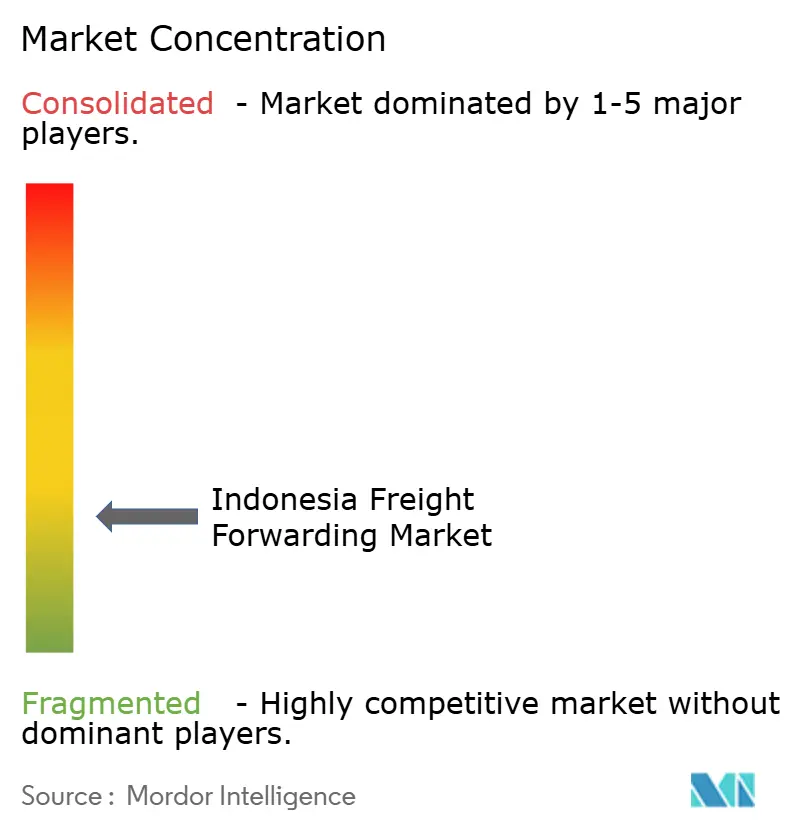
| Market Concentration | Low |
Major Players *Disclaimer: Major Players sorted in no particular order Image © Mordor Intelligence. Reuse requires attribution under CC BY 4.0. | |
Indonesia Freight Forwarding Market Analysis by Mordor Intelligence
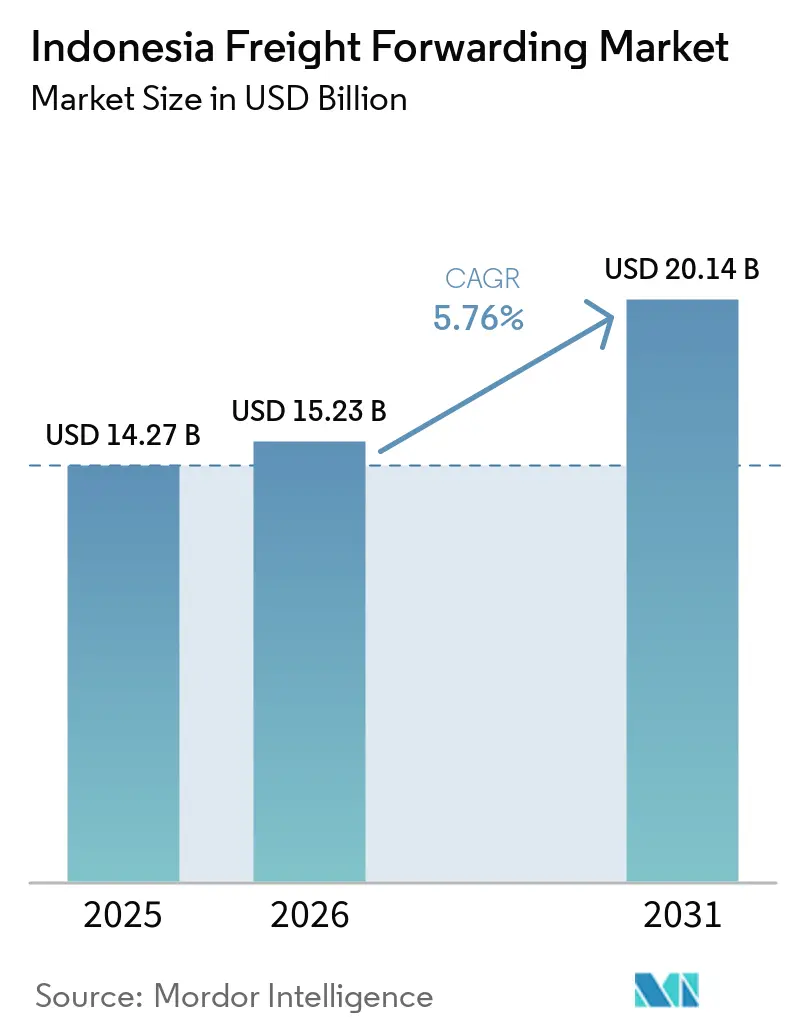
The Indonesia freight forwarding market size was valued at USD 14.27 billion in 2025, and is estimated to grow from USD 15.23 billion in 2026 to reach USD 20.14 billion by 2031, at a CAGR of 5.76% during the forecast period (2026-2031).
The country’s island geography remains central to trade flows between production areas, ports, airports, and destination markets. Manufacturing exports reached USD 75.57 billion in April 2026, while total exports reached USD 92.15 billion, supporting demand for cross-border logistics services. Industrial downstreaming is also increasing demand for services that can handle equipment, semi-finished materials, and managed documentation across new supply routes. Digital customs and terminal systems are changing how providers compete, since clients increasingly expect accurate shipment status and faster document processing. Infrastructure additions outside Java may widen opportunities, although port congestion, licensing uncertainty, and uneven system connectivity still affect service reliability.
Key Report Takeaways
- By mode of transport, ocean freight forwarding held 72.86% of Indonesia freight forwarding market size in 2025, while air freight forwarding is forecast to register at a 7.98% CAGR through 2031.
- By enterprise size, large enterprises held 68.43% of Indonesia freight forwarding market share in 2025, while small and medium enterprises are forecast to register at a 9.56% CAGR through 2031.
- By the forwarder model, traditional asset-light forwarders held 62.68% of Indonesia freight forwarding market size in 2025, while digital-first or online platforms are forecast to register at a 12.84% CAGR through 2031.
- By end-user industry, industrial and manufacturing held 31.82% of Indonesia freight forwarding market share in 2025, while retail and e-commerce are forecast to register at a 10.42% CAGR through 2031.
- By cargo configuration, containerized cargo held 46.63% of Indonesia freight forwarding market size in 2025, while liquid bulk cargo is forecast to register at a 7.04% CAGR through 2031.
- By region, Java, including Jakarta and BOD, held 57.43% of Indonesia freight forwarding market share in 2025, while Sulawesi is forecast to register at an 8.79% CAGR through 2031.
Note: Market size and forecast figures in this report are generated using Mordor Intelligence’s proprietary estimation framework, updated with the latest available data and insights as of January 2026.
Indonesia Freight Forwarding Market Trends and Insights
Drivers Impact Analysis*
| Driver | (~) % Impact on CAGR Forecast | Geographic Relevance | Impact Timeline |
|---|---|---|---|
| Expansion of Export-Oriented Manufacturing | +1.2% | Global, with primary pull from ASEAN and East Asia trade corridors, particularly Java, Batam, and Kalimantan | Medium term (2-4 years) |
| Cross-Border E-Commerce and Consumer-Goods Imports | +0.9% | Java and Sumatra core markets, with spillover to Sulawesi and Bali | Short term (≤ 2 years) |
| Port, Airport, and National Logistics-Corridor Modernization | +0.8% | Java, including Tanjung Priok, Patimban, and Soekarno-Hatta, expanding to Makassar New Port and Kalimantan | Long term (≥ 4 years) |
| National Logistics Ecosystem Digitalization | +0.7% | National, with early operational gains at Tanjung Priok and rollout across 12 major ports | Medium term (2-4 years) |
| Specialized EV, Healthcare, and Cold-Chain Cargo Flows | +0.5% | Java assembly zones, Sulawesi, and Kalimantan battery-input corridors | Long term (≥ 4 years) |
| Inter-Island Consolidation Demand from Secondary Economic Hubs | +0.5% | Sulawesi, Kalimantan, Papua, and Maluku, with feeder demand from the Sumatra hinterland | Long term (≥ 4 years) |
| Source: Mordor Intelligence | |||
Expansion of Export-Oriented Manufacturing and Specialized Cargo
Indonesia’s downstreaming policy is shifting nickel, copper, and bauxite processing closer to source locations, increasing international shipments of semi-finished goods, industrial equipment, and related documentation. Manufacturing exports reached USD 75.57 billion in April 2026, with China, the United States, and India as important destinations, supporting demand for freight forwarders that coordinate supplier documents, origin certificates, and handling requirements. Smelter and refinery construction also creates project logistics demand for oversized equipment requiring breakbulk and heavy-lift capabilities. In contrast, healthcare, chemical, and EV cargo require dangerous goods handling, temperature control, compliant records, and timed delivery. Rising just-in-time manufacturing and EV component sequencing further increase service requirements, creating opportunities for providers with specialized capabilities beyond standard container brokerage.
Cross-Border E-Commerce and Consumer-Goods Imports
Smaller parcels are shifting freight mixes toward lower average shipment weights, increasing demand for consolidation, less-than-container-load, and air cargo services. The Indonesia freight forwarding market benefits as e-commerce sellers require frequent dispatches, while domestic fulfillment connects customs-controlled locations with local delivery networks. This favors providers offering integrated forwarding, storage, customs processing, and delivery handoffs, although competition is increasing from marketplaces developing in-house logistics capabilities. Demand extends beyond Java and Sumatra to markets such as Sulawesi and Bali. At the same time, digital quotation and automated documentation can improve access for smaller importers and simplify high-volume, low-value shipments. However, lower revenue per parcel requires efficient consolidation, predictable handoffs, and transparent pricing, making international-to-domestic fulfillment integration important for protecting shipment value.
Port, Airport, Corridor Modernization and Digitalization
Pelindo’s trial operations at Container Terminal 2 in Tanjung Priok began in August 2026, adding a 517.5-meter quay and initial yard capacity of 8,425 TEUs, with 2 additional quay container cranes planned for Q4 2026. Expanded capacity and the Pelindo Indonesia Network Pendulum initiative, targeting up to 20 inter-island shipping corridors, can improve vessel handling, reduce delays and empty repositioning, and strengthen cargo links across hub and feeder routes, increasing the role of ports such as Patimban, Makassar New Port, and Kuala Tanjung[1]Indonesia Shipping Gazette, “Pelindo Launches Terminal 2 to Boost Tanjung Priok Productivity,” Indonesia Shipping Gazette, indoshippinggazette.com. Meanwhile, logistics digitalization streamlined documentation and bookings, with inter-island trade reporting rolled out across 12 ports through the PAB system and Indonesia National Single Window integration in October–November 2025, while Tanjung Priok’s Terminal Booking System introduced online and offline truck booking in August 2025. These developments can improve planning, document validation, and truck-slot predictability for forwarders with integrated digital workflows.
Inter-Island Consolidation and Secondary Economic Hubs
Economic activity outside Java is increasing demand for island-to-island consolidation, particularly across Sulawesi, Kalimantan, Papua, and Maluku, where mineral processing, agricultural products, fisheries, and construction materials generate growing cargo volumes. The Indonesia freight forwarding market requires feeder services that consolidate smaller loads, manage documentation, and connect secondary ports with national distribution centers, particularly where volumes do not justify dedicated container movements. Samudera Indonesia allocated USD 300 million for 2026 for fleet expansion, a Patimban container terminal, and a shipyard in Madura, highlighting the importance of domestic network capacity, while PELNI and Meratus Line agreed to improve cargo consolidation on Sea Toll routes S4A and S4B between eastern Indonesia and Java-based hubs[2]Jakarta Weekly, “PELNI–Meratus Collaboration Aims to Improve Logistics Distribution in Eastern Indonesia,” Jakarta Weekly, jakartaweekly.com. More regular connections can support partial-load consolidation and steadier schedules, although imbalanced import and export flows can increase costs across remote routes.
Restraints Impact Analysis*
| Restraint | (~) % Impact on CAGR Forecast | Geographic Relevance | Impact Timeline |
|---|---|---|---|
| Port Congestion and Container-Yard Constraints | -0.6% | Java, including Tanjung Priok and Tanjung Emas, with spillover to Belawan in Sumatra | Short term (≤ 2 years) |
| Customs Complexity and Documentation Risk | -0.5% | National, with acute impact at Tanjung Priok and Soekarno-Hatta Cargo Terminal | Medium term (2-4 years) |
| Inter-Island Network Imbalance and Empty-Container Repositioning | -0.4% | Sulawesi, Kalimantan, Papua, and Maluku | Long term (≥ 4 years) |
| Uneven Digital-System Interoperability Across Logistics Stakeholders | -0.3% | National, with the most severe effects in secondary ports outside Java | Medium term (2-4 years) |
| Source: Mordor Intelligence | |||
Port Congestion and Customs Complexity
Tanjung Priok handles the majority of Indonesia’s imports and around 40% of national container throughput, making congestion a key risk for the Indonesia freight forwarding market through longer vessel queues, higher yard occupancy, and greater demurrage exposure[3]Indonesia Shipping Gazette, “Adaptive Gate Pass Policy Helps Ease Port Congestion, Set Future Benchmark,” Indonesia Shipping Gazette, indoshippinggazette.com. During the March–April 2026 post-Eid peak, an Integrated Logistics Flow Control Command Center coordinated terminals, trucking firms, and public agencies, but new terminal capacity did not immediately address road access and truck-scheduling constraints, requiring forwarders to factor delays into transit times and cargo release planning. Customs clearance also requires coordination across duty, excise, quarantine, BPOM, and sector-specific licensing, with manual processes increasing documentation risks. The KBLI 2025 revision is being contested by around 600 freight-forwarding and logistics companies through ALFI, creating uncertainty for integrated service models and related investments. Providers with pre-arrival document checks and strong regulatory capabilities can reduce clearance delays and penalty risks.
Network Imbalance and Uneven System Interoperability
Inter-island routes face cargo imbalances because consumer and construction goods often move from Java to eastern islands without matching containerized return flows, with empty repositioning estimated at 15%–20% of round-trip vessel operating costs on eastern routes. This can keep eastbound freight rates higher and increase logistics costs for exporters outside Java. At the same time, the Pelindo Indonesia Network Pendulum aims to improve cargo matching across hub-and-spoke services over multiple years. Digital integration is also uneven, as port, customs, carrier, broker, road transport, and consignee systems do not consistently exchange shipment data, increasing reliance on manual updates and slowing exception management. Secondary ports may face longer documentation lead times due to less mature integration, increasing the importance of providers with connected carrier, customs, and shipper systems. The Indonesia freight forwarding market may therefore see a widening gap between digitally integrated providers and firms operating through disconnected processes.
*Our forecasts treat driver/restraint impacts as directional, not additive. The impact forecasts reflect baseline growth, mix effects, and variable interactions.
Segment Analysis
By Mode of Transport: Ocean Services Lead While Air Freight Grows Faster
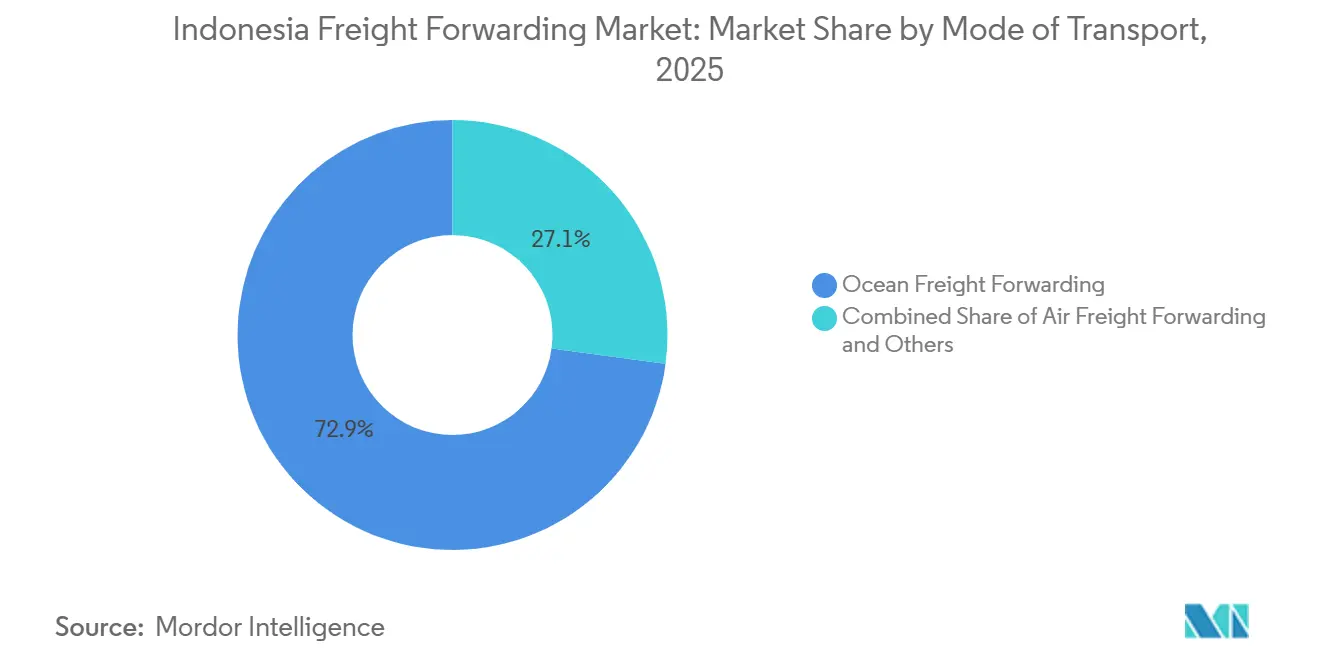
Ocean freight forwarding held 72.86% of the Indonesia freight forwarding market share in 2025, while air freight forwarding is forecast to expand at a 7.98% CAGR through 2031. The ocean freight serves containerized commodities, semi-processed products, and manufactured goods that need cost-effective long-distance transport. Full-container-load services support large shippers with regular export contracts in palm oil, coal, nickel products, garments, and related categories. Less-than-container-load movements serve suppliers that need more flexible dispatch timing and cannot fill a full container. Road forwarding connects factories, warehouses, and terminals across Java and the trans-Sumatra corridor. These first-mile and last-mile functions remain essential even when the main shipment moves by sea.
The Indonesia freight forwarding market size for air freight forwarding benefits from higher-value and time-sensitive cargo such as semiconductor components, pharmaceuticals, and fashion goods. Air services can meet short transit requirements that ocean movements cannot support. DHL Express opened an upgraded Surabaya Gateway in December 2025 and is expanding capacity at Jakarta Gateway. Rail forwarding remains limited because the freight network is concentrated on Java and faces gauge and capacity constraints. Sea-road intermodal options are becoming more relevant for palletized agricultural and fast-moving consumer goods between production areas and Java distribution centers. International Air Transport Association dangerous-goods and pharmaceutical standards are increasingly used by multinational shippers when selecting compliant air cargo services.



By Enterprise Size: Large Accounts Support Volumes While SMEs Expand
Large enterprises held 68.43% of the Indonesia freight forwarding market size in 2025, while small and medium enterprises are forecast to register at a 9.56% CAGR through 2031. Key customers include multinational manufacturers, state-owned energy companies, and large retailers that typically operate through preferred-carrier agreements. Their recurring shipment volumes support forwarders’ investments in gateways, warehousing facilities, and licensed brokerage capabilities, while strengthening negotiating power with carriers. Large customers also prioritize reliable capacity, regulatory compliance, and service continuity, supporting the role of established operators in Indonesia’s freight forwarding industry.
Online quotation, electronic bills of lading, and digital customs filing reduce the practical entry threshold for smaller exporters. Food processors, handicraft producers, electronics suppliers, and specialty chemical firms can access international freight services with smaller shipment sizes. These customers often require tracking, flexible consolidation schedules, and help with duty documentation. DSV completed its integration of DB Schenker into PT DSV Transport Indonesia in May 2026, expanding the combined company’s local service coverage[4]DSV A/S, “DSV Completes Acquisition of Schenker,” DSV, dsv.com. This broader coverage may extend enterprise-grade service options to mid-market accounts. Import licensing requirements still favor established and licensed providers over informal brokers for regulated goods.
By Forwarder Model: Traditional Networks Lead While Platforms Change Service Expectations
Traditional asset-light forwarders held 62.68% of the Indonesia freight forwarding market share in 2025, while digital-first or online platforms are forecast to register at a 12.84% CAGR through 2031. Established carrier relationships, customs brokerage licenses, and inter-island networks continue to support traditional providers. Their operational knowledge and local relationships also help manage exceptions such as cargo inspections, damage claims, and vessel diversions. As logistics processes often involve disruptions and non-standard requirements, the ability to resolve operational issues remains important. Traditional networks, therefore, continue to play a significant role alongside the growing adoption of digital freight forwarding tools.
These providers respond to demand for immediate quotes, digital documents, and shipment visibility. Their systems can reduce manual handoffs and reduce brokerage processing costs for selected shipments. This model is especially relevant for small and mid-sized accounts that need quick price comparisons and simple booking processes. Hybrid providers occupy a separate position because they own or lease selected warehouses, handling equipment, or trucking capacity. Kuehne+Nagel renewed a 4-year resupply contract for Indonesia’s largest LNG producer from its Lamongan Shorebase and continued an expansion project for the same facility. The contract shows how specialized physical capability can support recurring project logistics work.
By End-User Industry: Manufacturing Leads While Retail and E-Commerce Accelerate
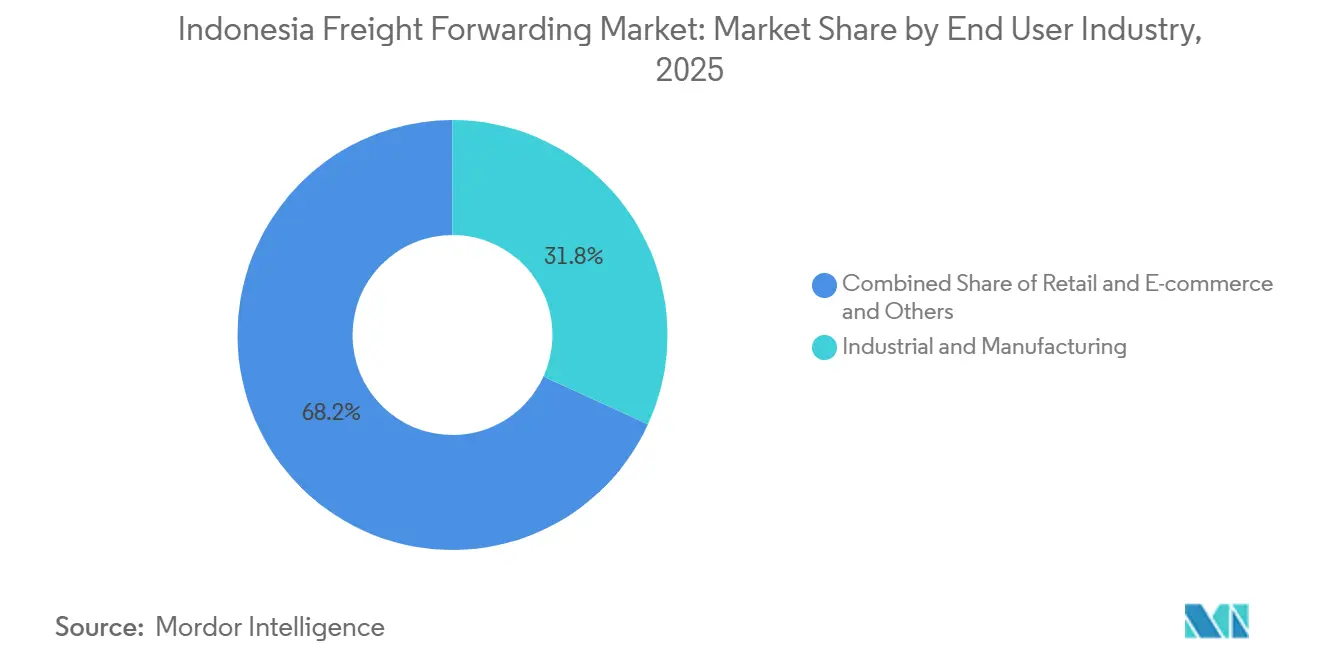
Industrial and manufacturing end users represented 31.82% of the Indonesia freight forwarding market share in 2025, while retail and e-commerce are forecast to expand at a 10.42% CAGR through 2031. Key customers include palm oil processors, textile and garment producers, footwear suppliers, automotive companies, and nickel-based manufacturers. These industries require coordinated movement of raw materials, production inputs, finished goods, and export documentation. Automotive manufacturing further increases demand for synchronized component deliveries and export bookings, while chemical inputs and semi-finished goods may require specialized handling. The scale and complexity of manufacturing shipments make these customers an important source of contracts for forwarders supporting international trade.
Faster clearance for eligible parcel shipments can support smaller online sellers that source internationally. Healthcare and pharmaceutical shipments represent a smaller revenue base but can require temperature control, Good Distribution Practice documentation, and BPOM permits. Food and beverage flows include imported ingredients and exports of processed seafood, palm oil products, and instant noodles. Chemicals, construction materials, and electronics components provide further work for the Indonesian freight forwarding market.
By Cargo Configuration: Containers Remain Central While Liquid Bulk Advances
Containerized cargo held 46.63% of the Indonesia freight forwarding market size in 2025, while liquid bulk cargo is forecast to register at a 7.04% CAGR through 2031. Standard 20-foot and 40-foot containers handle a wide range of manufactured goods and commodities, with the conversion of some bagged rice and fertilizer shipments to containers further supporting their use. Both full-container shipments and consolidation demand from diverse shippers contribute to container traffic. Containerized transport also provides flexibility for suppliers handling mixed products across different destinations, making it a key revenue segment for providers serving established trade lanes.
Chemical feedstocks, edible oils, and fuel distribution support tanker demand across the archipelago. Refinery and petrochemical activity can add specialized forwarding work because shipments require appropriate tanks, safety procedures, and documentation. Samudera Indonesia ordered 2 chemical tankers from Chinese shipyards as part of its 2026 capital expenditure program. Breakbulk and project cargo are relevant for smelter equipment, power systems, and offshore modules. Dry bulk continues to carry coal, minerals, and agricultural products, while downstreaming can gradually move its mix toward processed materials. Dangerous goods and pharmaceutical requirements create barriers for providers handling tank containers and reefer cargo.
Geography Analysis
Java, including Jakarta and BOD, accounted for 57.43% of the Indonesia freight forwarding market in 2025. The island concentrates manufacturing capacity, trade finance, and major port infrastructure. Tanjung Priok processes most of the country’s international container trade and remains the main gateway for many importers. Patimban is beginning to handle automotive and industrial overflow as Tanjung Priok approaches constraints during peak periods. Samudera Indonesia is developing a container terminal at Patimban as part of its capacity plans. Soekarno-Hatta is the primary air cargo gateway for pharmaceuticals, electronics, and fashion shipments.
Sulawesi is forecast to register at an 8.79% CAGR through 2031. The Indonesia freight forwarding market size in Sulawesi is supported by nickel processing activity and Makassar New Port’s role in eastern Indonesia freight flows. Belawan, Palembang, and industrial activity near Batam anchor Sumatra. Batam’s electronics cluster contributes to time-sensitive component movements, and DHL Express identified it as the fastest-growing node within its Indonesian operations. Kalimantan handles coal and palm oil export flows through Balikpapan, Banjarmasin, and Pontianak. The Nusantara capital relocation project also supports construction and project logistics demand in the region.
Bali and Nusa Tenggara are centered on tourism-related supply logistics, including fast-moving consumer goods, food and beverage supplies, and hotel imports. They also handle smaller volumes of processed seafood and handicraft exports. Papua and Maluku have lower volumes but retain strategic importance for specialized energy and community supply routes. The Tangguh LNG complex in West Papua supports demand for specialist forwarding associated with the energy supply chain. Sea Toll routes help maintain shipping services for communities that would otherwise be costly to reach. A July 2026 state logistics consolidation combined 7 enterprises under MTI and was intended to strengthen national distribution connectivity. The change may be especially relevant in eastern Indonesia, where private network coverage is less extensive.
Competitive Landscape
The Indonesia freight forwarding market is fragmented. DHL Group, DSV, Kuehne+Nagel, and A.P. Moller-Maersk compete through international reach, digital tools, and specialized service coverage. PT Samudera Indonesia and Meratus Group compete through their domestic vessel networks and experience across inter-island routes. DSV completed its EUR 14.3 billion (USD 16.3 billion) acquisition of DB Schenker in April 2025. PT DSV Transport Indonesia then began operating as the unified local business in May 2026. This combination adds pressure across air, ocean, and road freight services.
Competitive positioning increasingly depends on the ability to link shipment data, customs status, and transport execution. Global companies are developing capabilities in cold chain, controlled cargo, and integrated supply services. Domestic companies use local relationships, bonded-zone services, and familiarity with local-content requirements to support regional accounts. Samudera Indonesia added hundreds of IoT-equipped operational vehicles to its land transport fleet in June 2026. The fleet includes solar panel energy systems intended to reduce carbon intensity. This move supports better tracking and cargo security for customers who need operational visibility.
Maersk Logistics Indonesia received Bonded Logistics Center approval for its Semarang facility in August 2026. The facility recorded an investment of IDR 13.04 billion (USD 0.79 million), with projections of IDR 17.80 billion (USD 1.08 million) by 2030. The approval allows bonded storage and trade-linked logistics support from Central Java. This expands Maersk’s inland service position beyond port-to-port shipping. Kuehne+Nagel’s Lamongan project work shows the value of sector-specific logistics assets for energy customers. Competitive opportunities remain in pharmaceutical cold chain, EV components, and project cargo, where specialist procedures and reliable local execution remain important. The Indonesia freight forwarding market is likely to reward providers that combine compliant operations with clear shipment information.
Indonesia Freight Forwarding Industry Leaders
DHL Group
DSV A/S
Kuehne+Nagel
A.P. Moller - Maersk
PT Samudera Indonesia Tbk
- *Disclaimer: Major Players sorted in no particular order

Recent Industry Developments
- August 2026: PT Pelabuhan Indonesia launched trial operations of Container Terminal 2 at Tanjung Priok Port, Jakarta. The terminal features a 517.5-meter quay, an initial yard capacity of 8,425 TEUs, and 4 rubber-tyred gantry cranes, with 2 additional quay container cranes planned for the fourth quarter of 2026. The launch supports the Pelindo Indonesia Network Pendulum initiative targeting up to 20 new inter-island shipping corridors.
- May 2026: PT DSV Transport Indonesia commenced operations as a unified entity following the full integration of PT Schenker Logistics Indonesia into DSV's Indonesia platform. The integration consolidates air, sea, and road freight operations under a single local entity, expanding DSV's market coverage in Indonesia across all service tiers after DSV completed the EUR 14.3 billion (USD 16.3 billion) global acquisition of DB Schenker from Deutsche Bahn in April 2025.
- March 2026: Kuehne+Nagel renewed a 4-year resupply contract for Indonesia's largest LNG producer from its Lamongan Shorebase, where the company has progressively added marine resources and specialist personnel to serve the oil and gas supply chain. Kuehne+Nagel is also concurrently executing an expansion project for the same LNG facility, extending its exclusive logistics partnership at Lamongan Shorebase.
- December 2025: DHL Express inaugurated an upgraded Surabaya Gateway facility to strengthen East Java connectivity. The company is concurrently expanding Jakarta Gateway capacity as part of its strategy to position Indonesia as an Asia-Pacific logistics hub.


Indonesia Freight Forwarding Market Report Scope
| Ocean Freight Forwarding | Full Container Load (FCL) |
| Less-Than-Container Load (LCL) | |
| Road Freight Forwarding | Full Truck Load (FTL) |
| Less-Than-Truck Load (LTL) | |
| Air Freight Forwarding | |
| Rail Freight Forwarding | |
| Multimodal and Intermodal Forwarding |
| Small and Medium Enterprises |
| Large Enterprises |
| Traditional Asset-Light Forwarders |
| Digital-First / Online Platforms |
| Hybrid Asset-Enabled Forwarders |
| Industrial and Manufacturing |
| Retail and E-commerce |
| Healthcare and Pharmaceuticals |
| Oil, Gas and Energy |
| Food and Beverages |
| Automotive |
| Chemicals |
| Other End-Users |
| Containerized Cargo |
| Breakbulk and Project Cargo |
| Dry Bulk Cargo |
| Liquid Bulk Cargo |
| Java (Jakarta and BOD) |
| Sumatra |
| Kalimantan |
| Sulawesi |
| Bali and Nusa Tenggara |
| Papua Region and Maluku Islands |
| By Mode of Transport | Ocean Freight Forwarding | Full Container Load (FCL) |
| Less-Than-Container Load (LCL) | ||
| Road Freight Forwarding | Full Truck Load (FTL) | |
| Less-Than-Truck Load (LTL) | ||
| Air Freight Forwarding | ||
| Rail Freight Forwarding | ||
| Multimodal and Intermodal Forwarding | ||
| By Enterprise Size | Small and Medium Enterprises | |
| Large Enterprises | ||
| By Forwarder Model | Traditional Asset-Light Forwarders | |
| Digital-First / Online Platforms | ||
| Hybrid Asset-Enabled Forwarders | ||
| By End-User Industry | Industrial and Manufacturing | |
| Retail and E-commerce | ||
| Healthcare and Pharmaceuticals | ||
| Oil, Gas and Energy | ||
| Food and Beverages | ||
| Automotive | ||
| Chemicals | ||
| Other End-Users | ||
| By Cargo Configuration | Containerized Cargo | |
| Breakbulk and Project Cargo | ||
| Dry Bulk Cargo | ||
| Liquid Bulk Cargo | ||
| By Region | Java (Jakarta and BOD) | |
| Sumatra | ||
| Kalimantan | ||
| Sulawesi | ||
| Bali and Nusa Tenggara | ||
| Papua Region and Maluku Islands | ||


Key Questions Answered in the Report
What is the projected value of Indonesia freight forwarding in 2031?
The Indonesia freight forwarding market is forecast to reach USD 20.14 billion by 2031, registering at a 5.76% CAGR from 2026.
Which transport mode has the largest role in Indonesia freight forwarding?
Ocean freight forwarding led with 72.86% revenue share in 2025 because inter-island and international trade rely heavily on sea routes.
What is driving air freight forwarding demand in Indonesia?
Air freight is forecast to register at a 7.98% CAGR through 2031 as electronics, pharmaceuticals, and other time-sensitive shipments require faster transit.
Which region is expected to grow fastest for freight forwarding services?
Sulawesi is forecast to register at an 8.79% CAGR through 2031, supported by nickel processing and Makassar New Port activity.
How are digital freight platforms affecting logistics providers?
Digital-first or online platforms are forecast to register at a 12.84% CAGR through 2031 because customers increasingly need immediate quotes, digital documents, and tracking.
What are the main operational constraints for freight forwarders in Indonesia?
Tanjung Priok congestion, complex customs requirements, inter-island equipment imbalance, and uneven data integration can increase cost and delay cargo movement.
Page last updated on:


 Your data is secure and never sold or shared.


