
Indonesia Feed Additives Market Size and Share
Market Overview
| Study Period | 2021 - 2031 |
|---|---|
| Forecast Data Period | 2026 - 2031 |
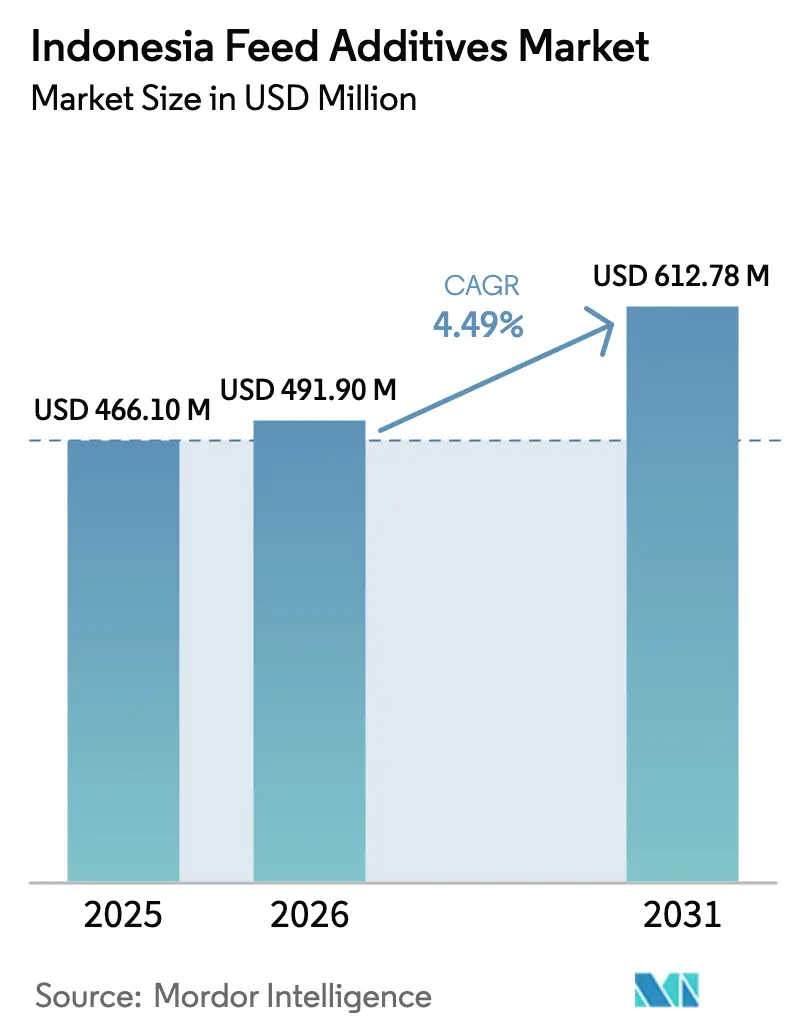
| Base Year Market Size (2025) | USD 466.10 Million |
| Market Size (2026) | USD 491.90 Million |
| Market Size (2031) | USD 612.78 Million |
| Growth Rate (2026 - 2031) | 4.49 % |
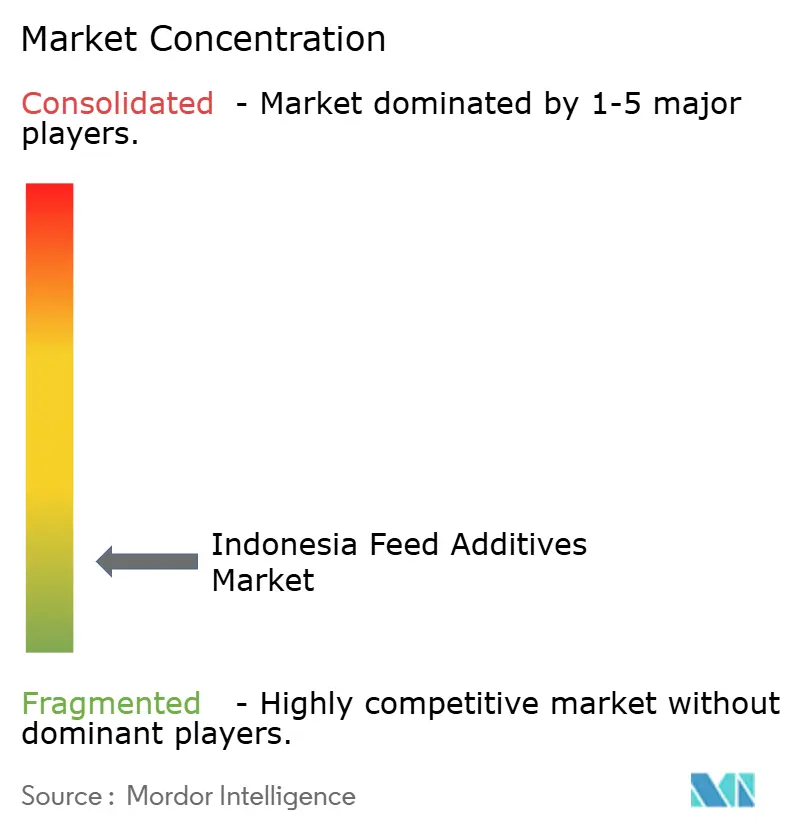
| Market Concentration | Low |
Major Players *Disclaimer: Major Players sorted in no particular order Image © Mordor Intelligence. Reuse requires attribution under CC BY 4.0. | |
Indonesia Feed Additives Market Analysis by Mordor Intelligence
The Indonesia feed additives market size is projected to increase from USD 466.10 million in 2025 to USD 491.90 million in 2026 and reach USD 612.78 million by 2031, growing at a CAGR of 4.49% over 2026-2031. Intensifying commercial livestock production, especially in poultry operations centered in Java and Sumatra, is the structural force behind this trajectory. The prohibition on antibiotic growth promoters continues to divert nutrition budgets toward probiotics, organic acids, and phytogenics, raising additive intensity per metric ton of finished feed. The shift of Indonesia’s biodiesel blend from B30 to B40 in 2025 tightened the energy density of palm kernel meal, amplifying demand for synthetic lysine and methionine to preserve feed conversion ratios. Parallel expansion in aquaculture is driving up demand for carotenoids and organic trace minerals as farmers pursue premium color grades for Japanese and European buyers. Multinational suppliers with local plants enjoy a cost edge by billing in rupiah, while smaller mills remain exposed to currency swings that inflated landed costs for imported vitamins and amino acids during 2024.
Key Report Takeaways
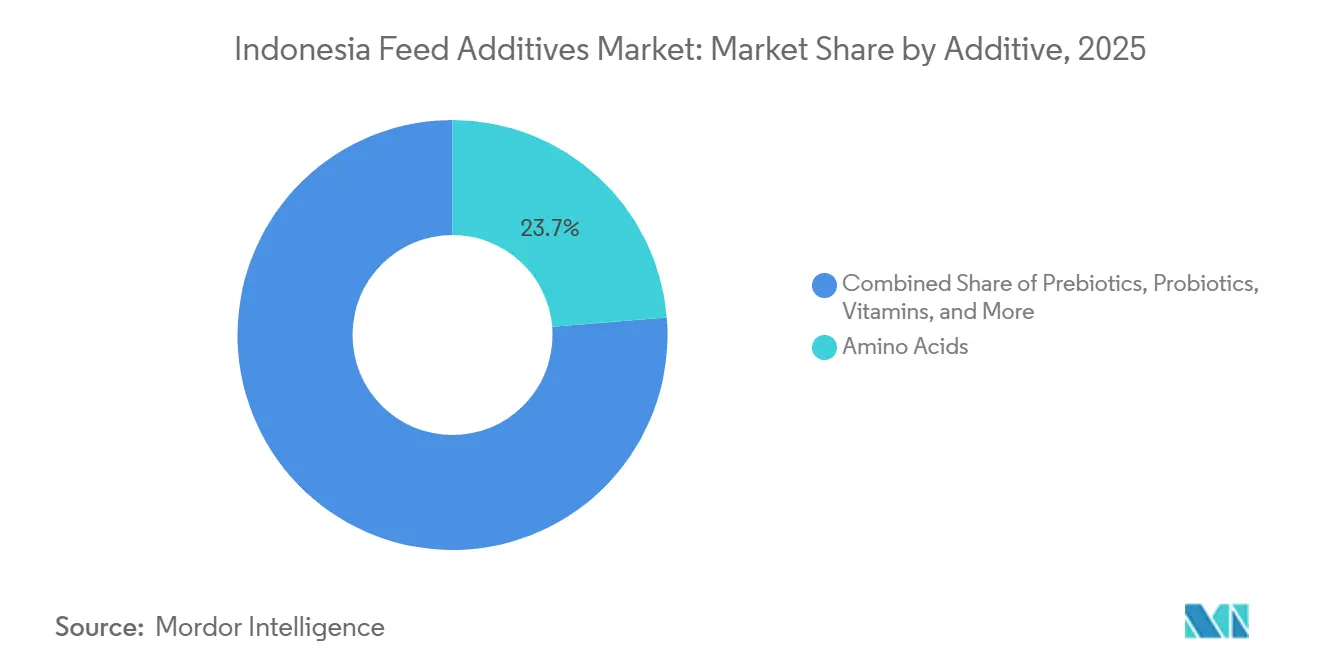
- By additive type, amino acids commanded 23.7% of the Indonesia feed additives market share in 2025, while acidifiers posted the fastest expansion at a 5.1% CAGR through 2031.
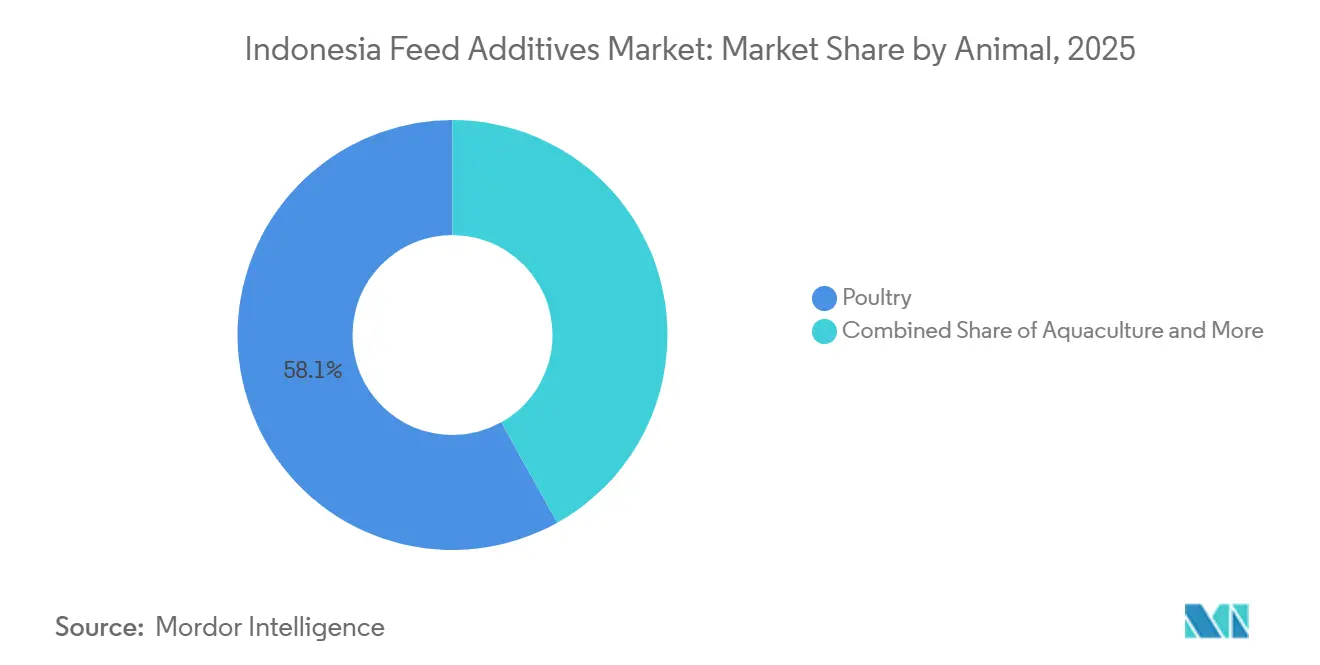
- By animal type, poultry captured 58.1% of the Indonesia feed additives market size in 2025 and is projected to grow at 5.1% through 2031, outpacing aquaculture and ruminants.
Note: Market size and forecast figures in this report are generated using Mordor Intelligence’s proprietary estimation framework, updated with the latest available data and insights as of 2026.
Indonesia Feed Additives Market Trends and Insights
Drivers Impact Analysis*
| Driver | (~) % Impact on CAGR Forecast | Geographic Relevance | Impact Timeline |
|---|---|---|---|
| Rising domestic poultry protein demand | +1.2% | National, with concentration in Java and Sumatra | Medium term (2-4 years) |
| Government ban on antibiotic growth promoters creates alternative opportunities | +0.8% | National regulatory implementation | Short term (≤ 2 years) |
| Cost-effective amino-acid supplementation to cut soybean meal usage | +0.9% | National, particularly feed mills in East Java | Medium term (2-4 years) |
| Surge in probiotic R&D from Indonesian institutes | +0.6% | National, led by IPB University and BRIN research centers | Long term (≥ 4 years) |
| Palm-oil biodiesel policy tightening energy density additives need | +0.7% | National, with focus on palm oil producing regions | Medium term (2-4 years) |
| Blockchain traceability programs for halal feed compliance | +0.4% | National, with emphasis on export-oriented facilities | Long term (≥ 4 years) |
| Source: Mordor Intelligence | |||
Rising Domestic Poultry Protein Demand
Per-capita poultry meat intake climbed to 13.2 kilograms in 2025, encouraged by urban diets moving beyond rice staples [1]Source: Food and Agriculture Organization, “Food Balances: Indonesia – Poultry Meat,” fao.org. Java, home to 56% of the broiler flock, absorbs most of the incremental additive tonnage as mills raise vitamin E and selenium yeast inclusions to lengthen meat shelf life. Government roadmaps aim for 15 kilograms per capita by 2028, which will keep amino acid and enzyme volumes on a steady uptrend. Rapid 28-day broiler grow-out cycles now require high-potency premixes to extract nutrients quickly. These factors together underpin persistent growth in the Indonesia feed additives market.
Government Ban on Antibiotic Growth Promoters Creates Alternative Opportunities
Enforcement of the ban reached full momentum in 2024, when unannounced audits began, accelerating organic acid and probiotic uptake. Propionic and fumaric acid, for instance, lower gut pH to curb Salmonella without resistance risks. In 2021, IPB University trials recorded 4.2% feed conversion gains with Lactobacillus strains paired with mannan oligosaccharides [2]Source: IPB University, “Probiotic strategies for mitigating heat stress effects on broiler chicken performance,” ipb.ac.id. Phytogenic blends rich in thymol now mimic earlier AGP growth effects, albeit at an additional cost of USD 3-6 per metric ton. Producers accept the premium to preserve export access and brand reputation, reinforcing substitution momentum in the Indonesia feed additives market.
Cost-Effective Amino Acid Supplementation to Cut Soybean Meal Usage
Soybean meal averaged USD 520 per metric ton in 2025, pushing formulators to use synthetic lysine and methionine for protein precision. Each one-percentage-point cut in soybean meal saves roughly USD 4.50 per metric ton while holding crude-protein targets. Falling threonine and tryptophan prices, down 12% in 2024, further open formulation windows. Shrimp and tilapia diets now layer methionine to enhance muscle deposition, aligning with export yield specs. Lower soy inclusion also reduces nitrogen excretion, making amino-acid fortification both economic and environmental for stakeholders in the Indonesia feed additives market.
Surge in Probiotic R&D from Indonesian Institutes
IPB University and Gadjah Mada University isolated heat-stable Bacillus coagulans that withstand 85 degrees Celsius pelleting and deliver extra broiler weight gain. Localized strains cut cold-chain expenses and thrive in humid climates where imported probiotics often fail. Public grants speed pilot trials, turning laboratories into commercial pipelines. Retailers now market probiotic-fed chicken as antibiotic-free premium lines in Jakarta and Surabaya. These developments add a long-run innovation layer to the Indonesia feed additives market.
Restraints Impact Analysis*
| Restraint | (~) % Impact on CAGR Forecast | Geographic Relevance | Impact Timeline |
|---|---|---|---|
| High import dependency for key raw materials | -0.9% | National, with particular impact on Java-based manufacturers | Medium term (2-4 years) |
| Volatile rupiah driving additive input-cost inflation | -0.7% | National, affecting all import-dependent operations | Short term (≤ 2 years) |
| Complex regulatory landscape raises compliance costs | -0.5% | National | Short term (≤ 2 years) |
| Infrastructure gaps in Kalimantan and Sulawesi elevate logistics costs | -0.4% | Emerging eastern regions | Long term (≥ 4 years) |
| Source: Mordor Intelligence | |||
High Import Dependency for Key Raw Materials
Indonesia relies on Argentina, Brazil, and the United States for 85% of its soybean meal, making mills susceptible to freight cost increases and shipping delays. This heavy reliance on imports exposes the market to global supply chain disruptions and price volatility. Synthetic amino acids are predominantly imported from China and Europe, as there is no domestic production to mitigate supply disruptions. The lack of local production capacity further exacerbates the supply chain's vulnerability. While government acreage programs aim to reduce this dependency, corn yields remain 30% below global benchmarks, limiting the potential for short-term import substitution. This reliance weakens pricing power in the Indonesia feed additives market, leaving it highly influenced by external factors.
Volatile Rupiah Driving Additive Input-Cost Inflation
The rupiah slid from 15,400 to 16,200 per United States dollar during 2024, adding 5.2% to vitamin and methionine landing costs. Small mills lack hedging tools and must either absorb or pass costs, risking supplier contracts. Firms with local plants, like DSM-Firmenich’s vitamin facility in Cilegon, invoice in rupiah and enjoy a buffer. Currency sensitivity in the Indonesia feed additives market aligns with commodity cycles, strengthening during palm oil booms and weakening during periods of increased imports, thereby contributing to operational uncertainty.
*Our forecasts treat driver/restraint impacts as directional, not additive. The impact forecasts reflect baseline growth, mix effects, and variable interactions.
Segment Analysis
By Additive Type: Amino Acids Anchor Formulation Economics
Amino acids are projected to account for 23.7% of the Indonesia feed additives market share in 2025, highlighting their importance in cost-effective diets that substitute expensive soybean meal. Lysine inclusion in broiler starter feeds typically ranges from 1.2% to 1.4%, while methionine averages around 0.5%, optimizing breast meat yield[3]Source: Ajinomoto, “Amino Acid Applications in Poultry Nutrition,” ajinomoto.com. Threonine and tryptophan gain ground as genetic evolution advances, and crystalline profiles enable precise protein delivery, reducing nitrogen excretion. Acidifiers, advancing at a 5.1% CAGR through 2031, benefit from the antibiotic ban, and propionic acid dominates mash formulations, whereas fumaric acid excels in pelleted feeds due to heat stability. Phytase and xylanase enzymes are now standard in corn-soy rations, reducing the cost of phosphorus supplementation.
Demand for probiotics and prebiotics expands alongside, with mannan oligosaccharides supporting gut health after AGP removal. Vitamins A, E, and B-complex remain staples inclusions, though pricing pressure from Chinese capacity curbs premix margins. Mineral usage is shifting toward organic chelates, which achieve higher bioavailability and reduce environmental discharge. Carotenoid pigments, such as astaxanthin, are integral to shrimp diets, while mycotoxin binders safeguard corn-heavy formulations in humid climates. The growing interest in phytogenics, including essential oils like thymol, is driven by the shift towards antibiotic-free branding, contributing to product diversification in the Indonesia feed additives market.



By Animal Type: Poultry Dominance Persists
Poultry absorbed 58.1% of Indonesia feed additive market volumes in 2025 and is projected to grow at 5.1% through 2031, reaffirming its lead within the Indonesia feed additives market. Broiler output reached high liveweight in 2024, driving sizable orders for amino acids, enzymes, and vitamins. Layers, centered in West and East Java, are fed choline chloride and methionine to sustain egg cycles exceeding 80 weeks. Aquaculture ranks next, boosted by shrimp farming that values carotenoids for shell coloration, which lifts export premiums.
Ruminants remain smaller yet steady, with dairy herds adding bypass fats and protected amino acids as the government targets 1.2 million metric tons of domestic milk in 2025. Swine’s limited presence, constrained by dietary preferences, translates into modest additive uptake confined mainly to amino acids and phytase. Ducks, quail, and ornamental fish together form a niche but high-margin channel for specialty additives. The broad poultry base, coupled with modern genetics and integrated feed lines, secures a resilient demand spine for the Indonesia feed additives market size outlook.
Geography Analysis
Java anchors about more than half of the national feed-mill capacity and poultry flock, delivering logistics savings that help mills consolidate procurement for the Indonesia feed additives market. West and East Java host vertically integrated complexes run by PT Japfa Comfeed Indonesia and PT Charoen Pokphand Indonesia, where additive volumes flow reliably through established supply chains. Sumatra is evolving into a second hub, and North Sumatra and Lampung benefit from proximity to palm plantations, though palm kernel meal’s low protein level requires additional amino acid and enzyme fortification.
Kalimantan and Sulawesi have strong demand potential but face logistics costs that are 12-18% higher than in Java. Sparse paved roads and limited cold storage lead to vitamin degradation during transport, preventing low-margin SKUs (Stock Keeping Units) from entering outer-island markets. Papua and Maluku remain marginal due to subsistence farming. The government’s eastern road plan budgets IDR 120 trillion (USD 7.4 billion) through 2029, yet near-term additive growth will stay Java-centric.
The geographic distribution of aquaculture in Indonesia significantly impacts the feed additives market. Shrimp farming, concentrated in East Java, South Sulawesi, and Lampung, drives the demand for carotenoids and organic minerals. Meanwhile, tilapia farming, prevalent in West and Central Java, relies on standard vitamin premixes at lower inclusion rates. However, the mismatch between Java-based feed mills and shrimp ponds in Sulawesi leads to inter-island freight, which reduces profit margins. Resolving this challenge in the Indonesia feed additives market would require infrastructure improvements or the development of decentralized small-scale mills.
Competitive Landscape
The Indonesia Feed Additives Market remains fragmented because of the leading five suppliers, such as Cargill, Incorporated, ADM, Nutreco NV (SHV Holdings NV), DSM-Firmenich, and BASF SE, in 2025. Their extensive portfolios and technical support contribute to the market's low concentration. Vertical integrators PT Japfa Comfeed Indonesia and PT Charoen Pokphand Indonesia exploit in-house formulation to capture margin and often source commodity additives directly from China. Niche specialists collaborate with local institutes to produce heat-stable enzymes and probiotics suited to tropical pelleting, commanding 15-25% price premiums.
Technology adoption is accelerating, with blockchain being utilized to ensure halal compliance. PT Sreeya Sewu plans to implement this system in 2024 to secure contracts in the Middle Eastern market. Near-infrared sensors connected to machine-learning algorithms now adjust additive inclusion rates in real time, reducing waste and boosting feed conversion. Intellectual property is rising in value, and DSM-Firmenich secured a 2023 patent for microencapsulated vitamin E that withstands high pelleting temperatures.
Chinese producers are beginning to bypass distributors and sell lysine and enzymes directly, compressing margins for incumbents. Regulatory barriers moderately shield established players because new entrants must navigate BPOM (Badan Pengawas Obat dan Makanan) registration and Ministry of Agriculture feed-safety rules. Overall, competition centers on price, technical service, and halal credentials, defining the strategic canvas for the Indonesia feed additives market.
Indonesia Feed Additives Industry Leaders
Cargill, Incorporated.
ADM
BASF SE
DSM-Firmenich
Nutreco NV (SHV Holdings NV)
- *Disclaimer: Major Players sorted in no particular order

Recent Industry Developments
- October 2024: Clariant established a feed additive production facility in Cileungsi, Bogor, West Java, Indonesia, to support the livestock sector in Southeast Asia. The facility manufactures additives that improve animal health and feed efficiency.
- October 2024: Cargill, Incorporated has introduced a new cocoa production line at its processing facility in Gresik, Indonesia, to address the increasing demand in Asia's consumer markets. This expansion enhances the company's integrated supply chain for animal nutrition and food ingredients in Indonesia.
- October 2024: De Heus has established its fifth feed production facility in Purwodadi, Central Java, to promote sustainable livestock farming in Indonesia. The facility produces high-quality feed products, including formulations with feed additives designed to enhance animal health, growth, and productivity.


Indonesia Feed Additives Market Report Scope
Feed additives are substances, microorganisms, or preparations added in small quantities to animal feed or water to serve specific purposes beyond basic nutrition. The Indonesia Feed Additives Market Report is Segmented by Additive (Acidifiers, Amino Acids, Antibiotics, Antioxidants, Binders, Enzymes, Flavors & Sweeteners, Minerals, Mycotoxin Detoxifiers, Phytogenics, Pigments, Prebiotics, Probiotics, Vitamins, and Yeast), and Animal (Aquaculture, Poultry, Ruminants, Swine, and Other Animals). The Market Forecasts are Provided in Terms of Value (USD) and Volume (Metric Tons).
| Acidifiers | Fumaric Acid |
| Lactic Acid | |
| Propionic Acid | |
| Other Acidifiers | |
| Amino Acids | Lysine |
| Methionine | |
| Threonine | |
| Tryptophan | |
| Other Amino Acids | |
| Antibiotics | Bacitracin |
| Penicillins | |
| Tetracyclines | |
| Tylosin | |
| Other Antibiotics | |
| Antioxidants | Butylated Hydroxyanisole (BHA) |
| Butylated Hydroxytoluene (BHT) | |
| Citric Acid | |
| Ethoxyquin | |
| Propyl Gallate | |
| Tocopherols | |
| Other Antioxidants | |
| Binders | Natural Binders |
| Synthetic Binders | |
| Enzymes | Carbohydrases |
| Phytases | |
| Other Enzymes | |
| Flavors and Sweeteners | Flavors |
| Sweeteners | |
| Minerals | Macrominerals |
| Microminerals | |
| Mycotoxin Detoxifiers | Binders |
| Biotransformers | |
| Other Mycotoxin Detoxifiers | |
| Phytogenics | Essential Oil |
| Herbs and Spices | |
| Other Phytogenics | |
| Pigments | Carotenoids |
| Curcumin and Spirulina | |
| Prebiotics | Fructo Oligosaccharides |
| Galacto Oligosaccharides | |
| Inulin | |
| Lactulose | |
| Mannan Oligosaccharides | |
| Xylo Oligosaccharides | |
| Other Prebiotics | |
| Probiotics | Bifidobacteria |
| Enterococcus | |
| Lactobacilli | |
| Pediococcus | |
| Streptococcus | |
| Other Probiotics | |
| Vitamins | Vitamin A |
| Vitamin B | |
| Vitamin C | |
| Vitamin E | |
| Other Vitamins | |
| Yeast | Live Yeast |
| Selenium Yeast | |
| Spent Yeast | |
| Torula Dried Yeast | |
| Whey Yeast | |
| Yeast Derivatives |
| Aquaculture | Fish |
| Shrimp | |
| Other Aquaculture Species | |
| Poultry | Broiler |
| Layer | |
| Other Poultry Birds | |
| Ruminants | Beef Cattle |
| Dairy Cattle | |
| Other Ruminants | |
| Swine | |
| Other Animals |
| Additive | Acidifiers | Fumaric Acid |
| Lactic Acid | ||
| Propionic Acid | ||
| Other Acidifiers | ||
| Amino Acids | Lysine | |
| Methionine | ||
| Threonine | ||
| Tryptophan | ||
| Other Amino Acids | ||
| Antibiotics | Bacitracin | |
| Penicillins | ||
| Tetracyclines | ||
| Tylosin | ||
| Other Antibiotics | ||
| Antioxidants | Butylated Hydroxyanisole (BHA) | |
| Butylated Hydroxytoluene (BHT) | ||
| Citric Acid | ||
| Ethoxyquin | ||
| Propyl Gallate | ||
| Tocopherols | ||
| Other Antioxidants | ||
| Binders | Natural Binders | |
| Synthetic Binders | ||
| Enzymes | Carbohydrases | |
| Phytases | ||
| Other Enzymes | ||
| Flavors and Sweeteners | Flavors | |
| Sweeteners | ||
| Minerals | Macrominerals | |
| Microminerals | ||
| Mycotoxin Detoxifiers | Binders | |
| Biotransformers | ||
| Other Mycotoxin Detoxifiers | ||
| Phytogenics | Essential Oil | |
| Herbs and Spices | ||
| Other Phytogenics | ||
| Pigments | Carotenoids | |
| Curcumin and Spirulina | ||
| Prebiotics | Fructo Oligosaccharides | |
| Galacto Oligosaccharides | ||
| Inulin | ||
| Lactulose | ||
| Mannan Oligosaccharides | ||
| Xylo Oligosaccharides | ||
| Other Prebiotics | ||
| Probiotics | Bifidobacteria | |
| Enterococcus | ||
| Lactobacilli | ||
| Pediococcus | ||
| Streptococcus | ||
| Other Probiotics | ||
| Vitamins | Vitamin A | |
| Vitamin B | ||
| Vitamin C | ||
| Vitamin E | ||
| Other Vitamins | ||
| Yeast | Live Yeast | |
| Selenium Yeast | ||
| Spent Yeast | ||
| Torula Dried Yeast | ||
| Whey Yeast | ||
| Yeast Derivatives | ||
| Animal | Aquaculture | Fish |
| Shrimp | ||
| Other Aquaculture Species | ||
| Poultry | Broiler | |
| Layer | ||
| Other Poultry Birds | ||
| Ruminants | Beef Cattle | |
| Dairy Cattle | ||
| Other Ruminants | ||
| Swine | ||
| Other Animals | ||


Market Definition
- FUNCTIONS - For the study, feed additives are considered to be commercially manufactured products that are used to enhance characteristics such as weight gain, feed conversion ratio, and feed intake when fed in appropriate proportions.
- RESELLERS - Companies engaged in reselling feed additives without value addition have been excluded from the market scope, to avoid double counting.
- END CONSUMERS - Compound feed manufacturers are considered to be end-consumers in the market studied. The scope excludes farmers buying feed additives to be used directly as supplements or premixes.
- INTERNAL COMPANY CONSUMPTION - Companies engaged in the production of compound feed as well as the manufacturing of feed additives are part of the study. However, while estimating the market sizes, the internal consumption of feed additives by such companies has been excluded.
| Keyword | Definition |
|---|---|
| Feed additives | Feed additives are products used in animal nutrition for purposes of improving the quality of feed and the quality of food from animal origin, or to improve the animals’ performance and health. |
| Probiotics | Probiotics are microorganisms introduced into the body for their beneficial qualities. (It maintains or restores beneficial bacteria to the gut). |
| Antibiotics | Antibiotic is a drug that is specifically used to inhibit the growth of bacteria. |
| Prebiotics | A non-digestible food ingredient that promotes the growth of beneficial microorganisms in the intestines. |
| Antioxidants | Antioxidants are compounds that inhibit oxidation, a chemical reaction that produces free radicals. |
| Phytogenics | Phytogenics are a group of natural and non-antibiotic growth promoters derived from herbs, spices, essential oils, and oleoresins. |
| Vitamins | Vitamins are organic compounds, which are required for normal growth and maintenance of the body. |
| Metabolism | A chemical process that occurs within a living organism in order to maintain life. |
| Amino acids | Amino acids are the building blocks of proteins and play an important role in metabolic pathways. |
| Enzymes | Enzyme is a substance that acts as a catalyst to bring about a specific biochemical reaction. |
| Anti-microbial resistance | The ability of a microorganism to resist the effects of an antimicrobial agent. |
| Anti-microbial | Destroying or inhibiting the growth of microorganisms. |
| Osmotic balance | It is a process of maintaining salt and water balance across membranes within the body's fluids. |
| Bacteriocin | Bacteriocins are the toxins produced by bacteria to inhibit the growth of similar or closely related bacterial strains. |
| Biohydrogenation | It is a process that occurs in the rumen of an animal in which bacteria convert unsaturated fatty acids (USFA) to saturated fatty acids (SFA). |
| Oxidative rancidity | It is a reaction of fatty acids with oxygen, which generally causes unpleasant odors in animals. To prevent these, antioxidants were added. |
| Mycotoxicosis | Any condition or disease caused by fungal toxins, mainly due to contamination of animal feed with mycotoxins. |
| Mycotoxins | Mycotoxins are toxin compounds that are naturally produced by certain types of molds (fungi). |
| Feed Probiotics | Microbial feed supplements positively affect gastrointestinal microbial balance. |
| Probiotic yeast | Feed yeast (single-cell fungi) and other fungi used as probiotics. |
| Feed enzymes | They are used to supplement digestive enzymes in an animal’s stomach to break down food. Enzymes also ensure that meat and egg production is improved. |
| Mycotoxin detoxifiers | They are used to prevent fungal growth and to stop any harmful mold from being absorbed in the gut and blood. |
| Feed antibiotics | They are used both for the prevention and treatment of diseases but also for rapid growth and development. |
| Feed antioxidants | They are used to protect the deterioration of other feed nutrients in the feed such as fats, vitamins, pigments, and flavoring agents, thus providing nutrient security to the animals. |
| Feed phytogenics | Phytogenics are natural substances, added to livestock feed to promote growth, aid in digestion, and act as anti-microbial agents. |
| Feed vitamins | They are used to maintain the normal physiological function and normal growth and development of animals. |
| Feed flavors and sweetners | These flavors and sweeteners help to mask tastes and odors during changes in additives or medications and make them ideal for animal diets undergoing transition. |
| Feed acidifiers | Animal feed acidifiers are organic acids incorporated into the feed for nutritional or preservative purposes. Acidifiers enhance congestion and microbiological balance in the alimentary and digestive tracts of livestock. |
| Feed minerals | Feed minerals play an important role in the regular dietary requirements of animal feed. |
| Feed binders | Feed binders are the binding agents used in the manufacture of safe animal feed products. It enhances the taste of food and prolongs the storage period of the feed. |
| Key Terms | Abbreviation |
| LSDV | Lumpy Skin Disease Virus |
| ASF | African Swine Fever |
| GPA | Growth Promoter Antibiotics |
| NSP | Non-Starch Polysaccharides |
| PUFA | Polyunsaturated Fatty Acid |
| Afs | Aflatoxins |
| AGP | Antibiotic Growth Promoters |
| FAO | The Food And Agriculture Organization of the United Nations |
| USDA | The United States Department of Agriculture |


Research Methodology
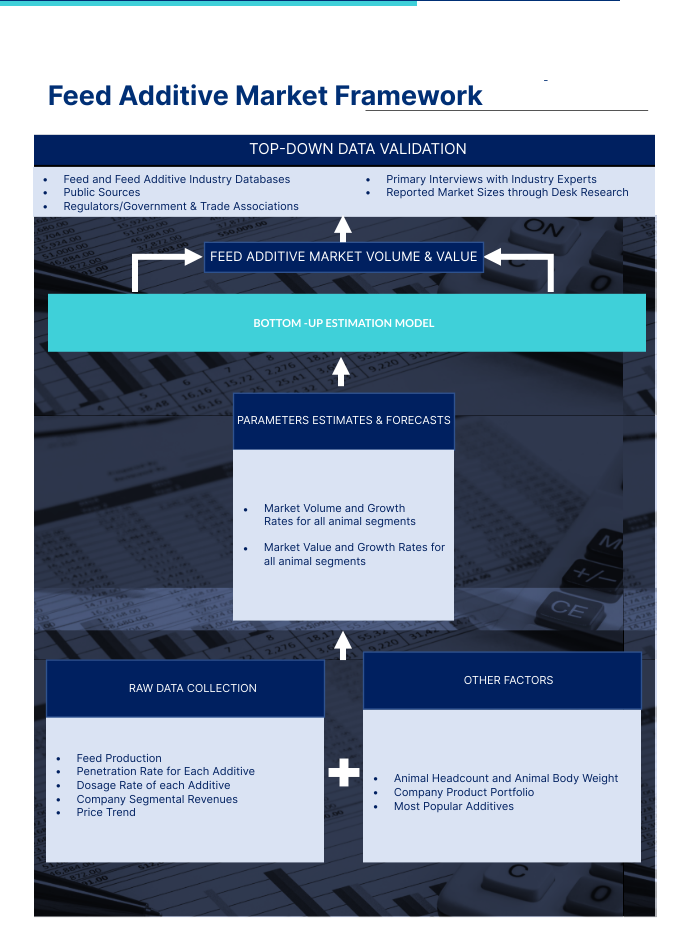
Mordor Intelligence follows a four-step methodology in all our reports.
- Step-1: IDENTIFY KEY VARIABLES: In order to build a robust forecasting methodology, the variables and factors identified in Step-1 are tested against available historical market numbers. Through an iterative process, the variables required for market forecast are set and the model is built on the basis of these variables.
- Step-2: Build a Market Model: Market-size estimations for the forecast years are in nominal terms. Inflation is not a part of the pricing, and the average selling price (ASP) is kept constant throughout the forecast period.
- Step-3: Validate and Finalize: In this important step, all market numbers, variables and analyst calls are validated through an extensive network of primary research experts from the market studied. The respondents are selected across levels and functions to generate a holistic picture of the market studied.
- Step-4: Research Outputs: Syndicated Reports, Custom Consulting Assignments, Databases & Subscription Platforms





 Your data is secure and never sold or shared.


