
Indonesia 3PL Warehousing Market Size and Share
Market Overview
| Study Period | 2020 - 2031 |
|---|---|
| Forecast Data Period | 2026 - 2031 |
| Base Year Market Size (2025) | USD 3.26 Billion |
| Market Size (2026) | USD 3.57 Billion |
| Market Size (2031) | USD 5.51 Billion |
| Growth Rate (2026 - 2031) | 9.10 % |
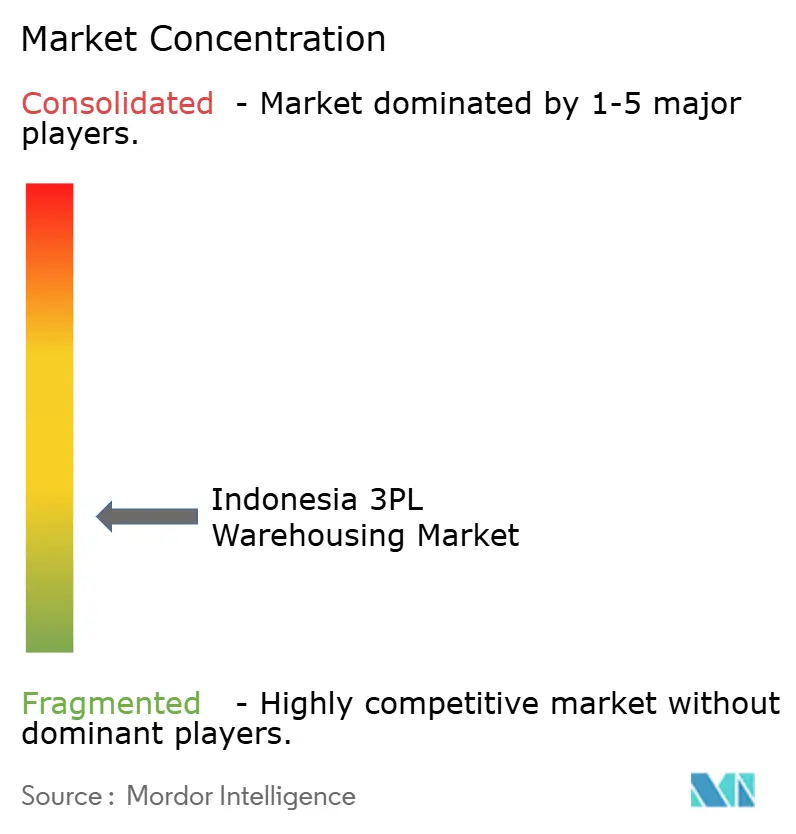
| Market Concentration | Low |
Major Players *Disclaimer: Major Players sorted in no particular order Image © Mordor Intelligence. Reuse requires attribution under CC BY 4.0. | |
Indonesia 3PL Warehousing Market Analysis by Mordor Intelligence
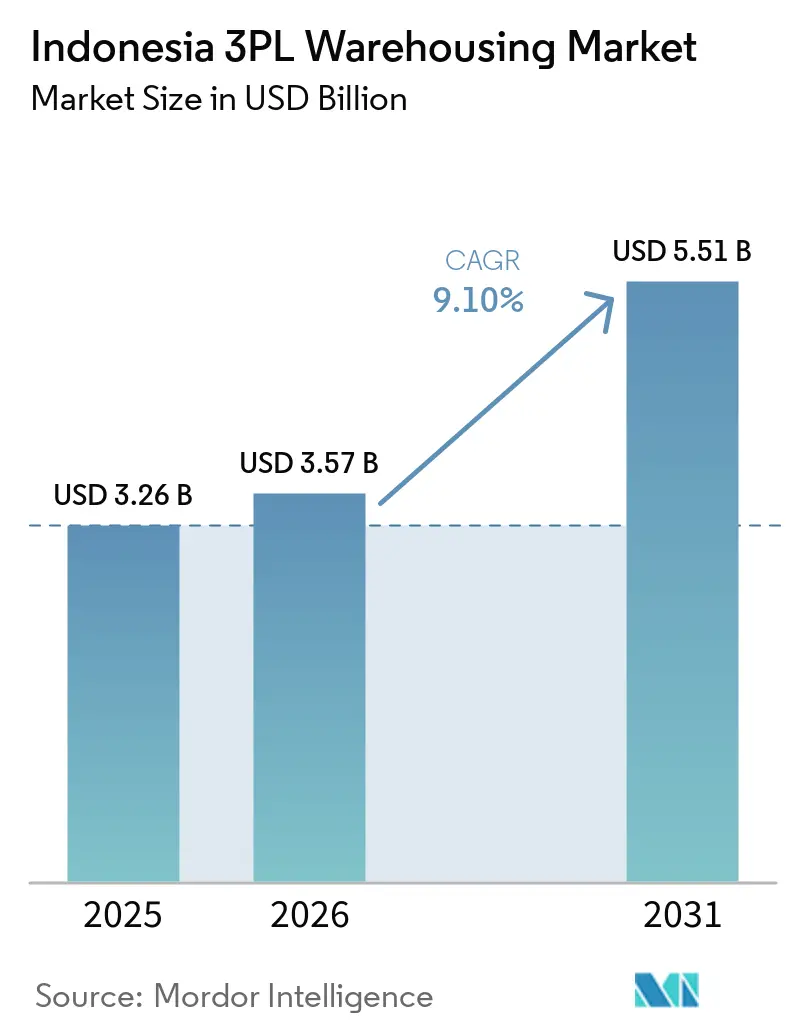
The Indonesia 3PL warehousing market size was valued at USD 3.26 billion in 2025 and is estimated to grow from USD 3.57 billion in 2026 to reach USD 5.51 billion by 2031, at a CAGR of 9.10% during the forecast period 2026-2031.
The Indonesia 3PL warehousing market is being shaped by e-commerce demand, manufacturing investment, and wider use of outsourced logistics services. Limited modern warehouse capacity makes facility upgrades and new construction more important, especially around Greater Jakarta. Demand is also moving beyond basic storage toward fulfillment, bonded services, and temperature-controlled operations. Competition is separating technology-enabled global providers from domestic operators that compete through local relationships, proximity, and flexible pricing. Inter-island distribution costs remain a constraint because they make networks outside Java more expensive to operate.
Key Report Takeaways
- By service type, storage held 47.43% of Indonesia 3PL warehousing market size in 2025, while value-added services and others are forecast to register at a 10.98% CAGR through 2031.
- By warehouse type, general shared or multi-client warehousing held 49.32% of Indonesia 3PL warehousing market share in 2025, while bonded warehousing is forecast to register at an 11.63% CAGR through 2031.
- By temperature control, non-temperature-controlled warehousing held 88.23% of Indonesia 3PL warehousing market size in 2025, while temperature-controlled warehousing is forecast to register at a 12.76% CAGR through 2031.
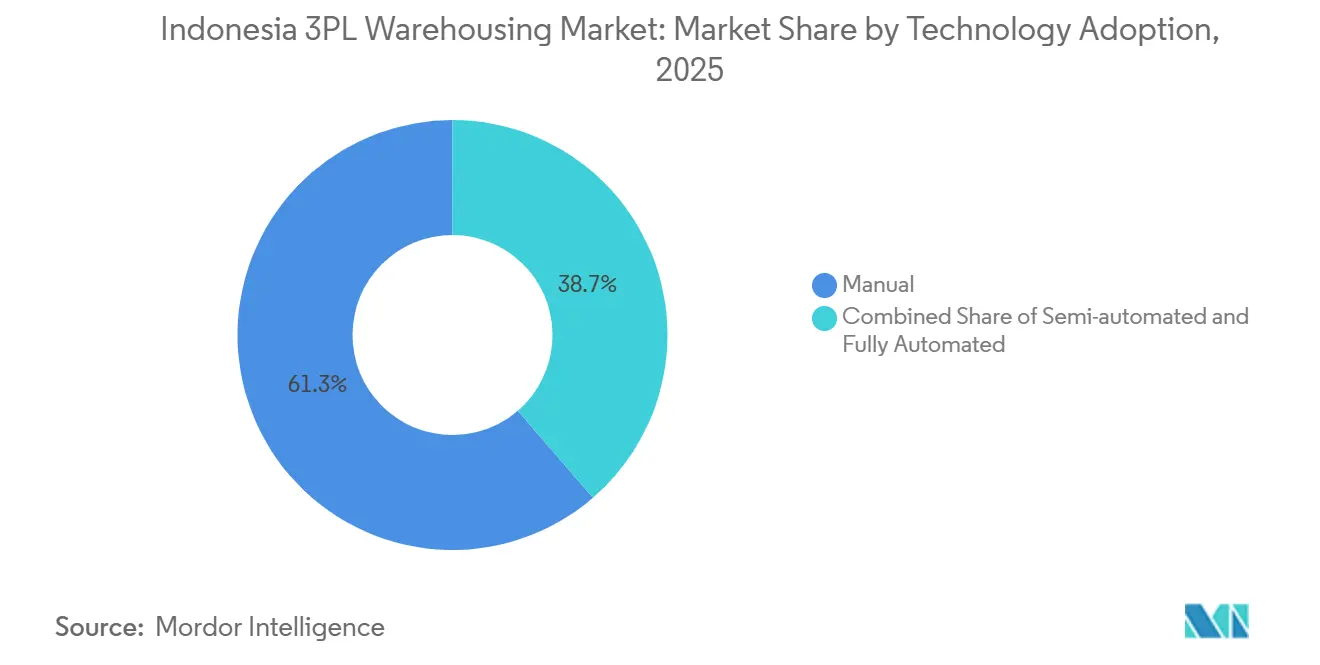
- By technology adoption, manual operations held 61.34% of Indonesia 3PL warehousing market share in 2025, while fully automated warehousing is forecast to register at a 13.68% CAGR through 2031.
- By end-user industry, manufacturing held 26.54% of Indonesia 3PL warehousing market size in 2025, while healthcare and pharma are forecast to register at a 10.92% CAGR through 2031.
- By geography, Java held 58.44% of Indonesia 3PL warehousing market share in 2025, while Sulawesi is forecast to register at a 12.32% CAGR through 2031.
Note: Market size and forecast figures in this report are generated using Mordor Intelligence’s proprietary estimation framework, updated with the latest available data and insights as of January 2026.
Indonesia 3PL Warehousing Market Trends and Insights
Drivers Impact Analysis*
| Driver | (~) % Impact on CAGR Forecast | Geographic Relevance | Impact Timeline |
|---|---|---|---|
| E-Commerce Growth Raising Omnichannel Demand | +2.5% | National, with concentration in Java, Greater Jakarta, Bandung, and Surabaya | Short term (≤ 2 years) |
| Industrial Expansion Raising Modern Warehouse Needs | +1.8% | Karawang, Subang, and Cikarang, with expansion to Batam and the Sumatra special economic zones | Medium term (2-4 years) |
| Inventory Outsourcing Increasing 3PL Adoption | +1.5% | National, with early gains in Greater Jakarta, Surabaya, and Medan | Medium term (2-4 years) |
| Cold-Chain Demand Expanding Temperature-Controlled Capacity | +1.2% | Java, Medan, and Makassar | Medium term (2-4 years) |
| Island Distribution Increasing Decentralized Inventory Needs | +1.0% | Sulawesi, Kalimantan, Papua, and Maluku | Long term (≥ 4 years) |
| EV and Electronics Growth Raising Warehouse Use | +0.8% | Karawang, Cikarang, Batam, and Kendal special economic zone | Medium term (2-4 years) |
| Source: Mordor Intelligence | |||
E-Commerce Growth Accelerating Omnichannel Warehousing Demand
Indonesia's e-commerce gross merchandise value reached USD 71 billion in 2025 and is estimated to approach USD 140 billion by 2030, increasing the inventory-management burden on logistics networks. The larger online retail base requires sellers to keep a broader range of products available while meeting customer expectations for speed and order accuracy. Marketplace sellers need stock positioned closer to consumers, which supports a shift from centralized hubs to networks that include secondary fulfillment locations. Greater Jakarta's modern logistics warehouse occupancy reached 98% in Q1 2026, showing that existing modern capacity on Java is under pressure. This occupancy level directs development toward adjacent corridors such as Karawang and Subang, where providers can still link facilities with Jakarta's consumer and port networks. Returns handling is also adding operational work because retailers need facilities that can inspect, sort, repack, and return goods to available inventory.
Industrial Expansion Increasing Modern Warehousing Requirements
Manufacturing investment is increasing the need for warehouses designed for specific supply chains and production schedules. Warehouse space inquiries in 2025 were led by the electric vehicle ecosystem and its suppliers, which often need specialized facility layouts. These customers may require controlled staging areas, customs-linked processes, and close access to factories that operate on planned delivery cycles. Modern logistics warehouse supply in Greater Jakarta reached 3.2 million m² in Q1 2026, with new capacity concentrated in the Bekasi, Karawang, and Cikarang corridor. ESR and Indonesia Investment Authority began development of ESR Cikarang Logistics Park 4 in August 2026 at Jababeka Industrial Estate. The project is intended to serve global 3PL operators and multinational manufacturers.
Cold-Chain Demand Expanding Temperature-Controlled Warehousing Capacity
Temperature-controlled capacity is increasing because food, pharmaceutical, and retail customers require more reliable handling across storage and distribution. These customers need providers that can keep goods within specified conditions from receipt through dispatch. I Squared Capital agreed to acquire Cella, which operated 5 facilities totaling 231,000 m² across Greater Jakarta and Surabaya[1]“I Squared Capital Launches Indonesian Industrial Logistics and Cold Storage Platform with the Acquisition of Cella,” I Squared Capital, isquaredcapital.com. The buyer plans to expand Cella's footprint to 1.5 million m² over 4-5 years through development and acquisitions. This activity shows that large infrastructure investors see room for greater cold-storage coverage in Indonesia. Smaller pharmaceutical warehouse operators face higher compliance demands for temperature monitoring, mapping, and quality management.
EV and Electronics Growth Boosting Warehouse Utilization
Electric vehicle and electronics supply chains need specialized handling for materials, components, and finished goods that move through different stages of production. These flows can involve battery raw materials, bonded holding, component staging, and outbound distribution. DHL Supply Chain Indonesia established a dedicated EV logistics team that provides specialized warehousing with battery testing and charging capabilities[2]“DHL Commits to Helping Indonesia Expand Its Fast-Growing Sectors and Aid Its Rise as a Global Trade Hub,” DHL, dhl.com. A CATIB cell plant with 6.9 GWh capacity began operations in Karawang in early 2026, adding demand near an established manufacturing corridor. Electronics activity in Batam and Greater Jakarta is also increasing the need for modern facilities. DHL Express opened a dedicated 6,000 m² facility in Batam in early 2026 to support the electronics manufacturing hub.
Restraints Impact Analysis*
| Restraint | (~) % Impact on CAGR Forecast | Geographic Relevance | Impact Timeline |
|---|---|---|---|
| Inter-Island Transshipment Reducing Network Efficiency | -0.8% | Sulawesi, Kalimantan, Papua, Maluku, and Bali | Long term (≥ 4 years) |
| Refrigeration Energy Costs Raising Operating Expenses | -0.5% | National, with greater exposure in outer islands where grid reliability is lower | Medium term (2-4 years) |
| Limited Modern Capacity Outside Java | -0.4% | Kalimantan, Sulawesi, Papua, and Maluku | Long term (≥ 4 years) |
| Digital and Customs Integration Gaps Increasing Complexity | -0.3% | National, especially bonded logistics zones in Semarang, Batam, and Surabaya | Medium term (2-4 years) |
| Source: Mordor Intelligence | |||
Inter-Island Transshipment Reducing Warehousing Network Efficiency
Serving more than 17,000 islands requires transfers between road, port, vessel, regional port, and final delivery networks. Each transfer adds coordination work and creates more points where cargo schedules can change. This process adds 2-4 days of transit time and related cost when compared with mainland markets of similar scale. PELNI and Meratus Line signed a cooperation agreement in April 2026 for hub-and-spoke cargo services on Sea Toll routes S4A and S4B. The agreement supports cargo consolidation for Eastern Indonesia, but service quality still depends on vessel capacity, schedule reliability, and port dwell times. 3PL providers need to hold more safety stock at regional nodes to manage variability, which raises carrying costs.
Refrigeration Energy Costs Increasing Warehouse Operating Expenses
Cold-chain operations need continuous refrigeration in a tropical climate, which keeps compressor loads high throughout the day and night. Temperature control cannot be interrupted without creating risks for products that require stable handling conditions. Diesel backup generation is common outside Java and can increase operating costs where the power supply is less reliable. Industrial electricity tariffs rose in 2025, which added pressure to cold-chain operating margins. Facilities in secondary and tertiary locations may not have enough volume to spread fixed energy costs across competitive rental rates. DHL Supply Chain has used solar-powered facilities in Indonesia, demonstrating a way to reduce exposure to grid-dependent operating costs.
*Our forecasts treat driver/restraint impacts as directional, not additive. The impact forecasts reflect baseline growth, mix effects, and variable interactions.
Segment Analysis
By Service Type: Value-Added Services Are Changing the Revenue Mix
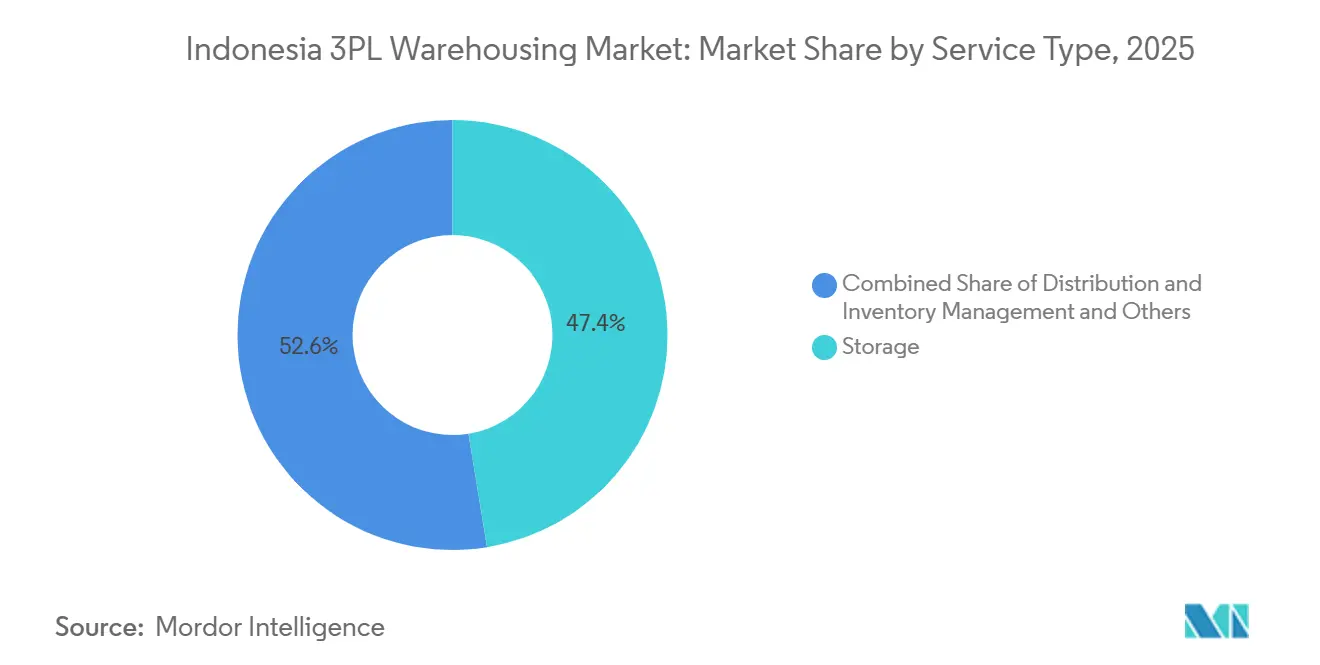
Storage held 47.43% of Indonesia 3PL warehousing market share in 2025, while value-added services and others are forecast to record a 10.98% CAGR from 2026 to 2031, highlighting the continued importance of storage alongside the increasing use of value-added activities. Storage provides the physical inventory position from which customers can organize replenishment, order handling, and outbound distribution. Value-added services include kitting, labeling, co-packing, product preparation, and returns processing. These tasks are becoming more important as retailers seek fulfillment partners that can adjust products and orders closer to final delivery. The Indonesia 3PL warehousing industry is therefore moving beyond storage alone toward activities that prepare inventory for sale.
Distribution and inventory management connect stored goods with transport and last-mile delivery networks. FMCG and retail customers need these services because inventory moves frequently between warehouses, stores, and consumer delivery channels. E-commerce sellers also need facilities that can reposition stock when demand changes across cities and islands. Warehouse management systems support this work by improving visibility of individual stock-keeping units and available storage locations. The service mix becomes more useful when a provider can coordinate storage, handling, and dispatch within a single operating process.



By Warehouse Type: Bonded Warehousing Is Becoming a Strategic Asset
General shared, or multi-client warehousing, held 49.32% of the Indonesia 3PL warehousing market size in 2025, while bonded warehousing is forecast to record an 11.63% CAGR from 2026 to 2031, reflecting the continued role of shared facilities alongside increasing demand for customs-controlled storage. General shared, or multi-client warehousing, gives shippers access to professional capacity without the fixed commitment needed for a dedicated facility. It also allows operators to pool infrastructure, labor, and handling resources across customers with changing volumes. The model fits a large base of small and medium-sized manufacturers that have varied storage requirements. Bonded warehousing is increasingly linked to export-oriented manufacturing, controlled storage, and customs procedures for international trade.
Maersk Logistics Indonesia received bonded logistics center approval for its Semarang facility in August 2026[3]Maersk Logistics Indonesia Perkuat Perdagangan Global melalui Persetujuan Pusat Logistik Berikat di Semarang,” Bea Cukai Kanwil Jateng DIY, beacukai.go.id. The facility had an initial investment of IDR 13.04 billion (USD 0.78 million) serving apparel, footwear, and luggage exports to Europe. This example shows how bonded facilities can combine customs administration with warehousing services for exporters. Dedicated Contract Warehousing remains relevant to automotive and healthcare customers that require tailored layouts, defined processes, and service commitments. The Indonesia 3PL warehousing market, therefore, includes shared capacity, dedicated facilities, and bonded locations linked to export production.
By Temperature Control: Cold-Chain Infrastructure Is Driving Growth
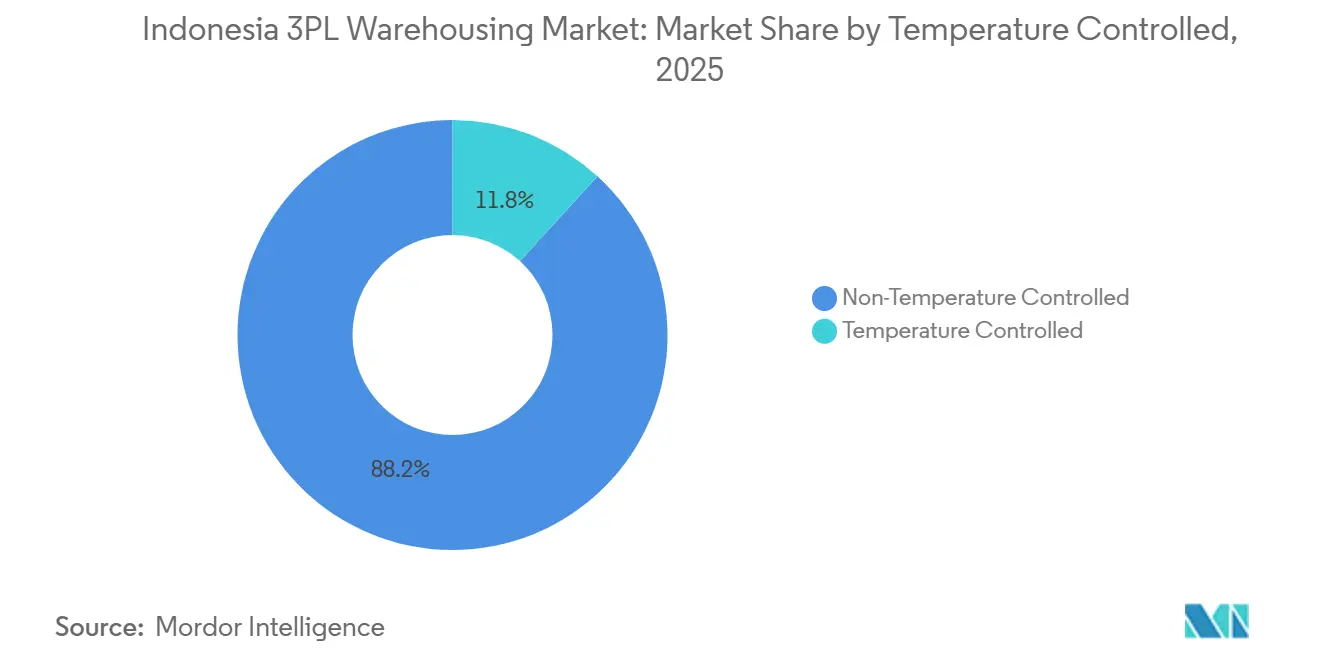
Non-temperature-controlled warehousing held 88.23% of the Indonesia 3PL warehousing market share in 2025, while temperature-controlled warehousing is forecast to record a 12.76% CAGR from 2026 to 2031, reflecting the dominant role of ambient storage alongside faster expansion in cold-chain capacity. Non-temperature-controlled warehousing supports manufacturing inputs, retail goods, consumer products, and general merchandise. Many shippers handle products that do not require refrigeration or controlled humidity, maintaining strong demand for conventional facilities. Temperature-Controlled warehousing is gaining importance as food safety expectations and pharmaceutical handling requirements increase demand for facilities with controlled operating conditions.
Peregrine Cold Logistics entered Indonesia in September 2026 through a joint venture with Sinar Primera. The venture acquired a Pluit facility while developing a Narogong site with 35,000 m² of freezer and chiller capacity. The combination provides an operating asset and a new facility within major Jakarta distribution areas. It also supports a hub-and-spoke approach for food and retail cold-chain demand. Temperature mapping, quality risk management, and continuous monitoring favor facilities that can document controlled operations. The Indonesia 3PL warehousing market is, therefore, attracting investment into cold-chain infrastructure alongside its established ambient storage base.
By Technology Adoption: Automation Is Rising Despite Manual Dominance
Manual operations held 61.34% of the Indonesia 3PL warehousing market size in 2025, while fully automated warehousing is forecast to record a 13.68% CAGR from 2026 to 2031, reflecting the continued importance of labor-based operations alongside faster adoption of automation. Competitive labor costs have supported manual operations, particularly in facilities that do not require high-volume automated processing. Older warehouse layouts can also make it difficult to add automated storage and retrieval equipment. Fully automated systems are gaining importance among e-commerce operators and multinational providers seeking higher throughput and more consistent processing during peak periods.
Semi-automated systems provide a practical transition between manual work and fully automated operations. Conveyors, pick-to-light systems, and mobile robots can improve movement and picking without requiring an entire facility to be rebuilt. Cainiao Network's Cikarang logistics park spans 320,000 m² across 6 warehouses designed for B2B and B2C digital logistics. The project illustrates the scale of modern facilities being developed in the eastern Jakarta corridor. Manual operators face higher service expectations as customers seek documented processes, reliable throughput, and better inventory control. The Indonesia 3PL warehousing market will retain labor-based operations while newer facilities establish higher technology benchmarks.
By End User Industry: Healthcare Leads Growth While Manufacturing Anchors Volume
Manufacturing held 26.54% of the Indonesian 3PL warehousing market share in 2025, while healthcare and pharma are forecast to record a 10.92% CAGR from 2026 to 2031, reflecting the continued importance of manufacturing alongside rising demand from regulated healthcare supply chains. Automotive, electronics, and consumer goods supply chains support manufacturing demand, particularly across Java's industrial corridors. These customers need reliable storage near production sites, ports, and domestic distribution centers. Healthcare and pharma require compliant handling, controlled processes, and reliable inventory management to support pharmaceutical distribution. JKN covered 284.3 million participants as of April 2026, supporting pharmaceutical distribution activity and associated warehousing requirements. Consumer goods, retail, and e-commerce also contribute to demand for packaged products and general merchandise.
Food and beverage customers use both ambient and temperature-controlled spaces because their products have different storage requirements. Indonesia had 5.28 million food-service businesses and exported 1.19 million tons of fishery products in 2024. These activities support regular inventory flows and increase demand for controlled handling where required. The other end-user category includes EV and battery supply chains, data center logistics, and renewable energy equipment. These applications have smaller current shares but require specific facility layouts and operating processes. The Indonesia 3PL warehousing industry, therefore, serves large manufacturing volumes while adapting to regulated and specialized customer requirements.
Geography Analysis
Java held 58.44% of the national total in 2025, supported by its concentration of industrial estates, ports, consumers, and production activity. Greater Jakarta's eastern corridor had 3.2 million m² of modern logistics warehouse supply in Q1 2026. ESR and Indonesia Investment Authority began ESR Cikarang Logistics Park 4 at Jababeka Industrial Estate in August 2026[4]ESR and INA Expand Partnership on New Logistics Developments in Indonesia,” ESR, esr.com. The partners also announced the ESR Cibitung Distribution Hub, a 3-story Grade A facility planned for completion in 2028. These projects reflect demand from global 3PL operators and multinational manufacturers in the eastern Jakarta corridor. Sumatra is the second-largest warehousing area, with Medan and Deli Serdang supported by palm oil, rubber, coffee, and consumer logistics. Rhenus Logistics expanded into Medan as its 4th Indonesian office and planned further locations in Makassar and Banjarmasin.
Sulawesi is forecast to register at a 12.32% CAGR from 2026 to 2031, supported by the Morowali nickel and EV battery supply chain and exports through Makassar. Kalimantan benefits from Nusantara-related construction logistics and consumer distribution demand in East and South Kalimantan. Coal-related activity continues to support conventional warehousing in Balikpapan and Banjarmasin. Bali and Nusa Tenggara serve tourism-linked FMCG and hospitality supply chains. Inter-island ferry services connect warehouse nodes across the Lombok Strait.
Papua and Maluku remain underserved, though the Sea Toll program is intended to improve the economics of consumer goods replenishment. Limited modern warehouse penetration outside Java creates a pipeline for providers able to accept longer investment horizons. The Indonesia 3PL warehousing market has its largest concentration on Java, while the outer islands create a longer-term route for network expansion.
Competitive Landscape
The Indonesia 3PL warehousing market is fragmented. DHL Group, A.P. Moller-Maersk, DSV, Kuehne+Nagel, and CMA CGM, through CEVA Logistics, hold leading positions in high-specification multi-client and contract warehousing. PT Samudera Indonesia, PT Puninar Logistics, PT Kamadjaja Logistics, Meratus Group, and Waresix are domestic participants in transportation-integrated and technology-enabled warehousing. Global providers use network scale, certified processes, and multimodal coverage to compete for multinational customers. DHL has invested more than USD 20 million in the Jakarta Gateway expansion and more than USD 10 million in the Surabaya Gateway.
Nippon Express Holdings integrated PT NX Lemo Indonesia Logistik and PT Nippon Express Indonesia into a unified company effective March 2026. The integration brings ocean and air freight forwarding under one management structure in Indonesia. It is designed to give regional shippers a unified customer interface and more consistent service. Maersk's approved Semarang bonded facility is another example of a global operator linking customs capability with export customer needs. These moves show that larger providers are deepening their local networks through integration and specialized infrastructure.
Waresix uses a platform model that connects warehouses and logistics assets with shippers. Its subsidiary, BSA Logistics listed on the Indonesia Stock Exchange in April 2026, and Waresix raised IDR 488 billion (USD 29 million) in Series C funding in August 2026. The funding was intended for warehouse expansion outside Java and for multimodal cold-chain services. Temperature-controlled 3PL capacity outside Greater Jakarta and Surabaya remains an opening for specialized operators. Bonded warehousing in Central Java and East Kalimantan is another opening tied to export manufacturing. The Indonesia 3PL warehousing market also has room for technology-enabled healthcare fulfillment as compliance requirements become more demanding.
Indonesia 3PL Warehousing Industry Leaders
DHL Group
DSV A/S
PT Samudera Indonesia Tbk
PT Puninar Logistics
PT Kamadjaja Logistics
- *Disclaimer: Major Players sorted in no particular order

Recent Industry Developments
- August 2026: I Squared Capital signed a definitive agreement to acquire Cella, an Indonesian industrial logistics and cold-storage platform with 5 facilities totaling 231,000 m² across Greater Jakarta and Surabaya, from NWP Property and CRE, Inc. I Squared has outlined plans to expand Cella's footprint sixfold to 1.5 million m² over 4-5 years through organic development and acquisitions, targeting geographic expansion into Medan and other secondary hubs.
- August 2026: ESR, Indonesia Investment Authority, and other capital partners jointly began construction of ESR Cikarang Logistics Park 4 at Jababeka Industrial Estate. The Grade A facility targets global 3PL operators and multinational manufacturers. A companion ESR Cibitung Distribution Hub, a 3-story Grade A facility in MM2100 Industrial Town, is planned for completion in 2028.
- August 2026: Maersk Logistics Indonesia received Pusat Logistik Berikat approval from Bea Cukai Jawa Tengah for its Semarang facility. The facility had an initial investment of IDR 13.04 billion (USD 0.78 million) and targeted export-oriented apparel, footwear, and luggage flows to Europe.
- March 2026: NX Group integrated PT NX Lemo Indonesia Logistik and PT Nippon Express Indonesia into one entity effective March 1, 2026. The integration unified ocean and air freight forwarding under 1 management structure to improve service quality.


Indonesia 3PL Warehousing Market Report Scope
| Storage |
| Distribution and Inventory Management |
| Value-Added Services and Others (Kitting, Labeling) |
| General Shared / Multi-client Warehousing |
| Dedicated Contract Warehousing |
| Bonded Warehousing |
| Non-Temperature Controlled |
| Temperature Controlled |
| Manual |
| Semi-automated |
| Fully Automated |
| Manufacturing |
| Consumer Goods |
| Food and Beverage |
| Retail and E-commerce |
| Healthcare and Pharma |
| Other End-user Industries |
| Java (Jakarta and BOD) |
| Sumatra |
| Kalimantan |
| Sulawesi |
| Bali and Nusa Tenggara |
| Papua Region and Maluku Islands |
| By Service Type | Storage |
| Distribution and Inventory Management | |
| Value-Added Services and Others (Kitting, Labeling) | |
| By Warehouse Type | General Shared / Multi-client Warehousing |
| Dedicated Contract Warehousing | |
| Bonded Warehousing | |
| By Temperature Control | Non-Temperature Controlled |
| Temperature Controlled | |
| By Technology Adoption | Manual |
| Semi-automated | |
| Fully Automated | |
| By End User Industry | Manufacturing |
| Consumer Goods | |
| Food and Beverage | |
| Retail and E-commerce | |
| Healthcare and Pharma | |
| Other End-user Industries | |
| By Region | Java (Jakarta and BOD) |
| Sumatra | |
| Kalimantan | |
| Sulawesi | |
| Bali and Nusa Tenggara | |
| Papua Region and Maluku Islands |


Key Questions Answered in the Report
What is the 3PL warehousing value in Indonesia?
The 2026 value is estimated at USD 3.57 billion and is forecast to reach USD 5.51 billion by 2031, at a 9.10% CAGR.
Which service is growing fastest in Indonesia 3PL warehousing?
Value-added services and others are forecast to register at a 10.98% CAGR through 2031, supported by kitting, labeling, co-packing, and returns processing.
Why is bonded warehousing expanding in Indonesia?
Bonded warehousing is forecast to register at an 11.63% CAGR through 2031 because export manufacturers need customs-connected storage and controlled trade flows.
What is driving cold-storage investment in Indonesia?
Temperature-controlled warehousing is forecast to register at a 12.76% CAGR through 2031 as food, retail, and pharmaceutical customers require controlled handling.
Which region leads 3PL warehousing demand in Indonesia?
Java held 58.44% in 2025 because it has the largest concentration of industrial estates, ports, consumers, and manufacturing activity.
How quickly is warehouse automation growing in Indonesia?
Fully automated warehousing is forecast to register at a 13.68% CAGR through 2031, the highest growth rate among the listed segment types.
Page last updated on:





