
Market Overview
| Study Period | 2020 - 2031 |
|---|---|
| Forecast Data Period | 2026 - 2031 |
| Base Year Market Size (2025) | USD 1.97 Billion |
| Market Size (2026) | USD 2.11 Billion |
| Market Size (2031) | USD 2.94 Billion |
| Growth Rate (2026 - 2031) | 6.91 % |
| Market Concentration | Medium |
Major Players *Disclaimer: Major Players sorted in no particular order Image © Mordor Intelligence. Reuse requires attribution under CC BY 4.0. | |
India Wood Flooring Market Analysis by Mordor Intelligence
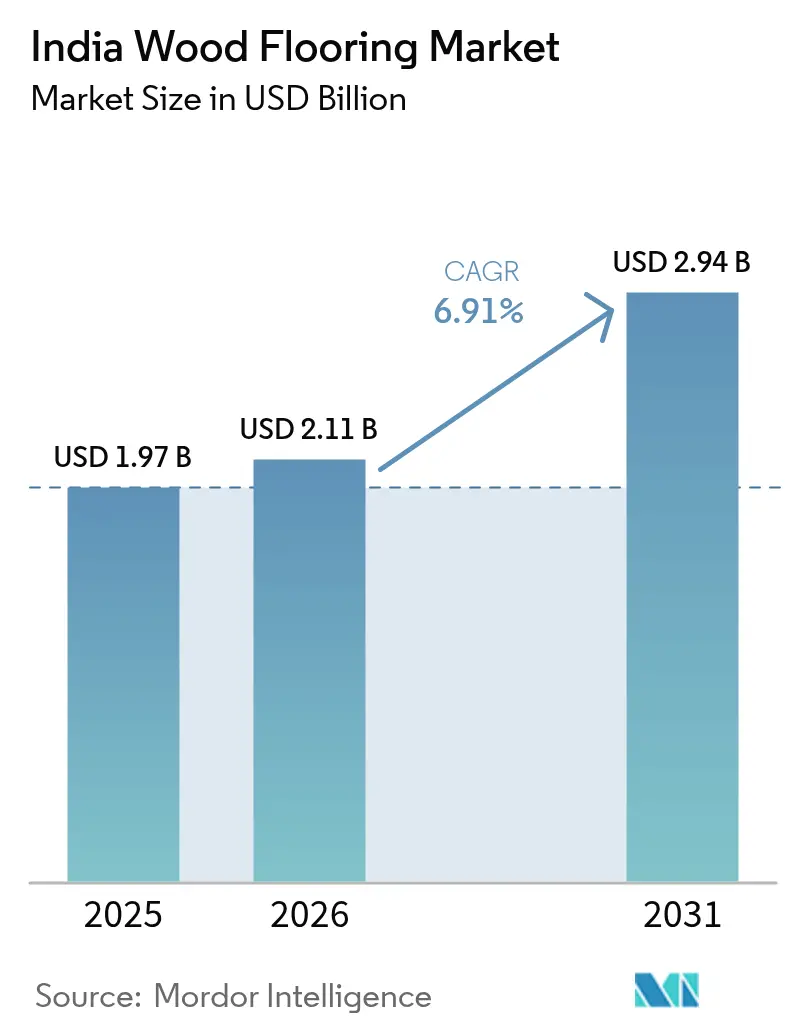
The India wood flooring market size was valued at USD 1.97 billion in 2025 and estimated to grow from USD 2.11 billion in 2026 to reach USD 2.94 billion by 2031, at a CAGR of 6.91% during the forecast period (2026-2031). This trajectory reflects rapid urbanization, stronger household balance sheets, and rising preference for premium interior finishes. Large institutional real-estate inflows, resilient housing demand across Tier-1 and emerging Tier-2 cities, and a visible shift toward ESG-compliant construction underpin sustained demand for engineered and laminated solutions. Organized players expand capacity to capitalize on policy support for manufacturing, while global brands introduce waterproof and acoustic-enhanced ranges that suit India’s diverse climate. Competitive intensity remains moderate; regional specialists still command sizable local loyalty, yet integrated producers with sustainability credentials gain share through channel partnerships and digital outreach.
Key Report Takeaways
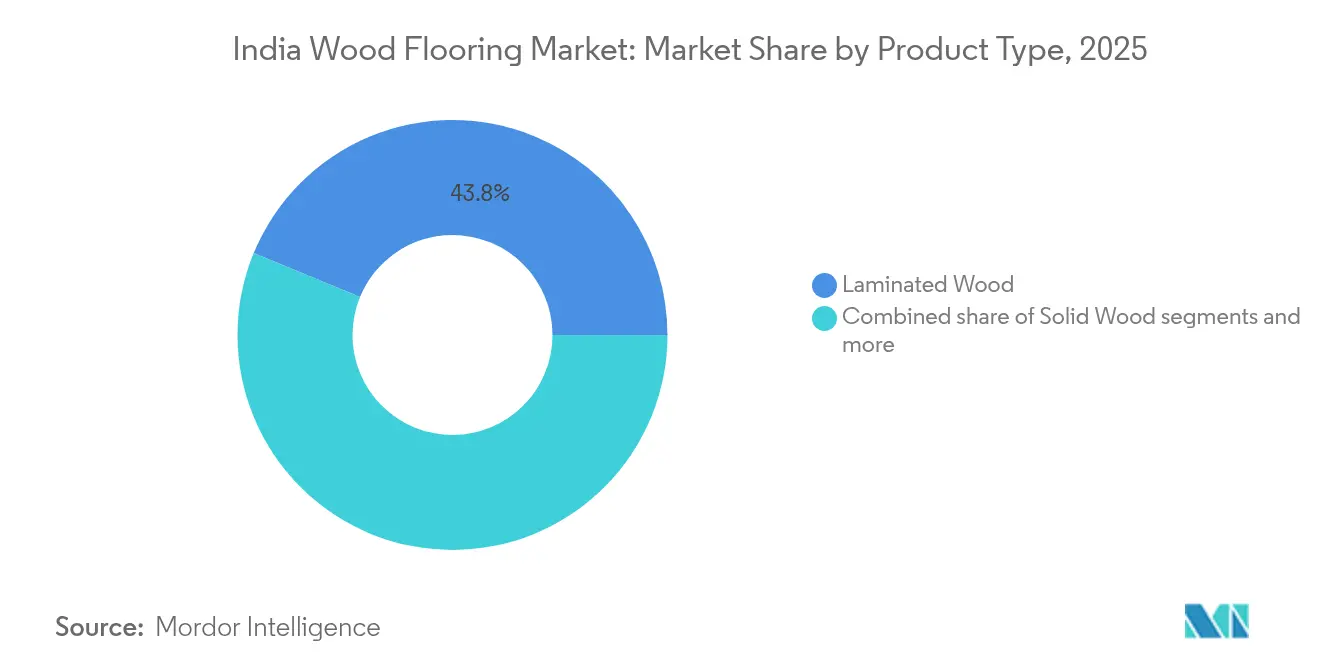
- By product type, laminated wood accounted for 43.78% of the India wood flooring market share in 2025, while the India wood flooring market size for engineered wood is forecast to expand fastest at a CAGR of 10.95% between 2026 and 2031.
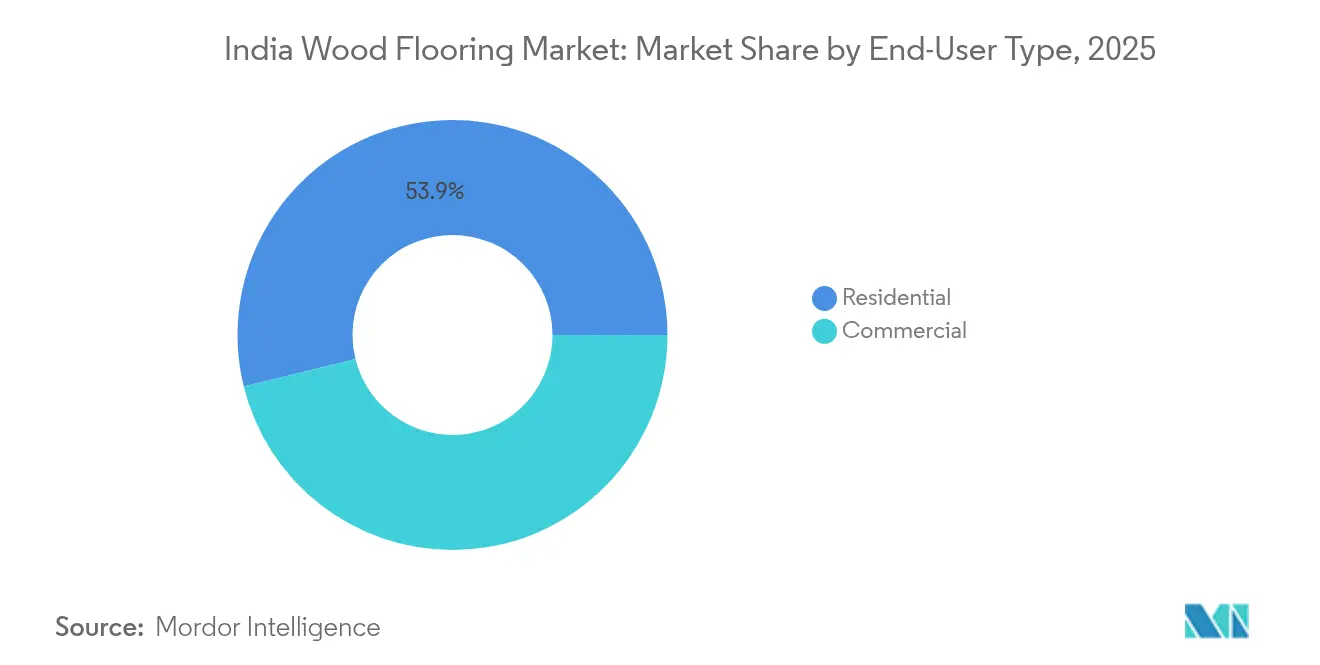
- By end-user type, residential applications captured 53.85% of the India wood flooring market share in 2025, with the India wood flooring market size for commercial end users projected to grow fastest at a CAGR of 9.22% during 2026-2031.
- By distribution channel, home centers represented 39.92% of the India wood flooring market share in 2025, while the India wood flooring market size for online channels is forecast to expand at the highest CAGR of 12.05% from 2026 to 2031.
- By geography, South India led with 32.75% of the India wood flooring market share in 2025, whereas the India wood flooring market size in West India is projected to grow fastest at a CAGR of 8.09% over 2026-2031.
Note: Market size and forecast figures in this report are generated using Mordor Intelligence’s proprietary estimation framework, updated with the latest available data and insights as of 2026.
India Wood Flooring Market Trends and Insights
Drivers Impact Analysis*
| Driver | (~) % Impact on CAGR Forecast | Geographic Relevance | Impact Timeline |
|---|---|---|---|
| Rapid urbanization-led housing boom | +1.8% | Nationwide, early gains in Mumbai, Bangalore, Chennai | Medium term (2-4 years) |
| Rising disposable incomes & premiumization | +1.5% | Urban centres, strongest in South & West India | Long term (≥4 years) |
| Commercial real-estate expansion & office retrofits | +1.2% | Tier-1 cities; spreading to Tier-2 markets | Medium term (2-4 years) |
| Cost-effective laminated/engineered options | +1.0% | National, deepening in Tier-2/3 cities | Short term (≤2 years) |
| Furniture QCOs favour certified wood flooring | +0.8% | Export hubs, premium residential projects | Long term (≥4 years) |
| E-commerce unlocking Tier-2/3 demand | +0.7% | Tier-2/3 cities countrywide | Short term (≤2 years) |
| Source: Mordor Intelligence | |||
Rapid Urbanization-Led Housing Boom
India is adding 100 million new homes this decade, yet the annual supply of 600,000 units leaves a sizeable gap that keeps flooring demand robust[1]. Residential floor space is set to surpass 50 billion m² by 2040, meaning most buildings that will exist in 2040 are still on the drawing board. The luxury housing market experienced significant growth, with its share increasing from 16% in 2018 to 43% in 2024. This expansion has driven demand for high-specification flooring solutions that offer enhanced acoustic properties and sustainability benefits. Developers targeting high-net-worth individuals are increasingly incorporating standardized engineered flooring ranges in their show apartments, a strategy that accelerates product awareness and adoption among potential buyers. Additionally, improved financing options, as banks extend mortgage accessibility to younger demographics, have facilitated the conversion of aspirational demand into finalized sales. This trend is evident across both metropolitan areas and emerging satellite towns, reflecting a broader shift in consumer preferences and purchasing power within the housing market.
Rising Disposable Incomes & Premiumization
In 2024, the high-value property market experienced a year-on-year growth, reflecting a sustained increase in purchasing power among affluent consumer segments. This trend highlights the resilience of demand within the premium real estate market, driven by the financial capacity and investment preferences of high-net-worth individuals. Shorter refurbishment cycles are driving repeat demand at a faster pace, particularly in urban apartment settings. Laminated planks, which can be replaced over a weekend without requiring extensive demolition, offer a cost-effective and time-efficient solution, making them a preferred choice for such environments. Retailers bundle extended warranties and post-installation care plans, reinforcing the value proposition of premium surfaces over low-end substitutes[2].
Commercial Real-Estate Expansion & Office Retrofits
Global capability centres and flex-space operators are increasingly modernizing older properties to meet Grade A specifications, focusing on sustainability and performance enhancements such as FSC-certified wood flooring, superior fire safety standards, and advanced acoustic solutions. The implementation of return-to-office policies has amplified the importance of employee-centric environments, driving demand for soft-touch, low-maintenance flooring options that contribute to achieving WELL or LEED certification. In central business districts (CBDs), rental growth is surpassing regional averages, motivating property owners to invest in upgrading high-traffic areas, including lobbies, circulation zones, and food courts, with durable engineered systems capable of withstanding significant footfall. The combination of retrofit activities and the development of greenfield IT parks is fuelling sustained demand for moisture-resistant, click-lock flooring products, which offer operational efficiency by reducing downtime during tenant turnover.
Cost-Effective Laminated & Engineered Options
Innovations such as edge-coating technologies now enable 24-hour spill resistance without raising the bill of materials, addressing India’s lengthy monsoon seasons. Finger-jointed plantation species have emerged as a cost-effective solution for reducing sourcing expenses. This innovation enables manufacturers to offer premium aesthetics at a more accessible price point, catering effectively to the mid-income consumer segment. Digital printing reproduces rustic or Scandinavian finishes with 4× resolution, narrowing the visual gap with solid hardwood. Engineered boards achieve transmission loss of 11 dB, satisfying new apartment acoustics codes in cities that regulate impact noise [3]. In Tier-2 markets like Indore and Lucknow, laminated price points as low as INR 120 per ft² broaden adoption among aspirational households while still providing better resale value than ceramic alternatives.
Restraints Impact Analysis*
| Restraint | (~) % Impact on CAGR Forecast | Geographic Relevance | Impact Timeline |
|---|---|---|---|
| High GST & import duties on processed wood | -1.2% | Nationwide, a higher impact on import-dependent areas | Short term (≤2 years) |
| Intense competition from ceramic & vinyl alternatives | -0.9% | Price-sensitive Tier-2/3 markets | Medium term (2-4 years) |
| Fragmented installer base & skills gap | -0.7% | National, acute in emerging towns | Long term (≥4 years) |
| Humidity-related durability concerns | -0.5% | Coastal belts of West & South India | Medium term (2-4 years) |
| Source: Mordor Intelligence | |||
High GST & Import Duties on Processed Wood
Wood flooring attracts 18% GST, while certain laminated and plywood categories incur 28%, eroding affordability compared with ceramic or SPC tiles taxed at lower slabs[4]. Despite the expansion of 24-hour clearance ports, delays in customs clearance continue to immobilize working capital and disrupt the efficiency of just-in-time inventory systems. Medium-sized traders face significant inefficiencies in reclaiming Input Tax Credit, which drives them to source lower-cost domestic alternatives. However, these substitutes often fail to meet durability standards, potentially impacting product quality and customer satisfaction. Policymakers are actively assessing measures for tax rationalization; however, the lack of clarity regarding future tax relief creates an environment of uncertainty. This uncertainty discourages distributors from committing to long-term pricing strategies, thereby affecting market stability and planning.
Intense Competition From Ceramic & Vinyl Alternatives
Rigid-core SPC and high-definition porcelain planks replicate oak or teak visuals with higher moisture tolerance, particularly attractive in coastal or ground-floor settings. Agrifiber-based SPC produced at LEED-certified plants exploits rice-husk waste, positioning itself as an eco-friendly option at a lower cost. Installation speed favours click-fit vinyl, which requires fewer specialist tools than tongue-and-groove wood, tipping project managers toward non-wood surfaces for fast-track handovers. Digital marketing by tile giants saturates consumer feeds, narrowing perceived differentiation with genuine timber. The cost-of-ownership narrative leans toward ceramic and vinyl in rental markets where landlords prefer minimal maintenance between tenants.
*Our forecasts treat driver/restraint impacts as directional, not additive. The impact forecasts reflect baseline growth, mix effects, and variable interactions.
Segment Analysis
By Product Type: Innovation Shifts Demand Toward Engineered Solutions
Engineered boards anchor growth after recording an 10.95% CAGR outlook, thanks to multilayer constructions that stabilize against India’s humidity swings. They account for a rising share of the India wood flooring market size and command premium positioning in both housing and commercial retrofits. Laminated panels, still the volume leader at 43.78% share in 2025, gain fresh life through enhanced wear layers and registered emboss finishes that mirror sawn timber grain. The India wood flooring market share of solid wood narrows to niche luxury projects where end-customers prize natural patina and are willing to fund rigorous maintenance. Manufacturers channel R&D into waterproof treatments, acoustic membranes, and recycled-content cores that align with green-building mandates.
Engineered lines now feature transmission loss up to 11 dB, fulfilling new multi-dwelling rules for impact isolation. Waterproof iterations ensure 24-hour spill protection, permitting continuous installation across kitchens and living spaces without metal junction profiles. Digital printing technology significantly enhances knot details with a 4× resolution, creating a seamless integration with solid planks. This technological advancement, coupled with the segment's focus on delivering superior aesthetics, high performance, and sustainability, strengthens its position as a key driver of growth in India's wood flooring market. The segment's ability to align with evolving consumer preferences and industry demands further underscores its leadership in shaping market dynamics.

By End-User Type: Commercial Momentum Outpaces Residential Dominance
Residential demand anchored 53.85% of 2025 revenues as urban households invested in aesthetics reflecting aspirational lifestyles. First-time buyers accelerate decision cycles with mortgage approvals moving online, enabling flooring upgrades at the point of sale. The India wood flooring market size for residential renovations rises on shorter replacement intervals of 10-12 years versus the previous 15 years. Luxury condominium developers standardize FSC-certified engineered ranges to differentiate branding, widening consumer exposure, and bolstering long-term conversion.
Commercial installations, forecast at a 9.22% CAGR, pivot on return-to-office strategies and Grade A stock additions. Corporate leases often specify LEED or WELL targets, compelling fit-out contractors to choose low-VOC, recycled-content planks. Flex operators refresh interiors every 3-5 years, generating recurrent volumes for laminated and hybrid-core products. Logistics and light manufacturing parks expand auxiliary office space, extending commercial flooring opportunities into peripheral districts. The confluence of accelerated capex and sustainability compliance positions commercial buyers as catalysts for technological adoption within the India wood flooring market.
By Distribution Channel: Digital Ecosystems Reshape Access
Home centres maintain a 39.92% share through bundled installation, finance, and after-sales packages that resonate with time-pressed urban consumers. Their private-label volumes leverage scale to hold entry-level price points, anchoring the laminated category. Online platforms, growing at a 12.05% CAGR, unlock the India wood flooring market for Tier-2 and Tier-3 buyers previously dependent on limited local selections. Visualizer apps and AI-led consultations replicate showroom experiences, shrinking discovery friction. Specialty stores focus on design-led assortments, often collaborating with architects to supply bespoke finishes for boutique hospitality or luxury villas.
Marketplace algorithms are increasingly leveraging curated bundles, which include components such as planks, underlays, and adhesives. This approach not only drives higher basket sizes but also minimizes risks associated with product compatibility, thereby enhancing the overall customer experience. Additionally, the enforcement of consumer-protection regulations requiring warranty disclosures is strengthening the position of organized brands. These regulations are effectively redirecting uncertain consumers away from unbranded imports, fostering greater trust in established players. Consequently, the adoption of omnichannel strategies has emerged as a critical factor in establishing a competitive advantage within the Indian wood flooring market.
Geography Analysis
South India retained a 32.75% revenue share in 2025 on the back of tech-sector prosperity in Bangalore, Chennai, and Hyderabad. High disposable incomes and sophisticated tenant profiles normalize engineered or solid planks in premium housing, while Grade A offices specify acoustic-rated floors to lift employee comfort. Manufacturing clusters across Tamil Nadu and Karnataka shorten lead times, aiding aggressive project schedules. Although coastal microclimates in Chennai demand higher-spec installation protocols, inland cities like Hyderabad experience thriving demand for mid-priced laminates.
West India is anticipated to achieve the highest CAGR of 8.09% through 2031, driven by the exceptional sales performance in the Mumbai Metropolitan Region during 2024 and the implementation of extensive infrastructure projects under the PM GatiShakti initiative. The increasing property valuations in peripheral locations, including Panvel and Thane, are contributing to higher flooring budgets and larger plinth areas, reflecting a shift in consumer preferences and investment patterns in the region. Gujarat’s industrial corridors and Rajasthan’s tourism-led urban revival further diversify demand. Logistics advantages via JNPT and Mundra ports facilitate raw-material imports and outbound distribution. Developers capitalize on premium seaside addresses by specifying waterproof engineered planks with salt-spray-resistant coatings, reinforcing market footholds despite climatic hurdles.
North, East, Central, and Northeast India contribute the remaining opportunity pool at varying readiness levels. Delhi-NCR’s mixed-use mega-projects drive specification of FSC-certified flooring to meet green ratings, yet affordability pressures temper penetration in mass housing. Kolkata’s commercial revival and smart-city projects in Bhubaneswar nurture gradual uptake. Central India leverages highway and industrial corridor programs to accelerate urbanity around Bhopal and Indore. Improved connectivity in Assam and Meghalaya opens nascent niches for organized suppliers.
Regulatory Landscape
India wood flooring products and their upstream wood-based inputs are shaped by Bureau of Indian Standards (BIS) standards and Government-issued Quality Control Orders (QCOs). The Wood Based Boards (Quality Control) Order, 2024, administered under the Ministry of Commerce and Industry framework and implemented through BIS licensing, mandates ISI marking for specified wood-based board categories used in construction and furniture applications. This increases compliance requirements for domestic producers and importers supplying substrates used in laminated and engineered flooring systems.
At the application level, BIS codes of practice continue to anchor installation and performance expectations, including IS 5389 (1969) for parquet and wood block floors and IS 3670 (1989) for construction of timber floors. Material guidance such as IS 287 (1993) also covers moisture-related considerations for timber. BIS also maintains product standards relevant to interior wood applications, including updated plywood specifications such as IS 303:2024 and IS 710:2024, along with related test and classification references (for example, IS 4833 for preservation testing and IS 12896 for timber classification). These requirements influence product qualification, tender specifications, and third-party testing practices across organized channels.
Value Chain Analysis
The India wood flooring value chain covers raw timber and plantation wood sourcing, wood-based panel inputs (MDF/HDF, particle board, plywood), flooring manufacturing (laminated, engineered, and solid), accessories (underlays, adhesives, trims), and downstream installation and after-sales service. Raw material procurement is often localized, with commonly cited operating practices centered on sourcing wood species within roughly a 250 km radius of manufacturing units to control delivered cost and improve supply reliability. Processing and product compliance are tied to BIS standards used across the wood products ecosystem, including IS 3670 for timber floor construction practices and panel standards such as IS 303 for general-purpose plywood, alongside BIS updates for MDF and particle board specifications that feed into core materials for laminated and engineered flooring.
On the manufacturing side, organized players increasingly link flooring to adjacent decorative surface and panel operations to secure substrates and reduce input volatility. For example, Greenlam Industries operates an engineered wooden flooring facility at Behror, Rajasthan, with a stated capacity of 1.0 million square meters, which highlights the role of integrated, scale manufacturing in supplying organized retail and project channels. Downstream, distribution runs through home centers, specialty stores, and online channels, while installation remains a key service layer. Availability of trained installers, seasonal raw material swings, and operational constraints such as power reliability can affect lead times, wastage, and delivered quality, particularly for premium engineered systems that require tighter moisture and subfloor tolerances.
Competitive Landscape
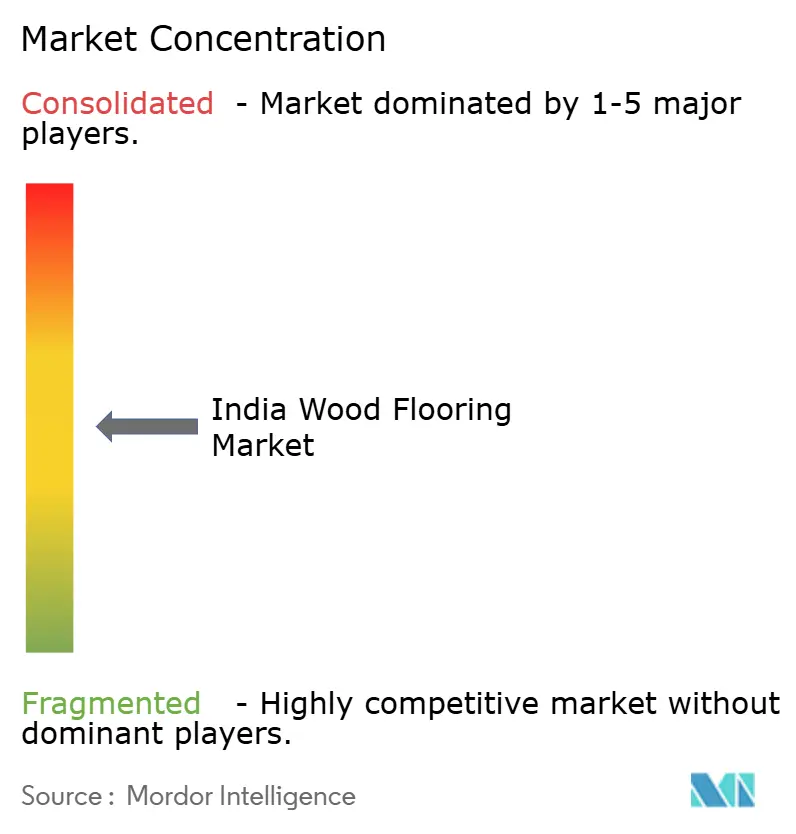
The Indian wood flooring market exhibits a moderately concentrated structure, with the top five brands collectively accounting for nearly 50% of the market share. This leaves significant opportunities for regional players and import-driven traders to establish a foothold. Leading companies are adopting vertical integration strategies, expanding into medium-density fiberboard (MDF), laminate, and decorative surface value chains. This approach not only mitigates the impact of raw material price fluctuations but also enhances operational efficiency and profit margins, providing a competitive edge in a dynamic market environment.
Sustainability has become a critical factor influencing purchasing decisions in the market. Certifications such as FSC (Forest Stewardship Council), PEFC (Program for the Endorsement of Forest Certification), GreenPro, and IGBC (Indian Green Building Council) are increasingly shaping both corporate procurement processes and consumer preferences. These credentials are now integral to meeting the growing demand for environmentally responsible products, positioning companies with strong sustainability practices as preferred suppliers in both B2B and retail segments.
International entrants are driving innovation by introducing advanced technologies, including high-definition printing and waterproof flooring solutions. To achieve nationwide market penetration, these players are forming strategic partnerships with domestic distributors. Additionally, they are investing in collaborative training programs aimed at standardizing installation practices, which currently vary significantly across regions. By addressing inconsistencies in workmanship, these initiatives are expected to enhance customer satisfaction and support the long-term growth of the market.
India Wood Flooring Industry Leaders
-
Greenlam Industries Ltd.
-
Pergo (Mohawk Industries)
-
Greenpanel Industries Ltd.
-
SquareFoot Flooring Pvt. Ltd.
-
Action Tesa
- *Disclaimer: Major Players sorted in no particular order
Market Opportunities and Future Outlook
Certification-led procurement and standards-driven consolidation create a clear whitespace for suppliers that can document legal sourcing and product compliance for modern projects. Corporate and developer procurement tied to green-building credentials (FSC/PEFC and India-focused labels such as IGBC and GreenPro) is already influencing specifications in Grade A offices and premium housing. The Wood Based Boards (Quality Control) Order, 2024, also lifts the relevance of BIS licensing and ISI marking across the substrate ecosystem used in laminated and engineered floors. Together, these factors favor organized brands that can support channel partners with tested, labeled products and installation systems aligned with BIS codes of practice such as IS 5389 and IS 3670.
A second opportunity area is local capacity and capability build-out in engineered surfaces and core materials that improve moisture and wear performance versus traditional solid wood, particularly for monsoon and coastal conditions that come up in buyer decision-making. Recent industry moves reinforce this direction. Greenlam Industries announced large-scale laminate manufacturing investment in Andhra Pradesh (Naidupeta), while Action TESA advanced a new MDF facility in Visakhapatnam with ANDRITZ supplying key refining technology. These investments expand domestic availability of boards and decorative surfaces that sit upstream to laminated and engineered flooring, supporting wider assortment (including waterproof and acoustic-oriented builds), faster replenishment for home centers and online channels, and more consistent quality where imports face duty and clearance friction.
Recent Industry Developments
- June 2026: Action TESA stated it is adding production capacity through a new state-of-the-art manufacturing plant in Visakhapatnam, Andhra Pradesh. The move strengthens local supply of wood-based products that feed into laminated and engineered flooring ecosystems and supports faster fulfillment for organized channels. Concentrating capacity in Andhra Pradesh also aligns with the state emerging as a manufacturing hub for decorative surfaces and wood-based boards.
- November 2025: Action TESA selected ANDRITZ to supply a pressurized refining system for a new MDF production facility in Visakhapatnam, with start-up targeted for Q2 2026. Advanced refining and process technology improves consistency and throughput of MDF, a critical core input for many wood-flooring constructions and related interior applications. The project signals continued investment in higher-performance board manufacturing within India.
- July 2024: Greenlam Industries announced an investment of INR 1,147 crore to set up a laminate factory in Naidupeta, Andhra Pradesh, eligible for incentives under the Andhra Pradesh Industrial Development Policy 4.0 (2024-29). Scaling laminate manufacturing supports the largest volume segment of wood-look flooring and adjacent decorative surface demand in India. The incentive-linked location choice also reflects competitive positioning around cost, logistics, and long-term capacity planning.
Research Methodology Framework and Report Scope
Market Definition and Coverage
For this methodology, the India wood flooring market covers the value of wood based flooring products sold and installed in India across residential and commercial buildings, counted at the point of sale or project billing in a given year.
Scope exclusions: Excludes non-wood floor coverings like ceramic tiles, vinyl, carpet, and stone, along with adhesives and underlay sold as standalone items.
Segmentation Overview
- By Product Type
- Solid Wood
- Laminated Wood
- Engineered Wood
- By End-User Type
- Residential
- Commercial
- By Distribution Channel
- Home Centers
- Specialty Stores
- Online
- Other Distribution Channels
- By Geography
- North India
- South India
- West India
- East India
- Central India
- Northeast India
Data Sources, Market Sizing, and Validation
Desk Research
To set the groundwork, we mapped the demand pool tied to construction and renovation where wood flooring is typically specified, then matched it with trade and supply signals. Public sources were used to understand housing completions, commercial building activity, and related material demand, such as Ministry of Statistics and Programme Implementation (MOSPI) releases, the Ministry of Commerce and Industry trade statistics, India's National Building Code references and CPWD schedules, and publications from bodies like the Indian Green Building Council and Bureau of Indian Standards.
We also reviewed company annual reports, investor presentations, and credible business press to understand product positioning, channel focus, and pricing movement for wood flooring. Where needed, we used paid subscriptions for company financials and news, plus an import export shipment-level database and a patent database, to cross-check supplier footprints and product innovation signals, without relying on any single data point. The desk sources listed here are illustrative only, and other public and paid references were used for validation and clarification through the study.
Primary Interviews and Surveys
We then validated the practical market boundary through expert interviews and structured surveys with distributors, installers, architects, contractors, and procurement teams involved in residential and commercial projects across India. Respondent inputs were used to confirm product mix, typical order sizes, replacement cycles, and channel margins, which helped tighten assumptions that public statistics alone could not reliably cover.
Distribution of primary research fieldwork respondents
| Company type | Respondent position |
|---|---|
| Top tier: 31% | CXOs: 13% |
| Mid tier: 55% | Functional/Unit leaders: 36% |
| Smaller Players: 14% | Managers: 51% |
Market-Sizing & Forecasting
The core model uses a top-down build where construction and renovation activity in India is translated into addressable flooring demand, then narrowed to wood flooring adoption using penetration rates validated in interviews. This demand pool is converted to value using average selling price bands that reflect product type, project type, and channel markups.
To keep totals grounded, we cross-check outputs with selective bottom-up approximations, including sampled installer throughput, distributor sell-through checks, and indicative import volume signals converted to square feet and value using realistic price ranges. Key inputs used in the model include new housing and premium apartment launches, commercial fit-out activity, renovation intensity in large cities, wood flooring share within interior spend, and typical installed price movement, especially for imported versus locally sourced material. Where supplier reporting is patchy, we handle gaps by using conservative channel markups and triangulating with multiple respondents before finalizing.
For forecasting, scenario analysis is used because demand is sensitive to real estate cycles and consumer spending on interiors. Assumptions on construction momentum, remodeling activity, and price progression are stress-tested using interview feedback before selecting the final forecast path.
Data Validation & Update Cycle
Model outputs are checked against independent signals such as trade movements, project pipeline commentary, and reported capacity additions, and then outliers are reviewed before sign-off. If a value shift is driven by one variable only, that assumption is revisited and respondents are re-contacted to confirm whether the change is real or an input issue.
Each report is refreshed annually, and interim updates are made when material events occur, such as sharp price changes, policy shifts affecting imports, or visible demand slowdowns in construction. Before delivery, we complete a fresh review pass so the final numbers reflect the latest available information and reconciled assumptions.
Mordor Intelligence's India Wood Flooring Market Size Measured Against Other Published Estimates
Published market values can differ even for the same country and product because the scope boundary is not always identical, and the pricing basis can shift the total significantly. Differences also come from how much of installation value is counted, which sales channels are included, and whether the estimate is tied back to measurable demand signals.
Import signals, installer throughput checks, and channel margin validation are the evidence points that keep Mordor Intelligence's estimate tied to real consumption and installed pricing, rather than being a simple revenue extrapolation from a narrow set of suppliers.
Benchmark comparison
| Source | Market Size | Gaps in Research Methodology |
|---|---|---|
| Mordor Intelligence | USD 1.97 B (2025) | |
| Industry Research Publisher A | USD 1.60 B (2025) | Often reflects a tighter definition of wood flooring demand, with more conservative penetration and pricing assumptions, and limited adjustment for installed value and channel markups across project types. |
| Business Journal B | USD 0.39 B (2026) | Uses a current rupee range presented as an annual market value without a clearly stated year basis or conversion timing, and it appears skewed toward premium residential and selective commercial usage rather than the full addressable market. |
The spread in the table mainly comes from how each source treats the demand boundary and the value layer, meaning product-only versus installed value and which end users are fully counted. By keeping the model traceable to construction activity, adoption rates, and practical price bands validated with market participants, the final number stays explainable and consistent across years.
Key Questions Answered in the Report
What is the projected size of the India wood flooring market by 2031?
It is forecast to reach USD 2.94 billion, reflecting a 6.91% CAGR between 2026-2031.
Which product category will grow fastest through 2031?
Engineered wood flooring is expected to record an 10.95% CAGR due to waterproof and acoustic enhancements.
How quickly are online channels expanding for wood flooring in India?
E-commerce sales are set to grow at a 12.05% CAGR as digital tools broaden access in Tier-2 and Tier-3 cities.
Which region will show the strongest growth momentum?
West India is projected to post an 8.09% CAGR through 2031 on the back of housing and infrastructure booms.
Why are certifications important when selecting wood flooring?
FSC and PEFC credentials assure legal, sustainable sourcing and help projects earn LEED points, leading many corporate buyers to favor certified products.
What hampers installation quality in emerging towns?
A fragmented installer base and limited formal training lead to inconsistent workmanship, restricting premium product adoption.