
India Traditional Snacks Market Size and Share
Market Overview
| Study Period | 2021 - 2031 |
|---|---|
| Forecast Data Period | 2026 - 2031 |
| Base Year Market Size (2025) | USD 6.64 Billion |
| Market Size (2026) | USD 7.37 Billion |
| Market Size (2031) | USD 12.84 Billion |
| Growth Rate (2026 - 2031) | 11.74 % |
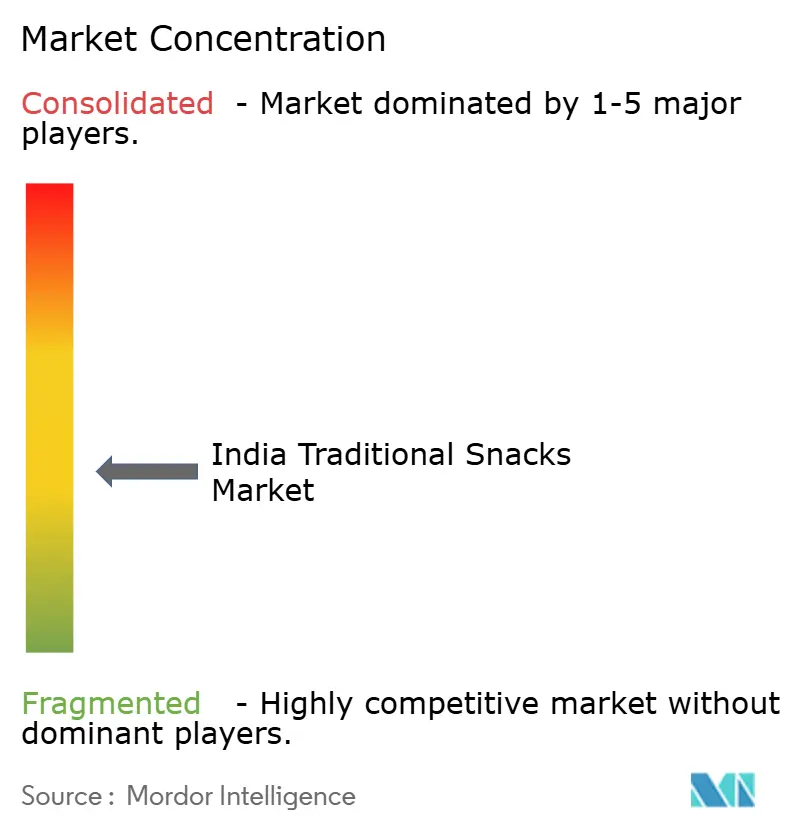
| Market Concentration | Medium |
Major Players *Disclaimer: Major Players sorted in no particular order Image © Mordor Intelligence. Reuse requires attribution under CC BY 4.0. | |
India Traditional Snacks Market Analysis by Mordor Intelligence
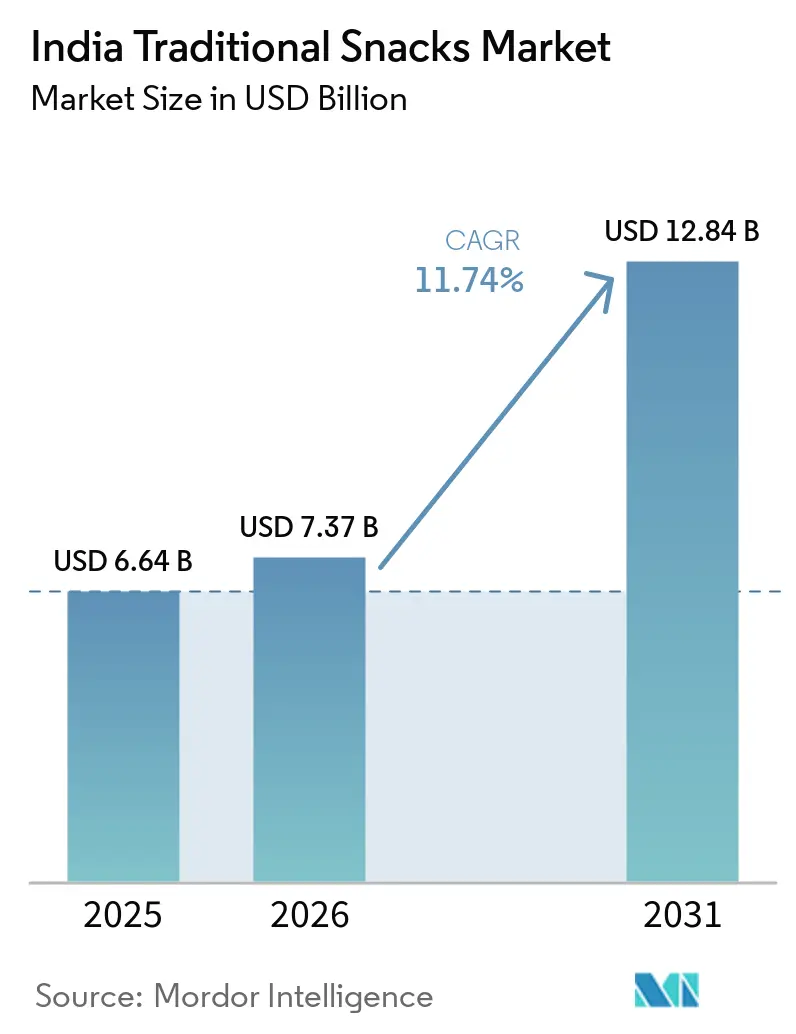
The India traditional snacks market size is expected to grow from USD 6.64 billion in 2025 to USD 7.37 billion in 2026 and is forecast to reach USD 12.84 billion by 2031 at a 11.74% CAGR over 2026-2031. Market growth is driven by the ongoing shift from loose, unbranded snacks to hygienically packaged products, supported by expanding organized retail and quick-commerce channels. Despite the increasing presence of branded manufacturers, the market remains fragmented, with regional and local players maintaining a strong foothold across states through localized product offerings and established consumer loyalty. Rising consumer preference for healthier formulations, including millet-based and low-oil variants, is encouraging product innovation, while raw material price volatility and competition from the unorganized sector continue to influence pricing strategies and profitability across the industry.
Key Report Takeaways
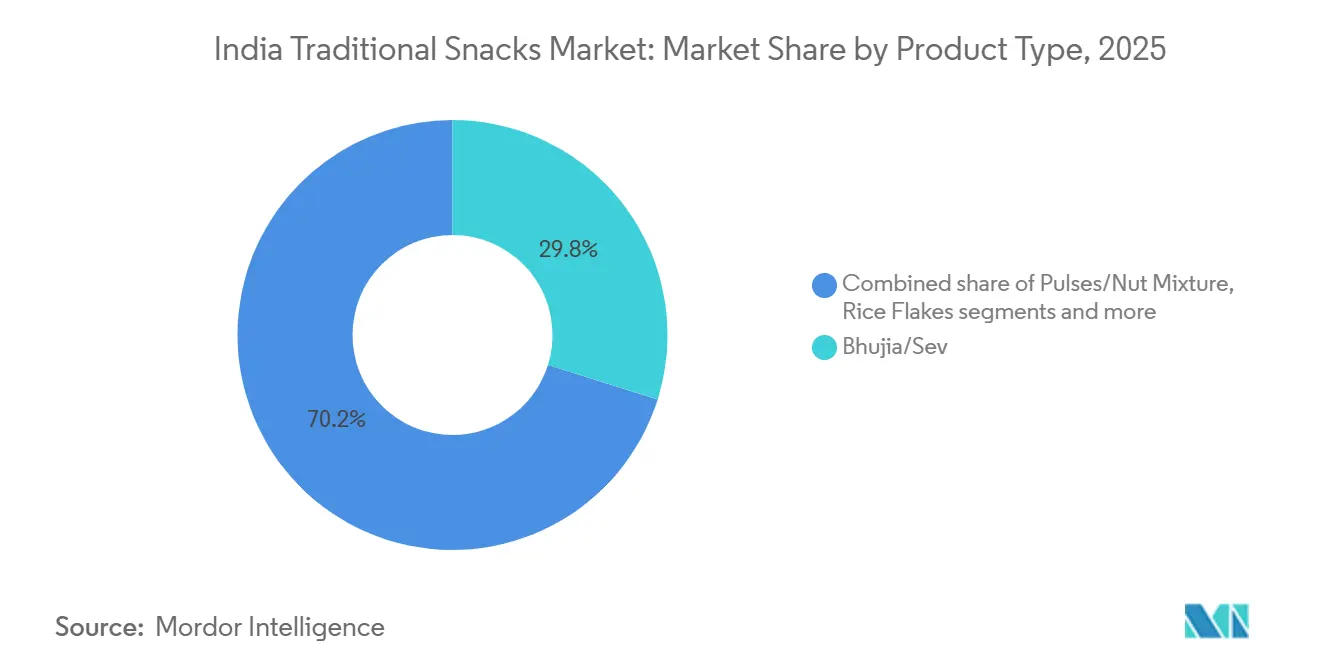
- By product type, bhujia/sev held the largest 2025 share of the India traditional snacks market at 29.84%, while rice flakes/cereal mixes is forecast to record the highest CAGR of 12.74% during 2026-2031.
- By ingredient base, pulse-based products led the India traditional snacks market with a 34.68% share in 2025, while millet-based products are forecast to grow at a 13.00% CAGR during 2026-2031.
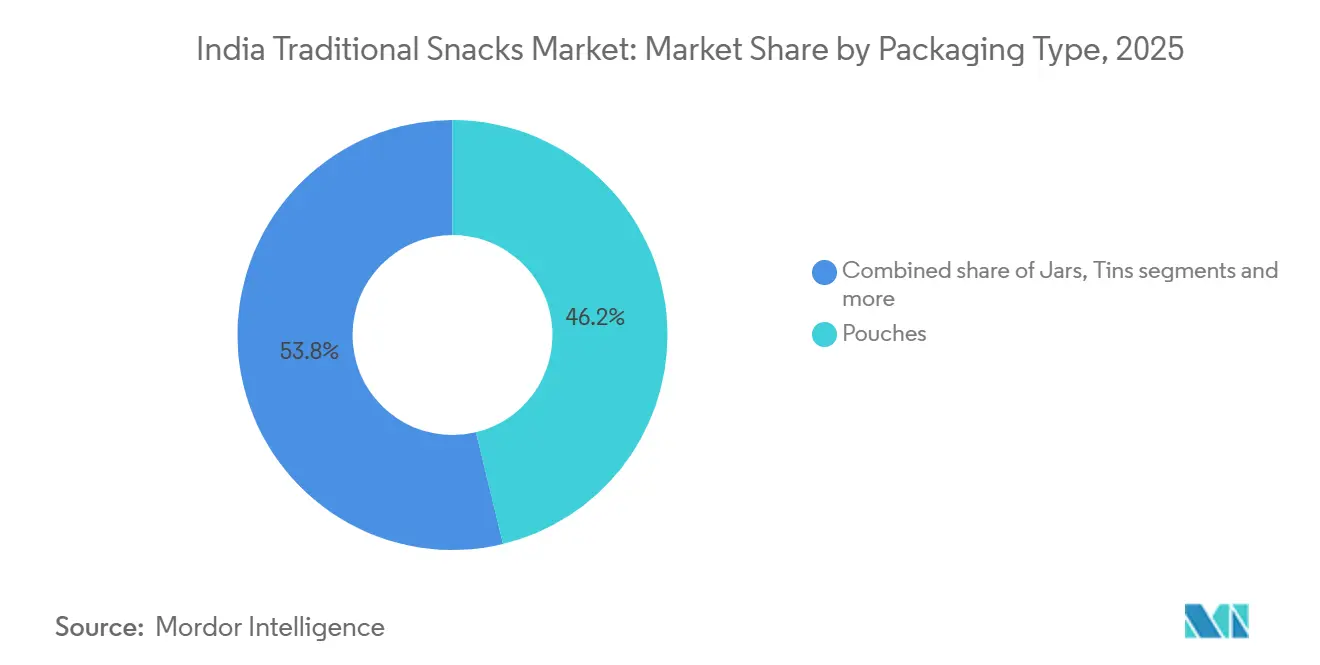
- By packaging type, pouches accounted for a 46.23% share in 2025, while single-serve packs are forecast to expand at a 12.13% CAGR during 2026-2031 across urban and smaller-city retail settings.
- By distribution channel, convenience stores represented the largest 2025 share at 42.34%, while online retail stores are forecast to grow at a 13.08% CAGR during 2026-2031, led by metro and tier-II city demand.
Note: Market size and forecast figures in this report are generated using Mordor Intelligence’s proprietary estimation framework, updated with the latest available data and insights as of January 2026.
India Traditional Snacks Market Trends and Insights
Drivers Impact Analysis*
| Driver | (~) % Impact on CAGR Forecast | Geographic Relevance | Impact Timeline |
|---|---|---|---|
| Rising demand for hygienic, branded packaged namkeen | +2.2% | Pan-India; strongest in North and West India | Short term (≤ 2 years) |
| Quick commerce and online grocery expand access to traditional snacks | +1.5% | Metro and Tier-1 cities, expanding to Tier-2 | Medium term (2–4 years) |
| Expansion of modern trade across tier-II and tier-III cities | +1.3% | Tier-2 and Tier-3 cities, pan-India | Medium term (2–4 years) |
| Growing demand for clean-label, low-oil, and millet-based traditional snacks | +1.5% | Pan-India; led by urban metros and Tier-1 cities | Long term (≥ 4 years) |
| Increasing preference for regional and authentic Indian flavors | +1.0% | Pan-India; regional pockets across North, South, and West | Medium term (2–4 years) |
| Premiumization of traditional Indian snacks through value-added offerings | +1.3% | Metro and Tier-1 cities, expanding to Tier-2 | Long term (≥ 4 years) |
| Source: Mordor Intelligence | |||
Rising Demand for Hygienic, Branded Packaged Namkeen
Growing consumer preference for hygienic, branded packaged namkeen is driving the India traditional snacks market, as food safety, product quality, and consistent taste become increasingly important purchasing considerations. Consumers are gradually shifting from loose, unbranded snacks to packaged alternatives that offer standardized manufacturing, clear ingredient labeling, and longer shelf life. This is further supported by the expansion of organized retail and e-commerce channels, which have improved the availability and visibility of branded traditional snacks across urban and semi-urban markets. In response, manufacturers are expanding their packaged namkeen portfolios with a wider range of regional flavors, convenient pack sizes, and premium offerings to meet evolving consumer preferences.
Quick Commerce and Online Grocery Expand Access to Traditional Snacks
The rapid expansion of quick commerce and online grocery platforms is improving consumer access to traditional snacks by increasing the availability of packaged namkeen across metropolitan and smaller cities. According to the India Brand Equity Foundation (IBEF), India had 280–300 million online shoppers in 2025, making it the world's second-largest e-retail market[1]. Tier-III cities recorded 21% year-on-year growth during the 2025 summer sales and contributed 38% of total e-commerce order volumes, reflecting the growing adoption of online shopping beyond major urban centers[2]. Additionally, 30% of India's online shoppers are from rural areas, while 45% are women, indicating the broadening demographic reach of digital commerce[3]. The continued expansion of online retail channels is enabling branded traditional snack manufacturers to strengthen product availability and reach a wider consumer base across the country.
Expansion of Modern Trade Across Tier-II and Tier-III Cities
The expansion of modern trade formats across tier-II and tier-III cities is driving the India traditional snacks market by improving the availability and visibility of branded packaged products. The growing presence of supermarkets, hypermarkets, and organized retail outlets is enabling manufacturers to expand beyond metropolitan markets and reach a broader consumer base with standardized product offerings. Modern retail channels also provide greater shelf space for regional and premium traditional snacks, encouraging product differentiation and brand recognition. As organized retail penetration increases across smaller cities, traditional snack manufacturers are strengthening their distribution networks and introducing localized product portfolios to cater to regional consumer preferences.
Growing Demand for Clean-Label, Low-Oil, and Millet-Based Traditional Snacks
Rising consumer awareness of health and nutrition is driving demand for clean-label, low-oil, and millet-based traditional snacks across India. Consumers are increasingly seeking products made with familiar ingredients, lower levels of oil and artificial additives, and grains perceived to offer higher nutritional value. In response, manufacturers are expanding their portfolios with baked, roasted, and millet-based variants while reformulating existing products to align with evolving dietary preferences. This shift is supporting product innovation and enabling companies to cater to health-conscious consumers without significantly altering the traditional taste and appeal of Indian snacks. The availability of these variants across both packaged and modern retail channels is also improving consumer access. Manufacturers are increasingly highlighting ingredient composition and preparation methods to differentiate healthier snack offerings.
Restraints Impact Analysis*
| Restraint | (~) % Impact on CAGR Forecast | Geographic Relevance | Impact Timeline |
|---|---|---|---|
| High raw-material price volatility | -1.5% | Pan-India; most acute for palm-oil-dependent manufacturers | Short term (≤ 2 years) |
| Health concerns around salt, oil, and deep-fried consumption | -1.0% | Urban metros and Tier-1 cities | Long term (≥ 4 years) |
| Intense competition from unorganized local snack manufacturers | -1.8% | Tier-2, Tier-3 cities, and rural India | Medium term (2–4 years) |
| Price sensitivity limits premiumization of traditional snacks | -1.2% | Semi-urban and rural markets | Long term (≥ 4 years) |
| Source: Mordor Intelligence | |||
High Raw-Material Price Volatility
Volatility in the prices of key raw materials, including edible oils, pulses, potatoes, spices, and packaging materials, is restraining the growth of the India traditional snacks market. Fluctuating input costs increase production expenses and make it difficult for manufacturers to maintain consistent pricing, particularly in value-oriented product segments. Small and regional producers are especially vulnerable to sudden cost increases due to limited procurement scale and lower bargaining power. As a result, manufacturers often face pressure on profit margins or must implement price revisions and adjust product pack sizes, which can affect consumer demand in price-sensitive markets.
Health Concerns Around Salt, Oil, and Deep-Fried Consumption
Growing consumer awareness of the health risks associated with high salt, oil, and deep-fried food consumption is restraining the India traditional snacks market. Increasing preference for healthier eating habits is encouraging consumers to moderate their intake of conventional fried snacks or switch to baked, roasted, and lower-fat alternatives. This shift is prompting manufacturers to reformulate products with reduced sodium and oil content while expanding healthier product offerings. However, balancing improved nutritional profiles with the traditional taste and texture expected by consumers remains a key challenge for manufacturers.
*Our forecasts treat driver/restraint impacts as directional, not additive. The impact forecasts reflect baseline growth, mix effects, and variable interactions.
Segment Analysis
By Product Type: Bhujia/Sev Anchors Share, Cereal Mixes Reshape the Frontier
Bhujia/sev accounted for the largest share of the India's traditional snacks market, representing 29.84% of the market in 2025. The segment's position is supported by its widespread consumption across households, strong regional heritage, and availability in a wide range of flavors and pack sizes. Its versatility as a standalone snack and as an accompaniment to traditional dishes has contributed to consistent demand across both urban and rural markets. The increasing availability of branded packaged bhujia through organized retail and online channels has further strengthened the segment's market position.
Rice flakes/cereal mixes is projected to register the fastest CAGR of 12.74% during 2026–2031. Growth is driven by rising consumer preference for lighter and perceived healthier snack options, along with increasing demand for clean-label and millet-based formulations. Manufacturers are expanding their portfolios with innovative cereal-based traditional snacks to cater to evolving dietary preferences. The growing presence of these products across supermarkets, hypermarkets, and online grocery platforms is expected to further support segment growth during the forecast period.

By Ingredient Base: Pulse-Led Value Pivot Toward Millet
Pulse-based ingredients accounted for the largest share of the India traditional snacks market, representing 34.68% in 2025. This segment's dominance is driven by the widespread use of gram flour, lentils, and other pulse-based ingredients in popular traditional snacks such as bhujia, sev, mixtures, and farsan. Their versatility, familiar taste, and suitability across a wide range of regional recipes have supported sustained demand. Additionally, the established domestic supply of pulses has enabled manufacturers to maintain a diverse portfolio of pulse-based traditional snacks across different price points.
Millet-based ingredients are projected to register the fastest CAGR of 13.00% during 2026–2031. Growth is supported by increasing consumer preference for nutritious and clean-label snack options, along with rising product innovation in millet-based formulations. Manufacturers are expanding their offerings to meet growing demand for healthier traditional snacks, while also benefiting from improved millet availability in India. Continued government support for millet cultivation and promotion is also expected to encourage wider adoption of millet-based ingredients in the traditional snacks market.
By Packaging Type: Pouches Dominate Value Economics, Single-Serve Formats Lead Growth
Pouches accounted for the largest share of the India traditional snacks market, representing 46.23% in 2025. This dominance is attributed to their cost-effectiveness, lightweight design, and ability to preserve product freshness while supporting convenient storage and transportation. Pouches are widely used across both premium and value-priced traditional snacks and are available in a broad range of pack sizes to cater to diverse consumer needs. Their strong presence across supermarkets, convenience stores, and online retail channels has further reinforced their position in the market.
Single-serve packs are projected to register the fastest CAGR of 12.13% during 2026–2031. Growth is driven by increasing demand for affordable, on-the-go snack options among urban consumers and the rising popularity of impulse purchases through convenience stores and quick-commerce platforms. Manufacturers are expanding their portfolios with smaller pack sizes to improve accessibility and encourage trial purchases across different consumer segments. The continued growth of organized retail and online grocery channels is expected to further support demand for single-serve packaging formats during the forecast period.
By Distribution Channel: Convenience Stores Drive Value, Online Retail Redefines Discovery
Convenience stores accounted for the largest share of the India traditional snacks market, representing 42.34% in 2025. This segment's dominance is driven by the extensive presence of kirana stores and neighborhood retailers, which provide consumers with easy access to traditional snacks across urban and rural markets. Their proximity, strong customer relationships, and ability to cater to frequent, low-value purchases make them the preferred retail channel for packaged namkeen and other traditional snacks. The widespread distribution networks of branded manufacturers through these outlets further support the segment's dominant position.
Online retail stores are projected to register the fastest CAGR of 13.08% during 2026–2031. Growth is supported by the rapid expansion of e-commerce and quick-commerce platforms, increasing smartphone and internet penetration, and rising consumer preference for home delivery. Online channels offer a wider assortment of regional and premium traditional snacks while enabling manufacturers to reach consumers beyond their conventional distribution networks. Continued improvements in digital commerce infrastructure and logistics are expected to further accelerate online retail growth during the forecast period.
Competitive Landscape
The India traditional snacks market is moderately fragmented and features large national brands alongside numerous regional and local manufacturers catering to diverse consumer preferences across the country. Haldiram Snacks Pvt. Ltd., Bikaji Foods International Ltd., Balaji Wafers & Namkeens, Gopal Snacks Limited, and Prataap Snacks Limited are among the key players, competing through extensive distribution networks, broad product portfolios, and continuous product innovation. Regional manufacturers maintain a strong presence by offering localized flavors and leveraging established distribution through traditional retail channels.
Leading companies are strengthening their market positions through capacity expansion, portfolio diversification, packaging innovation, and wider distribution across modern trade and digital commerce channels. They are increasingly introducing healthier product variants, premium offerings, and region-specific traditional snacks to address evolving consumer preferences. Strategic investments, partnerships, and manufacturing upgrades are enabling established players to improve operational efficiency and expand their presence in domestic and export markets.
The competitive landscape continues to evolve with the growing participation of regional manufacturers and emerging packaged snack brands. Smaller companies are differentiating themselves through authentic regional recipes, premium positioning, and clean-label product offerings while expanding their presence through e-commerce and organized retail. As consumer demand for branded traditional snacks continues to grow, competition is expected to intensify, with both established and emerging players focusing on innovation, distribution expansion, and product quality to strengthen their market positions.
India Traditional Snacks Industry Leaders
-
Haldiram Snacks Pvt. Ltd.
-
Bikaji Foods International Ltd.
-
Balaji Wafers & Namkeens
-
Gopal Snacks Limited
-
Prataap Snacks Limited
- *Disclaimer: Major Players sorted in no particular order
Recent Industry Developments
- February 2026: The Competition Commission of India (CCI) approved the proposed acquisition of a stake in Haldiram Snacks Food Pvt. Ltd. by L. Catterton India Fund, supporting the company's long-term growth strategy and strengthening its position in India's organized packaged traditional snacks market.
- October 2025: Haldiram Snacks Pvt. Ltd., Balaji Wafers, and Bikaji Foods International Ltd. expanded their festive product offerings and premium packaged snack portfolios ahead of the 2025 Diwali season, responding to rising consumer demand for healthier, premium, and gift-oriented traditional snacks while intensifying competition in India's organized snacks market.
- July 2025: Bikaji Foods International Ltd. entered into a 50:50 joint venture with Nepal's Chaudhary Group (CG Foods Nepal) to manufacture, market, and distribute Bikaji's snack portfolio in Nepal, supporting the company's international expansion strategy and strengthening its presence in the South Asian packaged snacks market.
India Traditional Snacks Market Report Scope
The India traditional snacks market comprises packaged traditional savory snacks widely consumed across the country for everyday snacking, festive occasions, and social gatherings. The market is segmented by product type into bhujia/sev, pulses/nut mixture, rice flakes/cereal mixes, deep-fried snacks, and others. Based on ingredient base, the market is categorized into pulse-based, potato-based, rice-based, fine wheat flour-based, millet-based, and other ingredient bases. By packaging type, the market is segmented into pouches, jars, tins, multipacks, and single-serve packs. Based on distribution channel, the market is categorized into supermarkets/hypermarkets, convenience stores, online retail stores, and other distribution channels. For each segment, the market sizing and forecasting have been done in value terms (USD billion).
| Bhujia/Sev |
| Pulses/Nut Mixture |
| Rice Flakes/Cereal Mixes |
| Deep-Fried Snacks |
| Others |
| Pulse-Based |
| Potato-Based |
| Rice-Based |
| Fine Wheat Four Based |
| Millet-Based |
| Other Ingredient Bases |
| Pouches |
| Jars |
| Tins |
| Multipacks |
| Single-Serve Packs |
| Supermarkets/Hypermarkets |
| Convenience Stores |
| Online Retail Stores |
| Other Distribution Channels |
| By Product Type | Bhujia/Sev |
| Pulses/Nut Mixture | |
| Rice Flakes/Cereal Mixes | |
| Deep-Fried Snacks | |
| Others | |
| By Ingredient Base | Pulse-Based |
| Potato-Based | |
| Rice-Based | |
| Fine Wheat Four Based | |
| Millet-Based | |
| Other Ingredient Bases | |
| By Packaging Type | Pouches |
| Jars | |
| Tins | |
| Multipacks | |
| Single-Serve Packs | |
| By Distribution Channel | Supermarkets/Hypermarkets |
| Convenience Stores | |
| Online Retail Stores | |
| Other Distribution Channels |
Key Questions Answered in the Report
What is the projected value of India traditional snacks in 2031?
The market is forecast to reach USD 12.84 billion by 2031, growing at a CAGR of 11.74% from 2026 to 2031.
Which product type had the largest share in 2025?
Bhujia/Sev was the largest product type, with a 29.84% value share in 2025.
Which ingredient category is expected to grow fastest through 2031?
Millet-Based products are forecast to grow at a 13.00% CAGR during 2026-2031, supported by health-oriented demand and domestic millet availability.
Which packaging format leads traditional snacks sales?
Pouches held 46.23% share in 2025 because they serve the low-price, frequent-purchase formats common in neighborhood retail.