
India Self-Monitoring Blood Glucose Devices Market Size and Share
Market Overview
| Study Period | 2020 - 2031 |
|---|---|
| Forecast Data Period | 2026 - 2031 |
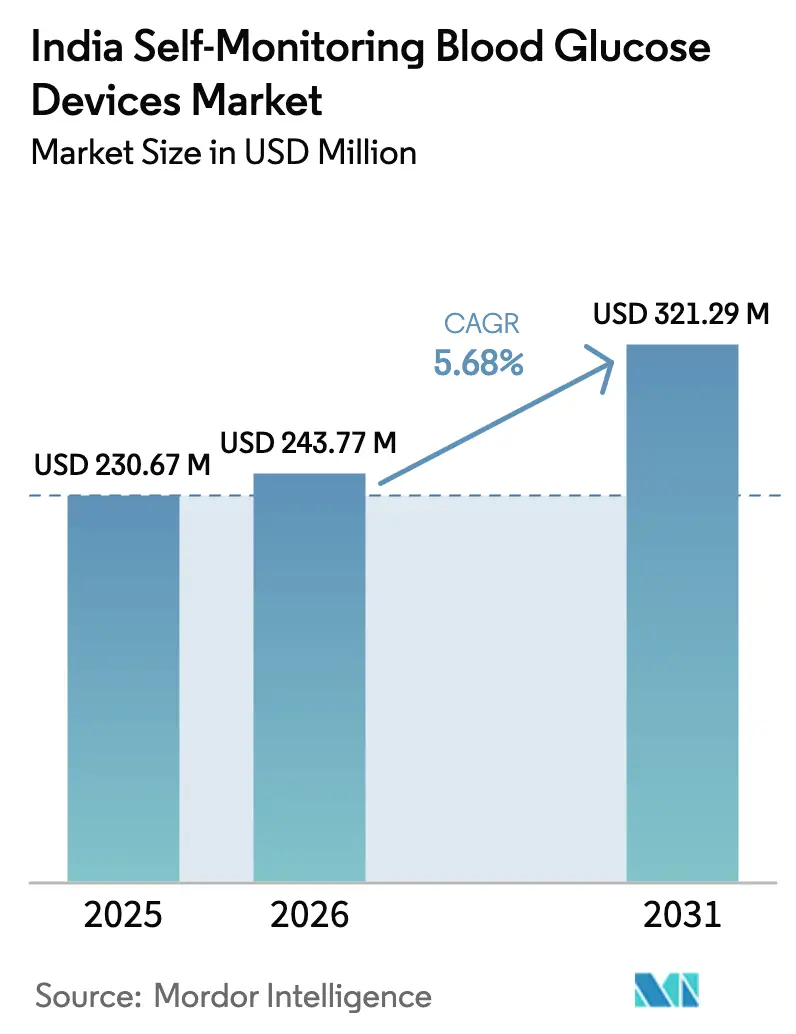
| Base Year Market Size (2025) | USD 230.67 Million |
| Market Size (2026) | USD 243.77 Million |
| Market Size (2031) | USD 321.29 Million |
| Growth Rate (2026 - 2031) | 5.68 % |
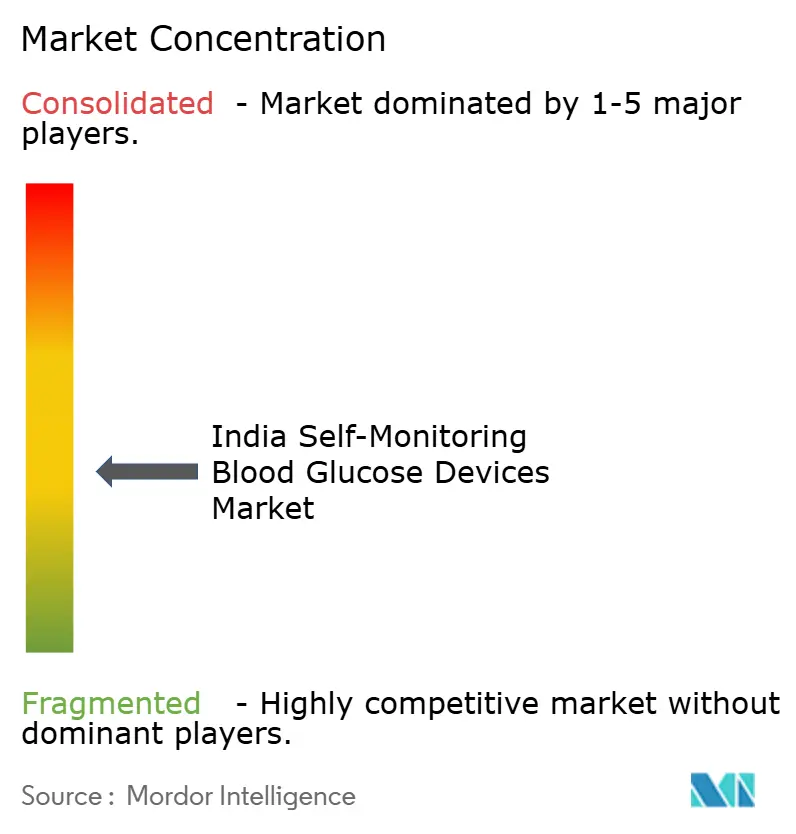
| Market Concentration | Medium |
Major Players *Disclaimer: Major Players sorted in no particular order Image © Mordor Intelligence. Reuse requires attribution under CC BY 4.0. | |
India Self-Monitoring Blood Glucose Devices Market Analysis by Mordor Intelligence
The India Self-Monitoring Blood Glucose Devices market size was valued at USD 230.67 million in 2025 and estimated to grow from USD 243.77 million in 2026 to reach USD 321.29 million by 2031, at a CAGR of 5.68% during the forecast period (2026-2031). Rising diabetes prevalence, earlier disease onset among working-age adults, and smartphone-enabled glucometers are propelling the India Self-Monitoring Blood Glucose Devices market. Government screening under the National Programme for Prevention and Control of Cancer, Diabetes, Cardiovascular Diseases and Stroke has boosted detection volumes, while tightening quality regulations are sidelining refurbished imports and counterfeit strips. Domestic production incentives lower consumable costs, e-pharmacy subscriptions improve rural access, and AI-enabled coaching drives adherence, all reinforcing the expansion of the India Self-Monitoring Blood Glucose Devices market.
Key Report Takeaways
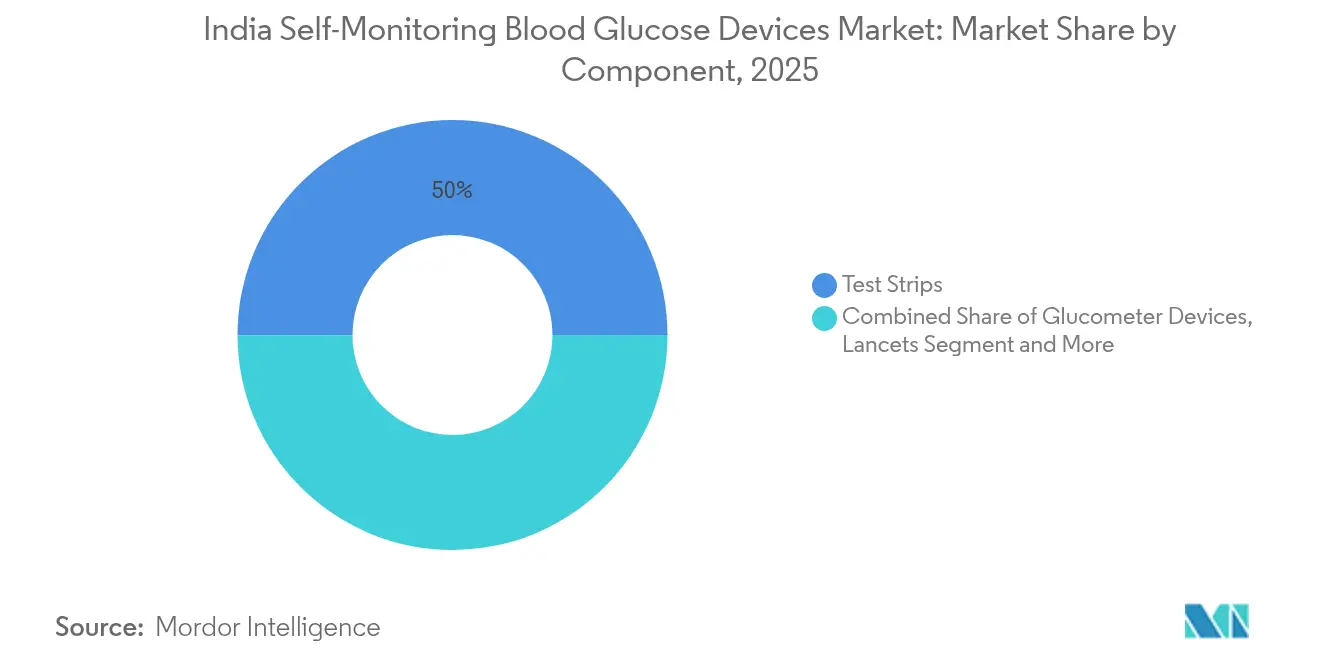
- By component, test strips led with 50.02% of the India Self-Monitoring Blood Glucose Devices market share in 2025; glucometer devices are expanding at an 10.74% CAGR through 2031.
- By technology, electrochemical biosensors commanded 76.10% revenue share in 2025, while smartphone-integrated dongles are projected to grow at a 15.28% CAGR to 2031.
- By end user, home-care patients accounted for 62.05% share of the India Self-Monitoring Blood Glucose Devices market size in 2025, with clinics & diagnostic labs advancing at a 12.35% CAGR through 2031.
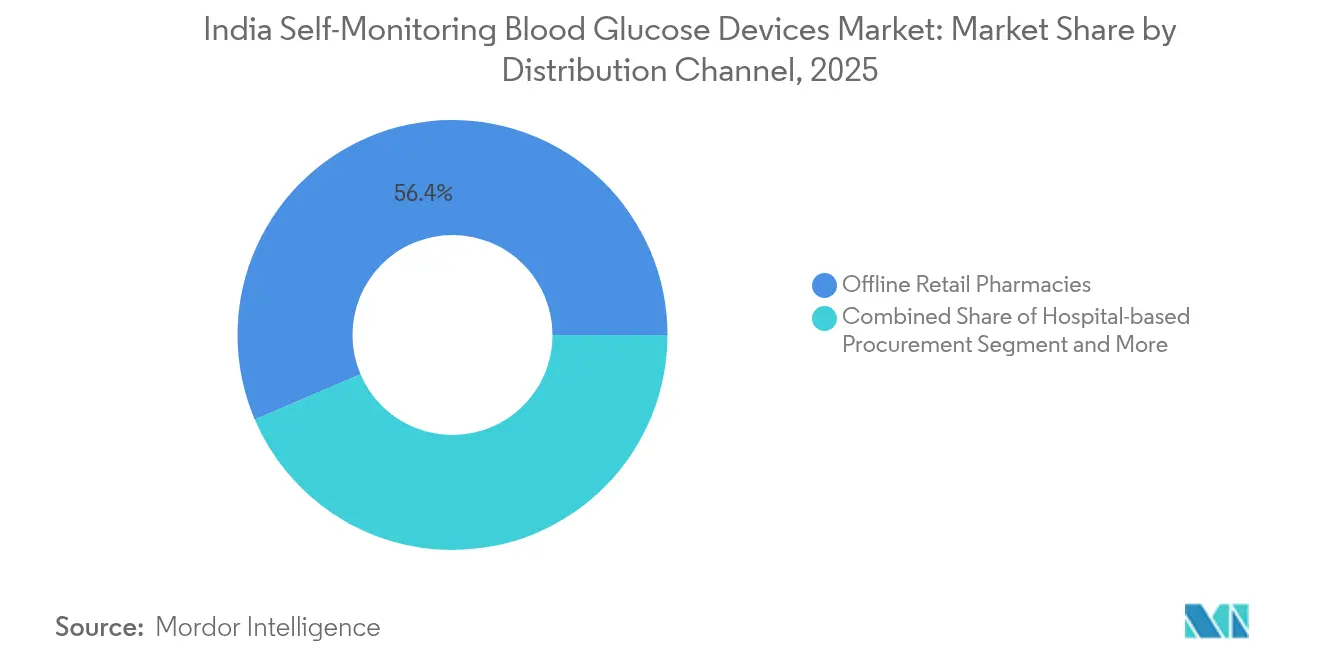
- By distribution channel, offline retail pharmacies held 56.42% revenue share in 2025; e-pharmacies & direct-to-consumer channels are forecast to register a 16.95% CAGR to 2031.
Note: Market size and forecast figures in this report are generated using Mordor Intelligence’s proprietary estimation framework, updated with the latest available data and insights as of 2026.
India Self-Monitoring Blood Glucose Devices Market Trends and Insights
Drivers Impact Analysis*
| Driver | (~) % Impact on CAGR Forecast | Geographic Relevance | Impact Timeline |
|---|---|---|---|
| Rising diabetes prevalence & earlier onset | +1.2% | Urban metros and expanding peri-urban zones | Long term (≥ 4 years) |
| Government screening & subsidy programmes | +0.8% | National, early gains in rural and semi-urban districts | Medium term (2-4 years) |
| Higher disposable income & lifestyle awareness | +0.9% | Tier-1 and tier-2 cities, spreading to tier-3 | Medium term (2-4 years) |
| Digital-health integration with glucometers | +1.1% | Urban first, gradually permeating smaller markets | Short term (≤ 2 years) |
| E-pharmacy subscription penetration (tier-2/3) | +0.7% | Tier-2 and tier-3 cities with limited pharmacy density | Short term (≤ 2 years) |
| Localised strip manufacturing under PLI scheme | +0.6% | National production hubs, price relief country-wide | Long term (≥ 4 years) |
| Source: Mordor Intelligence | |||
Rising Diabetes Prevalence & Earlier Onset
India’s 77 million adult Type 2 patient base, alongside 25 million prediabetic individuals, has intensified demand for self-testing devices. Earlier onset among professionals aged 25-40 pushes lifetime monitoring volumes higher and favors connected meters that fit digital lifestyles. The India Self-Monitoring Blood Glucose Devices market consequently records rising repeat purchases of strips and an uptick in premium device upgrades.
Government Screening & Subsidy Programmes
Nationwide screening now spans more than 700 districts, embedding glucose checks in public primary care. Tamil Nadu alone screened 2.5 million residents in 2024, stimulating downstream retail sales of meters and consumables[1]. Partial reimbursements under CGHS and ESIC cover meters but exclude strips, sustaining recurring revenue potential for suppliers while constraining adoption among low-income groups.
Digital-Health Integration with Glucometers
BeatO’s Curv model, launched in November 2024, links USB-C dongles to an AI coach, demonstrating how connected analytics heighten adherence by turning readings into actionable insights. Remote monitoring eases pressure on India’s strained 1:1,456 doctor-patient ratio. Academic innovation, such as SRM Institute’s mini-NIR non-invasive prototype unveiled in January 2025, signals future disruption, though commercial timelines remain uncertain.
E-Pharmacy Subscription Penetration (Tier-2/3)
Digital pharmacies fill chronic-care supply gaps outside major metros. Bundled strip-and-lancet plans lower per-test costs and guarantee monthly refills, anchoring the India Self-Monitoring Blood Glucose Devices market in towns formerly underserved by brick-and-mortar chemists. Government support for telemedicine and electronic prescriptions bolsters regulatory clarity for these channels.
Restraints Impact Analysis*
| Restraint | (~) % Impact on CAGR Forecast | Geographic Relevance | Impact Timeline |
|---|---|---|---|
| High recurring cost of consumables | −0.9% | Nationwide, acute in rural and low-income clusters | Long term (≥ 4 years) |
| Limited insurance / reimbursement coverage | −0.7% | Country-wide, especially middle- and lower-income | Medium term (2-4 years) |
| Counterfeit & grey-market strips | −0.5% | E-commerce-heavy urban pockets | Short term (≤ 2 years) |
| Data-privacy risks in app-linked devices | −0.3% | Initially tech-savvy urban users | Medium term (2-4 years) |
| Source: Mordor Intelligence | |||
High Recurring Cost of Consumables
Monthly strip expenses often exceed the one-time meter outlay, leading to reduced testing frequency among price-sensitive users. Limited private-insurance coverage and minimal public reimbursements exacerbate the affordability gap[2].
Limited Insurance / Reimbursement Coverage
Most private policies classify monitoring as preventive and exclude consumables; Ayushman Bharat covers hospitalization, not outpatient supplies[3]. Out-of-pocket spending slows scaling of the India Self-Monitoring Blood Glucose Devices industry.
*Our forecasts treat driver/restraint impacts as directional, not additive. The impact forecasts reflect baseline growth, mix effects, and variable interactions.
Segment Analysis
By Component: Consumables Drive Revenue Despite Device Innovation
Test strips retained 50.02% ownership of India Self-Monitoring Blood Glucose Devices market share in 2025, highlighting the consumable-centric revenue architecture. Glucometer devices, buoyed by replacement cycles and digital add-ons, are pacing at an 10.74% CAGR. Lancets and lancing devices, though smaller, follow a predictable volume trajectory. BeatO’s USB-C Curv launch exemplifies design upgrades aimed at younger, tech-friendly diabetics. SRM Institute’s non-invasive prototype, if commercialized, could compress strip demand and reshape the India Self-Monitoring Blood Glucose Devices market.
Electrochemical strips account for the bulk of manufacturing under India’s PLI scheme, trimming landed costs by 10-15% and enabling local brands to widen distribution beyond tier-1 cities.

By Technology: Electrochemical Dominance Faces Digital Disruption
Electrochemical biosensors claimed 76.10% of 2025 revenues, supported by mature supply chains and validated accuracy. Photometric platforms occupy niche institutional demand. Smartphone-integrated dongles, rising at 15.28% CAGR, capitalize on India’s 750 million internet-connected handsets. Continuous strip-free cassettes cater to users seeking lower lifetime spend but require higher upfront cash outlay. CDSCO approval processes promote safety yet elongate time-to-market for novel platforms, dictating the pace at which the India Self-Monitoring Blood Glucose Devices market absorbs next-gen formats.
By End User: Home-Care Dominance Reflects Healthcare Infrastructure Gaps
Home-care patients held 62.05% ownership of India Self-Monitoring Blood Glucose Devices market size in 2025. The preference mirrors cultural norms of family oversight and the shortage of endocrinologists in smaller cities. Government detection drives, however, are funneling newly diagnosed patients into clinical networks, giving clinics & diagnostic labs the fastest projected growth at 12.35% CAGR. Hospitals continue routine ward-based testing, but their share remains relatively stable as ambulatory monitoring shifts to homes.
By Distribution Channel: Digital Transformation Accelerates E-Pharmacy Growth
Offline pharmacies preserved 56.42% revenue share in 2025, offering immediate fulfillment and face-to-face counsel valued by seniors. Yet e-pharmacies and direct-to-consumer storefronts are rising at 16.95% CAGR, bundling monthly strip shipments with AI coaching and loyalty discounts. As logistics networks deepen, the India Self-Monitoring Blood Glucose Devices market relies increasingly on last-mile delivery to bridge rural gaps.
Geography Analysis
Variations across India hinge on income, urbanization, and state health initiatives. The north-western corridor, anchored by Delhi, Mumbai, and Pune, sets the adoption bar for connected meters thanks to higher per-capita income and stronger specialty-clinic density. Southern states trail closely: Tamil Nadu’s screening of 2.5 million citizens in 2024 spurred sharp retail demand, while Karnataka’s tech workforce favors app-paired meters. Eastern regions, led by West Bengal and Odisha, represent springboard opportunities as government schemes and e-pharmacy logistics mitigate historical supply shortages.
Tier-2 and tier-3 city penetration remains the principal upside lever. National Programme screening uncovers undiagnosed diabetics, and digital pharmacies deliver strip subscriptions to towns lacking chronic-care chemists. Nevertheless, uneven state-level enforcement of CDSCO norms creates compliance costs and rollout friction; multinationals often partner with verified local distributors to ensure regulatory conformity and customer trust.
Regulatory Landscape
Self-monitoring blood glucose (SMBG) products in India are regulated as in vitro diagnostic (IVD) medical devices by the Central Drugs Standard Control Organization (CDSCO) under the Ministry of Health and Family Welfare, within the framework of the Drugs and Cosmetics Act, 1940 and the Medical Devices Rules (MDR), 2017. Market entry is routed through CDSCO systems and documentation requirements, with import licensing typically filed via Form MD-14 and domestic manufacturing via MD-7/MD-8 pathways. In practice, registration, labeling, and traceable supply are prerequisites for large-scale channel expansion.
MDR, 2017 also raises quality and performance expectations through Quality Management System requirements aligned with ISO 13485 (Fifth Schedule). Applicable BIS-referenced standards such as IS/ISO 15197 anchor accuracy and performance evaluation for glucose meters and strips. Together, licensing, technical file expectations, and conformity to recognized standards increase the compliance bar for low-cost or informal supply, reinforcing the shift toward verified distributors and authorized strip supply across offline retail and fast-growing e-pharmacy channels.
Competitive Landscape
The India Self-Monitoring Blood Glucose Devices market features moderate fragmentation. Global entities such as Roche, Abbott, and others contend with domestic challengers including BeatO and Agatsa. Lawsuits over counterfeit strips in 2024 reinforced the premium placed on authenticity and pushed legitimate players to adopt holographic labels and app-based verification. BeatO differentiates on AI coaching, while Agatsa advances prick-less meters to attract needle-averse segments. CDSCO’s January 2025 embargo on refurbished imports sidelines gray-market products, widening lanes for Original-Design Manufacturers leveraging Production-Linked Incentives to localize strip fabrication at scale. Non-invasive prototypes from academic labs hint at future disruption, but commercialization hurdles safeguard incumbent revenues in the near term.
India Self-Monitoring Blood Glucose Devices Industry Leaders
-
Roche Diabetes Care
-
Abbott Diabetes Care
-
Ascensia Diabetes Care
-
LifeScan
-
Dr. Morepen
- *Disclaimer: Major Players sorted in no particular order
Market Opportunities and Future Outlook
A near-term whitespace is emerging in tier-2 and tier-3 cities where public detection programs and digital fulfillment overlap. Government screening under the National Programme for Prevention and Control of Cancer, Diabetes, Cardiovascular Diseases and Stroke has expanded testing reach to more than 700 districts, and Tamil Nadu reported screening 2.5 million residents in 2024. These outcomes convert newly identified patients into first-time meter buyers and recurring strip consumers, creating room for brands and channel partners that can bundle education, onboarding, and predictable consumable replenishment, particularly since home-care remains the dominant end-user setting.
The product mix is also moving beyond episodic finger-prick SMBG toward connected monitoring and higher-acuity use cases that link devices to coaching or clinical workflows. Recent launches such as Abbott's FreeStyle Libre 2 Plus in India (August 2025) and Zydus Lifesciences' Diasens and GlucoLive CGM devices (March 2026) point to continued investment in continuous and app-connected monitoring, while BeatO's connected Curv model (November 2024) highlights demand for smartphone-centric formats. On the supply side, MDR, 2017 compliance, including technical file and performance evaluation expectations benchmarked to IS/ISO 15197, tends to favor players that can sustain consistent quality across high-volume strips while maintaining authenticated distribution. This supports opportunities in anti-counterfeit packaging, app-based verification, and localized strip manufacturing programs that lower delivered costs for subscription-led channels.
Recent Industry Developments
- July 2026: Beurer India launched the GL 22 Blood Glucose Monitor, manufactured locally under the Make in India initiative. The launch improves domestic supply chain coverage and pricing accessibility for patients, supporting broader market penetration in India.
- March 2026: Tracky TatvaCare partnered to integrate TRACKY Bluetooth-enabled CGM systems with the GoodFlip digital platform for cardio-metabolic health management. The collaboration pushes connected CGM adoption and widens digital touchpoints for diabetes care.
- March 2026: Zydus Lifesciences launched Diasens and GlucoLive continuous glucose monitoring devices featuring AI-powered real-time data streaming and remote monitoring for high-risk patients. The new AI enabled CGM devices extend high-risk patient care capabilities and support uptake of remote monitoring.
Research Methodology Framework and Report Scope
Market Definition and Coverage
For this study, the market is defined as the value of devices and consumables used for self-checking blood glucose in India, captured through glucometers, test strips, and lancets or lancing devices sold through clinical and retail channels.
Scope exclusions: We exclude laboratory glucose analyzers and their reagents used for diagnostic testing in centralized labs.
Segmentation Overview
- By Component
- Glucometer Devices
- Test Strips
- Lancets & Lancing Devices
- By Technology
- Electrochemical Biosensors
- Photometric (Optical)
- Continuous Strip-Free (e.g., cassette)
- Smartphone-integrated Dongles
- By End User
- Home-care Patients
- Hospitals
- Clinics & Diagnostic Labs
- Pharmacies & Wellness Stores
- By Distribution Channel
- Offline Retail Pharmacies
- Hospital-based Procurement
- e-Pharmacies & Direct-to-Consumer
Data Sources, Market Sizing, and Validation
Desk Research
Desk research was used to build the starting shape of demand and supply in India, and to map how people access glucose monitoring products through hospitals, pharmacies, and e-pharmacies. We referenced public health and epidemiology materials to understand diabetes prevalence and screening momentum, then aligned those indicators with device adoption cues.
The sources we referred to include, for example, national health surveys and program updates from the Ministry of Health and Family Welfare and the National Health Mission, prevalence and care pathway statistics from the International Diabetes Federation, and related publications from the Indian Council of Medical Research and peer reviewed medical journals. We also used product registration and safety signals from the national regulator, along with company annual reports, investor presentations, and reputable press coverage to track launches, pricing direction, and channel expansion. In addition, a paid subscription for company financials and another for patent intelligence were used selectively to validate revenue exposure and technology claims. These examples are not exhaustive, and we checked other public documents and datasets to collect, cross verify, and clarify inputs.
Primary Interviews and Surveys
Primary interviews and surveys helped us convert broad indicators into usable sizing assumptions, especially for strip consumption per active user, replacement cycles for meters, and how pricing differs across channels. We spoke with manufacturers, importers, distributors, retail and e-pharmacy participants, and healthcare providers so the model reflects purchase behavior across major states and city tiers.
Distribution of primary research fieldwork respondents
| Company type | Respondent position |
|---|---|
| Top tier: 29% | CXOs: 14% |
| Mid tier: 53% | Functional/Unit leaders: 32% |
| Smaller Players: 18% | Managers: 54% |
Market-Sizing & Forecasting
Sizing was built using a top-down and bottom-up approach, starting from the addressable population that self tests and then translating that demand pool into annual volumes of meters, strips, and lancets. For India, the top-down build used diabetes prevalence and screening trends to estimate active self monitoring users, then converted those users into yearly strip usage and device replacement. When the demand logic was set, we cross checked it with selective bottom-up approximations, such as supplier and channel roll ups, sampled average selling price multiplied by implied volumes, and distributor level channel checks, so totals could be adjusted when they drifted from what the market can realistically supply.
A few inputs carried most of the weight in the model, and they were refreshed carefully. These include the share of diagnosed patients who self test at home, tests per week by therapy intensity, the split between offline pharmacy and e-pharmacy sales, average selling price ranges for strips and meters, and the installed base replacement cycle (including battery and accuracy driven upgrades). Where gaps existed, especially for smaller unlisted participants, revenues were inferred using category level price bands and channel presence, and then rechecked with interview feedback.
Forecasting relied on scenario analysis supported by a multivariate view of demand drivers, where prevalence growth, urbanization and income effects on testing frequency, e-pharmacy penetration, and quality enforcement that limits counterfeit or refurbished supplies were treated as key moving parts. Assumptions were finalized only after they aligned with what practitioners and trade respondents described as the most likely adoption path over 2026 to 2031.
Data Validation & Update Cycle
Validation happened through repeated checks across the model so the final totals stayed consistent with independent signals. We compared implied strip volumes per user against practical testing behavior, reviewed price curves against channel level reality, and then flagged any year on year jumps that did not match known policy, access, or supply changes.
Before sign-off, the work is reviewed in steps, first within the analyst team and then through a senior check focused on assumptions, arithmetic accuracy, and whether each driver is traceable to a source or an interview note. Reports are refreshed annually, and interim updates are triggered when major events occur, such as regulatory shifts, sharp pricing changes, or meaningful technology adoption moves. Right before delivery, a final pass is completed so clients receive the latest updated view.
Mordor Intelligence's India Self Monitoring Blood Glucose Devices Market Size Compared Against Other Published Estimates
Published market sizes for self monitoring blood glucose devices in India can look far apart, even when they seem to cover the same product set. The differences usually come from what gets counted as part of the market, which year is treated as the base, and whether pricing and usage assumptions were validated through trade feedback.
Some published figures roll continuous glucose monitoring and other broader glucose monitoring revenue into the same total, and that choice can push the number up quickly. Mordor Intelligence counts only self monitoring systems and consumables (meters, strips, and lancets) and keeps the model anchored on active strip consumption per user and realistic channel pricing in India.
Benchmark comparison
| Source | Market Size | Gaps in Research Methodology |
|---|---|---|
| Mordor Intelligence | USD 230.67 M (2025) | |
| Trade Report A | USD 366.53 M (2024) | Uses a broader glucose monitoring definition that typically bundles SMBG with continuous monitoring, and it is anchored to a different base year, which makes direct comparison difficult without scope normalization. |
| Industry Study B | USD 305.00 M (2022) | Older base year and limited visibility into channel mix and consumable run rate, which can understate the later uplift from e-pharmacy expansion and changes in testing frequency. |
Taken together, the spread is explained more by scope and base year choices than by arithmetic. By tying demand to active users, strip run rate, and channel level pricing, the estimate stays traceable to inputs that can be rechecked and updated as the market changes.
Key Questions Answered in the Report
What is the 2026 value of India self-monitoring blood glucose devices?
The market stands at USD 243.77 million in 2026, progressing toward USD 321.29 million by 2031.
How fast is demand for smartphone-integrated glucometers growing?
Devices that plug directly into phones are projected to log a 15.28% CAGR through 2031.
Which component generates the most revenue?
Test strips deliver 50.02% of 2025 revenues, reflecting the consumable-driven model.
Why are e-pharmacies important for diabetes care outside metros?
Subscription models guarantee monthly strip supply and extend reach to tier-2 and tier-3 cities lacking chronic-care pharmacies.
What regulatory move impacted refurbished device imports?
CDSCO halted refurbished medical device imports in January 2025, tightening quality controls and favoring original manufacturers.