
India Quick Service Restaurant Market Size and Share
India Quick Service Restaurant Market Analysis by Mordor Intelligence
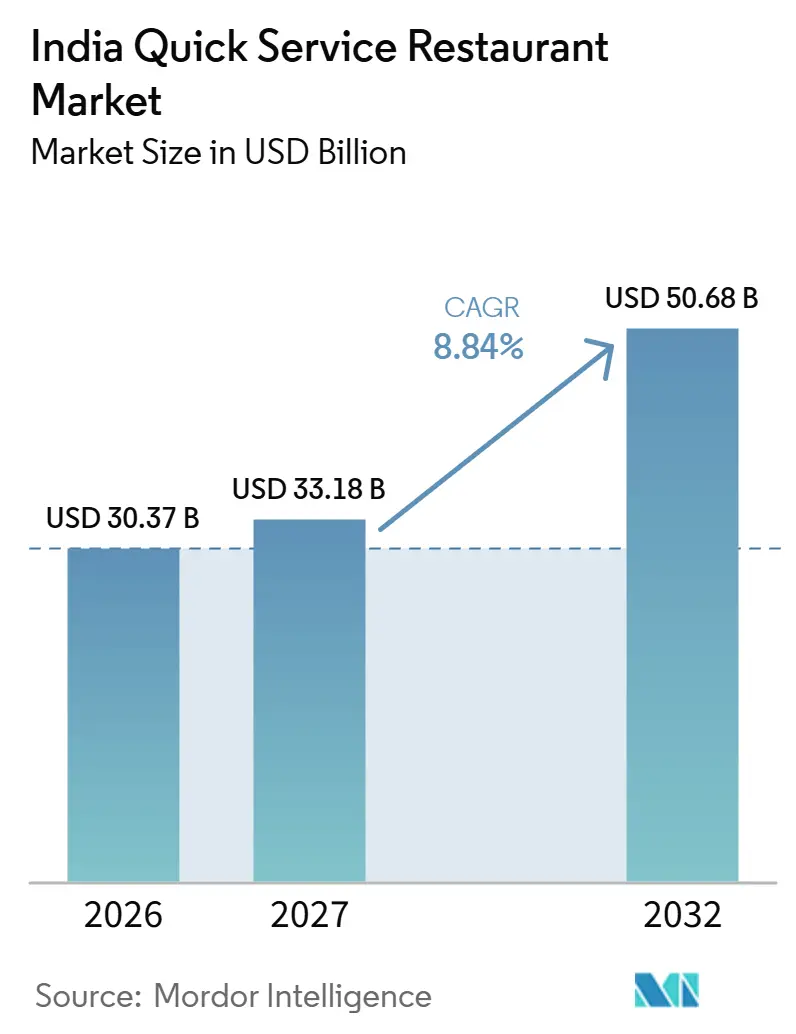
The India quick service restaurant market size is expected to increase from USD 30.37 billion in 2026 to USD 33.18 billion in 2027 and reach USD 50.68 billion by 2032, growing at a CAGR of 8.84% over 2027-2032.
In India, digital ordering broadens access to convenient quick-service meals. Locally developed menus can pair that convenience with consumers' interest in distinctive flavors. Minimum rent guarantees at airport outlets raise the sales each new restaurant must reach to cover occupancy commitments. The West Asia war disrupted Strait of Hormuz shipping from March 2026, constraining LPG supplies and interrupting service at some Indian chains. Digital reach and menu variety can deepen an outlet's sales base, but airport rent guarantees magnify the exposure when fuel shortages interrupt restaurant service.
Key Report Takeaways
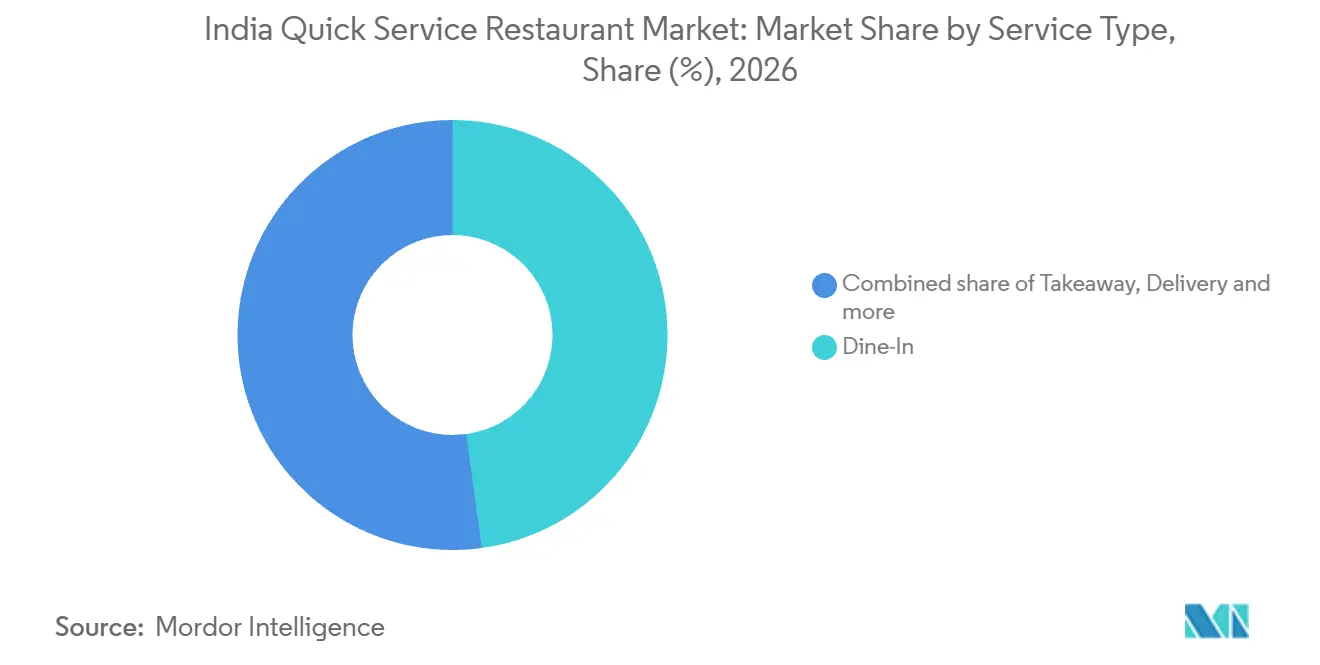
- By service type, dine-in led with a 47.82% India quick service restaurant market share in 2026, while delivery is the fastest-growing segment with a 10.15% CAGR over 2027-2032.
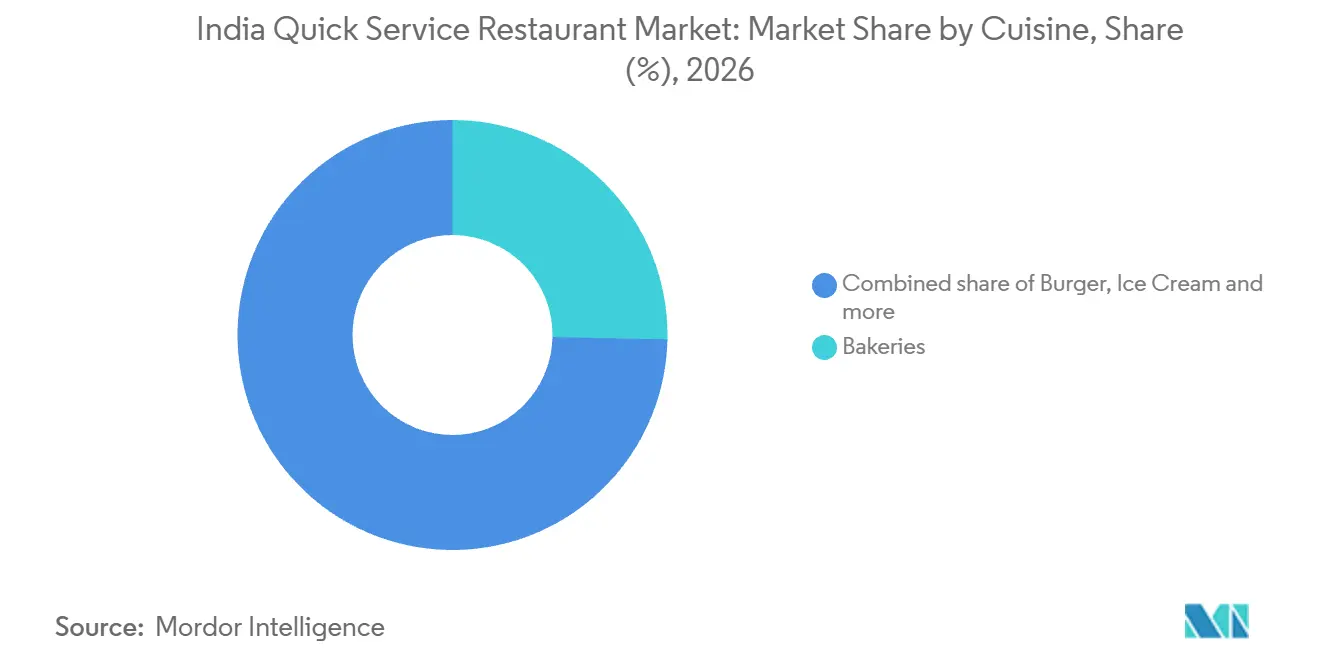
- Within the cuisine mix, bakeries held a 25.33% share of the India quick service restaurant market size in 2026, and pizza is forecast to grow fastest at a 10.8% CAGR over 2027-2032.
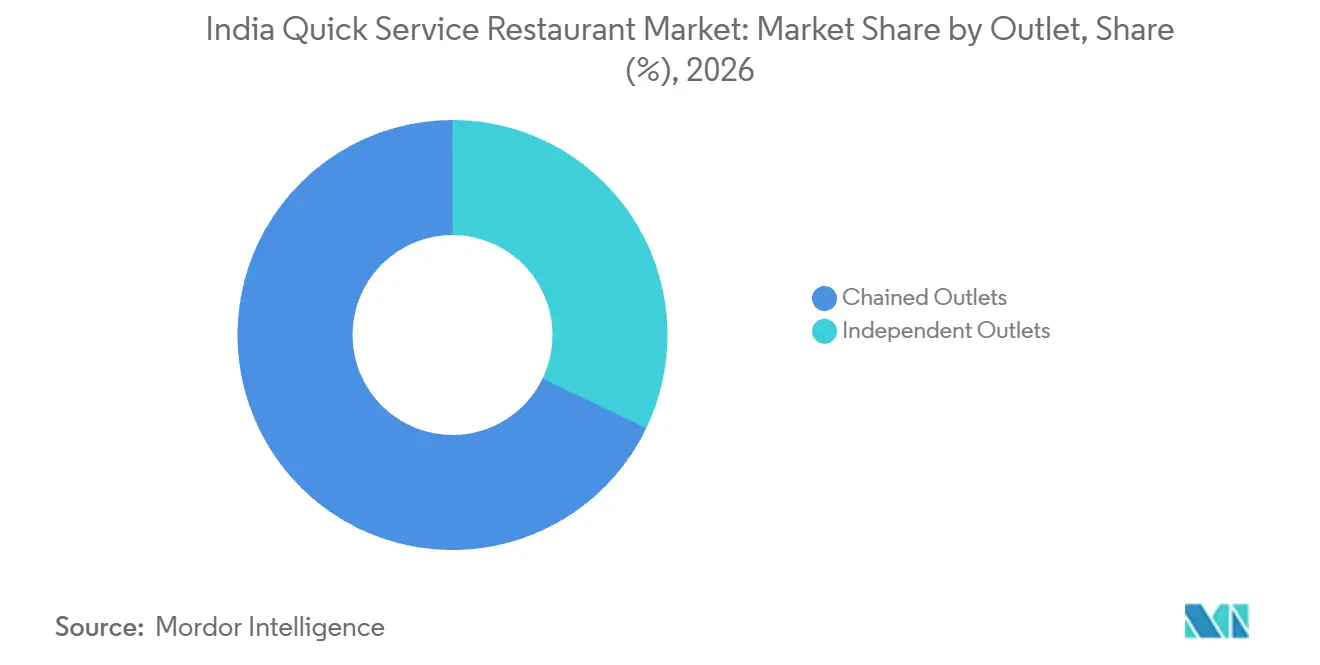
- Chained outlets led the outlet landscape with a 67.86% share in 2026, while independent outlets are forecast to grow fastest at a 10.4% CAGR over 2027-2032.
- Across locations, standalone restaurants accounted for 72.36% of sales in 2026, and travel is the fastest-growing segment with a 10.8% CAGR over 2027-2032.
- Geographically, the northern and western regions lead, while the southern states represent the fastest-growing geography.
Note: Market numbers in this report are based on Mordor Intelligence's proprietary estimation framework, which combines nine months of actuals with Q4 projections for base year 2026.
Market Trends and Insights
Drivers Impact Analysis of India Quick Service Restaurant Market*
| Driver | (~) % Impact on CAGR Forecast | Geographic Relevance | Impact Timeline |
|---|---|---|---|
| Popularity of Online Food Delivery Apps and Digital Ordering Platforms | +3.8% | Nationwide | Short term (≤ 2 years) |
| Evolving Consumer Preferences with Menu Localization by Brands | +2.7% | Nationwide | Medium term (2-4 years) |
| Rising Youth Population and Influence of Social Media | +2.2% | Nationwide | Long term (≥ 4 years) |
| Greater Exposure to Global Cuisines and Western Eating Habits | +1.9% | Nationwide | Medium term (2-4 years) |
| Strategic Alliances between QSRs and Delivery Aggregators | +1.3% | Nationwide | Short term (≤ 2 years) |
| Expansion of Cafe Culture and Snacking Trends | +1.1% | Bengaluru, Mumbai and Jaipur | Medium term (2-4 years) |
| Source: Mordor Intelligence | |||
Popularity of Online Food Delivery Apps and Digital Ordering Platforms
Digital ordering expands the audience that quick-service operators can reach beyond customers passing an outlet, creating additional occasions for off-premises meals. Swiggy reported 19.2 million average monthly food-delivery transacting users in Q1 FY2027, up from 16.3 million in Q1 FY2026.[1] Zomato had more than 27 million average monthly transacting customers in India in Q1FY27. This combination of audience growth and platform scale gives restaurants a route to incremental demand. For operators, aggregator reach makes additional dining space one option for expansion rather than a prerequisite for serving a broader customer base.
Evolving Consumer Preferences with Menu Localization by Brands
Local menu development gives quick-service brands a way to address interest in new flavors through products created for their operating geography. In KPMG in India's 2025 QSR customer findings, 29% of customers said they were eager to try new flavors and willing to pay a premium for unique menu items. In December 2025, Westlife Foodworld CEO Akshay Jatia said its India team had formalized and created as much as 90% of the menu at its McDonald's restaurants in West and South India. Such development capability can connect an international restaurant format with opportunities for menu experimentation in India. Customers' stated willingness to pay a premium for unique items makes menu creation in India a possible pricing lever as well as a novelty tool.
Rising Youth Population and Influence of Social Media
For quick-service brands seeking younger customers, online influence makes the food proposition relevant before a restaurant visit or order takes place. In 2026, 57% of surveyed Gen Z respondents in India said social media and online health trends significantly affected their food choices. On July 24, 2025, McDonald's India (West & South), operated by Westlife Foodworld, launched a plant-based vegetarian slice that adds 5 grams of protein to burgers. The option lets diners change a familiar meal's protein content rather than select an entirely different restaurant format. For brands addressing health-conscious younger consumers, optional additions offer a concrete purchase choice around which to explain nutrition, with the added ingredient forming part of the meal sold.
Greater Exposure to Global Cuisines and Western Eating Habits
Demand for international food gives quick-service operators room to build menus around cuisines with demonstrated ordering audiences. Swiggy recorded 16 million Mexican, more than 12 million Tibetan and 4.7 million Korean cuisine orders on its India platform from January 1 to November 30, 2025. These orders provide a commercial premise for serving global flavors through convenient restaurant formats, with recognizable cuisine identities helping define the offer. Their different scales also favor cuisine-specific decisions about menu breadth instead of assuming that every international food category attracts an equivalent audience. Mexican orders at 16 million were more than three times the 4.7 million Korean orders.
Restraints Impact Analysis of India Quick Service Restaurant Market*
| Restraint | (~) % Impact on CAGR Forecast | Geographic Relevance | Impact Timeline |
|---|---|---|---|
| Escalating Rental and Real Estate Expenses | -1.6% | Nationwide | Long term (≥ 4 years) |
| Surging Raw Material and Commodity Inflation | -1.4% | Nationwide | Short term (≤ 2 years) |
| Rigorous Food Safety, Licensing, and Regulatory Standards | -0.7% | Nationwide | Medium term (2-4 years) |
| Fierce Rivalry from Delivery-Only Cloud Kitchens | -0.5% | Delhi NCR and Bangalore | Short term (≤ 2 years) |
| Source: Mordor Intelligence | |||
Escalating Rental and Real Estate Expenses
Occupancy commitments can constrain restaurant expansion when access to a promising site requires payments before sufficient sales are established. Travel Food Services Limited's rent costs represented 32.26% of total expenses for its Travel QSR and Lounge operations in fiscal 2025. The measure included occupancy cost, depreciation of right-of-use assets and interest on lease liabilities. Its airport concessions typically linked fees to revenue, subject to a minimum guarantee, and certain agreements provided for annual increases in that minimum. These terms can raise the sales threshold needed to justify an additional outlet even where passenger traffic creates demand. During a slow sales ramp-up, a guaranteed minimum keeps occupancy expenditure inflexible and extends the financial exposure attached to each new site.
Surging Raw Material and Commodity Inflation
After the West Asia war disrupted commercial shipping through the Strait of Hormuz in March 2026, some Indian QSR chains faced dwindling LPG stocks and closed operations or limited menus. The government reported in March 2026 that about 90% of India's LPG imports came through the strait. JM Financial Institutional Securities reported that commercial LPG cylinder prices rose 8% month over month in March 2026 and warned of higher kitchen operating costs. In May 2026, Jubilant FoodWorks said energy, labor and commodity inflation could squeeze its margins in the following quarter. Passing higher input costs through to diners can weaken meal affordability, while absorbing them can restrict funds available for new outlets. A kitchen without reliable cooking fuel cannot convert even an affordable menu into restaurant sales.
*Our forecasts treat driver/restraint impacts as directional, not additive. The impact forecasts reflect baseline growth, mix effects, and variable interactions.
India Quick Service Restaurant Market Segment Analysis
By Service Type:
Dining Rooms Anchor Sales as Delivery ExpandsDine-in accounted for a 47.82% share of the India quick service restaurant market size in 2026. Connaught Plaza Restaurants Private Limited (CPRL), McDonald's master franchisee for north and east India, said in April 2025 that dine-in generated an average 65% of its McDonald's restaurant sales. CPRL described McDonald's as a family restaurant format requiring larger operating areas than rival QSR chains. That makes dining-room space part of the meal proposition for these customers, rather than merely a place to receive an order. Cutting seating to favor another channel would alter the family occasion that carries most of that operator's sales.
Delivery is forecast to be the fastest-growing segment, with a 10.15% CAGR over 2027-2032. Swiggy's food-delivery gross order value rose 22.6% year over year in the quarter ended March 31, 2026. Takeaway also featured in Sapphire Foods' Q4 FY26 KFC strategy, which aimed to drive dine-in and takeaway transactions in the quarter ended March 31, 2026. For its KFC restaurants, the recruitment approach combined advertising with a value call to action in northern and western markets and selected-day offers in southern markets. Delivery's rising order value supports investment in off-premises fulfillment, while Takeaway can share customer-recruitment spending with dine-in.

By Cuisine:
Bakery Revenue Levers Differ From Pizza Order GrowthBakeries were the largest cuisine segment, with a 25.33% share in 2026. Theobroma operates more than 335 restaurants across India. Theobroma Foods' revenue grew 28% year over year in fiscal 2025, with CRISIL attributing growth to store additions, same-store sales growth and pricing actions.
Pizza is forecast to be the fastest-growing segment, with a 10.8% CAGR over 2027-2032. Jubilant FoodWorks reported 6.5% year-over-year growth in Domino's India orders in the quarter ended June 30, 2026. A rising order count makes preparation and dispatch capacity commercially relevant as the restaurant network handles more transactions. Jubilant added that the delivery channel continued to outperform in that quarter. Domino's India reported like-for-like growth of 4.1% in the quarter ended September 30, 2026, according to a provisional update subject to limited auditor review.
By Outlet:
Chain Scale Meets New Independent FormatsChained outlets represented a 67.86% India quick service restaurant market share in 2026. Domino's India added 88 stores in the quarter ended September 30, 2026, bringing its network to 2,601 outlets. The company described that business update as provisional and subject to limited review by statutory auditors. For the largest segment, such capacity makes availability at multiple restaurant sites an advantage for a brand seeking customers across separate local catchments.
Independent outlets are forecast to be the fastest-growing segment, with a 10.4% CAGR over 2027-2032. Packaged-food brand Wakao Foods opened its first company-owned QSR in Panaji, Goa, in 2025. Its first restaurant offered a 15-item menu developed with food consultants. For a new single-unit operator, moving from packaged products to served meals brings product preparation and the customer encounter into one business. This entry route puts a distinct food proposition into a local restaurant without requiring an established multi-city estate.
By Location:
Standalone Sites Lead as Travel Formats GrowStandalone locations were the largest segment, accounting for 72.36% of sales in 2026. In 2026, Westlife Foodworld opened Chhattisgarh's first high-street McDonald's restaurant in Shankar Nagar, Raipur. This illustrates a chain's use of a street-based restaurant as a dedicated point of service, with access to its own local catchment. For the operator, the location decision can be organized around demand for the restaurant itself rather than the activities of a host venue. Standalone capacity can expand on a restaurant operator's own development timetable instead of depending on the opening schedule of a larger destination.
Travel is forecast to be the fastest-growing segment, with a 10.8% CAGR over 2027-2032. Travel Food Services added 87 Travel QSR outlets across its system-wide network in the 12 months to June 2026. Additions were mainly at Mumbai, Delhi, Hyderabad, Navi Mumbai, Cochin and Noida airports. Placing meal capacity within passenger journeys can connect a restaurant with customers who are already moving through the site. Those additions tie the expansion route to airport concessions in specific passenger hubs, rather than to a broad rollout across city neighborhoods.
Geography Analysis
northern and western regions Quick Service Restaurant Market
The northern and western regions form the largest geography for quick-service restaurants. In 2025, The Burger Company reported more than 80 North India stores and more than 30 West India stores within its network of more than 150 outlets. The chain's North India-led distribution illustrates how a restaurant brand's footprint can vary within the broader leading geography, with different existing outlet networks in the two regions. For that operator, the next expansion decision starts from different regional bases, so a strong combined presence does not make northern and western development opportunities interchangeable.
southern states Quick Service Restaurant Market
The southern states are the fastest-growing geography. Genesis BBQ's fried-chicken franchise opened 2 quick-service outlets in Bengaluru's HSR Layout and Koramangala on June 26, 2026, under a local master-franchise partnership. The restaurants combined a quick-service format with casual dining spaces for families and young professionals. That combination gives the entering brand a way to address quick meals and seated dining through the same neighborhood locations. Southern expansion can begin with a concentrated city offer serving different meal occasions before committing to a broader regional footprint.
City-level QSR development can also be organized around a specific buyer community rather than the size of a regional restaurant network. In July 2026, Wendy's India, operated by Rebel Foods under a master franchise agreement, opened a flagship restaurant at Hudson Lane in Delhi's GTB Nagar. That part of Delhi has a large student and youth population. The restaurant was designed to engage younger consumers through food, music, anime culture and community events. A student-focused site such as GTB Nagar gives community programming a role in differentiation alongside the meal, making regional outlet coverage only part of the competitive proposition.
Regulatory Framework and Outlook
This comparison covers selected jurisdictions from the perspective of a QSR operator managing food-business and workplace compliance. India's food-business licenses and registrations issued from April 1, 2026 have perpetual validity unless suspended, canceled or surrendered. Applicable hygiene and safety duties continue under that arrangement. Maharashtra's workplace framework includes the Shops and Establishments Act, 2017, which the Brihanmumbai Municipal Corporation implements within its Mumbai jurisdiction.
Regulatory Table of India Quick Service Restaurant Market
| Decision factor | India | Maharashtra |
|---|---|---|
| Primary authority | Food Safety and Standards Authority of India | Maharashtra Labour Department; Brihanmumbai Municipal Corporation within Mumbai |
| Key instruments or direction | Perpetual validity for licenses and registrations issued from April 1, 2026; continuing hygiene and safety requirements | Shops and Establishments Act, 2017 and nameboard provisions; April 30, 2026 registration circular |
| Commercial effect | No periodic renewal for qualifying authorizations; other statutory duties continue | Conditional removal of separate state registration after finalized OSH rules and actual OSH registration; other non-conflicting state duties continue |
| Current policy attractiveness | Medium | Medium |
| Future direction of policy attractiveness | No change | Easing |
| Source: Mordor Intelligence | ||
India's medium rating and stable outlook balance perpetual validity for qualifying authorizations against continuing hygiene and safety duties. Maharashtra's medium rating reflects non-conflicting state workplace duties and nameboard compliance for covered establishments. The April 30, 2026 circular removes separate state registration after rules are finalized and an establishment registers under the Occupational Safety, Health and Working Conditions Code, 2020 (OSH Code). The easing outlook reflects fewer registration steps after that transition, with ongoing duties preserving the operator's workplace compliance responsibilities.
Value Chain Stages
This comparison follows food inputs, restaurant preparation and the digital route to the customer. Cremica Food Industries manufactures condiments, sauces, spreads and other food products for retail and food-service customers in India. At the restaurant stage, Hardcastle Restaurants prepares McDonald's meals with ingredients sourced from local suppliers in India. Value capture occurs through the input product, the prepared meal and the service that facilitates an order.
Value Chain Analysis Table of India Quick Service Restaurant Market
| Primary activity | Key participants | Value capture | Bottleneck | Resilience response |
|---|---|---|---|---|
| Food ingredient manufacture | Food-service ingredient manufacturers such as Cremica Food Industries | Ingredient and prepared-input sales | Consistency across batches | Agree specifications and qualify alternative supplies |
| Restaurant preparation and meal sales | Restaurant operators such as Hardcastle Restaurants Pvt. Ltd., a Westlife Foodworld subsidiary | Prepared-meal sales | Preparation capacity when orders overlap | Match menu complexity and staffing to meal throughput |
| Customer ordering and delivery coordination | Restaurant technology platforms such as Swiggy | Agreed restaurant commissions and service fees | Coordinating order acceptance and food readiness | Synchronize order status with restaurant preparation |
| Source: Mordor Intelligence | ||||
In FY2025-26, Swiggy's Food Delivery revenue included pre-agreed commissions from restaurant partners and fees for other business-enablement services provided to restaurant partners. Restaurant meal receipts and platform earnings therefore reward different activities within the same route to the consumer. For a participating restaurant, the margin available depends on preparation economics and the agreed cost of reaching that customer. The platform's fee entitlement and the restaurant's meal margin must be assessed separately, because a paid order rewards facilitation without establishing the restaurant's return.
Competitive Landscape
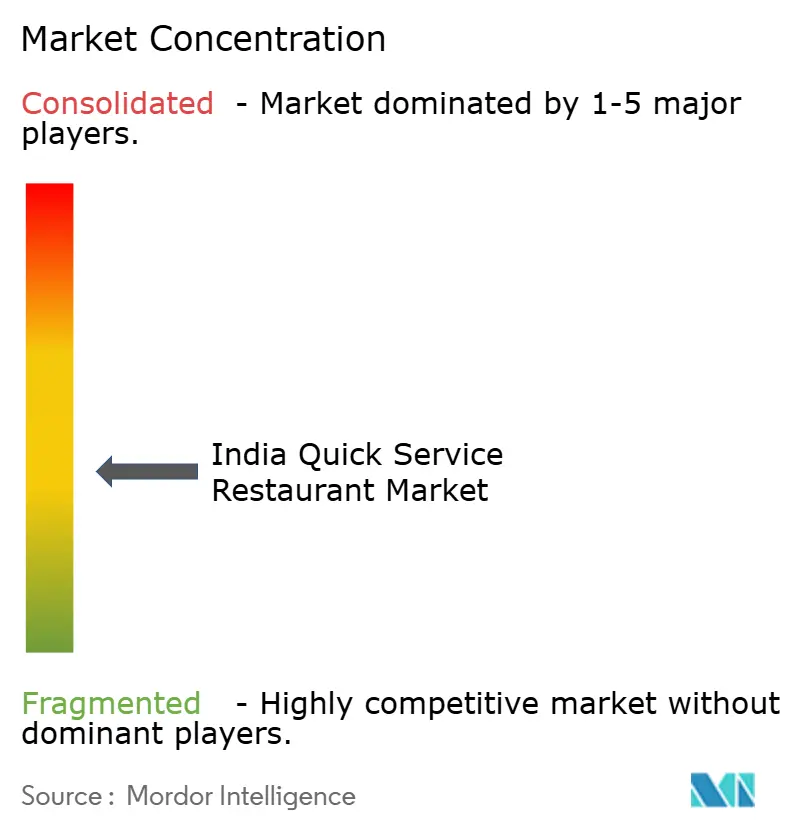
Competition spans multiple branded franchise systems and a substantial independent outlet base. Major participants include Domino's operator Jubilant FoodWorks Ltd, McDonald’s Corp. (Westlife Foodworld), Burger King's Indian franchisee Restaurant Brands Asia Ltd, Subway India and KFC franchisor Yum! Brands Inc. Restaurant Brands Asia added 68 net Burger King India restaurants in FY2026, reaching 581 at March 31, 2026, including 5 sub-franchisee restaurants, and Burger King India opened its 600th restaurant in Delhi on September 10, 2026. Westlife operates McDonald's restaurants in West and South India through subsidiary Hardcastle Restaurants under a master franchise agreement. This division between brand ownership and restaurant execution makes a recognizable brand and the capacity to operate its outlets separate competitive resources.
Westlife added 21 McDonald's restaurants in the quarter ended March 31, 2026, taking its Hardcastle-operated West and South India network to 478 restaurants across 78 cities.[3] Subway India is operated by EverBrands, part of Everstone Group, through its subsidiary Culinary Brands India Private Limited. At March 31, 2026, its 1,008 Indian Subway stores comprised 678 company-owned, company-operated restaurants and 330 franchise-owned, franchise-operated outlets. With 678 of its 1,008 stores company-operated at March 31, 2026, Subway India ran most of its estate directly, leaving the 330 franchise-operated outlets dependent on partner execution.
Food-safety positioning extends from supplier approval to restaurant-level checks. In March 2025, Restaurant Brands Asia said its Burger King India operations followed Food Safety and Standards Authority of India (FSSAI) guidelines, with approved suppliers, mandatory food-safety training, Hazard Analysis and Critical Control Points procedures and independent NSF inspections. At group level, Restaurant Brands Asia reported daily checks of temperature, holding time and cross-contamination, quarterly surprise audits and periodic third-party restaurant audits in FY2025-26. A challenger seeking comparable operating assurance must fund supplier approval, staff training and audit routines alongside its restaurant expansion.
India Quick Service Restaurant Industry Leaders
-
Jubilant FoodWorks Ltd
-
McDonald’s Corp. (Westlife Foodworld)
-
Restaurant Brands Asia Ltd
-
Eversub India Pvt. Limited (Subway)
-
Yum! Brands Inc.
- *Disclaimer: Major Players sorted in no particular order
India Quick Service Restaurant Market Companies Covered in this Report
- Coffee Day Enterprises Ltd
- Eversub India Pvt. Limited (Subway)
- Graviss Foods Pvt Ltd (Baskin Robbins)
- Jubilant FoodWorks Ltd
- McDonald’s Corp. (Westlife Foodworld)
- Restaurant Brands Asia Ltd
- Starbucks Corporation
- Wow! Momo Foods Pvt Ltd
- Yum! Brands Inc.
- Devyani International Ltd
- Rebel Foods Pvt Ltd
- Barbeque Nation Hospitality Ltd
- Haldiram Snacks Food Pvt Ltd
- Sunshine Teahouse Private Limited
- Mountain Trail Foods Pvt. Ltd
- Goli Vada Pav Pvt Ltd
- Burger Singh (Tipping Mr Pink Pvt Ltd)
- Bikanervala Foods Pvt Ltd
- Saravana Bhavan Private Limited
- Sagar Ratna Restaurants Pvt Ltd
Recent Industry Developments in India Quick Service Restaurant Market
- Oct 2026: Jubilant FoodWorks' Domino's India reported adding 88 stores in the quarter ended September 30, 2026, bringing its network to 2,601 outlets, according to a provisional update subject to limited auditor review.
- Jul 2026: Wendy's India, operated by Rebel Foods under a master franchise agreement, opened a flagship QSR restaurant at Hudson Lane in Delhi's GTB Nagar.
- May 2026: The Competition Commission of India approved a proposed stake acquisition in Restaurant Brands Asia by Lenexis Foodworks Private Limited, Aayush Agrawal Trust, Inspira Foodworks Private Limited, Aayush Madhusudan Agrawal and Inspira Agro Trading LLC.
Scope and Methodology
| Dine-In |
| Takeaway |
| Delivery |
| Bakeries |
| Burger |
| Ice Cream |
| Meat-Based Cuisines |
| Pizza |
| Other QSR Cuisines |
| Chained Outlets |
| Independent Outlets |
| Leisure |
| Lodging |
| Retail |
| Standalone |
| Travel |
| By Service Type | Dine-In |
| Takeaway | |
| Delivery | |
| By Cuisine | Bakeries |
| Burger | |
| Ice Cream | |
| Meat-Based Cuisines | |
| Pizza | |
| Other QSR Cuisines | |
| By Outlet | Chained Outlets |
| Independent Outlets | |
| By Location | Leisure |
| Lodging | |
| Retail | |
| Standalone | |
| Travel |
Market Definition
- FULL-SERVICE RESTAURANTS - A foodservice establishment where customers are seated at a table, give their order to a server and are served food at a table.
- QUICK SERVICE RESTAURANTS - A foodservice establishment that provides customers convenience, speed, and food offerings at lower prices. Customers usually help themselves and carry their own food to their tables.
- CAFES & BARS - A type of foodservice business that include bars and pubs that are licensed to serve alcoholic drinks for consumption, cafes that serve refreshments and light food items, as well as specialty tea and coffee shops, dessert bars, smoothie bars, and juice bars.
- CLOUD KITCHEN - A foodservice business that utilizes a commercial kitchen for the purpose of preparing food for delivery or takeout only, with no dine-in customers.
| Keyword | Definition |
|---|---|
| Albacore Tuna | It is one of the smallest species of tuna found in the six distinct stocks known globally in the Atlantic, Pacific, and Indian oceans, as well as the Mediterranean Sea. |
| Angus beef | It is beef derived from a specific breed of cattle indigenous to Scotland. It requires certification from the American Angus Association to receive the "Certified Angus Beef" quality mark. |
| Asian cuisine | It includes full-service offerings in restaurants that serve cuisines from cultures such as Chinese, Indian, Korean, Japanese, Bengali, Southeast Asian, etc. |
| Average Order Value | It is the average value of all orders made by the customers at a foodservice establishment. |
| Bacon | It is salted or smoked meat that comes from the back or sides of a pig. |
| Bars & Pubs | It is a drinking establishment that is licensed to serve alcoholic drinks for consumption on the premises. |
| Black Angus | It is beef derived from a black-hided breed of cows that don't have horns. |
| BRC | British Retail Consortium |
| Burger | It is a sandwich consisting of one or more cooked beef patties, placed inside a sliced bread roll or bun roll. |
| Café | It is a foodservice establishment serving various refreshments (mainly coffee) and light meals. |
| Cafes & Bars | It is a type of foodservice business that include bars and pubs that are licensed to serve alcoholic drinks for consumption, cafes that serve refreshments and light food items, as well as specialty tea and coffee shops, dessert bars, smoothie bars, and juice bars. |
| Cappuccino | It is an Italian coffee drink that is traditionally prepared with equal parts double espresso, steamed milk, and steamed milk foam. |
| CFIA | Canadian Food Inspection Agency |
| Chained Outlet | It refers to a foodservice establishment that shares brands, operates in several locations, has central management, and standardized business practices. |
| Chicken Tender | It refers to chicken meat prepared from the pectoralis minor muscles of a chicken bird. |
| Cloud Kitchen | It is a foodservice business that utilizes a commercial kitchen for the purpose of preparing food for delivery or takeout only, with no dine-in customers. |
| Cocktail | It is an alcoholic mixed drink made with either a single spirit or a combination of spirits, mixed with other ingredients such as juices, flavored syrups, tonic water, shrubs, and bitters. |
| Edamame | It is a Japanese dish prepared with soybeans (harvested before they ripen or harden) and cooked in its pod. |
| EFSA | European Food Safety Authority |
| ERS | Economic Research Service of the USDA |
| Espresso | It is a concentrated form of coffee, served in shots. |
| European cuisine | It includes full-service offerings in restaurants that serve cuisines from cultures such as Italian, French, German, English, Dutch, Danish, etc. |
| FDA | Food and Drug Administration |
| Fillet Mignon | It is a cut of meat taken from the smaller end of the tenderloin. |
| Flank Steak | It is a cut of beef steak taken from the flank, which lies forward of the rear quarter of a cow. |
| Foodservice | It refers to the part of the food industry which includes businesses, institutions, and companies which prepare meals outside the home. It includes restaurants, school and hospital cafeterias, catering operations, and many other formats. |
| Franks | Also known as frankfurter or Würstchen, it is a type of highly seasoned smoked sausage popular in Austria and Germany. |
| FSANZ | Food Standards Australia New Zealand |
| FSIS | Food Safety and Inspection Service |
| FSSAI | Food Safety and Standards Authority of India |
| Full service restaurant | It refers to a foodservice establishment where customers are seated at a table, give their order to a server, and are served food at a table. |
| Ghost Kitchen | It refers to a cloud kitchen. |
| GLA | Gross Leasable Area |
| Gluten | It is a family of proteins found in grains, including wheat, rye, spelt, and barley. |
| Grain-fed beef | It is beef derived from cattle that have been fed a diet supplemented with soy and corn and other additives. Grain-fed cows can also be given antibiotics and growth hormones to fatten them up more quickly. |
| Grass-fed beef | It is beef derived from cattle that have only been fed grass as feed. |
| Ham | It refers to the pork meat taken from the leg of a pig. |
| HoReCa | Hotels, Restaurants and Cafes |
| Independent Outlet | It refers to a foodservice establishment that operates with a single outlet or is structured as a small chain with no more than three locations. |
| Juice | It is a drink made from the extraction or pressing of the natural liquid contained in fruit and vegetables. |
| Latin American | It includes full-service offerings in restaurants that serve cuisines from cultures such as Mexican, Brazilian, Argentinian, Colombian, etc. |
| Latte | It is a milk-based coffee that is made up of one or two shots of espresso, steamed milk, and a thin layer of frothed milk. |
| Leisure | It refers to foodservice offered as a part of a recreation business, such as sports arenas, zoos, movie theaters, and museums. |
| Lodging | It refers to foodservice offerings at hotels, motels, guesthouses, holiday homes, etc. |
| Macchiato | It is an espresso coffee drink with a small amount of milk, usually foamed. |
| Meat-based cuisines | This inlcudes food items like fried chicken, steak, ribs, etc. where meat is the primary ingredient for the dish. |
| Middle Eastern cuisine | It includes full-service offerings in restaurants that serve cuisines from cultures such as Arabic, Lebanese, Iranian, Israeli, etc. |
| Mocktail | It is an non-alcoholic mixed drink. |
| Mortadella | It is a large Italian sausage or luncheon meat made of finely hashed or ground heat-cured pork, which incorporates at least 15% small cubes of pork fat. |
| North American | It includes full-service offerings in restaurants that serve cuisines from cultures such as American, Canadian, Caribbean, etc. |
| Pastrami | It refers to a highly seasoned smoked beef, typically served in thin slices. |
| PDO | Protected Designation of Origin: It is the name of a geographical region or specific area that is recognized by official rules to produce certain foods with special characteristics related to location. |
| Pepperoni | It is an American variety of spicy salami made from cured meat. |
| Pizza | It is a dish made typically of flattened bread dough spread with a savory mixture usually including tomatoes and cheese and often other toppings and baked. |
| Primal cuts | It refers to the major sections of the carcass. |
| Quick service restaurant | It refers to a foodservice establishment that provides customers convenience, speed, and food offerings at lower prices. Customers usually help themselves and carry their own food to their tables. |
| Retail | It refers to a foodservice outlet inside a mall. shopping complex or a commercial real estate building, where there are other businesses operating as well. |
| Salami | It is a cured sausage consisting of fermented and air-dried meat. |
| Saturated fat | It is a type of fat in which the fatty acid chains have all single bonds. It is generally considered unhealthy. |
| Sausage | It is a meat product made of finely chopped and seasoned meat, which may be fresh, smoked, or pickled and which is then usually stuffed into a casing. |
| Scallop | It is an edible shellfish that is a mollusk with a ribbed shell in two parts. |
| Seitan | It is a plant-based meat substitute made out of wheat gluten. |
| Self-service kiosk | It refers to a self-order point-of-sale (POS) system through which customers place and pay for their own orders at kiosks, enabling totally contactless and frictionless service. |
| Smoothie | It is a beverage made by placing all the ingredients in a container and processing them together, without removing the pulp. |
| Specialty coffee & tea shops | It refers to a foodservice establishment that serves only various types of tea or coffee. |
| Standalone | It refers to a restaurants that have an independent infrastructure setup and not connected to any other business. |
| Sushi | It is a Japanese dish of prepared vinegared rice, usually with some sugar and salt, accompanied by a variety of ingredients, such as seafood—often raw—and vegetables. |
| Travel | It refers to foodservice offerings such as airplane food, dining on long-distance trains, and foodservice on cruise ships. |
| Virtual Kitchen | It refers to a cloud kitchen. |
| Wagyu Beef | It is beef derived from any of four strains of a breed of black or red Japanese cattle that are valued for their highly marbled meat. |
Research Methodology
Mordor Intelligence follows a four-step methodology in all our reports.
- Step-1: Identify Key Variables: In order to build a robust forecasting methodology, the variables and factors identified in Step 1 are tested against available historical market numbers. Through an iterative process, the variables required for the market forecast are set, and the model is built on the basis of these variables.
- Step-2: Build a Market Model: Market size estimations for the forecast years are in nominal terms. Inflation is considered for average order value, and it is forecasted as per predicted inflation rates in the countries.
- Step-3: Validate and Finalize: In this important step, all market numbers, variables, and analyst calls are validated through an extensive network of primary research experts from the market studied. The respondents are selected across levels and functions to generate a holistic picture of the market studied.
- Step-4: Research Outputs: Syndicated Reports, Custom Consulting Assignments, Databases & Subscription Platforms


