
India Project Logistics Market Size and Share
Market Overview
| Study Period | 2020 - 2031 |
|---|---|
| Forecast Data Period | 2026 - 2031 |
| Base Year Market Size (2025) | USD 3.49 Billion |
| Market Size (2026) | USD 3.81 Billion |
| Market Size (2031) | USD 5.85 Billion |
| Growth Rate (2026 - 2031) | 8.95 % |
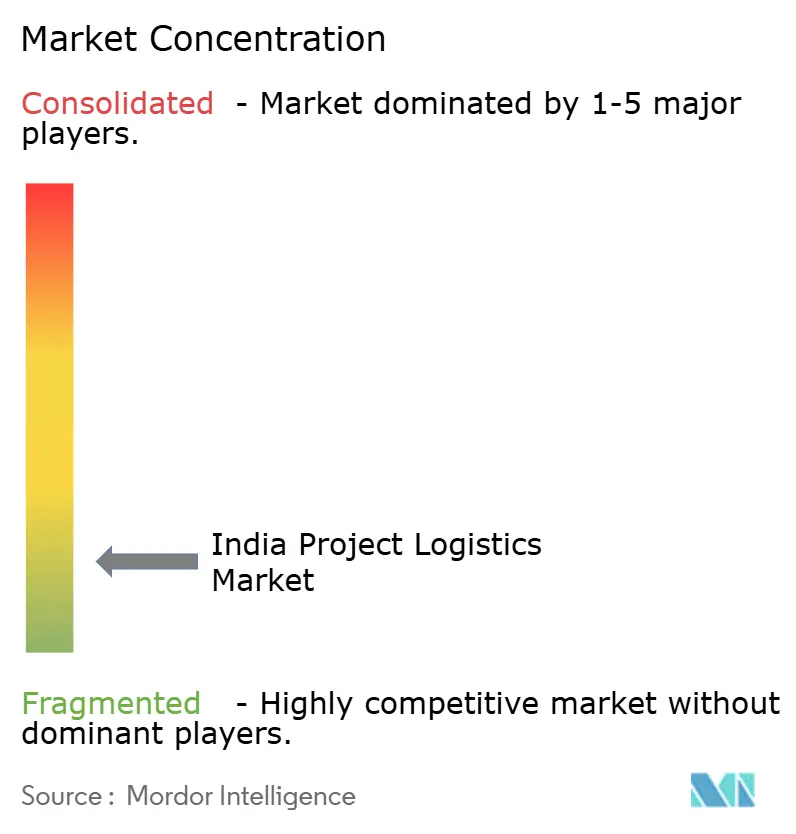
| Market Concentration | Low |
Major Players *Disclaimer: Major Players sorted in no particular order Image © Mordor Intelligence. Reuse requires attribution under CC BY 4.0. | |
India Project Logistics Market Analysis by Mordor Intelligence
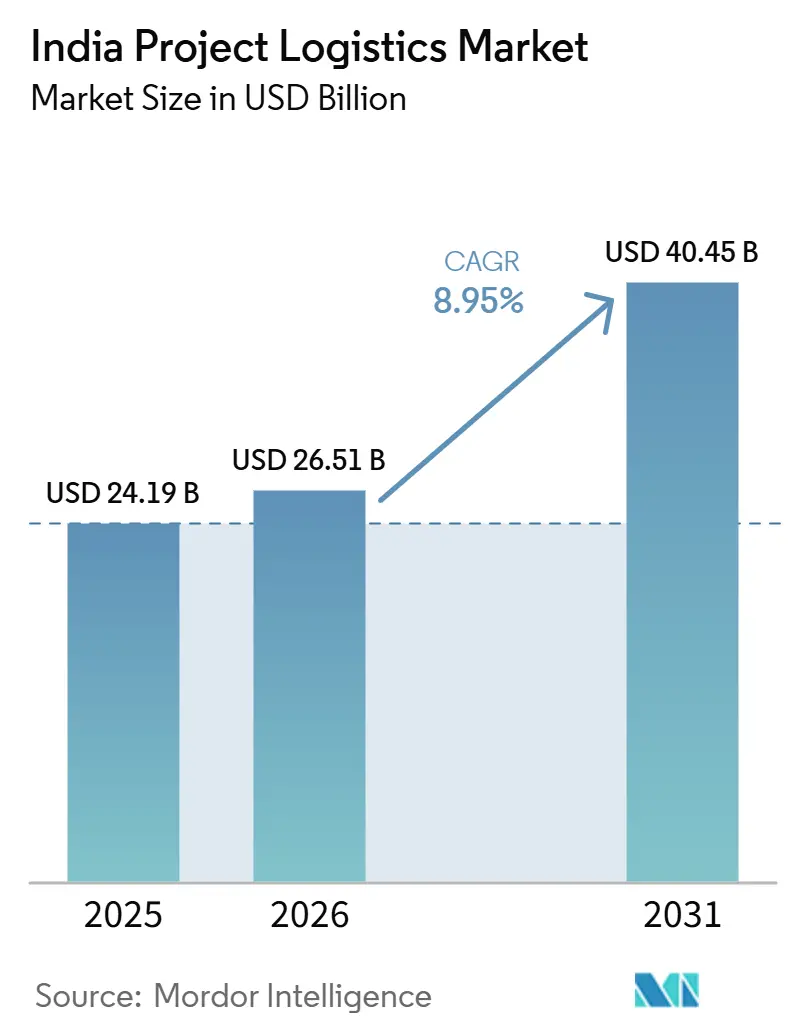
The India Project Logistics Market size is expected to grow from USD 3.49 billion in 2025 to USD 3.81 billion in 2026 and is forecast to reach USD 5.85 billion by 2031 at 8.95% CAGR over 2026-2031.
The India project logistics market is drawing steady momentum from a broad infrastructure buildout, with the National Infrastructure Pipeline tracking 14,563 projects as of March 2026, while central government project monitoring also showed 1,981 large projects worth INR 42.78 lakh crore (USD 476.13 billion) in April 2026, which keeps demand visible across roads, ports, rail, and industrial installations. The India project logistics market is also benefiting from improved freight infrastructure, as India’s Logistics Performance Index rank improved to 38 in 2023 from 54 in 2014, supporting more reliable handling of large and complex cargo movements across longer corridors. Inland waterways, dedicated freight corridors, and emerging multimodal logistics parks are expanding route options for oversized and heavy cargo, reducing reliance on road-only execution for every project movement in the Indian project logistics market. Competitive pressure remains high because global integrators and domestic specialists are both pursuing large EPC contracts, and contract wins increasingly depend on route planning, digital visibility, permit management, and access to scarce heavy-lift assets. The main limits on near-term execution remain permit delays, route restrictions for over-dimensional cargo, and corridor disruptions that can push up freight costs on sensitive energy-linked supply chains.
Key Report Takeaways
- By service, transportation held 70.29% of the India project logistics market share in 2025, while value-added services and others are projected to expand at a 9.73% CAGR through 2031.
- By cargo type, oversized cargo accounted for 28.69% of the India project logistics market share in 2025, while heavy-lift cargo is forecast to grow at a 9.33% CAGR through 2031.
- By end-user industry, oil and gas, mining, and quarrying accounted for 24.03% share of the India project logistics market size in 2025, while energy generation and transmission, including renewable energy, is projected to advance at a 9.70% CAGR through 2031.
Note: Market size and forecast figures in this report are generated using Mordor Intelligence’s proprietary estimation framework, updated with the latest available data and insights as of January 2026.
India Project Logistics Market Trends and Insights
Drivers Impact Analysis*
| Driver | (~) % Impact on CAGR Forecast | Geographic Relevance | Impact Timeline |
|---|---|---|---|
| Infrastructure-Led Project Cargo Buildout | +2.8% | Pan-India, concentrated in Gujarat, Maharashtra, Rajasthan, Odisha | Long term (≥ 4 years) |
| Shift Toward Multimodal Movement for Heavy Cargo | +1.9% | National, early gains in Gujarat, Maharashtra, West Bengal, Assam | Medium term (2-4 years) |
| Renewable Energy and Industrial Capex Pipeline | +2.1% | Tamil Nadu, Rajasthan, Gujarat, Andhra Pradesh | Medium term (2-4 years) |
| Early-Stage Logistics Planning for Scarce Heavy-Lift Assets | +0.7% | National, with priority in refinery belts of Gujarat and Rajasthan | Short term (≤ 2 years) |
| Digital Surveying, Route Simulation, and Permit Acceleration | +0.5% | National, with early gains in NH corridors under NHAI jurisdiction | Short term (≤ 2 years) |
| Port, Rail, and Inland Waterway Integration for ODC Movements | +0.7% | Coastal Gujarat, Maharashtra, Odisha, West Bengal, NW-1 and NW-2 corridors | Long term (≥ 4 years) |
| Source: Mordor Intelligence | |||
Infrastructure-Led Project Cargo Buildout
India’s central project pipeline remained large in 2026, with 1,981 projects worth INR 42.78 lakh crore (USD 476.13 billion) in the April 2026 flash report, and cumulative expenditure had already crossed INR 20.36 lakh crore (USD 226.60 billion) across 17 central ministries. Project additions also accelerated sharply in Q4 FY26, when 483 new projects worth INR 6.01 lakh crore (USD 66.89 billion) were added, and roads and highways alone accounted for 439 of them. This matters to the India project logistics market because every major road, refinery, rail, or port project creates parallel demand for moving heavy equipment, modules, structural sections, and installation systems before work at the site can advance. The India project logistics market also benefits well before commissioning, as logistics teams often need to mobilize cranes and transport systems and obtain route approvals months before the actual lift window. That pattern was visible in January 2025, when Mammoet deployed 3 very high-capacity cranes in India, including a 5,000-ton PTC210-DS, for refinery installations in Gujarat and Rajasthan[1]Ministry of Statistics and Program Implementation, “APRIL 2026.” MoSPI, www.mospi.gov.in/uploads/publications_reports/publications_reports.
Renewable Energy and Industrial Capex Pipeline
The India project logistics market is gaining additional support from the renewable energy buildout, especially from wind equipment movements that require long blades, large nacelles, and difficult port-to-site delivery planning. V.O. Chidambaranar Port recorded a 117.72% year-on-year rise in windmill blade handling in Q1 FY2026-27. At the same time, Deendayal Port Authority set a record with a single-vessel consignment of 153 wind turbine blades totaling 167,675 cubic meters in 2025. The Ministry of New and Renewable Energy launched the WT-MARUT portal in 2026 to track wind turbine supply chain components under the ALMM framework, demonstrating that logistics traceability is now more closely tied to renewable procurement and delivery discipline. Wind turbine and component exports crossed INR 12,000 crore (USD 1.33 billion) in FY26, nearly 50% higher year on year, which keeps pressure on ports and inland corridors to handle a larger flow of outsized cargo. As volumes scale, the India project logistics market stands to benefit from demand for purpose-built handling systems, staging areas, and final-mile transport solutions for cargo that standard freight networks cannot efficiently absorb[2]“Wind Mill Blades Handled.” Port news release reporting the Q1 FY2026-27 windmill blade handling increase and the port’s growing role in renewable energy cargo, V.O. Chidambaranar Port Authority, www.vocport.gov.in/api/files/news-media .
Shift Toward Multimodal Movement for Heavy Cargo
The India project logistics market is moving toward more multimodal execution because road-only movement is often the least efficient option for very large columns, transformers, and plant modules. India’s dedicated freight corridor network had reached 96.4% operationalization by March 2025, and inland waterway cargo climbed to a record 145.5 million tons in FY2024-25 as the government continued to expand operational national waterways and raise the modal role of water transport. CONCOR’s multimodal logistics park at Paradip handled its first import project cargo shipment for JSW Utkal Steel Plant in 2025, indicating that some logistics parks are beginning to serve as project cargo nodes rather than solely container-handling points. Rhenus Logistics also signed an MoU with IWAI in 2025 to deploy 100 cargo vessels and pusher tugs on national waterway routes, which widens the movement options for heavy equipment across North, East, and Northeast India. As these route combinations deepen, the India project logistics market should see more cargo split across port, rail, road, and barge legs, especially where road geometry or permit windows make a single-mode plan less practical.
Early-Stage Logistics Planning for Scarce Heavy-Lift Assets
The India project logistics market relies on a small pool of globally available heavy-lift cranes, SPMT fleets, and specialist handling crews, making early planning a real competitive advantage. When a high-capacity ring crane is assigned to a refinery or process plant installation, the equipment can remain committed for long periods, which leaves other projects waiting for the same type of lifting capability. That is why logistics providers that engage at the engineering stage are often better placed than firms that enter only after the execution schedule is fixed. In 2025, Express Global Logistics executed a multimodal barge-and-road movement of 905.6 metric tons of ODC columns from Vatva, Gujarat, to Nagothane, Maharashtra, using SPMT systems tailored for both marine and road handling. Revised Gazette notifications in October 2025 also authorized specific ODC route corridors, which reinforces the value of firms that already know how to align route design, permit filing, and asset booking early in the project cycle.
Restraints Impact Analysis*
| Restraint | (~) % Impact on CAGR Forecast | Geographic Relevance | Impact Timeline |
|---|---|---|---|
| Night Movement Restrictions and Road Geometry Constraints | -1.5% | National, acute on state highways in Rajasthan, Uttar Pradesh, Maharashtra, Madhya Pradesh | Long term (≥ 4 years) |
| Delayed Statutory Permits and Multi-Agency Clearances | -1.2% | National, with multi-state corridors most affected | Medium term (2-4 years) |
| Underdeveloped MMLP and First-Mile Last-Mile Connectivity | -0.9% | Northeast India, East India, interior Odisha, Chhattisgarh | Long term (≥ 4 years) |
| Weather Sensitivity and Monsoon-Linked Disruption Risk | -0.6% | Kerala, Odisha, West Bengal, Assam, Maharashtra coastal belt | Short term (≤ 2 years) |
| Source: Mordor Intelligence | |||
Night Movement Restrictions and Road Geometry Constraints
The India project logistics market still faces hard movement constraints on many state and national corridors where over-dimensional cargo cannot move without strict timing and escort controls. Night movement restrictions differ by state, route, and cargo dimensions, and these rules can add 1 to 3 days to a movement that would otherwise be much shorter if it ran continuously. Low bridge clearances, narrow culverts, and turning radius limits also force rerouting to longer corridors, which increases transport costs and the complexity of permits for each movement. The scale of this issue was clear in 2025, when NTC Logistics held a joint meeting with NHAI officials and participants from the renewable energy sector to assess the feasibility of moving wind blades and other oversized components on national highways. Until alternate rail, coastal, or inland water routes are available on the same corridor, the India project logistics market will continue to see project schedules slowed by physical road limits rather than by cargo availability alone[3]“Best Practices in Permitting of Oversize and Overweight Vehicles.” Government guidance on permitting, escorts, route surveys, and superload movement controls, Ministry of Road Transport and Highways / FHWA, ops.fhwa.dot.gov/publications/fhwahop17061/index.htm .
Delayed Statutory Permits and Multi-Agency Clearances
The India project logistics market also remains constrained by a fragmented permit structure across states and agencies. Complex multi-state ODC road permits often take 3 to 4 weeks under NHAI-linked approvals, and each state has its own fee structures, permit rules, and validity windows. When validity windows do not align across adjoining states, shipments can be forced into holding periods in the middle of the route, creating both cost pressure and schedule risk for EPC projects. The approval chain can involve MoRTH, state transport departments, NHAI, and, sometimes, environmental clearance authorities, so digital filing does not fully eliminate the delay caused by multi-agency sequencing. Even after Rajmarg Pravesh 2.0 and wider data integration measures, the India project logistics market still has to work through route surveys and structural load checks for very large cargo, especially for reactor vessels and transformer banks that place unusual stress on roads and bridges[4]National application portal for oversize and overweight cargo movement on Indian highways, showing centralized online processing and bridge-related review requirements, ODC/OWC Application, morth-owc.nic.in/auth/users/index.asp.
*Our forecasts treat driver/restraint impacts as directional, not additive. The impact forecasts reflect baseline growth, mix effects, and variable interactions.
Segment Analysis
By Service: Transportation's Scale Masks Faster Value-Added Service Growth
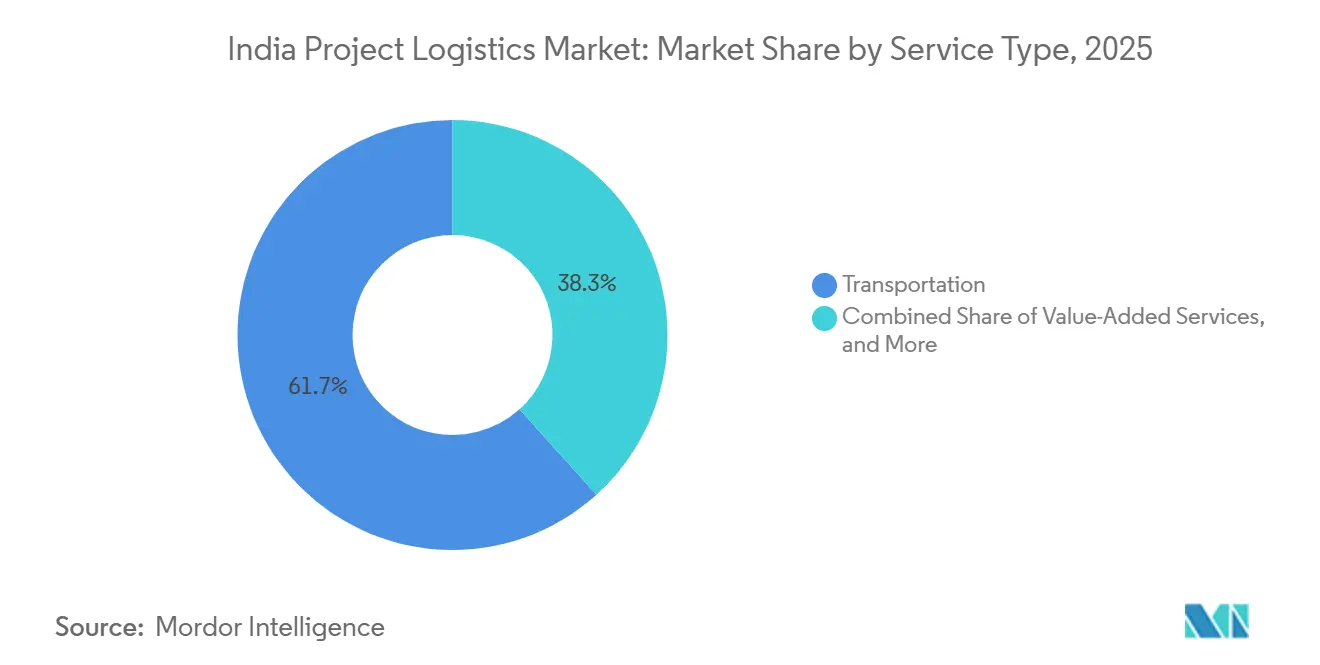
Transportation held 70.29% of the India project logistics market share in 2025, keeping it clearly ahead of other service categories, as most project cargo still requires a significant physical movement component before installation can begin. Road transport remained central because many project sites are still not fully connected to railheads or inland waterways. At the same time, coastal shipping and barge legs became important on western and eastern corridors, carrying large process equipment. Rail also remained relevant where payloads were high and dedicated freight connectivity could be used to reduce pressure on roads and permits. Warehousing, distribution, and inventory management served a smaller but necessary role because phased project deliveries often require staging, consolidation, and timed release to match the construction sequence. That structure means the India project logistics market still takes most of its value from movement execution. Still, larger operators are trying to protect margins by adding services around the physical move.
Value-added Services and Others is forecast to grow at a 9.73% CAGR through 2031, slightly faster than the overall market and reflecting demand for route studies, digital tracking, customs handling, and pre-commissioning support. Express Global Logistics showed that bundled execution is already gaining ground in 2025, handling super ODC columns along India’s western coast with 30-axle SPMT lines and coordinating barge movements under a single operating scope. Route-specific ODC authorizations under the Motor Vehicles Act also favor operators who can pair engineering and transport planning with permit compliance, helping integrated service models win repeat business. As a result, the India project logistics industry is not moving away from transportation; rather, it is clearly moving toward contracts in which transportation is only one part of the offer.



By Cargo Type: Oversized Cargo Dominates, Heavy-Lift Segment Accelerates
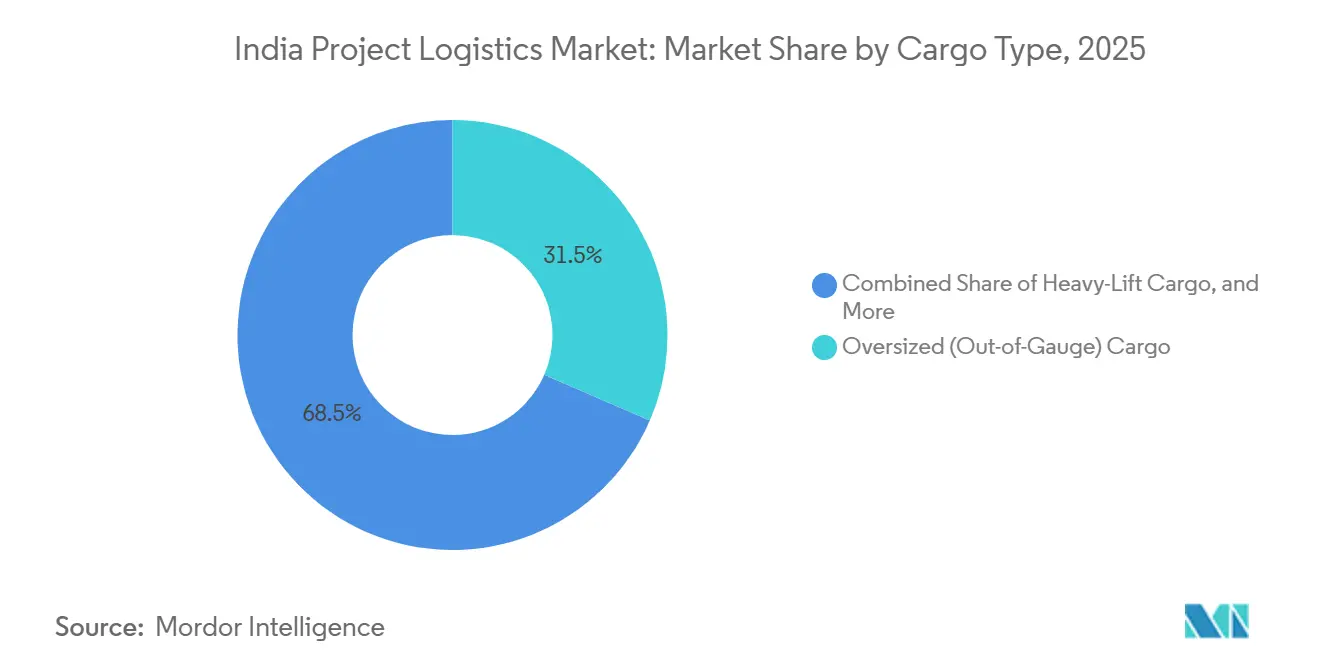
Oversized, or out-of-gauge, cargo held 28.69% of the India project logistics market size in 2025, making it one of the largest cargo category in the India project logistics market because wind blades, power transformers, pressure vessels, and large industrial modules remain core to the current capex cycle. Deendayal Port Authority handled a record 167,675 CBM of wind turbine blades in a single shipment in 2025, which shows the scale at which oversized renewable cargo is now entering Indian logistics corridors. Breakbulk cargo remained important for industrial machinery and equipment that exceeded container dimensions but did not need the most complex heavy transport systems. The others category continued to cover specialized items such as yachts, industrial molds, and sector-specific project components that fall outside the main cargo clusters.
Heavy-Lift Cargo is the fastest-growing cargo segment in the India project logistics market, and it is projected to expand at a 9.33% CAGR through 2031 as refinery, petrochemical, and power installations require more lifts above 500 tons. Sarens completed a five-month heavy-lift campaign at the HPL Haven Project in Haldia in 2026 after moving its CC8800-1 crawler crane from Paradip with 58 trailers, which shows how large the execution scale has become for inland industrial sites. JSI Alliance also completed a six-voyage installation campaign at Gujarat Chemical Port Ltd. between December 2025 and March 2026, handling 18 components ranging from 50 to 600 tons with the heavy-lift vessel Jumbo Javelin. These examples show that the India project logistics market is no longer handling heavy-lift work only on an occasional basis, because both ports and industrial zones are now receiving this kind of project cargo more regularly. They also show why firms with crane access, marine coordination, and engineered lifting capability are gaining ground within the India project logistics market.
By End-User Industry: Oil and Gas Anchors Demand While Renewables Expand Faster
Oil and gas, mining, and quarrying held 24.03% of the India project logistics market share in 2025, making it one of the largest end-user group, as refinery expansions, pipelines, and upstream works generate sustained heavy cargo demand. IOCL, ONGC, and BPCL each carried major FY26 capex programs, providing logistics providers with a durable flow of cargo tied to state-led energy investment cycles. The Paradip-Numaligarh Crude Oil Pipeline and the Numaligarh Refinery expansion also illustrate how multi-year oil infrastructure projects can generate recurring movements over long execution windows. Construction and infrastructure remained another large source of demand because bridge sections, metro elements, and large-span fabricated pieces still require specialized handling and timed site delivery.
Energy generation and transmission, including renewable energy, is one of the fastest-growing end-user segment, with the India project logistics market for this segment forecast to rise at a 9.70% CAGR through 2031. The growth is tied to wind, solar, and grid equipment flows that are larger in volume, more widely distributed, and often more time-sensitive than traditional cargo streams. Tiger Logistics moved nearly 2 GW of solar equipment in a single assignment in 2025 through Indian ports such as Nhava Sheva, Mundra, Hazira, and Chennai, underscoring the scale of logistics work now linked to renewable energy programs. The ALMM framework adds a compliance layer for component sourcing and certification, which rewards operators who can handle customs, documentation, and controlled handoffs without delaying site schedules. Manufacturing and industrial plants, aerospace and defense, and other sectors continue to broaden the revenue base. Still, renewable-linked project cargo is now expanding faster than many legacy end-user groups in the India project logistics market.
Geography Analysis
West India is making the strongest concentration zone for the India project logistics market, as Gujarat and Maharashtra combine major ports, industrial corridors, and established heavy cargo routes. JNPT, Mundra, Deendayal, and Hazira continue to anchor cargo inflows and coastal redistribution. Refinery and industrial activity in Gujarat and neighboring Rajasthan also keeps this corridor active for heavy-lift and oversized movements. Mammoet’s refinery crane deployments in Gujarat and Rajasthan, and the Dahej installation work completed by JSI Alliance, both reinforce West India’s role as the main hub for heavy project cargo. The India project logistics market in this zone is also supported by earlier freight infrastructure upgrades that reduced logistics costs as a share of GDP and improved corridor quality over the last decade.
North India is providing the India project logistics market with a strong base of inland origins and destinations across Delhi-NCR, Chandigarh, Rajasthan, and Madhya Pradesh. This region remains important for industrial plant equipment, power installations, and defense-related movements from inland production clusters. The Eastern Dedicated Freight Corridor from Ludhiana to Sonnagar improves rail access for heavy project cargo moving toward eastern gateways and industrial destinations. South India contributed 25% of overall logistics activity in FY25 and remains the most active renewable project cargo belt, especially in Tamil Nadu, where V.O. Chidambaranar Port handled record wind blade volumes in 2026. The Chennai Mappedu multimodal logistics park is being developed to support staging and multimodal connectivity to Chennai, Ennore, and Kattupalli, thereby strengthening project cargo handling in the South.
East India accounted for a minor share of overall logistics activity in FY25, but it is gaining in importance as logistics infrastructure investment is expanding faster from a lower base. CONCOR’s Paradip facility already handled project cargo for JSW Utkal Steel Plant in 2025, indicating that Odisha is increasingly supporting more complex logistics execution. Assam also gained visibility after progress on India’s first multimodal logistics park under the National Highways Logistics Management Limited, reflecting a wider push to create stronger nodes in the Northeast. The 2025 MoU for a multimodal logistics park in Varanasi linked rail, inland waterways, and air access into a single logistics concept for the Gangetic belt. Budget support for port-to-hinterland connectivity should further help East India, where first-mile and last-mile bottlenecks have historically limited the full potential of the India project logistics market.
Competitive Landscape
The India project logistics market remains fragmented in 2026, and no single operator controls more than a mid-single-digit share of the USD 26.51 billion market. Global players such as A.P. Moller-Maersk, DSV, Kuehne+Nagel, CMA CGM, and Geodis compete with domestic specialists, including Allcargo Logistics, Express Global Logistics, TCI Freight, deugro India, Mammoet India, Total Movements, Procam Logistics, SARR Freights, and CJ Darcl. Global firms usually compete through international forwarding networks, parent engineering capabilities, and long-standing relationships with EPC clients operating across borders. Domestic specialists often compete through local route knowledge, permit handling, familiarity with state agencies, and faster mobilization of SPMT systems and cranes. This mix keeps the India project logistics market competitive on both price and execution quality, especially for contracts that involve multiple cargo types and multi-state delivery coordination.
Strategic moves in 2025 and 2026 show that companies are trying to deepen capabilities rather than only add capacity. Kuehne+Nagel opened a new air logistics gateway in Bengaluru in 2025, strengthening its ability to handle high-value, time-sensitive project components alongside ocean and road operations. CMA CGM signed a USD 360 million shipbuilding contract with Cochin Shipyard for 6 LNG-powered feeder vessels, which expands its India presence across shipping and linked inland logistics corridors. Maersk also ordered 1,000 India-manufactured EXIM containers in July 2026, which points to a broader strategy of embedding more tightly into the local logistics and equipment ecosystem.
The India project logistics market is also opening space for firms that can add services around the final delivery task. Pre-commissioning logistics, route surveying, AI-led exception management, and digital twin route simulation are becoming stronger differentiators as project owners seek fewer execution handoffs. This is important in a market where permit delays, escort planning, and route readiness can be as critical as the transport asset itself. Allcargo’s November 2025 demerger and the stronger FY26 performance of the resulting structure signal that focused positioning can sharpen competition in cross-border and project-linked freight segments. Over time, the India project logistics market is likely to reward operators that combine local execution depth with digital control, rather than those that rely solely on transport capacity.
India Project Logistics Industry Leaders
DSV A/S
CMA CGM Group (Including CEVA Logistics)
Kuehne+Nagel
Express Global Logistics Private Limited
Allcargo Logistics Limited
- *Disclaimer: Major Players sorted in no particular order

Recent Industry Developments
- July 2026: Maersk orders 1,000 EXIM containers from DCM Shriram Group, manufactured in India. A.P. Moller-Maersk unveiled India's first domestically manufactured export-import container at the Maersk-CONCOR ICD in Dadri, Uttar Pradesh, and immediately placed an order for 1,000 additional units, backed by the Union Budget 2026-27 allocation of INR 10,000 crore (USD 1.11 billion) for the Container Manufacturing Promotion Scheme. The order positions India as an emerging alternate to China in global container manufacturing and deepens Maersk's vertically integrated India logistics strategy.
- June 2026: JSI Alliance completes six-voyage heavy-lift campaign at Gujarat Chemical Port, Dahej. JSI Alliance completed the installation of 18 heavy components, 50 to 600 tons each, across 6 voyages of the heavy-lift vessel Jumbo Javelin for GCPL's liquid cargo berth expansion at Dahej, raising the port's annual handling capacity to 12 million metric tons. The campaign began in December 2025 and concluded in March 2026, and it required a custom Fly Jib configuration to navigate strong tidal conditions in the Gulf of Khambhat.
- February 2026: CMA CGM signs USD 360 million shipbuilding contract with Cochin Shipyard for 6 LNG-powered vessels. CMA CGM signed the final contract with Cochin Shipyard Limited for 6 1,700 TEU LNG-powered container vessels, becoming the first major global carrier to commission LNG vessels from an Indian shipyard. The vessels will be built with technical cooperation from HD Hyundai Heavy Industries and registered under the Indian flag, with deliveries expected during 2029-2031. CMA CGM also established an AI and digital twins R&D hub in Chennai in partnership with Capgemini.
- January 2026: JNPA extends Allcargo Terminals CFS contract by 10 years, capacity nearly doubles. Jawaharlal Nehru Port Authority approved a 10-year extension of Allcargo Terminals' Speedy Multimodes CFS contract at JNPA. At the same time, Allcargo Terminals also announced a near-doubling of handling capacity at a nearby facility from 190,000 TEUs to 360,000 TEUs annually.


India Project Logistics Market Report Scope
| Transportation | Road |
| Rail | |
| Air | |
| Sea/Barge | |
| Warehousing, Distribution and Inventory Management | |
| Value-added Services and Others |
| Oversized (Out-of-Gauge) Cargo |
| Heavy-Lift Cargo |
| Breakbulk Cargo |
| Others |
| Oil and Gas, Mining and Quarrying |
| Energy Generation and Transmission (Includes Renewable Energy) |
| Construction and Infrastructure |
| Manufacturing and Industrial Plants |
| Aerospace and Defense |
| Others (Maritime and Shipbuilding, Telecommunications, etc.) |
| By Service | Transportation | Road |
| Rail | ||
| Air | ||
| Sea/Barge | ||
| Warehousing, Distribution and Inventory Management | ||
| Value-added Services and Others | ||
| By Cargo Type | Oversized (Out-of-Gauge) Cargo | |
| Heavy-Lift Cargo | ||
| Breakbulk Cargo | ||
| Others | ||
| By End-User Industry | Oil and Gas, Mining and Quarrying | |
| Energy Generation and Transmission (Includes Renewable Energy) | ||
| Construction and Infrastructure | ||
| Manufacturing and Industrial Plants | ||
| Aerospace and Defense | ||
| Others (Maritime and Shipbuilding, Telecommunications, etc.) |


Key Questions Answered in the Report
What is the size outlook for India project logistics through 2031?
The India project logistics market is expected to rise from USD 26.51 billion in 2026 to USD 40.45 billion by 2031 at an 8.95% CAGR.
Which service category leads project logistics revenue in India?
Transportation led with 61.67% share in 2025 because most oversized and heavy cargo still depends on road, rail, coastal, or barge movement before site installation begins.
Which cargo type is growing the fastest in India project logistics?
Heavy-Lift Cargo is projected to grow at a 9.41% CAGR through 2031, supported by refinery, petrochemical, and power sector installations.
Which end-user group creates the largest demand for project cargo services?
Oil and Gas, Mining and Quarrying held 25.05% share in 2025, helped by refinery expansion, pipeline work, and upstream energy capex.
Why are multimodal routes becoming more important for oversized cargo in India?
Rail, inland waterways, and multimodal logistics parks are improving route options, which helps reduce dependence on difficult road corridors and supports larger project loads.
What are the biggest operational constraints for project cargo movement in India?
Permit delays, night movement restrictions, and road geometry issues remain the key barriers because they extend lead times and complicate multi-state execution.
Page last updated on:





