
Market Overview
| Study Period | 2020 - 2031 |
|---|---|
| Forecast Data Period | 2026 - 2031 |
| Base Year Market Size (2025) | USD 1.72 Billion |
| Market Size (2026) | USD 1.79 Billion |
| Market Size (2031) | USD 2.21 Billion |
| Growth Rate (2026 - 2031) | 4.24 % |
| Market Concentration | Medium |
Major Players *Disclaimer: Major Players sorted in no particular order Image © Mordor Intelligence. Reuse requires attribution under CC BY 4.0. | |
India Metal Cans Market Analysis by Mordor Intelligence
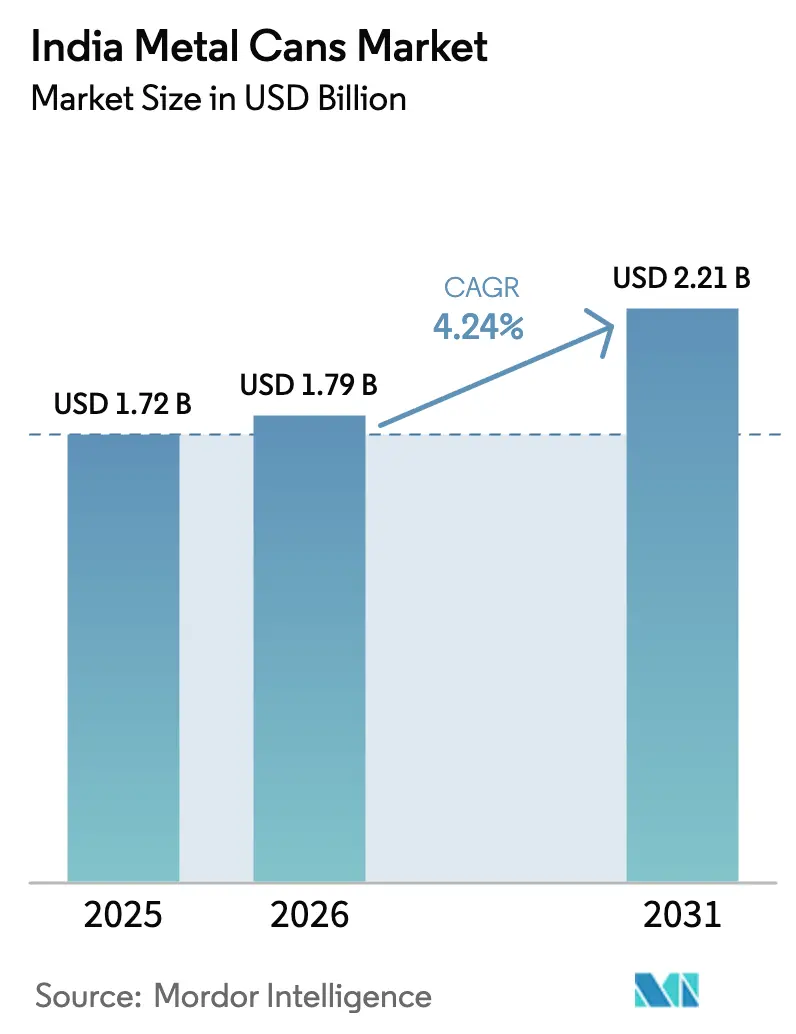
The India metal cans market size is expected to grow from USD 1.72 billion in 2025 to USD 1.79 billion in 2026 and is forecast to reach USD 2.21 billion by 2031 at 4.24% CAGR over 2026-2031. Rising demand for recyclable packaging, continued capacity additions by global and domestic converters, and aluminum’s cost advantage underpin this steady expansion. The India metal cans market benefits from the country’s 4.1 million-ton annual aluminum output, which secures local feedstock availability even as global metal prices remain volatile. Ongoing policy support through Extended Producer Responsibility (EPR) rules effective April 2025 reinforces metal’s appeal over single-use plastics, while investments such as CANPACK Group’s USD 150 million greenfield site in Uttar Pradesh confirm long-term confidence among international stakeholders. Rapid growth in ready-to-drink beverages, personal-care aerosols, and pharmaceutical inhalers continues to widen end-user diversity, allowing producers to spread risk across multiple consumer categories. Competitive intensity is gradually rising, yet fragmentation persists as regional specialists grow alongside multinational entrants.
Key Report Takeaways
- By material type, aluminum led with 69.92% of the India metal cans market share in 2025; steel is forecast to post the fastest 5.21% segment CAGR through 2031.
- By can structure, two-piece formats captured 52.74% of the India metal cans market size in 2025, while monobloc aerosol variants are projected to expand at a 5.61% CAGR to 2031.
- By capacity, 250-500 ml cans held 31.05% share of the India metal cans market size in 2025, yet ≤250 ml formats are advancing at a 5.72% CAGR through 2031.
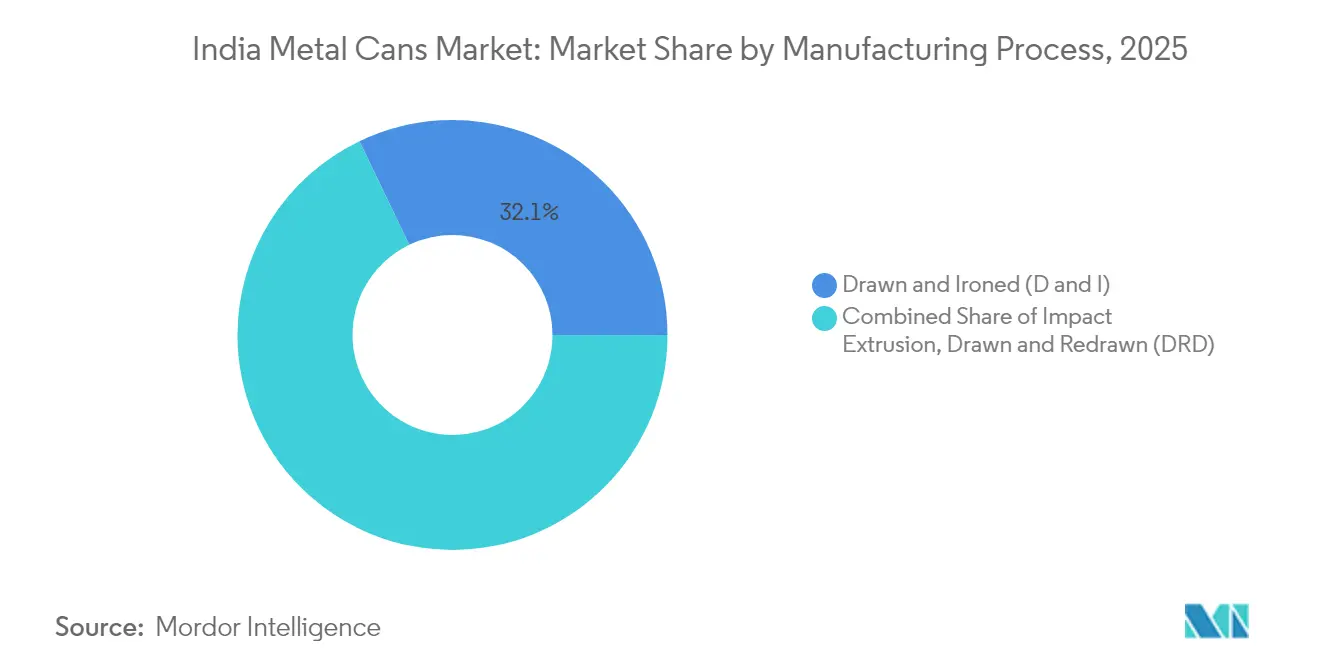
- By manufacturing process, Drawn and Ironed (D and I) accounted for 32.12% of the India metal cans market size in 2025; impact extrusion is registering the highest 5.55% CAGR on the back of aerosol demand.
- By end-user industry, beverages commanded 39.88% revenue in 2025, whereas pharmaceuticals register the strongest 5.78% CAGR through 2031.
- By geography, Maharashtra and Gujarat together represented 47.62% of the India metal cans market size in 2025, supported by integrated aluminum supply chains and port access.
Note: Market size and forecast figures in this report are generated using Mordor Intelligence’s proprietary estimation framework, updated with the latest available data and insights as of 2026.
India Metal Cans Market Trends and Insights
Drivers Impact Analysis*
| Driver | (~) % Impact on CAGR Forecast | Geographic Relevance | Impact Timeline |
|---|---|---|---|
| Rapid growth in convenience and RTD foods | +1.20% | National; early gains in Mumbai, Delhi, Bengaluru | Medium term (2-4 years) |
| Increasing beverage-can uptake in craft beer and energy drinks | +0.80% | Urban centers in Maharashtra, Karnataka, Goa | Short term (≤ 2 years) |
| Higher recycling rates and circular-economy regulations | +0.70% | National; compliance focus in major cities | Long term (≥ 4 years) |
| Aerosol demand surge in personal-care segment | +0.90% | Urban and semi-urban India | Medium term (2-4 years) |
| Rise of indigenous chai/coffee-in-a-can SKUs | +0.60% | National; premium channels | Medium term (2-4 years) |
| Rural fruit-processing clusters adopting canning | +0.40% | Maharashtra, Andhra Pradesh, Karnataka | Long term (≥ 4 years) |
| Source: Mordor Intelligence | |||
Rapid Growth in Convenience and RTD Foods
Shelf-stable ready-to-drink meals and beverages are pushing manufacturers to adopt metal packaging that supports 18-month ambient life spans, minimizes refrigeration costs, and allows premium positioning on modern retail shelves. The government’s Pradhan Mantri Kisan Sampada Yojana has earmarked INR 6,000 crore (USD 720 million) toward food-processing infrastructure, directly backing 42 mega parks that house new canning lines. Brands such as Tata Consumer Products capitalized on this support by introducing 180 ml RTD coffee cans in October 2024, priced 15–20% above PET alternatives yet registering higher off-take in metro supermarkets.[2]World Aerosols, “Latest Magazine Volume 8 Issue 3,” worldaerosols.comAluminum’s strong barrier against oxygen and light maintains flavor integrity, allowing processors to promise authentic chai or coffee taste without cold chain reliance. Subsidies covering 35% of capital cost for canning equipment further tilt the economics in favor of metal, especially for small-format packs geared toward portion-control and premium margins. As organized retail penetration climbs past 12% of India’s grocery turnover in 2025, the India metal cans market gains a durable growth engine.
Increasing Beverage-Can Uptake in Craft Beer and Energy Drinks
Aluminum’s light weight reduces logistics expenses by around 30% compared with glass, crucial for independent breweries shipping to distant metros.[3]Times of India, “Japan’s Nippon Paint Looks at Fresh Investments,” timesofindia.indiatimes.com Craft labels in Goa, Maharashtra, and Karnataka increasingly choose 330 ml and 500 ml sizes that fit premium pricing while safeguarding carbonation. Energy-drink makers tout aluminum’s thermal conductivity for rapid chilling an important impulse-purchase trigger in India’s hot climate. Industry feedback indicates 25% quicker inventory rotation for canned SKUs thanks to extended shelf life and lower breakage. Moreover, the Bureau of Indian Standards’ IS 18427 certification, finalized in 2024, gives alcoholic-beverage producers a clear compliance path that removes earlier regulatory ambiguity. As these niche categories scale, the India metal cans market receives incremental high-margin volume that offsets softer demand in commoditized soft-drink segments.
Higher Recycling Rates and Circular-Economy Regulations
EPR rules effective April 2025 oblige manufacturers to ensure 70% recycling of aluminum packaging by 2027, a target well within the metal can industry’s current urban recovery performance of 85%. Aluminum’s closed-loop recyclability saves 95% of the energy required for primary smelting, delivering tangible carbon-footprint reductions a metric large consumer-goods firms now disclose in annual ESG reports. Hindalco’s INR 45,000 crore (USD 5.4 billion) investment into a 500,000-ton scrap-processing network guarantees feedstock and lowers cost volatility. Reverse-logistics incentives embedded in EPR guidelines are expected to expand collection from tier-2 cities, boosting the India metal cans market while allowing converters to market cans as “near-zero-carbon” packaging.
Aerosol Demand Surge in Personal-Care Segment
Total aluminum aerosol shipments to India climbed to an estimated 650 million units in 2024, driven by deodorants, hair sprays, and rising men’s grooming categories. Local producer Sterling Enterprises now supplies monobloc cans as small as 50 ml, addressing demand for travel-size packs favored by e-commerce shoppers. Impact-extrusion lines can produce thinner walls without compromising pressure ratings, lowering metal input per can by 15% and improving margins. National disposable-income growth supports premiumization, while urban consumers demonstrate higher willingness to pay for recyclable metal over non-recyclable plastic propellant containers. These trends sustain a robust 5.94% CAGR for monobloc aerosols inside the India metal cans market through 2030.
Restraints Impact Analysis*
| Restraint | (~) % Impact on CAGR Forecast | Geographic Relevance | Impact Timeline |
|---|---|---|---|
| PET and flexible-packaging substitution pressure | −1.1% | National; higher impact in cost-sensitive segments | Short term (≤ 2 years) |
| Volatility in aluminum and tin-plate costs | −0.8% | National; all manufacturers | Medium term (2-4 years) |
| Domestic tin-plate supply bottlenecks | −0.6% | National; food clusters | Medium term (2-4 years) |
| EPR cost-pass-through uncertainty | −0.4% | National; small manufacturers | Short term (≤ 2 years) |
| Source: Mordor Intelligence | |||
PET and Flexible-Packaging Substitution Pressure
PET bottles and retort pouches still undercut cans by 20–30% on material cost, swaying price-sensitive fillers in carbonated soft drinks and edible oils. Private-equity firm PAG’s INR 8,400 crore (USD 1.01 billion) purchase of Manjushree Technopack in November 2024 underscores investor appetite for plastics. PET’s clarity caters to consumers who prefer visual product validation, while flexible packs enable stand-up pouches that occupy less shelf space. Plastic players are investing in bottle-to-bottle recycling infrastructure to blunt aluminum’s sustainability edge, an effort that could temper the India metal cans market’s near-term growth in mass-market segments. Even so, aluminum retains dominance where internal pressure or taste protection is non-negotiable, giving cans a secure beachhead despite substitution risk.
Volatility in Aluminum and Tin-Plate Costs
London Metal Exchange cash prices swung 25% during 2024, moving between USD 2,100 and USD 2,700 per ton as energy costs and geopolitical disruptions roiled the market. Tin-plate imports account for 60% of Indian demand, exposing canners to currency fluctuations and antidumping duties. Smaller converters lacking hedging mechanisms saw EBITDA margins shrink below 8% in late 2024. Large players mitigate risk via long-term supply agreements and in-house scrap recovery, but volatility remains an operating headache. Persistent metal-price swings could accelerate consolidation within the India metal cans industry as undercapitalized firms exit.
*Our forecasts treat driver/restraint impacts as directional, not additive. The impact forecasts reflect baseline growth, mix effects, and variable interactions.
Segment Analysis
By Material Type: Aluminum Secures Leadership
Aluminum retained 69.92% share of the India metal cans market in 2025, supported by domestic smelter capacity that shields converters from import exposure. The segment is set to post a 4.95% CAGR, underpinned by Hindalco’s recycling expansion, which lowers input costs by 20% versus primary metal. Tin-coated steel holds niche relevance in foods demanding elevated sulfur-corrosion resistance, yet its weight disadvantage limits penetration in beverages and aerosols. Consumers increasingly associate aluminum with premium, eco-friendly credentials, reinforcing its dominant role across multiple pack sizes. Supply-chain resilience and regulatory favorability ensure aluminum’s grip on the India metal cans market remains firm.
Secondary products such as steel cans for curries and pickles exploit three-piece construction that allows necking and shaping flexibility. However, limited domestic tin-plate manufacturing forces dependence on imports, increasing landed cost and constraining growth. Continuous investments in lightweight aluminum alloys and water-based interior lacquers further widen the performance gap, confirming aluminum as the mainstay of the India metal cans market.




By Can Structure: Two-Piece Dominance and Aerosol Upswing
Two-piece drawn-and-wall-ironed (DWI) cans delivered 52.74% share in 2025 thanks to material efficiency and high-speed production lines exceeding 2,000 cans/minute. Seamless walls prevent micro-leaks in carbonated beverages, supporting extended distribution cycles vital in a country where refrigeration grids remain uneven. CANPACK’s Uttar Pradesh facility breaking ground in February 2025 will add over 2 billion DWI units annually, easing supply tightness. Monobloc aerosol formats, though only 8.12% of unit volume, are expanding at a market-leading 5.61% CAGR as grooming habits evolve and pharmaceutical inhalers gain traction.
Three-piece bodies continue to serve food staples like ghee and condensed milk, where internal vacuum rather than pressure is the chief concern. Yet sustained capital inflows into DWI automation suggest two-piece cans will keep absorbing market share, once again highlighting productivity as a central lever in the India metal cans market.
By Capacity/Size: Mid-Range Leads, Small Formats Accelerate
Pack sizes between 250 ml and 500 ml accounted for 31.05% of 2025 volume, aligning with single-serving soft-drink and beer consumption norms. Smaller ≤250 ml units, including Tata Consumer’s 180 ml RTD coffee can, are riding a 5.72% CAGR wave, fueled by portion-control trends that resonate with weight-watching urban professionals. Mini-cans also help brands achieve premium price-points per milliliter, enhancing revenue per kilogram of aluminum consumed. Larger formats above 1,000 ml remain the domain of institutional paints and automotive lubricants, but growth here is muted by the emergence of composite containers and HDPE drums that offer cost advantages.
By Manufacturing Process: D and I Technology Rules
Drawn and Ironed technology handled 32.12% of 2025 output, prized for reducing aluminum usage by up to 15% relative to Drawn and Redrawn lines. The India metal cans market size for D and I cans is projected to expand at a stable 4.62% CAGR as additional high-speed lines arrive from Europe and China. Impact extrusion, the technology behind aerosol monoblocs, posts a quicker 5.55% CAGR. Automation upgrades such as robotics for can-end lining and in-line vision inspection lower defect rates below 150 ppm, a benchmark demanded by multinational fillers. Ball Corporation’s 2025 patent for reclosable ends demonstrates continuous innovation in this mature process, illustrating how incremental features can defend share against other pack formats
By End-User Industry: Beverages on Top, Pharma Rising Fast
Beverages owned 39.88% revenue in 2025 as beer, energy drinks, and flavored water brands prioritized aluminum’s pressure tolerance and flavor neutrality. The India metal cans market size for beverages is expected to grow at a steady 4.12% CAGR through 2031, aided by the craft-beer boom and vending-machine rollouts in tier-1 cities. Pharmaceuticals, although a modest 3.08% share today, exhibit a 5.78% CAGR driven by metered-dose inhalers that rely on aluminum canisters for sterility and dimensional accuracy. Personal-care aerosols also log above-average growth as grooming spends rise by double digits in metro markets. Paints, chemicals, and automotive fluids round out demand but remain sensitive to economic cycles, leading converters to diversify into high-margin specialty coatings to protect earnings.
Geography Analysis
Western India namely Maharashtra and Gujarat hosts nearly half of national manufacturing thanks to port access, raw-material proximity, and generous tax incentives. Maharashtra leverages its consumer base around Mumbai and Pune to fast-track new beverage launches, while Gujarat’s aluminum-rolling ecosystem tightens supply chains for can-body stock. Southern states such as Karnataka and Tamil Nadu specialize in pharmaceutical aerosols and specialty foods, harnessing skilled labor and biotech clusters. Shetron Limited’s plants in Bengaluru and Raigad highlight a dual-state model that balances logistics between northern and southern demand pockets. Northern India is now attracting large investments, with CANPACK’s Uttar Pradesh megasite positioned to serve the Delhi-NCR belt India’s largest single consumption zone while tapping dedicated freight corridors to reach eastern states. The east remains underdeveloped but could surface as a manufacturing hotspot post-2027 once corridor upgrades shrink transit times to ports like Kolkata and Paradip. Regional policy differentials in electricity tariffs, land-lease rates, and recycling mandates will continue shaping where new capacity lands, keeping location strategy a live question for every participant in the India metal cans market.
Regulatory Landscape
India metal can producers operate under food-contact packaging controls led by the Food Safety and Standards Authority of India (FSSAI) and quality standardization by the Bureau of Indian Standards (BIS). The Food Safety and Standards (Packaging) Regulations, 2018 (amended April 2, 2025) require metal containers used for packaging or storing food to conform to applicable Indian Standards, explicitly referencing prime-grade tinplate standards such as IS 1993, IS 13955, IS 9025, or IS 13954. This reinforces compliance needs across three-piece food cans and related closures.
A key near-term compliance shift is the Ministry of Commerce and Industrys Cookware, Utensils and Cans for Foods and Beverages (Quality Control) Order 2026, issued January 16, 2026. The order mandates BIS Standard Mark licensing under the Bureau of Indian Standards (Conformity Assessment) Regulations, 2018. BIS standards relevant to the category include IS 14407:2023 (aluminum cans for beverages) and IS 1993:2018 (electrolytic tinplate), tightening documentation, testing, and licensing requirements for converters serving food and beverage fillers.
Value Chain Analysis
The India metal cans value chain starts with aluminum and tinplate supply, where feedstock availability and food-contact specifications are key constraints. Aluminum can-body stock benefits from domestic metal output and recycling initiatives, while tinplate remains more import-exposed, which adds landed-cost and lead-time risk for three-piece food-can makers. For food applications, inputs must align with FSSAI packaging rules and corresponding BIS standards, such as IS 1993 for electrolytic tinplate and IS 14407 for aluminum beverage cans.
Converting then spans D and I beverage-can lines, impact-extrusion aerosol canisters, and three-piece food cans, followed by can-end, closure, coating or lacquer, and decoration ecosystems before shipment to fillers in beverages, foods, personal care, and pharmaceuticals. Industry structure stays a mix of multinational and domestic converters, with portfolio actions and operating discipline shaping upstream and downstream coordination. Oricon Enterprises transfer of its metal crown seals and ROPP business to Guala Closures (India) Pvt Ltd is one example, alongside tax and compliance management under GST that can influence working capital and plant utilization, as reflected in Hindustan Tin Works regulatory proceedings updates.
Competitive Landscape
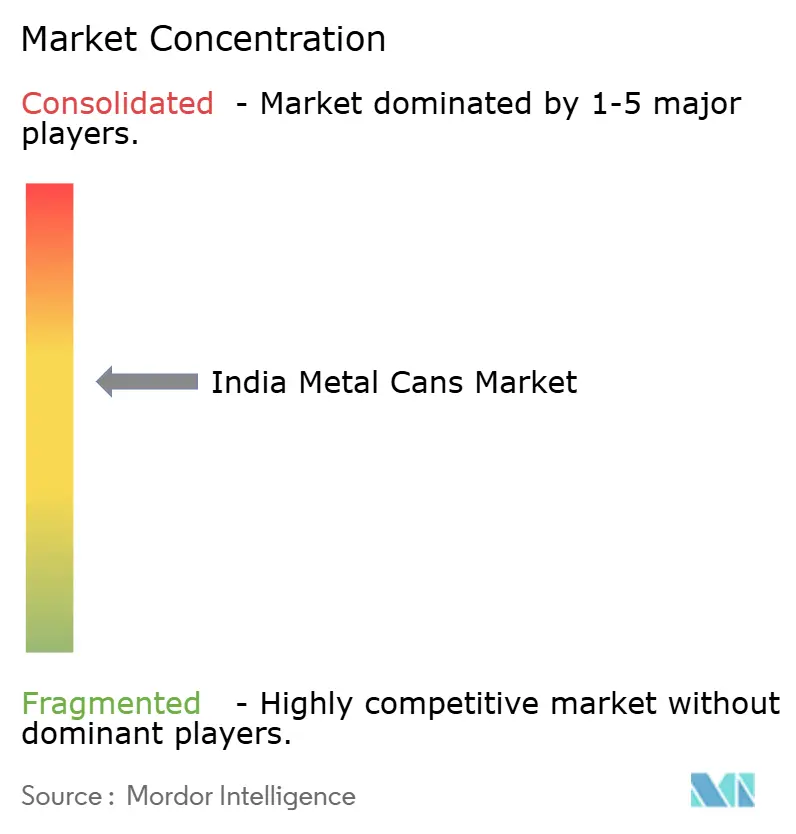
The India metal cans market displays moderate fragmentation, with the top five players controlling just under 60% of capacity. Global firms such as CANPACK, Crown Holdings, and Ball Corporation partner with or acquire stakes in local converters to bypass regulatory learning curves and secure land quickly. Domestic champions Hindustan Tin Works and Kaira Can Company leverage long-standing FMCG relationships and agility in short runs to defend regional share. Vertical integration into scrap collection and secondary-ingot casting is a clear trend: Hindalco leads with a 500,000-ton recycling build-out that offers 20% input-cost savings.[1]India Brand Equity Foundation, “Get Insights into the Metals and Mining Industry in India,” ibef.org Meanwhile, technological differentiation, exemplified by Ball’s reclosable-end patent, enables premium pricing in an otherwise commoditized container business. New entrants face high capital barriers each high-speed DWI line costs USD 55–60 million plus rigorous quality certifications, conferring incumbents a defensible moat. M&A chatter persists, centered on aerosol specialists and regional food-can players, signaling that market consolidation is likely to inch higher over the next five years.
India Metal Cans Industry Leaders
Casablanca Industries Pvt. Ltd
Can-Pack S.A.
Ball Corporation
Hindustan Tin Works Ltd.
Oricon Enterprises Limited
- *Disclaimer: Major Players sorted in no particular order

Market Opportunities and Future Outlook
Compliance-led upgrading is opening whitespace for licensed, standards-aligned supply in food and beverage cans. The Cookware, Utensils and Cans for Foods and Beverages (Quality Control) Order 2026 introduces mandatory BIS Standard Mark licensing for metal cans, with IS 14407:2023 providing a reference point for aluminum beverage cans. The requirement becomes applicable to general enterprises from October 1, 2026, increasing the value of certified production systems, testing capability, and traceable input sourcing. That dynamic creates room for organized converters to win share with national fillers that prefer auditable supply chains.
End-market diversification and convenience features also support premiumization, particularly in RTD beverages and specialty formats. Ball Corporation and Dabur partnering to launch Real Bites juice in 185 ml recyclable aluminum cans highlights brand willingness to use metal for new beverage propositions. Separately, CANPACKs collaboration with Canovation to advance CanReseal technology toward pilot-line implementation indicates continued interest in resealable ends for on-the-go consumption needs. Guala Closures acquisition of Oricons crown seals and ROPP closures business (enterprise value INR 42.5 crore) further signals investment in adjacent closure infrastructure that can support integrated offerings to fillers across western and northern India.
Recent Industry Developments
- June 2026: Hindustan Tin Works Ltd disclosed that GST proceedings initiated by the Proper Officer (GST) cum ETO, Ward-5, Sonipat, were dropped as per an order dated June 5, 2026. The closure reduces near-term compliance overhang and supports operating continuity for a major domestic metal packaging supplier.
- November 2025: Ball Corporation announced an investment of USD 60 million to expand production capacity at its Sri City, Andhra Pradesh manufacturing facility. The move strengthens local can supply and shortens lead times for beverage customers, supporting higher penetration of aluminum packaging in fast-growing RTD categories.
- December 2024: Ball Corporation partnered with Dabur India Limited to launch Real Bites juice in 185 ml recyclable aluminum cans. The collaboration broadened the use of metal cans in Indian packaged beverages beyond mainstream carbonated drinks and reinforced sustainability-led positioning for new product introductions.


Research Methodology Framework and Report Scope
Market Definition and Coverage
For this methodology, the India metal cans market covers the value of metal can packaging sold for use in India, including aluminum and steel cans used across food, beverages, and other consumer and industrial end uses.
Scope exclusions: Closures and caps, metal drums, pails, and intermediate bulk containers are excluded unless they are sold as part of a can product definition in the tracked categories.
Segmentation Overview
- By Material Type
- Aluminium
- Steel
- By Can Structure
- Two-Piece
- Three-Piece
- Monobloc Aerosol
- By Capacity / Size
- ≤250 ml
- 250–500 ml
- 500–1,000 ml
- >1,000 ml
- By Manufacturing Process
- Drawn and Ironed (D & I)
- Drawn and Redrawn (DRD)
- Impact Extrusion
- By End-User Industry
- Food
- Beverage
- Personal Care and Cosmetics
- Pharmaceuticals
- Paints and Industrial Chemicals
- Automotive Fluids and Lubricants
- Other End-User Industry
Data Sources, Market Sizing, and Validation
Desk Research
Desk research was used to build the starting structure for the market and to pin down the demand pool by end use, pack sizes, and material choices. We relied on public statistics and rules that shape packaging demand, such as India government releases and gazettes on waste management and EPR, Ministry of Commerce trade statistics, and data from the Ministry of Statistics and Programme Implementation for manufacturing output signals.
To keep assumptions realistic, we also pulled supporting reads from sources such as the Aluminium Association of India, BIS standards and notifications for packaging materials, UN Comtrade for cross-checking trade direction, and peer-reviewed packaging and recycling journals on can performance and recyclability trends. These were supplemented with annual reports, investor presentations, and credible news coverage, then selectively checked using paid subscriptions focused on company financials, patents, and shipment-level import export intelligence. This list is indicative only, and many other sources were consulted for data collection, validation, and clarifying open questions.
Primary Interviews and Surveys
Primary work focused on validating what portion of metal packaging demand is truly can-led, and how shifts in beverages, processed foods, and aerosols are changing mix. We spoke with participants across can manufacturing, raw material supply, brand and packer procurement, and distribution partners to confirm pricing logic, utilization patterns, and import dependence.
We stress-tested inputs across India-wide demand centers and manufacturing clusters so that regional consumption and supply realities were reflected. Then any weak spots from secondary reads were closed through follow-up questions before assumptions were finalized.
Distribution of primary research fieldwork respondents
| Company type | Respondent position |
|---|---|
| Top tier: 32% | CXOs: 18% |
| Mid tier: 46% | Functional/Unit leaders: 34% |
| Smaller Players: 22% | Managers: 48% |
Market-Sizing & Forecasting
Sizing started with a top-down build where India demand is reconstructed from can consumption signals across key end uses, then translated into value using observed price bands by material and can type. The model was subsequently checked using selective bottom-up approximations, where sampled supplier revenues, capacity and utilization discussions, and channel checks were used to confirm totals and adjust overstated or understated pools.
Key inputs included the split between aluminum and steel, two-piece versus three-piece mix, typical capacity bands used in beverages and foods, conversion spreads between can formats, and price movement tied to metal input costs and contract resets. Where bottom-up visibility was incomplete for smaller converters, gaps were handled using conservative shares anchored to production footprint and customer coverage, then tested against interview feedback.
For forecasting, scenario analysis was used to translate expected changes in beverage can penetration, processed food growth, and aerosol applications into volume and value paths, and then moderated assumptions were chosen when expert views diverged. The output was kept traceable so each driver can be revisited when a major regulation, capacity addition, or raw material swing occurs.
Data Validation & Update Cycle
Validation was handled through stepwise cross-checks rather than a single pass. Model outputs were compared with independent signals such as trade flows, manufacturing output direction, and changes in announced can-making capacity, and then large variances were reviewed before numbers moved forward.
A second analyst review is performed to challenge key assumptions like price progression, material mix, and end-use allocation, followed by targeted re-contacts when responses conflict or when new public data appears. Reports are refreshed annually, and interim updates are triggered when material events occur, such as a major plant commissioning, policy changes affecting packaging, or sharp metal price shifts. Before delivery, we run a final freshness check so clients receive the latest consistent view.
Mordor Intelligence's India Metal Cans Market Size Measured Against Other Published Estimates
It is normal to see different market values for metal cans because publishers do not always count the same products, years, or pricing basis. Differences also show up when one estimate relies on shipment proxies, while another relies on end-use demand signals, and these choices change the final total.
The biggest gap driver is whether adjacent metal packaging formats are folded into the can number, where Mordor Intelligence counts only can products (including two-piece, three-piece, and aerosol can forms) and avoids inflating the total with items like bulk containers or general metal packaging. Other gaps usually come from how aluminum versus steel mix is assumed, how ASPs are progressed during metal price volatility, and whether the base year is kept current or left on an older data cut.
Benchmark comparison
| Source | Market Size | Gaps in Research Methodology |
|---|---|---|
| Mordor Intelligence | USD 1.79 B (2026) | |
| Industry Association A | USD 1.95 B (2026) | Tends to bundle broader metal packaging demand, and the can-only split is often inferred from member coverage rather than reconstructed by end-use and can format. |
| Trade Journal B | USD 1.60 B (2025) | Uses an earlier base year and relies on selective producer shipment commentary, which can undercount smaller converters and miss mix shifts toward higher-value aluminum beverage cans. |
The spread in the table is largely explained by scope decisions and how price and mix are treated during the base year. By keeping the inputs tied to clear can formats, end-use demand signals, and interview-checked pricing bands, the resulting number stays easier to trace and update when the market changes.


Key Questions Answered in the Report
What is the current size of the India metal cans market?
The India metal cans market size is valued at USD 1.79 billion in 2026 and is set to reach USD 2.21 billion by 2031.
Which material leads India’s can production?
Aluminum dominates with 69.92% share, driven by local smelting capacity and strong recycling economics.
Which end-use segment is growing fastest?
Pharmaceuticals, particularly aerosol drug delivery systems, are advancing at a 5.78% CAGR through 2031.
How do EPR rules affect can makers?
EPR mandates 70% recycling of aluminum packaging by 2027, favoring cans because urban recovery rates already exceed 80%.
Which region attracts the most new capacity?
Western India remains the core hub, but northern Uttar Pradesh is emerging thanks to CANPACK’s large greenfield investment.
Page last updated on:





