
Market Overview
| Study Period | 2020 - 2031 |
|---|---|
| Forecast Data Period | 2026 - 2031 |
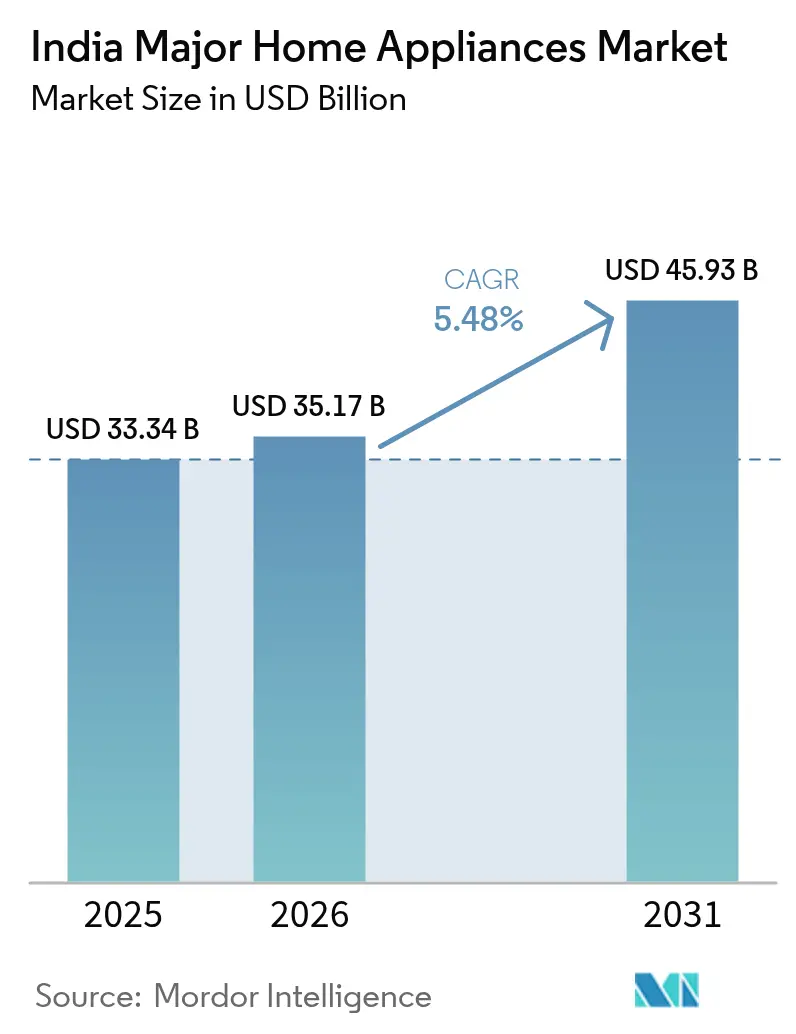
| Base Year Market Size (2025) | USD 33.34 Billion |
| Market Size (2026) | USD 35.17 Billion |
| Market Size (2031) | USD 45.93 Billion |
| Growth Rate (2026 - 2031) | 5.48 % |
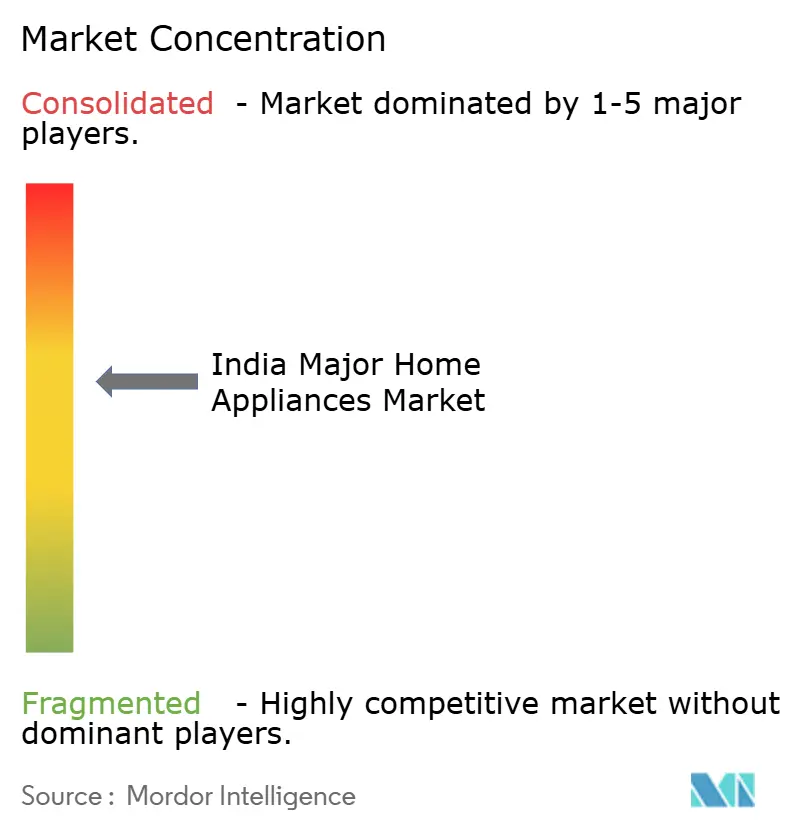
| Market Concentration | Medium |
Major Players *Disclaimer: Major Players sorted in no particular order Image © Mordor Intelligence. Reuse requires attribution under CC BY 4.0. | |
India Major Home Appliances Market Analysis by Mordor Intelligence
The India Major Home Appliances market size is expected to grow from USD 33.34 billion in 2025 to USD 35.17 billion in 2026 and is forecast to reach USD 45.93 billion by 2031 at 5.48% CAGR over 2026-2031. Solid policy support, premiumization, and omnichannel retail adoption underscore the long-term growth outlook for the India Major Home Appliances market. Production Linked Incentives (PLI) shorten import-led cost disadvantages, while stricter energy-efficiency norms stimulate faster replacement cycles and justify higher average selling prices. Rising disposable incomes, rapid urban nuclear-family formation, and last-mile electrification collectively unlock new unit sales, especially across tier-2 and tier-3 cities where baseline penetration remains low. Competitive intensity is rising because domestic firms scale capacity to capture PLI benefits and global brands launch AI-driven product portfolios to hold share in the India Major Home Appliances market.
Key Report Takeaways
- By product category, refrigerators commanded 29.02% of the India Major Home Appliances market share in 2025, while air conditioners are projected to expand at a 6.39% CAGR through 2031.
- By distribution channel, multi-brand stores captured 45.78% revenue in 2025; online retail is on track for a 6.95% CAGR between 2026-2031.
- By geography, West India held 27.05% of the India Major Home Appliances market size in 2025, whereas South India is expected to advance at a 6.55% CAGR to 2031.
Note: Market size and forecast figures in this report are generated using Mordor Intelligence’s proprietary estimation framework, updated with the latest available data and insights as of 2026.
India Major Home Appliances Market Trends and Insights
Drivers Impact Analysis*
| Driver | (~) % Impact on CAGR Forecast | Geographic Relevance | Impact Timeline |
|---|---|---|---|
| Rapid urban nuclear-family formation | +1.8% | National; sharper in South & West | Medium term (2-4 years) |
| Rising disposable income & premiumization | +1.5% | Urban clusters; strongest momentum in West | Long term (≥ 4 years) |
| Government PLI & domestic-manufacturing push | +1.2% | Manufacturing hubs across states | Short term (≤ 2 years) |
| Energy-efficiency norms spurring replacement sales | +0.9% | High-consumption urban corridors | Medium term (2-4 years) |
| India-specific IoT ecosystems (e.g., BharOS appliances) | +0.6% | Tech-forward metros | Long term (≥ 4 years) |
| Last-mile rural electrification unlocking new demand | +0.4% | Rural East & North | Long term (≥ 4 years) |
| Source: Mordor Intelligence | |||
Government PLI & Domestic-Manufacturing Push
The PLI allocation of INR 6,238 crore reinvigorates supply-side dynamics by doubling indigenous content in air conditioners from 25% to 55% and trimming cost disadvantages from 18% to 12%. Forty-two approved applicants, including component specialists for heat exchangers and compressors, collectively committed INR 3,898 crore in greenfield capacity. The incentive design rewards incremental sales rather than capacity creation, ensuring market-driven expansion and discouraging idle assets. Localization reduces working-capital lockups tied to long import cycles, improves just-in-time manufacturing, and positions India as an export base for South Asian markets that require tariff-free sourcing within regional trade pacts. Yet semiconductor constraints remain a weak link, urging coordinated execution of the USD 10 billion India Semiconductor Mission to provide microcontrollers and inverter chips at scale. High-pressure policy coordination among central ministries, state governments, and industry associations sustains momentum and ensures the India Major Home Appliances market continues to internalize value previously lost to imports.
Rising Disposable Income & Premiumization
Average urban household income is projected to rise from USD 7,050 in 2024 to USD 9,640 by 2030, lifting wallet share for discretionary durable purchases. Consumer surveys reveal that 62% of first-time buyers opt directly for energy-efficient, smart-enabled appliances rather than starting with entry-level SKUs. Volume spikes in 9 kg+ washing machines—up 91% in 2024—underscore how dual-income families prioritize capacity and convenience. Samsung’s goal to derive 50% of its India revenue from appliances and displays within three years signals broader corporate confidence in premium tiers. AI-powered refrigerators leverage predictive cooling algorithms, lowering annual energy usage by up to 20% and restricting food wastage—tangible benefits that rationalize higher ASPs. As electric-vehicle adoption pushes residential electricity tariffs toward time-of-day pricing, intelligent appliances that shift consumption to off-peak hours become even more attractive, creating a virtuous feedback loop of technology adoption and energy savings within the India Major Home Appliances market.
Energy-Efficiency Norms Spurring Replacement Sales
The Bureau of Energy Efficiency now mandates star-label visibility in both physical stores and e-commerce product listings, making energy consumption a primary decision criterion[1]Bureau of Energy Efficiency, “Star Label,” beeindia.gov.in. Proposed buy-back incentives of INR 2,000-INR 3,000 per retired air-conditioner further widen the affordability gap between legacy units and new five-star models, accelerating replacement cycles. Minimum set-point regulations—capping air-conditioner operation below 20 °C—are expected to eliminate an estimated 4 GW of peak load by 2028, aligning with the India Cooling Action Plan’s 40% cooling-energy-demand-reduction target. Energy-service companies now bundle extended warranties with efficiency-linked rebates, allowing households to pay for appliances via electricity-bill savings, thereby lowering effective ownership costs. Market education campaigns coordinated by utilities, manufacturers, and local governments amplify consumer awareness and translate policy mandates into purchasing behavior that drives further growth in the India Major Home Appliances market.
Rapid Urban Nuclear-Family Formation
Census projections indicate that nuclear families accounted for 52% of urban households in 2025 and will exceed 60% by 2030. Each new nuclear household typically requires a refrigerator, washing machine, and at least one cooling appliance within 18 months of establishment, creating multiple unit sales per address. Smaller city apartments sharpen demand for space-saving designs such as 250-liter bottom-freezer refrigerators and 1-ton inverter split air-conditioners with slim indoor units. Retail data confirm a 17% sales uplift for combo ovens that integrate convection, grill, and microwave functions, reflecting multipurpose preferences in compact kitchens. Regional variation is pronounced: Bengaluru and Hyderabad exhibit faster adoption of dishwashers due to dual-income demographic mixes, whereas Jaipur and Lucknow register stronger interest in fully automatic top-load washers that handle hard-water conditions. Urbanization policy that bundles affordable housing with mass-transit corridors accelerates the addressable customer base, cementing a robust demand pipeline for the India Major Home Appliances market.
Restraints Impact Analysis*
| Restraint | (~) % Impact on CAGR Forecast | Geographic Relevance | Impact Timeline |
|---|---|---|---|
| Semiconductor & compressor supply vulnerabilities | −1.1% | All manufacturing hubs | Short term (≤ 2 years) |
| Fragmented cold-chain limiting freezer uptake | −0.8% | Rural markets; tier-3 cities | Medium term (2-4 years) |
| High GST slabs on select appliances | −0.6% | Nationwide; premium SKUs worst hit | Medium term (2-4 years) |
| Low consumer credit penetration | −0.4% | Tier-2, tier-3, and rural districts | Long term (≥ 4 years) |
| Source: Mordor Intelligence | |||
Semiconductor & Compressor Supply Vulnerabilities
India currently imports almost 75% of the semiconductors used in inverter drives, Wi-Fi modules, and smart-display panels embedded in appliances[2]Information Technology & Innovation Foundation, “India’s Semiconductor Readiness,” itif.org. Freight surcharges and geopolitical tensions inflate lead-times to 18–20 weeks, prompting manufacturers to hold extra inventory and thus tie up working capital. Compressor manufacturing, meanwhile, is dominated by three local companies meeting just 40% of aggregate demand, forcing OEMs to rely on imports from Thailand and China. The mismatch caused a 7-10% unit cost spike during the 2024 summer peak, a margin squeeze not fully reversible through retail price increases. Medium-term mitigation includes backward integration by global brands into variable-speed compressor lines and joint-venture fabs under the India Semiconductor Mission. Failure to close these bottlenecks could lower utilization rates in newly built PLI-funded plants, undermining the competitiveness of the India Major Home Appliances market.
High GST Slabs on Select Appliances
Large-format smart televisions and side-by-side refrigerators remain in the 28% GST bracket, escalating end-consumer prices by up to 9% compared with pre-GST levies. Because premium SKUs generate 30-35% of industry gross profit, volume suppression at the top end threatens R&D reinvestment cycles critical for innovation. Tax-induced price elasticity also causes temporal demand bunching around festival discount periods, creating production scheduling inefficiencies and higher inventory holding costs. While repeated industry petitions have sought a rate cut, the GST Council’s hesitance stems from revenue concerns and the perception that premium appliances are luxury goods. Manufacturers mitigate demand friction by offering cashback schemes in collaboration with lenders, yet such financial engineering only partially offsets structural tax headwinds hampering the India Major Home Appliances market.
*Our forecasts treat driver/restraint impacts as directional, not additive. The impact forecasts reflect baseline growth, mix effects, and variable interactions.
Segment Analysis
By Product Type: Cooling Appliances Electrify Growth Prospects
The India Major Home Appliances market size attributable to air conditioners reached USD 6.42 billion in 2025 and will increase at a 6.39% CAGR through 2031. Elevated outdoor temperatures, rising heat-wave frequency, and a growing middle class accelerate inverter-based split AC adoption, with 1-ton and 1.5-ton variants comprising 68% of sales. Manufacturers now introduce R32 and R290 refrigerant options to satisfy global warming-potential norms, further differentiating premium SKUs.
Refrigerators remain the volume anchor with 29.02% 2025 market share; single-door models dominate rural zones, whereas frost-free bottom-freezer units gain urban share. Dishwashers, though under 4% household penetration, enjoy 18% annual growth within metros as domestic help costs rise. Microwave-convection combination ovens find traction via bundled recipe apps that simplify Indian cuisine presets, enabling younger consumers to personalize cooking routines. Emerging robotic kitchen assistants demonstrate first-mover advantage for brands that can localize voice support to Hindi, Tamil, and Telugu, thereby broadening user appeal across linguistic demographics. Each product innovation strengthens brand recall and fortifies ecosystem lock-in, pivotal for lifetime-value maximization in the India Major Home Appliances market.




By Distribution Channel: Omnichannel Convergence Accelerates
Multi-brand retailers continue to command 45.78% of value sales because they allow SKU comparisons and same-day fulfilment, yet online marketplaces already claim 25.10% share and are forecast to cross 31% by 2031 at a 6.95% CAGR. Average ticket value online stands 12% higher than offline due to consumer tilt toward premium energy-efficient models paired with extended warranties.
Exclusive brand outlets proliferate in tier-3 towns by leveraging franchise formats with capital-light rollouts, enabling demonstration zones for AI refrigerators and smart laundry combos. Social-commerce pilots on WhatsApp allow neighborhood dealers to livestream demos, close sales, and schedule service via integrated payment gateways—a model particularly useful for rural pin codes where trust in large e-commerce marketplaces is still evolving. Buy-now-pay-later penetration, fueled by thin-file credit scoring, lowers entry barriers for first-time buyers and broadens the addressable base. Robust omnichannel orchestration reduces stockouts and returns, enhancing customer satisfaction and reinforcing the India Major Home Appliances market’s competitive moats.
Geography Analysis
West India contributed 27.05% revenue to the India Major Home Appliances market in 2025, driven by higher per-capita income, matured organized-retail networks, and port-proximate logistics that favor rapid component imports. Maharashtra’s industrial clusters support final-assembly efficiencies, while Gujarat’s renewable-energy surplus lowers plant-level electricity costs, enabling margin resilience even during raw-material inflation cycles.
South India registers the fastest 6.55% CAGR through 2031, powered by large-scale electronics hubs in Andhra Pradesh, Telangana, and Tamil Nadu. LG’s USD 600 million Sri City facility will supply 1.5 million AC units annually from 2026 . The region’s technology-sector workforce and higher electric-tariff slabs propel the adoption of five-star inverter models. Government subsidies for rooftop solar further incentivize smart energy-monitoring appliances, reinforcing premiumization dynamics in the India Major Home Appliances market.
North and East India jointly account for 36.80% revenue yet show lower premium penetration due to disposable-income disparities and fragmented retail. Nonetheless, rural electrification programs such as Saubhagya add 28 million connections, generating new refrigeration demand for perishable food storage. Cold-chain gaps limit freezer sales, but agricultural policy encouraging farmer-producer organizations could unlock latent demand as produce travels longer distances to markets. Climate extremes—scorching summers in Rajasthan and high humidity in Assam—create micro-segment niches for desert coolers and high-dehumidification refrigerators, demanding granular go-to-market tailoring.
Value Chain Analysis
The India major home appliances value chain covers upstream inputs (steel, plastics, copper, refrigerants, and electronic controls), core components (compressors, heat exchangers, copper tubes, BLDC motors, PCBs, and inverter drives), OEM assembly, and downstream distribution through multi-brand stores, exclusive brand outlets, and online marketplaces supported by logistics networks. Policy continues to shape the manufacturing layer, with the PLI Scheme for White Goods (outlay INR 6,238 crore, active from FY 2021-22 to FY 2028-29) offering 4-6% incentives on incremental sales and expanding the local component ecosystem, including 85 selected companies and cumulative investment commitments of about INR 11,198 crore as of January 2026.
Key bottlenecks remain concentrated in high-value electronics and compressor supply, which increases lead times and working-capital intensity for OEMs and contract manufacturers during peak summer demand. Under PLI, localization efforts are increasingly focused on parts that drive cost and availability, including compressors and sub-assemblies, heat exchangers, copper tubes, and motors, supported by multi-tier supplier development and contract manufacturing partnerships, including around Sri City. As distribution becomes more omnichannel, after-sales service and spare parts networks are emerging as differentiation points, with brands and partners investing in faster installation and service fulfillment to protect premium ASPs and manage returns in online sales.
Competitive Landscape
The India Major Home Appliances market is moderately fragmented, with the leading vendors holding a significant cumulative share, leaving ample opportunities for emerging brands to compete. Samsung leads in premium refrigeration and washer-dryer combos, leveraging its SmartThings ecosystem and semiconductor vertical integration. LG invests heavily in indigenizing variable-speed compressors, aiming to hit 90% of local value by 2027. Whirlpool pursues a mid-market sweet spot by partnering with PG Electroplast for semi-automatic washing machines tailored to hard-water rural regions.
Domestic incumbents like Voltas-Beko exploit brand equity in air cooling and leverage Beko’s inverter expertise, while Godrej Appliances expands its environment-friendly R600a refrigerant refrigerator line to retain eco-centric customers. Haier and Hisense focus on tier-2 and tier-3 cities, promising “service within 24 hours” to overcome trust barriers. Blue Star channels its HVAC pedigree to cross-sell internet-connected room ACs that sync with commercial building dashboards, targeting upscale apartments.
Strategic alliances multiply: Whirlpool collaborates with Hindustan Unilever to co-market fabric-care solutions, reinforcing ecosystem stickiness. BSH Home Appliances pilots cognitive cooking algorithms in Bosch-branded ovens, anticipating demand for AI assistants that adjust spice levels for Indian palates. Meanwhile, component suppliers such as Amber Enterprises scale injection-molding and copper-tube lines to match OEM growth trajectories, illustrating how supply-side consolidation supports the expansive India Major Home Appliances market.
India Major Home Appliances Industry Leaders
LG Electronics India
Samsung India
Whirlpool of India
Godrej Appliances
Haier India
- *Disclaimer: Major Players sorted in no particular order

Market Opportunities and Future Outlook
Manufacturing corridor build-outs and deeper component localization are creating near-term demand for contract manufacturers and suppliers across cooling and laundry categories. In July 2026, EPACK Durable secured Andhra Pradesh government approval for an investment of about INR 1,084.31 crore to expand manufacturing of air conditioners, washing machines, and other home appliances at Sri City. In February 2026, Hisense opened its first India manufacturing facility in Sri City through the Epack Manufacturing Technologies joint venture to produce room air conditioners. Together, these actions broaden the addressable market for localized components (compressors, copper tubes, heat exchangers, BLDC motors) and for ancillary services such as tooling, testing, and compliance.
Premiumization and compliance-driven formalization also widen opportunities across product design, retail, and service execution. Kitchen and premium segments are seeing more localization activity, including INALSA investing INR 50 crore in a Sonipat manufacturing facility in July 2026 to scale output for premium kitchen appliance production. On policy, the fourth round of the PLI Scheme for White Goods selected five additional companies in January 2026, targeting INR 8,337 crore in production and supporting the shift from assembly-led models to component-led manufacturing. Capacity announcements in cooling-adjacent categories also point to continued scaling, such as Summercool Home Appliances planning a INR 250-300 crore Ghaziabad facility (production stated to commence in October 2026), which expands requirements for distribution, installation, and service ecosystems in tier-2 and tier-3 markets.
Recent Industry Developments
- July 2026: Samsung India introduced the Music Studio Series, a new lineup of Wi-Fi speakers designed for the Indian market. While it sits outside core major appliances, the rollout reinforces a broader smart-home ecosystem approach that also supports connected appliance upsell through platform-led bundling and shared retail shelf space.
- June 2026: LG Electronics India launched a new French Door Refrigerator range with an Auto Ice Maker in the 83.82 cm width segment. The release adds premium refrigeration options as brands compete for feature-led upgrades and a higher ASP mix across urban channels.
- April 2026: Whirlpool of India launched its No Tension Refrigerators range in the single-door category featuring automatic defrost technology branded as 6th Sense IntelliFrost. The product refresh is aimed at replacement-driven demand by combining convenience features with mainstream price points, helping defend share in high-volume refrigerator segments.


Research Methodology Framework and Report Scope
Market Definition and Coverage
For this study, we treat the India major home appliance market as the sales value generated from large household appliances purchased for residential use across India, captured at the point of sale in current USD for each year.
Scope exclusions: We exclude small appliances, commercial or institutional appliance demand, and add-on services such as installation, extended warranties, and repair-only revenue.
Segmentation Overview
- By Product
- Refrigerators
- Freezers
- Washing Machines
- Dishwashers
- Ovens (Incl. Combi & Microwave)
- Air Conditioners
- Other Major Home Appliances
- By Distribution Channel
- Multi-Brand Stores
- Exclusive Brand Outlets
- Online
- Other Distribution Channels
- By Geography
- North India
- South India
- East India
- West India
Data Sources, Market Sizing, and Validation
Desk Research
Desk work starts with building a clean fact base on appliance demand and supply in India, then mapping it to how the market is measured in value terms. Public sources are used to ground the model, such as the Ministry of Statistics and Programme Implementation (household and consumer indicators), the Ministry of Commerce and Industry (trade statistics), and the Bureau of Energy Efficiency (efficiency standards and labeling), which helps in understanding replacement cycles.
We also review sources such as India Energy Efficiency Scale Up Program type publications, industry association releases, and peer reviewed papers that discuss appliance penetration and usage patterns. Company annual reports, investor presentations, and reputable business press are used to identify pricing direction and channel mix shifts (online versus stores), along with capacity expansion plans. Where needed, paid subscriptions are referenced for company financials, shipment level import and export signals are used for cross-checks, and patent databases help sanity check technology change timing. The desk sources listed here are illustrative, and other public documents were used for data collection, validation, and clarification.
Primary Interviews and Surveys
Primary inputs are collected through expert interviews and structured surveys across brands, distributors, retailers, and component-linked participants, so that pricing, channel margins, and sell-through patterns can be verified. For India coverage, conversations are balanced across North, South, East, and West markets, since appliance mix and seasonality shift with climate, housing type, and income profile.
Distribution of primary research fieldwork respondents
| Company type | Respondent position |
|---|---|
| Top tier: 26% | CXOs: 15% |
| Mid tier: 58% | Functional/Unit leaders: 32% |
| Smaller Players: 16% | Managers: 53% |
Market-Sizing & Forecasting
Market sizing uses a top-down and bottom-up blended logic. The starting point is an India demand pool reconstructed by appliance penetration, household formation, and replacement behavior, then converted into value using year-specific pricing. Totals are checked through selective bottom-up approximations, including sampled average selling price (ASP) by appliance type multiplied by indicative unit volumes shared by channels, followed by distributor and retailer checks to adjust for outliers.
Key model inputs include appliance category penetration (for example, refrigerators and washing machines), seasonal demand lift for cooling products, import intensity for selected categories, energy-efficiency driven upgrade cycles, and channel mix shares between multi-brand stores, exclusive outlets, and online. Forecasts use scenario analysis supported by expert views on income growth, urban housing additions, and expected ASP movement from premiumization and efficiency norms. When unit or price signals are weak for a smaller category, we bridge using proxy indicators from adjacent categories, then re-test with primary inputs before finalizing.
Data Validation & Update Cycle
Before sign-off, outputs are cross-checked against independent signals such as import and export movement, category penetration direction, and channel commentary on demand strength. Anomalies are flagged through variance checks at product and region level, and assumptions are reviewed across more than one analyst pass so the logic stays consistent year to year.
If a material gap is seen, such as a sudden price jump not supported by channel feedback, respondents are re-contacted and the data is re-run with the revised assumption. Reports are refreshed annually, and interim updates are made when events like major policy changes, sharp currency moves, or demand shocks meaningfully alter pricing or volumes. Right before delivery, a final scan is performed so clients receive the latest updated view.
Mordor Intelligence's India Major Home Appliance Market Size Measured Against Other Published Estimates
It is normal to see different published market sizes for India major home appliances, because firms do not always count the same products, selling channels, and year-specific prices. The spread also widens when one estimate is built from retail value while another is closer to factory gate value, and when currency conversion timing differs.
Some external figures broaden the definition by mixing small appliances and service revenue into the same total, which can lift the number without a clear bridge back to unit demand. In the Mordor Intelligence approach, the value is limited to major household appliances sold in India, with services and small appliances kept outside the total so the model stays tied to appliance penetration, replacement, and ASP movement.
Benchmark comparison
| Source | Market Size | Gaps in Research Methodology |
|---|---|---|
| Mordor Intelligence | USD 33.34 B (2025) | |
| Industry Association A | USD 36.80 B (2025) | Often reported as a broader home appliance basket that can include small appliances and attached service revenue, and it may apply a single blended price assumption across categories. |
| Trade Journal B | USD 30.10 B (2025) | Sometimes closer to manufacturer value or tracked shipments, which can understate the retail value captured in multi-brand and online channels, and may not fully normalize category seasonality. |
The table shows that the biggest differences come from what is included in the appliance basket and whether the value reflects retail pricing or an upstream value proxy. By keeping the scope tied to major appliances and by validating ASP and channel mix through repeated checks, the final number remains transparent and easier to recreate from clear demand variables.


Key Questions Answered in the Report
What is the current value of the India Major Home Appliances market?
The India Major Home Appliances market size is USD 35.17 billion in 2026.
Which product category is growing most rapidly?
Air conditioners record the fastest 6.39% CAGR between 2026-2031.
Which Indian region shows the highest growth outlook?
South India is projected to expand at a 6.55% CAGR through 2031, supported by manufacturing investments and income growth.
How do government incentives influence local production?
PLI grants double localization in air-conditioner components and narrow cost gaps, transforming India into a regional export hub.
Why are premium appliances gaining traction?
Rising incomes and strict energy-efficiency norms push consumers toward smart high-efficiency models that lower lifetime operating costs.
What retail trend is reshaping appliance sales?
Online channels are expanding at 6.95% CAGR, driven by digital payments and nationwide last-mile delivery infrastructure.
Page last updated on:




