
India Car Loan Market Size and Share
Market Overview
| Study Period | 2020 - 2031 |
|---|---|
| Forecast Data Period | 2026 - 2031 |
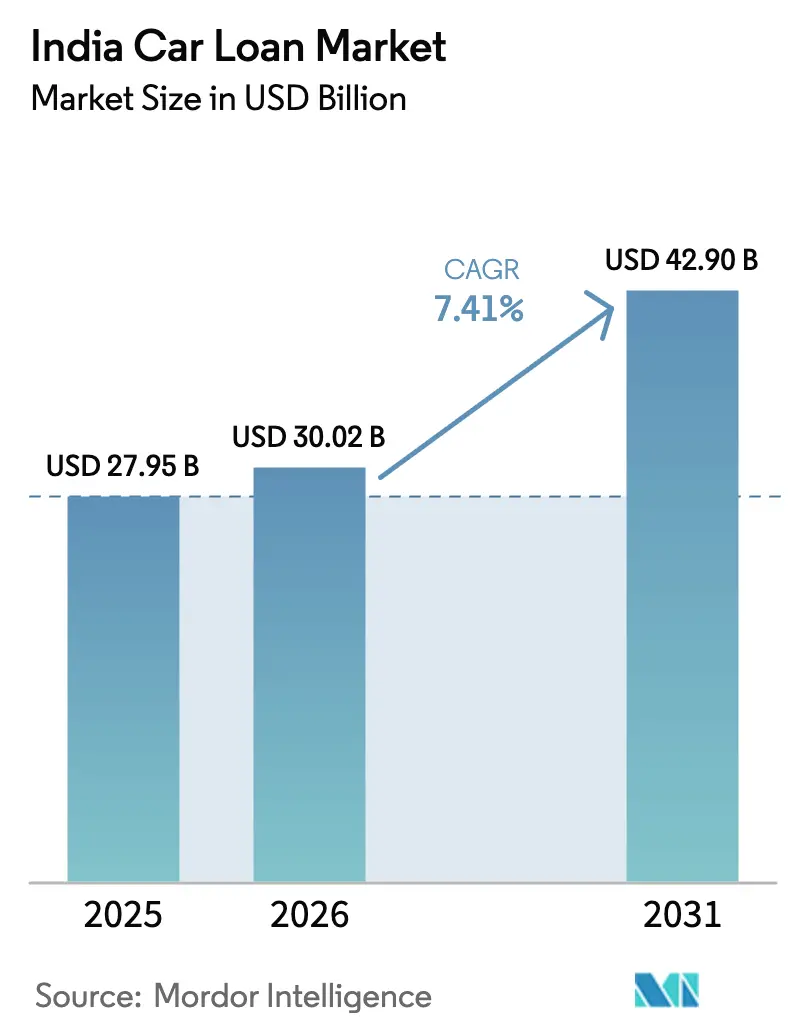
| Base Year Market Size (2025) | USD 27.95 Billion |
| Market Size (2026) | USD 30.02 Billion |
| Market Size (2031) | USD 42.90 Billion |
| Growth Rate (2026 - 2031) | 7.41 % |
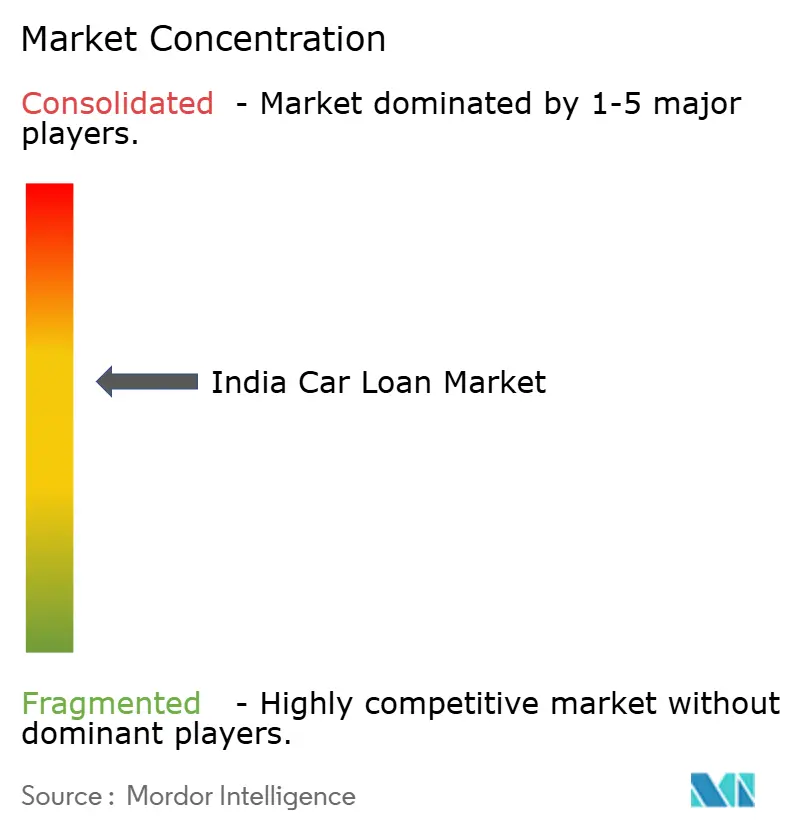
| Market Concentration | Medium |
Major Players *Disclaimer: Major Players sorted in no particular order Image © Mordor Intelligence. Reuse requires attribution under CC BY 4.0. | |
India Car Loan Market Analysis by Mordor Intelligence
The India Car Loan Market size is projected to be USD 27.95 billion in 2025, USD 30.02 billion in 2026, and reach USD 42.90 billion by 2031, growing at a CAGR of 7.41% from 2026 to 2031.
Favorable monetary policy, faster digital onboarding, and expanding alternative data sources combine to widen access to formal vehicle financing and push the India car loan market toward structurally higher growth levels. Competitive pricing by banks, growing securitization appetite, and manufacturer-subsidized electric-vehicle (EV) loans are compressing borrowing costs and lifting loan eligibility for new cohorts of consumers. Digital KYC and e-mandate rails now cut average turnaround time to under 30 minutes, improving customer experience and supporting volume growth in metro as well as tier-2 and tier-3 cities. Simultaneously, co-lending arrangements and Account Aggregator data flows diversify funding and underwriting models, ensuring that the addressable borrower pool for the India car loan market continues to expand even in risk-averse credit cycles[1].
Key Report Takeaways
- By loan-provider type, non-captive banks held a 61.45% share of the India car loan market in 2025, while non-banking financial companies recorded the fastest 7.82% CAGR through 2031.
- By vehicle type, new cars commanded 71.35% of the India car loan market share in 2025, whereas used-car financing is advancing at an 7.96% CAGR to 2031.
- By distribution channel, dealership point-of-sale captured 63.55% of the India car loan market in 2025; online direct lending, however, is forecast to grow at 8.78% CAGR through 2031.
Note: Market size and forecast figures in this report are generated using Mordor Intelligence’s proprietary estimation framework, updated with the latest available data and insights as of 2026.
Figures recorded within India feed into a worldwide estimate while studying the global industry. Mordor Intelligence's car loan market size captures this aggregation.
Market Trends and Insights
Drivers Impact Analysis of India Car Loan Market*
| Driver | ( ~ ) % Impact on CAGR Forecast | Geographic Relevance | Impact Timeline |
|---|---|---|---|
| Structural fall in repo/MCLR spreads boosts affordability | +1.2% | National, stronger in metro and tier-1 cities | Short term (≤ 2 years) |
| OEM-subsidized green-car loans accelerate EV adoption | +0.8% | National, early gains in Delhi, Mumbai, Bangalore, Hyderabad | Medium term (2-4 years) |
| Rapid digitization of KYC and e-mandate processes | +1.5% | National, higher uptake in urban centers | Short term (≤ 2 years) |
| Tier-2 and tier-3 income growth widens borrower base | +2.1% | Tier-2/3 cities nationwide | Long term (≥ 4 years) |
| Account-Aggregator data enables thin-file underwriting | +0.9% | National, stronger in under-banked regions | Medium term (2-4 years) |
| Rising securitization appetite lowers lender funding cost | +0.7% | National, concentrated among large NBFCs and banks | Medium term (2-4 years) |
| Source: Mordor Intelligence | |||
Structural Fall in Repo/MCLR Rate Spreads Boosts Affordability
RBI reduced the policy repo rate from 6.5% to 6% in five calibrated cuts during 2025, prompting a broad-based drop in retail vehicle-loan rates within 30-60 days of each announcement. Banks such as Bank of India and Punjab National Bank trimmed car-loan rates by 25 basis points, lowering equated monthly installments for a five-year INR 500,000 loan by INR 150-200. Lower monthly payments improve debt-to-income ratios and enlarge the eligible borrower pool by close to one-fifth, supporting incremental loan originations in both metro and tier-2 clusters. Competitive rate transmission also intensifies price-based rivalry among lenders, forcing traditionally conservative players to adopt dynamic repricing strategies. The India car loan market, therefore, enjoys a durable affordability tailwind as monetary policy remains growth-supportive in the short term.
OEM-Subsidized Green-Car Loans Accelerate EV Adoption
Auto manufacturers cooperate with captive finance arms and third-party banks to offer 0.05%-0.50% rate concessions on EV loans, narrowing the total-cost-of-ownership gap with internal-combustion models[2]. State Bank of India’s Green Car Loan facility prices EV credit at 8.85%-9.90%, while Bank of India provides an additional 0.50% markdown for battery-electric purchases. Layered onto central and state EV incentives, these concessions improve affordability and stimulate early-stage demand in pollution-conscious metro markets. Captive financiers from Toyota and Hyundai reinforce dealer relationships by bundling finance with warranty extensions and charging-station support. As charging infrastructure scales, the India car loan market captures incremental EV volumes and fortifies its medium-term growth outlook.
Rapid Digitization of KYC & E-Mandate Processes Cuts TAT to Under 30 Minutes
RBI Digital Lending Directions 2025 require standardized onboarding while permitting full e-KYC and e-mandate journeys that slash approval time to below 30 minutes[3]. Large banks deploy optical-character-recognition engines and AI-driven income analytics, trimming manual checks and boosting straight-through-processing ratios above 80%. Instant mandate creation on the NCPI e-NACH platform removes the need for paper forms and branch visits, elevating customer satisfaction and referral volumes. Account-Aggregator connectivity supplies consent-based transaction data that replaces multiple bank-statement uploads and accelerates underwriting for self-employed borrowers. Speed and simplicity become decisive selection criteria, strengthening the competitive position of tech-forward lenders in the India car loan market.
Tier-2/3 Income Growth & Formalization Widen Borrower Base
Vision IAS forecasts India’s GDP to quadruple to USD 40 trillion by 2047, with smaller cities driving 60% of new output and generating verifiable income trails through GST and digital payments. Rising disposable income, organized retail expansion, and formal payroll adoption enlarge the population of credit-worthy but previously underserved consumers. Banks establish satellite branches and mobile-based loan officers to harness local knowledge, while NBFCs exploit dense on-ground networks in towns such as Coimbatore, Indore, and Guwahati. Aspirational car ownership gains momentum as first-time buyers shift from two-wheelers to compact cars, lifting penetration in lower-tier markets. The India car loan market leverages this demographic dividend to secure a long-tail growth engine beyond metro centers.
Restraints Impact Analysis of India Car Loan Market*
| Restraint | ( ~ ) % Impact on CAGR Forecast | Geographic Relevance | Impact Timeline |
|---|---|---|---|
| Used-car collateral valuation volatility raises NPA risk | -0.9% | National, more acute in tier-2/3 cities | Medium term (2-4 years) |
| RBI’s higher retail-unsecured risk weight tightens credit | -0.6% | National, heavier impact on NBFCs | Short term (≤ 2 years) |
| EV residual-value uncertainty curbs lender LTV ratios | -0.4% | National, concentrated in major EV hubs | Long term (≥ 4 years) |
| Rising cyber-fraud in digital channels inflates cost-to-serve | -0.5% | National, acute for digital-first lenders | Medium term (2-4 years) |
| Source: Mordor Intelligence | |||
Used-Car Collateral Valuation Volatility Raises NPA Risk
Price discovery in India’s fragmented used-car ecosystem remains inconsistent because unorganized dealers dominate retail supply, and centralized valuation databases are nascent[4]. Lenders therefore face collateral markdowns when market demand softens, pushing loan-to-value ratios above realizable resale proceeds during stress scenarios. Regional demand swings, rapid model obsolescence, and limited uniform vehicle-inspection standards further complicate recovery prospects after default. To mitigate the risk, financiers lower LTV thresholds on used-car loans and integrate third-party inspection APIs that standardize condition reports, although these measures raise processing costs. The India car loan market must balance the growth opportunity in used vehicles with disciplined collateral management to prevent asset-quality deterioration.
RBI’s Higher Retail-Unsecured Risk Weight Tightens Credit
In November 2023, the central bank raised risk weights on unsecured personal loans, prompting a supervisory spill-over into secured retail books as lenders reassessed aggregate borrower leverage. Although February 2025 relaxations restored some capital relief, many NBFCs still encounter elevated wholesale-funding spreads that restrain aggressive expansion. Banks apply stricter debt-service-ratio cut-offs and higher documentation thresholds, excluding thin-file applicants and slowing disbursal run-rates during cyclical upswings. Co-lending agreements now require 10% minimum retention by originators, reshaping risk-transfer economics between banks and NBFC partners. The India car loan market will continue to manage growth-quality trade-offs as regulatory oversight prioritizes systemic stability.
*Our forecasts treat driver/restraint impacts as directional, not additive. The impact forecasts reflect baseline growth, mix effects, and variable interactions.
India Car Loan Market Segment Analysis
By Loan Provider Type:
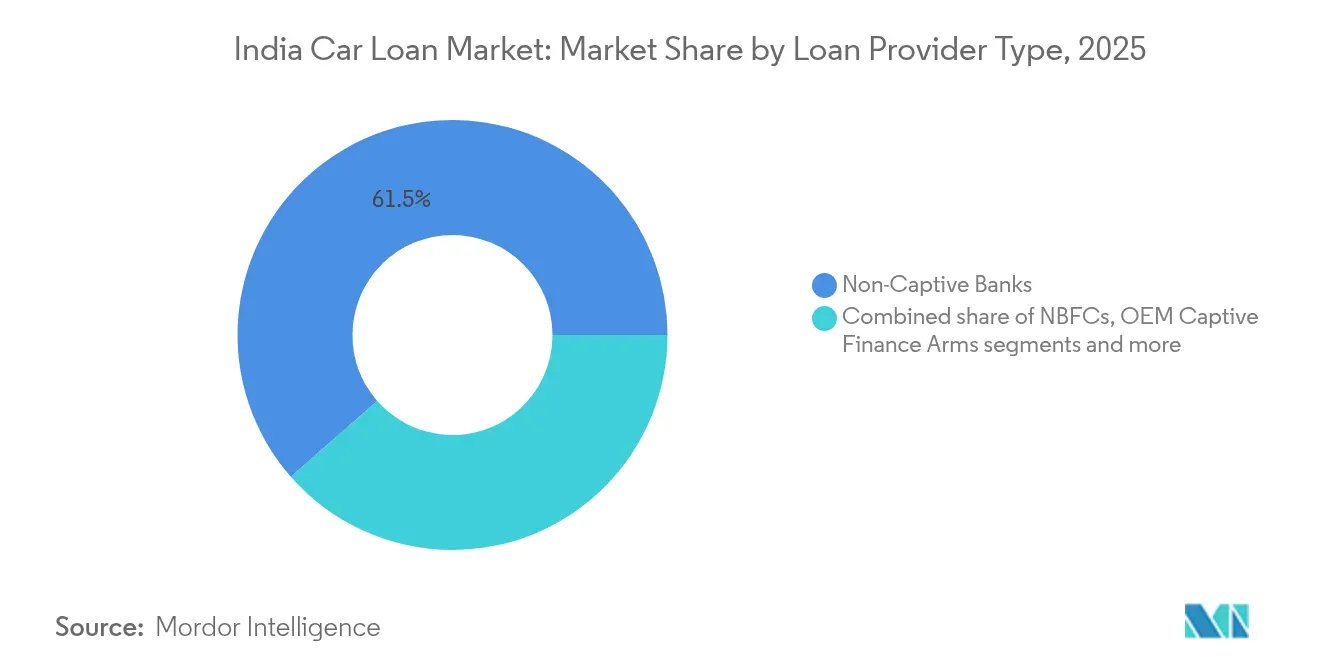
NBFCs Challenge Bank DominanceNon-captive banks commanded a 61.45% share of the India car loan market size in 2025, leveraging low funding costs and entrenched branch relationships to serve prime borrowers nationwide. NBFCs, however, are expanding at a 7.82% CAGR to 2031 by targeting self-employed customers, thin-file applicants, and tier-2/3 geographies where traditional banks remain under-penetrated. Regulatory clarity on co-lending permits NBFCs to loop in bank funds while retaining origination control, creating blended models that share risk capital yet accelerate disbursals. Captive finance arms of OEMs strengthen dealer throughput by bundling promotional rates with brand-specific warranty extensions, thereby defending niche pockets of the India car loan market. Competitive signaling through faster approvals, flexible repayment schedules, and digital dashboards redefines value propositions and keeps market-share shifts fluid.
Banks reinforce their primacy by cross-selling bundled savings accounts, credit cards, and insurance, turning vehicle loans into relationship footholds that broaden lifetime value. Meanwhile, fintech-enabled NBFCs adopt alternative data, telematics feeds, and psychometric scoring to deep-mine credit-invisible segments at scale. Regulatory guardrails around digital lending drive investments in governance tech, favoring well-capitalized providers with mature compliance frameworks. OEM captives increasingly partner with fintechs to embed finance at the point of vehicle configuration, meeting customer expectations for frictionless checkout. Thus, provider-type dynamics in the India car loan market remain balanced, with innovation and cost-of-funds acting as twin axes of competitive advantage.

By Vehicle Type:
Used Cars Accelerate Despite New-Car DominanceNew vehicles accounted for 71.35% of the India car loan market share in 2025 because organized dealer networks, predictable residual values, and OEM incentive schemes simplify credit risk management. Pre-owned cars, however, register an 7.96% CAGR through 2031 as digital inspection platforms, AI-based pricing tools, and warranty add-ons reduce information asymmetry and boost lender confidence. Organized retailers such as Maruti Suzuki True Value and Cars24 integrate real-time valuation APIs that lenders can query at origination to verify collateral quality. Rapid urbanization and aspirational ownership among first-time buyers in tier-2 cities drive demand for affordable used cars, expanding addressable volumes. Consequently, segmental diversification lowers portfolio concentration and supports counter-cyclical stability in the India car loan market.
Electric models introduce fresh complexities in both new and used segments owing to battery-health uncertainty, yet they also create opportunities for specialized finance products that bundle residual-value guarantees. Rising penetration of connected-car telematics delivers usage data that insurers and lenders use to refine risk-based pricing. Depreciation curves differ by fuel type, model generation, and regional demand, compelling lenders to adopt differentiated LTV matrices. Enhanced refurbishment standards at organized used-car outlets further de-risk collateral by ensuring mechanical quality and predictable resale timelines. As these ecosystem improvements gain traction, the India car loan market size for used vehicles is poised to rise rapidly without materially elevating non-performing assets.
By Distribution Channel:
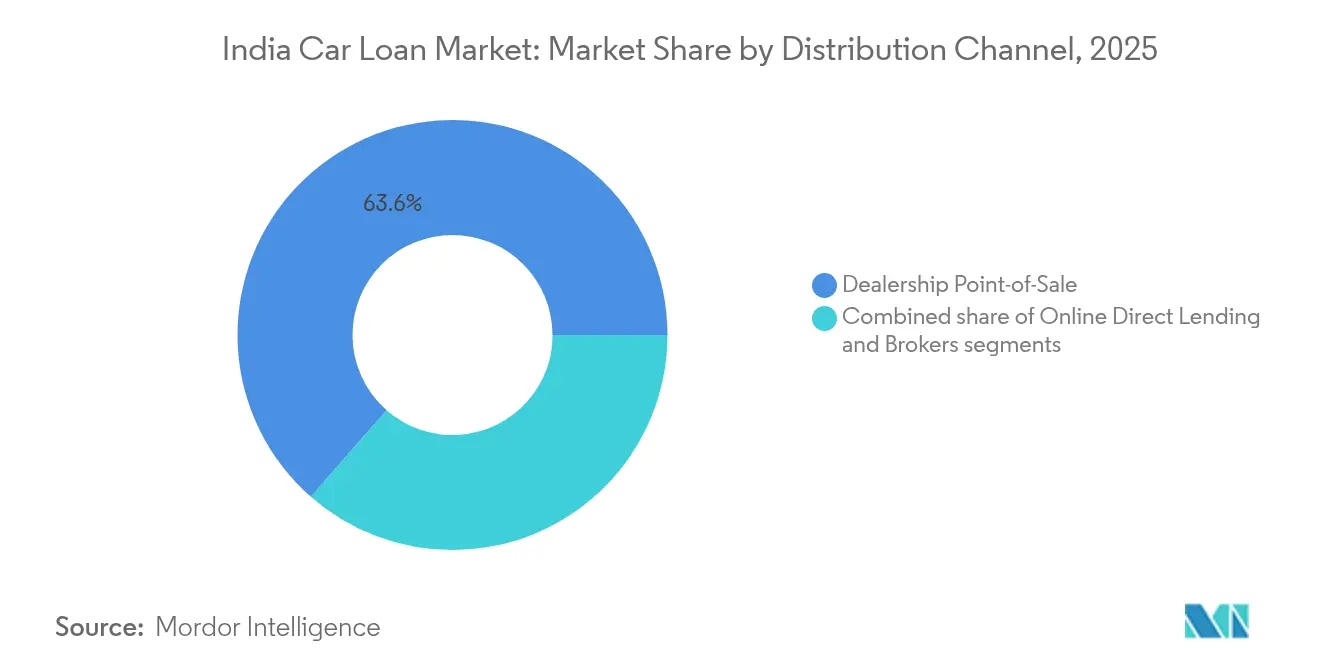
Digital Channels Disrupt Traditional ModelsDealership point-of-sale retained a 63.55% share of the India car loan market in 2025 because it synchronizes vehicle selection, financing, and delivery within a single visit. Nevertheless, online direct lending is forecast to expand at 8.78% CAGR through 2031 as consumers increasingly prefer anytime access, rate transparency, and app-based approval. Fintech marketplaces aggregate multiple lenders, enabling customers to compare pre-qualified offers and choose lower EMI structures in minutes. Account-Aggregator integration accelerates income verification while e-NACH simplifies mandate creation, compressing origination costs and improving margins for digital-first providers. These advantages allow online channels to penetrate beyond metros into smaller towns where branch networks are sparse, yet smartphone adoption is high, thereby enlarging the India car loan market.
Dealers respond by embedding lender APIs into showroom systems, offering hybrid journeys where customers initiate applications in person but complete documentation digitally. Captive finance companies exploit physical-digital convergence to pre-approve repeat buyers and arrange delivery within 24 hours, sustaining loyalty. Brokers and aggregators monetize data generated from price comparisons by supplying lenders with propensity-to-buy scores, raising conversion efficiency. RBI’s Digital Lending Directions mandate transparent rate disclosures and secure consent flows, encouraging responsible innovation while reducing mis-selling. Over time, channel boundaries blur, but speed, personalization, and regulatory compliance remain the critical success factors in distribution share battles across the India car loan market.
Geography Analysis
Metro and tier-1 cities contributed roughly 69.20% of disbursed value to the India car loan market in 2025, reflecting higher per-capita incomes, dense dealer networks, and mature banking infrastructure. Northern and western regions, home to industrial hubs such as Delhi-NCR, Mumbai, and Pune, hold the largest absolute market, while the south, led by Chennai and Bangalore, records robust adoption of digital loan journeys. Tier-2 and tier-3 cities like Lucknow, Coimbatore, and Jaipur are clocking double-digit loan growth as formal payroll penetration improves and organized retail expands footprints. Lenders tailor underwriting to local income mixes, incorporating agricultural cash-flow seasonality in semi-rural belts surrounding smaller cities. As highway construction under Bharatmala and state road upgrades link peripheral towns, latent mobility demand converts into financed car purchases that add breadth to the India car loan market.
Regional variations in road-tax rebates, vehicle-registration fees, and EV subsidies influence borrowing costs and repayment preferences, prompting lenders to customize EMI tenure options and seasonal moratoriums. In the east, Kolkata and Bhubaneshwar are witnessing an uptick in compact-SUV loans linked to mining and infrastructure employment, whereas the west shows higher penetration of premium sedans financed through salary-linked products. Bangladesh and Nepal border trade corridors encourage cross-state used-car flows, necessitating vigilant collateral tracking to prevent asset leakage. Digital channels enable lenders to underwrite customers in districts where physical branches are absent, and field-verification partners handle ground-truthing for high-ticket loans. Consequently, geography-specific strategies become indispensable for sustained share gains in the India car loan market.
State governments increasingly integrate Vahan and Sarathi transport databases, enhancing lien noting and ownership-transfer processes that lower fraud risks and speed repossession in default cases. Lenders employ geo-analytics to calibrate dealer recruitment, optimize collection routes, and allocate risk-adjusted capital by pin code clusters. Government-backed industrial corridors spur ancillary auto-component manufacturing clusters, bringing new employment families into the formal credit grid. Public-charging infrastructure rollouts in Delhi, Maharashtra, and Karnataka gradually normalize EV financing outside metros, diversifying geographic risk. Together, e r these trends underscore that a nuanced, region-aware playbook is critical for scaling operations while preserving portfolio hygiene in the India car loan market.
Mordor Intelligence evaluates the car loan market across all key regional markets, including Europe and Asia, with deeper country-level insights covering India, South Korea, France, Russia, China, Japan, and United Kingdom.
Regulatory Landscape
The India car loan market operates under the Reserve Bank of India (RBI) framework for banks and NBFCs, with consumer-protection and disclosure requirements becoming more prescriptive as digital origination scales. RBI guidance around standardized Key Fact Statements (KFS) for loans and the requirement that disbursals flow to the borrower bank account (with limited exceptions such as co-lending flows and direct end-beneficiary payments) supports transparent pricing, fee disclosure, and auditability across lender and dealer-led journeys.
For asset-quality governance, retail-loan recognition, asset classification, and provisioning are anchored to RBI Master Directions, including the RBI (Commercial Banks - Asset Classification, Provisioning and Income Recognition) Directions, 2026. In parallel, RBI Digital Lending Directions (as referenced in the report context) shape e-KYC, consent, and conduct expectations for app-based origination, while heightened scrutiny on mis-selling and recovery practices increases compliance requirements for banks, NBFCs, and outsourced collection partners operating in vehicle finance.
Value Chain Analysis
The value chain in the India car loan market starts with customer acquisition through dealership point-of-sale and increasingly through online direct lending and marketplaces, followed by eligibility screening and underwriting using bureau data and digital verification. Lenders have adopted Video-KYC and automated income checks to compress approval cycles, with e-mandates on rails such as e-NACH supporting paper-light onboarding and collections for both banks and NBFCs.
Disbursal and servicing are executed under tighter control and audit requirements. RBI emphasizes transparent disclosures (KFS) and direct-to-bank-account disbursal norms, which reduce cash-handling risk in dealer ecosystems. Product design and pricing are differentiated by lender type and customer risk: for example, ICICI Bank published car-loan rates effective June 1, 2026 starting from 8.40% for tenures above 36 months (subject to CIBIL score and vehicle segment), while SBI promotes high loan-to-value offerings up to 100% of on-road price in its new-car loan scheme, and HDFC Bank discloses step-down pre-closure charges by seasoning, shaping refinance behavior and portfolio churn. Downstream, collections and repossession rely on lien marking and vehicle documentation, while lenders also use capital-market funding (including securitization and co-lending structures referenced in the report context) to recycle capital for fresh originations.
Competitive Landscape
The India car loan market remains moderately concentrated, with the five largest lenders accounting major market share of outstanding balances, indicating space for agile challengers to capture niche segments. Large banks exploit inexpensive deposits and multi-product relationships to price loans competitively, yet NBFCs narrow the gap by harnessing securitization to recycle capital and maintain growth velocity. Fintech entrants differentiate via AI-driven underwriting and personalized in-app experiences that appeal to digitally native millennials, encroaching on the prime salaried customer base traditionally owned by banks. Co-lending partnerships allow banks to ride on NBFC origination strengths in smaller towns while sharing risk on a pro-rata basis, creating hybrid models that blur organizational boundaries. Against this backdrop, continual tech investment, regulatory compliance, and customer-centric innovation define competitive success factors in the India car loan market.
Strategic moves include HDFC Bank’s INR 90.6 billion securitization of auto loans to access cheaper market funding and free up capital for fresh disbursals. Axis Bank initiated a strategic review of Axis Finance in February 2025, exploring a potential majority stake sale valued at up to USD 1 billion to sharpen focus on core banking operations and optimize capital. Fintech marketplace CarDekho Rupyy partnered with multiple NBFCs to launch instant approval journeys that reduce dealer dependency and cut acquisition cost per file by 30%. Shriram Finance expanded telematics-based repayment tracking for commercial-use vehicles, enhancing early-warning signals and lowering Gross NPA ratios in its vehicle book. As players experiment with product innovation and inorganic moves, the India car loan market continues to evolve into a technology-augmented credit ecosystem.
Regulatory oversight under RBI Digital Lending Directions compels all providers to establish Board-approved product governance frameworks, strengthening consumer protection and data security. Market leaders allocate double-digit percentages of operating budgets to tech modernization, risk-model recalibration, and cyber-resilience programs. Consolidation pressures build as scale benefits in data, capital, and distribution become more pronounced, leading mid-sized NBFCs to seek mergers or strategic alliances. OEMs court fintech partners to embed financing at the vehicle-configuration stage, aiming to lock in buyers before they approach banks. In this environment, the India car loan market rewards institutions that can harmonize compliance rigor with user-centric digital journeys and razor-thin turnaround times.
India Car Loan Industry Leaders
-
State Bank of India
-
HDFC Bank
-
ICICI Bank
-
Axis Bank
-
Kotak Mahindra Bank
- *Disclaimer: Major Players sorted in no particular order
India Car Loan Market Companies Covered in this Report
- State Bank of India
- HDFC Bank
- ICICI Bank
- Axis Bank
- Kotak Mahindra Bank
- Bank of Baroda
- Punjab National Bank
- Canara Bank
- Federal Bank
- IDBI Bank
- Mahindra & Mahindra Financial Services
- Shriram Finance
- Bajaj Finance
- Tata Motors Finance
- Toyota Financial Services India
- Hyundai Motor India Finance
- Volkswagen Financial Services India
- Maruti Suzuki Smart Finance
- Cars24 Financial Services
- CarDekho Rupyy
- Sundaram Finance
- Cholamandalam Investment & Finance
- DMI Finance
Market Opportunities and Future Outlook
The key opportunity is scaling formal car-credit penetration outside metro and tier-1 centers through digital-first journeys that reduce turnaround time and documentation friction, particularly for thin-file and self-employed borrowers. The report context points to Account Aggregator-based data flows, standardized digital onboarding under RBI Digital Lending Directions, and e-mandate adoption as operational levers that lower acquisition and servicing costs, helping lenders serve tier-2 and tier-3 demand pockets on workable economics.
EV-linked financing is another active opportunity area as lender-OEM tie-ups and differentiated tenures shape product menus. The context highlights collaborations such as Axis Bank being named a preferred EV financier for Tesla in India (with extended tenure offerings) and EV financing collaborations involving VinFast with SBI and HDFC Bank, where lenders compete to secure early EV volumes via dealer-integrated finance and inventory funding. At the same time, RBI's emphasis on KFS-based disclosures and controlled disbursal flows raises the bar for compliant embedded finance at dealerships and marketplaces, creating room for lenders and platforms that can integrate transparent pricing, consented data usage, and post-disbursal servicing within a single audited workflow.
Recent Industry Developments in India Car Loan Market
- March 2026: Axis Bank became the preferred financing partner for Tesla in India, introducing a 10-year loan tenure for electric vehicles. The launch extends long-tenure EV financing, intensifying competition for the premium EV segment and strengthening the bank-OEM financing ecosystem.
- August 2025: State Bank of India (SBI) signed an MoU with VinFast Auto India to provide retail EV car financing. The partnership gives SBI access to VinFast's distribution networks and broadens EV financing reach.
- August 2025: HDFC Bank partnered with VinFast India to provide auto and inventory financing. The collaboration strengthens the HDFC VinFast financing channel and supports faster EV adoption in India.
India Car Loan Market Report Scope and Research Methodology
Market Definition and Coverage
This market covers the value of car loans originated and held in India for passenger vehicles, across common lender types and sales channels, and it is expressed in USD for consistent comparison across time.
Scope exclusions: This sizing excludes lending for two-wheelers, commercial vehicles, and non-loan payment options such as pure leasing or subscriptions when they are not structured as a car loan.
Segments Covered in This Report
- By Loan Provider Type
- Non-Captive Banks
- Non-Banking Financial Companies (NBFCs)
- OEM Captive Finance Arms
- Other Providers (Co-lending, FinTech platforms)
- By Vehicle Type
- New Car
- Used Car
- By Distribution Channel
- Dealership Point-of-Sale
- Online Direct Lending
- Brokers & Marketplaces
Data Sources, Market Sizing, and Validation
Desk Research
Desk research starts with the demand and supply context for passenger vehicle buying and credit availability, then aligns that with what lenders and regulators report for India. We typically refer to public sources such as Reserve Bank of India publications, Ministry of Road Transport and Highways vehicle registration statistics, National Statistical Office macro series, and SIDBI and IBA style industry releases where relevant to retail credit.
To cross-check growth patterns, we also use lender annual reports, investor presentations, securitization and rating-note disclosures, and reputable financial press coverage on auto retail finance. Where it helps fill gaps on company-level financials, credit trends, and news flow, plus any relevant documents around digital lending, we use selective paid database subscriptions that support financial intelligence and document tracking. The sources listed here are illustrative only, since many other public and paid references are also used for data collection, validation, and clarification.
Primary Interviews and Surveys
Primary work is used to validate what desk sources cannot fully explain for India car loans, especially how disbursements split between new and used car purchases and how channels like dealership point-of-sale versus online sourcing change conversion. We speak with a mix of lenders, distributors, and ecosystem experts across key Indian auto retail hubs, and the inputs confirm assumptions on ticket sizes, tenure mix, approval rates, and pricing behavior across credit cycle shifts.
Distribution of primary research fieldwork respondents
| Company type | Respondent position |
|---|---|
| Top tier: 39% | CXOs: 15% |
| Mid tier: 46% | Functional/Unit leaders: 42% |
| Smaller Players: 15% | Managers: 43% |
Market-Sizing & Forecasting
Sizing begins with a top-down build that reconstructs the addressable lending pool using passenger vehicle sales and the registration direction, the financed share of purchases, and the typical loan-to-value and tenure patterns that determine the financed amount per vehicle. After forming that demand pool, we apply lender mix and channel mix to align the total with how loans are actually originated and distributed across India.
Those totals are corroborated using selective bottom-up approximations, such as sampled average loan amounts by vehicle price band, branch and dealer channel checks, and roll-ups from publicly available lender disclosures where reporting is comparable. Key drivers include passenger vehicle sales momentum, used car financing penetration, average loan ticket size, interest rate and EMI affordability trends, delinquency signals that affect underwriting tightness, and the share of digital sourcing versus dealership-led origination.
For forecasting, we use scenario analysis so that credit tightening or easing, vehicle price inflation, and shifts in used car demand can be reflected without forcing one single path. Where a data point is missing for a smaller cohort, we bridge it using peer ratios and then adjust after interview feedback so the model remains consistent with observable lending behavior.
Data Validation & Update Cycle
Model outputs are checked against independent signals, including reported retail loan growth for the auto segment, vehicle sales trends, and directional changes in interest rates and borrower affordability in India. If a variance looks unusual, the assumptions are reworked and then re-tested, and follow-up calls are triggered when a gap cannot be explained through public information.
Before sign-off, results go through multi-step analyst reviews focused on unit consistency, currency timing, and year-over-year reasonableness across sub-pools like new and used car lending. The report is refreshed annually, and interim updates are made when material events occur, such as sharp policy rate changes or major shifts in auto demand. Right before delivery, a final update pass is completed so clients receive the latest adjusted view.
Mordor Intelligence's India Car Loan Market Size Measured Against Other Published Estimates
Published market sizes for India car loans can vary because the underlying counting approach is not always the same, even when the titles sound similar. Differences usually come from whether the value represents loan outstanding versus fresh disbursements, how new versus used car financing is split, and how currency timing is handled.
The main gap comes from mixing disbursement flows with outstanding loan stock, and Mordor Intelligence treats the India car loan market as a value measure aligned to a consistent base-year definition, then validates it using new and used car demand signals and lender-side reporting checks.
Benchmark comparison
| Source | Market Size | Gaps in Research Methodology |
|---|---|---|
| Mordor Intelligence | USD 27.95 B (2025) | |
| Industry Publisher A | USD 23.97 B (2024) | Uses a different base year and may be closer to a disbursement-led view for the year, which can understate the market versus a stock-aligned measure when lending is expanding. |
| Trade Media B | USD 40.13 B (2030) | Quotes a single-point forecast without clearly stating whether the path assumes faster penetration and ticket-size expansion, and the definition of included channels and used car finance is not fully transparent. |
The spread in the table mainly reflects timing and definition choices, not just growth expectations. By keeping the scope anchored to a repeatable set of demand indicators and lender validation checks, the final number stays traceable to clear steps that can be re-run as new public data and interview inputs come in.
Key Questions Answered in the Report
What is the projected value of the India car loan market by 2031?
The India car loan market is forecast to reach USD 42.9 billion by 2031, reflecting a 7.41% CAGR over 2026-2031.
Which loan-provider segment is growing fastest?
Non-banking financial companies are expanding at a 7.82% CAGR through 2031 by targeting underserved customer segments in tier-2 and tier-3 cities.
How large is the new-versus-used vehicle split?
New cars held a 71.35% share in 2025, while used-car financing is rising quickly with an 7.96% CAGR projected through 2031.
Why are online lending channels gaining traction?
Online direct lending offers rate transparency, instant approvals, and lower acquisition costs, enabling the channel to grow at an expected 8.78% CAGR over 2026-2031.
What regulatory changes are shaping digital car loans?
RBI Digital Lending Directions 2025 mandate standardized e-KYC, transparent pricing, and secure consent flows, reinforcing consumer protection while supporting innovation.
How does EV financing differ from conventional vehicle loans?
Electric-vehicle loans often feature OEM-subsidized rate concessions yet carry lower LTVs due to residual-value uncertainty, requiring specialized risk management frameworks.