
Market Overview
| Study Period | 2021 - 2031 |
|---|---|
| Forecast Data Period | 2026 - 2031 |
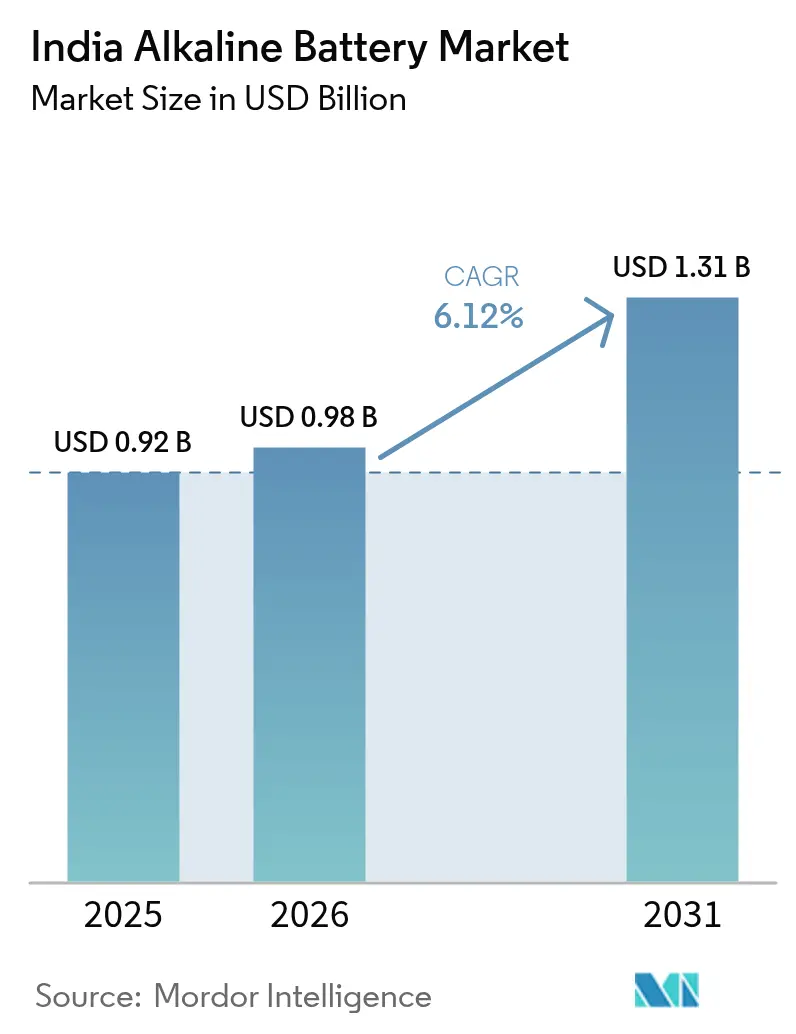
| Base Year Market Size (2025) | USD 0.92 Billion |
| Market Size (2026) | USD 0.98 Billion |
| Market Size (2031) | USD 1.31 Billion |
| Growth Rate (2026 - 2031) | 6.12 % |
| Market Concentration | High |
Major Players *Disclaimer: Major Players sorted in no particular order Image © Mordor Intelligence. Reuse requires attribution under CC BY 4.0. | |
India Alkaline Battery Market Analysis by Mordor Intelligence
The India Alkaline Battery Market size was valued at USD 0.92 billion in 2025 and estimated to grow from USD 0.98 billion in 2026 to reach USD 1.31 billion by 2031, at a CAGR of 6.12% during the forecast period (2026-2031).
Rising disposable incomes, expanding consumer-electronics penetration, and a structural shift away from zinc-carbon chemistry are steering demand toward longer-lasting alkaline cells. E-commerce platforms, organized retail expansion, and defense procurement increase addressability, while Bureau of Indian Standards (BIS) compliance rules favor branded suppliers over unorganized trade. At the same time, rechargeable lithium-ion solutions are cannibalizing high-drain applications, prompting incumbents to pivot into premium alkaline niches and rechargeable portfolios. Extended Producer Responsibility (EPR) guidelines, volatile potassium-hydroxide inputs, and counterfeit batteries temper the growth outlook but also accelerate consolidation among compliant players.
Key Report Takeaways
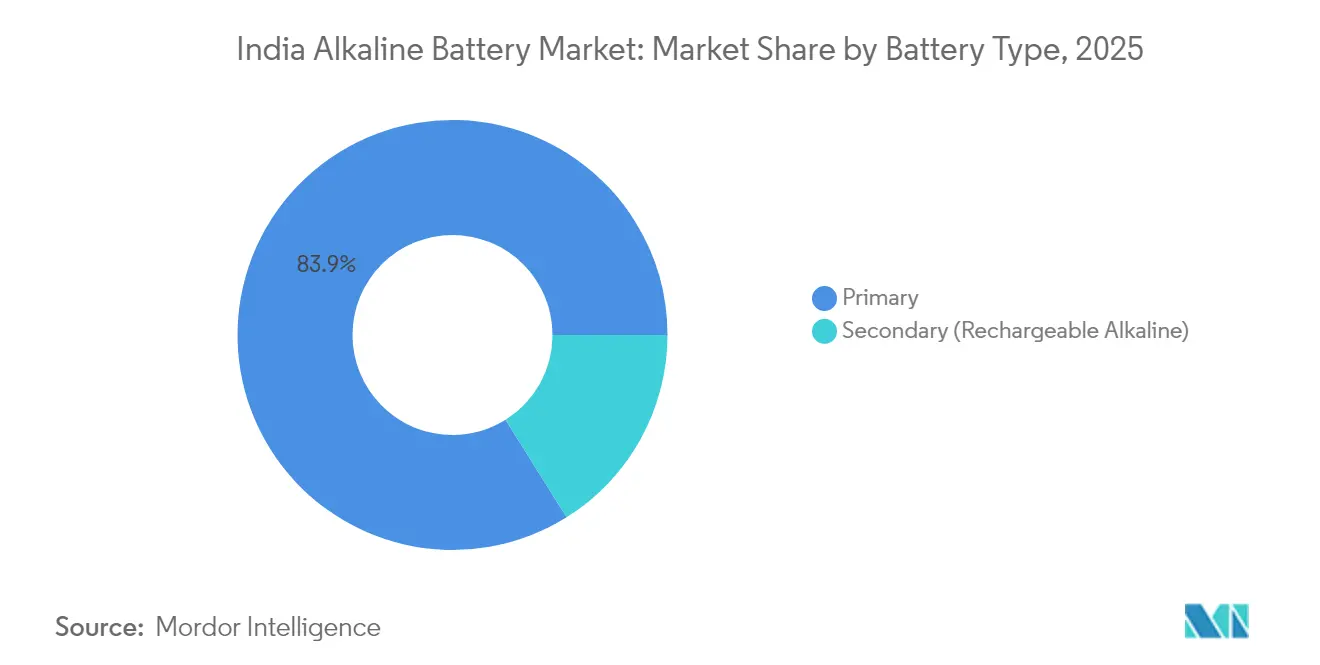
- By battery type, primary cells led with 83.90% of the India Alkaline Battery market share in 2025, while secondary (rechargeable alkaline) units are forecast to accelerate at an 11.05% CAGR through 2031.
- By size, AA (LR6) batteries accounted for 40.35% of the India Alkaline Battery market size in 2025, whereas 9-volt formats are projected to expand at a 9.62% CAGR between 2026 and 2031.
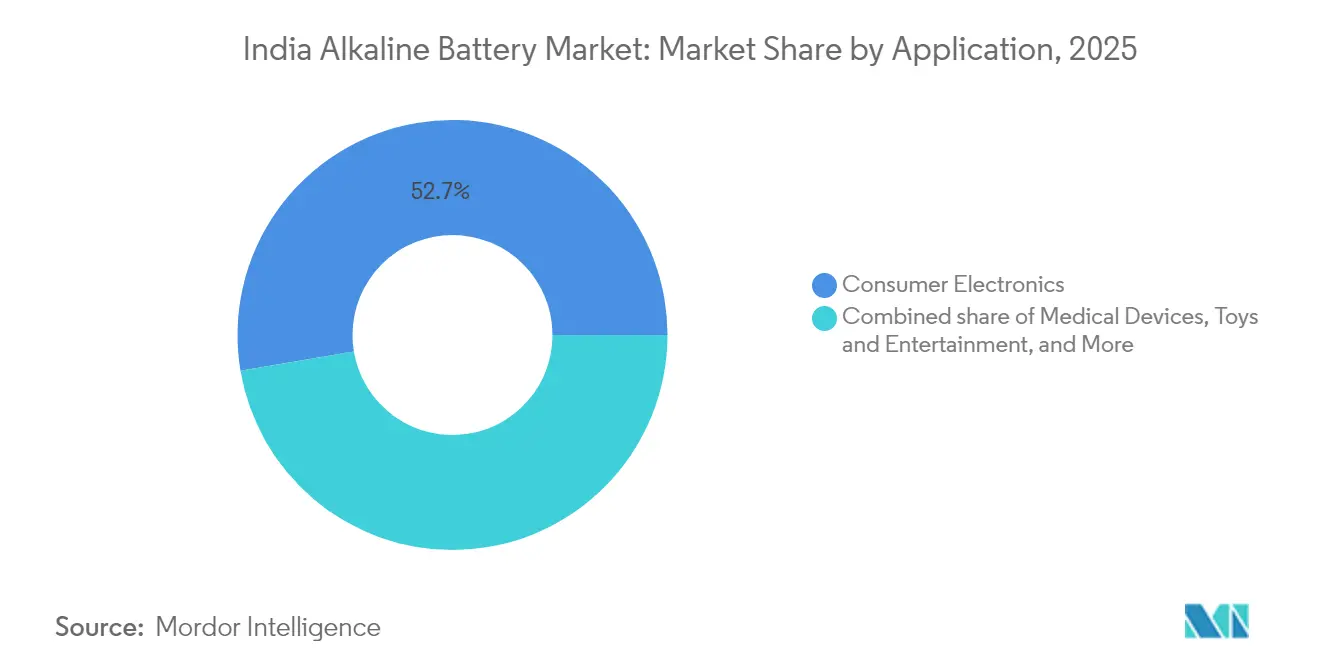
- By application, consumer electronics commanded a 52.65% share of the India Alkaline Battery market size in 2025, and medical devices are poised for a 9.95% CAGR through 2031.
Note: Market size and forecast figures in this report are generated using Mordor Intelligence’s proprietary estimation framework, updated with the latest available data and insights as of 2026.
India Alkaline Battery Market Trends and Insights
Drivers Impact Analysis*
| Driver | (~) % Impact on CAGR Forecast | Geographic Relevance | Impact Timeline |
|---|---|---|---|
| Surge in consumer electronics penetration & disposable income | 1.2% | Pan-India, with urban concentration in metros and Tier-1 cities | Medium term (2-4 years) |
| Rural electrification outages driving portable power demand | 0.8% | Rural and semi-urban areas, particularly Uttar Pradesh, Bihar, Jharkhand, and Northeastern states | Long term (≥ 4 years) |
| Defense procurement of rugged alkaline cells for border surveillance | 0.3% | Border regions including Jammu & Kashmir, Ladakh, Arunachal Pradesh, and Rajasthan | Long term (≥ 4 years) |
| Rapid growth in e-commerce & organized retail channels | 0.9% | Urban and Tier-2 cities with high internet penetration and logistics infrastructure | Short term (≤ 2 years) |
| Shift from zinc-carbon to alkaline on cost & energy density | 1.5% | Pan-India, with faster adoption in urban metros and Tier-1/Tier-2 cities; gradual penetration in rural markets | Medium term (2-4 years) |
| Toy manufacturing clusters' compliance needs (lead-free) | 0.4% | Manufacturing clusters in Maharashtra, Tamil Nadu, Gujarat, and Karnataka with BIS IS 15644:2006 enforcement | Medium term (2-4 years) |
| Source: Mordor Intelligence | |||
Surge In Consumer Electronics Penetration & Disposable Income
Disposable-income gains and an expanding installed base of battery-powered devices continue to widen the customer pool for the India Alkaline Battery market. Remote controls, toys, wall clocks, wireless peripherals, and digital thermometers dominate the replacement cycle, and a three-fold price premium over zinc-carbon translates to three-to-ten-times longer runtime for alkaline cells. Eveready’s alkaline revenue rose 90.8% year-on-year in Q3 FY25 as it pursued a 53% market-share target within four years. Mid-market entrant Nippo Thor followed with a 3-4% share after only 11 months on the shelf. Yet lithium-ion powerpacks have captured earbuds, smartwatches, and Bluetooth speakers, constraining alkaline’s headroom in the fastest-growing electronics segments. Manufacturers respond by deepening penetration in moderate-drain uses where rechargeability confers minimal benefit.
Rural Electrification Outages Driving Portable Power Demand
Intermittent grid supply in large swaths of rural India sustains a sizable opportunity for the India Alkaline Battery market. Despite a cumulative renewable-energy capacity of 220 GW, frequent load-shedding in Uttar Pradesh, Bihar, Jharkhand, and the Northeast prompts households to stockpile batteries for torches, radios, and emergency lanterns.[1] Alkaline chemistry offers superior shelf life and cold-weather performance, especially valuable in storage-heavy consumption patterns. Eveready’s new Jammu plant positions the firm near defense zones and rural markets in North India, trimming logistics costs and bolstering cold-chain supply. Rooftop solar adoption adds a paradoxical boost, as users attach alkaline-powered backup lights for the monsoon season or nighttime outages. Nevertheless, ongoing grid upgrades and declining prices for rechargeable lanterns may cap rural alkaline demand beyond the medium term.
Rapid Growth In E-Commerce & Organized Retail Channels
Digital marketplaces and big-box outlets are reshaping distribution economics for the India Alkaline Battery market. Amazon, Flipkart, Zepto, and Blinkit publish transparent pricing, customer reviews, and instant delivery options that shift buyers away from unbranded zinc-carbon cells traditionally sold at kiranas. Organized chains such as Reliance Retail and DMart allocate end-aisle displays and bundle promotions that elevate brand salience for alkaline SKUs. Indo National targets a near-doubling of revenue over five years, citing e-commerce reach as a central pillar in its growth thesis. Platform-owned private labels like Amazon Basics introduce price-competitive alternatives, intensifying the need for incumbents to emphasize superior leakage protection and BIS certification.
Shift From Zinc-Carbon To Alkaline On Cost & Energy Density
Alkaline batteries deliver up to ten times longer service life than zinc-carbon equivalents, cutting replacement frequency and total lifetime cost for moderate-drain devices. As disposable incomes rise, urban consumers increasingly value performance over initial outlay, pushing the India Alkaline Battery market deeper into mainstream retail channels. Eveready expanded alkaline capacity to underpin its shift from a zinc-carbon defensive stance to an aggressive share-capture strategy. Scalability benefits also emerge as higher unit volumes lower per-cell manufacturing costs, narrowing the premium and hastening the chemistry transition.
Restraints Impact Analysis*
| Restraint | (~) % Impact on CAGR Forecast | Geographic Relevance | Impact Timeline |
|---|---|---|---|
| Li-ion adoption cannibalizing primary alkaline sales | -0.6% | Urban metros and Tier-1 cities with high consumer electronics adoption | Short term (≤ 2 years) |
| EPR & single-use battery waste regulations tightening | -0.4% | Pan-India, with enforcement concentrated in urban municipal corporations | Medium term (2-4 years) |
| Volatile KOH supply chain inflating input costs | -0.3% | Pan-India impact on manufacturing costs, affecting all alkaline battery producers with domestic and imported potassium hydroxide sourcing | Short term (≤ 2 years) |
| Counterfeit low-grade cells eroding brand trust | -0.5% | Rural and semi-urban areas with unorganized retail dominance; Tier-3 cities and districts with limited BIS enforcement | Medium term (2-4 years) |
| Source: Mordor Intelligence | |||
Li-Ion Adoption Cannibalizing Primary Alkaline Sales
Rechargeable lithium-ion packs expand at a 22.7% CAGR in India, displacing single-use cells in earbuds, power tools, and portable speakers. In urban cores, a rechargeable AA-equivalent lithium-ion cell can replace fifty or more alkaline units over its life, tipping the value equation sharply. Eveready and Indo National hedge the risk by acquiring stakes in lithium-ion producers and broadening flash-light portfolios that maintain customer ties post-alkaline. Cannibalization remains most acute in metros where USB-C charging is pervasive; rural markets lag because of charger scarcity and higher perceived up-front costs.
EPR & Single-Use Battery Waste Regulations Tightening
The Battery Waste Management Rules 2022 require 90% collection of portable cells by 2026-27 and a minimum 5% recycled content by 2027-28, scaling to 20% by 2030-31.[2] Alkaline recycling yields low-value metals, rendering compliance a cost rather than a profit center. Producers must fund reverse logistics, certify collection audits, and integrate recycled zinc and manganese into supply chains despite limited domestic availability. For smaller players, regulatory overhead invites market exit, while compliant majors can leverage scale to absorb costs and differentiate on sustainability messaging.
*Our forecasts treat driver/restraint impacts as directional, not additive. The impact forecasts reflect baseline growth, mix effects, and variable interactions.
Segment Analysis
By Battery Type: Primary Cells Retain Lead While Rechargeable Niche Grows
Primary cells represented 83.90% of India's Alkaline Battery market share in 2025, reinforcing their dominance in moderate-drain devices such as remote controls and flashlights. The India Alkaline Battery market anticipates incremental substitution toward rechargeable formats, yet mass adoption remains restrained by charger availability gaps and higher first-purchase pricing. Eveready's 46.3% alkaline sales jump in Q4 FY25 underscores ongoing migration from zinc-carbon to single-use alkaline across all channels.
Rechargeable alkaline batteries are projected to expand at an 11.05% CAGR through 2031, albeit from a low installed base. They win favor in industrial instrumentation and professional lighting, where reusability offsets cost and where lithium-ion faces certification or safety hurdles at extreme temperatures. BIS IS 16046 standards support certification, but nickel-metal hydride and lithium-ion still outpace secondary alkaline in energy density.

By Size: AA Cells Dominate, 9-Volt Formats Accelerate
AA cells controlled 40.35% of the India Alkaline Battery market size in 2025, bolstered by the largest installed device base and ubiquitous channel presence. Competitive pricing, Duracell AA ten-packs at INR 205-256, keeps momentum strong, while local brands narrow the premium gap. AAA, C, and D categories serve flashlights, radios, and larger lanterns, but LED efficiency gains shrink these volumes over time.
The fastest trajectory belongs to 9-volt batteries, forecast to grow 9.62% CAGR through 2031, propelled by smoke-detector mandates, glucometers, and security sensors that demand assured runtime and leak-proof performance. Premium positioning enables higher margins, and suppliers leverage differentiated marketing that stresses safety compliance and long shelf life.
By Application: Consumer Electronics Drive Volume; Medical Devices Emerge
Consumer electronics contributed 52.65% of India's Alkaline Battery market demand in 2025, spanning hundreds of millions of remote controls and toys. However, high-growth wearables now rely exclusively on lithium-ion, restricting alkaline's upside in the most dynamic categories. Brands, therefore, focus on reinforcing performance messaging in moderate-drain peripherals and bundling batteries with device sales through e-commerce promotions.
Medical devices represent the fastest-growing end-use, advancing at a 9.95% CAGR as point-of-care diagnostics penetrate home-health settings. Reliable voltage delivery, sterilization constraints, and extended shelf life support alkaline preference in glucometers, pulse oximeters, and portable ECG monitors. Government health programs that distribute diagnostic kits to primary health centers further widen rural uptake.
Geography Analysis
Urban metros and Tier-1 cities absorbed roughly 64.40% of India's Alkaline Battery market demand in 2025, thanks to higher spending power, concentrated organized retail networks, and same-day e-commerce fulfillment. Maharashtra, Tamil Nadu, Gujarat, Karnataka, and Delhi-NCR together accounted for half of national consumption, while Eveready’s Jammu plant unlocks distribution efficiency for North India and border-state defense customers.
Rural and semi-urban regions delivered about 35.60% of volume, underpinned by grid-reliability gaps and zinc-carbon substitution as incomes rise. Distribution relies on multi-tier wholesaler networks that expose the market to counterfeit batteries lacking BIS IS 15063 certification. Quick-commerce and organized retail expansion into Tier-2 and Tier-3 cities gradually improves brand availability, lifting alkaline share in historically underserved areas.
Strategic demand arises in Ladakh, Arunachal Pradesh, Sikkim, and Rajasthan, where defense agencies procure alkaline packs for surveillance and communication gear. Extreme-temperature performance remains essential, and proximity to Eveready’s Jammu facility reduces lead times. Enforcement of Battery Waste Management Rules is strongest in Delhi, Mumbai, and Bengaluru, offering compliant players a regulatory moat and pushing non-conforming units out of organized channels.
Regulatory Landscape
India's alkaline (dry cell) batteries are governed primarily by the Battery Waste Management (BWM) Rules, 2022, notified by the Ministry of Environment, Forest and Climate Change (MoEFCC). The rules operationalize Extended Producer Responsibility (EPR) through mandatory producer registration and compliance on the Central Pollution Control Board (CPCB) online EPR Battery Portal, including the purchase and surrender of digital EPR certificates from authorized recyclers.
Compliance obligations tighten through stepped collection targets and recycled-content requirements, which increase the cost of servicing low-value alkaline waste streams. The Battery Waste Management (Second Amendment) Rules, 2024 (notified on 20 June 2024) set minimum recycled-material usage requirements applicable from FY 2027-28. In September 2024, CPCB updated guidance for environmental compensation (EC) for non-compliance, reinforcing the "polluter pays" enforcement toolkit alongside escalating annual targets (50% for 2025-26 and 60% for 2026-27 as referenced in industry guidance and rule-aligned reporting).
Value Chain Analysis
The value chain starts with inputs such as zinc, manganese dioxide, steel cans, separators, and potassium hydroxide, followed by cell manufacturing, packaging, and branding. A key shift in upstream structure emerged with Eveready commissioning a dedicated alkaline battery facility in Jammu in April 2026 (annual peak capacity cited at 360 million units). This reduces reliance on imported finished alkaline cells and shortens lead times for North India, while also creating a domestic node for procurement and quality control aligned with BIS compliance requirements.
Downstream, alkaline batteries move through national distributors, multi-tier wholesalers, and kirana retail, and increasingly through e-commerce and quick-commerce platforms that emphasize branded SKUs and transparent pricing. Institutional and B2B channels, including defense-linked demand pockets in border states, add volume stability but also raise tender and compliance requirements. EPR execution introduces an added "reverse" leg, where producers must organize collection and route waste to registered recyclers via CPCB's portal-based certificate mechanism, turning end-of-life logistics into a recurring operating cost for dry-cell portfolios.
Competitive Landscape
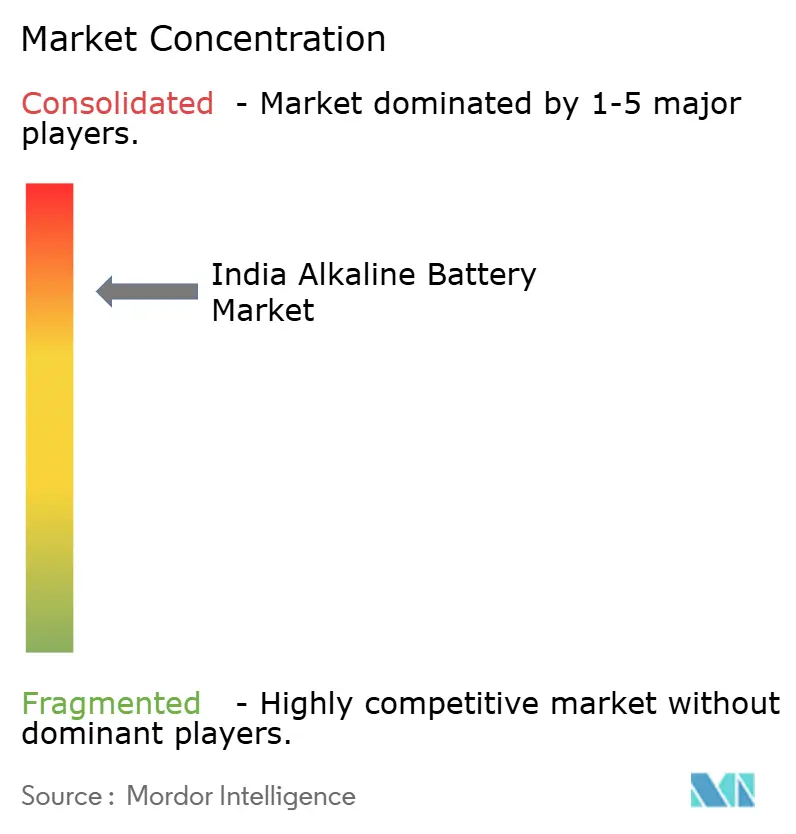
The India Alkaline Battery market is moderately concentrated: Eveready and Indo National jointly command roughly 75% of the broader dry-cell segment, yet the premium alkaline share historically skewed toward Duracell at nearly 70% of the high-end tier. Eveready’s INR 1.8 billion Jammu plant marks a decisive bid for majority alkaline leadership, while Indo National’s Nippo Thor scales rapidly from a 3-4% slice to a 20-25% revenue target within eighteen months. Duracell’s 2025 licensing pact with Satya International to produce automotive and inverter batteries across 59 countries signals diversification as EPR regulations raise compliance costs in single-use portfolios.
Private-label incursions from Amazon Basics intensify price pressure, exploiting platform data to segment customers and bundle subscription replenishment. Quick-commerce operators Zepto and Blinkit compress delivery windows to hours, raising per-capita battery turnover in urban enclaves. Regulatory oversight sharpened when the Competition Commission of India fined Panasonic Energy and Geep Industries INR 9.64 crore in 2018 for cartel behavior, cautioning vendors against exclusive tendering in institutional channels. Compliance with BIS toy-safety and battery-performance codes filters out counterfeit imports, but enforcement in rural districts remains inconsistent, keeping a gray market alive.
India Alkaline Battery Industry Leaders
-
Duracell Inc.
-
Indo National Limited
-
Eveready Industries India Ltd.
-
Panasonic Energy India Co Ltd.
-
Geep Industries Pvt. Ltd.
- *Disclaimer: Major Players sorted in no particular order
Market Opportunities and Future Outlook
Domestic alkaline manufacturing capacity and import substitution create a clear whitespace for brands that can scale quality, pricing, and distribution. Eveready's April 2026 commissioning of a Jammu alkaline facility (reported investment of around INR 200 crore and peak output of 360 million units annually) provides a local supply anchor for faster replenishment, regional customization of pack sizes, and deeper penetration in organized retail and e-commerce, where branded, BIS-aligned products displace unorganized supply.
EPR under the Battery Waste Management Rules, 2022 also opens opportunities in compliance services and operating models. Dry-cell collection economics are structurally harder than lithium-ion recycling, so producers that build common collection mechanisms, exchange schemes, and recycler partnerships to secure CPCB-compliant EPR certificates and manage cost volatility (including certificate pricing referenced in market reporting) can convert compliance readiness into a channel-access differentiator. This becomes more difficult for smaller or informal competitors as targets step up from 50% (2025-26) to 60% (2026-27) and recycled-content obligations start from FY 2027-28.
Recent Industry Developments
- July 2026: Panasonic Energy India reported a fire incident at its Pithampur manufacturing facility that impacted a production line, with the affected section temporarily suspended. The disruption points to operational risk and possible short-term supply tightening from an established domestic producer, increasing the importance of inventory planning and alternate sourcing for branded dry-cell channels.
- April 2026: Eveready Industries India commissioned its alkaline battery manufacturing facility in Jammu, following an investment of about INR 200 crore. The start-up adds dedicated domestic alkaline output and supports faster distribution into North India while strengthening Eveready's ability to compete against imported premium alkaline cells through local manufacturing control.
- December 2025: Parliament was informed that the government is backing the creation of 50 GWh of capacity through the Production Linked Incentive (PLI) scheme for Advanced Chemistry Cell (ACC) battery storage, alongside additional manufacturer plans for around 178 GWh over the next five years. While ACC focuses on advanced chemistries, the policy backdrop reinforces broader localization momentum and can indirectly influence investment and supply-chain development across the battery ecosystem, including materials and compliance infrastructure relevant to dry cells.
Research Methodology Framework and Report Scope
Segmentation Overview
- By Battery Type
- Primary
- Secondary (Rechargeable Alkaline)
- By Size
- AA (LR6)
- AAA (LR03)
- 9-Volt
- C
- D
- Coin and Specialty
- By Application
- Consumer Electronics
- Industrial and Commercial Devices
- Medical Devices
- Toys and Entertainment
- Lighting and Flashlights
Key Questions Answered in the Report
How large is the India Alkaline Battery market in 2026?
It stands at USD 0.98 billion and is projected to hit USD 1.31 billion by 2031.
Which battery type dominates sales?
Primary alkaline cells account for 83.90% of 2025 demand, supported by remote controls, toys, and flashlights.
Why are 9-volt batteries growing fastest?
Smoke-detector mandates, medical devices, and security sensors need leak-proof, longer-life power, driving a 9.62% CAGR through 2031.
What role does e-commerce play in distribution?
Platforms like Amazon and Flipkart provide transparent pricing and same-day delivery, accelerating branded-battery penetration, especially in Tier-1 and Tier-2 cities.
How will new EPR rules affect the sector?
Producers must collect 90% of sold batteries by 2026-27 and integrate recycled content, raising compliance costs and encouraging consolidation.
Which companies lead the competitive landscape?
Eveready Industries, Indo National (Nippo), and Duracell hold the largest branded shares, with Eveready targeting a majority stake via its new Jammu plant.